The impact of values on information systems development.
LAUENER, Angela.
Available from Sheffield Hallam University Research Archive (SHURA) at:
http://shura.shu.ac.uk/19945/
This document is the author deposited version. You are advised to consult the
publisher's version if you wish to cite from it.
Published version
LAUENER, Angela. (2004). The impact of values on information systems
development. Doctoral, Sheffield Hallam University (United Kingdom)..
Copyright and re-use policy
Fines are charged at 50p per hour
1 6 FEB
m 7
0 1 MAP ? W q ^
2 1
JUN
2007—
5 f ‘~
1 < JUl 2008
ProQuest Number: 10697251
All rights reserved
INFORMATION TO ALL USERS
The quality of this reproduction is dependent upon the quality of the copy submitted.
In the unlikely event that the author did not send a com plete manuscript and there are missing pages, these will be noted. Also, if material had to be removed,
a note will indicate the deletion.
uest
ProQuest 10697251
Published by ProQuest LLC(2017). Copyright of the Dissertation is held by the Author.
All rights reserved.
This work is protected against unauthorized copying under Title 17, United States C ode Microform Edition © ProQuest LLC.
ProQuest LLC.
789 East Eisenhower Parkway P.O. Box 1346
The Impact of Values on Information Systems Development
Angela Lauener
A thesis submitted in partial fulfilment of the requirements of Sheffield Hallam University
for the degree of Doctor of Philosophy
COLLABORATING ORGANIZATION
TABLE OF CONTENTS
Page
Table of Chapter Contents ii
Table of Illustrations vi
Table of Appendices ix
Acknowledgements x
Declaration xi
Abstract xii
List of Abbreviations xiii
Chapter 1 Introduction 1
PART ONE CONTEXT OF THE RESEARCH
Chapter 2 The value of research on values in information systems 11
development
Chapter 3 Research methods 63
PART TWO RESULTS AND ANALYSIS 107
Chapter 4 Results from preliminary studies 111
Chapter 5 Personal values in information systems development 134
Chapter 6 The interplay of corporate values and personal values 154
Chapter 7 The impact of values on ISD project management 188
PART 3 RETURNING TO THE WIDER CONTEXT
Chapter 8 The importance of the values of project managers 224
Chapter 9 Conclusions 246
References 257
TABLE OF CHAPTER CONTENTS
CHAPTER 1 INTRODUCTION
1.1 The values of the researcher
1.2 Evolution of research and researcher 1.3 Overview of the thesis
PART ONE CONTEXT OF THE RESEARCH
CHAPTER 2 THE VALUE OF RESEARCH ON VALUES IN INFORMATION SYSTEMS DEVELOPMENT
2.1 Introduction
2.1.1 Overview of literature in the context of phases of the research 2.1.2 Summary of development of the research question
2.2 How is the mental construct concept relevant to successful information systems development and how can research on values of the methodology user achieve new knowledge about this?
2.2.1 History of development of the mental construct concept in methodology research
2.2.2 Jayaratna’s (1994) NIMSAD framework and mental construct concept 2.2.3 A discussion of mental construct elements
2.2.4 Mental construct discussed in the context of problem solving 2.2.5 Problems with the mental construct concept
2.2.6 Conclusion - The value of researching values I
, 2.3 Why are social and behavioural factors important in avoiding failure in ISD and how can research on values achieve new knowledge about this?
2.3.1 Relevance of social and behavioural factors to success and failure in ISD 2.3.2 Addressing lack of detail on social and behavioural issues by research on
values
2.3.3 A case study showing how application of social values resulted in turning the London Ambulance Service Computer Aided Despatch (LASCAD) system around
2.3.4 Conclusion: The value of researching values II
2.4 What is the rationale for using an interpretive case study approach and the Spranger (1928) classification of values for research on success in ISD? 2.4.1 Definitions of values
2.4.2 Measures and categorisations of values
2.4.2.1 Spranger (1928) classification of values 2.4.2.2 The Rokeach Value Survey (1973)
2.4.2.3 Limitations of the Rokeach Value Survey for this research 2.4.3 Relevance of the Spranger (1928) classification of values to research for
gaining data on social and behavioural factors in ISD 2.4.4 Limitations of the Spranger (1928) model
2.4.5 Conclusion - The value of studying values III
2.5 How does the literature on success and failure shape the research on values? 2.5.1 The range of definitions and criteria for success and failure
2.5.2 The relevance of values to definitions and criteria for success and failure 2.5.3 The interplay of corporate and personal values in ISD success
CHAPTER 3 RESEARCH METHODS
3.1 Introduction
3.2 Philosophical issues underlying the rationale for using an interpretive case study approach to research the impact of values on information systems development 3.2.1 Justification for the interpretive case study approach
3.2.2 On interpretation and the role of the researcher as interpreter 3.2.3 Reflections based on Trauth’s 5 factors influencing the choice of
qualitative methods in IS research
3.3 Putting the research methods into practice in 3 phases of research activity - survey, interviews and interpretive case study
3.3.1 Phase 1. Preliminary studies Part 1: An investigation of the role of the mental construct in systems development using questionnaire survey and interviews at Prosper pic
3.3.2 Phase 2. Preliminary Studies Part 2: An investigation of the impact of values on systems development using semi-structured interviews 3.3.3 Phase 3. An investigation of the impact of values on systems
development using an interpretive case study 3.3.3.1 Observation - methodological issues 3.3.3.2 Document analysis - methodological issues 3.3.33 Fieldwork in the interpretive case study 3.4 Evaluation of the research methods
3.4.1 Evaluation of three phases of research 3.4.2 Evaluation of analysis
3.4.3 Reliability, validity and generalizability 3.5 Conclusions
PART TWO RESULTS AND ANALYSIS CHAPTER 4 RESULTS FROM PRELIMINARY STUDIES
4.1 Phase 1: An investigation of the role of the mental construct in information systems development
4.1.1 Findings from pre-survey interviews 4.1.2 Findings from survey
4.1.3 Findings from post-survey interviews
4.2 Phase 2: An investigation of the impact of values on systems development using semi-structured interviews
4.2.1 Development of new proposals 4.2.2 Findings relevant to proposals 4.3 Conclusions
CHAPTER 5 PERSONAL VALUES IN INFORMATION SYSTEMS DEVELOPMENT
5.1 Introduction
5.2 Values self assessment by project manager and other project team members 5.3 Reflections on preliminary studies and case study
5.3.1 Categorisations of personal values 5.3.2 Measures of values
5.3.3 Comparison with previous research on personal values
CHAPTER 6 THE INTERPLAY OF CORPORATE VALUES AND PERSONAL VALUES
6.1 Introduction
6.2 Corporate values at Prosper pic
6.2.1 Findings on corporate values from document analysis
6.2.2 Evidence of top-down communication and monitoring of values, standards and procedures
6.3 Attitudes of IT department staff in response to corporate values including the SDM methodology
6.4 Revisiting results from preliminary studies
6.5 A summary of Prosper pic's values using Mumford’s (1981) organizational values continuum
6.6 Value conflict
6.6.1 Conflict between individuals and the organisation in general 6.6.2 Conflict between one individual and another in general 6.6.3 Conflict specifically within the project team in the case study 6.6.4. Dealing with conflict
6.6.5 Values conflict and values congruence 6.7 Discussion
6.7.1 On the importance of shared values 6.7.2 Interplay of corporate and personal values 6.7.3 On Methodologies
6.7.4 On the variety of corporate values in the wider context and their relation to social and economic values
6.8 Conclusions
CHAPTER 7 THE IMPACT OF VALUES ON ISD PROJECT MANAGEMENT
7.1 Introduction
7.2 The application of project team members’ personal values in the project 7.2.1 Findings on personal values of systems developers who had no
management responsibilities
7.2.2 Findings personal values of systems developers with project management responsibilities
7.2.3. Findings on Peter, the project manager with overall responsibility for the project
7.2.3.1 Brief profile 7.2.3.2 Corporate values 7.2.3.3 Economic values 7.2.3.4 Social values 7.2.3.5 Political values 7.2.3.6 Theoretical values 7.2.3.7 Shaping of values
7.2.3.8 Supporting evidence from project group members 7.3 Supporting evidence from preliminary studies
PART THREE RETURNING TO THE WIDER CONTEXT
CHAPTER 8 THE IMPORTANCE OF THE VALUES OF PROJECT
MANAGERS
8.1 Reflections on findings at Prosper pic in relation to success and failure literature 8.2 The impact of values on systems development at Prosper pic
8.2.1 Corporate and personal values
8.2.2 Consideration of the interplay of personal and corporate values 8.2.3 The wide impact of values on systems development
8.2.4 The relevance of values to other mental construct elements 8.3 Applying the findings to a wider context
8.4 Implications for practice: the role of the project manager as a manager of values 8.5 Conclusions
CHAPTER 9 CONCLUSIONS
TABLE OF ILLUSTRATIONS
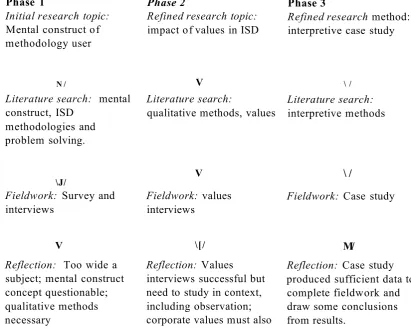
Figure 2.1 Figure 2.2 Figure 2.3 Figure 2.4 Figure 2.5 Figure 2.6 Figure 2.7 Figure 2.8 Figure 2.9 Figure 3.1 Figure 3.2 Figure 3.3 Figure 3.4 Figure 3.5 Figure 3.6 Figure 3.7 Figure 3.8 Figure 3.9 Figure 3.10 Figure 3.11 Figure 3.12 Figure 4.1 Figure 4.2 Figure 4.3 Figure 4.4 Page Chapter 2Table showing phases of the research and literature accessed 12
Diagram summarising stimulus for research and development
of the research question via two routes 15
Four eras in the evolution and development of ISD
methodologies 18
The NIMSAD framework (Jayaratna, 1994:53) 19
The mental construct (Source: Jayaratna 1994:64) 22
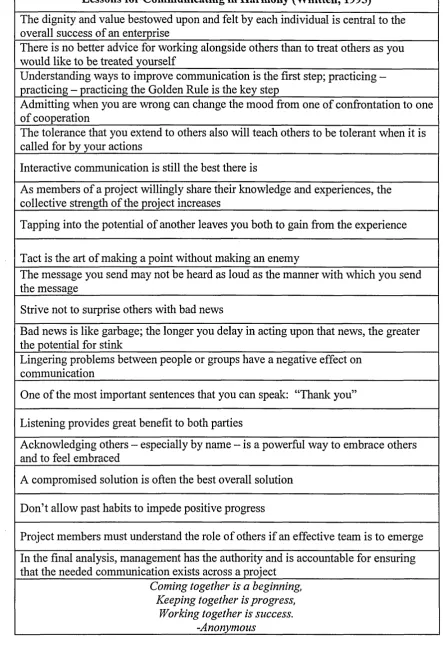
Lessons for Communicating in Harmony (Whitten, 1995) 39
Spranger’s classification of values summarised by Phares and Chaplin (1997:458) (bold type) and Allport, Vernon and
Lindzey (1960) (regular type) 46
Terminal Values (Rokeach, 1973) 47
Instrumental values (Rokeach, 1973) 48
Chapter 3
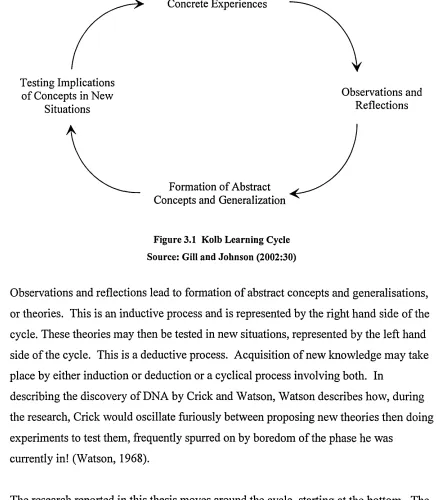
Kolb Learning Cycle. Source: Gill and Johnson (2002:30) 65
Rudestam and Newton’s Research Wheel 66
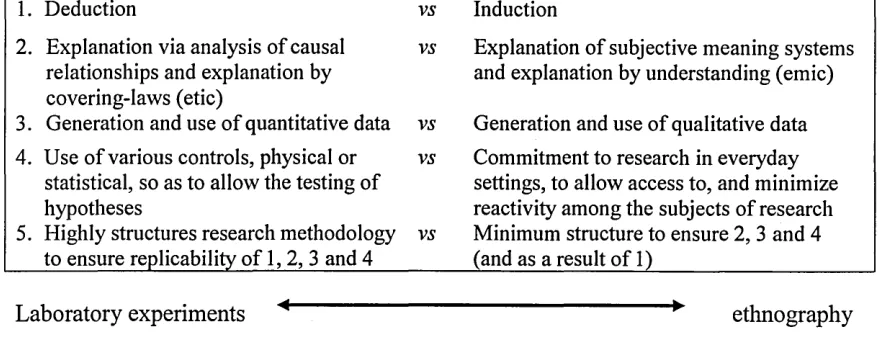
Research methods: nomothetic-ideographic continuum (Gill 69 and Johnson, 2002:44)
Diagram showing three cycles of action learning leading to final research question and application of interpretive case
study method 75
Summary of aims and outcomes of semi-structured interviews
prior to survey 79
Summary of aims and outcomes of survey by questionnaire 80
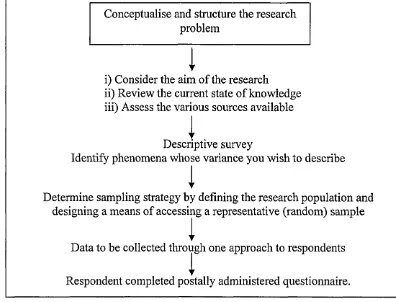
A summary of planning the survey, adapted from Gill and
Johnson (2002) 81
The questionnaire format - adapted from Gill and Johnson
(2002:115) 82
Summary of aims and outcomes of semi-structured follow-up
interviews 85
Summary of aims and outcomes of semi-structured interviews
on values 87
Interview guide for values interviews 88
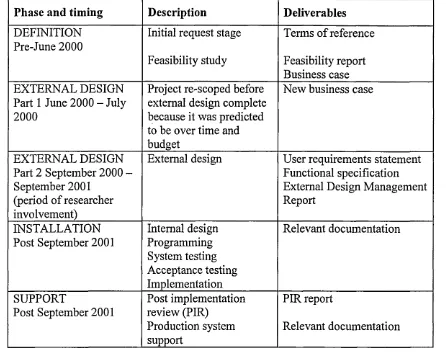
Summary of project in case study in chronological order 97
Chapter 4
Paraphrased extracts from pre-survey semi-structured
interviews on corporate values, standards and procedures 118
Extracts from the data from post-survey follow-up interviews
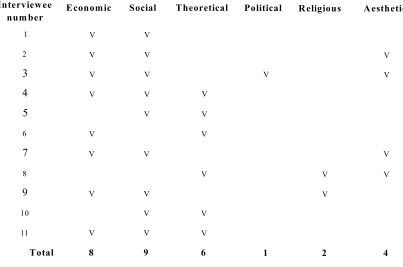
showing comments related to mental construct elements 121 Self-assessment of values by 11 interviewees during values
interviews using Spranger (1928) categorisation 123
Personal characteristics showing values related to project
Page 125 126 130 135 136 136 137 138 139 139 140 140 142 142 149 164 164 166
Examples of values into action at work related to management of people
Evidence of needs of project staff
Comments showing how values are shaped
Chapter 5
Project line management structure
Self-assessment of values by members of project group who have project management responsibilities
Self-assessment of values by members of project group who do not have project management responsibilities
Extracts from data explaining self-assessment of social values in project team members who have project management responsibilities
Extracts from data explaining self-assessment of social values in project team members who do not have project management responsibilities
Extracts from data explaining self-assessment of economic values in project team members who have project management responsibilities
Extracts from data explaining self-assessment of economic values in project team members who do not have project management responsibilities
Extracts from data explaining self-assessment of theoretical values in project team members who have project management responsibilities
Extracts from data explaining self-assessment of theoretical values in project team members who do not have project management responsibilities
Extracts from data explaining self-assessment of political values in project team members who have project management responsibilities
Extracts from data explaining self-assessment of political values in project team members who do not have project management responsibilities
Ormell’s classification of values (Straughan and Wrigley 1980:78-9)
Chapter 6
Extracts from data showing attitudes of project managers (Peter, Ray and Tracy) and two senior managers (Alan and Tom) to corporate values
Extracts from data showing attitudes to corporate values of project team members who do not have project management responsibilities
Page 166 169 170 175 183 201 202 203 204 205 206 208 209 210 212 214 218 219 237
Extracts from data showing attitudes to SDM methodology of project team members who do not have project management responsibilities
Attitudes to the methodology
Organizational values continuum showing results for Prosper pic (Adapted from Mumford, 1981)
Extracts from an interview with Tracy showing her opinions of Peter after completion of the requirements definition phase Examples of corporate values (adapted from Dearlove and Coomber, 1999:25)
Chapter 7
Observations on the project manager’s adherence to standards in informal settings i.e. outside formal meetings
Observation findings of the project manager in informal settings
Observations showing the project manager’s approach to chairing and minuting meetings
Observations of the project manager during meetings, showing his pragmatic approach to basic project tasks
Observation findings on the project manager in informal
settings showing a pragmatic approach to interactions with staff Observations of the project manager in informal settings,
showing his pragmatic approach to basic project tasks
Observations of the project manager showing social behaviour in informal settings
Observations of the project manager showing how he applied social values in communicating with the team
Summary of personal qualities of the project manager arising from observation data on application of social values
Observations on the project manager showing how he applied political values
Project Group perceptions of the project manager
Categories for interaction process analysis (adapted from Hayes, 1997:71)
Types of power (adapted from Hayes, 1997:98)
Chapter 8
TABLE OF APPENDICES
CHAPTER 3
Appendix 1:
Appendix 2: Appendix 3:
Appendix 4: Appendix 5:
CHAPTER 4
Appendix 6: Appendix 7: Appendix 8: Appendix 9:
CHAPTER 5
Appendix 10:
CHAPTER 6
Appendix 11:
CHAPTER 7
Appendix 12:
Page
PART ONE
Position Paper: Lauener (2002): An interpretive case study 1 approach to the study of values of systems developers in a
large financial institution
Questionnaire Used in Survey at Prosper pic 6 Paper: An investigation into the impact of values on systems
development 14
Sample page of field notes. 24
Researcher reflexivity field notes 25
PART TWO
Pre-survey interview results 29
Survey of the Use of SDM at Prosper pic. Report of Findings 32
Table of Findings from semi-structured follow up interviews 42
Table of results from semi-structured values interviews 46
Table of results from values interviews with project team 53
members
Observation data on attitudes of project staff to corporate 58
values
ACKNOWLEDGEMENTS
This thesis would not have come into being without the help of a number of people along the way, to whom I am thankful. Professor Nimal Jayaratna sowed the seeds for the research topic and gave the initial inspiration and stimulus. Dr. Fran Slack, my supervisor, has given guidance, encouragement and wise advice at all stages and her friendship has been invaluable. Professor John McAuley challenged me to write like a social scientist and his comments on early drafts of the thesis are most appreciated. Bob Steele, my Director of Studies, has overseen the whole process and I am particularly grateful for his help in the latter stages.
I am also grateful to Prosper pic for their collaboration. I am especially thankful to the project team for their willingness to accept me as an observer during the case study.
DECLARATION
ABSTRACT
The continuing occurrence of information systems development (ISD) failure persists as a strong motivator for both industrial and academic research to identify factors and develop methodologies which are more likely to lead to ISD project success.
While good technical design is fundamental to the successful implementation of information systems, it is well understood that social and behavioural factors also have an important impact on the design and development process. It is proposed here that values held by individuals - enduring beliefs about what is worthwhile that influence behaviour - are important in relation to the chances of success for corporate ISD projects. It is further proposed that values implicitly determine the underlying philosophy of corporate approaches to ISD and also inform definitions of success. However, it is also recognised that greater specificity is required to more clearly understand the impact of these factors on ISD projects. Obtaining a clearer
understanding of this should lead to greater success in developing methodologies or approaches which recognise and utilise values in the processes involved in the
development of information systems.
This research has addressed the need to provide greater specificity of these factors by investigating the process of systems development as undertaken in a large financial institution. The approach employed was exploratory and descriptive, including techniques such as survey, interviews and observation to examine the impact of
personal and corporate values in ISD projects. The results of the investigation are based on an interpretive case study of a team of systems developers who were using a
traditional structured systems methodology to help analyse and design the merging of a standalone database with a corporate information system. The research has employed a qualitative approach, using the interpretive skills of the researcher to provide the essential detailed descriptions and explanations of how social and behavioural factors affected the project at the micro-level.
The significance of the contribution of this research is the level of detailed explanation it provides about the impact that the social, economic, political and theoretical values of individuals have on an ISD project taking place within a corporate setting. In particular, it demonstrates the significance of the role of the IT project manager in relation to managing the interface between the competing demands of corporate,
LIST OF ABBREVIATIONS
INFP Introverted, Intuitive, Feeling, Perceiving
IS Information Systems
ISD Information Systems Development
IT Information Technology
NIMSAD Normative Information Model-based Systems Analysis and Design
Prosper pic Fictitious name of case study organization
SDM Fictitious name of systems development method as used at Prosper pic
PART ONE
CHAPTER 1
INTRODUCTION
Summary
This chapter describes the background of the research. It includes a rationale for studying the impact o f values on systems development and gives an overview o f the whole thesis. As appropriate for this topic and the research approach used, personal information about values and motivation is included and it is written in the first person.
1.1
The values of the researcher
Doing a PhD is not something that should be undertaken lightly or recklessly. Like getting married, you do not know precisely what you are letting yourself in for. Like having a child, it does not go away and gets more demanding as time goes on.
The opportunity to begin a PhD came at a time when my career focus at Sheffield Hallam University had changed - from researching and writing case studies and distance learning material on innovative use of information technology (IT) by organizations, to lecturing undergraduates on information systems development (ISD). Although I enjoyed the challenge and creativity of face-to-face interaction with students in my new role, I missed the rapport with professionals in the IT industry and the intellectual challenge of gathering information, analysing, synthesising and making sense of it for case studies. Also, as a lecturer on information systems development who had no first hand experience of working in industry, I felt a need to appreciate what it means to work in IT and to know about the daily work of systems developers.
Even prior to studying psychology as part of my zoology degree, I had always had an interest in ‘what makes people tick’ - why people behave as they do, what their thought processes are and why individuals behave differently. I enjoy intimate conversations with the opportunity to understand the mind of another and to share my thought
technology-focused since my MSc in Computer studies in 1991. I was fascinated by the
psychological and philosophical elements of Soft Systems Methodology (SSM), first encountered on the course then followed up as I took on a lecturing role in that subject. I was also intrigued and bemused by the knowledge that systems development projects frequently fail and often go over time and budget, usually because of human issues rather than technical issues. Naively, perhaps, I could not understand why SSM, with its people focus, was not more widely used. I was tired of literature repeatedly giving statistics on failure rates of projects and speculation about social and behavioural factors being the cause in general terms but never in any detail.
My ethical and moral beliefs gave me a concern for the victims of failed information systems - despondent developers, disappointed and frustrated customers, powerless shareholders. It seemed immoral and unethical that failure should be allowed to
continue to affect so many lives. So, I was satisfied that there was a powerful rationale for doing research in this area. With hindsight, I realise that my personality type also played a part in my determination and ability to contribute to knowledge in this field of information systems (IS). A Myers Briggs Type Indicator defines me as ‘INFP’
(Introverted, Intuitive, Feeling, and Perceiving). The Myers Briggs literature states:
“People with INFP preferences have an inner core of values that guides their
interactions and decisions. They want to be involved in work that contributes to both their own growth and inner development and those of others - to have a purpose beyond their pay cheque. They make a priority of clarifying their values and living in
congruence with them.”
“INFPs recognise and respect the emotional and psychological needs of others, even when others may not have recognised or expressed their own needs.”
“INFPs enjoy reading, discussing and reflecting on possibilities for positive change in the future”.
difficulty performing routine work that has little meaning for them” ... “They are adaptable and flexible until something violates their inner values”.
(Myers, 2000:27)
“They take a very personal approach to life, judging everything by their inner ideals and personal values. They stick to their ideals with passionate conviction.”
(Anon, 1991:2)
These skills and characteristics are highly relevant for pursuing research on values. They also support a commitment to do research both for personal development and the benefit of information systems developers and users.
During the course of the research, another motivating force became explicit. My
preference is for social values, defined by Spranger (1928) as putting emphasis on warm human relationships, altruistic, sympathetic, unselfish, and loving people. This is linked to my belief in the universality of spiritual needs in all areas of life, including the workplace. This led to the proposal, supported by the research findings, that social values and spirituality in the IT workplace are highly relevant to the social and behavioural factors responsible for project success and failure.
1.2 Evolution of research and researcher
Meloy (2002:1) states that “conducting and writing up a qualitative research project is evolutionary and inductive”. This is a truth borne out by the experience of this research, when insights and ideas continued to develop to the very end.
It is apt that as a zoology undergraduate in the 1970’s, I studied the theory of evolution because it is a theme that has characterised the research described in the thesis.
As a zoologist, I was interested in the idea of organisms as systems adapting to their environment in order to survive. This is also a concept drawn on by SSM, which is based on systems theory as its underlying philosophy. The task of arriving at a research question and suitable methods for investigation was also an evolutionary process
flexible in my epistemology, using an interpretivist approach in contrast to my positivist background.
1.3 Overview of the thesis
“In writing a problem down or airing it in conversation we let its essential aspects emerge. And by knowing its character, we remove, if not the problem itself then its secondary, aggravating characteristics: confusion, displacement, surprise
(Dunleavy, 2003:1)
Although, as indicated by Potter (2002) the way research really happens is not
straightforward, it may be written up in a logical manner. Dunleavy (2003) stresses the importance of good authoring of a PhD thesis, distilling the pertinent points from a wealth of data and presenting them in an ordered fashion. In this thesis, the 3-part structure and organisation of chapters aims to do this.
An overview of the content of each part, below, is followed by a more detailed summary of the content of each chapter.
Part One sets the context for the research. It describes the evolution of the research question in Chapter 2 and research methods in Chapter 3.
Part Two presents the results and analysis of the research conducted at Prosper pic in Chapters 4 to 7.
Part Three then returns to the wider context. Chapter 8 draws some conclusions and implications for practice, based on findings presented in Part Two. Chapter 9 then reflects on the whole process and suggests areas for further research.
The development of the research question is described in Chapter 2 in the context of relevant literature. I was offered the opportunity by Nimal Jayaratna, proposer of the Normative Information Model-Based Systems Analysis and Design (NIMSAD)
NIMSAD framework. This topic appealed to me because of the psychological bias. However, this feature alone was not sufficient incentive to make the large commitment needed for a PhD. The venture seemed more worthwhile, in terms of my values, when linked with the broader aim of information systems development (ISD) methodology research to improve success of ISD projects. I saw a link between the concept of the mental construct in methodology research and the notion of social and behavioural factors determining the outcomes of ISD projects in success and failure research. Ultimately, both seek to explain the behaviour of systems developers and the outcomes of ISD projects.
A critique of the mental construct concept shows it to be an unsure foundation on which to base a major piece of research. Alternatively, it is proposed that values, one of Jayaratna’s (1994) suggested mental construct elements, are a more reliable and focused theme to follow up. This is supported by a review of the literature on ISD success and failure. While much evidence exists for social and behavioural factors causing failure, the literature lacks detailed explanations. Analysis of this literature leads to the
argument that research on values could provide more specific explanations by posing the following research question:
What is the impact of values on ISD projects?
Chapter 3 describes how the interpretive case study took place in three phases of fieldwork in a large financial institution, fictitiously named Prosper pic. Phase 1
consisted of a survey by questionnaire on methodology use and mental construct, issued to over 500 IT staff. Phase 2 consisted of a series of follow-up interviews with IT project managers on how they apply their values in ISD projects. These preliminary studies provided useful pre-understandings, which formed a good background for the interpretive case study carried out in Phase 3. During Phase 3, a period of one year was spent visiting the financial institution regularly to do observation, interviews and document analysis while a team of systems developers worked on the design phase of a major project.
Evaluation of the research approach is presented at the end of Chapter 3. The
preliminary survey followed by interviews and observation proved fruitful in generating useful data and it was rewarding to conclude that the overall approach had been
successful.
Typical of qualitative research, the fieldwork and analysis evolved during the research. The findings from the preliminary studies are described in Chapter 4. This summarises a series of proposals, issues and reflections resulting from pre-survey interviews, the survey, post-survey follow-up interviews in Phase 1 then values interviews in Phase 2. During this activity, the findings supported the need to narrow the research focus from mental construct to values. Issues regarding the validity of the mental construct were developed and expanded during Phase 1. Narrowing the focus to research on values in Phase 2 proved successful and provided support for this alternative approach.
Three main themes emerged during analysis of results: Personal values
Interplay of corporate and personal values and Outcomes of the application of values in projects.
term goals of the project. Team members apply social and economic values in short term, daily tasks to interact with users and analysts and to meet targets. The legitimate power of the project manager role is used altruistically to support the team and the project. Project managers apply theoretical values to aid rational decision-making and to understand the wider context of the project.
Some staff reported that line managers had shaped their values. The chapter concludes by proposing that the values of project managers potentially have greater impact on systems development than other project team members due to their authority, responsibility and status.
The influence of corporate values is considered in Chapter 6. Evidence from document analysis shows the prevalence of corporate values, standards and procedures at the financial institution. Analysis of results shows that the organization is effective in communicating its values to IT staff mainly via use of a structured and disciplined systems development methodology that supports the corporate values and is enforced by line management and documentation. IT staff were found to be mainly compliant with the standards and procedures demanded by the methodology and their line managers, leading to a co-operative culture or a ‘controlled organization’ as defined by applying Mumford’s (1981) framework. Differences in the amount of control exercised by heads in different departments support the case for the influence of management on project outcomes. Evidence of value conflict was presented and discussed. It was concluded that value conflict is not a major problem at Prosper pic and that there is a high degree of values congruence.
Following the evidence built up in Chapters 5 and 6 for the important role of the project manager, Chapter 7 reports findings on the impact of values on project management. It provides a narrative for each of six project team members, including the project
Highly detailed results are presented for the project manager because of his higher profile and key role. They show how he interacts with others in formal and informal settings, how he manages his time to meet targets and how he adheres to corporate values and encourages others to do so, thus reducing risk of project failure.
The particular importance of social values is discussed in the context of the project management literature. It is suggested that the application of social values may help managers carry out essential project tasks more effectively, especially communication. This is supported by practitioner literature giving advice on successful communication and academic literature on interaction analysis.
Discussion of literature on types of power in the context of social values leads to the proposal that the exercise of power by project managers is more acceptable and effective if accompanied by the application of social values.
Trust and honesty are two social and behavioural factors cited in the literature as important in ensuring project success. It is proposed that if project managers apply social values, they are more likely to motivate and empower staff, thus engendering trust and honesty. This is essential if problems are to be reported before they have become large and damaging to the success of projects.
These findings from Chapter 7 are based on the high level of detail recorded in field notes, transcribed and included in this thesis. This demonstrates the importance of actually publishing such detail and is a significant contribution made by this research.
Chapter 8 draws together the findings from the case study and summarises the findings on the wider impact of values on systems development. This takes place at all levels in organizations, from top management to individuals at the lowest levels, and affects the following
• Choice of systems development methodology • Mode of application of the methodology • Definitions of success in IT projects • Project management
It concludes that the project manager is at a key interface, between corporate values, personal values, needs of team members and his own values. The amount of
congruence between these values will determine the outcome of the project.
A discussion of generalization of the findings at Prosper pic concludes that it is
legitimate to do so because the basic building blocks of IT projects are broadly similar. This is supported by obtaining similar findings from research in a contrasting setting on a large public sector IT project (Lauener, 2002).
Therefore, some implications for practice are described, drawing on the detailed
findings on the project manager at Prosper pic. The implications for practice consist of recommendations for managing potentially conflicting values of organisations,
individual project team members and project managers. It was found helpful to structure the recommendations around the NIMSAD framework. This is a rewarding outcome because it returns the focus of the research to the original starting point.
Chapter 9 revisits the literature reviewed at the start of the research and shows how the findings addressed the issues of concern expressed in Chapter 2. It concludes that the mental construct was a useful starting point for the research but focusing on values led to better research outcomes; the Spranger (1928) classification of values was practical and appropriate despite some initial concerns about its limitations; corporate values are linked to personal values in determining project outcomes and methodologies are more likely to be useful in aiding project success if carried out by project managers with social values.
The main strength of this thesis is that it reports on social and behavioural factors in greater detail by analysing a systems development project in terms of values applied by project managers and staff. A major contribution to the literature is that it enriches and elaborates on the NIMSAD framework by adding more detail, especially on the
methodology user.
spiritual values have a positive impact on project management, to clarify definitions of social and spiritual values and to investigate practical and realistic methods for
CHAPTER 2
THE VALUE OF RESEARCH ON VALUES IN
INFORMATION SYSTEMS DEVELOPMENT
Summary
The aim of this chapter is to explain and critique previous research on information systems development in relation to success and failure. It will be shown that previous research has not provided sufficient detail to result in practical, fine-grained knowledge, which may help provide recommendations for success in information systems
development. It is argued, in the context of relevant literature, that it is worthwhile to research the impact of values on information systems development because this has the potential to provide detailed new knowledge on social and behavioural factors.
Justification is given for using Spranger’s (1928) six classes of values, i.e. social, economic, theoretical and political, aesthetic and religious, in spite of some limitations of this classification. It concludes by arriving at the research question, ‘What is the impact of values on information systems development?’
2.1 Introduction
2.1.1 Overview of literature in the context of phases of the research
-3 p £ 3 o rsP VI VI p p P 3 p 5-3 £
u *■ P w < £
cn _P
o bo ’5b ? . a h o
c 8 803 33 1 P O
- S >,
5 £> p „
C o | Q5-1 ^ c/o
Oh CO P3
P 03 O 33-4-* <U a 33p e3 pcn P 5-h 0) .> on ^ P .-3
-5 *3a 3 > a
od 3 p
£> cn £ > P P
' ^ 3 0<L> O O
£ 3 3
& g M
-fi gnW
i-h cn i—i P S-H Jj3 *3 Ph 03 § on Q 00 S3o 3 3 3 3 on
3 3 3 3
03 &Q<3 cd
>
3
03 « ° S
- 3 & • &
^ ° 2 > u 3h
0. o S* -3 p j-3 <U so co £ bO .2 *-i—a>
3 03 3 O o 3 3 30 O O 3 S3 03O P S3 a P p a r~[ Ph HP O 3 HP O P ►>-» 3S-H p HP >C— cn3 3 O cn P CS 5h 1) Ph cn O 5-h Ph td on 5-h <0 30
3 hp
‘-3 °o
p
03 5h
3 Ph
3
■§ s 3 on 30 £
C ao '3 >s p
3 .g
eu .2
p H
o 3
Ph
cn ^
Sh p-h
P 3 s-h
2P o
3 0^-1
3 cn J£> 3 « 2
3 Ph Ph
>> 03
3
cn
O cn
03 cn
3 3
° O ° P cn
T3 > P 3 p ^
f f & l • 3 p Sn3 +-* Ur
a ”“' 3p 2^
3 3
3 3
_ 03 3 3
O 3
m OP
30 3 3 3
« °
03 cn
3 5-h
, 3 P
Ph cl Ph Cj_i
© O
5=1 -3 ° £ 23
K
p 3 035-h ^ Ph '-'
Ph
a
p
3
E
3 P ° a
?? ^
3 -2
OP P3 >
> U O
o 03 p ,
g S & u °
p cn Ph 5-h
P
Ph
cn
O
>, p
P -3p P3 P cn P P4 -3P P 3 P cn P P P -3HP Ph o p in 3 33 Ph P 3S © czj
e ^ w
E ^ 2 3 3
~ to Kr^
• Sf 3 O ^ P "© «,p 35 c^3
Sr —< “ -p
« ** ° S
E h h O
fl P P P
< a S a
.2 'O 3 pH cn 3 3 P cn 3 33 Ph P P Ph
I O '*-n PO O «h 3 P 3 'g ‘O
.2 p a
-HH H-<3 P o
.sp a S P o £h C«
3 p cn — s
3 3 nPP
(N 3 33 Ph 03 3 -HH C/0 3 3 P P Ph s «
l-H P
p e 3 JS 3 2v w e Ph 3 4S
° ° « 1 1 tf p3 p5 «
3 3 " “
b£ >• 3
HP pH 'HP cn o 3
« ,M p-^ P « 3
C rrt IT ^
a 2 1 .§ a .2
[image:31.614.85.469.87.657.2]3 O m p cn 3 33 Ph
Initially, during Phase 1 (Preliminary Studies) the topic of the research was ‘The mental construct of the problem solver’. This theme originated in the field of Information Systems Development (ISD) methodologies, specifically based on the ideas of Jayaratna (1994) so it was appropriate to review other literature on problem solving and mental construct including literature from fields outside IS. At this stage, a survey by
questionnaire was planned for providing data on mental construct and methodology use in Prosper pic, a large financial institution, so literature was also accessed to help with the design of the survey.
As Phase 1 was being conducted, severe doubts emerged about the usefulness and focus of researching the mental construct of the problem solver. During the literature review and survey, it was discovered that literature referencing the term ‘mental construct’ as used by Jayaratna (1994) was sparse and it did not appear to be a widely used or
standard term. Psychology professionals would avoid the word ‘mental’ because of its amateurish impreciseness and lack of clarity for describing concepts relevant to the human mind. However, similar concepts by alternative names abound in other fields, especially social science, showing the mental construct to be based upon theories recognising the social construction of reality or nominalist ontology. Also, Jayaratna (1994) proposed elements of the mental construct based on personal experience, unsupported by others’ experiences, with minimal explanation of how and why they were chosen.
The findings in Phase 1 provided justification for narrowing the focus of the research to ‘The impact of values on ISD’ in Phase 2. Reviews of the literature on values in ISD and other fields showed that the term ‘values’ has a precise, consistent and measurable definition. Pilot interviews with systems developers in the financial institution showed that this was a fruitful focus for providing detailed new knowledge on social and
validity of data, it was felt that these findings needed to be complemented by
observation of systems developers in the context of a project together with document analysis and interviews. By the end of Phase Two, it was clear that further fieldwork was necessary, using an interpretive case study approach.
By the start of Phase Three, it had become clear from the earlier phases that literature on project management and corporate values was relevant to this research. Also, in the context of the findings from the case study, it was deemed useful to review literature on the contribution of personal values, corporate values and project management to ISD project outcomes by analysing success and failure literature. Literature on interpretive approaches and researcher reflexivity was also accessed, highlighting the importance of the values and interpretations of the researcher in qualitative research.
2.1.2 Summary of development of the research question
Stimulus for
research:-The need for ISD to be successful. However, a high rate of failure persists despite much research on methodologies and on success and failure, ___________ as shown by two routes to the research question.___________
ISD Methodology route Success and failure route
V Methodologies introduced
to reduce ISD failure Lessons learned from cases of failure
Recommendations produced to avoid failure
Research on values of systems developers will add new knowledge
Research on values of systems developers will add new knowledge Still ISD failures occur.
Methodology user needs further investigation
Use of the Spranger (1928) classification of values justified and shown to be most appropriate
Still ISD failures occur. Social and behavioural factors need further investigation
Importance of social and behavioural factors recognised but described with limited specificity
Discussion of definitions of success shows relevance of both corporate and personal values Frameworks for
understanding and
evaluating methodologies. Includes NIMSAD
framework and mental construct of methodology user
F
A - ' Y v U — ■ .;U f f v UFA-,:.- .-nFrA-': :v ~'. • ■>. y;,::- -U.
Research question: What is the impact of values on ISD?
The common starting point for the two strands of the argument is the premise that it is desirable to be successful in information systems development. This is the rationale for both the development of methodologies and research into success and failure.
The first strand of the argument, labelled the ISD methodology route, takes a path through the literature on ISD methodology research, passing the little-researched mental construct concept on the way. ISD methodologies first arose in the 1970s to try to reduce the problems experienced in computer systems development. The burgeoning number of methodologies in the 1980s became known as the ‘methodology jungle’ and it became necessary to devise frameworks to understand and evaluate them, partly in order to decide which methodology was appropriate in any given situation. Jayaratna derived the NIMSAD framework in 1986, in which he claimed that methodology users and context must also be taken into account when evaluating methodologies. The concept of the mental construct of the methodology user is shown to be partially helpful for research on successful information systems development but it is argued that
research on values of the methodology user in the corporate context may be more fruitful. This is discussed more fully by addressing the question:
How is the mental construct concept relevant to successful information systems development and how can research on values of the methodology user
achieve new knowledge about this?
The answer to this question is discussed in section 2.2.
Why are social and behavioural factors important in avoiding failure in ISD and how can research on values achieve new knowledge about this?
The answer to this question is discussed in section 2.3.
Having arrived at the conclusion that it is worthwhile to research values in ISD, the next stage of the argument brings in literature on values. This includes definitions, measures and classifications and it also has implications for research methods. This is discussed more fully by asking the question:
What is the rationale for using an interpretive case study approach and the Spranger (1928) classification of values for research on success in ISD?
The answer to this question is discussed in section 2.4.
Definitions of success and failure must be explored and clarified because they will shape the research. Relevant literature is examined by asking the question:
How does the literature on success and failure shape the research on values?
This question is discussed in Section 2.5.
Finally, from the discussions in Sections 2.2 to 2.5, the resulting research question emerges:
2.2 How is the mental construct concept relevant to successful information systems development and how can research on values of the methodology user achieve new knowledge about this?
2.2.1 History of development of the mental construct concept in methodology research
The use of methodologies for information systems development has been taking place since the 1970s. They were devised as a preventive measure to avoid occurrence of a range of problems that caused failure in early computer systems development.
Mumford’s research (1981) on values, technology and work led her to realise the need for a humanistic approach to systems development and she incorporated this into a methodology called ETHICS. Although such methodologies solved some problems, ISD failure still occurs and methodologies have not been a panacea. Avison and Fitzgerald (2003) describe the current period as the ‘era of methodology reassessment’, the fourth era in the evolution and development of ISD methodologies. Figure 2.3 summarises four eras in the evolution and development of ISD methodologies, as described by Avison and Fitzgerald (2003).
ISD Methodology era Date Brief Comments The pre-methodology era Up to the early 1970s Traditional systems
development life cycle approach used. Many problems
The early methodology
era 1970s to early 1980s methodologies devised Some simple which attempted to address problems but still
problems occurred
The methodology era Mid 1980s to late 1990s ‘Methodology jungle’ - many methodologies devised. Frameworks developed to make sense of methodologies
The era of methodology
reassessment Mid to late 1990s onwards Realisation that methodologies are not the complete solution to problems in ISD
During the methodology era in the 1980s and 1990s, there was such a proliferation of methodologies that it was called the ‘Methodology Jungle’ (Avison and Fitzgerald,
1995:417). This posed problems in selection of methodologies so frameworks were devised to help choose an appropriate methodology for an ISD project e.g. Episkopou and Wood-Harper (1986) and the NIMSAD framework, incorporating the mental construct concept (Jayaratna, 1994).
2.2.2 Jayaratna’s (1994) NIMSAD framework and mental construct concept
The concept of the mental construct originated as part of the NIMSAD framework. Jayaratna initially developed the NIMSAD (Normative Information Model-based Systems Analysis and Design) framework in 1986, a meta-model for assisting
methodology users to understand and evaluate methodologies. This framework includes the concept of the ‘mental construct’ of the methodology user in addition to the
methodology and methodology context. The NIMSAD framework was refined in Jayaratna’s book published in 1994 entitled ‘Understanding and Evaluating
Methodologies. NIMSAD. A Systemic Framework’. (Jayaratna, 1994). He describes this framework as ‘a methodology-independent framework’, a general framework that can be used for understanding and evaluating any methodology, not simply those relating to information systems’. Please see Figure 2.4.
'M ental Construct'
'Problem situation' M ethodology user M ethodology
f context Evaluation
M ethodology
Problem-solving process
In the NIMSAD framework, Jayaratna implies that in any systems development project, the methodology is only one of three relevant factors that determine the outcome of the project. The methodology user has an important role and so does the ‘problem
situation ’ i.e. the context of the project. From the methodology user’s perspective, the context and methodology are ‘given’ or ‘fixed’ but the methodology user has some choice about how to work, leading to a variety of possible outcomes. This is due to the unpredictability of social behaviour compared to investigations in natural science, e.g. if copper is added to sulphuric acid, the same chemical reaction will take place and will always produce copper sulphate, hydrogen and water. If a systems development methodology, methodology user and problem context are combined, the outcome is much less predictable.
Jayaratna’s (1994) rationale for the elements of the NIMSAD framework is briefly as follows.
The ‘problem situation’ (the methodology context) - Jayaratna believes that consideration of methodology context is important because:
1. It is important to take into account the needs of the users of the system. This includes usability of systems.
2. It helps the analyst understand how the organization perceives the problem situation, and may help the organization re-examine the situation.
3. Interpersonal relationships need to be formed with organization members.
Here Jayaratna is showing that methodologies operate in a variety of contexts and the methodology user must be aware of the context for the above reasons.
The intended problem solver (the methodology user) - systems analysts who use methodologies have their own ‘mental construct’, which affects how they view the problem situation and apply the methodology.
Jayaratna (1994) gave this rationale for inclusion of the intended problem solver in the framework:
effective and efficient information processing systems design and development depends, among other things, on the personal characteristics of the intended problem solver. Intended problem solvers, by being human, tend to select some elements of the situation as being relevant and useful for study and transformation. Some of this selection is implicit and unconscious (i.e. based on gut feelings, hunches, assumptions), but at other times the selection is prompted by explicit concepts, models and methodologies that are employed.”
(Jayaratna, 1994:63-64).
This statement shows that Jayaratna recognises that individual human beings are unique so their perception and action in problem situations will be varied and different. By understanding the contribution of relevant personal characteristics and the
methodologies and models that developers may have learnt, this may help understanding of developer behaviour.
The problem-solving process (the methodology) - methodologies are based on a range of different philosophies and correspondingly, the suggested steps in the methodologies put the underlying philosophies into practice. Jayaratna proposes 3 elements that must be addressed in the methodology, or problem solving process:
Phase 1 - Problem formulation Phase 2 - Solution design
Phase 3 - Design implementation
Here, Jayaratna is abstracting three main functions present in all systems development methodologies
The evaluation of the above three - If using this framework to evaluate the
effectiveness of application of a methodology, it is suggested that this is done before, during and after intervention of the problem solver. This enables adjustments to be made during the intervention and lessons to be learnt afterwards.
2.2.3 A discussion of mental construct elements
Jayaratna’s rationale for proposing the mental construct concept is explained in the following quotation:
“It is not within the domain of humans to capture any ‘true’ account of the richness of a situation. The learned/acquired bounded knowledge sets, the inherent limitations of information receptor, effector and processor faculties together with prejudices, motives, values, ethics, experiences, models etc. which are themselves forms of closures,
condition the way humans perceive and structure their understanding of situations.” (Jayaratna, 1986:75).
Dynamic 'Mental Construct'
O Q
<J
The intended problem
solver (1) Perceptual process (2) Vbloes/ethrcs (3) Motives and prejudices (4) Reasoning ability (5) Experiences (b) Skills and knowledge (7) Structuring process (including methodologies) (8) Roles
(9) Models and frameworks
Figure 2.5 The mental construct (Jayaratna, 1994:64)
explanations that he has based his ideas on his personal experience as an individual and includes no evidence from other sources. However, he does recognise that other individuals ‘mental constructs’ may have a different composition.
The elements and their practical relevance to information systems development, as explained by Jayaratna (1994), will now be discussed. It will be seen that most of these elements are generally applicable when people interact in any situation. Text in italics denotes quotations from Jayaratna (1994:65-70).
Perceptual process refers to the belief that “each person perceives ‘reality ’ in different ways Therefore, the problem solver may perceive situations differently to
stakeholders. Elsewhere in the literature, this concept is generally recognised as the social construction of reality or interpretivism (Burrell and Morgan, 1979).
Values “help us pass judgement on situations” ... “provide a form o f guidance system ”, where some values dominate over others, e.g. social values and economic values (Guth and Tagiuri, 1965) may compete. In practice, this means that since values tend to be strongly held, if there is a conflict of values, opinions may be difficult to change, leading to an ill-structured situation so this would require very sensitive interpersonal relationship management skills. Jayaratna gives no justification for selecting Guth and Tagiuri’s ideas on values, no indication about other categorisations or types of values that may be relevant and no detailed evidence on how values affect the role of the problem solver in practice. Jayaratna et al (1999) return later to the issue of corporate and personal values in the context of methodology use but their assertions are not supported by empirical research.
Ethics are “standards which we and others place on a person’s expected behaviour” i.e. they are standards imposed externally as opposed to values, which may be described as internally imposed standards. The practical outcome of this for the problem solver is that it may be unethical to divulge sources of information when analysing systems.
Prejudices are “persistent opinions which we form from our values, experiences or out o f insecurity, i.e. fear o f the unknown ”. In information systems development, Jayaratna proposes that there are pros and cons of having prejudices. A prejudice against a certain form of technology or contributions of other people may form a mental block and preclude a good solution. However, it may be useful if it is based on previous
experience and reduces time spent information gathering. Problem solvers need to be aware that they may have prejudices.
Experiences “help us form implicit models for structuring and understanding situations. ” The pros and cons of this are similar to those of applying prejudices. Experience may help streamline information gathering and give confidence to assume expert status. However, it would be unwise to assume that each problem situation is the same.
Reasoning ability “is our ability to abstract the essential aspects from any situation and to understand the concepts underlying our thought processes, i.e. examine what makes us reason in a particular way. ” Jayaratna believes that it is helpful if problem solvers can explain their thought processes and this includes being aware of when they are using what he calls ‘intellectual’ thought processes as opposed to ‘political’ thought processes. This definition of reasoning ability, like Jayaratna’s definition of prejudices, motives, experiences and values, is really about self-awareness, critical self-reflection and acknowledging our thought processes.
Knowledge and skills ‘are acquiredfrom education, training and experience ’.
Jayaratna claims that methodologies should clarify the wider knowledge and skills needed by methodology users for effective methodology use because both technical and interpersonal skills are needed. However, it could reasonably be expected that it is up to the individual methodology user to apply interpersonal skills naturally because guidance from a methodology could only be general.
unique structuring processes. Jayaratna believes that it is important for systems developers to understand how methodologies structure their thinking and actions.
Models and frameworks - Jayaratna believes that “Modelling helps to develop one’s reasoning ability”. Some models are gained from experience and others are acquired by conscious training.
Roles “can be defined as the explicit behavioural characteristic sets that can be attributed to someone responsible for performing a set of tasks. ” Jayaratna claims that our role expectations may have to match the expectations that others have of that role, which may be in conflict. Therefore systems developers need to balance natural behaviour and personality with expectations. He believes that methodology creators need to explain role expectations implied by their methodologies. This author’s view is that it is unreasonable to expect a methodology to do this and implies a frustration with Jayaratna’s ability to manage his role and relationships as a systems developer.
It is clear from the explanation above how Jayaratna believes each individual proposed mental construct element is put into action when systems developers do projects. However, there is some overlap and interconnectedness between some of them. They can be grouped into different types of concepts:
Reasoning ability and perceptual process are both internal to the individual -
psychological processes that would be undertaken naturally by any human being in a wide range of activities.
Skills, knowledge sets, models and frameworks and structuring processes are external to the individual and need to may be learnt and acquired. They are relevant to the activity of developing systems because they aid understanding of situations and project
planning. They are not unique to individuals. They rely on the psychological processes - reasoning ability and perceptual process - to aid interpretation of situations and enable skills, knowledge sets, models, frameworks and structuring processes to be put into practice.
Ethics may be relevant either as an internal moral code unique to an individual, and similar to values, or as an externally imposed, profession-based moral code promoted by the organization in which the project takes place. However, individuals may choose to ignore it unless it agrees with their personal values.
Role acts as a delimiter and definer of what the systems developer is expected to do.
The elements listed above are relevant to the thought processes of systems developers, i.e. they affect how they think about the problem and perceive possible actions. The remaining elements - values, motives, experiences and prejudices - may affect what systems developers may actually do, i.e. they have some effect on guiding the actual outcome of the thought processes described above. Values, experiences, motives and prejudices are personal characteristics that may all be acquired over time and are likely
to be unique to individuals. In this research, it is proposed that these elements are more powerful in guiding the actions and behaviour of systems developers.
shows that there are potential problems researching the mental construct concept. However, the discussion prompts helpful issues and insights and reinforces the rationale for limiting the investigation to values of systems developers.
2.2.4 Mental construct discussed in the context of problem solving
The discussion will begin by considering what is positive and helpful about the concept in terms of understanding information systems development. Issues that require further exploration will then be discussed. Conclusions will be drawn on the value of
researching values, one element of the mental construct, as a means of contributing new knowledge on social and behavioural factors relevant to successful information systems development.
Jayaratna’s explanation of the NIMSAD framework makes clear that there are three important ingredients in any systems development project - methodology user,
methodology and organizational context. It therefore follows that success in using any tool or methodology must depend on the methodology user (systems analyst) and the context in which it is being used. It is obvious that where humans are involved, the outcome of combining the ingredients of a project will not be predictable because of human free will and choice, compared with the predictable outcomes of combining natural ingredients as in chemistry experiments or cookery.
The systems analyst’s role is to act as a problem solver. The act of doing systems development, with or without the use of a methodology, is seen as a problem solving activity and the mental construct of the systems developer is important in determining exactly how the work will be done.
mathematical equations, managing a business” (Bransford and Stein, 1984:2) and developing an information system may all be defined as problems, although Wilson (1990) and Checkland and Scholes (1990) prefer the term ‘problem situation’ and describe the problem solver’s role as bringing some improvement to the problem situation (Checkland, 1990:205). Wilson (1990:8) claims, “At the ‘soft’ end problems do not occur in a way which enables them to be readily isolated. It is more usual to find sets of problems which are highly interactive and it has been found to be more useful to examine, not a problem, but a problem situation, i.e. a situation in which there are perceived to be problems”. The distinction between ‘hard’ or clearly defined problems and ‘soft’ problems in the information systems literature is mirrored by the distinction between problem solving as search, when “the problem solver has a clear goal,
understands