DEVELOPMENT AND OPTIMIZATION OF NUTRACEUTICAL
FORMULATION CONTAINING CITICOLINE AND PIRACETAM
Asma B. Pathan*1, Nita B. Pawar2 and Ahad J. Pathan3
1
Department of Pharmaceutical Chemistry, M.C.E Society’s Allana College of Pharmacy,
Azam Campus, Camp, Pune (MS) India.
2
Department of Quality Assurance, Shree Santkrupa College of Pharmacy, Ghogaon, Karad,
Satara, (MS) India.
3
Department of Quality Assurance MIT Institute of Pharmacy, Pune (MS) India.
ABSTRACT
Development, Optimization and Evaluation of Citicoline and
Piracetam from their Formulation. The objective of present
investigations were to optimize different concentration of HPMC as
coating for taste masking. Citicoline, Piracetam and HPMC, distilled
water and methanol. Formulation was prepared by wet granulation
technique and evaluated for drug content, infrared spectroscopy,
scanning electron microscopy and in vitro dissolution study. The
purpose of this study was to develop and optimize taste masking
granule formulation for Piracetam using HPMC as a coating material.
Initially trials were done to optimize the concentration of HPMC on to
granules or its uniformity of size and Assay, varying the concentration
of HPMC as coating material. The cumulative drug release percentages
at 15, 30, and 35 min were the target responses and were restricted to 50%, 68%, and 98%
respectively. For formulation, the results suggests that considerable taste masking of
Piracetam was carried out by using 200 mg of HPMC and weight reduction was achieved as
compared to marketed formulation. Formulation of Citicoline and Piracetam were
successfully developed in this work.
KEYWORDS: Citicoline, Piracetam, Taste Masking, Wet Granulation.
Volume 6, Issue 12, 586-597. Research Article ISSN 2277– 7105
*Corresponding Author
Asma B. Pathan
Department of
Pharmaceutical Chemistry,
M.C.E Society’s Allana
College of Pharmacy, Azam
Campus, Camp, Pune (MS)
India.
Article Received on 12 August 2017,
Revised on 03 Sep. 2017, Accepted on 24 Sep. 2017
INTRODUCTION
In the present scenario, a variety of pharmaceutical research has been come in to focus to
develop new dosage forms for effective therapy with increased safety. Considering value of
life, most of these innovators have been focused on patient compliance.[1]
Palatableness of oral dosage form admits a key factor for achieving compliance especially in
pediatric, geriatric, bedridden, nauseous or non-compliant patients.[2] Who find difficulty in
swallowing or chewing solid dosage forms due to diseased state or is willingly reject to take
solid dosage forms due to concern of choking. Hence, a taste masking granule containing a
tablet seems a suitable alternative for them.[3] More than 50% of pharmaceutical products are
orally administered for several reasons and bitter and unpleasant taste of drug is one of the
important formulation problems that is encountered with such oral products.[4]
In the development of orally dosage forms and product development taste is most important
factor.[5] Taste masking of oral pharmaceuticals play a significant role to improve patient
compliance therefore taste masking technologies offer wide scope for innovation and
invention in the development of patient friendly in fixed dose administration.
Negligible perception of unpleasant taste of the drug two major strategies are commonly
utilized, are reduction of drug solubility in saliva where balance between reduced solubility
and bioavailability must be achieved, and secondly is to alter the ability of the drug to interact
with taste receptor.[6]
Taste smell, texture and after taste are important factors in the development of dosage form,
these are important factor in product preference. Good flavor and texture are significantly
affect sell of product. Undesirable taste is one of the important formulation problem
encountered with most the drugs, the methods most commonly involved for achieving taste
masking include various chemical and physical method that prevent the drug substance from
interaction with taste buds. The simplest method involves use of flavor enhancer. Where
these methods fail more complex methodologies are adopted.[7,8]
Citicoline is an intermediate in the biosynthesis and generation of CDP-choline it blood-brain
barrier and reaches the central nervous and cognitive enhancing, neuroprotective. Citicoline
also act as a precursor for synthesis of phospholipids are essential constitutients of cell
Fig. 1: Chemical structure of Citicoline.
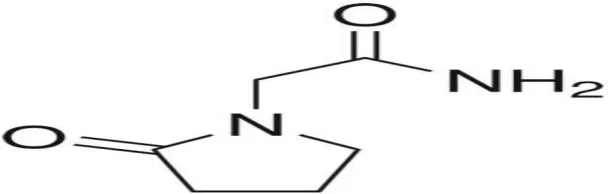
Piracetam is a derivative of GABA (gamma amino butyric acid) refred as a 2- oxopyrrolidine
acetamide. Piracetam increase the flow between the right and left hemisphere of brain, this
can be useful for the treatment of stroke, vertigo, dyslexia, alcoholism. Piracetam stimulates
the CNS with physical manifestation of similar to acetylcholine esterase inhibitors which
deactivates the neurotransmitter. Piracetam may exert its global effect on brain.[11-12]
Fig. 2: Chemical structure of Piracetam.
MATERIAL AND METHOD
Instrument: A Shimadzu model 1700 (Japan) double beam UV/Visible spectrophotometer
with spectral Width of 2 nm, wavelength accuracy of 0.5 nm and a pair of 10 mm matched
quartz cell was used to measure absorbance of all the solutions.
Reagents and Chemicals: Citicoline and Piracetam pure drug were obtained as gift samples
from the SRS pharmaceuticals Pvt. Ltd., Mumbai, India. The marked tablet formulation
strocit plus manufactured by Intas Pharmaceuticals, Sikkim, were procured from local
market. All other reagents were of analytical grade for Spectrophotometric method.
Formulation Trials: Initial formulation trials were done on optimization of taste masking
granules (F1-F4) and then trials are done on the coating solution composition for extending
[image:3.595.146.453.364.461.2]Precompression parameters[13]
Following precompression parameters such as bulk density, tapped density, hausner’s Ratio
Compressibility index and flow properties by angle of repose were studied by using standard
procedure.
Compatibility Studies
FTIR technique has been used to study the physical and chemical interaction between drug
and excipient.
DSC Study
Drug excipient compatibility study were carried out by Shimadzu DSC-60 in dry N2
atmosphere (flow rate 50 ml/min) and temperature scanning rate was 100C/min up to 3000C.
About 2 mg of each sample were weighed using closed aluminum pans. The DSC
thermogram of drug and intermediate step and final formulation were studies.
X-ray diffraction study
The X-ray diffractometer used for the present study was form Philips analytical. The target
material of instrument was copper and nickel was used as the filter and a voltage of 35 kv and
current of 30 ma was used the diffraction was done at room temperature of 3000c.
Preparation of taste masking granule of Piracetam
Taste masking granules of Piracetam for F1-F4 batches were prepared as per batch formula
by wet granulation method. Piracetam was accurately weighed and transfer in mortar and
pestle. HPMC dissolved in 10 ml of water was added to form a coherent mass then the
coherent mass was passed thorough sieve no 20 to form granules. The wet granules were
dried at 500c for 15 minutes.
Preparation of tablet formulation
Citicoline was mixed with prepared taste masking granules of Piracatam and this mixture was
compressed in to tablet using a standard capsule shape machine. The composition of tablet
formulation for F1-F4 batches listed in Table 1.
Evaluation of tablet formulation[14,15]
Prepared tablet formulations was evaluated for weight variation test, Hardness, Thickness,
Drug content
Drug content for F1-F4 formulations was determined by developed and validated inhouse
absorption ratio method for simultaneous estimation of Citicoline and Piracetam from tablet
assay method. Absorption ratio method was used for measuring the absorbance after suitable
dilution using a Schimadzu 1700.
In Vitro Dissolution Studies[16]
The release rate of Citicoline and Piracetam from tablets was determined using the USP
XXIV dissolution testing apparatus II (paddle method). The dissolution test was performed
using 900 ml of 0.1 N HCl at 37 + 0.50C at 75 rpm a sample (5 ml) of the solution was
withdrawn from the dissolution apparatus for 40 minute, and samples were replaced with
fresh dissolution medium. The sample diluted to a suitable concentration with distilled water.
Absorbance of this solution was measured using Schimadzu UV-Vis double beam
spectrophotometer at max of 213 nm for Citicoline and 228 nm for Piracetam cumulative
percentage drug release was calculated using the equation obtained from absorbance ratio
method.
Stability study
The stability studies of optimized batch were carried out at room temperature for a period of
three months. The effects of temperature and time on the physical characteristics of the tablet
were evaluated. The samples were observed periodically for any change in the disintegration
time and Cumulative drug release.
RESULT AND DISCUSSION Compatibility Studies
FTIR technique has been used to study the physical and chemical interaction between drug
and excipient, in the present study it was observed that there was no chemical interaction
between Citicoline, Piracetam and the polymer used. From the result of IR it was found that
the peaks for functional groups of pure drug i.e.–NH, -CN, were appeared in IR spectrum of
formulation also which indicates that drug shows compatibility with each other. Comparative
IR spectral data is shown in Fig. 3 and interpretation of IR spectrum for tablet formulation is
Fig. 3: Comparative IR spectral data A) Pure Citicoline, B) Pure Piracetam, C) Physical Mixture D) film coated granules of Piracetam, E) Tablet formulation.
Table. 1: Interpretation of IR spectrum for tablet formulation.
Sr. No. Wave No (cm-1)
Assigned Functional
Group Sr. No.
Wave No (cm-1)
Assigned Functional Group
1 3397.43 –NH 5 2970.1 C-H stretching
2 1395.28 C-N 6 1684.2 C=O saturated acyclic
3 1644.97 C=N 7 1710 C=O saturated acyclic
4 3316.4 Aliphatic primary amine 8 3338 Aliphatic primary amine
Formula for preparation of tablet formulation
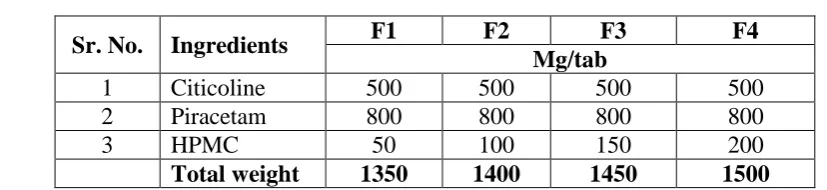
Different polymers were tired after that hydrophilic polymer HPMC was selected. Formula
for trial batches F1-F4 of tablet formulation is shown in Table 2.
Table. 2: Tablet formula for different batches.
Sr. No. Ingredients F1 F2 F3 F4
Mg/tab
1 Citicoline 500 500 500 500
2 Piracetam 800 800 800 800
3 HPMC 50 100 150 200
Total weight 1350 1400 1450 1500
SEM Study: Prepared taste masking granules of Piracetam was evaluated for coating of
HPMC by SEM study. It was observed that polymer coating achieved on Piracetam drug
particle, which can be clearly indicating in SEM study. SEM for Piracetam pure drug and
[image:6.595.80.494.543.638.2]Fig. 4: SEM images for A) Piracetam pure drug and B) coated granule of Piracetam. DSC Study.
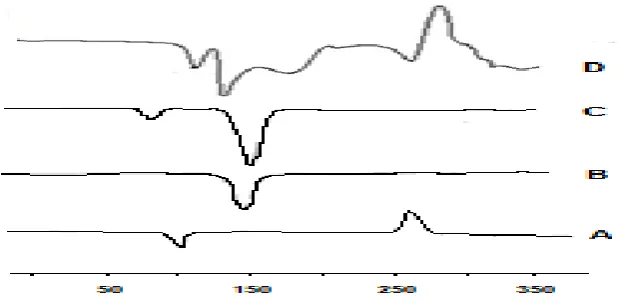
From the results of DSC it was found that at the endothermic peak at 109°c and exothermic
peak at 273°c in DSC of Citicoline and endothermic at 1500c in Piracetam coated granules of
Piracetam. Same peaks were appeared in thermal analysis of formulation which reveals that
there is no interaction with excipient and hence they are compatible with each other.
[image:7.595.137.446.431.583.2]Comparative DSC spectral data is shown in Fig. 5.
Fig. 5: Comparative DSC spectral data A) Pure Citicoline, B) Pure Piracetam, C) film coated granules of Piracetam, D) Tablet formulation.
Table. 3: Interpretation of DSC spectra.
Parameter Citicoline Piracetam Coated Granule Tablet Formulation
Peak(0 c)
Endothermic peak at 109 Exothermic peak at 273
Endothermic peak at 150
Endothermic peak at 109 for
Citicoline,154 for Piracetam
X-ray diffraction study: The result of XRD It was found that sharp and intense peak at
diffraction angle 22.22, 20.50, 22.366, 21.33.For citicoline, piracetam, coated granule, tablet
formulation so it indicates that diffraction peak for the drug and formulation were similar this
indicates that no chemical interaction was found in drug and excipient. Comparative XRD
[image:8.595.143.444.206.334.2]spectral data is shown in Fig. 6 and interpretation given in Table 4.
Fig. 6: Comparative XRD spectral data A) Pure Citicoline, B) Pure Piracetam, C) film
coated granules of Piracetam, D) Tablet formulation.
Table. 4: Interpretation of XRD spectra.
Sample 2Ѳ Intensity(cms)
Citicoline 22.22 260
Piracetam 20.50 258
Coated Granules 22.366 255
Tablet Formulation 21.33 250
Precompression parameters
Precompression composite was evaluated for precompression parameters suitability. From
obtained results it is found that precompression composite passes tests for relative parameter.
Result for Precompression parameters is given in Table 5.
Table. 5: Precompression parameters.
Batch No. Angle of Repose(0c)
Compressibility Index (%)
Hausner’s
Ratio (%) Bulk density Tap Density
F1 21.79±0.62 16.30±0.40 1.1±0.08 1.1±0.13 1.2±0.12
F2 20.46±0.32 22.18±0.38 2.1±0.03 2.0±0.26 1.3±0.01
F3 22.31±0.07 14.18±0.07 1.3±0.01 1.9±0.11 1.4±0.03
[image:8.595.65.529.633.723.2]Evaluation of tablet formulation
Final tablet formulation was evaluated for various tablet parameters. Results indicate passing
[image:9.595.132.463.323.411.2]of respective parameters. Result for evaluation of Tablet parameters is given in Table 6.
Table. 6: Evaluation of Tablet.
Batch No.
Weight Variation (%)
Thickness (mm)
Friability (%)
Hardness Kg/cm2
Disintegration time (mins)
F1 1.316±0.03 7.36±0.01 0.62±0.04 3.6±0.152 18.05±0.577
F2 1.317±0.04 7.38±0.05 0.68±0.08 3.8±0.452 21.57 ±0.57
F3 1.318±0.02 7.31±0.02 0.57±0.04 3.5±0.102 19.33±0.45
F4 1.316±0.01 7.27±0.03 0.52±0.09 3.4±0.129 20.33±0.48
Drug Content: Results obtained for drug content for F1-F4 formulations is given in Table 7.
Table. 7: Drug content.
In Vitro Dissolution Studies: The in vitro drug release for prepared F4 batch was found to be
97.27% and 99.53% in 40 minutes and for marketed formulation (Strocit plus) was found to
be 97.51% and 97.75%f in 30 minutes for Citicoline and Piracetam respectively.
Comparative cumulative percentage drug release for Citicoline and Piracetam of formulation
F1, F2.F3.F4 and marketed tablet formulation is shown in Fig. 7 and 8, respectively.
[image:9.595.140.458.538.714.2]
Fig. 7: Comparison of cumulative percentage drug release for Citicoline of formulation F1, F2.F3.F4 and marketed tablet formulation.
Batch Drug Content (%)
Citicoline Piracetam
F1 98. 35±0.020 99.69±0.112
F2 98.31±0.018 97.62±0.015
F3 97.21±0.028 98.64±0.020
Fig. 8: Comparison of percentage cumulative drug release for Piracetam of formulation F1, F2.F3.F4, with Marketed Tablet.
Stability study
Three month stability studies were carried out on optimized formulation batch F4, drug
content was estimated from developed assay method. It is observed that there is no significant
difference in the drug content before and after stability studies. F4 formulation was found
stable at room temperatures for a period of 3 months.
Table. 6: Stability study of optimized F4 formulation.
CONCLUSION
Through the research output of extensive experimental work it is being concluded that taste
masking granules of Piracetam was achieved with low cost wet granulation. Direct
compression of coated granule of Piracetam with a Citicoline has reduced the weight of tablet
as compared to weight of marketed tablet. The prepared formulation is superior over the
Batch % Drug release
Citicoline Piracetam F1
At 40 mins
98.35±0.20 99.69±0.12
F2 98.31±0.18 97.62±0.15
F3 97.43±0.28 98.64±0.20
F4 97.27±0.31 97.53±0.26
Marketed Formulation (Strocit Plus) At 30 mins 97.51±0.37 97.75±0.40
Drug content (%)
Initial After 15 days
After 1 month
After 2 month
After 3 month
Citicoline 98.22±0.9 98.45±0.87 98.23±0.85 98.90±0.65 97.2±0.34
marketed available formulation, for selected combination in term of weight reduction and
easy processing for formulation. In this research work different polymers were tried and form
that hydrophilic polymer HPMC was selected. The formulated tablets of all trials were
evaluated for pre-compression and post-compression characteristics all the values were found
to be satisfactory. IR, XRD and DSC studies clearly indicate that there was no drug-excipient
interaction. In-vitro drug release studies were carried out as per USP type II apparatus in
standard dissolution medium for optimized formulation F4 which showed similar drug
release characteristics as that of marked formulation. The cumulative percentage release of
optimized batch was 97.2 and 99.5% for Citicoline and Piracetam at 40 min respectively.
Stability study showed that optimized formulation is stable for conducted study period.
Development of taste masking granule of Piracetam is beneficial in treatment of Alzheimer
disease specially associated with geriatric patients to enhance palatability. Increase in drug
release time is beneficial to reduce frequency of administration and improve patient
compliance.
REFERENCE
1. Jadon NS, Amlan S, Vaidya V, Khemariya P, Subhate S. Taste masking of lornoxicam by
polymer carrier system and formulation of oral disintegrating tablets. Int J Drug Delivery,
2009; 27-31.
2. Kumar RA, Patil MB, Patil SR, Paschapur MS. Development characterization of
melt-in-mouth tablets of haloperidol by sublimation technique. IJPPS, 2009; 2(1): 67-73.
3. Shaikh SA, Khirsagar RV, Quazi AS. Fast disintegrating tablets an overview of
formulation and technology, IJPPS. 2010; 2(3): 9-15.
4. Suhagiya KV, Goyani NA, Gupta NR. Taste masking by ion exchange resin and its new
application A review, Int J Pharm Sci Res., 2010; (1): 22-37.
5. Shaikh SA, Shaikh SS, Shookur MA. Taste masking of Norfloxacin and tinidazole tablet
by coating a development approach.Int J Pharma World Res., 2010; 11-13.
6. Wagh DV, Ghadlinge VS. Taste masking methods and technologies in oral
pharmaceuticals current perspectives, J Pharma Res., 2009; (2): 1049-54.
7. Skoog DA, West DM and Holler FJ. In. Analytical Chemistry An Introduction. 6th Ed.
Saunders College of Publishing Philadelphia. 1994; 1.
8. Conners K. A. A Textbook of Pharmaceutical Analysis.3rd Ed. Wiley-Interscience
9. D’Orlando KJ, Sandage BW Jr., Citicoline (CDPcholine): mechanisms of action and
effects in ischemic brain injury. Neurol Res., 1995; 17: 281-284.
10. Rao AM, Hatcher JF, Dempsey RJ, CDPcholine: neuroprotection in transient forebrain
ischemia of gerbils. J Neurosci Res., 1999; 58: 697-705.
11. Muller WE, Eckert GP, Eckert A, “Piracetam:novelty in a unique mode of action”
Pharmacopsychiatry, 1999; 32(1): 2–9.
12. Grau M, Montero JL, Balasch J, “Effect of Piracetam on electrocardiogram and local
cerebral glucose utilization in the rat”. General pharmacology, 1987; 18(2): 205–11.
13. Michael E Aulton.pharmaceutics the design and manufacture of medicine. 2001; 3rd ed,
423-54.
14. Lanchman L, Herbert A. the theory and practice of industrial pharmacy Mumbai. 3rd ed.
2009; 310-50.
15. Seetman Sc, editor martindale. The complete drug reference. London Pharmaceutical
press, 2002; 33: 273.
16. Sau Lawrence Lee, Andre S. Raw, Lawrence Yu, Dissolution Testing.