NP1600 EFFECT ON CHANGE IN BIOCHEMICAL PARAMETERS IN
TURKEY
Dahmani Fouzia*, Fatima Zahra Milouk, Adnane Remmal
Turkey.
SUMMARY
This study is to investigate the effect of the product on NP1600 changes in biochemical parameters (total cholesterol, triglycerides, urea, creatinine) in female turkeys, like flesh, older than 16 days a total of 40 was divided into 4 groups, half of the animals was pretreated with NP1600 added to the feed, and the other half was treated with antibiotics, antiparasitics and scavengers mycotoxins. Serum concentrations of the parameters studied were found generally higher in the control group, by against these concentrations were greatly decreased in batches added NP1600 compared to lots of added anticoccidial In conclusion, in female turkeys kinds flesh, addition product NP1600 to their diet has a dramatic effect on total cholesterol, triglycerides, creatinine and urea. Objective: To study the effects of NP1600 on the variation in serum biochemical parameters: total cholesterol, triglycerides, creatinine and urea. Methods and Results: 40 female fleshy turkeys were divided into four batches of ten animals, half of the animals were previously treated with NP1600 supplemented with the feed and the other half treated with antibiotics, antiparasitics and Mycotoxin two fixers of treatment lots and two control batches; The addition of NP1600 to the treated batch decreased the rate of biochemical parameters studied in comparison with the batches treated with antibiotics and antiparasitic agents. Conclusion: In turkeys, the addition of NP1600 to their diets had impressive effects on total cholesterol, triglycerides, creatinine and urea. Importance and Impact of the Study: This work is a contribution to develop effective and natural components protecting turkeys against certain pathologies.
KEYWORDS: cholesterol-triglycerides- creatinine- urea - turkey - NP1600.
INTRODUCTION The use of herbal supplements has become very popular as an alternative
Volume 6, Issue 12, 1224-1231. Research Article ISSN 2277– 7105
*Corresponding Author
Dahmani Fouzia
Turkey.
Article Received on 26 August 2017,
Revised on 16 Sep. 2017, Accepted on 07 Oct. 2017
DOI: 10.20959/wjpr201712-9752
Union (EU) ban on the use of antibiotics in animal feed in 2006, essential oils, like other "natural" plant extracts, are undergoing significant development. Vegetable food additives consist of plant groups including herbs, spices and volatile oils (Mueller et al., 2012). Aromatic plant extracts are frequently used because of their anti-hypocholesterolemic and anti-inflammatory activity (Lopez Bote et al., 1998, Craig 1999, Botsoglou et al., 2002, Labban et al., 2014). The effect of essential oils on the health of poultry has dose-related yields (Williams and Rosa 2001). The present study was designed to study the effects of NP1600 on the variation in total cholesterol, triglycerides, creatinine, urea, as compared to coccidiosis in female flesh-type turkeys.
MATERIAL AND METHODS
Experience Animals
A total of 40 female fleshy turkeys were used in this experiment and divided into four batches of ten animals. Half of the animals were previously treated with NP1600 supplemented with the feed and the other half was treated with antibiotics, Antiparasitic agents and mycotoxin scavengers two batches of treatment and two control batches; The addition of NP1600 to the treated batches decreased the level of the biochemical parameters studied.
Blood parameters
Blood samples were taken during the time of slaughter in 10 ml glass dry tubes, the serum was separated by centrifugation and stored at -20 ° C until analysis, serum samples were collected Were analyzed for creatinine, urea, total cholesterol, triglycerides. All biochemical analyzes were performed with commercial kits (R.S. A biosystem).
Statistical analysis
The results of the values obtained for all the studied parameters were entered on Excel and analyzed with the software (SPSS.10.0 program). Values were expressed as mean ± SD. The level of significance used in all tests was p <0.05.
RESULTS
Table 1: Mean concentrations of biochemical parameters tested in treated (1, 3) and
untreated (2.4) batches.
Lots Weight Total Cholesterol Triglycerides Urea Creatinine
Lot1 ** 1,43±73 *** 2,769±0.08 * 1,9±0.52 3,91±0.95 *** 1,68±0,61 Lot 2 690±25 5,15±0.46 4,93±0;95 8,75±2,25 6,56±0,56 Lot 3 *** 318±81,25 ** 8,49±0.90 * 3,08±0.97 16,75±1,25 * 3,87±0.82 Lot 4 720±115 12,27±1,03 5,08±1 19±40 13±3,30
The values represent the mean ± standard deviation. The comparison of the means between the treated batches and the untreated batch is carried out by the Student test according to the SPSS10 software and according to the following meanings:
* P <0.05: the difference is significant ** P <0.01: the difference is very significant
*** P <0.001: the difference is very highly significant.
[image:3.595.183.416.337.515.2]Fig. 1: Cholesterol concentration variation Total as a function of NP1600.
[image:3.595.184.415.551.731.2]Fig. 3: Variation in the concentration of urea According to NP1600.
[image:4.595.179.419.505.675.2]Fig. 4: Variation in creatinine concentration as a function of NP1600.
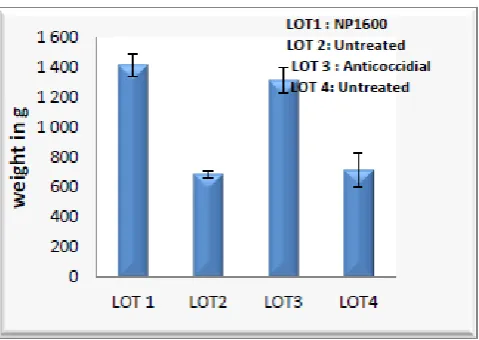
Fig. 5: Variation in weight of turkeys in treated batches And untreated.
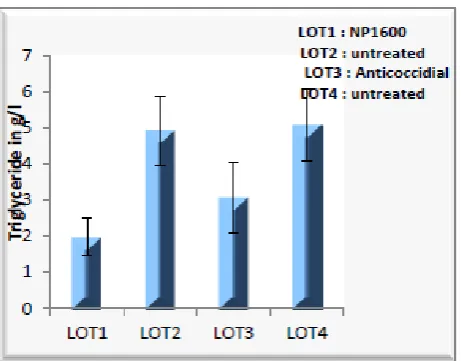
batch treated with the anticoccidial The results are shown in Table 1 and in Graphs 1, 2, 3 and 4. In lot 1 treated with NP1600; Low total cholesterol concentrations (5.15 ± 0.46) (Figure 1), triglycerides (1.9 ± 0.52) (Figure 2), urea (3.91 ± 0.95) (Fig 3), and creatinine (1.68 ± 0.61) (Fig 4), compared to the control batch.
In lot 3 treated with anticoccidia; Low total cholesterol concentrations (8.49 ± 0.90) (Figure 1), triglycerides (3.08 ± 0.97) (Figure 2), urea (16.75 ± 1.25) (Figure 3), creatinine (3.87 ± 0.82) (Figure 4), compared to control batch 4, but these concentrations remain high compared to those observed in the batch treated with NP1600.
Concerning the weight of the turkeys; It increases in the treated batches (1, 3) compared to the untreated batches (2, 4).
The comparison between the batch treated with NP1600 and the control batch revealed a very significant difference in total cholesterol (fig1) and creatinine (Figure 4) and a significant difference in triglyceride (Figure 2). However, no significant differences were found for urea (Figure 3).
The comparison between the batch treated with the anticoccidial agents and the control batch revealed a very significant difference in total cholesterol (lot1) and a significant difference in creatinine (Fig 4) and in triglycerides. However, no significant differences were found for urea (Figure 3).
There was a very significant difference between the treated batches (1 and 4) for total cholesterol and urea and a significant difference for creatinine.
DISCUSSION
In our study, serum concentrations of total cholesterol and triglycerides were higher in the control than in the NP1600 supplemented batch. Thus the addition of NP1600 to the feed decreased the rate of these two biochemical parameters.
cholesterol due to supplementation of thyme seeds. Zargari (2001) showed that high fiber levels of these seeds can increase excretion of bile, which can reduce blood cholesterol levels. Thus, Isa (2011) showed that the significant reduction of cholesterol and triglycerides in the presence of thyme is due to the ability of these substances to decrease these harmful parameters in blood serum; The reduction in triglyceride and cholesterol levels noted by the addition of thyme was attributed to the lowering effect of thymol or carvacrol on HMG-Co A reductase (Lee et al., 2003) which is a key regulatory enzyme Of cholesterol synthesis and therefore the cholesterol-lowering effect (Lee et al., 2004). Crowell, 1999 also showed that the components of pure essential oils can inhibit reductive HMG-CoA.
The significant results obtained in the comparison of the batches treated with NP1600 and the control batch; And the variation in total cholesterol and triglycerides suggests that the addition of NP1600 has a beneficial effect in protecting the vessels against hyperlipidemia (fat deposition). The serum concentrations of urea and creatinine were higher in the control group than in the NP1600 supplemented batches. Thus the addition of NP1600 decreased the level of these two biochemical parameters; By comparison of the control batch and the treated batches; A very highly significant difference was observed for creatinine; This variation suggests that the addition of NP1600 in the turkey diet has a good effect on creatinine decrease and thus to prevent the kidney from kidney failure. Knowing that creatinine is a good marker of renal function; Its realization is carried out routinely by the veterinarians, in particular in the context of the diagnosis, prognosis and follow-up of renal insufficiency, it is used for its exploration without prejudging its origin and its more or less chronic character. In renal insufficiency; The two renal parameters (creatinine and urea) increase in parallel in a staggered manner, the increase in urea being earlier (Grégory, Daniel, Eric Casseleux, 2007) The isolated increase in urea is due to decreased renal perfusion and is often the result of hypovolemia. (Grégory, Daniel, Eric Casseleux, 2007).
Comparison of values of mean concentrations between triglycerides and renal balance revealed a very highly significant difference (p <0.001), thus hypertriglyceridemia increased creatinine and urea levels. Quaschning et al. (2001); Mekki et al reported that, lypertriglyceridemia is a common abnormality during chronic renal failure.
CONCLUSION
values of the concentrations of these parameters in the treated batch compared to the values obtained in the control batch are different and the comparison of these values made it possible to demonstrate the significant effect of NP1600 on the variation of the parameters studied. Our biochemical results are in general consistent with the literature and provide a number of useful indications for the practitioner in current practice.
Thus the positive effects of NP1600 on the variation of biochemical parameters in turkeys can be attributed to biological function or to pharmacological activities also for the interpretation and follow-up of pathological cases which possesses many interesting potentialities to exploit.
BIBLIOGRAPHIC REFERENCE
1. Botsoglou NA, Florou-Panerı P, Chrıstakı E, Fletourıs DJ, and Spaıs AB. Effect of dietary oregano essential oil on performance of chickens and on iron-induced lipid oxidation of breast, thigh and abdominal fat tissues. British Poultry Science, 2002; 43: 223–230.
2. Cabuk M, Eratak S, Alcicek A, and Bozkurt M. Effects of Herbal Essential Oil Mixture as a Dietary Supplement on Egg Production in Quail Hindawi Publishing Corporation.The Scientific World Journal, 2014; 2014: 3.
3. Craig WJ. Health-promoting properties of common herbs. Am. J. Clin. Nutr., 1999; 70: 491-499.
4. Ghazalah AA, and Ali AM. Rosemary leaves as a dietary supplement for growth in broiler chickens. International Journal of Poultry Science, 2008; 7: 234-239.
5. Crowell, P. L. Prevention and therapy of cancer by dietary Monoterpenes. J. Nutr., 1999; 129: 775-778.
6. Darshana B. Bhaisare, D. Thyagarajan, Effect of four herbal seeds on blood parameters in Turhey poults: International Jjournal of Science and Research (IJSR); ISSN (online): 2319- 7064; Impact Factor (2012): 3.358; August 2014; 3(8): www.ijsr.net pp ID: 02015250.
7. Grégory, Daniel, Eric Casseleux, Determination des valeurs usuelles biochimiques et hematologiques du chiot age de zero a huit semaines, 2007.
9. K.W. Lee, H. Everts, H.J Kappert, M. Frehner, R. Losa and A.C. Beynen, “Dietary carvacrol lowers body weight gain but improves feed conversion in broiler chickens”, Journal of Applied Poultry Research, 2003; 12: 394-399.
10.Lee, K.W.; Everts, H. and Beynen, A. C. Essential oils in broilernutrition. Int. J. Poult. Sci., 2004; 3: 738-752.
11.Lopez-Bote LJ, Gray JI, Gomaa EA, Flegal CI. Effect of dietary administration of oil extracts from rosemary and sage on lipid oxidation in broiler meat. Br. Poult. Sci., 1998; 39: 235-240.
12.Mekki K, Bouchenzk M, Remaou M, Belleville J. Effect of long term hemodialysis on plasma lecithin: cholesterol acyltrasferase activity, HDL2, HDL3 amount and composition in patients with chronic renal failure, treated by hemodialysis: a 9 years longitudinal study. Medical science. Monitor, 2004; 10(8): 439-446.
13.Mueller K, Blum NM, Kluge H, Mueller AS. Influence of broccoli extract and various essential oils on performance and expression of xenobiotic- and antioxidant enzymes in broiler chickens. British Journal of Nutrition, 2012; 108: 588-602.
14.H.M. Navid, M.M. Nezhady, “The effect of using Thyme, Garlic and Nettle on performance, carcass quality and blood parameters”, Annals of Biological Research, 2011; 2(4): 315-320.
15.Quaschning T, Krane V, Metzger T, Wanner C. Abnormalities in uremic lipoprotein metabolism and is impact on cardiovascular disease. Am J kidney Dis, 2001; 38(4): 14-9. 16.M. Toghyani, M. Mohammadrezaei, A. Gheisari, S. Ali, Tabeidian and H. Ghalamkarix, “Effect of cocoa and thyme powder alone or in combination on humoral immunity and serum biochemical metabolites of broiler chicks”, 2nd Intl. Conf. Agric. Animal Science, 2011; 22: 114-118.
17.Williams P, Rosa R. The use of essential oil and their compounds in poultry nutrition. World Poult., 2001; 17(4): 14-15.