
www.wjpr.net Vol 7, Issue 08, 2018. 812
MASS SPECTRAL STUDY ON THE FRAGMENTATION OF
3-[2-(3,5-DIMETHYL-1
H
-PYRAZOL-1-YL)THIAZOL-4-YL]-2
H
-CHROMEN-2-ONE BY AM1 METHOD
Kodam Sujatha, Bojja Rajeshwar Rao1 and Vedula Rajeswar Rao*
Department of Chemistry, National Institute of Technology, Warangal-506 004, Telangana
State, India.
1
Senior Chemist (Retired), Chemical Division, Kakatiya Thermal Power Project (O&M),
Chelpur- 506 170, Telangana State, India.
ABSTRACT
The mass spectrum of 3-[2-(3,5-dimethyl-1H
-pyrazol-1-yl)thiazol-4-yl]-2H-chromen-2-one has been studied in the context of correlating
fragmentation pathways with electronic charges of atoms. The atomic
charges were found to be good prediction for evaluating the
fragmentation mechanism and stability of fragments with the electron
bombardment. In this connection, considering an isolated molecular
fragments in the gas phase, which was surrounded by vacuum using
semi-empirical molecular orbital AM1 method, the heats of formation
(∆Hfo), dipole moment (µ), ionization potential (IP), full atomic
charges and energies of frontier molecular orbitals (EHOMO and ELUMO)
have been performed and discussed to evaluate stable fragments.
KEYWORDS: AM1, mass spectrometry, fragments, 3-(2-bromoacetyl)coumarin, thiosemicarbazide, acetylacetone, 3-[2-(3,5-dimethyl-1H-pyrazol-1-yl)thiazol-4-yl]-2H
-chromen-2-one, frontier molecular orbital.
INTRODUCTION
Thiazole with two hetero atoms sulphur and nitrogen at 1,3-positions is found in many
applications[1] such as anti-cancer[2], anti bacterial[3], anti-malarial[4], anti-tubercular[5],
fluorescent dyes.[6] Pyrazole with two nitrogen atoms at 1,2 positions is found a major role as
therapeutic agents[7] such as anti oxidants[8], anti-inflammatory[9], anticancer[10],
SJIF Impact Factor 8.074
Volume 7, Issue 08, 812-821. Research Article ISSN 2277–7105
Article Received on 22 Feb. 2018,
Revised on 14 March 2018, Accepted on 04 April 2018
DOI: 10.20959/wjpr20188-11843
*Corresponding Author
Vedula Rajeswar Rao
Department of Chemistry,
National Institute of
Technology, Warangal-506
004, Telangana State, India.
www.wjpr.net Vol 7, Issue 08, 2018. 813
tubercular[11], anti-diabetic[12] etc. Thus, the combination of thiazole, pyrazole and coumarin
rings have been extensively examined in the 3-[2-(3,5-dimethyl-1H
-pyrazol-1-yl)thiazol-4-yl]-2H-chromen-2-one derivatives for biological activity.[13,14] In continuation of our earlier
work[15, 16] we have synthesized the model compound in one step.
Recently a new approach of analysis of fragmentation processes of organic compounds in
electron impact mass spectrometry has been described to give a good correlation with the
electronic charges of each atom.[17] The fragmentation process has beentaken place mainly at
the level of atoms bearing high negative or positive charges.[18, 19] It has been found that the
AM1 method presents a good reliability.[20, 21, 22] This is prompted us to investigate the
electronic charges of atoms became a valuable data for understanding the fragmentation
processes of 3-[2-(3,5-dimethyl-1H-pyrazol-1-yl)thiazol-4-yl]-2H-chromen-2-one in mass
spectrum. Austin Model-1 (AM1) is one of the semi-empirical quantum calculation methods,
which is based on the MNDO (modified neglect of diatomic overlap) integral approximation,
it includes experimental parameters and extensive simplification of the Schrodinger’s
equation (HΨ=EΨ) to optimize molecules for calculation of various properties to solve
chemical problems.[23-27] In this way quantum chemistry simulates chemical structure and
allows studying chemical phenomena by running calculations on computer rather than by
examining reactions experimentally. Thus, theoretical investigation is considered and
worthwhile to study the fragmentation process of 3-[2-(3,5-dimethyl-1H
-pyrazol-1-yl)thiazol-4-yl]-2H-chromen-2-one with a view to calculate their atomic charges, heats of formation
(∆Hfo), dipole moment (µ), ionization potential (IP), full atomic charges and energies of
frontier molecular orbitals (EHOMO and ELUMO), which are an advantage for investigating the
stability of fragments during the electron impact mass spectrum.
Electronic properties of 3-[2-(3,5-dimethyl-1H-pyrazol-1-yl)thiazol-4-yl]-2H-chromen-2-one
(1) in gas phase usually considering isolated molecules which was surrounded by vacuum
and it has been evaluated by AM1 method. From the obtained optimized electronic structure
of 3-[2-(3,5-dimethyl-1H-pyrazol-1-yl)thiazol-4-yl]-2H-chromen-2-one (1) and its fragments
(2 - 8) which are observed from mass spectrum (Figure-2). The mechanism of fragmentation
processes (Scheme-2 to -6) have been studied by comparison of the relative values of net
www.wjpr.net Vol 7, Issue 08, 2018. 814 Experimental
General procedure of 3-[2-(3,5-dimethyl-1H-pyrazol-1-yl)thiazol-4-yl]-2H
-chromen-2-one[28]
A mixture of 3-(2-bromoacetyl)coumarin (1.33 g, 0.005 mol) and thiosemicarbazide (0.45 g,
0.005 mol) was taken in 10 ml of acetylacetone and stirred for 5 minutes at room
temperature. The solid separated was filtered, washed with ether to remove excess of
acetylacetone and crystallised from benzene. Yield (90%), m.p. 220-222oC [Found C, 63.15;
H, 4.02; N, 13.00; S, 9.91. C17H13N3O2S requires C, 63.16; H, 4.02; N, 13.00; S, 9.91%].
[image:3.595.142.452.407.602.2]Scheme-1: Synthesis of 3-[2-(3,5-dimethyl-1H-pyrazol-1-yl)thiazol-4-yl]-2H -chromen-2-one.
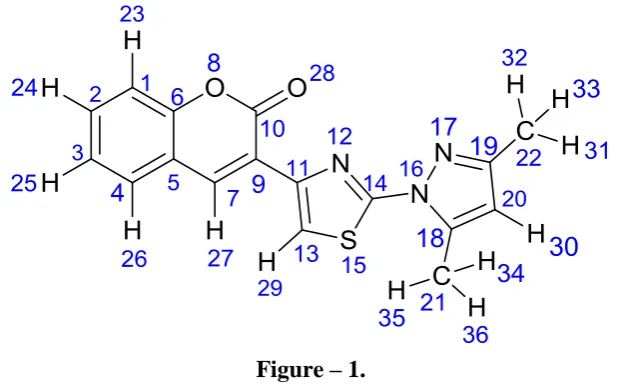
Figure – 1.
Mass spectrum
The mass spectrum was obtained by electron impact mass spectrometry (EIMS) on a
www.wjpr.net Vol 7, Issue 08, 2018. 815 Figure 2: Mass spectrum of 3-[2-(3,5-dimethyl-1H-pyrazol-1-yl)thiazol-4-yl]-2H -chromen-2-one.
Computational methods[23,24]
Semi-empirical molecular orbital calculations were performed on the fragments as shown in
Scheme-2, 3, 4, 5 & 6 using the MOPAC93 in WinMOPAC ver 5.13 program by means of
Intel Dualcore D102GGC2 DDR2 1GB SDRAM PC. The Austin Model 1 (AM1) method is a
modification of MNDO, offering more accurate parameterizations for polar systems and
transition states. Geometry calculations in the ground state (keywords: PRECISE, equivalent
to GNORM= 1.0, CHARGE, GEO-OK, and MMOK to correct the increase in the barrier to
rotation of the amide linkage) were completely optimized until the lowest energy was found.
The position of the atom in the molecule is mentioned as subscript shown in Figure- 1.
RESULTS AND DISCUSSION
Electronic structure of 3-(2-(3,5-dimethyl-1H-pyrazol-1-yl)thiazol-4-yl)-2H -chromen-2-one (1) and its fragments (2 to 8)
The mass spectrum is a record of the masses and relative abundances of the molecular ion
and fragments formed with electron bombardment. The relative intensity of an ion peak
depends on its rates of formation and rates of fragmentation. The optimized electronic
structure of 3-(2-(3,5-dimethyl-1H-pyrazol-1-yl)thiazol-4-yl)-2H-chromen-2-one (1) and its
[image:4.595.87.501.67.363.2]www.wjpr.net Vol 7, Issue 08, 2018. 816
fragments (1 to 8) are presented in Table-I. The heats of formation (∆Hfo), ionization
potential (IP), dipole moment (µ), the energies of frontier molecular orbitals (EHOMO and
ELUMO) are presented in Table-II.
The calculated values of frontier orbital energies (EHOMO and ELUMO) reveal that hardness of
molecules 1 to 8 are investigated in the order of 6 < 2 < 3 < 1 < 5 < 4 < 7 < 8 as per electron
excitation energies (Table-II). The promotion of an electron from HOMO to LUMO, in a
photochemical reaction, the supra-facial path way may be allowed in the case of molecules 1
to 8, due to the presence of same sign.[29] The dipole moment of molecules depends on the
nature of the atoms and bonds comprising the molecules and on their arrangement. The
dipole moment is increasing in the order of 1 < 2 < 5 < 8 < 6 < 4 < 7 < 3. Fragment (3) shows
higher dipole moment. The electronegative hetero-atoms cause displacement of electrons that
induces an additional dipole moment in the molecule. According to the heat of formation
(∆Hfo) data, the stability of fragments have decreased in the order of 4 > 3 > 1 > 5 > 6 > 2 > 7
> 8.
Formation of molecular ion (1), m/z 323
The m/z ratio of molecular ion of the 3-[2-(3,5-dimethyl-1H-pyrazol-1-yl)thiazol-4-yl]-2H
-chromen-2-one (1) is in good agreement with the expected molecular weight is an indication
of the stability of the parent ion. According to the different charges of atoms, the most
probable point of electron may be removed from the oxygen atom (O28). The significant
fragmentation processes have been investigated the most important base peak with relative
abundance of 100%.
Formation of the fragment (2), m/z 295
The fragmentation process has been shown with the elimination of CO group bearing C9 and
O8 atoms in the formation of fragment (2) as per Scheme-2. It is found with relative
abundance of 3.2%.
www.wjpr.net Vol 7, Issue 08, 2018. 817 Formation of the fragment (3), m/z 282
This fragment (3) had been observed with the elimination of CH3-CN group with
rearrangement as shown in Scheme-3 from parent molecule. It is found with the relative
abundance of 4.2%.
Scheme-3
Splitting of the parent ion (1)
This fragments 4, (m/z 202) and 5 (m/z 121) are formed by direct splitting at C14-S15 and C11
-N12 bonds of parent ion (1) due to the difference of charges. The fragmentation process has
been given as per Scheme-4 with simultaneous rearrangement. It is also observed that
fragment (4) is more stable than molecular ion as per ΔHf values. But it is formed with equal
3.2% relative abundance.
Scheme-4
Formation of the fragment (6), m/z 254
This fragment, 6 (m/z 254) is formed by expulsion of CH3-CN group with simultaneous
rearrangement from the fragment 2, (m/z 295). The fragmentation process has been agreed as per Scheme-5. It is also observed that fragment is more stable as per ΔHf values with 2.5%
relative abundance.
www.wjpr.net Vol 7, Issue 08, 2018. 818 Splitting of the fragment (3), m/z 282
The splitting of fragment 3 is investigated by breaking of bond between C9 and C11 atoms,
due to different charges -0.1220 and +0.0421 respectively on adjacent atoms. The
fragmentation process has been given as per Scheme-6. It is also observed that fragments (7
and 8) are less stable as per ΔHf values.
Scheme – 6.
Table I: Atomic charges on Carbon, Sulphur, Nitrogen and Oxygen atoms of
3-[2-(3,5-dimethyl-1H-pyrazol-1-yl)thiazol-4-yl]-2H-chromen-2-one (1) and its fragments (2 to 8) from AM1 calculations.
Atoms* 1 2 3 4 5 6 7 8
C1 -0.1490 -0.1266 -0.1470 -0.1425 - - -0.1229 -0.1089 - -
C2 -0.0814 -0.1087 -0.0774 -0.0914 - - -0.1057 -0.0215 - -
C3 -0.1584 -0.1518 -0.1571 -0.1511 - - -0.1474 -0.1220 - -
C4 -0.0668 -0.0772 -0.0686 -0.0885 - - -0.0785 -0.0306 - -
C5 -0.1451 -0.1004 -0.1462 -0.0791 - - -0.0961 -0.1557 - -
C6 +0.1046 +0.0232 +0.1089 +0.1042 - - +0.0239 +0.0743 - -
C7 +0.0070 -0.1304 -0.0054 -0.2893 - - -0.1516 +0.0412 - -
C9 -0.1124 +0.0451 -0.1220 -0.1921 - - +0.0426 +0.1760 - -
C10 +0.3483 - - +0.3447 +0.3754 - - - - +0.3610 - -
C11 -0.0255 - - +0.0421 -0.0774 - - - - - - +0.2616
C13 -0.4530 - - -0.4428 -0.4622 - - - - - - -0.6134
C14 -0.1245 - - -0.2887 - - +0.0058 - - - - -0.5358
C18 -0.0566 - - -0.1254 - - -0.0136 - - - - -0.0965
C19 -0.1064 - - - - - - -0.0866 - - - - -
C20 -0.2154 - - 0.1254 - - -0.2246 - - - - +0.0443
C21 -0.1756 -0.1755 -0.1406 - - -0.1708 -0.1412 - - -0.1714
C22 -0.1471 -0.1476 - - - - -0.1518 - - - - -
S15 +0.5094 +0.5060 +0.5819 +0.6390 - - +0.5883 - - +1.2920
N12 -0.1016 -0.0813 -0.0863 - - - - -0.0867 - - -0.1785
N16 -0.0707 -0.0724 -0.0983 - - - - -0.0978 - - +0.1195
N17 -0.0284 -0.0238 - - - - - - - - - - - -
O8 -0.1845 -0.1149 -0.1822 -0.1909 - - -0.1101 -0.1279 - -
O28 -0.3021 - - -0.2826 -0.2889 - - - - -0.1061 - -
www.wjpr.net Vol 7, Issue 08, 2018. 819 Table –II: Heat of formation (∆Hfo in kcal/mol), dipole moment (µ in Debye), energies of frontier molecular orbitals (in eV) Electron excitation energy (eV) and Ionization
potential (eV) of 3-[2-(3,5-dimethyl-1H-pyrazol-1-yl)thiazol-4-yl]-2H-chromen-2-one (1) and its fragments (2 to 8) from AM1 calculation along with observed molecular weight (m/z) and relative abundance (%) from mass spectrum.
Parameters 1 2 3 4 5 6 7 8
∆Hfo (kcal/mol) 85.0543 138.3421 57.6384 -13.2305 102.4750 108.2446 251.9622 338.6579
µ (Debye) 2.2607 3.2051 7.0182 5.1290 3.6932 3.9199 5.4547 3.8072
EHOMO (eV) -8.660 -8.440 -8.239 -9.078 -9.975 -8.194 -14.258 -14.024
ELUMO (eV) -1.142 -0.871 -1.474 -1.139 -0.114 -0.991 -8.274 -7.699
Electron excitation
energy (eV) 9.802 9.311 9.713 10.217 10.089 9.185 22.532 21.723
IP (eV) 8.6601 8.4399 8.2392 9.0777 9.9746 8.1941 14.2584 14.0236
Molecular weight 323.369 295.358 282.316 202.227 121.141 254.306 145.137 137.179
*m/z values 323 295 282 202 121 254 145 137
*Relative
abundance (%) 100 3.2 4.2 3.2 3.2 2.5 11.2 2.5
*Measured from mass spectrometry as per Figure-2.
CONCLUSION
We have successfully synthesized a facile
3-[2-(3,5—Dimethyl-1H-pyrazol-1yl)-4-thiazolyl]-2H-1-benzopyran-2-one derivatives via one pot multi component approach under solvent free
reaction conditions. The method had the advantages of mild reaction conditions, simple
procedure and better yields. Mass spectrometry is an useful tool for the prediction of the
fragmentation process in 3-[2-(3,5-dimethyl-1H-pyrazol-1-yl)thiazol-4-yl]-2H
-chromen-2-one. It has been considered AM1 semi-empirical method for understanding and explaining of
all fragments obtained from the target compound. The correlation between atomic charges
and fragmentation process of the molecule had been found to be very appropriate. The utility
of theoretical predictions is important for evaluating the fragmentation mechanism and
stability of fragments with electron bombardment.
ACKNOWLEDGEMENTS
This research work has been carried out with the encouragement of Director, National
Institute of Technology, Warangal-506004, Telangana, India for providing the research
facilities and one of the authors (Kodam Sujatha) is more thankful to the MHRD, India for
www.wjpr.net Vol 7, Issue 08, 2018. 820 REFERENCES
1. M. V. Nora De Souza. Journal of Sulfur Chemistry, 2005; 26: 4-5, 429-449.
2. S. Zheng, Q. Zhong, Q. Jiang, M. Madhusoodanan, Q. Zhang, N. Zhu, M. E. Burow, R.
A. Worthylake, G. Wang. ACS Med. Chem. Lett, 2013; 4(2): 191-196.
3. M. Khalil, M. A. Berghot, M. A. Gouda. Eur. J. Med. Chem, 2009; 44: 4434-4440.
4. D. G. Cabrera, F. Douelle, T. S. Feng, A. T. Nchinda, Y. Younist, K. L. White, Q. Wu, E.
Ryan, J. N. Burrows, D. Waterson, M. J. Witty, S. Wittlin, S. A. Charman, K. Chibale. J.
Med. Chem, 2011; 54(21): 7713-7719.
5. X. Lu, X. Liu, B. Wan, S. G. Franzblau, L. Chen, C. Zhou, Q. You. Eur. J. Med. Chem,
2012; 49: 164-171.
6. V. C. Rucker, S. Foister, C. Melander, P. B. Dervan. J. Am. Chem. Soc, 2003; 125(5):
1195-1202.
7. M. J. Naim, O. Alam, F. Nawaz, Md. J. Alam, P. Alam. J Pharm Bioallied Sci., 2016;
8(1): 2-17.
8. Padmaja, T. Pavani, G. Dinneswara Reddy, V. Padmavathi. Eur. J. Med. Chem, 2009; 44:
4557-4566.
9. A. Bekhit, T. Abdel-Aziem. Bioorg. Med. Chem, 2004; 12: 1935-1945.
10.S. Chauhan, S. Paliwal, R. Chauhan. Synth. Commun, 2014; 44: 1333-1374.
11.Z. Xu, C. Gao, Q. C. Ren, X. F. Song, L. S. Feng, Z. Sheng LV. Eur. J. Med. Chem,
2017; 139: 429-440.
12.H. M. Faidallah, M. M. Al-Mohammadi, K. A. Alamry, K. A. Khan. J Enzyme Inhib Med
Chem, 2016; 31(S1): 157-163.
13.H. A. El-Wahab, M. A. El-Fattah, N. A. El-Khalik, H. S. Nassar, M. M. Abdelall. Proress
in Organic Coatings, 2014; 77: 1506-1511.
14.K. Karrouchi, S. Radi, Y. Ramli, J. Taoufik, Y. N. Mabkhot, F. A. Al-aizari, M. Ansar.
Molecules, 2018; 23: 134.
15.P. Vijaya Kumar, K. Manohar Reddy, V. Rajeswar Rao. Indian. J. Chem, 2010; 49B:
836-839.
16.P. Santhosh, V. Rajeswar Rao. Synth. Commun, 2012; 42: 3395-3402.
17.Cisse L, Tine A, Kabore L, Saba A, Spectrosc let, 2009; 42: 95-99.
18.Cisse L, Kabore L, Tine A, Saba A, Bull Chem Soc Ethiopia, 2010; 24(2): 305.
19.Cisse L, Kabore L, Saba A, Tine A, Phys Chem News, 2010; 53: 101.
20.Djande A, Sessouma B, Cisse L, Kabore L, Bayo K, Tine A, Saba A, Res J Chem Sci,
www.wjpr.net Vol 7, Issue 08, 2018. 821
21.Djande A, Sessouma S, Kini FB, Kabore L, Karifa B, Guissou PI, Saba A, Bull Chem Soc
Ethiop, 2012; 26(2): 311-318.
22.P. Kavitha, B. Rajeshwar Rao, V. Ravinder, Int J Pharm & Chem Sci, 2014; 3(3):
714-720. www.ijpcsonline.com
23.M. J. S. Dewar, E. G. Zeobisch, E. F. Healy, J. J. P. Stewart, J Am Chem Soc, 1985; 107:
3902-3909.
24.J.J.P. Stewart, MOPAC, A general molecular orbital package, QCPE 455, 5th edn, 1988.
25.B.P. Coppola, Chem Educator, 1997; 2(2): 1-8. Springer-verlag New York, INC.
26.J.A. Pople, D.L. Beveridge, Approximate molecular orbital theory, Mc Graw-Hill, New
York, 1970.
27.Fleming I, Frontier Orbital and Organic Chemical Reactions, Wiley-Interscience, New
York, 1976.
28.V. Rajeswar Rao, K. Srimanth. J. Chem. Research (S), 2002; 9: 420-421.
29.Woodward RB, Hoffmann R, The conservation of orbital symmetry, (Academic press,
![Figure 2: Mass spectrum of 3-[2-(3,5-dimethyl-1H-pyrazol-1-yl)thiazol-4-yl]-2H-](https://thumb-us.123doks.com/thumbv2/123dok_us/857152.596810/4.595.87.501.67.363/figure-mass-spectrum-of-dimethyl-h-pyrazol-thiazol.webp)

