Ubiquitous computing and knowledge management
CROWTHER, P.
Available from Sheffield Hallam University Research Archive (SHURA) at:
http://shura.shu.ac.uk/40/
This document is the author deposited version. You are advised to consult the
publisher's version if you wish to cite from it.
Published version
CROWTHER, P. (2006). Ubiquitous computing and knowledge management.
International journal of knowledge culture and change management, 6 (2), 77-86.
Copyright and re-use policy
See
http://shura.shu.ac.uk/information.html
Ubiquitous Computing and Knowledge
Management
Paul Crowther
INTERNATIONAL JOURNAL OF KNOWLEDGE, CULTURE AND CHANGE MANAGEMENT http://www.Management-Journal.com
First published in 2006 in Melbourne, Australia by Common Ground Publishing Pty Ltd www.CommonGroundPublishing.com.
© 2006 (this paper), the author(s)
© 2006 (selection and editorial matter) Common Ground
Authors are responsible for the accuracy of citations, quotations, diagrams, tables and maps.
All rights reserved. Apart from fair use for the purposes of study, research, criticism or review as permitted under the Copyright Act (Australia), no part of this work may be reproduced without written permission from the publisher. For permissions and other inquiries, please contact <[email protected]>. ISSN: 1447-9524 (print), 1447-9575 (online)
Publisher Site: http://www.Management-Journal.com
The INTERNATIONAL JOURNAL OF KNOWLEDGE, CULTURE AND CHANGE MANAGEMENT is a peer refereed journal. Full papers submitted for publication are refereed by Associate Editors through anonymous referee processes.
Ubiquitous Computing and Knowledge Management
Applications of MOBIlearn
Paul Crowther, Sheffield Hallam University, United Kingdom
Abstract: MOBIlearn is a large European research project to develop a mobile learning system to facilitate formal, non formal and informal learning. The project has two primary objectives: • Develop a methodology for creating mobile learning scenarios and producing learning objects to implement them. • Develop the technology to deliver the learning objects to users via mobile computing devices. This paper will concentrate the MOBIlearn health care domain. One of this applications main objectives is managing and sharing of tacit knowledge. Using the system participants discuss case studies and alternative approaches to speciic problems are evaluated and documented. This is then used and extended in future case studies. In a mobile learning environment, individual health workers can use the system to either advanced their skills, or in a ‘live’ incident, use it for reference and indeed call for backup.
Keywords: m-learning, Knowledge Management, Ubiquitous Computing, Community of Practice
Introduction
T
HIS WORK ISthe MOBIlearn project funded by thebased on experiences from European Framework V IST programme. Learners today want to learn when and where they want, in formal, non-formal and informal ways (Brand et al, 2002). MOBIlearn meets learners’ re-quirements utilising mobile communications and personal computing devices such as a PDA, smart phone or portable computer. In other, words mobile or ubiquitous computing.A key part of the MOBIlearn project is the integ-ration of new technologies in education. It aims at improving access to knowledge for selected target users giving them ubiquitous access to appropriate learning objects (Taylor, 2003). Initially the MO-BIlearn requirements were provided by four scenari-os:
• A visit to an art Gallery;
• Access to training and basic medical knowledge in a hospital;
• A master’s course in business administration; • University orientation for new students
The aim of MOBIlearn is therefore ‘...the creation of a virtual network for the diffusion of knowledge and learning via a mobile environment ... to ... demonstrate the convergence and merging of learning supported by new technology, knowledge manage-ment, and new forms of mobile communication.’ (MOBIlearn 2002, Annex 1, p. 7).
The pedagogic basis of the system is the learner who interacts with a mobile learning portal to access learning objects and participate in online activities.
Each of the test scenarios has its own learning ob-jects. However all these learning objects need to be delivered in a lexible way to a variety of devices (Stone, 2003). For example the interface character-istics of a tablet computer are far different from that of a PDA. One challenge is therefore to deliver the correct interface to a learning object or oblette to the mobile device.
There are a variety of ways of delivering learning objects to devices with differing characteristics in-cluding re-authoring, transcoding and the functional-based object model (Kinshuk and Goh, 2003). Ideally an open standard should be used to allow different content providers to make their material available on mobile devices. The approach taken in MOBIlearn is to use re-authoring where page descriptions are held as XML which is compatible with the standard suggested by Loidl (2005).
The requirements for MOBIlearn were developed using a scenario driven methodology (Beynon-Davies and Holmes, 2002). A scenario was developed for each of the areas mentioned above and the require-ments extracted with speciic attention to those common to all applications. These were documented using a Volere template (Robertson and Robertson, 2001) based database which was accessed by the technical developers.
The technical aspects of MOBIlearn were de-veloped by a widely dispersed team of developers using service oriented architecture. Services were designed to communicate asynchronously using un-stable communication channels (MOBIlearn, 2002). At the centre of the system is the component providing the portal services including a main portal component providing access to the entire system.
INTERNATIONAL JOURNAL OF KNOWLEDGE, CULTURE AND CHANGE MANAGEMENT, VOLUME 6, 2006
This represents the single access point for the user to all the services and learning objects provided by the MOBIlearn system.
This paper concentrates on the knowledge manage-ment applications of the system as illustrated by the health care scenario. The activity where learners are required to evaluate an incident presented visually on their mobile devices will be examined in detail in terms of knowledge management theory.
In the health care domain, learners are encouraged to share practises and discuss possible solutions to problems which they encounter. The contribution of the MOBIlearn systems methodology in encouraging the development of communities of practice and learning organisations will be discussed.
Virtual Communities of Practice
A community of practice has been deined as “... a lexible group of professionals, internally bound by common interests, who interact through interdepend-ent tasks guided by a common purpose thereby em-bodying a store of common knowledge”; (Jubert, 1999: 166). In the health care environment, paramed-ics clearly fall under this deinition. However, when you consider Ellis et al (2003), not all the criteria suggested are strictly met for health care workers, for example, the concept of a voluntary and emergent group of individuals and self regulation. By the nature of the profession, the community cannot be self regulating and it is arguable whether membership is voluntary.
Other criteria are less controversial, for example, mutual sources of gain, shared practices, mutual trust and tacit understanding of common interests and is-sues of concern.
MOBIlearn is primarily about learning. However, core to the methodology is an assumption that users will work in a collaborative way, no matter which scenario is being considered. For an e-learning sys-tem to encourage the formation of a community of practice it is useful to consider the guidelines of Desanctis et al (2003) who suggest collaborative learning should:
• aim for frequent interactions
• foster the technology as a platform for group discourse
• aim for deep discussion (over time)
• recognise the importance of facilitators • recognise the importance of routines • encourage groups to experiment
All of these points relate to features found in MOBIlearn and which encourage the formation of a community of practice. The irst point is particu-larly important as Koh and Kim (2004) reported that the amount of interaction, speciically knowledge sharing, is an indication of the state of health of a community.
Learning
Engagement, learning and transfer are, according to Waight and Stewart (2005), the major outcomes which can be achieved via e-learning. MOBIlearn provides a tool to facilitate collaboration and team-work. It expands on systems such as OTIS (Occupa-tional Therapy Internet School) (Beer et al, 2005) where occupational therapy students from across Europe came together to discuss the practice of their subject in each country. The objective of OTIS was for students to identify similarities and differences in their practices based on a series of case studies.
MOBIlearn provides a framework which can be used in variety of learning situations. It allows a variety of learning styles and can be delivered on mobile computing devices ranging from laptop computers to smart phones. Learners today want to learn when and where they want, in formal, non-formal and innon-formal ways (Brand et al, 2002, Cook and Smith, 2004).
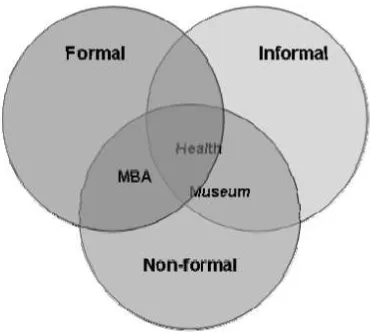
The types of learning, shown in Figure 1, are characterised by the following attributes:
• Formal
Mandatory participation •
• Objectives and means controlled by a facilit-ator
• Non-formal
Voluntary participation •
• Objectives controlled by learners • Means controlled by a facilitator • Informal
Grows out of spontaneous situations •
• Objectives and means controlled by learners • There may be a facilitator who may provide
some content and moderation
Figure 1: Learning and the Position of the MOBIlearn Scenarios
The Health Care Scenario
Harun (2002) states that there is a constant need to rapidly train employees and update their skills in all types of working environments, and especially in the healthcare environment. It is further stated that e-learning and knowledge management are core to achieving this. Young (2003) provides the example of e-learning to improve leadership skills among nurses. The majority of nurses preferred engaging with material at home and over the internet in their own time and own pace. A survey of the nurses suggested a high percentage had applied the know-ledge they had gained. MOBIlearn aims to develop skills by providing ubiquitous access to learning so a health care worker can learn when and where it suits them.
The health care scenario is a non-formal learning environment where a community of practice is being encouraged. The system is designed to deliver a variety of content ranging from reference material to training case studies which can then be discussed and developed. Learning has no start or end point and new members can join (and leave) at any time, however it may be a condition of employment that
staff engage with the activities as part of their con-tinuing professional development. As already stated, this does contradict some of Ellis et al’s (2003) cri-teria for a community of practice, speciically a vol-untary and emergent group. However, if staff mem-bers engage with the learning environment, a virtual community of practice could develop meeting other criteria including a mutual source of gain. Users are motivated by their own interests as well as the organ-isations interests (Cook and Smith, 2004). It is an example of a sponsored community.
Within the health care scenario, a quiz game, visualisation activity, enactment and self-evaluation were all required as well as the more generic require-ments of the MOBIlearn system as a whole. Figure 2 shows a use case diagram, a UML (Uniied Mod-elling Language (Rumbaugh et al (1999)) model which documents user requirements for the health care scenario. Some of these were common to the other scenarios. The health care requirements could be grouped into the following categories with the associated learning types described earlier
• Connect to the system
• Collaborate (informal, non formal) • Manage Material (informal)
• Case Study Scenarios (non formal, formal)
[image:7.595.76.504.81.458.2]• Quiz Management (non formal, formal) • Locate assistance
Figure 2: Use Case Diagram of the Health Care Scenario
Therefore, although primarily a non-formal learning environment, the health care scenario has elements of both formal and informal learning associated with it. There are basic proiciencies, skills and responses to situations which must be learned. These can be delivered by the quiz and the evaluation of a case study. Using criteria based assessment, a health worker could improve their certiication. This is formal learning and will need to be validated by ap-propriate professional bodies if it is to be used as such.
There is also an informal component where health workers with particular interests could develop their knowledge in a more spontaneous and unstructured way. Again individuals and groups could develop a knowledge base in a speciic type of case study rather than a broad range.
The system also allows reference material to be created and managed. For example a user can call up instructions on how to deal with minor wounds. The template used for detailing the procedure is illus-trated in igure 3.
Material developed as part of the discussions of the visualisation case study, described in detail below, could become part of the reference material after discussion and validation. If this was the case it could be described using the template and added to the system.
An Example of a Case Study
One of the activities in the scenario is ‘visualisation’, or as labelled in the use case diagram, ‘Evaluate Scenario’. This is designed to test a variety of skills of an individuals and teams of individuals. In the requirements scenario it is presented as:
“....Gill receives a picture of a irst aid event. .... The picture is accompanied by a text message asking her to scrutinise the picture, and ile an initial assess-ment ....” (MOBIlearn, 2002, p 17)
Speciically it aims to:
• improve observation and appraisal skills,
• improve decision making under pressure, • encourage learners to examine their response, • facilitate collaboration with other learners.
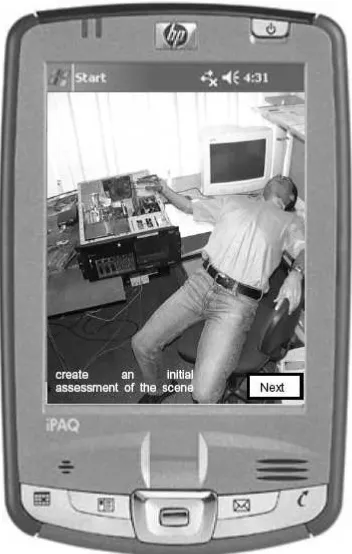
[image:8.595.88.524.85.427.2]An example of how a case study would be presented to a learner is shown in Figure 4 where an incident has been staged. Learners are stepped through the incident and are required to give an as-sessment at each stage. This asas-sessment can then be discussed by other members of the community.
Figure 4 shows the irst of three images in the case study ‘collapse 2’ which involves an incident of a collapsed unconscious IT worker. It was discovered during evaluation that a series of still images was more effective than a video clip for a user to add observations and assessments. Each subsequent im-age shows a relevant section of the case study in close up and allows further assessments to be made and reined. For example, the last image shows, in close up, the victims’ hand is touching the computer frame.
Figure 4: PDA Based Version of the Learning Object ‘Collapse 2
Visualisation case studies were documented using the template illustrated in igure 5. This structure al-lows a case study developer who has no experience in developing web based material to specify require-ments to the content developer along with images which can be used.
Once a team member has completed their assess-ment, other members of the team can comment on
the responses to the scenario revealed that it initially had to be assumed it was a case of electrocution and the environment had to be made safe (if the equip-ment was still ‘live’, a rescuer could be come a second victim by touching the subject). This came about from a discussion on how to determine if the
subject was asleep and the dangers posed by shaking him.
Currently the case studies are created and moder-ated by a supervisor, but learners could be encour-aged to create their own case studies using the visu-alisation case study template.
Learning in a healthcare environment using the visualisation case study is consistent with the models of Nonaka and Tecuchi (1995) and Nonaka et al (2000) where learning is regarded as a transition between individual and group tacit and explicit knowledge. This knowledge is developed as a learning spiral.
MOBIlearn is a system which facilitates this type of learning. Assessment of case studies requires a learner to apply explicit knowledge to a new situ-ation. This may lead to the development of new tacit knowledge in the individual. The discussion phase - socialisation in the model - is the stage where the tacit knowledge is reined and made more explicit. If the case study results in a new procedure accepted by peers and the health care organisation, it can be
added to the system as reference material. For ex-ample, in the case described above, the irst step of any response is to secure the environment by making sure there are no potentially live electrical devices touching a subject. In some environments this could be widened to other hazards, for example gas or chemical spills. The cycle then continues with the new explicit knowledge being applied to new case studies by an individual learner.
innovation. In the visualisation exercise, learners are being exposed to a virtual representation of the physical world as well as virtual social interaction with other learners. The result may be the generation of new knowledge as described above.
Conclusions
The MOBIlearn prototypes objective was to provide effective communication to the learner as they moved around a real scenario. In many ways this could be compared with turning the real world into a virtual reality type of experience. The use of mobile phones and PDAs to communicate meant that learners were fully aware of and familiar with the use of the com-munications facilities from the start and communic-ated freely both to share experiences and to leave comments as they moved around the real environ-ment. So, for example, in the museums scenario this led to what was effectively the sticking of post-it notes with comments on some very well known paintings. These shared views became a major part of the learning experience. The healthcare scenario described in detail in this paper was very much an attempt to guide learners through particular scenarios required by competency programmes aimed at providing conidence in dealing with certain types of situation that a irst aider is likely to ind in the real world. The objective was therefore to deliver the training as it was required, without the learner having to wait for the next available face-to-face course but without loosing the learning associated with the conventional group interactions and peer support.
This paper has concentrated on the knowledge management principles and the facilitation of com-munities of practice embodied in the health care scenario of the MOBIlearn project. Although it is
not possible for management to create a community of practice, MOBIlearn encourages it by providing both a technological infrastructure and a methodo-logy to exploit it by providing templates to create learning objects.
In terms of organisational learning, MOBIlearn provides an infrastructure to facilitate learning con-sistent with both the knowledge spiral of Nonaka et al (2000) and the generative dance between know-ledge and knowing of Cook and Brown(1999). A method of knowledge transfer from individual to organization can be implemented. MOBIlearn also provides a mechanism for individuals to interact with a virtual representation of the physical and social world.
Learning in health care is primarily concerned with non-formal learning but also has elements of formal and informal learning. Central to knowledge creation and sharing is the visualisation of an incident which a learner has to evaluate and then discuss with other learners. This requires the application of exist-ing knowledge, and promotes the generation of new knowledge which can then be added to the reference component of the system. The system therefore facil-itates learning by translation of tacit into explicit knowledge which can then be retained as a reference. Existing knowledge is constantly reviewed as it is applied to the new incident case studies.
Acknowledgements
We acknowledge the EU for inancial support through the MOBIlearn project (IST-2001-37440). The views expressed in this paper are those of the authors and may not represent the views of the EU. We would speciically like to acknowledge Mr Terry Keefe, one of the MOBIlearn team, who developed the content for the health care scenario.
References
Beer, M, Slack, F. and Armitt, G., (2005), ‘Collaboration and teamwork: Immersion and presence in an Online Learning Environment’,Information Systems Frontiers, Vol. 7 (1), pp. 27- 35.
Beynon-Davies, P. and Holmes, S., (2002), ‘Design breakdowns, scenarios and rapid application development’,Information and Software Technology, Vol. 44, pp. 579–592.
Brand, O., Petrak, L. and Zitterbart, M. (2002), ‘Support for Mobile learners in Distributed Space’, Learning Lab Lower Saxony (L3S), accessed on 11/07/03, www.learninglab.de/~brand/Publications/elearn02.pdf
Cook, J. and Smith, M., (2004), ‘Beyond formal learning: Informal community eLearning’,Computers and Education, Vol. 43, pp. 35-37.
Cook, S. D. N. and Brown, J.S., (1999), ‘The Generative Dance between Organizational Knowledge and Organizational Knowing’,Organization Science, Vol. 10(4), pp 381-400.
Desanctis, G., Fayard, A-L., Roach, M. and Jiang, L. (2003), ‘Learning in Online Forums’,European Management Journal, Vol. 21(5), pp. 565 - 577.
Ellis, D., Oldridge, R. and Vasconcelos, A., (2003), ‘Community and Virtual Community’, In Cronin, B. (Ed.)Annual Review of Information Science and Technology, Vol. 37, pp.145-146.
Fernandes, K. J., Raja, V. And Austin, S. (2005), ‘Portals as a knowledge repository and transfer tool – VIZCon case study’. Technovation, Vol. 25, 1281-1289.
Jubert, A., (1999), ‘Developing an infrastructure for communities of practice: the Siemens experience’.Proceedings of the 3rd International Online Information Meeting, Online Information 99. London. pp 165 - 158.
Kambourakis, G., Kontoni, D. N., Rouskas, A. and Gritzalis, S. (in press), ‘A PKI approach for deploying modern secure distributed e-learning and m-learning environments’ [electronic version].Computers and Education.
Kinshuk and Goh, T., (2003), ‘Mobile Adaptation with Multiple Representation Approach as Educational Pedagogy’, Pro-ceedings of Wirtschaftsinformatik 2003 - Medien - Markte - Mobilitat, Heidelberg, Germany. pp.747 - 763. Koh, J. and Kim, Y. -G., (2004), ‘Knowledge sharing in virtual communities: an e-business perspective’,Expert Systems
with Applications, Vol. 26, pp. 155-166.
Loidl, S., (2005), ‘Towards pervasive learning: WeLearn.Mobile. A CPS package viewer for handhelds’,Journal of Network and Computer Applications, in press (electronic version available through Elsevier ScienceDirect http://www.sci-encedirect.com )
MOBIlearn (2002), ‘Next Generation paradigms and interfaces for technology supported learning in a mobile environment exploring the potential of ambient intelligence, Annex 1’, Information Society Technologies Program EU Propos-al/Contract: IST-2001-37187.
Nonaka, I, Toyama, R., Konno, N (2000), ‘SECI,Baand leadership: a uniied model of dynamic knowledge creation’,Long Range Planning, Vol. 33(1), pp 5 - 34.
Nonaka, I.; Takeuchi, H. (1995), The Knowledge-Creating Company : How Japanese Companies Create the Dynamics of Innovation. New York: Oxford University Press
Robertson, J. and Robertson, S. (2001).‘Volere: Requirements Speciication Template’, 8thed., Atlantic Systems Guild.
Rumbaugh, J., Jacobson, I. and Booch, G. (1999),The Uniied Modelling Language Reference Manual, Addison Wesley. Stone, A. (2003), ‘Designing Scalable, Effective M-Learning for Multiple Technologies’,Proceedings of MLEARN 2003:
Learning with Mobile Devices, London, United Kingdom. pp. 145 - 153.
Taylor, J. (2003), ‘A Task-centred Approach to Evaluating a mobile Learning Environment for Pedagogical Soundness’, Proceedings of MLEARN 2003; Learning with Mobile Devices, May, London.
Waight, C.L. and Stewart, B.L. (2005), ‘Valuing the adult learner in e-learning: part one - a conceptual model for corporate settings’,The Journal of Workplace Learning,Vol. 17, pp 337 - 345.
Xu, D., Wang, H., and Wang, M., (2005), ‘A Conceptual Model Of Personalised Virtual Learning Environments’,Expert Systems with Applications, Vol. 29, pp 525-534.
Young, K. (2003), ‘Using e-learning to liberate the talents of nurses’,Industrial and Commercial Training, Vol. 35 (4), pp 137-141
About the Author Dr Paul Crowther
I am a principal lecturer in charge of the Information Systems subject group at Shefield Hallam University. My research interests are in knowledge base systems, particularly knowledge acquisition techniques. I have published widely in this ield, particularly the capture and structuring of visual knowledge. Since my move from the University of Tasmania to Shefield Hallam University, I have moved into the area of knowledge management. My most recent work has been associated with the European Union funded MOBIlearn project where I have been involved in requirements analysis and the use of the system as a knowledge management tool.
THE INTERNATIONAL JOURNAL OF KNOWLEDGE, CULTURE AND CHANGE MANAGEMENT
EDITORS
Mary Kalantzis, University of Illinois, Urbana-Champaign, USA. Bill Cope, University of Illinois, Urbana-Champaign, USA.
EDITORIAL ADVISORY BOARD
Verna Allee, Verna Allee Associates, California, USA. Zainal Ariffin, Universiti Sains Malaysia, Penang, Malaysia. Robert Brooks, Monash University, Melbourne, Australia. Bruce Cronin, University of Greenwich, UK.
Rod Dilnutt, William Bethway and Associates, Melbourne, Australia. Judith Ellis, Enterprise Knowledge, Melbourne, Australia.
Andrea Fried, Chemnitz University of Technology, Germany. David Gurteen, Gurteen Knowledge, UK.
David Hakken, University of Indiana, Bloomington, Indiana, USA. Sabine Hoffmann, Macquarie University, Australia.
Stavros Ioannides, Pantion University, Athens, Greece. Margaret Jackson, RMIT University, Melbourne, Australia. Paul James, RMIT University, Melbourne, Australia. Leslie Johnson, University of Greenwich, UK.
Eleni Karantzola, University of the Aegean, Rhodes, Greece. Gerasimos Kouzelis, University of Athens, Greece.
Krishan Kumar, University of Virginia, USA.
Martyn Laycock, University of Greenwich and managingtransitions.net, UK. David Lyon, Queens University, Ontario, Canada.
Bill Martin, RMIT University, Melbourne, Australia.
Pumela Msweli-Mbanga, University of Kwazulu-Natal, South Africa. C Gita Sankaran, Southern Cross University, Australia.
laudia Schmitz, Cenandu Learning Agency, Germany. Kirpal Singh, Singapore Management University, Singapore. Dave Snowden, Cynefin Centre for Organisational Complexity, UK. Chryssi Vitsilakis-Soroniatis, University of the Aegean, Rhodes, Greece.
Please visit the Journal website at http://www.Management-Journal.com for further information: - ABOUT the Journal including Scope and Concerns, Editors, Advisory Board and Associate
Editors
- FOR AUTHORS including Publishing Policy, Submission Guidelines, Peer Review Process and Publishing Agreement
- JOURNAL PROFILE including Statistics/Citations and where the Journal is indexed/abstracted
SUBSCRIPTIONS
The Journal offers individual and institutional subscriptions. For further information please visit
http://ijm.cgpublisher.com/subscriptions.html. Inquiries can be directed to
INQUIRIES