development.
YAPA, Saman T.W.S.
Available from Sheffield Hallam University Research Archive (SHURA) at:
http://shura.shu.ac.uk/20584/
This document is the author deposited version. You are advised to consult the publisher's version if you wish to cite from it.
Published version
YAPA, Saman T.W.S. (2006). A structured approach to rapid simulation model development. Doctoral, Sheffield Hallam University (United Kingdom)..
Copyright and re-use policy
See http://shura.shu.ac.uk/information.html
Return to Learning Centre of issue
Fines are charged at 50p per hour
All rights reserved
INFORMATION TO ALL USERS
The quality of this reproduction is dependent upon the quality of the copy submitted.
In the unlikely event that the author did not send a com plete manuscript and there are missing pages, these will be noted. Also, if material had to be removed,
a note will indicate the deletion.
uest
ProQuest 10701231
Published by ProQuest LLC(2017). Copyright of the Dissertation is held by the Author.
All rights reserved.
This work is protected against unauthorized copying under Title 17, United States C ode Microform Edition © ProQuest LLC.
ProQuest LLC.
789 East Eisenhower Parkway P.O. Box 1346
S. T. W. S. Yapa
A thesis submitted in partial fulfillment of the requirements of Sheffield Hallam University
for the degree of Doctor of Philosophy
A Structured Approach to Rapid Simulation Model Development
By
S. T. W. S. Yapa
This thesis presents a new methodology to accelerate the simulation model development process. Three research strategies were adopted during the research namely; case study, questionnaire survey and literature survey. Investigations done during the research revealed that among the stages within a simulation project life cycle the model development phase is the longest. Results of the case study research and literature review revealed that two major reasons for the lengthiness are the lack of understanding of the system to be simulated between the modeller and the user, and difficulty in programming. Many researchers have tried to accelerate the process mainly by improving the programming efficiency. However it is important to develop a model which represents the actual system to be simulated. Existing approaches to accelerating the simulation model development process do not guarantee that the model developed in a shorter time is the model which represents the actual physical system. Therefore there is a need for a new methodology to develop a model at a shorter time while ensuring that it represents the actual system.
First and foremost, I wish to thank my supervisor, Dr. David Clegg. You have been a great
mentor and a great friend. You provided not only academic guidance but also the support in
solving my personal problems. I would never have finished my studies without your
guidance and support. I am proud to have been able to work with you.
Secondly, I am very thankful to Prof. Terance Perara of Sheffield Hallam University and
Prof. D. Tantrigoda of University of Sri Jayewardenepura, who provided useful ideas in
writing this thesis.
I like to thank all my friends, especially to Sam, Anura Samantilaka and Ruwan, for their
friendship and support.
Finally, I would like to extend my deepest gratitude to my wife Manori, and two daughters
Page
A bstract... i
Acknowledgements... ii
C hapter One: Introduction... 1
1.1 Background of the Study... 1
1.2 Justification for the Research... 2
1.3 Aims and the Objectives of the Research... 2
1.4 Outline of the Thesis... 3
1.5 Summary... 5
C hapter Two: L iterature Review... 6
2.1 Simulation... 6
2.1.1 Types of Simulation...;... 7
2.1.2 Systems and Models... 8
2.2 Stages of a Simulation Project... 10
2.2.1 Model Building... 12
2.3 Simulation Software... 18
2.3.1 Features expecting from a simulation tool... 21
2.4 Summary... 23
C hapter Three: Research D esign... 25
3.1 Research Questions... 25
3.2 Research Philosophy... 27
3.3 Research Approach... 27
3.4 Selection of Research Paradigm... 29
3.5 Research Strategy... 30
3.5.1 E-mail Questionnaire Survey... 30
3.5.2 Case Study Research... 33
3.5.3 Literature Survey... 34
3.6 Development of New Rapid Simulation Model Development Framework 34
3.7 Summary... 34
C hapter Four: Case Study Research... 36
4.1 Background of the Study... 36
4.2 Case Study A... 37
4.3 Case Study B... 38
4.4 Case Study C... 40
4.5 Summary of the Discussions... 42
4.6 Lessons Learned... 49
4.7 Summary... 52
-5.1 Reasons for Lengthening Simulation Model Development Process... 54
5.2 Rapid Simulation Model Development: Current Status... 58
5.2.1 Model Reuse Approach ... 58
5.2.1.1 Model Reuse: Library Driven Approach... 59
5.2.1.2 Model Reuse: Library Driven Plus Knowledge Based Approach... 63
5.2.1.3 Model Reuse: Object Oriented (00) Approach... 65
5.2.2 Integration with Other Packages... 67
5.2.3 Knowledge Based / Artificial Intelligence Approaches... 71
5.3 Review of Existing Rapid Simulation Model Development Approaches 80 5.3.1 Model Reuse ... 80
5.3.2 Library Driven Plus Expert System Approach... 82
5.3.3 Object Oriented Approach... 82
5.3.4 Integration with Other Packages... 83
5.3.5 Knowledge Based/Artificial Intelligence Approach... 83
5.4 Is there a Need for a New Methodology... 84
5.5 Summary... 85
C hapter Six: Results of the Questionnaire Survey... 87
6.1 Questionnaire... 87
6.2 Sample... 89
6.3 Findings... 89
6.4 Discussion... 95
6.5 Summary... 97
C hapter Seven : Software Development Methodologies... 98
7.1 ‘Waterfall’ or Linear Sequential Model... 99
- 7.1.1 Issues in adapting Waterfall Model ... 100
7.2 Rapid Application Development (RAD) Approaches... 102
7.2.1 Rapid Application Development as Proposed by James Martin 104
7.2.2 Dynamic System Development Method (DSDM)... 107
7.2.3 Issues in adapting RAD approach... 109
7.2.4 Tools under RAD Approaches... I ll 7.2.4.1 Prototyping... 112
7.2.4.2 Computer Aided Software Engineering (CASE) Tools... 115
7.3 Summary... 118
C hapter Eight: Development of the New M ethodology... 119
8.1 Direction for a New Framework for Accelerating Simulation Model Development... 119
8.2 Use of Software Development Techniques in Simulation Model Development... 121
-Process... 123
8.3.1 Joint Application Development Tearn... 125
8.3.2 A CASE Tool to Develop Prototypes... 126
8.3.3 Translation of Conceptual Model to Computer Model... 130
8.4 How the Proposed Methodology Accelerates Simulation Model Development Process?... 132
8.5 Validation of the Proposed Methodology... 136
8.5.1 Validation in Computer Science in General... 136
8.5.2 Validation of the Proposed Methodology... 139
8.5.2.1 Case Study... 140
8.5.2.2 Literature Review... 142
8.5.2.3 Expert Opinion... 145
8.6 Summary... 146
Chapter Nine: Presentation of the Rapid Simulation Model Development Tool... 14«
9.1 Structure of the Tool... 148
9.2 Initialization of the System... 149
9.3 Development of the Conceptual Model... 154
9.4 Construction of the Quantitative Model... 157
9.5 Presentation of the Model... 158
9.6 Translation of Conceptual Model into Computer Simulation Model 159 9.7 System requirements... 162
9.8 Summary... 163
Chapter Ten: Discussion and Conclusions... 164
10.1 Conceptual Model Development Tool... 164
10.1.1 Alternative Approaches to Develop the Conceptual Model... 164
10.1.2 Purpose of the Tool... 169
10.1.3 Joint Application Development Approach... 173
10.2 Implications to the Simulation Industry... 175
10.3 Conclusions... 178
10.4 Contribution to the Knowledge... 178
10.5 Further Research... 179
10.6 Summary of the Research... 182
References... 185 Appendix I - Questionnaire on Simulation Model development
Appendix II - Letter to Simulation Experts Appendix III- List of Publications
-Introduction
1.1 Background of the Study
Simulation is one of the most powerful tools available to decision-makers responsible for
the design and operation of complex processes and systems. The Oxford Advanced
Learner’s Dictionary presents a definition suitable for any type of simulation, i.e. either
physical or mathematical, as the deliberate making of certain conditions that could exist in
reality, e.g. in order to study them or leam from them. Computer simulation which is the
discipline within which the present research was conducted is defined as “methods for
studying a wide variety of models of real world systems by numerical evaluation using
software designed to imitate the system’s operations or characteristics, often over time”
(Kelton et al.,1998). According to Robinson (1994) since the 1950s computer simulation
has been used to tackle a range of business problems leading to improvements in efficiency,
reduced costs and increased profitability. Simulation has become an indispensable problem
solving methodology for engineers, designers and mangers in an increasingly competitive
world. Therefore, a large number of research studies are conducted by academics and
practitioners in the field of simulation. Even though many authors/researchers have divided
the simulation process into different stages in different ways, modelling had been identified
as a major step in all cases (e.g. Pidd, 1992; Robinson, 1994; Oakshott, 1997; Mehta, 2000;
Shannon, 2000; Umeda and Jones, 2001). The excessive time and cost needed for the
modelling stage when compared to other stages has made the acceleration of simulation
1.2 Justification for the Research1
The literature suggest that the formulation phase of an abstract model and the construction
phase of a computer-programming model for simulation often involve lengthy and costly
procedures (So and Lew, 1999; Arons, 1999; Son et ah, 2000). Research studies conducted
in both Japan and USA have shown that approximately 40% of the total simulation project
time is spent on model design (Umeda and Jones, 1997; Trybula, 1994). According to
Amico et al. (2000), the length of the development process, which may take years,
compounds the problems of developing a useful simulation model. Any methodology
leading to the acceleration of the simulation model development process not only saves
money and time but also provides more time for experimentation to provide better results
for the client. Therefore it is worthwhile to explore the ways of accelerating the simulation
model development process.
1.3 Aims and the Objectives of the Research
The aim of this research was to examine and propose a methodology for accelerating the
simulation model development process. This led to the formation of the research title
A Structured Approach to Rapid Simulation Model Development
In finding a new approach the following were set as the objectives of the research
1. Identify the factors leading to lengthening the simulation model development
process.
2. Review different rapid simulation model development methods/approaches in order
to identify the strengths, weaknesses and limitations of each of the
method/ approach.
1 Empirical evidence for justification are found in chapter six
-3. Empirically validate the assumptions regarding simulation model development that
were made based on the literature review.
4. Construct a new framework for rapid simulation model development based on the
results of the above three phases.
5. Demonstrate the feasibility of applying the proposed methodology into a real life
simulation project and to draw conclusions.
1.4 Outline of the Thesis
There are eleven chapters in the thesis. Each chapter starts with an introductory paragraph
which briefly explains the contents of the chapter and ends with a summary paragraph
drawing conclusions from the chapter. The contents of each chapter are outlined below.
Chapter One Introduction
This chapter gives an overview of the research and explains the background, justification,
aims and objectives of the research as well as outlining the contents of the thesis.
Chapter Two Literature Review
Concepts which come within the scope of the research are described in detail in this
chapter. Then the simulation project life cycle, simulation model development process and
simulation software are discussed in this chapter.
Chapter Three Research Design
Research questions which were formulated in achieving the objectives stated in section 1.3
are explained in this chapter. Further, research philosophy, approach, paradigm and strategy
Chapter Four Case Study Research
Three case studies carried out during the research are explained in detail in this chapter.
Chapter Five Findings o f the Research
This chapter presents the answers to the research questions which will be formulated in
chapter three. This includes a discussion on the current status of the research on rapid
simulation model development. This discussion identifies a number of approaches proposed
by researchers to accelerate the simulation model development process. Then the strengths
and the weaknesses of the each of the identified approach are discussed in detail. Finally,
this chapter provides the answer to the question “is there a need for a new methodology for
accelerating the simulation model development process?” .
Chapter Six Questionnaire Survey Results
Results of an e-mail questionnaire completed by simulation practitioners and academics in
order to empirically validate the findings of the literature survey are explained in detail in
this chapter.
Chapter Seven Software Development Methodologies
Since a simulation model is also a piece of software, various software development
approaches and techniques are explained as a prelude to identifying a better approach for
simulation model development.
Chapter Eight The New Methodology for Accelerating the Simulation Model
Development process
The new methodology proposed under the present research is explained in detail in this
accelerates the simulation model development process. A detailed discussion on the
validation of the proposed framework is also included into this chapter.
Chapter Nine Presentation o f the Rapid Simulation Model Development Tool
This chapter explains the tool (CASCoMoD) developed to assist the modeller and the user
to develop the conceptual model of the system to be simulated and subsequently translate
the conceptual model into the simulation computer model.
Chapter Ten Discussion and Conclusions
Implementation issues of the proposed methodology and the implications for simulation
software industry are discussed in this chapter. Latter part of the chapter is reserved to
present the conclusions of the research and suggestions for further research on rapid
simulation model development.
1.5 Summary
This chapter presented the background of this study, justification for and the objectives of
the research. A comprehensive survey of literature on relevant concepts is presented in the
Literature Review
The first chapter explained the background of the study, justification for the research, aims
and objectives of the research. This chapter presents the concept of simulation in the
context of the present research. Then different stages of a simulation project in general and
model building, which is the main focus of the research, in particular are discussed. Finally,
the chapter is concluded with a discussion on simulation software.
2.1 Simulation
As mentioned in the first chapter, the Oxford Advanced Learner’s Dictionary defines
simulation as “the deliberate making of certain conditions that could exist in reality, e.g. in
order to study them or learn from them”. In fact, “simulation” is an extremely general term
since the idea applies across many fields, industries and applications (Kelton et al.,1998).
But in the present research, attention was paid on the use of simulation in engineering and
business applications such as manufacturing, health care, business process reengineering,
supply chain management, banking and other service industries. In this context a number of
definitions for simulation can be identified from the literature.
“Simulation refers to a broad collection of methods and applications in mimic the
behaviour of real systems, usually on a computer with appropriate software” (Kelton
et al.,1998).
“The process of designing a model of a real system and conducting experiments with
this model for the purpose of understanding the behaviour of the system and/or
evaluating various strategies for the operation of the system” (Shannon, 1998).
-“Process for exercising mathematical models through simulated time wherein one or
more models can be run with varying values of input parameters to evaluate the
effects of interaction among variables” (IMTI,2000).
Oakshott (1997) quotes two definitions for simulation and recommends the use of the latter
in business-type applications.
“The modelling of a process or system in such a way that the model mimics the
response of the actual system to events that take place over time” (Schriber, 1987).
“The process of designing a model of a real system and conducting experiments with
this model for the purpose of understanding the behaviour of the system and/or
evaluating various strategies for the operation of the system” (Pegden et al.,1995).
From all these definitions it is clear that simulation is about analyzing the behaviour of a
system over the time through imitating that system, by developing a model of the real
system under study. Theoretically, simulation can be carried out manually. However, today
simulation, generally and within the context of this thesis means computer assisted
simulation.
2.1.1 Types of Simulation
There are two main types of simulation namely, discrete event simulation and continues
simulation. If the system to be modelled can be represented by a series of discrete events1,
1 An event is where the state of the system changes instantaneously.
-the method is known as discrete-event simulation (DES). This method assumes that nothing
of interest occurs between these events so simulation time can progress from event to event.
Systems that can be modelled using the discrete approach are generally systems where
queuing mechanisms operate (Oakshott, 1997). Whereas in a continuous model, the state of
the system can change continuously over time (Kelton et al., 1998). Examples are flow of a
fluid into a tank or the cooling of an ingot after it has been removed from a furnace. It is
also possible to have combined discrete-event and continues simulation in one system.
2.1.2 Systems and Models
Computer simulation deals with models of systems (Kelton et al.,1998). According to
Shannon (1998), a system is a group or collection of interrelated elements that cooperate to
accomplish some stated objectives and a model is a representation of a group of objectives
or ideas in some form other than that of the entity itself. Even though the physical models
of a system can be built, only the logical (or mathematical models) are considered in
simulation. A mathematical model is defined as “a set of mathematical and logical
relationships among different elements of the system. In mathematical simulation the
relations of a system are expressed in mathematical formulae, which can be done in two
ways: analytical and numerical. In the case of analytical simulation, the modeller will be
able to derive an optimal simulation, i.e. one single solution for the problem. Maximization
or minimization, for example cost or distance, problems are examples for this type of
problems. Numerical simulation deals with behaviour of systems and not so much with
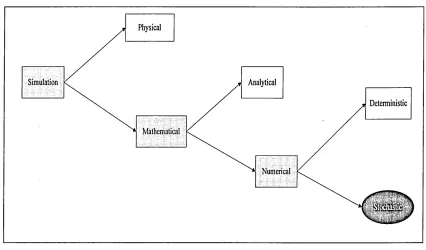
ascertaining optimal solutions. There are two kinds of numerical simulations: Deterministic
and Stochastic. Deterministic numerical simulation entails fixing the values of parameters,
for the variables” (Berends and Romme, 1999) (See Figure 2.1). Simulation is particularly
advantageous when the complexity or operational viability of systems under study renders
the application of purely analytical models impossible (Silva et al., 2000; Khan, 1999).
Physical
Simulation Analytical
Deterministic
Mathematical
[image:18.612.92.518.114.364.2]Numerical
Figure 2.1: Overview of Simulation (Berends and Romme, 1999)
Only the systems which can be represented by network of queues are considered in this
research. Such a system is modelled by studying the flow of entities that move through that
system. These entities can have individual characteristics, which are called attributes. As
the entity flows through the system, it will be processed by a series of resources. For
example in a factory where parts move from one machine to another, parts are the entities
and machines are the resources. Attributes might be things such as name, priority, due date
and account number. Most of the parameters related to such a system such as arrival rate of
parts and processing time in a machine are probabilistic. However, when the probabilities
of parameters become either 0 or 1 depending on the situation, a stochastic system becomes
simulation. However, in real life, most of the systems belonged to the above mentioned
category have probabilistic parameters. Hence, the research is mainly focussed on
stochastic simulation.
In order to analyze the behaviour of a system, it is necessary to build a simulation model
and to conduct experiments by using the built model. It is a lengthy process consisting of
several stages. These stages are explained in detail in the next section.
2.2 Stages of a Simulation Project
According to Banks (2000(a)), simulation is used to describe and analyze the behaviour of
a system and, ask “what if’ questions about the real system, and aid in the design of real
systems. Both existing (as-is) and conceptual systems (to-be) can be modelled with
simulation. According to Banks (2000(b)), simulation is not only a software. It is a multi
disciplinary technique that requires a fair amount of training, skills and experience to
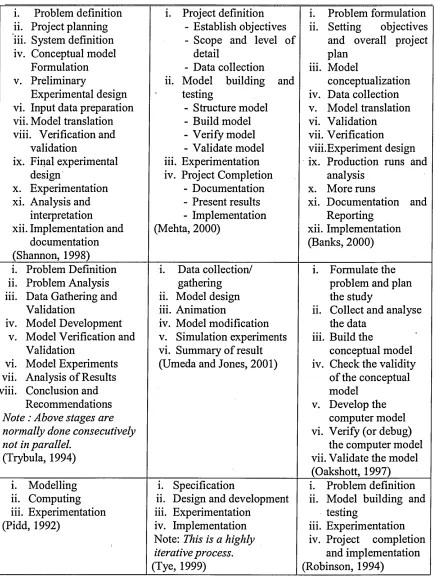
perform effectively. Simulation is a multi-stage process. Many authors have divided this
process into different stages in different ways (see table 2.1). Some argue that each stage
must be carried out in a satisfactory manner before the next stage is started (Oakshott,1997;
Shannon, 1998; Mehta,2000; Banks,2000; Trybula,1994) whilst others argue that
simulation is an iterative process (Robinson, 1994; Tye,1999). For example, as suggested by
Robinson (1994), experimentation may identify some additional issues which alter the
definition of the problem and require further model building before experimentation
continues. According to Son et al. (2000), the degree of difficulty in building models, the
fidelity of the visualization, and the sophistication of the analysis tools vary dramatically.
Consequently, building, running and analyzing a simulation model can be a time-
consuming and error-prone process.
-i. Problem definition ii. Project planning iii. System definition iv. Conceptual model
Formulation v. Preliminary
Experimental design vi. Input data preparation vii. Model translation viii. Verification and
validation
ix. Final experimental design
x. Experimentation xi. Analysis and
interpretation
xii. Implementation and documentation (Shannon, 1998)
i. Project definition - Establish objectives - Scope and level of
detail
- Data collection ii. Model building and
testing
- Structure model - Build model - Verify model - Validate model iii. Experimentation iv. Project Completion
- Documentation - Present results - Implementation (Mehta, 2000)
i. Problem formulation
ii. Setting objectives
and overall project plan
iii. Model
conceptualization iv. Data collection v. Model translation vi. Validation vii. Verification viii.Experiment design
ix. Production runs and
analysis x. More runs
xi. Documentation and Reporting
xii. Implementation (Banks, 2000)
i. Problem Definition ii. Problem Analysis iii. Data Gathering and
Validation
iv. Model Development v. Model Verification and
Validation
vi. Model Experiments vii. Analysis of Results viii. Conclusion and
Recommendations
Note : Above stages are normally done consecutively not in parallel.
(Trybula, 1994)
i. Data collection/ gathering ii. Model design iii. Animation
iv. Model modification v. Simulation experiments vi. Summary of result (Umeda and Jones, 2001)
i. Formulate the problem and plan the study
ii. Collect and analyse the data
iii. Build the
conceptual model iv. Check the validity
of the conceptual model
v. Develop the computer model vi. Verify (or debug)
the computer model vii. Validate the model (Oakshott, 1997) i. Modelling
ii. Computing iii. Experimentation (Pidd, 1992)
i. Specification
ii. Design and development iii. Experimentation
iv. Implementation
Note: This is a highly
iterative process.
(Tye, 1999)
i. Problem definition ii. Model building and
testing
iii. Experimentation iv. Project completion
[image:20.612.92.527.34.615.2]and implementation (Robinson, 1994)
Three major generic steps in a simulation project development process can be identified
among the divisions given in table 2.1; i.e. identification of the problem/ problem
formulation , model building, and experimentation and implementation. Model
building phase, which is the phase under study in the present research, of the simulation
project life cycle is discussed in detail in the next section.
2.2.1 Model Building
Simulation modelling is a practical and yet intellectually challenging activity, one which
benefits from careful thought and planning. As pointed out by Pidd (1996) models should
be developed gradually. If circumstances permit, the best approach is to develop a simple
model and then to collect data to parameterise and test it. It may then be clear that the
simple model is fine for the intended purpose or it may be that the model needs to be
refined.
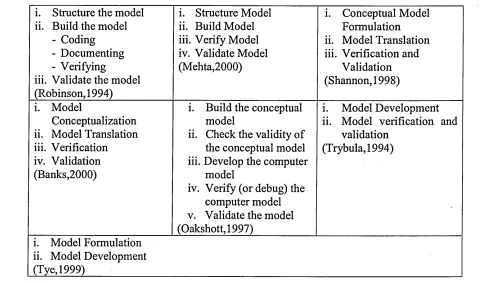
i. Structure the model ii. Build the model
- Coding - Documenting - Verifying
iii. Validate the model (Robinson, 1994)
i. Structure Model ii. Build Model iii. Verify Model iv. Validate Model (Mehta,2000)
i. Conceptual Model Formulation ii. Model Translation iii. Verification and
Validation (Shannon, 1998)
i. Model
Conceptualization ii. Model Translation iii. Verification iv. Validation (Banks,2000)
i. Build the conceptual model
ii. Check the validity of the conceptual model iii. Develop the computer
model
iv. Verify (or debug) the computer model v. Validate the model (Oakshott,1997)
i. Model Development ii. Model verification and
validation (Trybula,1994)
[image:21.612.60.554.381.664.2]i. Model Formulation ii. Model Development (Tye,1999)
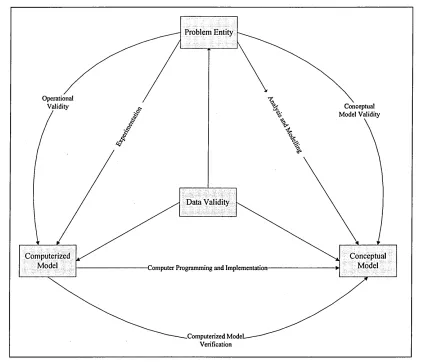
Problem Entity
Operational
Validity Conceptual
Model Validity
Data Validity
Computerized M odel
Conceptual M odel
■Computer Programming and
[image:22.612.85.516.59.421.2]Implementation-.Computerized Model Verification
Figure 2.2: Simplified Version of the Modelling Process (Sargent,2000) .
According to Shannon (1998) what is needed is to design a model of the real system that
neither oversimplifies the system to the point where the model becomes trivial (or worse
misleading) nor carries so much detail that it becomes clumsy and prohibitively expensive
to build and run. Simulation is both an art as well as a science. The programming and
statistical components are the science part and the analysis and modelling components are
the art (Shannon, 1998; Banks, 2000). One of the fatal errors made by a simulationist is
The model building phase of a simulation project has also been sub-divided in to various
stages by different authors (See Table 2.2). Further Sargent (2000) has explained the model
building process by using the diagram as shown in Figure 2.2.
Even though different authors have divided the model building process into between 2-5
stages, basically three generic stages can be identified, namely:
■ Conceptual model building;
■ Computer model building;
■ Model verification and validation.
From Table 2.2 and Figure 2.2, it is apparent that a conceptual model is built before the
computer model is built. A conceptual model is essentially a model where mathematical
and logical relationships are defined (Oakshott,1997; Sargent,2000; Banks,2000).
Conceptual model is seen as a model that is formulated completely independent of any
programming language or simulation language (Arons, 1999). According to Mehta (2000)
it is extremely useful to map out or structure the model on paper before building the model.
The structure or map of the model can help to get an overview of the whole model and map
out any of the complex areas where further investigation is needed. Practitioners are having
the view that many of the pitfalls in the latter stages of the simulation model development
process can be avoided by structuring conceptual model before building it on the computer
(Robinson, 1994; Shannon, 2000; Mehta, 2000).
Once the conceptual model is built, it is translated into the computer model. A
computerized model is the conceptual model implemented on a computer (Sargent, 2000).
The computer model is actually a computer program. As noted by Trybula (1994), if the
14-logic is complex, the modeller may need to develop the model, run the simulation while
tracing the code, and make modifications to the operation of the model.
After building the computer model, it is to be tested to find syntax and logical errors.
According to Shannon (1998), this process is called verification and it gives the answer to
the question “does the model work correctly?”. But validation is the determination that the
model is an accurate representation of the real system. It provides the answer to the
question “does the model behave the way the real world system does or will?”. Debugging
a simulation model that is developed using a simulation language can be tedious and time
consuming (Oakshott, 1997; Sadowski and Grabau,1999; Sargent, 2000). Further it is an
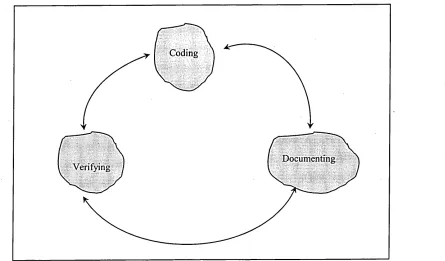
iterative process (Robinson, 1994) (See Figure 2.3). Several versions of a model are usually
developed prior to obtaining a satisfactorily valid model (Sargent, 2000; Oakshott, 1997).
Coding
[image:24.612.80.525.366.627.2]Documenting Verifying
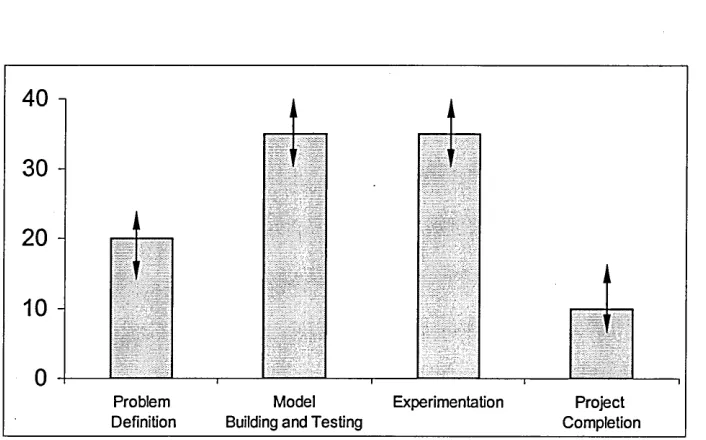
Model building and experimentation are the most time consuming stages of a simulation
project (Robinson, 1994) (see Figure 2.4). According to Sakthivel and Agrawal (1992),
deriving a simulation model from an understanding of the system to be simulated is perhaps
the most complex and time-consuming task of the simulation life-cycle. Other available
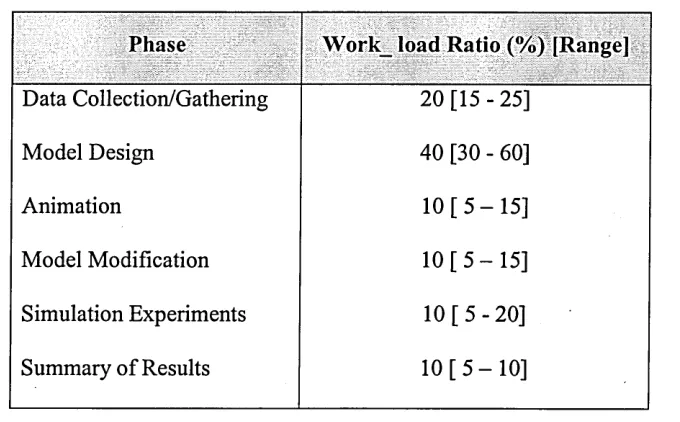
literature also support the above view.(e.g. Trybula, 1994; Umeda and Jones, 2001; Brown
and Powers, 2000; Arons, 1999) (See Tables 2.3 and 2.4).
40 i
30
20 H
10
0
[image:25.612.96.449.197.417.2]Problem Model Experimentation Project Definition Building and Testing Completion
Figure 2.4: Project time -scales : a percentage breakdown(excluding implementation)
(Robinson, 1994).
Therefore it can be argued that model building is a very time consuming phase of the
simulation project development process. However, building a valid simulation model which
represents the actual system is critical for the successfulness of a simulation project. A
large number of tools are available to assist the modeller in developing a simulation model.
Any mechanism that can assist in the development of a simulation model is called a
software which allows the modeller to develop the model and to make experiments. These
software are explained in detail in the next section.
Stage Percentage time
Problem Definition -10%
Problem Analysis -10%
Data Gathering and Validation 10% - 40%
Model Development 10% - 40%
Model Verification and Validation -10%
Model Experiments 10% - 20%
Analysis of Results -10%
Conclusion and Recommendations -5%
Table 2.3: Time requirements for eac
experiences (Trybula, 1994).
i stage of a simulation model based on personnel
Phase Work_ load Ratio (%) [Range]
Data Collection/Gathering 20 [15 - 25]
Model Design 40 [30 - 60]
Animation 10 [ 5 -1 5 ]
Model Modification 10 [5 -1 5 ]
Simulation Experiments 10 [5-20]
Summary of Results 10 [ 5 -1 0 ]
Table 2.4: Time requirements of each stage of a simulation project. Based on a survey
conducted among simulation users in Japan (Umeda and Jones, 2001).
[image:26.612.84.543.81.342.2] [image:26.612.83.423.418.629.2]17-2.3 Simulation Software
As mentioned earlier, computer simulation refers to “methods for studying a wide variety
of models of real world systems by numerical evaluation using software designed to imitate
the system’s operation or characteristics, often over time” (Kelton et ah, 1998). A
simulation model is therefore a computer program which represents the logic of the system
as entities with attributes arrive, join queues to await the assignment of required resources,
are processed by the resources, released and exit the system. According to Shannon (1998),
modellers have three generic choices in formulating the computer simulation model,
namely:
■ Build the model in a general-purpose language
■ Build the model in a general purpose simulation language
■ Use a special purpose simulation package (simulator)
Presently more than fifty different simulation software are available in the market from
various vendors at different prices ranging from starting less than US$50 up to US$48,000
and almost all of them are PC based and Windows compatible (Swain,2001). Independent
economic studies have estimated the size of the manufacturing simulation and visualization
software market in the range of US$650 million (NIST,2000).
Simulation languages allow the user to develop a model by writing a program using the
constructs of the language. Simulators are packages that model a specific class of
application. They are generally menu driven, requiring a user to input data and basic logic
(1994), users of simulation languages are experts, central organizations and regular users
while users of simulators are non-experts, distributed users and occasional users (see Figure
2.5).
Simulators Simulation Languages
Experts Non-Experts
Regular
users usersOccasional
Figure 2.5: Simulation software preferences (Robinson 1994).
The main advantage of using a simulator is that the modeller does not need to spend time
and effort on making models but the flexibility is not as great as the flexibility of a
language. Programming-like commands and interfaces with programming languages are
features which make a simulator flexible. But the distinction between simulators and
simulation languages is blurring. They are moving towards each other by offering special
features (Nikoukaran and Paul, 1999).
General-purpose languages such as FORTRAN, Pascal and C++ have been used by
modellers in developing simulation models in addition to the simulation languages. Some
of the common simulation languages are SIMAN, GPSS, SIMSCRIPT, SLAM and
recent simulation languages and packages have been written in an object-oriented
programming language (Oakshott, 1997).
With the wide spread use of Windows environment in PCs in 1990s graphical user interface
(GUI) entered in to the simulation software. This involved the use of graphical objects or
icons to represent parts of the model. The model could then be developed by linking these
icons together in a logical fashion. They often incorporated a range of functions to assist in
data input and output analysis (Oakshott, 1997). Modem simulation software such as
ARENA and AUTOMOD combine the ease of use of a simulator with the power and
flexibility of a simulation language (Kelton et al., 1998; Rohrer, 2000). A modeller can
develop the model by using the ARENA graphical interface and ARENA generates the
underlying SIMAN model (Takus and Profozich, 1997). However, according to Koh et al.
(1996) simulation modelling still requires a high level of training, expertise and time,
despite the availability of user-friendly simulators with their graphical use interface (GUI)
modelling environment. For more detail and complex modelling, simulation languages are
still preferred over simulators
Modem simulation software have features such as animation, real-time viewing, export
animation (e.g. MPEG version that can ran independent of simulation for presentation)
(Swain, 2001). Animation is a powerful presentation and debugging tool that can greatly
increase model clarity. Animation icons moving from block to block represent the flow of
items through the system. Simulation software such as Arena allows the user to import
graphics from other software such as AutoCAD and allows to link programme modules
Even though simulators have received wide acceptance among simulation users a survey
conducted among academic and industrial simulation users has shown that majority of them
still use simulation languages as well (Hlupic, 2000) . (See Table 2.5).
Type of Software Academics (%) Industrial (%)
Simulators 83.3 55.5
Simulation Languages 61.1 22
Table 2.5: Percentage of different types of simulation software users among academic and
industrial users (Hlupic, 2000).
Another reason for the use of general-purpose languages on simulation model development
may be the high cost of simulation software. For example Arena standard version costs
US$ 13,500, AUTOMOD standard costs US$15,000 and ProModel costs US$ 18,500
(Swain,2001).
2.3.1 Features Expected from Simulation Software
According to Stanford and Graham (1998), until recently, discrete-event simulation tools
were expensive, difficult to use, and limited in use to specialists within large corporations.
However, in the last few years several low-cost (under US$2000) discrete event simulation
products have been introduced targeted for use by a broader range of simulation users than
ever before. These tools take advantage of advances in computer hardware, software
standards, graphical design and ease-of-use. Due to the diversity of simulation users,
2 Simulationists’ current practice of simulation software is shown in chapter six
-different users expect -different features from a piece of simulation software. Some of the
most important features, as suggested by Oakshott (1997), are modelling flexibility (ability
to use the software for any application), ease of use (ability to use a simulation tool with a
minimum of learning time), animation (ability to watch the system being simulated in
graphic detail), general simulation function (handling the generation of random varieties
and specifying warm-up period etc.), statistical functions, interfacing with other software
(such as spreadsheets and scheduling software), product help and support (on-line help,
tips, good user guides etc.), price (inexpensive) and expandability. According to Mehta
(2000), simulation software should provide tools that facilitate flexible modelling, ease of
sharing the simulation efforts and effective utilization of the work already done in the past
thereby avoiding the need of duplication of efforts. Research done among simulation users
in Japan has shown that modelling support tools are considered as the most important
feature when choosing a simulation software. User-friendly, icon-based modelling tools
reduce the time and cost associated with building and maintaining simulation models
(Umeda and Jones,2001).
The main three limitations of the simulation software as identified in user’s surveys
(Hlupic, 1999) are given in table 2.6.
Software limitations - 1992
survey Software * limitations - 1997 survey
Restricted flexibility
Slow
Validation difficulties
Limited standard
features/flexibility
Difficult to learn
Expensive
Table 2.6: Major simulation software limitations (Hlupic, 1999)
-In the same set of researches, when being asked about the success of modelling, 30.8% of
participants in a 1992 survey had declared that they had been able to model desirable
features of the system being modelled, 38.4 % had managed to model most of the features
whilst 30.8% had problems. In a 1997 survey, 51.9% participants had declared that they
had been able to model desirable features of the system being modelled whilst 48.1% had
problems in modelling due to the software limitations and inflexibility (Hlupic, 1999).
In a panel discussion done at the 2000 Winter Simulation Conference on the topic
Simulation In The Future, all 8 panellists (simulation consultants) emphasized the need for
providing more modelling capabilities to users of simulation software. Their suggestions
include tighter integration with other software, web based simulation, library driven
simulation models as well (Banks,2000). So it is clear that there is a greater need for
simulation software which provides efficient and simple methods for developing simulation
models for simulation experts as well as non-simulation experts.
2.4 Sum m ary
Discrete-event simulation is one of the most important tools available to engineers as well
as to managers for analyzing the behaviour of large and complex systems. It is a multi-stage
process and the most important stages of a simulation project are problem identification,
model building, experimentation and implementation. Model building is the most time
consuming phase among those phases. That phase consists of three stages: conceptual
model building; computer model building; validation and verification. In building the
computer model, a user can employ a general-purpose computer language, a simulation
but there is a greater need for simulation software which provides efficient and simple
methods for developing simulation models for simulation experts as well as non-simulation
experts. Research problems formulated to achieve the objectives specified in the first
Research Design
It was necessary to formulate a set of research questions in order to achieve the objectives
specified in the first chapter. Finding the answers to those questions will ultimately enable
the objectives to be fulfilled. It was very important to design the research appropriately to
archive the objectives effectively. A number of methodologies for carrying out research and
relevant concepts are discussed in the contemporary literature on research methods.
However, the effectiveness of the research methodology employed depends on the context
within which the research is carried out. Therefore, it was necessary to study the various
concepts and methodologies before a suitable methodology was selected. Research
questions formulated to achieve the objective stated in the first chapter are explained in the
early part of this chapter. Research methodologies used in the present research are
explained in detail in the latter part of the chapter.
3.1 Research Questions
The main objective of this research was to propose a new framework for rapid simulation
model development. Three research questions were formed in order to achieve this
objective. These three questions and rational behind the formulation of those questions are
described below.
Literature on simulation revealed that model development was the most time consuming
task among the stages of a simulation project life cycle1. In order to accelerate this process
it was necessary to know the reasons for lengthening the model development process.
Research Question 1 was formulated for this purpose. Identification of those factors will
enable the model development process to be accelerated by eliminating those factors or by
reducing the impact of those factors on the model development process.
Question 2 : What are the alternative methods available for accelerating the
simulation model development process ?
Once the above mentioned factors are identified it was necessary to understand the state of
art relating to rapid simulation model development before proposing a new methodology.
Therefore, the objective of this question was to find out different ways of accelerating the
simulation model development process. To find the answer for this question, different
research attempts of acceleration of simulation model development were reviewed.
Question 3 : Is there a need for a new methodology for accelerating the '
simulation model development process? If so, what is it?
It was necessary to critically review the existing approaches to find out whether there was a
need for a completely a new approach. If that is the case, a new framework will be
developed, otherwise improvements to the existing methodologies will be suggested.
1 Results of the questionnaire survey also revealed the same (See chapter six).
-26-Research methodology adopted in finding the answers for above mentioned questions is
explained in detail in the rest of the chapter. However, a detail discussion on theories on
research methodology is beyond the scope of this thesis. Since the present research is more
descriptive in nature it was required to borrow some of the concepts from other fields such
as sociology, medicine and psychology which are the areas where those kind of researches
are frequently carried out. As a prelude to the selection of suitable research paradigm, some
of the relevant concepts are explained briefly in sections 3.2 and 3.3.
3.2 Research Philosophy
According to Saunders et al. (2003) three views about the research process dominate the
literature: positivism, interpretivism and realism. If positivism is adopted the researcher
will prefer working with an observable social reality and that the end product of such law
like generalizations similar to those produced by the physical and natural scientists. There
will be an emphasis on a highly structured methodology to facilitate replication and on
quantifiable observations that lend themselves to statistical analysis. However, if the
objective is to find the details of the situation to understand the reality or perhaps a reality
working behind then the most suitable will be interpretivism. Realism, more related to
social sciences, is based on the belief that a reality exists that is independent of human
thoughts and beliefs.
3.3 Research Approach
According to Saunders et al. (2003) the main research approaches are deductive approach,
a theory and hypothesis (hypotheses) are developed and a research strategy is designed to
a result of data analysis. The following table shows the differences between these two
approaches.
Deduction emphasis Induction emphasis
■ Scientific principles
■ Moving from theory to data
■ The need to explain causal relationships between variables
■ The collection of quantitative data ■ The application of controls to ensure
validity of data
■ The operationalisation of concepts to ensure clarity of definition
■ A highly structured approach
■ Researcher independence of what is being researched
■ The necessity of select samples of sufficient size in order to generalise conclusions
■ Gaining an understanding of the meanings humans attach to events ■ A close understanding of the research
context
■ The collection of qualitative data ■ A more flexible structure to permit
changes to research emphasis as the research progresses
■ A realisation that the researcher is part of the research process
■ Less concern with the need to generalise
Table 3.1: Major differences between deductive and inductive approaches to research
(Saunders et al., 2003)
According to Basili (1996), in the area of software engineering inductive paradigm might
be best used when trying to understand the software process, product, people or
environment. It attempts to extract from the world some form of model which tries to
3.4 Selection of Research Paradigm
The success of a simulation project depends on various factors ranging from technical
issues such as facilities provided by simulation software to organizational issues such as
human interaction and top management commitment. Therefore in order to answer the
research questions mentioned above it was necessary to explore the simulation model
development process thoroughly and to understand the reasons leading to lengthening the
process. Once those factors were identified next stage was to build a new framework, or
theory, for accelerating simulation model development process. Therefore, the nature of
this research was qualitative rather than quantitative. According to Patton (1990) qualitative
methods permit the evaluator to study selected issues in depth and detail. Approaching
fieldwork without being constrained by predetermined categories of analysis contributes to
the depth, openness, and detail of qualitative inquiry. Quantitative methods on the other
hand, require the use of standardized measures so that the varying perspectives and
experiences of people can be fit into a limited number of predetermined response categories
to which numbers are assigned. Qualitative methods typically produce a wealth of detailed
information about a much smaller number of people and cases. This increases
understanding of the cases and situations studied but reduces generalizability. According to
Denzin and Lincoln (1998), Qualitative research is multi method in focus, involving an
interpretive, naturalistic approach to its subject matter. This means that qualitative
researchers study things in their natural settings, attempting to make sense of, or interpret,
phenomena in terms meaning people bring to them. Qualitative research involve the studied
use and collection of a variety of empirical materials-case study, personal experience,
texts-that describe routine and problematic moments and meanings in individual's lives. In this
context the most suitable philosophy for the present research was interpretivism and the
appropriate research approach was induction. Once it was clear on the nature, philosophy
and the approach of the research, next step was to identify the research strategy to be
adopted in the selected paradigm.
3.5 Research Strategy
According to Saunders et al. (2003), some of the available research strategies are
experiment, survey, case study, grounded theory, ethnography, action research, cross
sectional and longitudinal studies and exploratory, descriptive and explanatory studies.
Since the present research is qualitative in nature, and interpretivism and induction were
adopted, it was necessary to select research strategies to reflect those characteristics in
finding answers to the stated research questions. Therefore, the selected strategies were
survey (e-mail questionnaire survey), case study and literature survey.
3.5.1 E-mail Questionnaire Survey
According to Saunders et al. (2003), questionnaires are usually not particularly good for
exploratory or other research that requires large-number of open-ended questions. They can
be used for descriptive or explanatory research. Descriptive research such as that
undertaken using attitude and opinion questionnaire and questionnaires of organizational
practices, will enable the researcher to identify and describe the variability in different
phenomena. The objective of the first research question was to identify the reasons for
to obtain opinion about various statements built based on the literature and to know about
the practices of different simulation practitioners and academics as a prelude for developing
a new methodology for accelerating the simulation model development process. E-mail
was selected against postal as the mode of questionnaire delivery due to three reasons.
Firstly, it is easy to reach a large audience throughout the globe with a e-mail survey. It is
difficult to obtain postal addresses of simulation practitioners and academics, but there are
several simulation user groups which maintain forums for simulation practitioners. In
addition, e-mail directory of attendees of conferences such as Winter Simulation
Conference is available on the web. Secondly, it is cost effective to conduct a e-mail
survey because no postal cost is involved. Thirdly, ‘Reply’ facility in the mail software
encourages the respondents to reply quickly. However, Sheehan and Hoy (1999) argued
that use of ‘reply’ function of their e-mail programmes to return the completed surveys,
write names and e-mail addresses on the electronic message the researcher would receive.
While previous research has indicated that anonymity may have affected response rates
positively, other researchers suggest that the lack of anonymity may not have any effect on
response rates. However, in the present research anonymity is not a major problem as the
questions asked are neither personal nor sensitive. Further, they have identified that a lack
of national directory of e-mail addresses as a limitation of e-mail surveys. But as mentioned
earlier, in the present research it was easier to obtain e-mail addresses than postal addresses
of simulation practitioners. The following table shows the attributes of on-line surveys and
Mode Attribute
On line Postal
Populations
characteristics for which suitable
Computer literate individuals who can be contacted by e-mail or internet
Literate individuals who can be contacted by post
Confidence that right
person has responded High if using e-mail Low
Size of the sample Large, can be geographically dispersed
Likely response rate Variable, 30% reasonable
within organizations, internet 10% or lower
Variable, 30% reasonable
Feasible length of
questionnaire however, fewer screens Conflicting advice;
probably better
6-8 A4 pages
Suitable type of questions Closed questions but not
too complex, complicated sequencing fine if uses IT. Must be of interest to respondent
Closed questions but not too complex, simple sequencing only. Must be of interest to respondent
Table 3.2: Attributes of on line and postal questionnaire surveys
The population characteristics given under the on-line survey exactly fit to the population
of simulation practitioners and academics. Therefore e-mail survey was more suitable in
the present research against postal questionnaire survey. However, since the length of the
questionnaire was kept at the minimum to increase the response rate and there was no
interaction with the respondents, other methods were also applied in conjunction with the
questionnaire method. The questionnaire survey and results are explained in detail in
3.5.2 Case Study Research
Case study technique is used in two stages of the research process. Firstly, as a tool of
finding answers to ‘why’, ‘what’ and ‘how’ questions, or understanding the situation and
secondly as a tool of validation of the proposed technique. As noted by Zelkowitz and
Wallace (1998), in a case study, researchers monitor a project and collect data over time.
Yin (2003) provides a two part definition for a case study.
7. A case study is an empirical inquiry that
• investigates a contemporary phenomenon within its real-life context,
especially when the boundaries between phenomenon and context are not
clearly evident.
2. The case study inquiry that
• copes with the technicality distinctive situation in which there will be many
more variables of interest than data points, and as one result
• relies on multiple sources of evidence, with data needing to converge in a
triangulating fashion, as another result
• benefits from the prior development theoretical propositions to guide data
collection and analysis.
Further he identifies three common concerns about the case studies. Firstly, lack of rigor of
case study research. Secondly, case studies provide little basis for scientific generalization.
Thirdly, they take too long and result in massive, unreadable documents. He strongly
argues against these concerns and proves that case study is also a solid research strategy as
3.5.3 Literature Survey
The last strategy used for finding answers for the stated research questions was literature
survey. Reasons for lengthening the simulation model development process and alternative
approaches to accelerating the simulation model development process were found from
journal articles, conference proceedings, electronic database, theses and books on
simulation. Since those materials are authored by experts in the field, they are reliable and
may provide a direction for a new methodology for accelerating the simulation model
development process.
3.6 Development of New Rapid Simulation Model Development Framework
Once the data were collected by applying the above mentioned strategies, they were
critically reviewed to find the answers for research questions. If it was found that the
present approaches were not the best for accelerating the simulation model development
process a new methodology would be proposed based on the facts collected. Once the new
methodology was proposed it was validated using three strategies. The new methodology
and the validation process is discussed in detail in Chapter eight. Figure 3.1 provides a
comprehensive view of the research design.
3.7 Summary
In the context and the nature of the present research it was found that the most suitable
research philosophy was interpretivism and the most suitable research approach was
induction. In this context the strategy used for research in order to find the answers to the
formulated three research questions were case study, questionnaire survey and literature
survey. A detail description of three case studies done in order to find the answers to the
„ , Objectives of the -Requires--- ' ' Research,
Literature Review on Simulation
P 13
2? 3
8 <
n> E.'
P o & »
W c
s*3. 2 o
a e
-Leading to- Formulation of the Research Questions
Most Suitable Research Philosophy to Find Answers
New Framework for Rapid Simulation Model Development Interpretivism Research Approach Induction Research Strategy
Exploratory, Descriptive and Explanatory Studies
E-mail Questionnaire
Survey Case Study
Literature Review on Simulation Model Development and Software
Engineering Provide ' Answers for Propose--- Research Questions Needs
Validation of the Proposed Methodology
Case Study Literature Expert Opinions
-Propose- Direction for
Future Research
Case Study Research
One of the research strategies which was identified in the third chapter was case study
research. The same set of case studies were used for three different purposes in this
research. Firstly, to find out reasons for lengthening the simulation model development
process. Secondly, to obtain an idea about the direction of the new methodology for
accelerating the simulation model development process. Thirdly, once the new
methodology is proposed, it is applied to these cases in order to validate the proposed
method. This chapter explains three case studies carried out1 and presents the facts gathered
through discussions held with the consultants involved in each of the selected cases.
Lessons learned from the case studies when they were taken as a whole are explained at the
end of the chapter.
4.1 Background of the study
Three recently concluded simulation projects which were undertaken in manufacturing
organizations were selected as cases for study. Detailed structured discussions were held
with the consultant for each case study with the objectives mentioned above in mind. The
typical situation of each case was that a number of different parts move through a system of
machines. In each case, only one consultant was involved in the model development
process from the beginning to the end.
1 Some real time data are not presented to preserve client confidentiality
-36-4.2 Case Study A
In this study the client wanted to develop two simulation models for two scenarios of a
printing press. This press has not yet been installed and the client wanted to develop two
simulation models, one for a push system and one for a pull system. There were 7
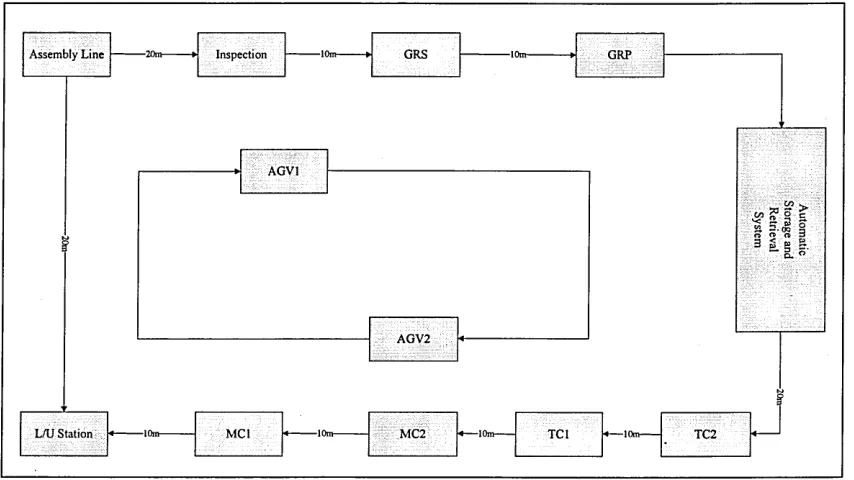
machines, one inspection, one common assembly station and automated storage and
retrieval system in the facility (See Figure 4.1). This company produced 10 products by
assembling 35 different components according to bill of materials (BOM). Each component
follows a different route through the facility and at the each machine there is a set-up time
and a process time for each component. Parts and the final products are moved through the
facility by using two automatic guided vehicles (AGV). Since, the client’s office located
150 miles away from the consultant’s office, communication was mainly done through
telephone, e-mail and fax.
Assembly Line Inspection GRS GRP
AGV1
AGV2
[image:46.612.92.519.372.612.2]L/U Station MCI MC2 TCI TC2
Client provided the layout plan of the proposed factory which is shown in Figure 4.1,
BOMs in the form of a tree diagram, Route for each part in a table, setup and process time
and assembly times for each part on each machine in the same table and a description about
the processes to be simulated. (See Figure 4.2)
(V
f p i .3..-,.. * 2
MC1.GRP.1NSP-P2 3 - MCl.GRP.INSP
P3 3 , M Cl.GRPJNSP
P4 5 4; MC2,GRP,INSP
PS 5' 4. w .v :.,.-. MC2,GKJP,INSP,
I f 5 4 MC2,GRP,INSP
Pi n P4 P5 P 6 - C T
/ ^ ! 1 * ^
Figure 4.2: Some of the information provided by the client
4.3 Case Study B
The client in this case was a manufacturing company producing compressor casings. This
company was recently acquired by a large company based in Germany. Due to the
acquisition, the manufacture of the compressor casing is now considered one of the core
competencies in this site. The equipment currently used to machine the compressor casing
is more than 20 years old and considered outdated. This is significant as it is anticipated
that production will increase four fold by 2008. The purpose of this project was to evaluate
the consequences of purchasing new equipment for machining the casings. Since the
problem was too complex to resolve manually, the client believed that a simulation model
would give a true dynamic representation of how the Compressor Casing Cell performs
based on all real life variables such as queue times, down times, repair times, manning
availability and so on in addition to enabling what-if analysis. The objective was to
determine the performance of the current system and compare it against that anticipated