KNOWLEDGE AND UTILIZATION OF POST-NATAL CARE
SERVICES. THE CROSS-SECTIONAL STUDY IN BAGHDAD
1
Arwa Saad Shakir and 2*Shaimaa Abd Ali Ghani
1
MBChB, Obstetric Practitioner, Al_ Salam Primary Health Care Centre, Al_Amel District,
Al_Kharkh Health Directorate in Baghdad, Iraq.
2
MBChB, FICMS (CM), Community Medicine Physician, Al_ Salam Primary Health Care
Centre, Al_Amel District, Al_Kharkh Health Directorate in Baghdad, Iraq.
ABSTRACT
Objective: to evaluate the level of knowledge and awareness of
women about post-natal services. Methods: across sectional study was
conducted on 298 women who attended AL-Salam PHCC, at AL-Amel
district in Baghdad from June to September 2018 using a modified
structured questionnaire. Results: level of utilization of postnatal care
services was (65.7%), most of the participants were housewives, with
intermediate income and with intermediate and secondary education.
Conclusion: the utilization rate was relatively high, with significant
association with factors such as, age, occupation, parity, history of
abortion and awareness about the presence of the services.
KEYWORDS: post-natal care, postpartum.
INTRODUCTION
The health of society is indicated by the health of mothers. Those mothers need special care
and attention before, during and after birth. The care given to the mothers in the post-natal
period (the first six weeks after birth)[1], is very important because most of the maternal and
neonatal complications and deaths occur shortly after labor (in developing countries more
than half of the maternal deaths occur in this period)[2], thus the care provided after delivery
is of huge help and importance for the mother and the baby as well, to overcome the
complications, to increase the knowledge and awareness of the mother.[3] and to provide
helpful information for taking care of the baby regarding feeding and vaccination.[4]
Volume 8, Issue 2, 93-100. Research Article ISSN 2277– 7105
*Corresponding Author Shaimaa Abd Ali Ghani
MBChB, FICMS (CM),
Community Medicine
Physician, Al_ Salam
Primary Health Care Centre,
Al_Amel District,
Al_Kharkh Health
Directorate in Baghdad,
Iraq.
Article Received on 05 Dec. 2018,
Revised on 26 Dec. 2018, Accepted on 16 Jan. 2019
Systematic examination for both the baby and the mother should be included in the post-natal
care (PNC) services in addition to the advice given to the mother.[5]
There are many recommendations from the world health organization for post-natal care,
including.
PNC should be provided in the first 24 hours after birth, because most of the complications
occur in this period.[6]
Mothers and their newborn babies should stay in the health facility for 24 hours, and not to be
discharged early.
During the first 6 weeks after birth, mothers and newborns should be checked up four times
at least.
Health massages to the families and care providers should be ensured.[7]
Despite these recommendations, three quarter of women do not have any care provided to
them in the postpartum period, this was concluded from Demographic and Health Surveys
between 1999 and 2004 done in 30 low income countries.[8]
Utilization of services given postnatally is influenced by many factors such as the age of the
mother, level of education, occupation, type and place of labor, gravidity, knowledge of the
mother about the danger sings, the source of the mother's information, knowledge about the
presence of services postnatally.[9, 10]
low utilization could also be due to lack of women’s knowledge about its importance,
difficulty in reaching health care facilities, lack of encouragement from health care providers
to have PNC, and liability of the mothers to give priority to the health needs of the infants
rather than their own needs.[8]
METHODS
A cross sectional study was conducted on 298 women who attended AL-Salam Primary
Health Care Center (PHCC), at AL-Amel district at AL-Karkh Health Directorate in Baghdad
from June to September 2018. this study was approved by the scientific and ethical research
committees at AL-Karkh Health Directorate. The ladies, who agreed to participate in the
structured questionnaire. Most of the questions were of close – ended type with the simple
answer of “yes “or “no”. The form includes questions about the socio-demographic
information (age, level of education, occupation, income) and parity. The second part of the
questions was about the accessibility of the mothers to the PHCC, their knowledge about the
presence and the importance of PNC services and the source of their information, whether
being from media, friends and family, or from health personnel. The sample was chosen
conveniently from mothers who attended our center, only in two days a week. Days that were
crowded, or holidays were excluded.
Statistical analysis was made by excel sheets and chi square test was used to look for any
statistical significance.
RESULTS
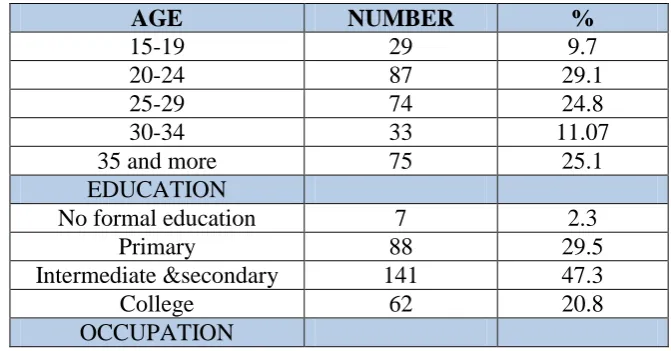
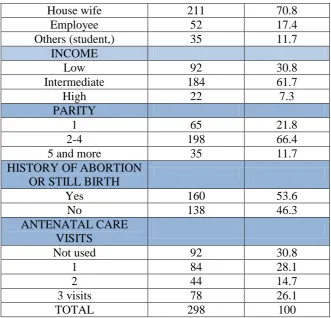
A total of two hundred ninety-eight women who attended our center were interviewed and
participated in the study. Most of them were in age group 20-24 (29.1%), house wives
211(70.8%), with intermediate &secondary education 141(47.3%) and with intermediate
income 184(61.7%).
Most of the ladies who participated in the study 198 (66.4%) had 2-4 children, with the
history of abortion or still birth 160 (53.6%), and 92(30.8%) of them did not attend antenatal
care. (Table -1-).
Most of the ladies (65.7%) had post-natal visits and a significant association was found
between age, occupation, parity, history of abortion or still birth and awareness about the
[image:3.595.128.464.595.770.2]presence of PNC services with the utilization of the services. (Table -2-).
Table 1: Socio demographic and obstetric characteristics of the participants.
AGE NUMBER %
15-19 29 9.7
20-24 87 29.1
25-29 74 24.8
30-34 33 11.07
35 and more 75 25.1
EDUCATION
No formal education 7 2.3
Primary 88 29.5
Intermediate &secondary 141 47.3
College 62 20.8
House wife 211 70.8
Employee 52 17.4
Others (student,) 35 11.7
INCOME
Low 92 30.8
Intermediate 184 61.7
High 22 7.3
PARITY
1 65 21.8
2-4 198 66.4
5 and more 35 11.7
HISTORY OF ABORTION OR STILL BIRTH
Yes 160 53.6
No 138 46.3
ANTENATAL CARE VISITS
Not used 92 30.8
1 84 28.1
2 44 14.7
3 visits 78 26.1
TOTAL 298 100
Table 2: Association between some socio demographic, obstetric and awareness about
postnatal care with the utilization of post-natal services.
AGE UTILIZATION
NO
UTILIZATION P-
VALUE
NUMBER % NUMBER %
15-19 24 82.8 5 17.2
0.01*
20-24 64 73.5 23 26.5
25-29 48 64.9 26 35.1
30-34 18 54.5 15 45.5
35 and more 42 56 33 44
EDUCATION
No formal education 6 85.7 1 14.3
0.15
Primary 54 61.4 34 38.6
Intermediate & secondary 96 68.1 45 31.9
College 40 64.5 22 35.5
OCCUPATION
House wife 138 65.4 73 34.6
0.025*
Employee 30 57.7 22 42.3
Others (student,) 28 80 7 20
INCOME
Low 63 68.5 29 31.5
0.06
Intermediate 122 66.3 62 33.7
High 11 50 11 50
[image:4.595.132.464.69.387.2]1 50 76.9 15 23.1
0.024*
2-4 123 62.1 75 37.9
5 and more 23 65.7 12 34.3
HISTORY OF ABORTION OR STILL BIRTH
Yes 101 63.1 59 36.9
0.04*
No 95 68.8 43 31.2
ANTENATAL CARE VISITS
Not used 63 68.5 29 31.5
0.15
1 50 59.5 34 40.6
2 30 68.2 14 31.8
3 visits 47 60.3 31 39.7
AWARENESS ABOUT THE PRESENCE OF SERVICES
Yes 153 69.9 66 30.1
0.003*
No 43 54.4 36 45.6
AWARENESS ABOUT THE IMPORTANCE OF
SERVICES
Yes 82 64.1 46 35.9
0.06
No 114 67.1 56 32.9
SOURCE OF MOTHERS INFORMATION
Radio -TV 43 63.2 25 36.8
0.29
Newspapers & books 20 71.4 8 28.6
Friends & family 102 66.2 52 33.8
Health personnel 31 64.6 17 35.4
DIFFICULTY TO ASSESS HEALTH FACILITY
Difficult 72 64.9 39 35.1
0.07
Not difficult 124 66.3 63 33.7
DISCUSSION
Maternal and child health should be paid a lot of attention, especially in the postnatal period,
as most of the complications and maternal deaths occur in this critical period.
The socio- demographic characteristics of the participants shows that most of them were in
age group 20-24 years (29.1%) and (47.3%) with intermediate and secondary education[11],
(66.4%) were with 2-4 children, with intermediate income and housewives, which is similar
to study done in Palestine[12], (53.6%) had obstetric complication which is similar to which
was found in Gondar[13] and Nepal.[14]
Regarding utilization of PNC services our findings (65.7%) is close to which was found in
Ethiopia (66.83%)[16] and in Addis Ababa city (65.6%).[17]
This result is high compared to studies done in Nigeria (41.2%)[18] and in Nepal (43.2%).[19]
This high utilization rate could be due to the accessible and acceptable role of the health
facilities in the community in addition to other reasons such as going for vaccination of the
baby or medical checking for him.
Many factors show significant association with utilization of the services such as age,
occupation, parity, awareness about the presence of the service and history of abortion.[15]
Age has a strong association with the utilization of the services.[20]
Utilization is strongly associated with awareness about the presence of the services just like
what was found in Saudia Arabia[21], in Uganda[22] and in northern Ethiopia.[23]
On the other hand, many factors did not show statistical significance with utilization such as:
education[12], income, having antenatal care during pregnancy and the source of information.
In countries with the low or middle level of income, the association might not be clear
between income and utilization of postnatal care service, because the woman may have no
control over her resources or finances.[24], [25] Also, women with higher income may tend to
go to private clinics rather than government institute.
The majority of the participants had antenatal care during their last pregnancy but antenatal
care has no significant association with post-natal care utilization.[9], [26]
Also, the source of information, whether was from TV, radio or health personnel had no
association with the utilization.[27]
REFERENCES
1. WHO (2000). Technical consultation on postnatal and postpartum care. Available from:
http: ∕∕whqlibdoc.who. int∕hq∕2010∕WHO-MPS-10.03.
2. Rahman, M. The determinants of use of postnatal care services for mother: does
differential exist between the urban and rural area in Bangladesh? The International
3. Central Statistical Agency. Ethiopia demographic and health survey 2005. Addis Ababa,
Ethiopia, 2006; 118-120.
4. Warren C, Mwangi A, Oweya E, Kamunya R, Koskei N. Safeguarding maternal and
newborn health: Improving the quality of postnatal care in Kenya. International Journal
for Quality in Health Care, 2010; 22(1): 24-30. dio: 10.1093/intqhc/ mzp050. (Pub Med)
5. Dutta, D.C (2014). Text book of obstetrics. 6th ed. Kolkata: New central book agency
(p)Ltd.
6. WHO (2014). WHO Recommendation on postnatal care of the mother and newborn.
7. Post-natal care for mothers and newborns. Highlights from the World Health
Organization 2013 Guidelines.
8. John NK. Mbilu Essentials of obstructs and Gynecology for clinical officers and
Midwifes.
9. H. Berhe, W. Tilahun, A. Aregay, G. Bruh, and H. Gebremedhim, “Utilization and
associated factors of post-natal care in Adwa Town, Tigray, Ethiopia - a cross sectional
study “, Advanced Research in Pharmaceuticals and Biological, 2013; 3(1): 353-359.
10.N. Regassa, “Antenatal and postnatal care service utilization in Southern Ethiopia: a
population – based study “, African Health Sciences, 2011; 11(3): 390- 397.
11.Dawidowicz, A., Krajewska, K., Krajewska – Kulak, E., Kulikowski, M., Szyszko –
Perlowska, A., Rolka, H., & Leszczynska, K. [Women’s Knowledge of health behaviors
in the puerperium]. Wiadomosci Lekarskie (Warsaw, Poland, 2003; 960, 57, 70-73.
12.Dhaher E, Mikolajczyk RT, Maxwell AE, Kramer A. Factors associated with lack of
postnatal care among Palestinian women: a cross- sectional study of three clinics in the
West Bank. BMC Pregnancy Childbirth, 2008; 8(1): 26.
13.Abebaw G, Alemayehu W, Mesganaw F. Maternal complications and Women’s Behavior
in Seeking Care from Skilled Providers in North Gondar, Ethiopia. PLoS One, 2013; 8: 3.
14.Sulochana D, Glyn N, Padam P. Utilisation of postnatal care among rural women in
Nepal. BMC Pregnancy and Child birth, 2007; 7: 19.
15.Belachew T, Taye A, Belachew T. Postnatal care service utilization and associated factors
among mothers in Lemo Woreda, Ethiopia. J Women’s Health Care, 2016; 5: 318.
16.Tesfahun F, Worku W, Mazengiya F, Kifle M. Knowledge, perception and utilization of
postnatal care of mothers in Gondar Zuria District, Ethiopia: a cross- sectional study.
Matern Child Health J, 2014; 18: 2341-51.
17.S. Berhanu, Y. Asefa, and B. W. Giru, “Prevalence of Postnatal Care Utilization and
in Selected Government Health Centers in Addis Ababa, Ethiopia, “Journal of Health,
Medicine and Nursing, 2016; 26.
18.Stella B., Adesegun F. Determinants of use of maternal health services in Nigeria –
looking beyond individuals and house hold factors. BMC Pregnancy and Childbirth,
2005; 9: 43.
19.Vishnu K, Mandira A, Rajendra K. Factors associated with the utilization of postnatal
care services among the mothers of Nepal: analysis of Nepal Demographic and Health
Survey 2011. BMC Women’s Health, 2014; 14: 19.
20.Sharma, B. Utilization of Antenatal care services in Nepal. Nepal population 2004; 11:
79-97. Sharma (2007) Kathmandu declaration on reproductive health rights.
21.Abdul Abyaidi (2008) barriers on utilization of postnatal care in AL-Hassa Saudia
Arabia.
22.Aminah K. Factors determining the utilization of postpartum care service in Uganda. Hdi,
2009; 5: 1623u.
23.Workineh YG, Hailu DA. Factors affecting utilization of postnatal care service in Jabi
tena district, Amhara region, Ethiopia. Sci J Public Health, 2014; 2(3): 169-76.
24.Gabrysch S, Campbell OM. Still too far to walk: a literature review of the determinants of
delivery service use. BMC Pregnancy Childbirth, 2009; 9(1): 34.
25.Addai I. Determinants of use of maternal – child health services in rural Ghana. J Biosoc
Sci, 2000 Jan; 32(1): 1-15.
26.Di Bari JN, Yu SM, Chao SM, Michael CL. Use of Postpartum care: predictors and
barriers. J Pregnancy, 2014; 2014: 530769.
27.Tarekegn S, Lieberman L, Giedraitis V. Determinants of maternal health service
utilization in Ethiopia: Analysis of the 2011 Ethiopian Demographic and Health Survey.