An Advanced Appliance Interaction Architecture
by
Darragh O' Sullivan, BSc.
Thesis
Presented to the
University of Dublin, Trinity College
in partial fulllment
of the requirements
for the Degree of
Master of Science in Computer Science
University of Dublin, Trinity College
Declaration
I, the undersigned, declare that this work has not previously been submitted as an
exercise for a degree at this, or any other University, and that unless otherwise stated,
is my own work.
Darragh O' Sullivan
Permission to Lend and/or Copy
I, the undersigned, agree that Trinity College Library may lend or copy this thesis
upon request.
Darragh O' Sullivan
Acknowledgments
A sincere thanks to my supervisor Alexis Donnelly for all his support and guidance throughout the dissertation. Also, I would like to thank my family for their support. Thanks to Amanda for her support throughout the year and her very helpful proof-reading towards the end of the dissertation. Finally, I would like to thank my classmates for their shared knowledge and making the year enjoyable.
Darragh O' Sullivan
An Advanced Appliance Interaction Architecture
Darragh O' Sullivan
University of Dublin, Trinity College, 2005
Supervisor: Alexis Donnelly
In the future, the ability to monitor and control home appliances over the Internet could become one of the conveniences that we wonder how we ever managed without. Also, the ability to interact with networked appliances within the home, using dier-ent user devices and modalities, could prove to be hugely benecial to certain users, especially the disabled and elderly. Using a single device to discover and communicate multi-modally with many appliances based on dierent technologies could bring untold advantages to such people. There are a number of issues however, preventing these scenarios from being realised.
Contents
Acknowledgments iv
Abstract v
List of Figures x
Chapter 1 Introduction 1
1.1 Communicating with Networked Appliances . . . 1
1.2 Why is this technology important? . . . 3
1.2.1 Home Networks and Automation . . . 3
1.2.2 Remote Access and Monitoring over the Internet . . . 4
1.2.3 Vehicular Networks . . . 4
1.3 Dissertation Outline . . . 5
Chapter 2 Requirements and Specication 6 2.1 Functional Requirements . . . 7
2.1.1 Heterogeneous Discovery and Communication . . . 7
2.1.2 Interacting with Appliances over the Internet . . . 7
2.1.3 Multi-modal interaction with networked appliances . . . 10
2.2 Non-Functional Requirements . . . 13
2.2.1 Adaptation to Failure . . . 13
2.2.2 Consistency . . . 13
2.2.3 Security . . . 14
2.2.4 Open Standards . . . 17
2.2.6 Resource Constraints . . . 17
2.3 Specication . . . 18
Chapter 3 Enabling Technologies and State-of-the-Art 22 3.1 Hardware and Transport Medium Technologies . . . 23
3.1.1 Structured Wiring . . . 24
3.1.2 Existing wiring . . . 25
3.1.3 Wireless Infrastructure . . . 27
3.2 Discovery and Communication Technologies . . . 29
3.2.1 Jini . . . 30
3.2.2 UPnP (Universal Plug and Play) . . . 31
3.3 Wide-area Communication Technologies . . . 34
3.3.1 HTTP (Hyper Text Transfer Protocol) . . . 34
3.3.2 SIP (Session Initiation Protocol) . . . 35
3.4 User Interface technologies . . . 39
3.4.1 XUL (XML User Interface Language) . . . 40
3.4.2 XIML (eXtensible Interface Markup Language) . . . 41
3.4.3 UIML (User-Interface Mark-up Language) . . . 41
3.4.4 Context-Aware and Synchronized User-Interfaces . . . 45
3.5 Gateway Server . . . 47
3.5.1 OSGi Services Platform . . . 47
3.5.2 OSGi Research Eorts . . . 53
3.6 State-of-the-Art Conclusion . . . 54
Chapter 4 Proposed Architecture 55 4.1 Physical placement of components . . . 55
4.2 Technologies and Protocols . . . 56
4.2.1 Protocol used for Wide-Area Communication . . . 57
4.2.2 Deployment of the Gateway Server . . . 58
4.2.3 Hardware and Transport Protocols . . . 59
4.2.4 Discovery and Communication Protocols . . . 60
4.2.5 Multi-Modal Interaction . . . 61
4.3.1 SIP Service . . . 64
4.3.2 HTTP Service . . . 64
4.3.3 User Device Adapters . . . 65
4.3.4 User Device Registry . . . 65
4.3.5 Generic User Interface Manager . . . 65
4.3.6 Appliance Registry . . . 66
4.3.7 Appliance Drivers . . . 66
4.4 Sequence Diagrams . . . 67
4.5 Additional Functionality . . . 69
Chapter 5 Implementation and Evaluation 72 5.1 Scenario . . . 73
5.2 Implementation Details . . . 73
5.3 Evaluation of the architecture . . . 84
Chapter 6 Conclusion and Future Work 86 6.1 Future Work . . . 87
Appendix A Use Case Diagrams 88
Appendices 88
Appendix B Implementation 93
List of Figures
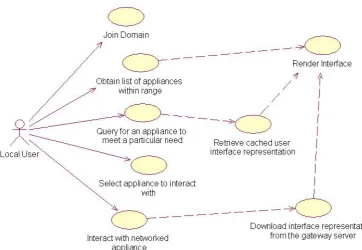
2.1 Use case diagram for a local user within the domain . . . 19
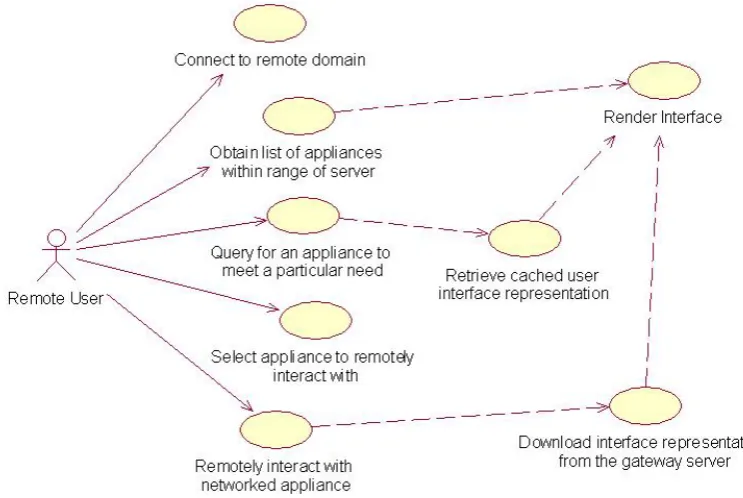
2.2 Use case diagram for a remote user accessing networked appliances over the Internet . . . 20
2.3 Use case diagram for the gateway server . . . 21
3.1 Basic structure of a UIML document . . . 42
3.2 OSGi Framework taken from [1] . . . 49
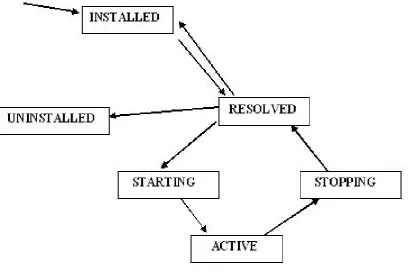
3.3 Lifecyle of a bundle . . . 50
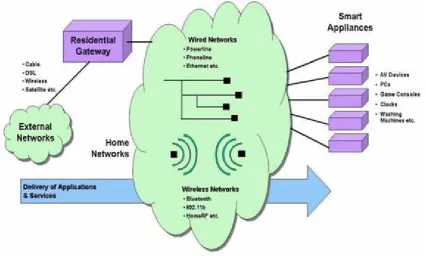
4.1 External networks interacting with internal networks (image taken from http://www.ida.gov.sg) . . . 56
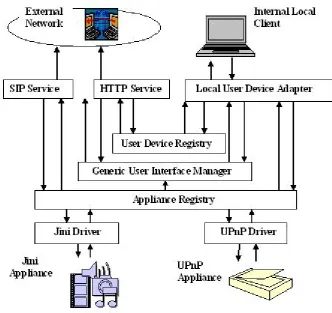
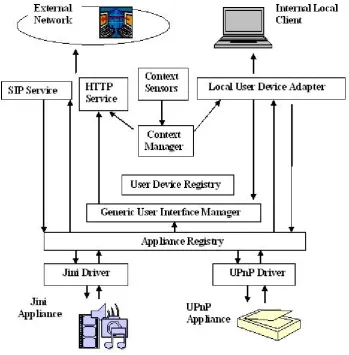
4.2 Proposed Architecture . . . 63
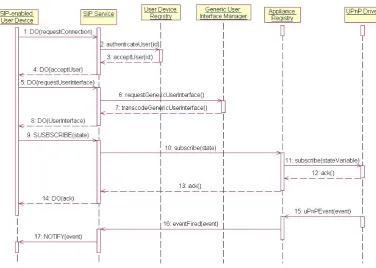
4.3 A SIP user subscribing to an UPnP state variable and being notied of an UPnP event. . . 68
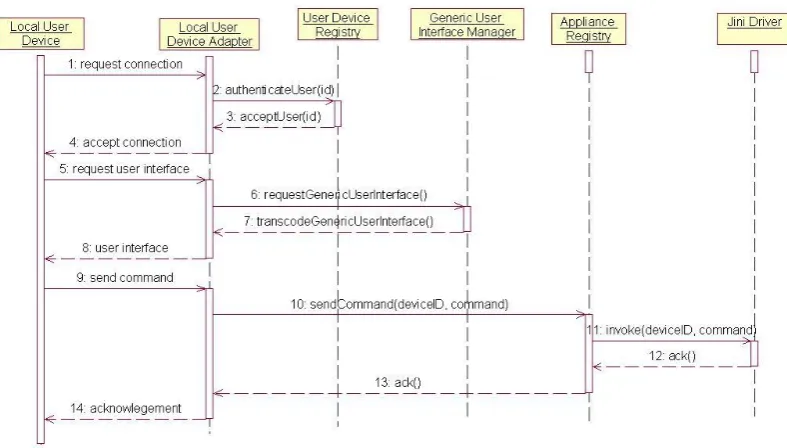
4.4 A local user sending a command to a networked appliance. . . 69
4.5 Extended architecture with context awareness functionality. . . 70
5.1 Deployed components of the architecture . . . 74
5.2 Activator's start method . . . 78
5.3 Obtaining a reference to services oered by the Appliance Registry . . 78
5.4 Interface provided by the Appliance Registry . . . 79
5.5 Client bundle getting the time from the networked clock . . . 79
5.6 Implementation of notifyUPnPEvent method by a UPnPEventListener 81 5.7 ImageGrabber interface . . . 81
5.9 Grabbing an image . . . 82
B.1 Manifest entries for the Appliance Registry . . . 93
B.2 Activator for the Appliance Registry Bundle . . . 94
B.3 Manifest entries for Appliance Servlet . . . 94
B.4 Activator for Appliance Servlet . . . 95
B.5 Manifest entries for Java Sockets Adapter . . . 96
Chapter 1
Introduction
1.1 Communicating with Networked Appliances
The advancement of technologies to enable communication with networked appliances is providing new opportunities, which enables the user to control and monitor net-worked appliances such as entertainment systems, air conditioners, lights etc., within the home or vehicle, or remotely over the Internet. Despite these opportunities, there are a number of major issues that are preventing the widespread deployment of net-worked appliances.
Another issue that is preventing the widespread use of networked appliances is that, despite the wide range of solutions and standards that exist for interconnecting appliances inside the home, there is currently very little support for wide-area commu-nication with networked appliances over the Internet. In order for wide-area protocols to communicate with networked appliances they need to meet the requirements dened for communicating with networked appliances. Solutions should provide support for invoking control actions, such as turning on the lights, querying appliances, and receiv-ing notications, for example, if the power usage increases above a certain threshold value [2].
1.2 Why is this technology important?
Before going any further, it is necessary to discuss why this technology is important and who it may potentially benet. After all, there is no real point in investing research eort into a technology that will not benet society to some extent.
The purpose of any technology is to make people's lives easier. The technology being researched and developed in this dissertation has the potential to improve the quality of life for many dierent people with varying needs and abilities. The appli-cation space for such technology is huge and could potentially be applied to, but not limited to, home networks and automation, assistance for the disabled and elderly, remote access and monitoring of home appliances, and vehicular networks.
The market for such technology is set to expand. The population of the world is aging and will become more dependent on technology to assist them around the home. Also, young people are becoming more technology savvy and are becoming more dependent on technology to save time.
1.2.1 Home Networks and Automation
The ability to control home appliances based on disparate communication and dis-covery technologies and using dierent user devices and modalities could prove to be hugely benecial to users, particularly disabled and elderly persons. Using a single user device to communicate multi-modally with home appliances based on dierent tech-nologies could bring untold advantages to such people. Communication with networked appliances is set to become more intuitive as advances are made in user interaction technologies, such as, hand gesture and voice interaction. Thus, any potential solution should accommodate the deployment of new user interface technologies without having an eect on the existing system.
sophisticated as advances are made in the elds of ubiquitous computing and articial intelligence.
1.2.2 Remote Access and Monitoring over the Internet
In the future, the ability to monitor and control appliances remotely over the Internet could become one of those conveniences that we wonder how we managed without. As an example, imagine being away from your home and getting a call on your mobile phone from a repairman who is standing outside the front door of your home and needs to get into your house to do some repair work. Using your mobile phone, it is possible to check the identity of the repair man from a discreet camera above the door and remotely open the door to let the repair man into the house.
Other possible scenarios include the ability to monitor and control appliances such as heaters, lights, bath-tubs etc. over the Internet. This has obvious advantages in that it allows users to congure their home remotely from work or the car, to be ready for them when they arrive home. Remote monitoring could also be used by people to monitor their elderly relatives. For example, by checking the status of the kettle in an elderly relative's home from your oce, it is possible to tell if your relative has used the kettle that morning. If they have not, then something may be wrong and they may need assistance.
1.2.3 Vehicular Networks
reliability of vehicles in the future. Remote monitoring of vehicles could also be useful for the eet management and other such industries.
1.3 Dissertation Outline
The layout of the remainder of the dissertation is as follows:
Chapter 2 presents both the functional and non-functional requirements for com-municating multi-modally with networked appliances.
Chapter 3 presents the current state-of-the-art technologies in the domain that at-tempt to meet the requirements dened in the previous chapter. This includes a dis-cussion on communication and discovery technologies, wide-area access protocols, user interface technologies and services gateways.
Chapter 4 presents the proposed architecture using the most recent state-of-the-art technologies to address the problem of communicating multi-modally with networked appliances in a heterogeneous environment.
Chapter 5 presents a proof-of-concept implementation of the proposed architecture, followed by an evaluation of the architecture and implementation.
Chapter 2
Requirements and Specication
As in any software development project, before deciding on the appropriate technologies or designing the architecture, it is necessary to gather and clearly dene the require-ments of what needs to be built.
The purpose of the technologies and architectures being researched in this disserta-tion is to facilitate multi-modal communicadisserta-tion with networked appliances. It should be possible to discover and interact with appliances irrespective of the underlying tech-nology of the appliance. This should be done transparently to the user. It should also be possible to interact with appliances using a preferred interaction mode, both for the user, the device and the current situation. This multi-modality should also be trans-parent to the user. Another requirement of this project is that users should be able to interact with appliances remotely over the Internet. This should be as simple for the user as interacting with appliances within the local network that the appliances operate.
2.1 Functional Requirements
The functional requirements for this dissertation fall under three major categories:
• Heterogeneous discovery and communication
• Interacting with appliances remotely over the Internet • Multi-modal interaction with networked appliances
2.1.1 Heterogeneous Discovery and Communication
In a home network or a vehicle network, there are numerous disparate technologies in operation. There are a number of dierent hardware and transport mediums in oper-ation (e.g. 802.3, 802.11, Bluetooth, infrared, wired, X.10 using the powerline etc.). Also, there are a number dierent discovery and communication protocols in use (e.g. Jini, UPnP, Salutation, HAVi etc.). And nally, the exact characteristics and capabil-ities of the devices and appliances in the network will all be dierent. To fully exploit the capabilities oered by networked appliances, the complex diversity of networking infrastructures and device technologies must be coordinated. The requirements to en-able heterogeneous communication that is independent of any particular technology are presented concisely in [3]:
"It must be possible to work with dierent in-domain networking technologies trans-parently. This requirement applies both to the physical networking and the application networking technologies."
Networked appliances should be auto-conguring as much as possible. There should be minimal user interaction, but advanced users should still be allowed to congure their appliances if they so wish.
2.1.2 Interacting with Appliances over the Internet
user when away from their local environment. This should require no more eort on the part of the user than interacting with the same appliances within the local envi-ronment. The same mechanisms that exist for interacting with networked appliances within the domain should exist outside the domain. It should be possible to browse and search for particular available networked appliances within a remote domain. Nat-urally, some of the appliances and services that may be available to a local user should not be made available to a remote user. Any potential wide-area solution should cater for this. The requirements for communicating remotely with networked appliances are addressed extensively in the IETF Internet Draft [4].
Much of the requirements listed below are taken from this draft. The draft di-vides the requirements for wide-area access to networked appliances into the following sections:
• Naming and Addressing requirements • Communication protocol requirements • Communication mode requirements
Naming and Addressing Requirements
• A networked appliance must be assigned a globally unique name so that it can
be referred to unambiguously.
• There must be support for classication of addresses and selection between
mul-tiple instances. For example, it must be possible to search for all air conditioning units, or allow for renement of a search for a particular air conditioning unit in a particular room.
• The addressing scheme must use UTF-8 for character representation.
Wide-area Communication Protocol Requirements
• Any potential communication protocol must provide a exible payload capability
• The communication protocol must provide reliability against all forms of
commu-nication errors. If an error is unrecoverable, the commucommu-nication protocol should be capable of signalling this to participating entities.
• Since most communication with networked appliances is in real-time, the protocol
must support ecient messaging for control. Messages should be as short as possible and be delivered as quickly as possible.
• Event notication is very important for interaction with networked appliances
(e.g. notication that your washing machine is over a certain temperature), con-sequently, the protocol must have support for event subscription and notication.
• The communication protocol must be capable of encapsulating various appliance
characteristics. For example, some appliances may respond to a user command immediately whereas other appliances may not respond or may respond after a non-determinate amount of time.
Communication Mode Requirements
There are a number of dierent modes for interacting with networked appliances. Sup-port for the following interaction modes are required:
• Control - It must be possible to send control commands to appliances, for
exam-ple, set the air conditioner temperature to 20 degrees.
• Queries - The communication protocol should facilitate the querying of the state
of networked appliances, for example, what is the temperature of the air condi-tioner?
• Asynchronous events - Notication is very important for communicating with
networked appliances. The protocol should allow users to subscribe to receive notications when events happen, for example, notify a user's mobile phone when the house burgular alarm is set o.
• Discovery - A protocol should allow users to look for appliances to meet particular
• Media Streaming Sessions - Any potential wide-area protocol should support
media streaming sessions, for example, to view a baby sitter cam.
2.1.3 Multi-modal interaction with networked appliances
Interaction with networked appliances requires users to be able to access information and issue commands from a wide variety of user devices, with some devices designed to suit the user's specic usage requirements. The increasing rise in the computational power available to these user devices coupled with advancements in the elds of ubiq-uitous computing and articial intelligence will allow client devices to oer evermore sophisticated modalities and functions on ever more miniaturised devices. Users will come to demand multi-modal interaction on a single device, or multiple devices, in or-der to maximise their interaction with networked appliances in eyes-free and hands-free environments (e.g. driving a car) [5]. Studies have shown how context independent interfaces and disability interfaces are closely related. For example, the problem of a user needing to be eyes-free and hands-free whilst driving a car resembles the problems with low-vision issues for disabled users [5]. It is necessary for there to be a continu-ity in the interface metaphors and the "look-and-feel" of the dierent user-interfaces, even though a user may be interacting entirely visually at one point, for example, in the home or oce or entirely aurally at another point, for example, while driving a car [5]. The interfaces should be straight-forward and easy to learn so that it is not neccesary to have to re-learn when switching between modalities. Also, new functions and capabilities should be easy to master as they are introduced.
To allow for multi-modal interaction, user-interfaces should be made available in formats that can be rendered by the user devices. Rather than a user-interface designer providing code for all the dierent possible user devices and modalities, using a generic user-interface format oers a much more ecient and sensible approach. The generic user-interface format can then be either transcoded to the target specic format on the server, or transported to the client to be transcoded locally. The requirements for multi-modal communication with networked appliances and for this generic user interface format are as follows [6, 7]:
• There should be a natural separation of user-interface and non-user-interface
code.
• The generic interface representation should be completely independent of the
technology and protocols used for transport over the network.
• The interface representation should not be limited to one specic modality, but
it should allow mapping to other modalities. It should be possible to render the representation in the device specic format, or in a personalised format, e.g. for disabled users.
• The interface representation should be extensible. New features can be added
without aecting existing features.
• The interface representation should promote a high degree of usability for persons
with disabilities. Accessiblity for disabled persons may require user interface technology such as voice, braille etc.
• The interface representation should independent from the target format as much
as possible.
• It should be possible to use the rendered interface to interact with networked
appliances both locally within the domain and remotely over the Internet.
• The server and the user devices should be capable of run-time content negotiation
• It should be possible for clients to cache the user interface representation. This
being either the generic format or the actual target-specic user interface code. This is done so that user devices do not need to download the user-interface representation every time they communicate with the same appliance.
Synchronized multi-modal user interfaces
A hot area of research at the moment is coordinated, synchronized multi-modal in-teraction that works across a multiplicity of modalites and user devices. This allows a user to switch between modalites while interacting with a networked appliance, for example, interacting visually with an appliance and then switch, mid-task, to speech interaction. The requirements for synchronizing multi-modal user-interfaces that work across a multiplicity of modalities and user devices, all accessing the same informa-tion base, are outlined in [8]. Applied to the domain of networked appliances, the requirements are:
• A potential user should be able to interact in parallel with the same networked
appliances via a multiplicity of user devices and networked appliances.
• A unied, synchronized and coordinated view of the networked appliances should
be present across the user devices.
• There should be synchronized interaction history across the user devices.
• Interacting with appliances should be uniform and behaviour independent of the
user device or modality.
• There should be tight synchronization across multiple parallel modalities. • There should be coordination of the user interfaces, behaviours and services. • Mechanisms should be in place to achieve synchronized interaction in a
distrib-uted environment.
• Updates to the underlying status of a networked appliance via any given user
• User interfaces must support dynamic and often unpredictable switches across
modalities.
2.2 Non-Functional Requirements
Due to the dynamic nature of a home or vehicular network, with a wide variety of net-worked appliances and user devices joining and leaving, it is necessary for a netnet-worked appliance architecture to be robust and capable of dealing with change and failure on many levels. It is also necessary to deal with security and real-time communication issues. It is vital to meet these non-functional requirements for there to be any major rise in the use of networked appliances by the general population.
2.2.1 Adaptation to Failure
It is expected in a pervasive environment such as a networked appliance network that connectivity will not be continuously guaranteed. Any potential solution must display a fair reaction to this situation. Communication must be best eort and be capable of recovering from failures.
2.2.2 Consistency
2.2.3 Security
The importance of security to networked appliances is obvious. A broad range of secu-rity threats exist for networked appliances. Ease of use, location transparency, multiple user-interfaces and mobile terminals raise many security concerns with regards to net-worked appliances. If the system is connected to actuators of any kind, a compromised networked appliance has the potential to spoil food, injure its user, or set re to a house [9] and naturally one does not want his or her front door to be opened by an unauthorised person. Also, information such as the existence of certain networked ap-pliances, their locations within the home, the times and frequencies an owner accesses these appliances, may all be sensitive information.
The traditional taxonomy of security threats identies three main classes; con-dentiality, integrity and availablility [9]. Condentiality is violated when unauthorized users gain access to private information; integrity is violated when unauthorized users modify information or systems; and availability is violated when an entity in the sys-tem is prevented from performing its intended function. Protection against all these security threats relies on a distinction between authorised and unauthorised users. A failure in authentication can easily lead to violations of condentiality, integrity and availability.[9] The security considerations for communicating with networked appli-ances will be addressed under these three headings.
Condentiality
When people rst think about security issues for pervasive computing, they think of eavesdropping as a consequence of wireless communication. This concern is not really an issue of major concern however. Once the dicult problem of authenticating the users and sharing key material has been done, there are mature and robust symmetric ciphers such as AES (Advanced Encryption Standard) for protecting the communica-tion channel's condentiality [10].
networked appliances usually involves communication between a relatively small set of communicating entities. At one end is the gateway server. On the other end will be the relatively small number of various user devices. These include the users' mobile phones, PDAs, laptops and so on. It is conceded that occasionally a user may bor-row another person's mobile phone, or similar user device, to interact with the home network. While this is possible, it is more likely that a user will be using his own user devices most of the time. This characteristic can be exploited to allow the use of shared secrets on the user devices. Symmetric-key algorithms are generally much faster to execute than asymmetric key algorithms. This would be an obvious advantage on resource constrained user devices, such as mobile phones and PDAs.
It is much more dicult, however, to protect the condentiality of the user de-vices themselves. Today, the information held on user dede-vices is not very valuable but as innovations are made in communicating with networked appliances, it is likely that information about user's personal activities and preferences will be stored on the user devices. This opens up the issue of abuse of personal privacy if the condentiality of the devices is compromised.
Thus, it is important to protect the condentiality of the data held in the user devices that interact with the networked appliances. In a networked appliance envi-ronment, use of a particular service must be restricted to authorised users only and authenticity of the user must be veried in a reliable way before the user is granted access. If a user's authenticity is not veried, it is possible for many threatening sce-narios to occur. Another issue of ensuring condentiality is protecting within the user device any long-term keys used to encrypt the commands being sent to the networked appliance or gateway server. It is also important to have a procedure to recover from a user device theft when the thief has possession of the user's password.
Integrity
The basic integrity problem is to ensure that messages from the user device to the networked appliance (or gateway server) are not corrupted by a malicious third party. This is similar to the condentiality problem already addressed in that, once the hard work of authentication and key distribution is done, the problem of integrity is easy to address using well known cryptographic mechanisms, such as message authentication codes [10]. The most dicult issue for integrity, therefore, is again not with the trans-mission of the messages but with the user devices themselves. The most eective way to address integrity is to ensure that the user devices and the services oered by the networked appliances are tamper-proof.
Availability
The classic attack on availability is the denial-of-service attack. Some networked ap-pliances may be particularly vulnerable to denial-of-service attacks because of their limited power supply, for example, battery operated appliances. Because of this lim-ited power supply it may be necessary for some networked appliances to go on stand-by to conserve energy. An eective attack on such appliances would be to continuously send messages to the networked appliance, thereby keeping it awake, until it runs out of battery and dies. Authentication combats this to some extent, but the problem arises when networked appliances serve queries from unknowns. It is very unlikely that a networked appliance will receive commands or queries from unknowns since most communication with networked appliances will be done through a gateway server, but it is still necessary to be aware that this may be a possiblity.
than disconnecting. Networked appliances are particularly attractive for DDOS attacks because the appliances are permanently connected to the network and will usually not have a knowledgable system administrator looking after them and noticing security breaches [9].
2.2.4 Open Standards
It is necessary to base all the protocols and formats used in the system on open stan-dards. This includes the communication protocol, the deployment of the gateway server, and the format of the generic user-interfaces. This is an obvious requirement in order to make the proposed solution as interoperable, exible, and as future-proof as possible. Usage of open standards leads to seamless integration of technologies, proto-cols and devices throughout the environment.
2.2.5 Performance
Since communication with networked appliances is going to be done in real time, it is neccessary that all messages sent to networked appliances are sent as quickly and as eciently as possible. This requirement encourages the use of a lightweight and exible protocol for wide-area communication. The protocol should work equally well in connection-oriented mode (over TCP) and in connectionless mode(over UDP).
2.2.6 Resource Constraints
2.3 Specication
The specication provides more detail on the issues described in the requirements. It describes the behaviour of the architecture as seen by an external observer. This is neccessary to ensure that there is no ambiguity about the features and behaviour of the system before the design phase.
In communicating with networked appliances, there are three dierent entities that are capable of performing actions. They are; a local user within the domain, a remote user accessing the domain over the Internet, and nally the gateway server. The gate-way could be a lightweight server in a vehicle or a residential gategate-way in a home. It is used as a gateway to the Internet and is also used to federate the disparate technolo-gies that are operating within the domain. The gateway also stores, or generates, the generic user-interface descriptions used to facilitate multi-modal communication with networked appliances. Depending on the client device capabilities, it may also be the responsibility of the gateway server to transcode the generic user-interface format to the target-specic format.
Chapter 3
Enabling Technologies and
State-of-the-Art
The number of networked environments, as well as the number of networked appliances and devices within the environment, are increasing at an accelerated pace. Common-place home appliances, such as air conditioners, refrigerators, coee pots etc., as well as vehicle systems, are being networked together. This trend, coupled with the prol-eration of a variety of user devices is making the home and vehicle network ever more complex. This results in a myriad of communication standards and protocols, many of them proprietary, which do not interoperate easily with each other. This expanding list of technologies includes hardware and transport technologies such as IEEE 802.3, IEEE 802.11, Bluetooth, Infrared and X.10 using the powerline. Coupled with this there is also a wide array of discovery and communication protocols such as, Jini, UPnP, HAVi and many more. The state-of-the-art in these technologies is discussed, as are methods of federating the disparate technologies to enable communication using a multitude of protocols and technologies.
research in the area of remote access to networked appliances has been done. Based on an analysis of this research, it seems that most prominent solutions for remote ac-cess to networked appliances over the Internet are based on either HTTP (Hyper-Text Transfer Protocol) or SIP (Session Initiation Protocol), both of which run over the Internet Protocol(IP). The use of SIP for remotely interacting with networked appli-ances provides certain advantages, and an extended version of SIP has been proposed, specically designed for communicating with networked appliances. The specics of this extended version of SIP are presented.
The diculties of having a wide variety of user devices, each with a specic modality, was outlined in the previous chapter. A possible solution to this is to use a generic user-interface representation to encode the user user-interface and then transcode this generic representation to the target-specic format. The state-of-the-art in generic user inter-face languages and technologies including, XIML, UIML and DISL is presented in this chapter.
Finally, the deployment of the gateway server needs to be decided. Recently, the gateway has evolved from a simple hub, providing internet services to a few networked PCs, into a services gateway [12]. A services gateway is a platform on to which appli-cations and services can be dynamically deployed and managed. It has also become the responsibility of the services gateway to federate the disparate technologies in operation within the environment. The Open Services Gateway Inititive (OSGi) is a speccation for such a services gateway and is explained in detail.
3.1 Hardware and Transport Medium Technologies
applications such as controlling a coee pot will require low bandwith. In general, wired technologies support higher bit rates over longer distances when compared to wireless technologies and would be suited to applications like video-streaming[13]. Wireless technologies are generally more suited to low bit-rate services requiring a high degree of mobility. In [13], the physical media that home networks operate over is organised into three broad groups: structured wiring, existing wiring, and wireless.
• Structured wiring requires the installation of new cabling in the walls. Both
the cabling and its installation are dened by standards (e.g. 802.3 for Ethernet). The cabling is typically unshielded twisted pair (UTP) or bre optics).
• Existing wiring uses the existing infrastructure of electrical, telephone, or other
wiring already installed within the home.
• Wireless avoids the use of any wired infrastructure by sending signals through
the air.
3.1.1 Structured Wiring
It is recognised in [14], that installing new structure wiring is a safe way to deploy new services in the home environment, as these technologies have been tested in the entre-prise and business sectors. The structured wiring technogies that deserve particular consideration are Ethernet, Universal Serial Bus (USB), and IEEE 1394.
Ethernet
USB (Universal Serial Bus)
The main advantage of USB for home networks is its ability for "hot-swapping" (i.e. plugging and unplugging devices without interrupting the operation of other devices) of multiple peripherals in a daisy-chain architecture [14]. Connecting USB devices is more or less an automatic process, since most modern PCs and operating systems provide support for USB connections. Moreover, in many cases, it is unnecessary for a USB device to have a power source, as the power can be automatically delivered from the PC. USB provides both asynchronous data transfer and isochronous audio/video streaming channels which promise transfer rates of up to 460-480 Mbit/s, and covers the requirements of bandwith devices such as cameras [14]. However, it is unlikely that USB will achieve dominance in home networks, since it requires the networked device to be located a short distance from the gateway server.
IEEE 1394
IEEE 1394 (also known as Firewire or i.Link) was initially proposed by Apple Computer in the 1990s, as a PC and digital video serial bus interface. It provides isochronous real-time data services and high transfer rates. Though originally designed for entertain-ment applications, it has turned into an emerging standard that targets all multimedia applications. IEEE 1394 does not specify a physical medium and mostly uses copper or plastic optical bre (POF). The main advantage of IEEE 1394 for networked appliances is that it implements an easy to set-up, hot-plugging scalable architecture that does not require terminators or device IDs. It allows for a mix of transfer speeds, enabling the interconnection of devices with dierent speed capabilities and costs. Currently, a number of standardisation bodies and committees, including DVB (Digital Video Broadcasting), DVC (Digital VCR Conference), the Consumer Electronic Association (CEA) and the Versatile Home Network (VHN) have adopted IEEE 1394 as their default interface for broadband, low-cost, digital communications. [14]
3.1.2 Existing wiring
most prominent solutions for using existing wiring within a home are X10, LonWorks, HomePlug and CEBus over the powerline and HomePNA over the phoneline.
X.10
X.10 provides a solution for controlling simple home appliances. It utilizes existing electrical wiring in buildings and, hence, does not require any additional cabling. The basic command set of X.10 includes commands for switching power on and o, adjusting brightness level and querying statuses with optional numerical parameters. X.10 has 256 possible addresses within a domain. X.10 species dierent modules for controlling dierent appliances. For example, a lamp module is specied for controlling lamps. This module is capable of switching a lamp on or o and dimming the brightness of the lamp. More complex modules are required for controlling more sophisticated appliances. A infrared and radio frequency based transport are also dened for X.10. One major problem with X.10 is slow data rates of around 20 bit/s. This shortcoming means that X.10 is, in practice, restricted to very simple operations on very simple networked appliances (e.g. turning a coee pot on etc.). [15]
HomePlug
The HomePlug Powerline Alliance was formed to build a cost eective technology that uses the existing powerline and oers Ethernet standard connectivity rates. The al-liance consists of 12 founding members and over 80 participating companies. The current HomePlug standard allows for speeds up to 14 Mbit/s. In August 2005, a new standard which allows for speeds greater than 100 Mbit/s was approved by the Home-Plug Powerline Alliance. This standard is still backward compatible with HomeHome-Plug 1.0. [15]
LonWorks
and heating and ventilation systems. [15]
CEBus
Consumer Electronic Bus is a communications standard for in home networks devel-oped by the Electronics Industry Association (EIA) and the Consumer Electronics Manufacturers Association. Like LonWorks, the standard does not just apply to com-munication over the powerline but also coaxial cable, radio frequency and Infrared. A disadvantage of CEBus is that there are relatively few products available and the high cost of those products. [15]
HomePNA
HomePNA is being dened by the Home Phoneline Networking Association whose aim is to promote and standardise technologies for home phone-line networking, and to ensure compatibility between home networking products[14]. Since HomePNA takes advantage of the existing home phone wiring, this enables an immediate market for HomePNA devices. HomePNA 2.0 provides 10 Mbit/s rates.
3.1.3 Wireless Infrastructure
Wireless connectivity is extremely desirable for communicating with networked appli-ances, because it allows unhindered mobility and access. If the networked appliance architectures are to benet all intended audiences, particularly disabled and elderly users, then wireless access is a necessity. Today, there are a broad range of tech-nologies available to construct a wireless infrastructure. It is unlikely that any one technology will win out, since each of the technolgies is designed for dierent situa-tions. It is much more likely that a home network or a vehicle network will consist of a number of complementary technologies, all part of the overall solution. Some of the prominent candidates for communication with networked appliances are presented.
IEEE 802.11
wire-standardise wireless LANs. It is a mature, robust technology that has been deployed for some time in corporate settings. It operates in the unlicenced band of 2.4 and 5 GHz. IEEE 802.11 systems operating within the 2.4GHz range provide data rates up to 2 Mbps. Enhancements to the 802.11 standards have created faster versions of the specication. The most signicant is the IEEE 802.11b specication, which achieves data rates of 5.5 and 11 Mbps by using CCK (code keying modulation). [16]
Bluetooth
Also known as IEEE 802.15.1, Bluetooth has been suggested as a potential candidate for wirelessly connecting networked appliances [14, 16, 17]. Bluetooth is under the direction of the Bluetooth Special Interest Group. This group denes proles for use with Bluetooth, for example, the Hands-Free Prole that allows hands free kits in cars to communicate with mobile phones. Bluetooth has a range of up to 10 metres, operates in the 2.4GHz unlicenced band, and provides rates of up to 10 Mbit/s. Bluetooth operates by having up to 7 slave devices communicating with a master device. This arrangement of up to 8 devices is known as a piconet. It is possible to link piconets together to form a scatternet, allowing for a more exible conguration. Because of the limited bandwith, Bluetooth is unlikely to be used for audio and video transmission. Also, because of the limited range, it is likely to be restricted to only certain applications within the home.
Infrared
IEEE 802.15.3
IEEE 802.15.3, also known as UWB (Ultra Wide Band), is designed to oer an wide bandwidth over a limited area. It is targeted specically at high-denition video and high-delity audio and oers a wide bandwidth to such applications (3.1 - 10.6 GHz). The speciction dictates a data rate of 55 Mbps or more. The standard is optimised for short-range transmissions limited to 10 metres. This enables appliances to have very low-power requirements (approx 200uW. This is an obvious advantage for battery operated appliances.
IEEE 802.15.4
IEEE 802.15.4 is an emerging standard for low-power wireless monitoring and control. It has the potential to scale to many devices and has a typical range of 10-75 metres. ZigBee is the network and application layer on top of IEEE 802.15.4 and is standard-ised by the ZigBee Alliance. It is specically aimed at devices with low data rates and low-power consumption. Again, like IEEE 802.15.3, it is aimed at very low-power devices, but it has much lower data rates. Possible applications within the home could include low data rate, battery operated devices, like smoke detectors.
3.2 Discovery and Communication Technologies
and register to use that service. Common service and discovery protocols include Jini, UPnP, SLP (Service Location Protocol), SDP (Service Description Protocol) and Salu-tation. Two of the more prominent discovery protocols used for communicating with networked appliances, Jini and UPnP, are discussed below.
3.2.1 Jini
Jini-based technology, developed by Sun Microsystems, addresses the problems of dis-tributed systems by dening mechanisms to support the federation of machines or pro-grams into a single, dynamic distributed system. Jini provides mechanisms for service construction, advertisement, lookup, communication, and use in a distributed system [18]. Each Jini enabled device provides a service by publishing its own interfaces, which other devices can then discover and access the service provided by the device. Each device in the Jini network is represented as a Java object and the object's interface advertises the services that the device has to oer. Discovery and lookup services allow Jini clients to obtain references to the remote objects advertised by the devices. The clients can then invoke the methods of the remote objects using Java RMI (Remote Method Invocation). Examples of services operating within the home domain might be air conditioners, coee pots etc. Examples of clients would be user-devices that wish to use this service.
Lookup Service
Leasing
To improve fault tolerance within a Jini network, Jini grants access to services on a lease basis. It is likely that devices or appliances may leave the domain or suddenly fail without having a chance to deregister themselves. To protect against this, a service is granted for a negotiated time period between the client and the service provider. The lease must be renewed before its expiration if a service user wishes to continue using the service. Otherwise, the resources associated with the services are released. [18]
Jini Surrogate Architecture
Jini also allows non-Jini devices to join a Jini network. This is useful for devices that may lack the resources to run their own JVM (Java Virtual Machine) which is likely to be the case for many networked appliances. A surrogate host is used is used to act on behalf of the non-Jini device. The surrogate host performs the discovery and lookup tasks, thereby allowing the non-Jini device to participate within the Jini federation. All future communications between the non-Jini device and the other Jini-enabled devices takes place through the surrogate proxy [19].
3.2.2 UPnP (Universal Plug and Play)
UPnP is a service and discovery protocol that exploits existing open standards, such as IP, TCP, UDP, HTTP, SOAP and XML. In UPnP, a device can dynamically join a network, obtain an IP address, provide its capabilities upon request and learn about the presence and capabilities of other devices. All of this is done automatically. The fol-lowing are the characteristics of UPnP that make it attractive for networked appliances [20]:
and announce its presence.
• Standards based - UPnP is built on standards such as IP, TCP, UDP, HTTP,
SOAP and XML. This enables UPnP to be a very interoperable protocol.
• Platform independent - Because UPnP is standards based it can be
imple-mented using any programming language, on any operating system or hardware platform.
• Transport layer independence - UPnP can be used over a wide variety of
underlying physical mediums providing it has an IP stack.
UPnP Services
A UPnP service provides actions that can be invoked by clients. The state of a service is modelled by state variables. It is possible for clients to subscribe to be notied of changes to these state variables. A UPnP enabled device may contain a number of services. The UPnP forum is establishing standards for UPnP devices and services, for example lighting controls.
Control Point
A UPnP control point is capable of discovering and controlling other devices. Control points are analagous to clients in Jini. It is possible for UPnP control points to also provide services.
UPnP Communication
The operation of UPnP can be explained in ve steps [18]:
an IP address. If the DHCP server fails, then Auto-IP will be used to assign an address.
2. Discovery - UPnP uses Simple Service Discovery Protocol (SSDP) for service discovery. SSDP is built on top of HTTPU (HTTP over unicast) and HTTPMU (HTTP over multicast). When a device is added to the network, the device advertises its services to the control points on the network, by sending out a multicast message. Similarly, when a control point is added to the network, a SSDP discovery message is multicasted, in order to look for devices of interest. Any devices that match the search criteria specied by the control point must respond to it with a unicast message.
3. Description - For the control point to learn more about the capabilities of the device it needs to know the capabilities of the device. The advertisement message sent by the device contains a URL that points to an XML le describing the features and capabilities of the device and the services it oers. The control point can retrieve this XML le to inspect the features of the device and the services it oers to see if it ts its purposes. This XML description allows complex, powerful desciption of services, as opposed to Jini's interface API oering. The XML le contains URLs for control and eventing. For each service, the description includes a list of commands or actions to which the service responds. The description also includes a list of state variables which model the state of the services at run time.
4. Control - Once a control point has the XML device description document, it can control the device. A control URL for each of the services oered by the device is provided in the XML description document. Control messages are expressed in XML using the Simple Object Access Protocol (SOAP). HTTP is used as the underlying protocol to send the messages.
an event message containing the new value of the state variable. These event messages are expressed in XML and are formatted using the General Event No-tication Architecture (GENA). GENA is dened to send and receive messages using HTTP over TCP/IP and using HTTPMU over UDP/IP.
3.3 Wide-area Communication Technologies
As discussed in the previous chapter, the problems that need to be addressed by a potential wide-area solution to communicating with networked appliances are [21]:
• limited address capabilities. • handling of mobility.
• security, in particular preventing unauthorised access to home appliances. • resource limitations in mobile terminals and networked appliances.
• simple protocol, so as not make networked appliances complex and expensive.
HTTP (Hyper-text transfer protocol) and SIP (Session Initiation Protocol) are the two most common solutions for communicating with networked appliances over the Internet. There are a number of reasons why SIP, with some extensions, might be particulary attractive for communicating with networked appliances.
3.3.1 HTTP (Hyper Text Transfer Protocol)
3.3.2 SIP (Session Initiation Protocol)
SIP is a call setup and management protocol for multi-media communications. It is the most popular protocol used for Voice over IP solutions. SIP is an application protocol and is independent of the underlying transport protocol and only requires unreliable datagram service, as it provides its own reliability mechanism. It usually runs over UDP or TCP, but it could just as easily run over many other transport protocols. SIP also provides a suite of security services which include denial-of-service prevention, authentication, integrity and encryption.
INVITE sip:[email protected] SIP/2.0
Via: SIP/2.0/UDP pc33.atlanta.com;branch=z9hG4bK776asdhds Max-Forwards: 70
To: Bob <sip:[email protected]>
From: Alice <sip:[email protected]>;tag=1928301774 Call-ID: [email protected]
CSeq: 314159 INVITE
Contact: <sip:[email protected]> Content-Type: application/sdp
Content-Length: 142
Extended SIP
An extended version of SIP, specically designed for communicating with networked appliances, has been suggested [22]. Rather than design a new protocol from scratch, the designers decided that reusing the infrastructure of an existing protocol and adding a few extensions would be more appropriate. The new methods added to SIP are DO, SUBSCRIBE and NOTIFY. Messages or requests for networked appliances are car-ried in the body of the DO request, and are delivered to the home environment [24]. Since event notication forms a very important part of networked appliance commu-nication, SUBSCRIBE and NOTIFY methods were added [25]. SUBSCRIBE enables user devices, or other networked appliances, to subscribe to certain events within the network, and NOTIFY allows appliances to notify subscribers of events occurring. The advantages of using SIP for communication with networked appliances over other protocols, or over designing a completely new protocol, are presented in [26]. Succinctly, these advantages are:
• Scalability - SIP is a very scalable protocol. It works equally well in LAN
and WAN conditions. SIP can also work over a variety of transport protocols, including UDP and TCP.
• Simplicity - SIP allows service providers to rapidly deploy new services easily.
it can be implemented on a small footprint, an attractive feature for networked appliances. It is also well integrated with the IP (Internet Protocol) family of protocols.
• Flexibility - It is very simple to add extensions to support new features. The
protocol is dened in such a way that any provider can easily dene extensions to the existing grammar to add features which may not exist in the core SIP specication yet. This is useful for accommodating novel applications. Most importantly, SIP species mechanisms ensuring that any new extension does not break an existing SIP aware node that may be in route but does not understand the new extension.
• Registration - In SIP, it is not necessary that a calling device needs to know
exactly where to locate the called device or appliance. An appliance can register its current location with its registrar. The exact location will be resolved by the proxy in conjunction with the registrar.
• Personal Mobility - Related to the above point, SIP provides the concept of
personal mobility at no extra cost.
• Security - SIP provides both authentication and encryption using schemes such
as PGP (Pretty Good Privacy) to provide end-to-end security. This has obvious advantages since security is very important for networked appliances.
• Transport Independence - SIP is agnostic about the underlying lower layer
transport protocol. This essentially means that SIP messages can traverse through various heterogeneous networks.
• Event notication - SIP has been extended to introduce SUBSCRIBE and
NOTIFY methods for communicating with networked appliances. This enables entities to subscribe to certain events and to be notied when they occur. This is one of the more attractive features of using SIP to communicate with networked appliances.
addressing requirements, which may well be the case for communicating with networked appliances.
• Integration with existing SIP service mechanisms - Using SIP enables
networked appliances to exploit the rich infrastructure that SIP provides.
• Session based and non-session based communication - SIP allows
com-munication using both session based and non-session based transactions, which is ideal for communicating with networked appliances providing dierent types of services.
• Business models - Finally, since the extended version of SIP is the only
proto-col specically designed for communicating with networked appliances, it would introduce the possiblities of dierent service models for networked appliances. This is similar to what HTTP has done for the world-wide-web. For example, Electrolux are already investigating a "pay-per-use" washing machine based on remote monitoring of use over the Internet.
Solutions for interacting with appliances using the extended version of SIP and util-ising the new DO, SUBSCRIBE and NOTIFY methods are presented [27, 28, 21]. Two other extensions, LOCK and UNLOCK are suggested in [27] to allow appliances to interact with each other without interference. With the LOCK and UNLOCK extensions, it is possible for services to gain exclusive control of an appliance. For example, a burglar alarm service may want a door to remain locked and not allow any other service to open it.
DMP messages. For example, it may be possible for HTTP to carry DMP messages by setting the MIME type to "text/dmp" [2]. Another advantage of using XML is that it is relatively easy to process. DMP captures all the requirements for communicating with networked appliances - conveying information pertaining to control, query and event subscription and notication. Protocol bridges are required to convert between DMP and the various technologies that exist within the domain (e.g. X10, UPnP etc.). This translation is done by the gateway server.
A solution for applying SIP Security to Networked appliances is presented in [11]. The paper recognises that SIP supports basic and digest authentications, which follows a challenge-response paradigm. The solution outlined also suggests using shared secrets in communication with networked appliances. As discussed in the previous chapter, it is likely that communication with networked appliances will involve a relatively small number of communicating entities. Most of the time, a user will be using his or her own user devices to communicate with the same networked appliances. This charac-teristic can be exploited to allow the use of shared secret keys. This is an advantage because symmetric key security is typically more ecient than public key encryption for the same level of security. At the same time however, it is pointed out, that because of the relatively frequent communications with networked appliances, it is necessary to update the symmetric key in a timely fashion. Otherwise, attackers may be able to determine the key for an analysis of the large amount of information that is being passed. The use of Secure Remote Password (SRP) [29] is suggested as the session key agreement algorithm in communicating with networked appliance. An expiry time of 24 hours is suggested as the expiry time for the session key, since it would be demanding, and unpractical, to have to set up a session key for every single session. It is beyond the scope of this disseration to go into details on the security features, but basically the security solution presented in [11] provides protection for dierent users accessing networked appliances and for the same user roaming across multiple user devices.
3.4 User Interface technologies
user-interface technologies that may be in operation within a networked appliance environment include:
• Java Swing and Visual C++ for desktop PC applications.
• Mark-up languages such as WML (Wireless mark-up language) for mobile devices,
and HTML (Hypertext mark-up language) for web browsers.
• VoiceXML, SpeechML and other such languages for voice-enabled user devices.
It is unreasonable to expect users to exclusively use a single modality or device, so solutions need to be oered that cater for multiple modalities. It is also unreasonable to expect user-interface developers to develop numerous dierent user-interfaces for every potential user device. This would require developers to be experts in all of the user-interface technologies and languages used to communicate with networked appliances which is almost impossible. The solution to these problems is to build interfaces with a single, generic language, free of assumptions about the user devices and the interface technologies that they use, as much as possible citeAPPLIANCEINDEPENDENT. Some of the more prominent generic user-interface languages are presented next.
3.4.1 XUL (XML User Interface Language)
3.4.2 XIML (eXtensible Interface Markup Language)
XIML (eXtensible Interface Markup Language) is an XML-based solution for common representation for interaction data [31]. Its initial development took place at the re-search laboratories of RedWhale Software. XIML is an organised collection of interface elements that are categorized into ve basic components: user tasks, domain objects, user types, presentation elements and dialog elements. A relation in XIML is a den-ition or a statement that links any two or more XIML elements either within the one component or across components. An attribute in XIML is a feature or property of an element that can be assigned a value. XIML is suciently expressive to dene entire interface denitions for a number of applications. XIML achieves this by making a very strict separation between the denition of the user-interface and the rendering of that interface on the target device. It is possible to render an interface for a PDA, and an interface for a PC from the same XIML representation. XIML also supports the reconguration of the layout of a user-interface. This is based on knowledge about the user interface, also captured in the XIML representation. It is also possible to specify personalised information in the XIML representation, for example, disabled users pref-erences. [32, 33]
At the moment, XIML is probably the most advanced user-interface specication language. However, currently, there is not yet a public tool freely available to transcode XIML representations to target specic representations. Also, several parts of XIML are still under development.
3.4.3 UIML (User-Interface Mark-up Language)
<uiml >
<interface >
<structure > ... </ structure > <style > ... </ style > <content > ... </ content > <behavior > ... </ behavior > </ interface >
<peers > </ peers > </ uiml >
Figure 3.1: Basic structure of a UIML document
• structure - The <structure> tag contains a list of <part> elements describing
some abstract part of the user interface.
• style - The <style> tag contains a list of <property> elements, which give
presentation properties of the parts, for example, blue background.
• content - The <content> tag contains the text, images, and other content
that belongs to the interface. This is especially useful when creating user-interfaces that might be used in multiple languages. For example, separate con-tent would be needed for a user interface that is in both German and English.
• behaviour - The <behaviour> tag contains a set of rules to dene how the User
Interface reacts to stimulus. Each rule consists of a <condition> tag and an <action> tag. The rule res by executing the <action> when the <condition> is satisied.
• peers - The <peers> section maps the generic user-interface description to a
provided by Harmonia Inc [35]. The UI developer uses the platform specic tags or class names as <part> names in the <structure> element. Harmonia also provides a tool for rendering UIML to these target specic platforms.
UIML oers a fairly sophisticated method of user-interface representation with a high degree of modularisation [36]. The problem with UIML however, is that it is not completely independent from the target- specic platform. Also, the behavioural part of UIML is not well developed and does not give sucient means to specify real inter-active, state-oriented user interfaces [36]. There is currently much research being done in the UIML community to address the problem of UIML being too tightly coupled to the target specic representation.
specic <style> element species in its source attribute the name of the common, shared <style> element shared by both the HTML and Java Swing style elements. Thus, it is possible for a Java or a HTML renderer to utilize both the generic <style> element and the platform specic <style> element. [37] Generic vocabularies are use-ful for specifying interfaces for families of devices but not interfaces across families of devices. This drawback is likely to limit the adoption of UIML generic vocabularies.
More sophisticated solutions suggest a UIML oriented language which mainly de-scribes the dialog model, with only hints to its appearance, in order to provide a maximum degree of generality. The Multi-modal Interaction (MMI) framework de-nes an architecture that uses such a language to cater for combined audio, speech, handwriting, and keyboard interaction [36]. This language is the Dialog and Interface Specication Language (DISL) and is based on an UIML subset. The salient features of DISL are presented next.
DISL (Dialog and Interface Specication Language)
XSLT transformation is required to atten the tree structure used in DISL into a S-DISL representation. Tools for processing and manipulating S-DISL are not yet freely available.
3.4.4 Context-Aware and Synchronized User-Interfaces
manipu-lation of the same underlying model by various controllers (i.e. devices) provides a synchonized view for all the devices. Each view can be considered as a transformation of the underlying modality-independent XML representation. These transformations provide a natural mapping amongst the various views, since any portion of the view can be mapped back to underlying modality-independent XML representation. This portion consequently maps back to the corresponding view in a dierent modality by applying the appropriate transformation rules for that modality. This solution works, as there is always a model of the current conversation/dialog independent of the ren-dering modality. This acts as a repository of the current dialog state, the dialog ow and the whole conversation history and context. [8]
3.5 Gateway Server
As outlined previously, it is envisioned that the networked home and vehicle of the future will have a wide range of technologies and protocols in operation (e.g. UPnP, Jini, X10 etc) that need to be integrated. It is also envisioned that home and vehicle networks will have a diversied range of services on oer such as, audio/video, moni-toring, networked appliance control and many more. The services gateway has evolved to meet these requirements for a platform on to which services can be dynamically delivered and managed. The services gateway also facilites the integration of the dis-parate technologies in operation within the network. Basically, the services gateway acts as a mediator between the end user and the networked appliances. Obviously, it is desirable for this platform to be standardised in some way so that applications and services are not tied to any particular product. The most prominent standards solution, with seemingly overwhelming industry support, is the Open Services Gateway Initiative (OSGi) Service Platform dened by the OSGi Alliance [1].
3.5.1 OSGi Services Platform
a number of useful, optional services, such as a logging service, a HTTP service and a Device Access architecture. The framework and the service denitions together form the foundation of a platform for building service-oriented applications for communica-tion with networked appliances . The OSGi framework allows for just-in-time service delivery whereby a service can be downloaded over the network when the service is needed. The service may then be used just once and discarded, or it may be kept persisently on the server. The framework is also capable of updating existing services dynamically from a remote location. This is useful for software used to interact with networked appliances, since it is likely that new versions of the software will be fre-quent. The framework also provides a service and discovery mechanism with which a component or service in the framework can consult a service directory to obtain and use a service within the framework. The service directory, or registry, contains service de-scriptions published by service providers. The service registry allows service requesters to discover and bind published services. This service-orientation is a key feature of the OSGi framework allowing for a very dynamic networked environment in which a wide variety of services may be oered. OSGi technology plays a complementary role to other technologies operating with the home or vehicle, such as Jini, UPnP and HAVi. [41, 42]
OSGi Framework
bundle. A diagrammatic representation of the OSGi framework is illustrated in Figure 3.2.
Figure 3.2: OSGi Framework taken from [1]
to start, it implicitly moves into the STARTING state temporarily, for a brief period, while the bundle is starting up. If the activator class is successful in starting up the bundle, the bundle moves into the ACTIVE state, and the bundle is started, ready for its services to be used by other bundles within the framework. When a bundle is to be stopped, the framework takes up the responsiblity of tidying up after the bundle. The framework unregisters and releases any services provided by the bundle, noties inter-ested listeners that the bundle is being stopped and moves the bundle back into the RESOLVED state. The framework can generate three kinds of events that interested listeners can receive event notications for; a ServiceEvent reports the registration, unregistration, or changes for services, a BundleEvent reports changes in a bundle's life cycle and a FrameworkEvent reports that the framework has encountered errors. [44, 43]
the service registry. This registration is done by the activator class of the bundle when the bundle is started up. As part of registering a service, the registering bundle may attach a set of properties in the form of attribute-value pairs to the service. These properties can be used to distinguish between multiple providers of the same service. When another bundle is looking for a service, it uses the service interface name and an optional Lightweight Directory Access Protocol (LDAP) query selection lter over the service properties. When a bundle is deactivated the activator class unregisters the services that it provides, and it releases the services of other bundles, that it is using. It is therefore necessary for bundles that use services to monitor the availability of those services. When a service departs the framework, as a result of a bundle being deactivated, the bundle using that service must release references to the departing service and take an
![Figure 3.2: OSGi Framework taken from [1]](https://thumb-us.123doks.com/thumbv2/123dok_us/895408.602024/60.595.217.418.169.337/figure-osgi-framework-taken-from.webp)