Addressing Dynamic Contextual Adaptation with a Domain-Specific Language
Serena Fritsch, Aline Senart, Siobhán Clarke
Distributed Systems Group, Trinity College Dublin, Ireland
fritschs, senarta, [email protected]
Abstract
The increasing number of mobile devices and sensors equipped with wireless networking capabilities enable a new generation of pro-active applications. These appli-cations make use of context to adapt their behaviour to better fit their current situation. To support unanticipated changes to application behaviour, mechanisms are needed to specify when and how to adapt an application during its runtime. Many dynamic platforms exist that achieve this to some extent, and that are built on general-purpose languages (GPLs). However, these approaches suffer from standard difficulties of GPLs relating to the lack of seman-tic expressiveness of their constructs. In this paper, we de-scribe high-level declarative constructs that can be used to specify the adaptation of application behaviour to specific situations. The language is supported by a framework that enables the exchange and merge of behaviours on-the-fly. Our approach is evaluated against application scenarios in the domain of autonomous vehicles.
1
Introduction
In a near future, a multitude of sensors will be deployed in the physical world to gather information about the chang-ing environment in which applications execute and various communication technologies will be available to support rich interaction between these applications across space and time. This demands a change of paradigm in application development towards self-adaptable and autonomous appli-cations that operate in a highly mobile environment. These applications particularly need to adapt their behaviour to ad-just to the current situation [5].
Writing adaptive applications remains an arduous task for application developers. Existing approaches such as the strategy pattern and the decorator pattern [10] demand the design of all adaptational parts of an application at design time. However, it is not feasible to anticipate all the situations in which an application may be required to adapt. Hence, mechanisms are needed that allow the
dy-namic change of application behaviour at runtime.
Existing dynamic adaptation mechanisms, such as dy-namic aspect-oriented programming [13], provide means for application developers to state when and how behaviour of an application should be adapted. However, these ap-proaches usually rely on general-purpose language con-structs and do not allow programmers to reason at a higher semantic level. Hence, application developers have to ex-press adaptations in the format of the supporting platform which often remains difficult.
Domain-specific languages [12] offer a solution to raise the semantic level of expressivity. These languages are tailored to a specific application domain with expressive mechanisms for application developers that result in a higher semantic level of reasoning about concerns of a do-main. In our approach, we propose a language that provides higher-level constructs for expressing the adaptation of ap-plication behaviour due to a change in context. Apap-plication behaviour is modelled with state machines. State machines are a well-known technique to describe the behaviour of ap-plications and provide abstractions that enable code main-tenance and reuse [8]. By applying this technique to pro-active applications, we define a context graph where a state describes contextual behaviour of an application and tran-sitions between behaviours are triggered depending on new situations. Using context graphs, contextual behaviours can be separated and better understood, while allowing their reuse and future extensions.
The rest of this paper is structured as follows: Section 2 discusses related work. Section 3 motivates the needs for a declarative language with two scenarios. Section 4 describes our approach in detail. Section 5 concludes this paper.
2
Related Work
to changing system resources/services by selecting dynami-cally the resources/services to use based on their quality and availability. In contrast to them, our language focus on the actual change of the application logic during runtime. In the following discussion, we distinguish between component-based ([2], [15]), middleware ([4], [6]), linguistic ([11], [1], [9]) and technique-based approaches ([14]).
Component-based approaches, like PCOM [2], follow a generic automatic adaptation approach, i.e., the application developer specifies functional and non-functional properties of services that are required by an application and defines additional adaptation goals. An adaptation goal contains the adaptation preferences of the application, e.g., choose dy-namically the service with the highest available resolution. Adaptation is applied when a change in one of the required services occurs. The system then tries to automatically find the most suitable service at runtime.
Gaia [15] provides programming abstractions for devel-opers to define the required functionality of an application on an abstract level. Developers can specify active space entities and common operations on these spaces. An ac-tive space is a physically bounded collection, such as a room of devices, applications and services. During run-time, these entity definitions are bound to actual available services. Adaptation occurs when the user moves from an active space to another. Gaia and PCOM address the adap-tation of the services available to the application rather than the adaptation of the application logic itself.
The authors of [4] propose a reflective middleware ar-chitecture that uses reflection and context-awareness to sup-port the adaptation to a changing context. Adaptation deci-sions are encapsulated inside XML-based user profiles and the appropriate reconfigurations are redirected to the basic application code. However, the reconfiguration actions ad-dress changes to services, e.g., communication and their delegation to user code through callbacks makes them hard to understand.
Ledoux et al. [6] present a framework for self-adaptive components. Adaptation logic is separated from the busi-ness parts of an application. The specification of the adap-tation logic follows the Event-Condition-Action pattern and makes use of events emitted by a context-aware service that provides information about the execution context of the ap-plication. Their approach is rather focused on the adapta-tion of system services, e.g. the size of the cache, than the change of application behaviour.
The Container Virtual Machine (CVM) is a generic adap-tation language for component-based applications [11]. The language provides domain-specific constructs for describ-ing the adaptation of system services of components, e.g., adding an encryption service. Each adaptation can be trans-lated to different target platforms, depending on the current execution platform of the application. However, the
lan-guage does not explicitly support the change of application logic.
Babu et al. [1] provide explicit language constructs for abstracting change of behaviour in objects. Change in be-haviour is modelled as first class entity and the basic appli-cation is annotated with specific constructs to weave the ad-ditional behaviour during runtime. The base code can then become cluttered with many annotations, interfering with its readability.
Fuentes et al. [9] describe an XML-based domain-specific language that allows to write adaptation strate-gies. The approach is based on the DAOPAmI platform, a component- and aspect-based platform that provides a list of common services for ambient intelligence applications. However, the language only considers the architecture of an application and the adaptation of system services, like cache size and communication mechanisms, to better fit a current situation.
The authors of [14] propose a new approach based on technique-based programming, in which goals represent ab-stract services and techniques are selected at runtime to ful-fil these goals. A runtime process supports the adaptation of the application to changing availability in resources. This approach focusses on the adaptation of an application to changing resources in a mobile environment.
3
Application Scenarios
In this section, we study two scenarios from the domain of autonomous sentient vehicles in order to derive the re-quirements that our language should fulfill. Both scenar-ios require applications to adapt their behaviour in unantic-ipated ways. In order to describe these scenarios in detail, we will first define a number of terms.
We define behaviour as "a set of actions and reactions of an application in a specific situation". A change in a situ-ation requires a change in the behaviour of an applicsitu-ation and hence in the actions to take.
The various behaviours of a pro-active application can be modelled as a context graph [16]. A context graph encap-sulates application behaviour into a set of distinct context states and therefore provides a useful and modular abstrac-tion to structure complex, context-aware applicaabstrac-tions [3].
A context state in a context graph corresponds to a spe-cific situation that is determined based on input from sen-sors. Each state contains a set of appropriate actions that characterise the contextual behaviour to be carried out by an application, and a set of context variables that describe context. The values of context variables can be either static, e.g., the name of an entity, or can change continually, e.g., the position of a mobile entity.
Figure 1. Context graph for an autonomous vehicle
Figure 2. Exchanging application behaviour
transitions are based on the evaluation of transition rules that assess the values of state variables.
Figure 1 depicts an example of a context graph for an au-tonomous vehicle with the statesCruise,AcquireWaypoint,
AvoidObstacle and ObeyTrafficLight. This context graph
determines the default behaviour of a vehicle, e.g., in the
Cruisestate, the vehicle travels in a straight line,
acceler-ating to cruising speed. When the vehicle is in the state
AvoidObstaclesafter it has detected an obstacle on the road
with its sensors, it either brakes or changes direction. Tran-sitions between states are triggered by events, e.g., the de-tection of a traffic light leads to a transition from theCruise
state to theObeyTrafficLightstate. Note that for reasons of clarity, we omit other transitions in Figure 1.
3.1
Exchanging Behaviour
Figure 2 presents a scenario where there is a need for an autonomous vehicle to change its default behaviour based on an unplanned situation. After the arrival of an emergency vehicle, the vehicle has to adapt its behaviour to avoid col-lisions with the ambulance and with other vehicles and free the way. The behaviour for this situation is contained in the context graphAmbulanceArrivalthat contains the
con-text statesGetOutOfTrajectoryandIsOutOfTrajectory. The states contain actions specific to this new situation.
However, this situation is not reflected in the currently active context graphSentientVehiclethat describes the de-fault behaviour of a vehicle. In order to react appropriately, an exchange of context graphs has to take place that results in an adaptation of the application to better match the cur-rent situation.
In the following, we list a set of issues (Ix) with regards to the above mentioned scenario. We assume that the vehi-cle is in theCruisestate initially. For illustrating purposes, the two context graphs shown in Figure 2 have been simpli-fied.
I1: Point in time of adaptation: A mechanism is needed to specify when an adaptation should take place. In the sce-nario, an adaptation is necessary when an emergency vehi-cle arrives.
I2: Applicability of an adaptation: The question arises whether the exchange of behaviour can be executed imme-diately or need to be delayed until some actions are finished. For example, if the vehicle is sending a message to another entity or is currently braking, the exchange of behaviour has to be delayed until the action has ended.
I3: State conservation: The current active context in the context graph should be saved for later reactivation. As there is a set of variables associated with each state, these variables have to be either saved or migrated to the new be-haviour. For example the state variabledestinationcan be migrated as it is still valid in the new behaviour. However, variables likecurrentSpeedare not meaningful for the new behaviour and as a result of this, it is not necessary to mi-grate them.
I4: Determination of the new state: The initial state of the new application behaviour has to be determined. Often the mapping to the state of another context graph is depen-dent on the values of context variables. For example, in our scenario, whether to map to the initial state
IsOutOfTrajec-toryorGetOutOfTrajectorydepends on the current position
and destination of the autonomous vehicle and the emer-gency vehicle. For this, explicit constructs are needed to specify which variables to consider for the actual exchange of behaviour. Moreover, a mechanism is required that is able to constantly monitor these variables.
Figure 3. Merging of Behaviour
3.2
Merging Behaviour
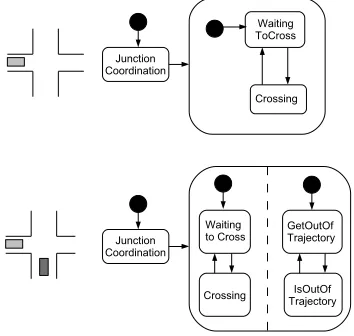
Figure 3 depicts a scenario where two behaviours have to be merged together in order to react to a specific situation. The first context graph shows the behaviour of a vehicle that enters an unsignalised junction and coordinates its be-haviour with approaching cars to cross the junction safely. Later, an emergency vehicle arrives raising a need for the vehicle to react accordingly in order not to crash with the ambulance vehicle and to free the way. In this case, a simple exchange of context graphs is not sufficient, as the vehicle still needs to coordinate its behaviour with upcoming vehi-cles at the junction. This scenario extends the list of issues to the following:
I6: Determination of currently active behaviour: In the scenario, the resulting merged context graph consists of two sub-context graphs, each of which determining the be-haviour of a vehicle with regards to other vehicles. For example, when an emergency vehicle arrives, the context graph on the right hand side should be active and the be-haviour of a vehicle is determined with regards to this. Hence, a mechanism is needed to determine which sub-context graph to activate based on the type of situation and interacting entity.
I7:Exclusion of states: In some situations, an entity can-not be in two states at the same time as these states exclude each other. For example, the state Crossing and the state
IsOutOfTrajectoryare incompatible to each other, as a
ve-hicle cannot at the same time ensure a non-collision with an emergency vehicle while crossing the junction. The ques-tion here arises how to formalise these constraints.
I8: State explosion: As there are potentially an un-bounded amount of sub context graphs, the merged con-text graph potentially results in a huge state explosion. A mechanism should be provided that minimises the number of states and sub-context graphs.
3.3
Requirements for the language
From the issues identified above, we derived some re-quirements (Rx) our language should fulfil:
R1:The language should support the dynamic exchange of context graphs.
R2:The language should support the dynamic merge of context graphs.
R3:The language should provide mechanisms to specify when to exchange or merge context graphs.
R4:The application developer should be able to specify context variables that can be accessed and that can be used at runtime to trigger an adaptation.
R5: The language should provide mechanisms to deter-mine the initial state of the new context graph after an ex-change or merge of context graphs.
R6:In the case of a merge, the language should provide mechanisms to express which sub-context graph should be active, dependent on the new situation.
R7: Capturing the state of a context graph is necessary before switching or merging behaviours. Such capture re-quires to save the value of context variables for each state of the context graph at the time of the capture.
R8:The language should provide constructs for specify-ing the duration of an adaptation.
R9: The application developer should be able to define constraints such as timeliness or mutual exclusion of states of different context graphs.
R10: The language should support a scalable merging operator for context graphs.
4
Our Approach
In this section, we describe our overall approach to sup-port the above identified requirements (c.f. Figure 4).
The proposed framework consists of the domain-specific language that allows the specification of dynamic changes in application behaviour. Additionally, it defines a mech-anism that allows the actual dynamic adaptation of be-haviours at runtime and the supervision of the application at runtime. Finally, the context-based programming model is used by application developers to design pro-active appli-cations.
4.1
Domain-specific language for dynamic
contextual adaptation
Figure 4. Overall System Architecture
a conceptual higher level. We illustrate some of the con-cepts by means of the previously discussed scenarios. The mechanism how to define valid configurations and to re-strict the possibility of an explosion of context graph states remains an open question and needs further investigation. Subsequently, the following language constructs cover only a subset of the identified requirements.
Listing 1 illustrates the specification for exchanging con-text graphs, when a message from an emergency vehicle is received. We will refer to parts of this listing when dis-cussing the relevant requirements.
1 $ e n t i t y 1 = " s e n t i e n t C a r " ; 2 $ e n t i t y 2 = " e m e r g e n c y V e h i c l e " ;
3bind $ p o s i t i o n C a r = $ e n t i t y 1 : : p o s i t i o n ; 4bind $ p o s i t i o n E m V e h i c l e = $ e n t i t y 2 : : p o s i t i o n ; 5bind $ d i r e c t i o n C a r = $ e n t i t y 1 : : d i r e c t i o n ; 6bind $ d i r e c t i o n E m V e h i c l e = $ e n t i t y 2 : : d i r e c t i o n ; 7 t r y u n t i l ( m e s s a g e == E m e r g e n c y V e h i c l e P a s s e d ) 8when ( m e s s a g e == E m e r g e n c y V e h i c l e A r r i v a l ) do { 9 e x c h a n g e b e h a v i o u r " S e n t i e n t V e h i c l e " "
A m b u l a n c e A r r i v a l " ;
10 map t o c o n t e x t S t a t e " G e t O u t O f T r a j e c t o r y " on c o n d i t i o n
11 ( $ p o s i t i o n C a r , $ p o s i t i o n E m V e h i c l e ) < t h r e s h o l d &&
12 ( $ d i r e c t i o n C a r == $ d i r e c t i o n E m V e h i c l e ) 13 e l s e map t o c o n t e x t S t a t e " I s O u O f T r a j e c t o r y " 14 }
Listing 1. Exchange Behaviour Code Example
R1: To support the dynamic exchange of context graphs, we have defined an exchange language construct (see line 9) that takes as input two behaviours, modelled as context graphs, and replaces the first behaviour with the second be-haviour. The general syntax for this is as follows:
exchange contextgraph1 contextgraph2
Listing 2 illustrates the specification of the merging of the two context graphs JunctionCoordinationand
Ambu-lanceArrivalwhen an emergency vehicle arrives.
1 $ e n t i t y 1 = " s e n t i e n t C a r " ; 2 $ e n t i t y 2 = " e m e r g e n c y V e h i c l e "
3 $ c o n t e x t G r a p h 1 = " J u n c t i o n C o o r d i n a t i o n " ; 4 $ c o n t e x t G r a p h 2 = " A m b u l a n c e A r r i v a l " ;
5 t r y u n t i l ( m e s s a g e == E m e r g e n c y V e h i c l e P a s s e d ) 6when ( m e s s a g e == E m e r g e n c y V e h i c l e A r r i v a l ) do { 7 merge $ c o n t e x t g r a p h 1 $ c o n t e x t g r a p h 2 ; 8 i f $ e n t i t y 1 a p p l y $ c o n t e x t G r a p h 1 ; 9 i f $ e n t i t y 2 a p p l y $ c o n t e x t G r a p h 2 ; 10 }
Listing 2. Merge Behaviour Code Example
R2: To support the dynamic merge of context graphs, we have defined the merging language construct (see - line 7) that takes as input an arbitrary number of context graphs and merges their behaviours into a resulting context graph. The first context graph is replaced with a context graph con-taining the merged behaviour.
merge contextgraph1 contextgraph2
...contextgraphn
R3:To enable the application developer to specify when an adaptation has to be performed, we follow the Event-Condition-Action pattern, widely used in active databases [7]. The language construct below denotes a lazy context switch. This construct can be used when the new behaviour should be applied only when the application is in a consis-tent state and it is safe to execute an adaptation.
try ... when event do adaptation
As an example, Listing 1 - line 8 and Listing 2 - line 6 specify that the adaptation should occur when a message from an emergency vehicle is received.
R4: To enable the application developer to specify con-text variables and to associate them with a specific entity, we have defined the following language construct:
bind variableName =
entityName::contextVariable,
wherevariableNameis a placeholder of our language,
andentityNameandcontextVariablerefer to an actual
con-text variable of a specific entity.
Lines 3 - 6 in Listing 1 illustrate the use of these con-structs, by binding the context variablespositionand direc-tionthe sentient car and emergency vehicle respectively.
R5:To specify the initial state of the new context graph, we have defined a language construct that expresses what is the initial state and what are the conditions to switch to this state. The proposed general syntax for this is illustrated below:
map to contextState identifier
map to contextState identifier on
condition conditionIdentifier
TheconditionIdentifierspecifies into which context state
to switch, depending on the values of context variables, e.g., current position and speed of an entity.
be-tween them is below a specified threshold, the initial state of the new behaviour will beGetOutOfAmbulanceTrajectory, else the initial state will beIsOutOfAmbulanceTrajectory.
R6: To enable the application developer to express which context graph to activate in case of a merge of contexts, we provide the following structure that specifies which context graph to apply depending on the interacting entity:
if entity apply contextgraph
For example, in Listing 2, lines 7 and 8, the active con-text graph should be either theJunctionCoordinationor the
AmbulanceArrivalcontext graph, depending on the entity
with which the vehicle interacts.
R7: To capture the state of a context graph, we need to ensure that its state is consistent. Therefore, before a capture, we automatically stop the context graph so that it will not react anymore to incoming events. The events are logged and will be resend when the new context graph is started. We have defined language constructs that allow the application developer to specify stop/start actions as part of an adaptation when the default behaviour is not appropriate. These actions can be applied to either the complete context graph or a specific state.
stop contextgraph/state
start contextgraph/state
R8:To define until when an adaptation of the application behaviour is valid, we have defined the language constructs illustrated below. These constructs allow the application de-veloper to define until when the adaptation of application behaviour is valid. Validity can either be based on a specific duration or until a specific condition becomes true.
try for time when event do adaptation
try until condition when event do
adaptation
For example, Listing 1 line 7 and Listing 2 line 5 specify that the adaptation is valid until the emergency vehicle has passed.
4.2
Runtime Adaptation Framework
In this section, we present the framework that supports the domain-specific language and that provides an execu-tion platform for pro-active applicaexecu-tions. It is comprised of the Runtime Adaptation Mechanism that dynamically ex-changes application code and of the Monitoring Engine that determines when adaptations should occur. Figure 5 illus-trates the execution environment of our framework.
[image:6.595.347.503.69.159.2]Runtime Adaptation Mechanism The runtime adapta-tion mechanism is responsible for adapting the actual be-haviour of the running pro-active application. To achieve this, we employ dynamic aspect-oriented programming
Figure 5. Execution Platform
mechanisms (AOP) [13] that allow the adaptation of an ap-plication during its runtime by continuously monitoring its execution and executing pieces of code at specified points in the execution (so-called join points).
In particular, language constructs, like the specification of the adaptation are translated into executable aspects of a general-purpose, dynamic aspect language. An aspect con-tains the definition of when to apply a specific adaptation of behaviour and the actual exchange or merge of this be-haviour. Application behaviours are stored in a behaviour pool. In our approach, adaptations occur when the Monitor-ing Engine detects a reception of a message, e.g.,
emergen-cyVehicleArrival. The adaptation aspect then chooses the
specified behaviour from the behaviour pool and executes the adaptation.
To execute the actual adaptation, reflective capabilities are needed by the Runtime Adaptation Mechanism. Re-flection refers to the ability of a program to introspect and change its own structure at runtime. In our model, the context-based programming model provides reflective ca-pabilities to reason about and change the current behaviour of the application.
Monitoring Engine The monitoring engine monitors the application at runtime and evaluates the conditions on con-text variables to determine whether to trigger behavioural adaptations. For example, in the above described scenarios, the engine triggers an adaptation that requires a merge or an exchange of behaviour, when an emergency vehicle notifies the vehicle about its arrival by sending a message.
Moreover, the monitoring engine is responsible for mon-itoring the current values of variables to trigger adaptations. For example, in the first scenario the context variables po-sition and direction of the vehicle and emergency vehicle have to be monitored and their latest values have to be re-trieved when an adaptation takes place in order to determine what the initial state of the new context graph is.
4.3
Context-based Programming Model
graph. The granularity of contexts is application-specific. A context can represent a single short action like turning or a more elaborate one like travelling from a source to a desti-nation.
An execution platform will be provided that enables ap-plications designed with the context-based programming model to run. As a starting point, we envisage to use Mo-CoA [16], a middleware platform, as our execution plat-form.
MoCoA supports a small set of abstractions that can be used to support a wide range of context-aware (mobile) ap-plications. Applications are structured using the sentient object model [3]. A sentient object is a mobile, intelligent entity that extracts, interprets and uses context information obtained from sensors to derive its behaviour.
Behaviour in the sentient object model follows the con-text graph paradigm, where each state defines the actions of an entity for a specific situation. The platform offers a well-defined API and is therefore easily expandable.
5
Conclusion and Outlook
In this paper, we have proposed a domain-specific lan-guage for describing dynamic contextual adaptations at a higher level. The language constructs support the ex-change and merge of behaviours that are specified as context graphs. The requirements for the language constructs were illustrated with two examples in the domain of autonomous vehicles. We have proposed an overall programming frame-work that consists of the domain-specific language, a run-time adaptation mechanism and a context-based program-ming model. The runtime adaptation mechanism is respon-sible for the actual execution of the dynamic adaptation, whereas the context-based programming model defines the underlying building blocks of an application. We are cur-rently investigating how to support constraints on context graphs and how to provide scalable merging of behaviour.
Acknowledgement
This work is funded by Science Foundation Ireland un-der the Research Frontiers Program.
References
[1] C. Babu, W. Jaques, and D. Janakiram. Dynamic cus-tomisation in pervasive computing environments. InIEEE Conference on Enabling Technologies for Smart Appliances (ETSA), 2005.
[2] C. Becker, M. Handte, G. Schiele, and K. Rothermel. Pcom - a component system for pervasive computing. In Proceed-ings of the Second IEEE International Conference on Perva-sive Computing and Communications (PerCom’04), 2004.
[3] G. Biegel and V. Cahill. A framework for developing mo-bile, context-aware applications. In Proceedings of the
2ndIEEE International Conference on Pervasive Comput-ing and Communications (PerCom), 2004.
[4] L. Capra, W. Emmerich, and C. Mascolo. Reflective mid-dleware solutions for context-aware applications. In Pro-ceedings of the Third International Conference on Metalevel Architectures and Separation of Crosscutting Concerns (Re-flections), 2001.
[5] J. Coutaz, J. Crowley, S. Dobson, and D. Garlan. Context is key.Commun. ACM, 48(3):49–53, 2005.
[6] P. David and T. Ledoux. Towards a framework for self-adaptive component-based applications. In Proceed-ings of Distributed Applications and Interoperable Systems, (DAIS), 2003.
[7] K. R. Dittrich, S. Gatziu, and A. Geppert. The Active Database Management System Manifesto: A Rulebase of a ADBMS Features. In2nd International Workshop on Rules in Database Systems (RIDS), 1995.
[8] M. Fowler. UML Distilled, Third Edition. Addison-Wesley Professional, 2003.
[9] L. Fuentes and D. Jimenez. An ambient intellgent language for dynamic adaptation. InWorkshop on Object Technology for Ambient Intelligence and Pervasive Computing (OT4AmI 2006), 2006.
[10] E. Gamma, R. Helm, R. Johnson, and R. Vlissides. Design Patterns: Elements of Reusable Object-Oriented Software. Addison-Wesley, 1995.
[11] A. Hachichi, G. Thomas, C. Martin, B. Folliot, and S. Patarin. A generic language for dynamic adaptation. In11th International European Parallel Processing Confer-ence (EuroPar), 2005.
[12] M. Mernik, J. Heering, and A. Sloane. When and how to de-velop domain-specific languages.ACM Computing Surveys, 37(4):316–344, 2005.
[13] A. Nicoara and G. Alonso. Dynamic aop with prose. In In-ternational Workshop on Adaptive and Self-Managing En-terprise Applications (ASMEA), pages 125–138, 2005. [14] J. Paluska, H. Pham, U. Saif, M.Chau, C. Terman, and
S.Ward. Technique-based programming. Technical report, MIT Computer Science and Artificial Intelligence Labora-tory, 2007.
[15] M. Roman and R. Campbell. Gaia: enabling active spaces. InProceedings of the 9th workshop on ACM SIGOPS Euro-pean workshop (EW), 2000.