OPTIMIZING MATRICULATION COLLECTION THROUGH SCHEDULING PARAMETERS
*,1
Patrick G. Galleto
1
Research Coordinator of the Collge of Teacher Education, Jose Rizal Memorial State University, Main Campus,
2Vice President for Research, Extension and Development, Jose Rizal Memorial State University, Main Campus,
ARTICLE INFO ABSTRACT
Optimizing matriculation collection is a responsibility of every higher education institution. This study was conducted to optimize matriculation collection through scheduling parameters of Jose Rizal Memorial State University System, school year 2016
was used with the aid of questionnaire checklist which was administered to 360 students, 167 teachers, and 12 tellers in which collected data were treated via frequency count, percent, and Chi
Finding revealed that the students meet
payment of Php
shall be paid during the conduct of the preliminary, midterm and final examinations was preferred to optimize matriculation collection. However, this requires that the univ
standard to strongly support the
university. As the economic langscape continues to change, it has become increasingly important that those responsible for
which funds are appropriately collected and managed.
Copyright©2017, Patrick G. Galleto and Evelyn R. Campiseño
permits unrestricted use, distribution, and reproduction in any medium, provided the original work is properly cited.
INTRODUCTION
Matriculation collection represents the lifeblood of every institution of higher learning. It supports students’ access to services and facilities offered by the institution. This demands that institution of higher learning should have matriculation collection strategies and functional procedures. Impotantly, appropriate scheduling to optimize matriculation collection should be established to ensure business in place and warrants financial support to technical and subtantive maintenance to the operations and projects of the institution. Republic Act 8292 or the Higher Education Modernization Act of 1997 provides that State Universities and Colleges (SUCs) Boards have the power to fix the matriculation fees and other school charges and at the same time adopt and implement a socialized scheme of tuition and school fees for greater access to poor but deserving students. In more specific terms, SUCs are authorized to retain and utilize their income generated from matriculation fees and other charges.
Corresponding author:Patrick G. Galleto
Research Coordinator of the Collge of Teacher Education, Jose Rizal Memorial State University, Main Campus, Dapitan City, Philippines
ISSN: 0975-833X
Article History:
Received 13th March, 2017 Received in revised form 09th April, 2017 Accepted 26th May, 2017 Published online 20th June, 2017
Key words:
Optimizing,
Matriculation collection, Scheduling parameters.
Citation: Patrick G. Galleto and Evelyn R. Campiseño
of Current Research, 9, (06), 52201-52206.
RESEARCH ARTICLE
OPTIMIZING MATRICULATION COLLECTION THROUGH SCHEDULING PARAMETERS
Patrick G. Galleto and
2Evelyn R. Campiseño
of Teacher Education, Jose Rizal Memorial State University, Main Campus,
Dapitan City, Philippines
Vice President for Research, Extension and Development, Jose Rizal Memorial State University, Main Campus,
Dapitan City, Philippines
ABSTRACT
Optimizing matriculation collection is a responsibility of every higher education institution. This study was conducted to optimize matriculation collection through scheduling parameters of Jose Rizal Memorial State University System, school year 2016 – 2017. Descriptive survey method of research was used with the aid of questionnaire checklist which was administered to 360 students, 167 teachers, and 12 tellers in which collected data were treated via frequency count, percent, and Chi
ng revealed that the university carried out various matriculation collection pract
students meet their fee obligations which in turn registered huge amount of receivables. Further, payment of Php 500 upon registration and three equal installments of the remaining each of which shall be paid during the conduct of the preliminary, midterm and final examinations was preferred to optimize matriculation collection. However, this requires that the univ
standard to strongly support the matriculation collection procedures and scheduling parameters of the university. As the economic langscape continues to change, it has become increasingly important that those responsible for the administration of public funds in the university develop processess through which funds are appropriately collected and managed.
Patrick G. Galleto and Evelyn R. Campiseño. This is an open access article distributed under the Creative Commons Att
use, distribution, and reproduction in any medium, provided the original work is properly cited.
Matriculation collection represents the lifeblood of every institution of higher learning. It supports students’ access to services and facilities offered by the institution. This demands that institution of higher learning should have matriculation ection strategies and functional procedures. Impotantly, appropriate scheduling to optimize matriculation collection should be established to ensure business in place and warrants financial support to technical and subtantive maintenance to the Republic Act 8292 or the Higher Education Modernization Act of 1997 provides that State Universities and Colleges (SUCs) Boards have the power to fix the matriculation fees and other school charges and at the pt and implement a socialized scheme of tuition and school fees for greater access to poor but deserving students. In more specific terms, SUCs are authorized to retain and utilize their income generated from matriculation fees and
Research Coordinator of the Collge of Teacher Education, Jose Rizal Memorial State University, Main Campus, Dapitan City, Philippines.
Manasan and Revilla (2015) posited that matriculation fees account for the bulk of total SUCs income from students. Hence, SUCs should collect all fees at the most efficient manner.On the other hand, Manasan and Revilla (2015) asserted that an assessment and/or review on the income collection and utilization of SUCs has become mandat
pointed out further that reviewing the specific s
internally generated income of SUCs analyzes how these incomes are allocated and utilized. Tolentino (2014) also posited that a more realistic and justifiable budget plan ensure the improvement of infrastructure and school equipment. In so doing, the matriculation collection strategy encourages SUCs to use their economic assets to maximize their income
capabilities (Cuenca, 2011).However, records showed that in Jose Rizal Memorial State University System matriculation collection evidently painted a bleak picture of receivables. Non-payment of matriculation fees has become a persistent challenge of the university since not all students are able to pay their obligation on time and in full. For this reason, this study was conducted to specifically determine the family source of income of the students, verify the students’ matriculation payment, find out the current mode of students’ matriculation payment and scheduling paramet
International Journal of Current Research
Vol. 9, Issue, 06, pp.52201-52206, June, 2017
Patrick G. Galleto and Evelyn R. Campiseño, 2017. “Optimizing matriculation collection through scheduling parameters
OPTIMIZING MATRICULATION COLLECTION THROUGH SCHEDULING PARAMETERS
of Teacher Education, Jose Rizal Memorial State University, Main Campus,
Vice President for Research, Extension and Development, Jose Rizal Memorial State University, Main Campus,
Optimizing matriculation collection is a responsibility of every higher education institution. This study was conducted to optimize matriculation collection through scheduling parameters of Jose Rizal 017. Descriptive survey method of research was used with the aid of questionnaire checklist which was administered to 360 students, 167 teachers, and 12 tellers in which collected data were treated via frequency count, percent, and Chi-Square test.
university carried out various matriculation collection practices for allowing their fee obligations which in turn registered huge amount of receivables. Further, 500 upon registration and three equal installments of the remaining each of which shall be paid during the conduct of the preliminary, midterm and final examinations was preferred to optimize matriculation collection. However, this requires that the university should develop a policy procedures and scheduling parameters of the university. As the economic langscape continues to change, it has become increasingly important that the administration of public funds in the university develop processess through
tive Commons Attribution License, which
Manasan and Revilla (2015) posited that matriculation fees f total SUCs income from students. Hence, SUCs should collect all fees at the most efficient
On the other hand, Manasan and Revilla (2015) asserted that an assessment and/or review on the income collection and utilization of SUCs has become mandatory. It is pointed out further that reviewing the specific sources of income of SUCs analyzes how these incomes are allocated and utilized. Tolentino (2014) also posited that a more realistic and justifiable budget plan ensure provement of infrastructure and school equipment. In so doing, the matriculation collection strategy encourages SUCs to use their economic assets to maximize their income-generating However, records showed that in emorial State University System matriculation collection evidently painted a bleak picture of receivables.
payment of matriculation fees has become a persistent challenge of the university since not all students are able to pay e and in full. For this reason, this study was conducted to specifically determine the family source of income of the students, verify the students’ matriculation payment, find out the current mode of students’ matriculation payment and scheduling parameters, determine the monthly
INTERNATIONAL JOURNAL OF CURRENT RESEARCH
receipts and statement of receivables of the university for calendar years 2013 – 2015, establish the optimal matriculation collection through scheduling parameters as perceived by the students and teachers, and establish the students’ and teachers’ preference on the major examination scheduling parameters. The offshoot of the study would serve as strong basis in redefining the university’s matriculation collection procedure that would be both beneficial to the students and the university as a whole.
MATERIALS AND METHODS
This study employed the descriptive survey method of research with the aid of the validated researcher-questionnaire checklist. Interview with student leaders was conducted to supplement the data gathered through the research instrument. There were 360 student-respondents in which 135, 110, 51, and 64 were
from Dapitan, Dipolog, Katipunan, and Tampilisan,
respctively; 167 teacher-respondents in which 71, 40, 26, and 30 were from Dapitan, Dipolog, Katipunan, and Tampilisan, respectively, and 12 teller-respondents in which 3, 3, 2, 2, and 2 were from Dapitan, Dipolog, Katipunan, Tampilisan, and Siocon, respectively. Frequency count and percent were used to quantify the surveyed data. Chi-Square test was also utilized to determine the significant association in the responses of the respondents in optimizing the matriculation collection and the scheduling parameters.
RESULTS
[image:2.595.312.560.53.182.2]Figure 1 reveals that more than 40 percent of the surveyed students (42%) belonged to families whose income was derived from farming. This means that greater proportion of families whose students are in the university primarily depends on farming as the main source of living. This implies that the affordability of the parents to send their children to the university relies mostly in farming. This supported the fact that Zamboanga del Norte is an agricultural province. Although, it can be viewed in the figure that there were students in the university whose source of family income was derived from government and private employment. Yet, a small proportion of the students in the university engaged in fishing. The figure shows further that considerable percent of the families (12%) was involved in other activities just to earn an income. Interview revealed that some families were engaged in driving (habal-habal), sari-sari store, fruit and fish vending. Overall finding manifested that 60 percent of the surveyed students in the university belonged to below average earning family Among the farmers, about 40 percent indicated that income of the family occurred every four months which usually happened in April and August every year. Interview revealed that these families earned larger income than those with quarterly, semi-annually, and monthly harvests.But, it is a disadvantage since it takes long time for the harvest to recur. However, August harvest is found timely for the opening of the semester which certainly provides the children to enrol in the university. On the other hand, quarterly harvests often fell in December, July and March. It is timely likewise for about 30 percent of the students whose family earned income in July since this month is the enrolment period in the university. It is important to note, however, that family monthly harvests were engaged by about 30 percent of the surveyed students. Interview supported that these families earned income that primarily provided the needs of the family.
Figure 1. Source of Family Income
Figure 2. Occurrence of Family Income Among Farmers
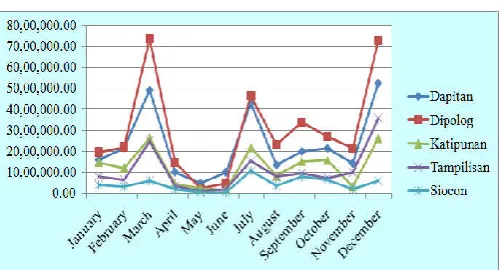
[image:2.595.309.560.209.520.2]support the daily needs of the family. Interview confirmed that students who belonged to these families were hired as student labors or working students in the university and others outside the university. Some also were receipient of the scholarships offered by the government and other supportive agencies. This means that a considerable number of students in the university were least earners yet they prioritized education.Figure 4 presents that about 60 percent of the students whose payment to their obligation in school was derived mainly from the family main source of income. It can be construed that matriculation collection should be scheduled to appropriately correspond to the calendar of family earnings.Presented in Table 1 is the mode of matriculation payment previously and currently practiced by the students in the university. Payment of Php 500 upon registration and installments of the remaining which were paid during the preliminary examination, midterm examination, and final examination was dominantly practiced by the students. This refuted however to the current policy of the university requiring students to pay a minimum of Php 1000 upon registration. Likewise, the table shows variations in the students’ practices in paying their obligation to the university. Moreover, payment of Php 500 upon registration and the remaining was paid during enrolment of the succeeding semester was practiced by about 2 percent of the respondents. This means that these students accrued their obligation to the university and failed to settle their financial commitment on time. This scenario certainly affects the university’s internally generated income. Moreover, the situation characterizes the semestral receivables of the university.Figure 5 pictures out that the monthly receipts of the university were higher in March and in October in almost all campuses of the university system. This supports to the fact that March and October are the ends of the semesters where bulk of students is expected to pay their financial obligation to the university.
[image:3.595.337.532.44.786.2]A similar picture can be seen in Figure 6 where collections of almost all of the campuses of the university system were higher in March and in October. March and October for calendar year 2014 were the closing periods of the semesters where students paid their matriculation obligation to the university.In Figure 7, March, July and December reflected the highest monthly receipts. March was the closing period of the second semester, 2014 – 2015, July was the enrolment period of the first semester, 2015 – 2016, and December was the closing period of the first semester, 2015 – 2016. Data showed that the large size of students in the university settled their matriculation payment during the ends of the semester. Results contradicted the current policy of the university in which students were expected to pay bigger amount during the preliminary and midterm examinations and supposedly projected higher monthly receipts.Figure 8 reveals that all campuses of the university registered receivables every at the end of the semester. Receivables ranged from more than 500 thousand pesos to almost 6 million pesos in Dapitan Campus from 2013 to 2015, more than 8 million to almost 15 million pesos in Dipolog Campus, more than 3 million to almost 9 million pesos in Katipunan Campus, more than 2 thousand to almost 9 million in Tampilisan Campus, and more than 1 million to about 3 million pesos in Siocon Campus. In comparison, Dipolog Campus registered the highest figure of receivables. This means that the current matriculation collection policy of the university is not properly implemented. The findings concluded the need of matriculation collection procedures to address the amount of receivables and thus optimize matriculation collection.
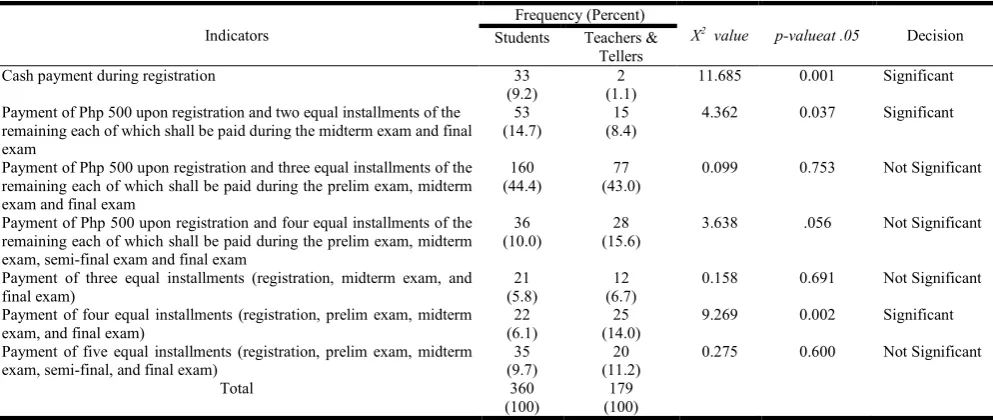
On the other hand, Table 2 presents the mode of matriculation payment to optimize theuniversity’s matriculation collection as perceived by the students and teachers/tellers. The table shows differences between the opinions of the students and teachers/tellers along cash payment during registration, payment of Php 500 upon registration and two equal installments of the remaining each of which shall be paid during the midterm exam and final exam, and payment of four equal installments (registration, prelim exam, midterm exam, and final exam). This means that the opinions of the two groups do not conform to these payment schemes.The table also presents that students and teachers/tellers were homogeneously unfavored along payment of Php 500 upon registration and three equal installments of the remaining each of which shall be paid during the prelim exam, midterm exam and final exam (about 56% of the students and 57% of the teachers/tellers); payment of Php 500 upon registration
[image:4.595.82.517.83.201.2]and four equal installments of the remaining each of which shall be paid during the prelim exam, midterm exam, semi-final exam and final exam (90% of the students and about 85% of the teachers/tellers); payment of three equal installments (registration, midterm exam, and final exam) (about 94% of the students and the teachers/tellers); and payment of five equal installments (registration, prelim exam, midterm exam, semi-final, and final exam) (91% of the students and about 89% of the teachers/tellers). On the positive side, however, about 45 percent of the students and 43 percent of the teachers/tellers preferred payment of Php 500 upon registration and three equal installments of the remaining each of which shall be paid during the preliminary examination, midterm examination and final examination. This means that the two groups uniformly favored in this payment scheme to optimize the matriculation collection of the university. However, this necessitates that strict implementation of the matriculation collection through
Table 1. Mode of Matriculation Payment Previously and Currently Practiced
Indicators Percent
Cash payment during registration 5
Payment of Php 500 upon registration and installments of the
remaining which were paid during the preli exam, midterm exam, and final exam
33
Payment of Php 500 upon registration and installments of the remaining which were paid during the midterm exam and final exam
17
Payment of Php 500 upon registration and the remaining was paid during the final exam
19
Payment of Php 500 upon registration and the remaining was paid monthly 0.2
Payment of Php 500 upon registration and the remaining was paid during enrolment of the succeeding semester 1.8
Others 24
[image:4.595.54.551.237.447.2]Total 100
Table 2.Mode of Matriculation Payment to Optimize the University Collection
Indicators
Frequency (Percent)
X2 value p-valueat .05 Decision Students Teachers &
Tellers
Cash payment during registration 33
(9.2)
2 (1.1)
11.685 0.001 Significant
Payment of Php 500 upon registration and two equal installments of the remaining each of which shall be paid during the midterm exam and final exam
53 (14.7)
15 (8.4)
4.362 0.037 Significant
Payment of Php 500 upon registration and three equal installments of the remaining each of which shall be paid during the prelim exam, midterm exam and final exam
160 (44.4)
77 (43.0)
0.099 0.753 Not Significant
Payment of Php 500 upon registration and four equal installments of the remaining each of which shall be paid during the prelim exam, midterm exam, semi-final exam and final exam
36 (10.0)
28 (15.6)
3.638 .056 Not Significant
Payment of three equal installments (registration, midterm exam, and final exam)
21 (5.8)
12 (6.7)
0.158 0.691 Not Significant
Payment of four equal installments (registration, prelim exam, midterm exam, and final exam)
22 (6.1)
25 (14.0)
9.269 0.002 Significant
Payment of five equal installments (registration, prelim exam, midterm exam, semi-final, and final exam)
35 (9.7)
20 (11.2)
0.275 0.600 Not Significant
Total 360
(100)
179 (100)
Table 3. Parameters to Schedule Major Examinations
Scheduling Parameters Frequency (Percent) X2 value p-value Decision
Students Teachers & Tellers
Final Examinations Only 15
(4.2)
13 (7.3)
2.327 0.127 Not Significant
Midterm and Final Examinations 37
(10.3)
21 (11.7)
0.263 0.608 Not Significant
Preliminary, Midterm and Final Examinations 238
(66.1)
95 (53.1)
8.608 0.003 Significant
Preliminary, Midterm, Semi-Final and Final Examinations 70 (19.4)
50 (27.9)
4.978 0.026 Significant
Total
360 (100)
[image:4.595.66.534.487.603.2]scheduling parameters should be observed in the university system. Moreover, a policy standard should be formulated and to be approved by the Board of Regents to strongly support the matriculation collection procedures in the university.Table 3 reveals the major examination schedules.
[image:5.595.40.289.121.268.2]Figure 4. Main Source of Matriculation Payment
Figure 5. Monthly Receipts of the University for the Calendar Year 2013
Figure 6. Monthly Receipts of the University for the Calendar Year 2014
[image:5.595.46.285.295.442.2]Figure 7. Monthly Receipts of the University for the Calendar Year 2015
Figure 8.Receivables from March of 2013 to December of 2015
As reflected in the table, about 96 percent of the student-respondents and about 93 percent of the teachers/tellers homogeneously unfavored to have only final examinations. Similarly, about 90 percent of both the students and the teachers/tellers homogeneously unfavored to have midterm and final examinations. This means that final examinations only, and midterm and final examinations were not favorably preferred by both the students and the teachers/tellers.On the other hand, the table shows further that more than 65 percent of the students and about 54 percent of the teachers/tellers preferred three major examinations, namely: preliminary, midterm, and final examinations. However, responses of the students differed significantly from that of the teachers/tellers along these schedules of major examinations. This means that the two groups are not homogeneously favored to have three major examinations in a semester. The implication is obviously seen that the frequency counts are not identically distributed across the two groups. Finding also supports the above finding that matriculation collection should be done during the preliminary, midterm, and final examinations. However, this requires that the university should establish strong basis in the formulation of matriculation collection policy that will be strictly implemented and to be treated as part of the quality management system of the university.
DISCUSSION
[image:5.595.40.290.470.602.2] [image:5.595.40.290.640.775.2]students have a role to play, not only in paying their school fees, but also ensuring that the university receives the correct amount of matriculation from them.Most importantly, results of the study highlight the “Scheduling Theory” (Encyclopedia of Mathematics, 2016) which deals with optimization problems for a process of processing a finite set of actions in a system with limited resources. In the case of Jose Rizal Memorial State University, facilitating all students in the payment process is central to the success of the collection of fees. Making provisions to allow a minority of students to pay in a non-standard method will help ensure that the university system optimizes the amount of fees which it collects.
REFERENCES
Commission on Audit Circular No. 2000-002. Accounting Guidelines and Procedures on the Use of Income of SUCs Pusuant to Republic Act No. 8292. Retrieve September 18,
2016 from http://www.coa.gov.ph/phocadownloadpap/
userupload/Issuances?Circulars/Circ2000/COA_C2000-002.pdf
Commission on Higher Education Memorandum Order No. 20, Series of 2011. Policies and Guidelines for the Use of Income, Special Trust Fund and Programs of Receipts and Expenditures of the State Universities and Colleges (SUCs).
Retrieved September 24, 2016 from
http://www.ched.gov.ph/wp-content/uploads/2013/07/ CMO-No,20-s2011.pdf
Cuenca, J.S. 2011. Efficiency of State Universities and Colleges in the Philippines: A Data Envelopment Analysis. Retrieved September 28, 2016 from http://dirp3pids.gov.ph /ris/dps/pidsdps1114.pdf
Encyclopedia of Mathematics 2016. Scheduling Theory.
Retrieved September 28, 2016 from http://www.
encyclopediaofmath.org/index.php/Scheduling_theory Manasan, R.G. and Revilla, M.L.D. 2015. Assessment of
Sources and Utilization of Funding of State Universities and Colleges. Retrieved September 18, 2016 from http://www.dbm.gov.ph/wp-content/uploads/DBM%20 Publications/FPB/ZBB-2014/Final%20Report_Assessment %20of%20Sources%20and%20Utilization%20of%20Fundi ng%20of%20State%20Universities%20and%20Colleges.pd f
Manasan, R.G. and Revilla, M.L.D. 2015.Assessment of Sources and Utilization of Funding of State Universities and Colleges. Retrieved September 18, 2016 from http://dirp4.pids.gov.ph/ris/dps/pidsdps1203.pdf
Republic Act 8292. Higher Education Modernization Act of 1997. Retrieved September 18, 2016 from http://www. chanrobles.com/republicacts/republicactno8292.html#.V95 Q1tSrSt8
Tolentino, M.R.L. 2014. COA: Despite P168-M trust fund,state
university fails to modernizeThe Manila Times. Retrieved
September 28, 2016 from http://www. manilatimes.net/coa-
despite-p168-m-trust-fundstate-university-fails-modernize/131978/