FACE VERIFICATION ACROSS AGE PROGRESSION
*Prof. Sujata S. Virulkar, Prof. Ashvini
International Institute of Information Technology
ARTICLE INFO ABSTRACT
Face Recognition is the process
makes it possible to use the facial images of a person to authenticate him into a secure system, for criminal identification, for passport verification. Face recognition approaches for st
broadly categorized into holistic methods and feature based methods .Holistic methods use the entire raw face image as an input, whereas feature based methods extract local facial features and use their geometric and appearance properties
important problem that has not been widely addressed. The problem by designing and evaluating discriminative approaches is discussed. These directly tackle verification tasks without explicit age modeling, which is a hard problem by itself. First, we find that the gradient orientation (GO), after discarding magnitude information, provides a simple but effective representation for this problem. This representation is further improved when hierarchi
of the gradient orientation pyramid (GOP). When combined with a support vector machine (SVM) GOP demonstrates excellent performance in this topic, in comparison with seven different approaches including two
passport datasets, one of them being the largest ever reported for recognition tasks. Second, taking advantage of these datasets, we empirically study how age gaps and related
quality, spectacles, and facial hair) affect recognition algorithms. This topic found surprisingly that the added difficulty of verification produced by age gaps becomes saturated after the gap is larger than four years, for gaps of
more of a challenge than facial hair.
Copyright © 2016, Prof. Sujata S. Virulkar et al. This
unrestricted use, distribution, and reproduction in any medium, provided the original work is properly cited.
INTRODUCTION
A.Biometric
Any automatically measurable, robust and distinctive physical characteristic or personal trait that can be used to identify an individual or verify the claimed identity of an individual. Biometrics is automated method of identifying a person or verifying the identity of a person based on a physiological or behavioural characteristic. Examples of ph
characteristics include hand or finger images, facial characteristics. Biometric authentication requires comparing a registered or enrolled biometric sample (biometric template or identifier) against a newly captured biometric sample (for example, captured image during a login).
recognition can be used in mode, where the biometric system identifies a person from the entire enrolled population by searching a database for a match based solely on the biometric.
*Corresponding author: Prof. Sujata S. Virulkar,
International Institute of Information Technology, Hinjawadi, Pune, India.
ISSN: 0975-833X
Article History:
Received 27th August, 2016
Received in revised form 22nd September, 2016
Accepted 27th October, 2016
Published online 30th November,2016
Key words:
Face verification,
Principle Component Analysis, Age progression,
Gradient orientation pyramid, Support vector machine.
Citation: Prof. Sujata S. Virulkar, Prof. Ashvini Kulklarni and Prof. Amit Kasar, 2016. of Current Research, 8, (11), 41631-41638.
RESEARCH ARTICLE
FACE VERIFICATION ACROSS AGE PROGRESSION
Prof. Sujata S. Virulkar, Prof. Ashvini Kulklarni and Prof. Amit Kasar
itute of Information Technology, Hinjawadi, Pune,
ABSTRACT
Face Recognition is the process of identification of a person by their facial image. This technique makes it possible to use the facial images of a person to authenticate him into a secure system, for criminal identification, for passport verification. Face recognition approaches for st
broadly categorized into holistic methods and feature based methods .Holistic methods use the entire raw face image as an input, whereas feature based methods extract local facial features and use their geometric and appearance properties. Face verification in the presence of age progression is an important problem that has not been widely addressed. The problem by designing and evaluating discriminative approaches is discussed. These directly tackle verification tasks without explicit age modeling, which is a hard problem by itself. First, we find that the gradient orientation (GO), after discarding magnitude information, provides a simple but effective representation for this problem. This representation is further improved when hierarchical information is used, which results in the use of the gradient orientation pyramid (GOP). When combined with a support vector machine (SVM) GOP demonstrates excellent performance in this topic, in comparison with seven different approaches including two commercial systems. This topic is conducted on the FGnet dataset and two large passport datasets, one of them being the largest ever reported for recognition tasks. Second, taking advantage of these datasets, we empirically study how age gaps and related
quality, spectacles, and facial hair) affect recognition algorithms. This topic found surprisingly that the added difficulty of verification produced by age gaps becomes saturated after the gap is larger than four years, for gaps of up to ten years. In addition, we find that image quality and eyewear more of a challenge than facial hair.
This is an open access article distributez under the Creative Commons Att use, distribution, and reproduction in any medium, provided the original work is properly cited.
Any automatically measurable, robust and distinctive physical that can be used to identify an the claimed identity of an individual. Biometrics is automated method of identifying a person or verifying the identity of a person based on a physiological or behavioural characteristic. Examples of physiological characteristics include hand or finger images, facial characteristics. Biometric authentication requires comparing a registered or enrolled biometric sample (biometric template or identifier) against a newly captured biometric sample (for captured image during a login). Biometric recognition can be used in mode, where the biometric system identifies a person from the entire enrolled population by searching a database for a match based solely on the biometric.
International Institute of Information Technology, Hinjawadi, Pune, India.
Sometime identification is called "one
A system can also be used in mode, where the biometric system authenticates a person’s claimed identity from their previously enrolled pattern. This is also called “one
matching. In most computer access or network access environments, verification mode would be used.
B. Face Recognition
Biometric identification by scanning a
matching it against a library of known faces. Face is the most common biometric used by humans. It is a form of computer vision that uses faces to attempt to identify a person or verify person’s claimed identity. The identification of a pe
their facial image can be done in a number of different ways such as by capturing an image of the face in the visible spectrum using an inexpensive camera or by using the infrared patterns of facial heat emission. Facial recognition in visible light typically model key features from the central portion of a facial image. Using a wide assortment of cameras, the visible light systems extract features from the captured image(s) that International Journal of Current Research
Vol. 8, Issue, 11, pp.41631-41638, November, 2016
INTERNATIONAL
Citation: Prof. Sujata S. Virulkar, Prof. Ashvini Kulklarni and Prof. Amit Kasar, 2016. “Face verification across age progression”,
FACE VERIFICATION ACROSS AGE PROGRESSION
Amit Kasar
, Hinjawadi, Pune, India
of identification of a person by their facial image. This technique makes it possible to use the facial images of a person to authenticate him into a secure system, for criminal identification, for passport verification. Face recognition approaches for still images can be broadly categorized into holistic methods and feature based methods .Holistic methods use the entire raw face image as an input, whereas feature based methods extract local facial features and use their . Face verification in the presence of age progression is an important problem that has not been widely addressed. The problem by designing and evaluating discriminative approaches is discussed. These directly tackle verification tasks without explicit age modeling, which is a hard problem by itself. First, we find that the gradient orientation (GO), after discarding magnitude information, provides a simple but effective representation for this problem. cal information is used, which results in the use of the gradient orientation pyramid (GOP). When combined with a support vector machine (SVM) GOP demonstrates excellent performance in this topic, in comparison with seven different approaches commercial systems. This topic is conducted on the FGnet dataset and two large passport datasets, one of them being the largest ever reported for recognition tasks. Second, taking advantage of these datasets, we empirically study how age gaps and related issues (including image quality, spectacles, and facial hair) affect recognition algorithms. This topic found surprisingly that the added difficulty of verification produced by age gaps becomes saturated after the gap is larger than up to ten years. In addition, we find that image quality and eyewear present
under the Creative Commons Attribution License, which permits
Sometime identification is called "one-to-many" matching. A system can also be used in mode, where the biometric
person’s claimed identity from their previously enrolled pattern. This is also called “one-to-one” matching. In most computer access or network access environments, verification mode would be used.
Biometric identification by scanning a person’s face & matching it against a library of known faces. Face is the most common biometric used by humans. It is a form of computer vision that uses faces to attempt to identify a person or verify person’s claimed identity. The identification of a person by their facial image can be done in a number of different ways such as by capturing an image of the face in the visible spectrum using an inexpensive camera or by using the infrared patterns of facial heat emission. Facial recognition in visible t typically model key features from the central portion of a facial image. Using a wide assortment of cameras, the visible light systems extract features from the captured image(s) that
INTERNATIONAL JOURNAL OF CURRENT RESEARCH
do not change over time while avoiding superficial features such as facial expressions or hair. Several approaches to modelling facial images in the visible spectrum are Principal Component Analysis, Local Feature Analysis, neural networks, elastic graph theory, and multi-resolution analysis. Some of the challenges of facial recognition in the visual spectrum include reducing the impact of variable lighting and detecting a mask or photograph. Some facial recognition systems may require a stationary or posed user in order to capture the image, though many systems use a real-time process to detect a person's head and locate the face automatically. Major benefits of facial recognition are that it is non-intrusive, hands-free, continuous and accepted by most users.
C. Challenges
The challenges of face verification across age progression are due to several sources, given as automatically locate the face, recognize the face from a general view point under different illumination conditions, facial expressions, and aging effects, out-of-plane Rotation:frontal, 45 degree, profile, upside down, presence of beard, moustache, glasses etc. facial expression ,occlusion by long hair, hand. Image Condition: Size, lighting condition, distortion, noise, compression. To increase the capability of security and surveillance system.
D. Application Mode
1) Face Identification (1:N)
Figure out “Who is X?”
Accomplished by system performing a “one-to-many” search.
2) Face Verification (1:1)
Answer the question “Is this X?”
Accomplished by the system performing a “one-to-one” search.
E. Face Verification Algorithm
Step 1) Acquiring the image of an individuals face
Three ways to acquire image
1) Acquire an image from standard image Data Base. 2) Digitally scan an existing photograph.
3) Acquire a live picture of a subject.
Step 2) Locate image of face
Software is used to locate the faces in the image that has been obtained
Step 3) Analysis of facial image
Software measures face according to is peaks and valleys (nodal points)
Focuses on the inner region of the face known as the “golden triangle”
Nodal points are used to make a face print.
Step 4) Comparison
The face print created by the software is compared to all face prints the system has stored in its data base.
Step 5) Match or no match
Software decides whether or not any comparisons from step 4 are close enough to declare a possible match.
F.Image Data Base
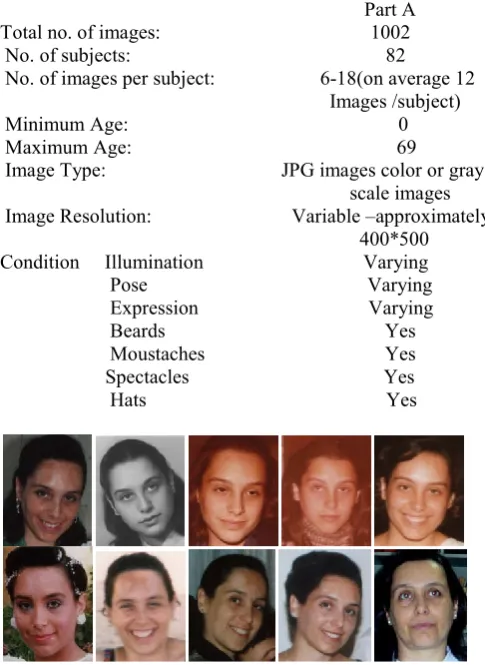
Weuse the FERET Data Base, MORPH Data Base FG-NET Aging Database (Face and gesture recognition working group, 2000) that is widely used for image based face recognition. FG-NET Aging Database is widely used for image based face aging analysis. The FG-NET Aging database is an image database containing face images showing a number of subjects at different ages. The database has been developed in an attempt to assist researcher who investigate the effects of aging on facial appearance. Widely used for image based face aging analysis. Very useful for age progression study such as estimation and simulation. Very challenging for my presentation because the largest gap of age provided by it is 45 years. It is a publicly available database, but some data may be paid data.
FG-NET Image Database Specification
Part A Total no. of images: 1002 No. of subjects: 82
No. of images per subject: 6-18(on average 12 Images /subject)
Minimum Age: 0 Maximum Age: 69
[image:2.595.306.549.331.664.2]Image Type: JPG images color or gray scale images Image Resolution: Variable –approximately 400*500 Condition Illumination Varying Pose Varying Expression Varying Beards Yes Moustaches Yes Spectacles Yes Hats Yes
Fig. 1. Typical images with age differences. Photos from the FG-NET Aging Database (Face and gesture recognition working
group, 2000)
G. Approaches for Face Recognition
holistic approaches includes: (1) the Eigen faces, known also as the Principal Components Analysis (PCA) and also as Kahunen-Loeve transformation (KL), (2) the Fisher faces known as the linear Discriminant analysis (LDA), and (3) Independent Component Analysis (ICA). PCA is unsupervised technique for dimensionality reduction; it searches for directions in the dataset that have the largest variance and define a projection matrix to project the data onto it. This leads to a lower dimensional presentation of the data, and therefore removes some of the noisy directions. Batch mode determination of principal axes for data with varying reliability and missing data was studied in (Geng et al., 2007; Guo et al., 2009; Hammond and Simoncelli, 2005; Jonsson et al., 2002).
1) Appearance (holistic) Based Approach
Principle Component Analysis(PCA)
Independent Component Analysis(ICA)
Linear Discriminator Analysis(LDA)
2) Feature (Structural) Based Approach
Discrete Fourier Transform
Discrete Wavelet Transform
Discrete Cosine Transform
Gabor Filter.
II. Face Recognition by PCA
A. Introduction to Principle Component Analysis
Statistical technique that has found application in field such as face recognition and data compression. Commonly referred as the use of Eigen faces. Technique pioneered by Kirby & Sirivich in 1988.Goal of PCA is to represent a face as a co-ordinate system. Turk & Pentland used this approach to develop a Eigen face based algorithm for face recognition. It is a dimensionality reduction technique based on extracting the desired no. of principle component of the multi-dimensional data. PCA also known as Karhunen-Loeve projection. PCA calculates the Eigen vectors of the covariance matrix, and projects the original data onto a lower dimensional feature space, which is defined by Eigen vectors with large Eigen values.PCA has been used in face representation and recognition where the Eigen vectors calculated are referred to as Eigen faces. In gel images, even more than in human faces, the dimensionality of the original data is vast compared to the size of the dataset, suggesting PCA as a useful first step in analysis. There are many approaches to face recognition ranging from the Principal Component Analysis (PCA) approach (also known as Eigen faces). Prediction through feature matching. The idea of feature selection and point matching has been used to track human motion. Eigen faces have been used to track human faces. PCA is a useful statistical technique that has found application in fields such as face recognition and image compression, and is a common technique for finding patterns in data of high dimension. The basic goal is to implement a simple face recognition system, based on well-studied and well-understood methods. One can choose to go into depth of one and only one of those methods. The method to be implemented is the PCA (Principle Component Analysis). It is one of the more successful techniques of face recognition and easy to understand and describe using mathematics. This method involves using Eigen faces. The first step is to produce a feature detector (dimension
reduction). Principal Components Analysis (PCA) was chosen because it is the most efficient technique, of dimension reduction, in terms of data compression. This allows the high dimension data, the images, to be represented by lower dimension data and so hopefully reducing the complexity of grouping the images.
B. Face Verification using PCA
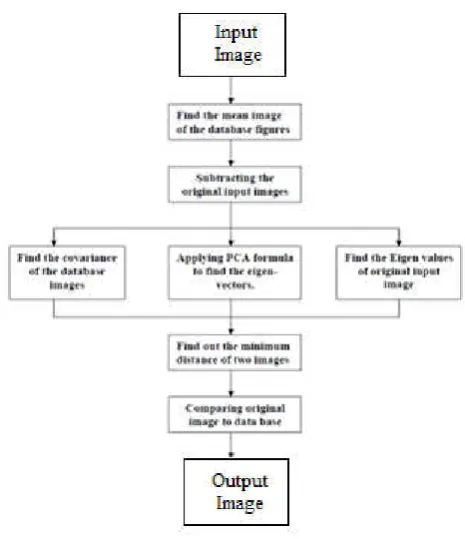
Step 1) Form a face database that consists of the face images of known individuals.
Step 2) Choose training set that includes a number of images (M) for each person with some variation in pose and different faces.
Step 3) Calculate the M x M matrix L, find its Eigen vectors and Eigen values, and choose the M’Eigen vectors with the highest associated Eigen values.
Step 4) Combine the normalized training set of images to produce M' Eigen faces.
Step 5) Store these Eigen faces for later use.
Step 6) For each member in the face database, compute and store a feature vector.
Step 7) Choose a threshold value e that defines the maximum allowable distance from any face class. Optionally choose a threshold f that defines the maximum allowable distance from face space.
Step 8) For each new face image to be identified, calculate its feature vector and compare it with the stored feature vectors of the face library members.
Step 9) If the comparison satisfies the threshold for at least one member, then classify this face image as "known", otherwise a miss has occurred and classify it as "unknown" and add this member to the face library with its feature vector.
[image:3.595.314.547.447.717.2]
Fig. 2. Face Recognition Proposed System for PCA
C. Benefits of PCA
No data redundancy as components is Orthogonal.
With help of PCA, complexity of grouping the images can be reduced.
Application of PCA in the prominent field of criminal investigation is beneficial.
PCA also benefits entrance control in buildings, access control for computers in general, for automatic teller machines in particular, day-to-day affairs like withdrawing money from bank account, dealing with the post office, passport verification, and identifying the faces in a given databases.
D. PCA Features
PCA computes means, variances, covariance’s, and correlations of large data sets
PCA computes and ranks principal components and their variances.
Automatically transforms data sets.
PCA can analyze datasets up to 50,000 rows and 200 columns.
E. RESULTS
F
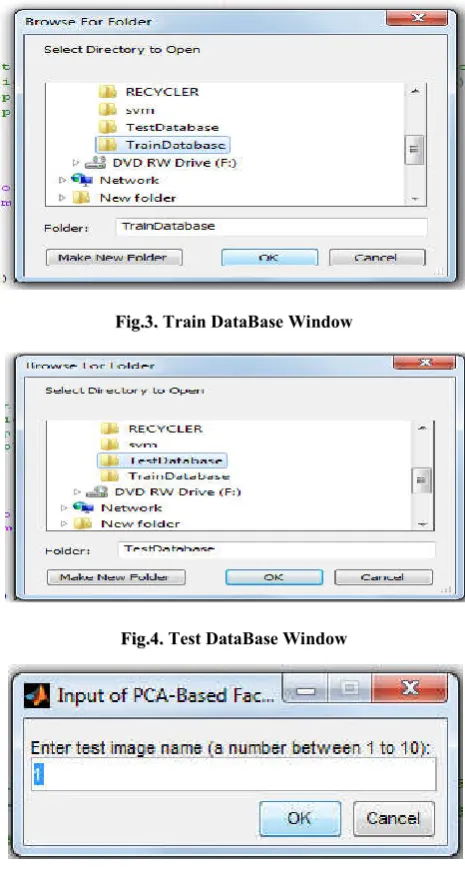
Fiigg..33.. Train DataBase Window
F
[image:4.595.315.545.44.501.2]Fiigg..44.. Test DataBase Window
Fig.5. Input of PCA-Based Face Recognition System Window
2D Image to 1D Column Vector Mean
22 Covariance Matrix
Deviation
[image:4.595.318.554.55.266.2]Eigenvalues EigenVector
Fig. 6. Result Window
Test Image Equivalent Image
23
Output On Command Window
Fig 7. Test image, equivalent image and command window
III. Face Verification across age progression
A. Introduction to Face Verification across Age Progression
[image:4.595.45.278.340.775.2]Recognition (CVPR), 2006; Tsumura et al., 1999; Modeling
shape and textural variations in aging faces.” In International Conference on Face & Gesture Recognition (FG),
2008; Lanitis, 2008). Face verification across age has been subject to relatively little attention. Some previous work applies age progression for face verification tasks. When comparing two photos, these methods either transform one photo to have the same age as the other, or transform both to reduce the aging effects. One of the earliest works appears in Lanitis et al. (2002), where a statistical model is used to capture the variation of facial shapes over age progression. The model is then used for age estimation and face verification. Ramanathan and Chellappa (2006) use a face growing model for face verification tasks for people under the age of eighteen. This assumption limits the application of these methods, since ages are often not available. A recent work in Biswas et al. (1993) studies feature drifting on face images at different ages and applies it to face verification tasks. Other studies using age transformation for verification include (Geng et al., 2007; Singh et al., 2007; Wang et al., 2006; Park et al., 2008; Patterson et al., 2007). The above methods can be roughly categorized as generative methods since aging needs to be modeled. In fact, most of them use verification to evaluate the age modeling algorithm. While these methods explicitly address the aging issue, they usually require additional information about the images being compared, such as actual age. In addition, many landmark points are often used for modeling age progression or building statistical models. All the methods mentioned above use the 68 landmarks that are pre-labeled for each photo in the FGnet dataset (Face and gesture recognition working group, 2000). Furthermore, both age estimation and age simulation are still open problems and may bring instabilities to the generative methods. To avoid these problems, we study discriminative methods that directly tackle the face verification problem.
B. Related Work
The most related work for face verification across age progression is
“Face Verification Across Age Progression” by N. Ramanathan and R. Chellappa, IEEE, in 2006. (Ramanathan and Chellappa, 2006)
- Where the probabilistic eigenspace framework is adopted for face identification across age progression.
- Here instead of using a whole face, only a half face (called as a point five face) is used to alleriate the Non-uniform illumination problem.
- Eigen space technique and a Bayesian model combined to capture the intra-personal and extra- personal image difference.
“Evaluating the performance of face aging algorithm” by A. Linitis, IEEE, in 2008. (Evaluating the performance of face-aging algorithms, 2008)
- Where an eigenspace is used in combination with a statistical model on the FG-NET dataset and on MORPH dataset.
C. Task
The goal of the study is two-fold
Fig.4. 1. Typical images with age differences. Top row: scanned passport or visa photos. Bottom row: photos from the FG-NET Aging Database
[Face and gesture recognition working group, 2000]
To investigate representation and algorithms for verification.
To study the effect of age gaps and related issues (including image quality, spectacles & facial hair) on verification algorithms.
D. Challenges
The challenges of face verification across age progression are due to several sources.
The first source is the biometric change over years, including facial texture (e.g., wrinkles as on the forehead in Fig. 1(i)), shape (e.g., weight gain, Fig. 1 d-f), facial hair (mustache and beard, e.g., Fig. 1(a-c,kl)), presence of glasses (e.g., Fig. 1(d-e)), scars, etc.
The second source is the change in the image acquisition conditions and environment, including the illumination conditions, the image quality change caused by using different cameras, etc.
In addition, for images converted from non-digital photos, additional artifacts (e.g., saturation in Fig. 1(e)) sometimes appear due to scanning processes and sometimes the original photos are smudged. Some examples of these challenges are shown in Fig.4
E. Proposed Approach
The proposed approach tackle the verification by
Using Gradient Orientation Pyramid (Gaussian Pyramid) to capture the magnitude information of the image.
Combine with the Support Vector Machine (SVM), used as age classifier for providing excellent performance.
And the proposed approach used only FG-NET Image Data Base.
1.1Gaussian Pyramid
Aim: Develop representation to decompose image into
information at multiple scales, to extract features or structures of interest, to attenuate noise.
Input: Image I of size (2N+1)*(2N+1).
1.2. Gaussian Pyramid Presentation
The representation is based on 2 basics operations.
Smoothing: Smooth the image with a sequence of smoothing
filters each of which has twice the radius of the previous one.
Down sampling: Reduce image size by ½ after each
smoothing.
1.3 Gaussian Pyramid(Smoothing)
Operation 1) Smooth Image at N-1 Scales.
Operation 2) Down sample the smoothed image.
Fig.4.9. Gradient Orientation Pyramid of an Image
Smoothing and down sampling are combined into a single reduce function.
Fig.4.13. Gradient Orientation Pyramid of an Image using REDUCE function
IV. Support Vector Machine (SVM)
A. Introduction
It is a concept in computer vision for a set of related supervised learning methods that analyze data & recognize patterns used for classification & regression analysis. The foundations of
Support Vector Machines (SVM) have been developed by Vapnik (1995). Gaining popularity due to many attractive features, and promising empirical performance. SVM used as age difference classifier tat classifies face images of individuals based on age difference & perform face verification across age progression.
B. SVM applications
SVM has been used successfully in many real-world problems
Text categorization.
Image classification.
Bioinformatics (Protein classification, Cancer classification).
Hand-written character recognition
Pattern recognition.
C. Linear Classifiers
The classifier is a separating hyperplane.
Most “important” training points are support vectors; they define the hyperplane.
Fig.4.20. Data Classification with more margin
D. Properties of SVM
Flexibility in choosing a similarity function.
Sparseness of solution when dealing with large data sets - only support vectors are used to specify the
separating hyper plane.
Ability to handle large feature spaces
- complexity does not depend on the dimensionality of the feature space.
Over fitting can be controlled by soft margin approach.
Nice math property: a simple convex optimization problem which is guaranteed to converge to a single global solution.
Feature Selection.
E. Weakness of SVM
It is sensitive to noise
- A relatively small number of mislabeled examples can dramatically decrease the performance
It only considers two classes
- how to do multi-class classification with SVM?
Conclusion
separated face images decreases with age. The lesser the variations due to facial hair, facial expressions and glasses on age separated face image, the better the success of the age-difference classifier. With more training data, the proposed approach can be used in applications such as automated
renewal of passport images. The Eigen face approach provides a practical solution that is well fitted for the
problem of face recognition. It is fast, relatively simple, and works well in a constrained environment. Certain issues of robustness to changes in lighting, head size, and head orientation, the tradeoffs between the number of Eigen faces necessary for unambiguous classification are matter of concern.
REFERENCES
——, “Evaluating the performance of face-aging algorithms.” in International Conference on Face & Gesture Recognition (FG), 2008.
——, “Modeling age progression in young faces,” in IEEE Conference on Computer Vision and Pattern Recognition (CVPR), vol. 1, 2006, pp. 387–394.
——, “Modeling shape and textural variations in aging faces.” in International Conference on Face & Gesture Recognition (FG), 2008.
“Face and gesture recognition working group,” 2000. (Online). Available: http://www-prima.inrialpes.fr/FGnet/ Alvarez, L., F. Guichard, P. L. Lions, and J. M. Morel,
“Axioms and fundamental equations of image processing,” Archive for Rational Mechanics and Analysis, vol. 123, no. 3, pp. 199–257, 1993. (Online).\Available:http://www.springerlink.com/content/t 6h8523k61074131
Bichsel, M. 1991. “Strategies of robust object recognition for the automatic identification of human faces,” Ph.D. dissertation, ETH Zurich.
Biswas, S., G. Aggarwal, N. Ramanathan, and R. Chellappa, “A nongenerative approach for face recognition across aging,” Biometrics: Theory, Applications and Systems, 2008. BTAS 2008. 2nd IEEE International Conference on, pp. 1–6, 29 2008-Oct. 1 2008. IEEE transactions on information forensics and security, VOL. xx, NO. xx, xxx 2010 9
Chang C.-C. and C.-J. Lin, “Libsvm : a library for support vector machines,” 2001. (Online). Available: http://www.csie.ntu.edu.tw/ cjlin/libsvm (2002) The IEEE website. (Online). Available: http://www.ieee.org/
Chen, H., P. Belhumeur, and D. Jacobs, “In search of illumination invariants,”in IEEE Conference on Computer Vision and Pattern Recognition (CVPR), vol. 1, 2000, pp. 254–261.
Dalal N. and B. Triggs, 2005. “Histograms of oriented gradients for human detection,” in IEEE Conference on Computer Vision and Pattern Recognition (CVPR), vol. 1, pp. 886–893.
Fu Y. and T. S. Huang, 2008. “Human age estimation with regression on discriminative aging manifold,” IEEE Transactions on Multimedia, vol. 10, no. 4, pp. 578–584. Geng, X., Z.-H. Zhou, and K. Smith-Miles, 2007. “Automatic
age estimation based on facial aging patterns,” IEEE Trans. Pattern Anal. Mach. Intell., Vol. 29, no. 12, pp. 2234–2240. Guo, G., G. Mu, Y. Fu, and T. S. Huang, 2009. “Human age estimation using bio-inspired features,” in IEEE Conference on Computer Vision and Pattern Recognition
(CVPR), Access Control (MAC) and Physical Layer (PHY) Specification, IEEE Std. 802.11, 1997.
Guo, G., Y. Fu, C. R. Dyer, and T. S. Huang, 2008. “Image-based human age estimation by manifold learning and locally adjusted robust regression,” IEEE Transactions on Image Processing, vol. 17, no. 7, pp. 1178–1188.
Hammond D. K. and E. P. Simoncelli, 2005. “Nonlinear image representation via local multiscale orientation,” Courant Institute Technical Report, New York University, Tech. Rep. TR2005-875.
Jonsson, K., J. Kittler, Y. Li, and J. Matas, 2002. “Support vector machines for face authentication,” Image Vision Comput., vol. 20, no. 5-6, pp. 369–375.
Kwon Y. H. and N. da Vitoria Lobo, 1999. “Age classification from facial images,” Computer Vision and Image Understanding, vol. 74, no. 1, pp.1–21.
Lanitis, A. 2008. “Comparative evaluation of automatic age-progression methodologies,” EURASIP J. Adv. Signal Process, vol. 8, no. 2, pp. 1–10.
Lanitis, A., C. Draganova, and C. Christodoulou, 2004. “Comparing different classifiers for automatic age estimation,” IEEE Trans. Syst Man Cybern B Cybern, vol. 34, no. 1, pp. 621–628, February.
Lanitis, A., C. J. Taylor, and T. F. Cootes, 2002. “Toward automatic simulation of aging effects on face images.” IEEE Trans. Pattern Anal. Mach. Intell., vol. 24, no. 4, pp. 442–455.
Ling, H., S. Soatto, N. Ramanathan, and D. W. Jacobs, 2007. “A study of face recognition as people age,” in Proceedings of the International Conference on Computer Vision (ICCV’07).
Lowe, D. G. 2004. “Distinctive image features from scale-invariant keypoints,” Int. J. Comput. Vision, vol. 60, no. 2, pp. 91–110.
Mart´ınez, A. M. 2002. “Recognizing imprecisely localized, partially occluded, and expression variant faces from a single sample per class.” IEEE Trans. Pattern Anal. Mach. Intell., vol. 24, no. 6, pp. 748–763.
Moghaddam B. and A. Pentland, 1997. “Probabilistic visual learning for object representation,” IEEE Trans. Pattern Anal. Mach. Intell., vol. 19, no. 7, pp. 696–710.
Moghaddam, B., W. Wahid, and A. Pentland, 1998. “Beyond eigenfaces: Probabilistic matching for face recognition.” in International Conference on Face & Gesture Recognition (FG), pp. 30–35.
Montillo A. and H. Ling, 2009. “Age regression from faces using random forests,” in IEEE International Conference on Image Processing, to appear.
Park, U., Y. Tong, and A. K. Jain, 2008. “Face recognition with temporal invariance: A 3d aging model.” in International Conference on Face & Gesture Recognition (FG).
Patterson, E., A. Sethuram, M. Albert, K. Ricanek Jr., and M. King, 2007. “Aspects of age variation in facial morphology affecting biometrics.” In Biometrics: Theory, Applications and Systems, BTAS, 2nd IEEE International Conference on, pp. 1–6.
Phillips, P. J. 1999. “Support vector machines applied to face recognition,” in Advances in Neural Information Processing Systems 16 (NIPS), vol. 2, pp. 803–809. Phillips, P. J., H. Moon, S. A. Rizvi, and P. J. Rauss, 2000.
Pittenger J. B. and R. E. Shaw, 1975. “Aging faces as viscal-elastic events: Implications for a theory of nonrigid shape perception,” J. of Exp. Psychology: Human Perception and Performance, vol. 1, no. 4, pp. 374–382.
Ramanathan N. and R. Chellappa, 2006. “Face verification across age progression,” IEEE Transactions on Image Processing, vol. 15, no. 11, pp.3349–3361.
Ricanek Jr. K. and T. Tesafaye, 2006. “Morph: A longitudinal image database of normal adult age-progression,” in Seventh IEEE International Conference on Automatic Face and Gesture Recognition (FG 2006), 10-12 April 2006, Southampton, UK, pp. 341–345.
Singh, R., M. Vatsa, A. Noore, and S. K. Singh, 2007. “Age transformation for improving face recognition performance,” in Second International Conference on Pattern Recognition and Machine Intelligence (PReMI), pp. 576–583.
Suo, J., S. Zhu, S. Shan, and X. Chen, 2009. “A compositional and dynamic model for face aging,” IEEE Trans. Pattern Anal. Mach. Intell., vol. 99, no. 5.
Suo, J., X. Chen, S. Shan, and W. Gao, 2009. “Learning long term face aging patterns from partially dense aging databases,” in Proceedings of the International Conference on Computer Vision (ICCV’09), pp. 622–629.
Tsumura, N., H. Haneishi, and Y. Miyake, 1999. “Independent component analysis of skin color image,” Journal of Optical Society of America A, vol. 16, pp. 2169–2176.
Tsumura, N., N. Ojima, K. Sato, M. Shiraishi, H. Shimizu, H. Nabeshima, S. Akazaki, K. Hori, and Y. Miyake, 2003. “Image-based skin color and texture analysis/synthesis by extracting hemoglobin and melanin information in the skin.” ACM Trans. Graph., vol. 22, no. 3, pp. 770–779. Vapnik, V. 1995. The Nature of Statistical Learning Theory.
New York, NY: Springer.
Wang, J., Y. Shang, G. Su, and X. Lin, 2006. “Age simulation for face recognition,” in 18th International Conference on Pattern Recognition (ICPR’06), pp. 913–916.
Yan, S., H. Wang, X. Tang, and T. S. Huang, 2007. “Learning auto-structured regressor from uncertain nonnegative labels,” in Proceedings of theInternational Conference on Computer Vision (ICCV’07).
Zhou S. K., B. Georgescu, X. S. Zhou, and D. Comaniciu, 2005. “Image based regression using boosting method,” in IEEE International Conference on Computer Vision (ICCV), vol. 1, pp. 541–548.
Zhao W., R. Chellappa, P. J. Phillips, and A. Rosenfeld, 2003. “Face recognition: A literature survey,” ACM Comput. Surv., vol. 35, no. 4, pp.399–458.