
ISSN Online: 1947-3818 ISSN Print: 1949-243X
DOI: 10.4236/epe.2019.112006 Feb. 27, 2019 92 Energy and Power Engineering
Temperature Stimulation of Effective Value of
Density of the Current of Semiconductor Solar
Cells
Aliev Rayimjon
1, Ikromov Rustamjon Gulomjonovich
2, Alinazarova Mahfuza Alisherovna
31Department of Physics, Andizhan State University, Andizhan, Uzbekistan
2Department of Physics, Namangan Engineering and Technology Institute, Namangan, Uzbekistan 3Department of Physics, Namangan State University, Namangan, Uzbekistan
Abstract
Influence of temperature on effective value of a current density of a semicon-ductor solar cell is investigated. New equations for explanation of dependence of photovoltaic characteristics of solar cell from temperature are received.
Keywords
Semiconductor Solar Сell, Effective Value of a Current, Temperature Dependence of Photovoltaic Parameters, Photovoltaic Characteristics
1. Introduction
The semiconductor photo-electric power takes a perspective place among set of renewable energy. Thus on a way of wide application of solar cells (SC) in power supply programs, there are some problems. Most considerable of them are the high cost price of solar energy and low efficiency of SC [1].
Semiconductor SC with high cost can be used without an exception in various special conditions. For example, at their use as an energy source of space flying devices, they are exposed to essential cooling [2]. At use of SC for conversation of the concentrated radiation is inevitable their strong heating [3]. Therefore, research of temperature properties of SC is one of important applied problems of a modern science.
Now is spent theoretical and experimental researches influence of ambient temperature on the cores Photovoltaic parameters of SC [2]. For interpretation of the temperature properties of SC defined experimentally scientists often ad-dress to the received by theoretical way laws. Thus quite often there are
inex-How to cite this paper: Rayimjon, A., Gulomjonovich, I.R. and Alisherovna, A.M. (2019) Temperature Stimulation of Effec-tive Value of Density of the Current of Semiconductor Solar Cells. Energy and Power Engineering, 11, 92-97.
https://doi.org/10.4236/epe.2019.112006
Received: October 23, 2018 Accepted: February 24, 2019 Published: February 27, 2019
Copyright © 2019 by author(s) and Scientific Research Publishing Inc. This work is licensed under the Creative Commons Attribution International License (CC BY 4.0).
http://creativecommons.org/licenses/by/4.0/
DOI: 10.4236/epe.2019.112006 93 Energy and Power Engineering
ciency of conversation of solar energy is effective power which is traditionally expressed by formula [1]:
m m m
P = j U (1) where Jm and Um are maximum (effective) values of according to photocurrent density and voltage.
Experimental results show that Jm and Um are depends on temperature. But in the scientific literature the expressions allowing preliminary to define these de-pendence almost are not presented.
Therefore in this work the results, the research conducted by us by a semi-empiric method definition of dependence of effective value of Jm and Um from temperature are stated.
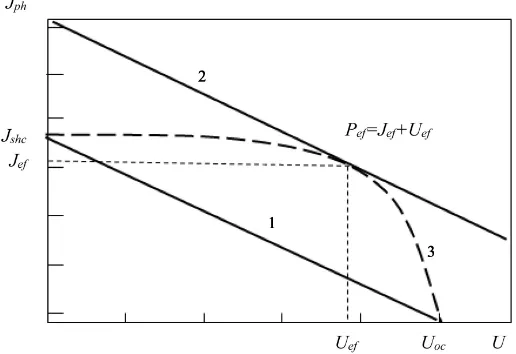
On Figure 1 the qualitative method of definition of a point of effective power, from experimental I - V (3-curve) of SC is shown. For this purpose in the begin-ning define a straight line passing through two points of I - V, voltage of idling and density of a current of short circuit, i.e. (Uoc whence are defined; 0) and (0;
Jsc) (1-straight line). By parallel shifting of this line to a effective point of SC I - V it is possible to receive a 2-straight line. From this I - V point defines effective power of SC. Being based on this method it is possible to deduce the formula for defining effective value of density of a photo current of SC developed.
As it is known the equation for a straight line which is passing through two points has the following appearance
1 1
2 1 2 1
j j U U
j j U U
− −
=
− − (2)
From this Equation (2) it is possible to receive for a 1-straight line (Figure 1):
sc sc oc
j
j U j
U
= − + (3)
It is visible that the angular factor of this straight line matters sc oc
j a
U
= − . For
DOI: 10.4236/epe.2019.112006 94 Energy and Power Engineering Figure 1. A method of definition of a point of effective power from experimental I - V of SC.
0 exp 1
ph eU sc
j j j
nkT
= − −
(4)
where jph—photocurrent density, j0—density of a saturation current, e—a elec-tron charge, k—constant of Boltzmann, T—temperature.
It is known that value of factor not idealities (n) of SC I - V is define by type of an electric current [4]. Therefore, it is possible to assume that leaving voltage of SC does not depend on this parameter. We define a derivative on pressure from SC I - V and we will find its value at U = Um then for and we will receive:
( )
0 exp mph m e eU
a j U j
nkT nkT
′
= = −
(5)
From a condition of parallelism of two straight lines, the angular factor of these lines should be identical:
0 exp
sc m
oc
j j e eU
U nkT nkT
=
(6)
From equality (6) for effective value of SC voltage (Um) we will receive:
0 ln sc m oc j nkT nkT U
e j eU
=
(7)
Substituting the expression, defining effective value of SC voltage (Um), we receive for effective value of density of a current:
0 exp m 1
m eU sc
j j j
nkT
= − −
(8)
0 1 m sc oc sc j nkT j j eU j = − −
(9)
DOI: 10.4236/epe.2019.112006 95 Energy and Power Engineering
perature of SC at not so low temperatures can be described in a kind:
0 T
ϕ ϕ= −γ (13)
where ϕ0—height of a potential barrier at temperature Т = 0, γ—temperature
factor of height of the potential barrier, having identical sense with temperature factor of width of the band gap [5]. Value ϕ0 can be defined, from the formula
(11), by extrapolating dependence of voltage of idling on temperature Uoc(T) to
T = 0 K. From a temperature dependence of width of the band gap knows that value of temperature factor of height of a potential barrier lies in an interval 10−3 ÷ 10−5 V/К [8].
3. Results & Discussion
On Figure 2 results of experiment (curve-1) and calculation (curve-2) the cur-rents of short circuit for SC which made on the base of AlGaAs-GaAs[1] re-ceived by (11) temperature dependence are presented. Conformity of results of experiment and calculation (section A) is received for dates: n = 1.0028; φo = 1.42 V and γ = 5 × 10⁻⁵ V/К. From drawing, it is visible that expression (11) not only explains results of experiences but also supplements them (Section A and C). Calculations have shown that short circuit currents of these SC at T = 500 K have a weak maximum (Jsc ≈ 122 mА), at temperatures more low T = 120 K and above T = 620 K start to decrease strongly. It is defined also that short circuit currents at temperatures T < 110 K and T > 770 K will be equal to zero (Jsc = 0). These results once again show correctness of the expressions received in works
[5] [6].
Now we pass to calculation of temperature dependence of effective value of SC current density. Delivering expressions for currents density of jo—saturation and
Jshc—short circuit, and Uoc—voltage of idling in (9) is possible to receive the formula defining temperature dependence of effective value of density of SC current.
DOI: 10.4236/epe.2019.112006 96 Energy and Power Engineering Figure 2. Dependence of density of a current of short circuit (mA) on temperature SC. 1-experiment [2] and 2-results of calculation from expression (11) when n = 1.0028; φo = 1.42 V and γ = 5 × 10⁻⁵ V/К.
Figure 3. Dependence of effective value of SC current density on temperature.
1-experiment [2] and 2-results of calculation received by expression (9) at n = 2.5; φo = 1.42 V and γ = 2 × 10⁻⁴V/K.
and γ = 5 × 10⁻⁵ V/К. It is visible that in the expressions received for tempera-ture dependence of short circuit current density and of current effective value from temperature has distinction only in values of I - V not ideality factor (n) of SC. This says that electric current type in these points of I - V differs from each other. From drawing it is visible that, as well as the density, and a short circuit current, and effective value of current density of SC have a weak maximum at T
[image:5.595.256.495.329.535.2]DOI: 10.4236/epe.2019.112006 97 Energy and Power Engineering
110 K and above T = 540 K (that follows because of equality to zero of effective value of current density of such SC).
Conflicts of Interest
The authors declare no conflicts of interest regarding the publication of this paper.
References
[1] Natarova, J.V., Gnatenko, A.S. and Galat, A.B. (2018) Research of Photo-Electric Converters on the Basis of Various Semiconductor Materials. Journal of Nano- and Electronic Physics, 10, 04023. (In Russian)
[2] Bjub, F.A. (1987) Solar Cells (the Theory and Experiment). М, Energoatomizdat, 278 p. (In Russian)
[3] Bavin, M.R. (2014) Development and Research of Refracting Photoelectric Installa-tions. The Dissertation on Competition of a Scientific Degree of Cand. Tech. Sci. a Speciality 05.14.08, Power Installations on the Basis of Renewable Energy. Moscow, 139 p. (In Russian)
[4] Zi, S. (1984) Physics of Semiconductor Devices. The Book 1, М, Mir, 456 p. (In Russian)
[5] Zaynobiddinov, S., Ikramov, R.G., Aliev, R., Ismanova, O.T., Niyazov, О. and Nu-ritdinova, M.A. (2003) Influence of Temperature on Photoelectric Characteristics of Solar Cells from Amorphous Silicon. Geliotecknica, №3, 19-22. (In Russian) [6] Aliev, R., Zaynobiddinov, С., Ikramov, R.G., Ismanova, O.T. and Nuritdinova, M.A.
(2003) An Estimation of Photoelectric Parameters of Solar Cells on the Basis of Amorphous Silicon. Geliotecknica, № 1, 18-22. (In Russian)
[7] Aliev, R., Alinazarova, M.А., Ikramov, R.G. and Ismanova, O.T. (2009) Features of Influence of Temperature on Photocurrent of Solar Cell, Created on the Basis of the Amorphous Semiconductor. Geliotecknica, № 3, 15-20. (In Russian)
![Figure 2. Dependence of density of a current of short circuit (mA) on temperature SC. 1-experiment [2] and 2-results of calculation from expression (11) when n = 1.0028; φo = 1.42 V and γ = 5 × 10⁻⁵ V/К](https://thumb-us.123doks.com/thumbv2/123dok_us/9100446.407193/5.595.256.495.329.535/figure-dependence-circuit-temperature-experiment-results-calculation-expression.webp)
