HAZARDS OF SOIL EROSION IN INDIA: A GROWING CONCERN
Department of Geography, The University of Burdwan, Burdwan
ARTICLE INFO ABSTRACT
In an agro
erosion/degradation of such valuable resource is a major environmental concern. According to a report of the NCEPC, India was losing more
terms of major nutrients
loss is many times more. So, the first and foremost task must be to identify the areas of major c as well as required measures to check the damages. Soil conservation is especially critical in India because of its spatial and temporal nature of rainfall. Spatially, annual rainfall varies from 10 to 1,000 centimeters. Temporally, 70% of the annua
June and September. Under these handicaps, India produces crops on more than half of its total land area. The problems of soil erosion in India are varied and complex, which needs urgent and increas attention.
Copyright © 2015 Jana. This is an open access article distributed under the Creative Commons Att and reproduction in any medium, provided the original work is properly cited.
INTRODUCTION
Expanding human requirements and economic activities are putting ever-increasing pressures on finite soil/land resource. If human requirements are to be met in a sustainable manner, it is essential to move towards effective and efficient use of soil/land resources. Out of the total geographical area of India (about 329 m.ha), the area available for land use classification is only for 305 million hectare (m.ha). Thus, out of the 305 m.ha, 41 m.ha. is out of bounds for agricultural purposes. Of the remaining 264 m. ha, about 107.4 m.ha are degraded land. Out of this degraded land about 67.6 m.ha are subjected to wind and water erosion, waterlogged area is estimated to be about 3.20 m.ha and 2.38 m.ha are affected due to shifting cultivation. The total degraded forest is about 30.70 m.ha, which accelerates soil erosion. This situation indicates that soil erosion is a growing concern for an agro
like India. Soil erosion may be defined as the wearing down of land surface and removal of loosened rock materials and soils by natural agents. Erosion is the main cause of degradation of most Indian soils. Natural or normal geologic erosion erosion of land in its natural state by natural agents, undisturbed by human activity. Accelerated soil erosion place when the ecosystem is additionally disturbed by human intervention and sometimes by animals. The soil forming factors also aid soil erosion under disturbed conditions.
*Corresponding author: Jana, N. C.
Department of Geography, The University of Burdwan, Burdwan-713104, West Bengal, India.
ISSN: 0975-833X
Article History:
Received 23ed April, 2015 Received in revised form 21st May, 2015 Accepted 20th June, 2015 Published online 31st July,2015
Key words:
NCEPC, N, P, K
Citation:Jana, 2015. “Hazards of soil erosion in India: A growing concern
18698-18706.
RESEARCH ARTICLE
HAZARDS OF SOIL EROSION IN INDIA: A GROWING CONCERN
*Jana, N. C.
Department of Geography, The University of Burdwan, Burdwan-713104, West Bengal, India
ABSTRACT
In an agro-based country like India, land is by far the most valuable asset. The continuous erosion/degradation of such valuable resource is a major environmental concern. According to a report of the NCEPC, India was losing more than 6,000 million tones of topsoil per year in 1972 in terms of major nutrients-N, P, K, which alone represented an annual loss of Rs. 700 crores. Today the loss is many times more. So, the first and foremost task must be to identify the areas of major c as well as required measures to check the damages. Soil conservation is especially critical in India because of its spatial and temporal nature of rainfall. Spatially, annual rainfall varies from 10 to 1,000 centimeters. Temporally, 70% of the annual rainfall occurs during a four
June and September. Under these handicaps, India produces crops on more than half of its total land area. The problems of soil erosion in India are varied and complex, which needs urgent and increas attention.
is an open access article distributed under the Creative Commons Attribution License, which and reproduction in any medium, provided the original work is properly cited.
Expanding human requirements and economic activities are increasing pressures on finite soil/land resource. If human requirements are to be met in a sustainable manner, it is essential to move towards effective and efficient use of esources. Out of the total geographical area of India (about 329 m.ha), the area available for land use classification is only for 305 million hectare (m.ha). Thus, out of the 305 m.ha, 41 m.ha. is out of bounds for agricultural purposes. Of 264 m. ha, about 107.4 m.ha are degraded land. Out of this degraded land about 67.6 m.ha are subjected to wind and water erosion, waterlogged area is estimated to be about 3.20 m.ha and 2.38 m.ha are affected due to shifting forest is about 30.70 m.ha, which accelerates soil erosion. This situation indicates that soil erosion is a growing concern for an agro-based country Soil erosion may be defined as the wearing down of land surface and removal of loosened rock materials and soils by natural agents. Erosion is the main cause of degradation of
normal geologic erosion is the
its natural state by natural agents,
Accelerated soil erosion takes
place when the ecosystem is additionally disturbed by human intervention and sometimes by animals. The soil forming
rbed conditions.
Department of Geography, The University of Burdwan,
When the ecosystem is disturbed, the balance between soil development and soil removal is greatly upset and the removal is faster than that of formation. This marks the beginning of the hazards of erosion.
Soil erosion is a serious problem in India. According to an estimate, soil erosion is taking place at the rate of 16.35 t/ha/annum, which is more than t
n 11.2 t/ha. About 29% of the total eroded soil is lost permanently to the sea. Ten percent of it is deposited in reservoirs. The remaining 61% is dislocated from one place to the other (Dhruba, Narayana and Babu, 1983).
Types, Processes and Regional Variations of Soil Erosion in India
The FAO/UNEP Project on “Soil Degradation” has prepared a list of seven types of soil erosion such as water erosion, wind erosion, glacial erosion, damage due to the excess of salts, chemical degradation, biological degradation and fertility erosion. All these are very active in Indian situation.
Although the effects of chemical and biological degradation as well as fertility erosion are felt strongly but their exact quantification has not been made so far in India. Different types, processes and regional variations of soil erosion in Indian context are discussed below (De and
International Journal of Current Research
Vol. 7, Issue, 07, pp.18698-18706, July, 2015
INTERNATIONAL
Hazards of soil erosion in India: A growing concern”, International Journal of Current Research
HAZARDS OF SOIL EROSION IN INDIA: A GROWING CONCERN
West Bengal, India
based country like India, land is by far the most valuable asset. The continuous erosion/degradation of such valuable resource is a major environmental concern. According to a than 6,000 million tones of topsoil per year in 1972 in N, P, K, which alone represented an annual loss of Rs. 700 crores. Today the loss is many times more. So, the first and foremost task must be to identify the areas of major concern as well as required measures to check the damages. Soil conservation is especially critical in India because of its spatial and temporal nature of rainfall. Spatially, annual rainfall varies from 10 to 1,000 l rainfall occurs during a four-month period i.e. between June and September. Under these handicaps, India produces crops on more than half of its total land area. The problems of soil erosion in India are varied and complex, which needs urgent and increased
ribution License, which permits unrestricted use, distribution,
When the ecosystem is disturbed, the balance between soil development and soil removal is greatly upset and the rate of removal is faster than that of formation. This marks the beginning of the hazards of erosion.
Soil erosion is a serious problem in India. According to an estimate, soil erosion is taking place at the rate of 16.35 t/ha/annum, which is more than the permissible value of 4.5 1-n 11.2 t/ha. About 29% of the total eroded soil is lost permanently to the sea. Ten percent of it is deposited in reservoirs. The remaining 61% is dislocated from one place to the other (Dhruba, Narayana and Babu, 1983).
s, Processes and Regional Variations of Soil Erosion in
The FAO/UNEP Project on “Soil Degradation” has prepared a list of seven types of soil erosion such as water erosion, wind erosion, glacial erosion, damage due to the excess of salts, chemical degradation, biological degradation and fertility
hese are very active in Indian situation.
Although the effects of chemical and biological degradation as well as fertility erosion are felt strongly but their exact quantification has not been made so far in India. Different types, processes and regional variations of soil erosion in
t are discussed below (De and Ghosh, 1993).
INTERNATIONAL JOURNAL OF CURRENT RESEARCH
Water Erosion
Water erosion is the most spectacular and destructive form of soil erosion in India. There are several types of water erosion:
Stream-Bank Erosion: Rivers are active in eroding their
banks, especially in the rainy season. During sudden floods, stream-bank erosion becomes very much evident, particularly at curves. Within the last 100 years, the Koshi River of Bihar has changed its courses westward by about 65 miles. In the past, River Damodar has caused severe stream-bank erosion while spilling over. Most of the rivers flowing through the Great Plains, particularly the Lower Bengal Rivers are often engaged in stream-bank erosion. This type of erosion is also known as riparian erosion.
Seashore Erosion: This type of erosion gets momentum
through striking effects of the strong sea-waves. The coastal parts of Gujarat, Maharashtra and Kerala are very much affected by this type of erosion. Out of the 380 miles of the Kerala coast, about 200 miles has been threatened by seashore erosion in which the worst affected places are Quilon and Aleppy.
Splash Erosion: This erosion is caused by the splashing of
soil through falling raindrops. The velocity of raindrops may be as high as 30 kph. On sloping land, splash may cause considerable soil movement. Splash can breakdown the soil aggregates and clogged the pores of surface soil with finer particles, thereby retarding water infiltration into the soil and increasing surface runoff. Splash erosion is very common in northern India, Bihar, West Bengal, Orissa, northeastern parts particularly Assam, Meghalaya, Tripura.
Sheet Erosion: Removal of soil in thin layer by rain from the
entire surface of a large area, which is particularly observed on gently sloping land. This type of erosion is common in Himalayan foothills, northeastern parts of the Peninsula, Assam, Western and Eastern Ghats, N-E hills including Shillong plateau, Mikir hills, Nagaland, Manipur and Tripura.
Rill Erosion: It is such type of erosion in which runoff
water-laden soils flows along the slopes forming small finger-like channels. This is an intermediary stage between sheet and gully erosion. Mainly the northeast Indian States and mid-Indian States like Madhya Pradesh, southwestern U. P., eastern Rajasthan, eastern Orissa and north eastern Maharashtra are subjected to intensive rill erosion.
Gully Erosion: With the increase in volume of concentrated
runoff and increase in velocity on slopes, the rills are enlarged into gullies - the most destructive form of soil erosion in India. At an advanced stage, gullies are transformed into ravines, which are about 50 ft. to 100 ft. deep. The common areas of gully erosion are ‘Chos’ of northern Haryana and Punjab, badlands of Madhya Pradesh, Rajasthan and Uttar Pradesh.
It is estimated that more than 37,00,000 hectares of agricultural lands in India have been rendered wastelands due to intense rill and gully erosion. Soil erosion through rill and gully erosion has assumed alarming dimension in Uttar Pradesh (12,30,000
hectares), Madhya Pradesh (6,83,000 hectares), Bihar (6,00,000 hectares), Rajasthan (4,52,000 hectares), Gujarat (4,00,000 hectares), Punjab (1,20,000 hectares), West Bengal (1,04,000 hectares), Tamil Nadu (60,000 hectares) and Maharashtra (20,000 hectares).
Slip Erosion: Landslides are the main causes of slip erosion.
It is often caused by rainwater soaking into the soil and earthy material on a steep slope. Their weight is much increased and they become more mobile. Large masses of soil are bodily slipped down and damage the field and habitats. This is mainly common in Himalayan slopes and some slopes of Nilgiri and Western Ghats.
Wind Erosion
Wind erosion is the movement and loss of soil by the action of wind. It is mainly found under dry conditions, areas with high velocity of wind and lack of vegetation. In the north Indian plains and the desert, there is a continuous period of strong dusty winds called ‘Loo’ from late March to early June, which are most effective in soil erosion. Wind erosion is also triggered by the destruction of natural vegetation cover of land by over-felling and over-grazing.
The areas severely affected by wind erosion are western and northern Rajasthan comprising of the districts of Jodhpur, Jaisalmer, Bikaner, Kotah, Jaipur, Bharatpur and some parts of northern Gujarat. The Rajasthan desert, which is affected by severe wind erosion, covers an area of about 207,200 sq. km. The areas moderately affected by wind erosion are found in Punjab, Haryana, and western Uttar Pradesh surrounding the Rajasthan desert. Slight wind erosion is evident in semi-arid parts of some south Indian states where rainfall is less as well as soil is dry and friable in nature.
The newer alluvial soils of the north Indian states are also affected by slight wind erosion. According to a report of the
National Committee on Environmental Planning and Coordination (NCEPC), irrational use and mismanagement of
land and water resources in India has led to an environmental threat of alarming state. According to the Tiwari Committee, out of the total land area of 304 million hectares in India, about 175 million hectares are exposed to various kinds of degradation, the main causes of which are water and wind erosion and water-logging. Water and wind erosion alone has affected 150 million hectares of fertile land. It may, however, be pointed out that the total cultivated area in India is only 169 million hectares, but the amount of degraded land is more than all our arable land put together (Sharma, 2002-2003).
Glacial Erosion
India has a large area under snows and glaciers, which are found in the Himalayas. In winter, when the ice expands, disintegration of rocks and erosion of soil/land take place. During summer, the melted glaciers flow through mountain slopes, cause erosion in the valley bottoms and valley sides. Thus, continuous glacial erosion is found in the upper and middle Himalayas, Karakoram Range etc. (Map No. 1)
Degradation Due to Excess of Salts
Excess of salts in soil damage the soil structure, which is ultimately responsible for soil removal and quality deterioration. This type of soil degradation is evident in the Kutch region of Gujarat and surrounding lands, some parts of
Rajasthan, the coastal Sundarban of West Bengal as well as some other coastal tracts of Tamil Nadu and Kerala. Some drier lands with a very low underground water table receive effervescence of sodium salts, which also causes soil degradation.
D. R. Khullar, 2000
Chemical Degradation
This is the most harmful type of soil degradation in which chemical matters are washed away or leached out of the soil profile. Both the processes of chemical degradation, i.e. washing of chemical matters (macro and micro nutrients) from the field by surface runoff as well as the leaching of chemical matters through percolating water are very common in north India, particularly eastern and northeastern parts where rainfall is quite higher than other parts of the country.
Biological Degradation
This is the deterioration of soil quality due to the bad effect created by plants, animals and human being. The burrowing animals like ants, rabbits, pigs, rats etc. cause much erosion of soils in almost every part of India. Plant roots cause maximum soil erosion mainly on the slopping hilly terrain of the Himalayas, Western Ghats, Nilgiri hills etc.
Intensity of human activities may be considered to be a major factor of soil quality deterioration in the present decade, for example, deforestation. The mining areas of the Chotanagpur belt, Madhya Pradesh, Karnataka, West Bengal, Rajasthan and other states are also susceptible to biological degradation.
Fertility Erosion
It is the loss of plant nutrients by erosion, which is evident in all the agricultural tracts of the country where rainfall is sufficient to remove soil nutrients either through soil movement or without any movement of soils. It has been estimated that the total annual loss of soil nutrients in India is of the order of 5.37 million tonnes of N. P. K.
Other Forms of Erosion
There are some specialized forms of erosion, which also deteriorate the soil quality as given below:
Pedestral erosion, which results when a stone or tree root
protects the soil from splash erosion removing the surrounding soil. This is mainly found in the hilly slopes of India.
Pinacle erosion, which occurs in gullies due to the widening
of deep vertical rills until pinnacles are left in the gully bed. This is very common in the gully and/or ravine tracts of India.
Piping is also a form of erosion in which formation of
continuous pipes and channels underground and erosion through them are most common. This is often formed in agricultural lands.
Slumping is a process of geological erosion. It occurs
(excepting the gullies, river banks and coasts) with human interference. This type of erosion is found in ravine lands of north India mainly along the north Indian rivers as well as western and eastern coasts.
In an agro-based country like India, land is by far the most valuable asset. The continuous erosion/degradation of such
valuable resource is a major environmental concern. According to a report of the NCEPC, India was loosing more than 6,000 million tones of topsoil per year in 1972 in terms of major nutrients-N, P, K, which alone represented an annual loss of Rs. 700 crores. Today the loss is many times more. So, the first and foremost task must be to identify the areas of major concern as well as required measures to check the damages (Sharma, 2002-2003).
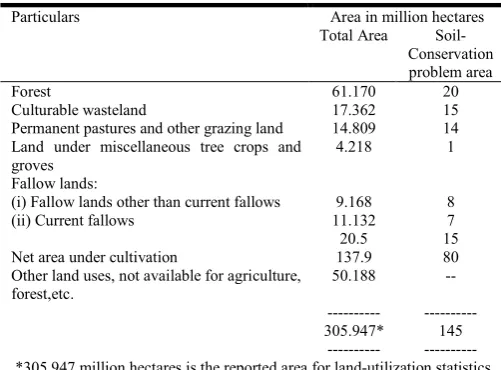
In India, there is very little area free from the hazard of soil erosion. It is estimated that out of 305.9 million hectares of reported area, 145 million hectares is in need of conservation measures.
In India, differential nature and magnitude of soil erosion contributes to increasing wastelands. In the country, wastelands statistics indicate that about 63.85 million hectares, which account for 20.17 per cent of the total geographical area (328.72 million hectares), exist as wastelands in the country. Table-1 shows category-wise wastelands of different states in India. If we go through the table cited here, we will find that the different states represent the predominance of different categories of wastelands depending on their physico-ecological settings (Map. 2, Courtsey: NRSA).
Methods of Soil Conservation
Soil conservation means the rational use of land. Actually it is the use of land with the limits of economic probability, as per its capabilities and needs in order to keep it permanently productive. There are mainly two methods of soil conservation (De and Ghosh, 1993).
Agronomic Practices
Strip Cropping: This type of cultivation consists of
erosion-enhancing crops such as maize, bajra, etc. in alternate strips with erosion-checking crops like pulses, grasses etc. This prevents the soil and water flow as well as increases the moisture-holding capacity of the soil.
Crop Rotation: A good rotation of crops including densely
cultivated small grains, legumes along with the main crops (paddy, wheat, tobacco, potato etc.) check the soil erosion.
Plantation of Cover Crops: Cover crops like grasses,
barseem, groundnut etc. provide a canopy to the falling raindrops and help in maintaining good soil drainage as well as making good soil structure and checking soil erosion.
Use of Organic Manures: Mixing of organic manures to
the soil help to form good soil structure (e.g. granular, crumby), which reduce erosion by increasing the permeability of soil.
Mulching: Ploughing the soil without turning the furrow
and leaving the stubble on the surface increases infiltration, reduces evaporation and provides good protection to soil wasting.
Agrostological Practices
Dense grasses bind the soil through roots, increase water retention capacity and improve soil structure thereby protecting soil from erosion.
Map 2: Wastelands Atlas of India
They may also be used to protect bunds, waterways, badlands and gully lands. Different types of grasses act differently, e.g., Dub (Cynodon dactylon) prevents runoff water, Kudzu vine controls gully erosion, Kans (Sachharum spontaneum) checks stream bank erosion as well as Dinanath (Pennisetum pedicellatum) protects bunds and water outlet.
Mechanical Methods/Engineering Practices
Mechanical methods/engineering practices are used to control the movement of water and wind over the soil surface, which are normally employed in conjunction with agronomic measures as follows:
Contour Tillage: On sloping lands, cultivation is done at
right angles to the slope, thus it holds water and reduces soil erosion.
Contour Bunding: In this method, the sloping land is broken
up into smaller, level compartments by constructing earthen embankments on contours, which reduces water erosion.
Terracing: Flat platforms are constructed on slopes to
control the runoff or to divert water along the channels on the terraces, thus checking soil erosion.
Narrow Terraces: These are series of terraces cut along the
slope. For example, in the foothill slopes of north India, having moderately deep soils, paddy as well as some strip crops are grown in narrow terraces.
Diversion Ditches or Channel Dams: In case of pastures on
steeper slopes, contour furrows serve as water diversion channels, woodlots and pastures at the bottom slopes or on the hillside may serve as outlets for various channels. Grassed waterways and sometimes, concrete waterways have proved to be ideal channels for water diversion. Uncontrolled channel cutting may be prevented through the construction of temporary dams and then plantation of sod as well as other vegetation is done to minimize the action of flowing water.
Basin Listing: Cutting of small basins at regular intervals on
sloping lands control the surface runoff.
Water Harvest: The places suitable for storing water like
ponds, tanks or reservoirs are recommended, which control flood and reduce soil erosion.
Pan Breaking and Sub-Soiling: These permit good water
percolation and infiltration as well as minimize runoff and erosion.
Trash Tillage, Wind Breaks and Stabilization of Sand
Dunes: These three methods are generally used in arid region
to check wind erosion.
Soil Conservation in India: An Urgent Need
Soil conservation is especially critical in India because of its spatial and temporal nature of rainfall. Spatially, annual rainfall varies from 10 to 1,000 centimeters. Temporally, 70% of the annual rainfall occurs during a four-month period i.e. between June and September. Under these handicaps, India produces crops on more than half of its total land area. The problems of soil erosion in India are varied and complex, which needs urgent and increased attention (Arakeri and Donahue, 1984).
[image:6.595.307.558.188.373.2]The problem of conserving soil and moisture is also of very great importance in the extensive regions of low and uncertain rainfall, forming parts of Punjab, Madhya Pradesh, Maharashtra, Andhra Pradesh and Karnataka. These tracts are characterized by scanty, ill-distributed and highly erosive rains, undulating topography, high wind velocity and generally shallow soils. The period of heavy downpours from August to October is the period of the heaviest erosion in these regions (Table 2).
Table 2. Problem of conservation of land and water in India
Particulars Area in million hectares Total Area
Soil-Conservation problem area
Forest 61.170 20
Culturable wasteland 17.362 15 Permanent pastures and other grazing land 14.809 14 Land under miscellaneous tree crops and
groves
4.218 1
Fallow lands:
(i) Fallow lands other than current fallows 9.168 8 (ii) Current fallows 11.132 7 20.5 15 Net area under cultivation 137.9 80 Other land uses, not available for agriculture,
forest,etc.
50.188 --
--- --- 305.947* 145
--- --- *305.947 million hectares is the reported area for land-utilization statistics
out of a geographical area of 328.809 million hectares
India is a country of diversified physical, climatic and socio-economic phenomena. In each physiographic unit the soil/land is eroded in different manner under different environmental situations. So, to check the magnitude of soil/land erosion as well as to protect the environment for future sustainable development, the soil/land conservation is urgently needed. In India, different types of soil/land erosion can be checked by adopting mechanical methods or by biological methods and or in some cases through both the methods (De and Ghosh, 1993).
Control of Water Erosion
Stream Bank Erosion Control: Measures to reduce stream
bank erosion are of two types, which make the floods less damaging as well as make the banks more resistant to erosion. These are:
Controlling Stream Flow: To deflect the water away from
the vulnerable points, it is essential to control meandering to protect stream bank, highways, railways and other nearby structures.
Protecting the Bank: Plants suitable for vegetative control
including grasses and mechanical measures like wood and concrete mattresses, rock or stone, asphalt and sacked or monolithic concrete etc. are necessary to protect the banks against erosion. Stream bank erosion is common mainly in north India.
Seashore Erosion Control: Generally soil and
sand-binding trees are planted to obstruct the ocean currents and thus reducing sea bank erosion. Sometimes embankments or bunds of stones, iron pillars and concrete structures are used to check the seashore erosion.
Puddle Erosion Control: Prevention and reduction of
falling raindrops are the measures to control puddle erosion control. Plantation of cover crops and grasses as well as admixture of organic matter and stubble mulch to soil is the common measures for conservation.
Gully Erosion Control: Several measures can be taken to
check gully erosion, which are generally found in deep alluvial soils. These are:
Construction of bunds for water diversion
Construction of check dams and plantation of suitable vegetation and grasses to control the velocity of running water along the gullies.
Closure of the gullies and prevention of the entrance of animals into it.
Landslip Erosion Control: Generally walls are constructed
to check or reduce landslip erosion. Dams and weirs are constructed to control this type of erosion. The walls are made considering the water pressure, soil condition, slope of the land etc.
Control of Silt Deposition: Deposition of silt within the
reservoirs of the multi-purpose projects may be controlled through the construction of check dams and/or other structures at necessary points as well as plantation of forests around the affected reservoir.
Control of Wind Erosion
The measures are necessary for controlling wind erosion as follows:
Vegetal Cover: To stabilize the soil, proper vegetal cover is
of utmost necessity.
Conservation of Moisture: If the soil is kept moist, there is
little danger of wind erosion. Ploughing during rainy season, leveling, terracing, bunding, and water harvesting help to conserve moisture.
Stubble Mulching: Presence of stubble mulch in the soil has
been proved to be effective in controlling wind erosion.
Trash Tillage: Tillage system that leaves the clods and trash
at the surface reduces wind erosion because they are not easily blown away.
Organic Matter: Use of organic matter in improving soil
structure and reducing wind erosion is an effective measure. Crop residues are also kept in the field for this control.
Control of Overgrazing: Plantation of suitable grasses
accompanying with simple mechanical devices like furrowing and trenching in the necessary points are suitable conservation practices in the grazing lands.
Control of Deforestation: Deforestation is to be checked
immediately to control wind erosion on the affected lands.
Strip Cropping: Strips or rows of erosion-resistant crops are
to be frequently alternated with erosion-permitting crops. In the arid zones of India, grass strip of Lasiurus sindicus has been found to be most effective barrier to wind erosion.
Rough Surface: If the surface is left rough during high
winds, the intensity of erosion is reduced.
Barriers: Any type of obstruction reduces the length of
eroding surface. But artificial barriers such as board walls, stonewalls etc. are very expensive.
Shelterbelts / Windbreaks: Rows of trees and shrubs along
the field margins should be planted as well as be maintained to reduce the wind velocity.
Stabilisation of Sand Dunes: To save the agricultural lands
surrounding the deserts, stabilisation of sand dunes by soil-binding vegetation is necessary. For this purpose, creeping grasses as well as drought-resistant trees like cashew nut/screw pine/acacia Arabica/agave americana/andropogon laniger etc. are cultivated.
The adoption of the UN Convention on Desertification by many members of the United Nations is evidence of the growing political commitment to the cause of safeguarding the biological potential of the soil. Now, the Government has to provide the required technological and financial support for halting further desertification as well as rehabilitating the drought prone areas. The influx of environmental refugees from rural to urban areas and across nations will increase in intensity, unless the loss of rural livelihoods due to land degradation, deforestration and drying of water sources is prevented. Therefore, conservation and sustainable and equitable management of land, water and forest resources are local, national and global imperatives (Planning Commission, 2001).
Control of Soil Salinity / Alkalinity
This type of soil deterioration can be controlled by the following measures:
Leaching: If the irrigation water itself is saline and contains
certain amount of salts, more water will be required to bring down the soil salinity to the desired level.
Water Treatment: Fresh water may be used to reduce the
salinity of soil. There should be a good drainage system in the affected fields.
Manuring: Green manuring, green-leaf manuring, as well as
crop residues through production of CO2 and organic acids neutralizes high pH of soil.
Gypsum Treatment: Gypsum is to be applied along with
leaching, which improves permeability and facilitates leaching of soils and reduces soil deterioration.
Use of Fertilisers: Chemical fertilisers like ammonium
sulphate, zinc sulphates etc. are added to conserve these soils.
Cropping Pattern: The best cropping pattern for saline-sodic
soils of India is Dhaincha-paddy-wheat/barseem/sugarbeet.
Conservation in Irrigated Lands
Cultivation of favourable crops, adoption of good plantation methods, use of suitable irrigation methods such as check method, flooding method, border method, corrugated method etc. is very common and useful conservation measures.
Conservation of Lands Damaged by Shifting Cultivation
Control of Fertility Erosion
This type of erosion is controlled by the following measures: (i) vegetal cover, (ii) mulching, (iii) strip cropping, (iv) mixture of organic matter, (v) use of chemical fertilisers in infertile soils, (vi) good tillage, (vii) bunding, (viii) terracing, (ix) outlet channel, (x) proper irrigation, (xi) scientific soil, water and crop management practices.
Control of Unscientific Methods of Construction
Faulty construction as well as poor management of the railways, roadways and waterways causes severe erosion, which may be checked through proper construction, scientific management and adequate plantation of trees.
Conclusion
Over-use, misuse and under-use of soil are the main causes responsible for soil erosion/land degradation. In fact, the land cannot be expanded; but population is rising and exerting pressure on the land beyond its carrying capacity. The biotic pressure results in soil erosion/land degradation of various types - be it physical, chemical and biological. Accurate assessments for soil erosion/land degradation have not yet been completed, though a beginning has been made. Protective cover of the natural forest is declining due to increasing urbanization and industrialization leading to the loss of valuable biodiversity. Common property resources on which the rural poor survive are highly degraded and encroached upon. The land base per person is shrinking; posing the challenge of maintaining the soil health while obtaining more and more from less and less area and quality of land (fig.1). The task should be to reduce soil erosion/land degradation under the present patterns of land use, biotic pressure, state of technology and investment.
Attempts have been made to develop soil loss equations from values of parameters influencing soil erosion under a set of conditions like slope, climate, rainfall, crop management and conservation practices. One such is the Universal Soil Loss
Equation (Brady and Well, 2002):
The combined SL factor may be calculated from the graph according to USDA Soil Conservation Service. The values of some of the factors obtained under the soil and climatic conditions of India are as follows:
K factor – 0.3 for silty clay loam soil at Dehra Dun, 0.34 for lateritic soil of South India, 0.059 for alluvial soil of Baroda;
C factor – maize 0.73, wheat 0.73, moong 0.465, groundnut 0.374, cowpea 0.317, potato-potato 0.82, potato-barley 0.93, potato-fallow 0.83;
P factor – contour cultivation 0.321, bench terracing 0.076 (Biswas and Mukherjee, 1987).
Efforts of pursuing research in this regard have also been made at the institutional level.
Fig.1. Soil Erosion affects Land Use and Rural Development
The Central Soil and Water Conservation Research and Training Institute at Dehradun (Uttaranchal), undertakes many programmes like erosion control, waste/degraded land development, rainwater management, watershed management, training in soil and water conservation and watershed management etc. The Indian Council of Agricultural Research (ICAR), New Delhi; National Bureau Soil Survey & Land Use Planning (NBSS & LUP), Nagpur; Central Arid Zone Research Institute (CAZRI), Jodhpur and Central Soil Salinity Research Institute (CSSRI), Karnal are the premier institutes of the country devoted to soil and land research. In addition, some NGOs like Bhoovigyan Vikas Foundation and Society for Promotion of Wastelands Development, New Delhi are engaged in the study of soil/land deterioration and sustainable management. Besides, the Agricultural Universities as well as the PG Departments of various Universities especially Geography, Chemistry and Environmental Science are pursuing research studies in this particular field.
REFERENCES
Arakeri, H. R. and Donahue, Roy 1984. Principles of Soil
Conservation and Water Management, Oxford & IBH
Publishing Co., New Delhi.
Bennet, H. H. 1955. Elements of Soil Conservation, McGraw-Hill Book Company Inc. New York, Toronto, London.
Biswas, T. D. and Mukherjee, S. K. 1987. Textbook of Soil
Science, Tata McGraw-Hill Publishing Company Ltd.,
New Delhi.
Brady, N. C. and Well, R. R. 2002. The Nature and Properties
of Soils, Pearson Education Pvt. Ltd., Singapore.
De, N. K. and Ghosh, P. 1993. India: A Study in Soil
Geography, Sribhumi Publishing Company, Calcutta.
Dhruva V. V. Narayana and Ram Babu 2003. “Estimation of Soil Erosion in India”, Irrig. and Drain. Engrg. Volume 109, Issue 4, pp. 419-434 (November/December 1983) http://www.krishiworld.com/html/soil_water_con9.html Hudson, Norman 1984. Soil Conservation, ELBS, London ICAR 1961, 1987. Handbook of Agriculture, New Delhi. Khullar, D. R. 2000. India: A Comprehensive Geography,
Kalyani Publishers, New Delhi
Planning Commission, Govt. of India 2001. Report of the Task
Force on Greening India for Livelihood Security and Sustainable Development, July-2001.
Rama Rao, M. S. V. 1962. Soil Conservation in India, ICAR, New Delhi.
Raychaudhuri, S. P. 1966. Land and Soil, National Book Trust, New Delhi.
Sharma, P. D. 2002-2003. Ecology and Environment, Rastogi Publications, Meerut.
Singh, Savindra 1991. Environmental Geography, Prayag Pustak Bhavan, Allahabad.
The Pulse of Indian Agriculture, Krishiworld (Source: www.krishiworld.com)
Wastelands News, Vol. XXI, No. 4, May-July 2006, New
Delhi
Wastelands News, Vol. XXII, No. 1, August-October 2006,
New Delhi