z
RESEARCH ARTICLE
EFFECT OF GROWTH MEDIUM COMPOSITION ON EARLY GROWTH AND DEVELOPMENT OF
THREE VARIETIES OF PEPPER SEEDLINGS
1,*
Lawal, B. A.,
2Ojo, M. A.,
2Jolaoso, M. A.,
1Ilupeju, E. A. O. and
1Akanbi, W. B.
1
Department of Crop Production and Soil Science, Ladoke Akintola University of Technology, Ogbomoso, Nigeria
2Raw Material Research and Development Council, Abuja, Nigeria
ARTICLE INFO ABSTRACT
Organic pepper production seems to be a solution in most urban and peri-urban areas in Nigeria. Production of health transplant is the major operation in pepper production. However, due to farmers’ shallow knowledge of the preparation and/or the use of organic substrates, this activity is still at low patronage. Three pepper varieties (NHA1 – Sombo, NHB1 - Bawa and Rodo) and five substrates formulation [100% soil; 100% tithonia compost (TC); 75% soil + 25% TC; 50% Soil + 50% TC; 25% Soil + 75% TC by weight] were tested in an experiment laid out in completely randomized design with six replicates. The chemical properties of the substrates, seeding growth parameters and nutrient uptake of the tissue were evaluated during the experiment to identify which among the growth media and pepper varieties is the best. The results showed that, irrespective of the variety, 100% TC substrate produced the best growth, highest dry matter yield and highest nutrient uptake seedling. The results obtained with this growth medium were consistently similar to those observed with the use of 25% Soil + 75% TC growth medium. The economic analysis equally showed that farmers return is higher with the use of 25% Soil + 75% TC. The study concluded that combination of 25% Soil + 75% TC seemed to be optimum for production of health seedlings of pepper and that incorporation of organic fertilizer into sowing media ensured nutrient availability during the growth period.
Copyright © 2015 Lawal et al. This is an open access article distributed under the Creative Commons Attribution License, which permits unrestricted use, distribution, and reproduction in any medium, provided the original work is properly cited.
INTRODUCTION
Domesticated peppers could be broadly classified as sweet and hot types based on their level of pungency. Nutritionally, peppers are rich in vitamins particularly A and C. However, the supply and quality produced is inadequate due to the low productivity of the crop (Muthukrishnan et al.,, 1986). Despite its economic importance, growers are not in a position to produce good quality capsicums due to erratic behaviour of weather, the crops grown in open field are often exposed to fluctuating levels of temperature, humidity, wind flow among others which ultimately affect the crop quality and productivity adversely (Ochigbu and Harris, 1989). This necessitates sowing of pepper seeds and nurturing of the seedlings in the nursery before transplanting to the open field. The use of soil as nursery media is an age long practices. Because of its cheapness and availability, soil is a choice of nursery materials by peasant farmers for preparation of crop seedlings. However, Akanbi et al., (2002) noted its limitations due to its inherent low
*Corresponding author:Lawal, B. A.
Department of Crop Production and Soil Science, Ladoke Akintola University of Technology, Ogbomoso, Nigeria.
fertility, as a storehouse for pest, diseases and their propagules and poor physical components. These factors predispose crop seedlings to unfavourable environment and hence offer great set back to seedlings establishment on the field. One potential solution to this problem is the use of locally composted organic wastes that can serve as a partial or complete potting medium and nutrient source. In 2004, Sanchez-Monedero et al.,
reported that considerable research has been performed over the past two decades evaluating composts, derived from various feed stocks, as potting media constituents in vegetable and ornamental plant production. Earlier researchers have shown that composts can be used successfully as partial, and sometimes as complete substitutes for soil. However, in many of these studies, the nutrient contributions are not addressed because the composts are considered only as substrate alternatives to soil. The plant-available nutrient contribution, a characteristic of high importance to organic producers, is often presumed to be inadequate.
Improvement in development of the vegetative structure of crop seedling, dry matter production and accumulation as a consequence of crop waste compost application have been reported by many researchers. Safo et al. (1997) and Wange
ISSN: 0975-833X
Available online at http://www.journalcra.com
International Journal of Current Research
Vol. 7, Issue, 07, pp.17659-17664, July, 2015
INTERNATIONAL JOURNAL OF CURRENT RESEARCH
Article History:
Received 22nd April, 2015 Received in revised form 26th May, 2015
Accepted 19th June, 2015
Published online 28th July,2015
Key words:
Organic fertilizer, Growth substrates, Pepper seedling, Dry matter, Tissue content, Health transplant.
and Kale (2004) reported increase in crop dry matter as a result of organic fertilizer application in cowpea and garden eggs, respectively. Again, Shukla et al. (1987) and Prabhu et al.
(2003) observed bigger leaf area in bell pepper and garden egg, respectively as a result of application of organic fertilizer when compared to the use of inorganic fertilizers. These observations were attributed to the presence of balanced nutrition in organic fertilizer or composts.
In the recent time, the world is moving toward organic farming. One of the tenets of organic farming is the use of compost as nursery materials. Organic farming is not mere non-chemical agriculture, but it is a system integrating relations between soil, plant, water, soil micro flora and fauna. Organic farming helps in healthy soil, helps in proper energy flow in soil, crop, water environment systems, keeps biological life cycle alive and helps in sustaining considerable levels in yield (Lampkin, 1990). It is mainly based on principles of restoration of soil organic matter in the form of humus, increasing microbial population, skilful application of the factors contributing soil life and health and treating manures and compost in bio dynamic way (Pathak and Ram, 2003). Application of organics which is an important component in organic farming, apart from improving the soil physical, chemical and biological properties with direct impact on moisture retention, root growth and nutrient conservation, can also reduce the cost of producing healthy crop seedlings.
Organic farming of vegetables is most appropriate as most of the vegetables are consumed in the fresh form and pesticidal residues have adverse effect on human health. Capsicum being a high value crop, with a quest to harvest high yield in the modern capsicum cultivation, fertilizers and pesticides are being indiscriminately used. Nonetheless, information on organically cultivated pepper seedlings or capsicum fruits is rather scanty. Hence, the present study was undertaken to know the response of pepper seedlings to soil, organic substrates and their mixture with respect to its growth and tissue nutrient contents.
MATERIALS AND METHODS
This experiment was conducted at the Teaching and Research Farm of Ladoke Akintola University of Technology, Ogbomoso, Oyo state. Ogbomoso lies on latitude 8010' N and longitude 40 10' E with elevation of 390 m above sea level. The area had a bimodal rainfall pattern with April-July and September–November as wettest months. The mean daily maximum and minimum temperatures of the area were about 33 and 20oC, respectively. Top soil used for sole and soil-compost mixture growth media was collected from the research farm. The compost used for this study was Tithonia Compost (TC). It was prepared from Tithonia and poultry manure according to the method described by Akanbi (2002) and Adediran et al. (2003). Prior to use, the soil and compost were subjected to laboratory analysis to determine their physical and chemical composition.
Treatments and experimental design
The treatments consisted of three varieties of pepper and five different growth media composition. The pepper varieties used
are Sombo (V1); Bawa (V2); and Rodo (V3). The five growth media composition are:
T1 – 100% soil
T2 – 75% soil + 25% compost T3 – 50% soil + 50% compost T4 – 25% soil + 75% compost T5 - 100% compost
The factorial combination of the two factors gave 15 treatment combinations, which was replicated six times. Each treatment unit is made up of 6 kg of the treatment in a plastic bowl of about 60 cm in diameter used as media container. The plastic bowls were perforated at the base and plugged with cotton wool to control drainage and facilitate aeration. The treatments were laid out in complete randomize design (CRD). Two-four seeds of each pepper variety were sown into each pot. They were watered heavily immediately after sowing and subsequent watering is as needed. Weeding was by rouging out the weeds as they emerged. Insect pest control was achieved by spraying the seedling with Cypermetring at the rate of 1liter/ha. The seedlings were allowed to grow for a period of six weeks.
The following data were collected during the experiment.
a. Seed germination percentage
b. Seedling vigour at 6 weeks after sowing (WAS). Taking with rating scale of 1- 4; 1 = least firm and 4 = best vigour seedling
c. Growth parameters such as stem height and girth, number of leaves and leaf area all at 6 WAS.
d. Seedling dry matter yield, tissue nutrients content and uptake: To obtain these parameters, 3 seedlings were uprooted per treatment at 6 weeks old. They were dried to constant weight at 70 oC and weighed to obtain dry matter yield. Thereafter, they were milled and subjected to laboratory analysis to determine the tissue contents and Nutrient Uptake (NU). The NU was determined as a product of percentage tissue nutrient content and dry matter yield
Data collected were subjected to analysis of variance according to CRD as described by Gomez and Gomez (1984). Significant means were compared using Duncan Multiple Range test at 5% probability level.
RESULTS AND DISCUSSION
the 3 varieties. The higher percentage seed germination recorded with this treatment might be due to more favourable conditions provided by the compost, which enhances germination. According to Togun and Akanbi (2003) matured compost is friable, with good water holding capacity and favourable bulk density. All these favoured seed germination and early emergence compared with the use of soil. Again, it was observed that the higher the proportion of compost in the treatment the better the percentage seed germination. This is in line with report of Adebayo et al. (2011) on moringa seed germination. In the report, it was concluded that addition of organic materials in the sowing medium stimulated and culminated into higher percentage seed germination.
Table 1. Effects of growth medium composition on percentage seed germination of three varieties of Pepper
Growth medium composition Pepper variety Sombo
(NHA1) Bawa
(NHB1) Rodo Mean
100% soil 65.51 56.98 54.79 59.09c
75% soil + 25% compost 66.90 71.56 56.71 65.06b
50% soil + 50% compost 71.80 81.34 67.89 73.68ab
25% soil + 75% compost 82.92 80.78 75.65 79.78a
100% compost 87.51 90.20 81.45 86.39a
Mean 74.93a 76.17a 67.30b
Interaction: Variety x Medium: *
Means along the column with the same letter(s) are not significantly different from each other using Duncan Multiple Range Test at 5% probability level
Data collected on pepper seedling vigour in response to the applied treatments is as presented in Table 2. Irrespective of variety, the seedling vigour of plant sown in 100 percent compost consistently had higher value compared to the other treatments. The seedling vigour of plants planted in 100 percent compost is similar to that of 25 percent soil + 75 percent compost. The seedlings of the three pepper varieties had similar response in each of the growth media tested, however, Rodo x 100 percent compost gave the best interactive effect.
Table 2. Pepper seedling vigour+ in response to different variety and growth medium composition
Growth medium composition Pepper variety Sombo
(NHA1) Bawa
(NHB1) Rodo Mean
100% soil 1.5 1.5 1.0 1.3c
75% soil + 25% compost 1.5 1.5 1.5 1.5c
50% soil + 50% compost 2.0 2.5 2.5 2.3b
25% soil + 75% compost 3.5 3.0 3.5 3.3a
100% compost 3.5 3.5 3.8 3.6a
Mean 2.4a 2.4a 2.5a
Interaction: Variety x Medium: **
+
Seedling vigour taking with rating scale of 1- 4; 1 = least firm and 4 = best vigour seedling
The result of this study shows that compost contains more nutrients that are required for adequate growth and development of pepper seedlings. The better performance of seedlings sown in media with higher compost contents might be as a result of higher nutrients contained. This enhance uptake of both macro and micro nutrients required for crop seedling development (Adediran et al., 2003).
Applied treatments had significant effects on the vegetative parameters of pepper seedlings. The height of pepper seedlings
[image:3.595.37.288.236.333.2]was highly significantly influenced by variety, growth media composition and their interactions. Among the varieties, Sombo produced the tallest seedling, followed by Bawa while the shortest seedlings were observed with Rodo (Table 3). In case of growth medium composition, the use of 100 percent compost gave the tallest seedling (17.71 cm), followed by that of 25 percent soil + 75 percent compost (13.40 cm) while the least was obtained from pepper planted in 100 percent soil treatment. The interactive effect of the variety and growth medium was highly significant (P≤0.1) on seedling height, Bawa sown in 100 percent compost given the best value.
Table 3. Pepper seedling height (cm) at 6 weeks in response to variety and growth medium composition
Growth medium composition Pepper variety
Sombo (NHA1)
Bawa
(NHB1) Rodo Mean
100% soil 11.65 10.60 8.28 10.21c
75% soil + 25% compost 11.99 10.67 9.97 10.90c
50% soil + 50% compost 14.77 11.98 9.03 11.90b
25% soil + 75% compost 16.47 16.50 7.35 13.40b
100% compost 20.14 20.90 12.10 17.71a
Mean 15.01a 14.10b 9.30c
Interaction: Variety x Medium: **
Means along the column with the same letter(s) are not significantly different from each other using Duncan Multiple Range Test at 5% probability level
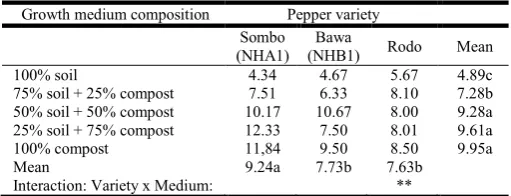
Data collected on per plant number of leaves of pepper seedling in relation to the applied treatment are presented in Table 4. Leaves production increased with increase in quantity of compost in the growth medium reaching peak at 100 percent compost. It should be noted that the number of leaves on pepper seedlings planted in 50, 75 and 100 percent compost are statistically similar and are significantly higher than what was recorded for the other growth media. Among the varieties, Sombo seedlings had the highest number of leaves per plant while Rodo had the least.
Table 4. Pepper seedling number of leaves at 6 weeks in response to different variety and growth medium composition
Growth medium composition Pepper variety
Sombo (NHA1)
Bawa
(NHB1) Rodo Mean
100% soil 4.34 4.67 5.67 4.89c
75% soil + 25% compost 7.51 6.33 8.10 7.28b
50% soil + 50% compost 10.17 10.67 8.00 9.28a
25% soil + 75% compost 12.33 7.50 8.01 9.61a
100% compost 11,84 9.50 8.50 9.95a
Mean 9.24a 7.73b 7.63b
Interaction: Variety x Medium: **
Means along the column with the same letter(s) are not significantly different from each other using Duncan Multiple Range Test at 5% probability level
The higher stem height observed with the use of medium that contain either 50, 75 or 100 percent compost show that compost application aided vegetative development of pepper seedlings in the nursery. But the superior performance of 100 percent compost treatment may be due to its higher nutrient contents. Compost used in this study consisted of tithonia biomass and poultry manure in ratio 3:1 by dry weight. With this, it contained many valuable materials that are needed for seedling development. This corroborates the report of Adani et al., (1997), where ability of compost to release nutrients slowly to the crop was fully stressed.
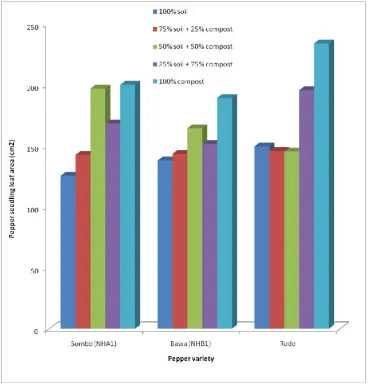
[image:3.595.305.561.507.605.2] [image:3.595.39.287.509.607.2]The leaf production of pepper seedlings as affected by variety and growth medium composition is presented in Fig 1. The responses of Bawa and Rodo to variation in component of the growth media were similar. In all, Rodo seedling nourished with 100 percent compost had the largest leaf area. In case of dry matter accumulation, pepper seedling dry matter was also significantly (P ≤0.05) affected by sowing their seeds in different growth media composition.
The bigger leaf area observed in the 100 percent compost and 25 percent soil + 75 percent compost treated seedlings could be attributed to increased uptake of nutrients by the plants leading to enhanced carbohydrate synthesis which might have resulted in increased cell division and enlargement, therefore, increased size of seedling leaf area. Similar observations have been made in bell pepper (Shukla et al., 1987) and in garden eggs (Prabhu et al., 2003). The increased uptake of plant nutrients supplied by compost resulted in improved vegetative structure development (Suthar et al., 2005). Balanced nutrition has been found to result in active cell division, cellelongation as well as development of meristematic tissues which consequently results in better development of vegetative parts of the plant. Seedling dry matter accumulation was also significantly affected by growing media and variety tried. The least seedling dry matter was found in the treatment that contained 100
[image:4.595.116.486.156.544.2]percent soil (Table 5). Among the varieties, Sombo and Rodo seedlings produced similar result, which are significantly higher than that of Bawa. The interactive effects of the two factors were significant with Rodo x 25 percent soil + 75 percent compost having the best. The increase in crop dry matter as a result of crop waste compost or organic fertilizer application has been reported in cowpea (Safo et al., 1997) and garden eggs (Wange and Kale, 2004).
Table 5. Pepper seedling dry matter yield (g/plant) at 6 weeks in response to different variety and growth medium composition
Growth medium composition Pepper variety
Sombo (NHA1)
Bawa
(NHB1) Rodo Mean
100% soil 1.05 1.23 1.25 1.18c
75% soil + 25% compost 1.38 1.31 1.59 1.43b
50% soil + 50% compost 1.79 1.63 1.34 1.59b
25% soil + 75% compost 1.86 1.42 1.88 1.72a
100% compost 1.96 1.90 1.62 1.83a
Mean 1.61a 1.49b 1.54a
Interaction: Variety x Medium: *
Means along the column with the same letter(s) are not significantly different from each other using Duncan Multiple Range Test at 5% probability level
[image:4.595.308.558.595.694.2]Increase in dry matter as a result of the use of compost could be attributed to balanced nutrient uptake by seedlings sown in media that contain compost.
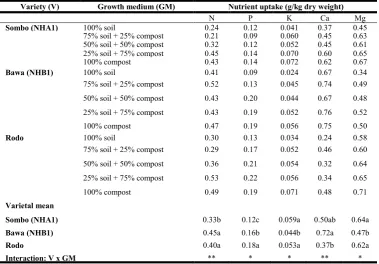
This enhanced cell division and enlargement and lead to better leaf number and area development and hence better capturing of radiant energy for the production, partitioning and accumulation of dry matter by pepper seedlings. Varietal differences were significant for uptake of macro nutrients by the pepper seedlings. Despite this, there was no defined pattern of nutrient uptake by the seedlings of the three pepper varieties. The N uptake of Rodo planted in 75 percent compost and 25 percent soil (0.53 g/kg dry weight) was the highest (Table 6) while Sombo had the least (0.21 g/kg dry weight). In case of P uptake, Rodo absorbed highest quantity (0.22 g/kg dry weight) and when planted in 75 percent compost and 25 percent soil. The K and Mg uptake by the pepper seedlings followed the same trend of having highest uptake in 100 percent compost growth medium while highest Ca uptake was in 75 percent compost and 25 percent soil. For K and Mg, Sombo and Rodo had 0.072 and 0.71 g/kg dry weight respectively as the highest uptake. In contrary, Bawa absorbed 0.76 g Ca/kg dry weight as the highest. Uptake of nutrients into the shoot of pepper seedlings was significantly affected by the growth media composition. The use of 100 percent compost gave the highest value for N uptake and the result was similar to the uptake recorded for other treatments with the exception of 100 percent soil. Across the growth media, Bawa seedling is the most efficient in Ca uptake but the contrary is the case with Mg uptake.
Conclusion
The nutrient composition of the various growth medium used in the study varied with its mixing proportion. From the results, it appears that combination of 25percent Soil + 75 percent TC seemed to be optimum for production of health seedlings of pepper and that incorporation of organic fertilizer
into sowing media ensured nutrient availability during the growth period.
REFERENCES
Adani, F., Genevini, P. L., Gasperi, F., and Zorzi, G. 1997. Organic matter evolution index (OMEI) as a measure of
composting efficiency. Compost Science & Utilization,
5(2), 53-62.
Adebayo, A. G; H. A. Akintoye, A. O. Olufolaji, O.O. Aina, M. T. Olatunji and A. O. Shokalu, 2011. Assessment of organic Amendments on Vegetative Development and Nutrient Uptake of Moringa oleifera Lam in the Nursery.
Asian Journal of plant Science, 10 (1): 74- 79.
Adediran, J. A, L. B. Taiwo and R. A. Sobulo 2003. Effcet of organic wastes and method of composting on compost maturity, nutrient composition of compost and yield of two vegetable crops. J. Sustainable Agric., 22: 95 – 109. Akanbi, W.B, Togun, A.O. and R.A Baiyewu, 2002.
Suitability of Plant Residue Compost as Nursery Growing medium for some Tropical Fruit tree seedlings. The Nigerian Journal of Forestry Vol. 31 (1&2): 1-6.
Akanbi, W.B. 2002. Growth, Nutrient uptake and Yield of maize and okra as Influenced by compost and Nitrogen fertilizer under different cropping systems. Ph.D. Thesis, University of Ibadan, Nigeria. 162pp.
Gomez, K. A., and Gomez, A. A. 1984. Statistical procedures
for agricultural research. John Wiley & Sons.
Lampkin, N. 1990. In : Organic Farming, Ipswich, U. K. Press Books, pp. 701-710.
[image:5.595.111.491.75.339.2]Muthukrishnan, C. R., Thangaraj, T. and Chatterjee, R. 1986. Chilli and capsicum. In: Bose TK, Som MG, editors. Vegetable Crops in India. Calcutta, India: Naya Prokash; p. 343–384.
Table 6. Nutrient uptake of seedlings three varieties of pepper in response to different growth medium composition
Variety (V) Growth medium (GM) Nutrient uptake (g/kg dry weight)
N P K Ca Mg
Sombo (NHA1) 100% soil 0.24 0.12 0.041 0.37 0.45
75% soil + 25% compost 0.21 0.09 0.060 0.45 0.63
50% soil + 50% compost 0.32 0.12 0.052 0.45 0.61
25% soil + 75% compost 0.45 0.14 0.070 0.60 0.65
100% compost 0.43 0.14 0.072 0.62 0.67
Bawa (NHB1) 100% soil 0.41 0.09 0.024 0.67 0.34
75% soil + 25% compost 0.52 0.13 0.045 0.74 0.49
50% soil + 50% compost 0.43 0.20 0.044 0.67 0.48
25% soil + 75% compost 0.43 0.19 0.052 0.76 0.52
100% compost 0.47 0.19 0.056 0.75 0.50
Rodo 100% soil 0.30 0.13 0.034 0.24 0.58
75% soil + 25% compost 0.29 0.17 0.052 0.46 0.60
50% soil + 50% compost 0.36 0.21 0.054 0.32 0.64
25% soil + 75% compost 0.53 0.22 0.056 0.34 0.65
100% compost 0.49 0.19 0.071 0.48 0.71
Varietal mean
Sombo (NHA1) 0.33b 0.12c 0.059a 0.50ab 0.64a
Bawa (NHB1) 0.45a 0.16b 0.044b 0.72a 0.47b
Rodo 0.40a 0.18a 0.053a 0.37b 0.62a
Interaction: V x GM ** * * ** *
Varietal Means for each nutrient with the same letter(s) are not significantly different from each other using Duncan Multiple Range Test at 5% probability level. ** and * = significant at 1% and 5% level, respectively.
Ochigbu, A. A. and Harris, G. P. 1989. Effect of film plastic cover on the growth and yield of bush tomato grown in a bed system. J. Hortic. Sci., 64 (1) : 61-68.
Pathak, R. K. and Ram, R. A. 2003. Organic farming systems prevalent in India. Nation. Symp. on Organic Farming in Horticulture for Sustainable Production, 29-30 August, Central Institute of Subtropical Horticulture, Lucknow, pp. 1-2.
Prabhu, M., Veeraraghavathatham, D., and Srinivasan, K.
2003. Effect of nitrogen and phosphorus on growth and
yield of brinjal hybrid COBH-1. South Indian Horticulture. 51(1-6), 152-156.
Safo E.Y., Ankomah A.B., Branford- Arthur J. 1997. Short communication: Palm bunch ash effects on growth of
cowpea and the characteristics of a Ghanaian soil.
African Crop Science Journal, 5(3):303-308.
Sánchez-Monedero, M. A., Roig, A., Cegarra, J., Bernal, M. P., Noguera, P., Abad, M., & Antón, A. 2004. Composts as media constituents for vegetable transplant production.
Compost science and utilization, 12(2), 161-168.
Shukla V.K., Srinivas K., Prabhakar B.S. 1987. Response of bell pepper to nitrogen, phosphorus and potassium
fertilization. Indian Journal of Horticulture, 44:81-84. Suthar M.R., Singh G.P., Rana M.K., and Lal M. 2005.
Growth and fruit yield of brinjal (Solanum melongena L.)
as influenced by planting dates and fertility levels.
Crop Research, Hisar. 30(1):77-79.
Togun, A. O. and Akanbi, W. B. 2003. Comparative effectiveness of organic-based fertilizer to mineral fertilizer
on tomato growth and fruit yield. Compost science and
utilization, 11(4), 337-342.
Wange S.S. and Kale R.H. 2004. Effect of biofertilizers under graded nitrogen levels on brinjal crop. Journal of Soils and Crops, 14(1):9-11.