EVALUATING CLIMATE AND INTERACTION
*
Victor Aeby, MS EdD, Tracy Carpenter
MSW M. Dawn Valentine
School of Social Work, East Carolina University, Carolina
ARTICLE INFO ABSTRACT
Groupwork is
outcomes. The purpose of this study was to deconstruct group development using common group assessments and comparing them to sociograms. Further, this study examined t
which interns in a field education learning unit experienced their own task group development in order to better implement groupwork with middle school students. The results indicated that individualistically
essential for the continuation of their internship and understanding of group dynamics.
Copyright©2016, Victor Aeby et al. This is an open access article distributed under the Creative Commons Att distribution, and reproduction in any medium, provided the original work is properly cited.
INTRODUCTION
Group work is an essential part of the social work profession and therefore, as a student learning to work in groups is vital to the existence of a social work academic program
profession. The fundamentals of learning to work with others in a group setting consist of several stages. These stages are inclusion/orientation, uncertainty/exploration, mutuality/goal achievement, and separation/termination. Throughout the process, the development of group cohesion and understanding group dynamics must be embraced in order to bond and formulate a successful group. These factors are necessary for achieving the goals of the group. The ability to work in groups may be determined by the success of these factors. Research demonstrates that students who learn to successfully work in groups may add more value to the social work profession, due to the necessity for collaboration and connection with others in the field. The purpose of this paper is to examine the process by which individual Social Work interns became a team while participating in a task group. The bond of the task group formed out of the necessity and desire to complete corrections for an Internal Review Board (IRB) appl
approval for implementing a Middle School Dropout
*Corresponding author: Victor Aeby, MS EdD, School of Social Work, East Carolina University, Carolina
ISSN: 0975-833X
Article History:
Received 21st March, 2016
Received in revised form 17th April, 2016
Accepted 28th May, 2016
Published online 30th June,2016
Key words:
Group Climate, Socio-Grams, Group Development
Citation: Victor Aeby, MS EdD, Tracy Carpenter
interaction in a field learning unit to enhance group work
RESEARCH ARTICLE
EVALUATING CLIMATE AND INTERACTION IN A FIELD LEARNING UNIT
TO ENHANCE GROUP WORK
Victor Aeby, MS EdD, Tracy Carpenter-Aeby, PhD, LCSW, Jacqueline Coleman
MSW M. Dawn Valentine-Barrow, MSW and Victoria C. Aeby, MSW
School of Social Work, East Carolina University, Carolina
ABSTRACT
Groupwork is routinely utilized in social work practice due to its economic value and evidence outcomes. The purpose of this study was to deconstruct group development using common group assessments and comparing them to sociograms. Further, this study examined t
which interns in a field education learning unit experienced their own task group development in order to better implement groupwork with middle school students. The results indicated that individualistically-oriented interns began functioning as a team. The teamwork component was essential for the continuation of their internship and understanding of group dynamics.
is an open access article distributed under the Creative Commons Attribution License, which distribution, and reproduction in any medium, provided the original work is properly cited.
social work profession and therefore, as a student learning to work in groups is vital to academic program and the profession. The fundamentals of learning to work with others in a group setting consist of several stages. These stages are inclusion/orientation, uncertainty/exploration, mutuality/goal achievement, and separation/termination. Throughout the ess, the development of group cohesion and understanding group dynamics must be embraced in order to bond and formulate a successful group. These factors are necessary for achieving the goals of the group. The ability to work in groups the success of these factors. Research demonstrates that students who learn to successfully work in groups may add more value to the social work profession, due to the necessity for collaboration and connection with others in his paper is to examine the process by which individual Social Work interns became a team while The bond of the task group formed out of the necessity and desire to complete corrections for an Internal Review Board (IRB) application to obtain
Middle School Dropout
School of Social Work, East Carolina University, Carolina.
Prevention Program. In addition, this internship involved developing an intervention for vulnerable clients (in this case, at risk middle school students and their families). As a result, it was necessary to receive external approval from the university IRB to evaluate client risks and discomforts, as well as benefits (for their protection). Therefore, the purpose of this project was to deconstruct group dynamics and cohesion, using group climate and socio-grams as an experiential learning process in a social work internship. The process of the group’s development took place out of the willingness of the group members to band together as a unit to accomplish the necessary goal. The group’s dynamics were varied, however, throughout the event the dynamic changed due to power redistribution as goals were redefined among team member Changes in group phase occurred when a participant entered or exited the task group. Although the goal, focus and determination to complete the task of Institutional Review Board (IRB) application revision remained the same, the group work was dynamic.
The Precipitating Event
Group members gathered research information concerning the dropout prevention rate within the county’s school system. After the fourth submission of the IRB, notice came from the board that over 40 changes needed to be made within a time Available online at http://www.journalcra.com
International Journal of Current Research
Vol. 8, Issue, 06, pp.33764-33771, June, 2016
INTERNATIONAL
Victor Aeby, MS EdD, Tracy Carpenter-Aeby, PhD, LCSW, Jacqueline Coleman-Carmon, MSW et al
in a field learning unit to enhance group work”, International Journal f Current Research, 8, (06), 33764-33771.
IN A FIELD LEARNING UNIT
Aeby, PhD, LCSW, Jacqueline Coleman-Carmon,
Barrow, MSW and Victoria C. Aeby, MSW
routinely utilized in social work practice due to its economic value and evidence-based outcomes. The purpose of this study was to deconstruct group development using common group assessments and comparing them to sociograms. Further, this study examined the parallel process in which interns in a field education learning unit experienced their own task group development in order to better implement groupwork with middle school students. The results indicated that unctioning as a team. The teamwork component was essential for the continuation of their internship and understanding of group dynamics.
ribution License, which permits unrestricted use,
Prevention Program. In addition, this internship involved intervention for vulnerable clients (in this case, at risk middle school students and their families). As a result, it was necessary to receive external approval from the university IRB to evaluate client risks and discomforts, as well as benefits ir protection). Therefore, the purpose of this project was to deconstruct group dynamics and cohesion, using group grams as an experiential learning process in The process of the group’s t of the willingness of the group members to band together as a unit to accomplish the necessary goal. The group’s dynamics were varied, however, throughout the event the dynamic changed due to power redistribution as goals were redefined among team members. Changes in group phase occurred when a participant entered or exited the task group. Although the goal, focus and determination to complete the task of Institutional Review Board (IRB) application revision remained the same, the group
Group members gathered research information concerning the dropout prevention rate within the county’s school system. After the fourth submission of the IRB, notice came from the board that over 40 changes needed to be made within a time
INTERNATIONAL JOURNAL OF CURRENT RESEARCH
span of 24 hours in order to have the research approved for implementation by the university. This situation created anxiety, frustration, and anger among participants. Although tensions were high, once the group came together with the common goal of obtaining approval, the team members were determined to work as a unit to complete the task.
The Group Climate
Interns were required to practice problem-solving skills while deciphering through the changes requested by the IRB office. Interns worked together to reach a common goal and work through their differences and differing opinions. In order for this to occur, a level of trust amongst the team members was necessary to ensure appropriate changes were made. Interns bonded with each other despite exhaustion throughout their group formulation to realize their common goal. Yalom’s theory of therapeutic factors worked best for the group of interns. According to Yalom (1995) “Among the 11 therapeutic factors identified, cohesion and interpersonal learning have been considered to be of particular importance to facilitating positive group outcomes.” According to Yalom, group cohesiveness is more likely to occur when there is trust, warmth, empathy and acceptance. Cohesion has been defined as “a group property with individual manifestations of belongingness or attraction to the group” (Lieberman et al., 1973:337). Cohesion in a group is an important factor with three variables contributing to it; those factors include attraction to individual members of a group, the instrumental value of the group, and risk-taking that occurs in the group. According to Lott and Lott (1961), various small group researchers assume that group cohesion is a function of the attraction group members has for one another. Very little data exists to show the relation of attraction to the group and attraction to individuals in the group. Despite the assumption that attraction to individuals in a group leads to group cohesion, practical evidence is lacking. Lott and Lott (1961) conclude the relationship between the concept of cohesion and instrumental value suggests the variation of group attraction is based on meeting participant’s needs and helpfulness to group members. Researchers confer cohesion is a function of instrumental value therefore a group with high instrumental value for its members is rewarding and arouses positive affect that yields liking or attraction (Lott & Lott, 1961, Lieberman,
et al., 1973, Yalom,1995). This value does not appear out of
thin air but rather through stages.
Stages of Group Development
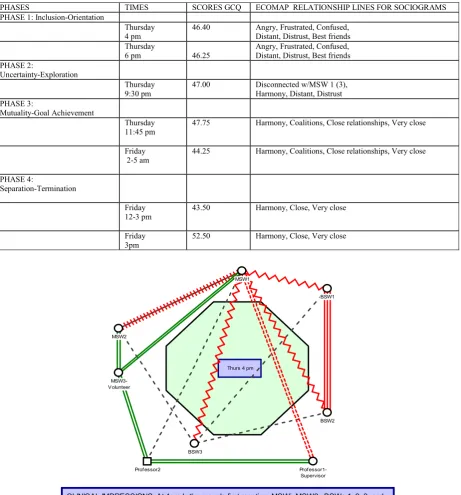
Group development is a very difficult concept to quantify. For that reason, the development of each stage the task group navigated is illustrated using socio-grams (See Figures 1-2). The Northen and Kurland Model “point out that each stage has its own developmental issues that must be attended to and at least partially resolved before the group can move into the next stage” (Zastrow, 2006, p. 17). Northen and Kurland described a four-stagemodel, which emphasized socio-emotional themes. The first stage was Inclusion-Orientation, which included group members feeling of inclusion in the process. Individuals may face anxiety and uncertainty as they met with the other members of the group and the group leader.
Uncertainty-Exploration was the second stage, which discussed group members’ uncertainty regarding issues of power and control. According to Zastrow (2006), “the socio-emotional issue pertains to conflict, especially in relationship to the group leader;” group members explored and tested their relationship with each other and the group leader in order to establish roles, and to develop trust and acceptance (p. 17). Mutuality- Goal Achievement was the third stage in Northen and Kurland Model which explained mutual aid and problem solving. During this stage, group members showed “greater self-disclosure, empathy, and mutual acceptance” (Zastrow, 2006, p. 17). Furthermore, group members came together to achieve individual and common goals; therefore conflict and differences are ways of coming to the goals. The fourth and final stage of the Northen and Kurland Model was Separation-Termination. Group members may have felt reluctant to leave the group and the group leader. Zastrow (2006) stated that the task of this stage was to “help prepare members for termination, deal with any unfinished business, and most importantly, help group members transfer what they have learned in group to life outside the group” (p. 18). Successful group work requires passage through each stage no matter how small.
Field Education Learning Units
The partnerships created between universities and social service agencies define the learning objects of the field education learning. Bernotavicz (1994) explained while the university educates, social service agencies deliver services and prepare students for the real life situations encountered as a professional working in the social services realm. Further, Bernotavicz (1994) suggested that tension is inevitable between what is taught in the classroom and what can be accomplished in direct social work practice. The conflict between theoretical and practical application in social work practice proves to be a challenge for students in field education learning.
Field education learning is imperative to prepare social workers for the professional atmosphere upon completion of their degree. Goldstein (2007) stated, “the field component always has been as an integral component of all professional social work programs, and it should not be diminished or diluted in any way” (p.22). By joining social work students with established professionals and practitioners through the field education learning process, the quality and availability of skilled social workers is improved (Bernotavicz, 1994). Simpson, Williams, and Segall (2007) described field education learning as “the primary opportunity for students to develop therapeutic skills by applying clinical social work knowledge” (p.9). “It is through case-oriented learning in the field that students are most likely to experience the epiphany offinally understanding how some aspect of theory or research or a practice model applies to a real person” (Simpson, Williams, Segall, 2007, p.10).
Group Work and Evaluation
Using socio-grams with group work has become synonymous with the practice of group work and small group research. Socio-grams represent and demonstrate the analysis and intimate relationships in group research. There are several advantages of using socio-grams to represent the social networks and relationships in a group. Although not much information about this theory has been researched or written about, socio-grams illustrate and explain the dynamics of groups in a way that the written word does not. Carpenter-Aeby, Carpenter-Aeby, & Boyd (2007) used socio-grams to define the relationships among participating systems such as family members, teachers, and communities. Furthermore, no single system is completely responsible for the group’s development or success.
Procedure
Participants
Participants were interviewed to join in a field education-learning unit combining a clinical and research placement in a dropout prevention program in a public middle school in southeastern NC. All participants listed on the IRB were social work students. Three students were candidates for a bachelor of social work and two interns and one student volunteer were working towards the completion of a master’s degree in social work. All participants were females with ages ranging from 21 to 27. Each participant completed SITI training modules for IRB training certification and had individually completed an IRB application for a separate research study under the direction of a research professor. Out of five participants invited to participate in this research, four elected to participate.
Interview format
Researchers gave participants eight blank ecomaps with an emotional relationship legend from the software program Genopro. Participants were asked to read the instructions provided by the researchers in the following script:“We want to know what made our program successful this semester. As we agreed in supervision, the night we completed the IRBapplication revisions seemed to be a turning point for everyone participating in this internship placement. We want to examine the turning point based on the Northen and Kurland Model of Group Development and sociograms. If you would like to participate in this research, please fill out the ecomaps using the provided legend and list the events as you recall them. Do not put your name or any indentifying marks on the ecomaps. If you elect not to participate, destroy these blank papers.” The eight ecomaps were synthesized into sociograms representing each of the four group development phases. Once researchers completed synthesizing the information, sociograms were provided to participants to member-check the information. Participants were asked to respond back to the researchers to verify if the feelings and events represented in the sociograms were accurately remembered and portrayed. If information was not accurate, participants were asked correct the sociograms, again omitting all identifying information.
The sociograms were used to represent the four stages in the Northen and Kurland Model. The multi-site dropout prevention IRB supported the use of a recollection proxy pretest design. Researchers compiled the corrections and events to create a timeline. Researchers examined the events and timeline using the Northen and Kurland Model of Group Development to determine if the stages occurred and when. If participants wanted to examine the results or read the final paper the email address of the primary researcher was provided. Upon participant review of the results changes based on participant feedback were made.
Instruments
Assessment of the dependent/outcome variable utilized the McKenzie group climate scale, socio-grams, and questionnaires. Each participant completed a McKenzie group climate scale and answered three questions concerning their thoughts on group development, trust, and cohesion several times throughout the event. Participants were surveyed each time a member entered, left, or re-entered the group. From the data provided by the climate scale, socio-grams were constructed to describe the emotional climate and relationships between each participant at the specified intervals of the evening.
McKenzie Scale
The McKenzie Scale Questionnaire is an instrument that utilizes information pertaining to feelings of a particular event or situation within a group. The Likert type scale uses numbers zero to six representing the following responses respectively: not at all, a little but, somewhat, moderately, quite a bit, a great deal, and extremely. There were a total of 12 questions ranging from how/whether members of the group cared about each other, if they revealed sensitive personal information or feelings, how they felt about what was happening, and how participants perceived the participation of self and others (See Table 1). The completion of this questionnaire produced a point of view regarding the emotional ties and relationships of the participants throughout the process. The McKenzie Scale provided the quantitative data for this research
Research design
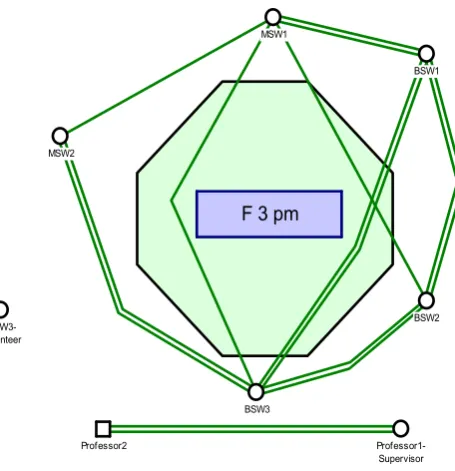
Researchers instructed participants that participation was voluntary. Students whom elected to voluntarily complete separate ecomaps illustrated the changes in group development during the 24-hour period when the IRB application was completed. The anonymously collected ecomapsrepresented each individual’s emotional and relational lines as they occurred at each of the four stages of group development. Researchers consolidated the individual ecomaps into one socio-gram per stage of development (See Figures 1-2). All participants and the research team were provided the ecomaps and sociograms to member check for accuracy and trustworthiness of the data, as well as identify group interventions at each stage of development.
Intervention
Participants at 12 different points throughout a 24 hour period completed the McKenzie Group Climate Scale. Participants completed questionnaires and time increments were attached when any member entered, left, or re-entered the group. Socio-grams were completed at five points throughout the evening at points of extreme emotional peaks and valleys (See Figure 1). Furthermore, faculty supervisors provided individual and group counseling to participants at each phase of group development to redefine goals and assist in formulating plans for task completion.
Ethical considerations
An ethical consideration to address was the trustworthiness of the participants. With such a small group (N=5) there could have been the risk of dignity and embarrassment due to uneasiness of displaying feelings about each other when having to work with each other the rest of the semester. Therefore participants’ feelings of vulnerability in answering the interview questions, although anonymous, may have caused participants to answer fallaciously. By using the research team and participants to member-check each phase of the process for accuracy, validity, and credibility trustworthiness was assessed. Researchers made participants feel involved in making decisions causing participants to feel more respected and valued yielding more dependable data (Zastrow, 2009, p.21). Furthermore since an all female groups are typically relational based, a feeling of safety situatesa woman’s group at a place of increased trust and self-disclosure in which expressing feelings can be done in such a way where risk of dignity or loss of value within the group (Zastrow, 2009, p. 253). Being female was not the only characteristic factor of the participants.
The task group making up the participants of the research were all students receiving credits and grades for participation in a field education learning class. An ethical consideration was the coercion of students by professors to participate in the research to assure internship placement and a superior grade. Professors saw participation by the task group as a process; therefore any involvement in the course work was deemed as a learning opportunity including the voluntary participation in the research. For example, one member of the task group chose not to participate in the research, which did not affect the student’s grade or internship placement.
Coercion was limited by giving participants a choice to participate with no penalties for not participating.
RESULTS
Socio-grams were created from the data retrieved from individual ecomaps, the McKenzie Group Climate Scale and the three open ended questions concerning trust, engagement, and group development. Participants completed questionnaires and then reflected upon the data throughout the evening when any member entered, left, or re-entered the group. As the task group meeting progressed, participants became agitated and tensions were high with the group.
Throughout this process, there were significant behavioral changes in the Northen and Kurland Four Phase model. Phase one, the inclusion orientation phase occurred from four o’clock to six o’ clock post meridian with McKenzie Group Climate Scale scores of 46.40 and 46.25 respectively (See Table 1). During phase one, participants demonstrated anger, frustration, confusion, distance, and distrust based on data collected using the ecomap relationship lines (See Figure 1). Phase two titled uncertainty exploration took place at half past nine post meridian. The McKenzie Score results were 47.00 during phase two (See Table 1). Data presented in ecomaps relationship lines represented participants in phase two exhibited disconnection, distrust, and discord. Through power redistribution among participants in phase three that was the mutuality-goal achievement phase and occurred from 11:45pm through 2:00am. McKenzie Scores were 44.25 and 47.75 and participants exhibited harmony, coalitions, and close relationships formed according to ecomaps relationship lines (See Table 1). Phase four, the separation termination phase, happened from noon to three o’clock post meridian with 43.50 and 52.50 McKenzie Group Climate Scores (See Table 1). Ecomap relationships showed at the time of the fourth phase participants had progressed to harmony and closeness (See Figure 2). Quantitative data was provided by the completion of the McKenzie Group Climate Scale by team members 12 times throughout a 24 hour period. Responses on the McKenzie Group Climate Scale were entered into SPSS to analyze data. This analysis revealed that the group climate began at a high level, decreased, increased, decreased, and then finally
increased again towards the finality of the project (See Table 1).
Table 1. An Examination of Phases of Group Development using Northen and Kurland Model and Times of Data Collection, Scores of the MacKenzie Group Climate Questionnaire (GCQ), and Ecomap Emotional Relationship Lines for the Sociogram
PHASES TIMES SCORES GCQ ECOMAP RELATIONSHIP LINES FOR SOCIOGRAMS
PHASE 1: Inclusion-Orientation
Thursday 4 pm
46.40 Angry, Frustrated, Confused,
Distant, Distrust, Best friends Thursday
6 pm 46.25
Angry, Frustrated, Confused, Distant, Distrust, Best friends PHASE 2:
Uncertainty-Exploration
Thursday 9:30 pm
47.00 Disconnected w/MSW 1 (3),
Harmony, Distant, Distrust PHASE 3:
Mutuality-Goal Achievement
Thursday 11:45 pm
47.75 Harmony, Coalitions, Close relationships, Very close
Friday 2-5 am
44.25 Harmony, Coalitions, Close relationships, Very close
PHASE 4:
Separation-Termination
Friday 12-3 pm
43.50 Harmony, Close, Very close
Friday 3pm
52.50 Harmony, Close, Very close
Figure 1. Inclusion/Orientation - 4:00 pm- Thursday
Thurs 4 pm
CLINICAL IMPRESSIONS: At 4pm In the group's first meeting, MSWi, MSW2, BSWs 1, 2, 3, and Professors 1 and 2 were present. The task group was beginning a project after receiving vital information at the last minute. MSW1 was leaving just as the group was beginning the task. At this time, interactions were mostly hostile with one being distrustful all aimed at the MSW1 who often served as the leader in the absence of anyone else stepping forward. BSW1 and BSW2 appeared to be fused, typically working as a single unit. Also present, MSW3-Volunteer (close friend of MSWs 1 and 2 and Professor2 and outsider to the group) may have served as a mediator and a calming influence in MSW1's absence. Other interactions were distant. Notably, the relationship between MSW1 and Professor1-Supervisor is characterized by discord and conflict.
Submitted by: DVB, Research Assistant Date: 7-12-10 From the perspective of: The Research Team
Emotional Relationships Legend
Distant / Poor Discord / Conflict
Friendship / Close
Hostile Distrust
Fused
BSW1
BSW2
MSW3-Volunteer
BSW3
Prof essor1-Supervisor Professor2
MSW2
In Patton’s 2002 study, it was shown that interviewers must be trained before asking questions in order to protect against any discrepancies. This supported the idea for standardized questions being the preferred instrument in creating the socio-grams.
DISCUSSION
Participants were interviewed and assigned to internships through the university field office. One Bachelors of Health Education, one Masters of Social Work and one Bachelors of Social Work intern along with their faculty field instructor prepared the initial IRB. The Masters of Social Work intern received notification that the university IRB required revisions. The faculty field instructor met with students to determine if the group was interested in pursuing the required revisions. The group decided to move forward with the revision process and input was provided. As the task group meeting progressed, participants became agitated and tensions were high within the group. Throughout this process, there were significant behavioral changes in the Northen and Kurland Four Phase model. These changes are summarized in Table 1.
The independent variable was considered the task group style. The team members worked interdependently to complete the specific task of obtaining IRB application approval, in order to implement an intervention program at a local public middle school. According to Alavi & McCormick (2008), high interdependence in early group stages is related to higher group efficacy in latter stages. The participants had previously worked independently of each other, posing an obstacle for group collaboration. However, this obstacle served as a catalyst for developing group cohesion that was sustained throughout the internship placement. Different motivations can lead to conflict and/or tension, yet conflict can be a beneficial in some scenarios. Traditionally, cooperation has been viewed as positive and conflict has been viewed as negative.
Current research reflects cooperation and conflict as a process (Dovidio, Saguy, &Shnabel, 2009). By overcoming adversity and conflict within the group, participants effectively worked together for the duration of the internship placement.
The cohesiveness of a group is its inclination to forge social bonds and interpersonal fondness, resulting in sticking together and remaining united. Data revealing the cohesiveness and climate of the group determined by the completion of the socio-grams, questionnaires, and McKenzie climate scale. The results suggest the possibility of a halo effect, through the high increase in harmony towards the end of the project, in which participants evaluated the group successfulness higher due to being relieved, that the project was completed. The development of the group was characterized through the four-stage Northen and Kurland model, which emphasizes socio-emotional themes. The four stages of this model in order of development are: inclusion-orientation, uncertainty-exploration, mutuality-goal achievement, and termination-separation. The participants formed a unique bond due to the IRB’ srequest for revisions of the IRB application throughout the approval process. The group’s determination to complete the given task of successfully gaining IRB approval was a common tie that bound the group together.
[image:6.595.185.413.48.284.2]The fourth request for revisions of the IRB application created a frustrated, edgy, and irritated group.“Of interest are social scientific program evaluators, many of whom seen extraordinarily sympathetic to IRB oversight but who also appear increasingly frustrated, annoyed, and upset by IRB decisions, inconsistencies, delays, and misunderstandings (Hessler, Galliher, and Reynolds 1983; Murray 1998; Niemonen 2000; Ross et al. 2000; Shea 2000; Timmermans 1995; Warren and Staples 1989).” (Oakes, 2002, p.445).The underlying theme for the creation and process of the task group was completing the IRB application in order for submission and review.
Figure 2. Separation/Termination – 3:00pm – Friday
F 3 pm
BSW1
BSW2
MSW3-Volunteer
BSW3
Professor1-Supervisor Professor2
MSW2
The task groups timeline projected quick approval process allowing the middle school dropout prevention program to begin. The IRB revisions included forty- two changes before resubmission for approval. The general consensus of the task group was to complete the revision as expeditiously as possible. Individuals were tense, emotions were high and fatigue played a major role in the participants’ mental capacity throughout the event. The participants’ relationships became stronger as the urgency and need to complete the revisions climaxed. A major component in completion of the IRB revisions was to dissect and delineate each question. Group members obtained the IRB approval to implement this program through a collaborative effort.
Conclusion
This group experience proved that with focus, dedication, a common goal, and tenacity any task can be achieved. Group members agreed this task was an egregious process that took the concerted group effort to navigate. During this process, group members had to remain focused on the goal for task completion. Individuals relied on each other’s strengths, points of view, and various experiences to complete this project.
Limitations
There were several limitations to this research project. First, each university’s IRB has its own set of rules and regulations and makes decisions based upon prior experiences and situations; therefore this research project cannot truly be replicated and has low rate of generalization. Also, qualitative data relies upon answers from participants, and researchers must assume that participants were being honest with their responses. According to Rubin and Babbie (2007), a limitation of pre-experimental design research includes the idea that causality cannot be determined due to possible external independent variables. Participants were chosen to contribute to this research through their decision to work in the middle school dropout prevention program as a social work internship placement; therefore there was no randomized selection of participants. According to Trochim (2006) a recollection proxy design is not a type of design one should use by choice. This type of design uses measures that approximate how one might have answered questions prior to the intervention. By using this type of design, participants may suffer memory lapses or distort their pretest answers, which produce inaccurate results and/or bias. However, this design is useful when researchers are determining what participants thought at the time rather than where participant actually were on the pretest (Trochim, 2006, http://www.socialresearchmethods.net/kb/quasioth.php). Another limitation to this study includes social desirability. Since the participants were in a field education learning unit, the participants may have selected answers to questions that reflected what the instructors/supervisors desired instead of what actually occurred.
Application for Social Work Practice
Social workers can use this experience to guide their therapeutic and treatment philosophy. They can utilize group development methods and studies while working with groups
of individuals, on both macro and micro levels. The process of group development aided social work interns with the transition from individual effort to working together as a team or field education learning unit. Personal and group development can be attributed to Bandura’s social learning theory through learning competencies while engaging in group work (Miller & Dollard, 1941). Social workers should be knowledgeable of group development and how to use sociograms to relate to group work. The usage of these items contributes heavily to group cohesion.
The cohesion of the group led to an achieved outcome that may have been unobtainable by the work of a single individual. The importance of working as a group to complete this task can be well defined by Helen Keller, “Alone we can do so little; together we can do so much.” As Helen Keller alluded, together, the interns in the Field Education Group used the cohesion they developed during the task group to establish the professional working relationships necessary to complete their field placements and to build relationships with their clients.
REFERENCES
Alavi, S. B. and McCormick, J. 2008. The roles of perceived task and group members’ Interdependence in the development of collective efficacy in university student group contexts. The British Psychological Society,78, 375-393.
Barbera, R. 2008. Relationships and the research process: Participatory action research and social work. Journal of
Progressive Human Services, 19(2), 140-159.
Bernotavicz, F. 1994. Field instruction units: Collaboration in
practice. Portland, MA: University of Southern Maine.
Carpenter-Aeby, T., Aeby, V. G., Boyd, J. S. 2007. Ecomaps as visual tools for deconstructing reciprocal influences: Triage with disruptive students at an alternative school. The
School Community Journal, 17(2), 45-72.
Casey-Campbell, M. and Martens L. M. 2009. Sticking it all together: A critical assessment of the group cohesion-performance literature. International Journal of
Management Reviews, 11, 223-246.
Dovidio, J. F., Saguy, T. and Shnabel, N. 2009. Cooperation and conflict within groups: Bridging intragroup and intergroup processes. Journal of Social, Issues, 65(2), 429-449.
Goldstein, E. 2007. Social work education and clinical learning: Yesterday, today, and tomorrow. Clinical Social
Work Journal, 35, 15-23. doi: 10.1007/s10615-006-0067-
Huddy, L. (n.d). Contrasting theoretical approaches to intergroup relations. Political Psychology, 25(6), 947-967. Hulse-Killacky, Killacky, and Doigian 2001. Making task
groups work in your world. As cited in Corey, M., Corey, G., & Corey, C. (2010). Groups: Process and practice.
CentrageLearning, 12.
Kalliola, S. 2009. Learning along with participatory action research: A Finnish perspective. International Journal of
Action Research, 5(3), 289-321.
Lott, A.J. and Lott, B.E. 1961. Group cohesiveness, communication level, and conformity. Journal of Abnormal
and Social Psychology, 62(2),406-412.
Miller and Dollard. 1941. Social learning and imitation. New Haven, CT: Yale University.
Moreno, J. 1950. The sociometric approach to social casework.
Sociometry, 13(2), 172-175.
Nitza, A. 2005. Mechanisms of change: The contributions of Rex Stockton to group development and outcome in research and practice. Journal for Specialists in Group Work, 30(3), 271-281.
Oakes, J. M. 2002. Risks and wrongs in social science research: An evaluator’s guide to the IRB. Evaluation
Review26(5), 442-479.
Oliver, B. 2004. Professional education as co-inquiry: An evaluation of the learning approach to developing the role of connexions personal adviser. Assessment & Evaluation
in Higher Education, 29(1), 109-121.
Patton, M Q. 1990. Qualitative evaluation and research methods. Newbury Park, CA: Sage Publications.
Patton, M. Q. 2002. Qualitative research and evaluation methods (3rd Ed.).Thousand Oakes,CA: Sage Publications. Rubin, A. and Babbie, E. 2007. Essential research methods for
social work. Belmont, CA:Brooks & Cole.
Shore, N. 2009. Student research projects and the institutional review board. Journal of Teaching in Social Work29, 329-345.
Simpson, G., Williams, J. and Segall, A. 2007. Social work education and clinical learning. Clinical Social Work
Journal 35, 3-14. doi: 10.1007/s10615-006-0046-4
Thyer, B.A. and Myers, L.L. 2007. A social worker’s guide to
evaluating practice outcomes. Alexandria, VA: Council on
Social Work Education.
Trochim, W. M. K. 2006. Other quasi-experimental designs. Retrieved from http://www.socialresearchmethods.net/kb/ quasioth.php
UrchDruskat, V. and Wolff, S. (n.d). Effects and timing of development peer appraisals in self-managing work groups.
Journal of Applied Psychology, 84(1), 58-74.
Yalom, I. D. 1995. The theory and practice of group
psychotherapy (4th ed.).New York NY: Basic Books.
Zastrow, C. 2006. Social work with groups: A comprehensive
workbook (6th ed.). Belmont, CA: Thomson Brooks/Cole.
Zastrow, C. 2009. Social work with groups: A comprehensive
workbook (8th ed.). Belmont, CA: Thomson Brooks/Cole.