ENZYMATIC STUDIES FOR IMPROVING WOOL QUALITY
1,
*Mohamed A. Hassan,
1, 21,*
Protein Research Department, Genetic Engineering and Biotechnology Research Institute (GEBRI), City of
Scientific Research and Technological Applications (SRTA
2
King Abdulaziz City for Science and
3
Botany and Microbiology Department, Faculty of Science (Boys), Al
4
Biotechnology Department, Graduated Studies and Research Institute, Alexandri
ARTICLE INFO ABSTRACT
The Biotechnologist chemicals in many industr technical
by Bacillus amyloliquefaciens
water absorption. The wool straight off sheep was washing with triton X100 and hydrogen peroxide for scouring and bleaching respectively to facilitate the enzymes diffusion. Enzymatic treatment of wool fibers with keratinolytic protease was carried ou
activity and stability of the enzyme. The various enzymatic treatments have been conducted with intervals time as follow: 1, 2, 3, 6, 9 and 12 hours. Scanning electron microscope (SEM) demonstrated smoother of wo
However, the tensile strength test proved increasing the tensile of wool. Water uptake techniques showed increasing in the wool water absorption and retaining after enzymatic treatment
benefit for further application of dye on wool fibers. The best results of wool treated with keratinolytic protease produced by
incubation for 12 hrs. These results have important indust
process which is environmental friendly in compared with chlorine treatment process.
Copyright © 2015 Mohamed A. Hassan et al. This is an open access article distributed under the Creative Commons Att unrestricted use, distribution, and reproduction in any medium, provided the original work is properly cited.
INTRODUCTION
Wool is a natural protein fiber that has been widely used in different textile products such as carpets and blankets due to its high quality textile material. The typical commercial process for wool finishing is the chlorine-Hercosett
process leads to pollution of water with organic halogen (AOX) by-products (Silva et al., 2006). Hence, there
urgent need using environmentally friendly, controllable and cheap processes for wool finishing. In recent years, the development of technology in the textile industry and increasing demand to wool made the researchers of worldwide have been investigated the eco-friendly ways to improve wool quality. Such efforts enable the substitute of wool chemical treatment by environmental friendly enzymatic process (Amara and Serour, 2008; Amara, 2013; Jus
*Corresponding author: Mohamed A. Hassan,
Protein Research Department, Genetic Engineering and Biotechnology Research Institute (GEBRI), City of Scientific Research and Technological Applications (SRTA-City), New Borg El
Box: 21934 Alexandria, Egypt.
ISSN: 0975-833X
Article History:
Received 27th January, 2015
Received in revised form 22nd February, 2015
Accepted 08th March, 2015
Published online 30th April,2015
Key words:
Bacillus amyloliquefaciens,
Keratin,
Keratinolytic protease, H2O2.
RESEARCH ARTICLE
ENZYMATIC STUDIES FOR IMPROVING WOOL QUALITY
Ehab A. Serour,
3Bakry M. Haroun and
1,Protein Research Department, Genetic Engineering and Biotechnology Research Institute (GEBRI), City of
Scientific Research and Technological Applications (SRTA-City), New Borg El-Arab, P.O. Box: 21934
Egypt
King Abdulaziz City for Science and Technology, Riyadh, Kingdom of Saudi Arabia
Botany and Microbiology Department, Faculty of Science (Boys), Al-Azhar University, P.O. Box: 11787 Cairo,
Egypt
Biotechnology Department, Graduated Studies and Research Institute, Alexandria University, Alexan
ABSTRACT
The Biotechnologists are interesting in the safe biotechnological products as an alternative to chemicals in many industrial applications. One of the interesting biotechnological products is the technical enzymes which can be used in textile industry. In this study, kertainolytic protease produced
Bacillus amyloliquefaciens MA20 is applied to improve wool fibers surface, tensile strength water absorption. The wool straight off sheep was washing with triton X100 and hydrogen peroxide for scouring and bleaching respectively to facilitate the enzymes diffusion. Enzymatic treatment of wool fibers with keratinolytic protease was carried out at 50°C and 60°C which act as the maximum activity and stability of the enzyme. The various enzymatic treatments have been conducted with intervals time as follow: 1, 2, 3, 6, 9 and 12 hours. Scanning electron microscope (SEM) demonstrated smoother of wool surface in comparing with other untreated due to remove impurities. However, the tensile strength test proved increasing the tensile of wool. Water uptake techniques showed increasing in the wool water absorption and retaining after enzymatic treatment
benefit for further application of dye on wool fibers. The best results of wool treated with keratinolytic protease produced by B. amyloliquefaciens MA20 were exhibited at 60°C and after incubation for 12 hrs. These results have important industrial applications of enzymatic wool finishing process which is environmental friendly in compared with chlorine treatment process.
is an open access article distributed under the Creative Commons Attribution License, which use, distribution, and reproduction in any medium, provided the original work is properly cited.
Wool is a natural protein fiber that has been widely used in different textile products such as carpets and blankets due to its The typical commercial process Hercosett method. This process leads to pollution of water with organic halogen . Hence, there is an urgent need using environmentally friendly, controllable and
In recent years, the ent of technology in the textile industry and increasing demand to wool made the researchers of worldwide friendly ways to improve wool quality. Such efforts enable the substitute of wool chemical riendly enzymatic process (Amara and Serour, 2008; Amara, 2013; Jus et al., 2007).
Protein Research Department, Genetic Engineering and Biotechnology Research Institute (GEBRI), City of Scientific Research City), New Borg El-Arab, P.O.
Wool fiber consists of two major morphological parts: the cuticle and the cortex; wool cuticle cells are subdivided into two main layers, exocuticle and endocutic
The resistant of wool cuticle is owing to the covalent isopeptide crosslinks and covalently attached lipid
Hocker, 1995). The chlorination treatment alters the surface properties of the fiber by reducing its hydrophobic natur enhances textile properties such as dye uptake, polymer adhesion in shrink resist treatments and electrical conductivity (Brack et al., 1999).
Due to the scale layers of wool, it tends to shrinkage and unsoftness. These scale layers affect the dying
absorption of wool as well as, their disulfide bonds resists the wool degradation by protease enzymes. Therefore, the removing or decreasing these layers is main process of wool finishing (Cai et al., 2011). The wool never has been remained in the environment due its degradation by proteolytic enzymes which can be secreted by different microorganisms.
Keratinolytic proteases were produced by different microorganisms using keratinous substrate such as hair, waste International Journal of Current Research
Vol. 7, Issue, 04, pp.14867-14873, April, 2015
INTERNATIONAL
ENZYMATIC STUDIES FOR IMPROVING WOOL QUALITY
1, 4
Amro A. Amara
Protein Research Department, Genetic Engineering and Biotechnology Research Institute (GEBRI), City of
Arab, P.O. Box: 21934 Alexandria,
Riyadh, Kingdom of Saudi Arabia
Azhar University, P.O. Box: 11787 Cairo,
a University, Alexandria, Egypt
are interesting in the safe biotechnological products as an alternative to . One of the interesting biotechnological products is the In this study, kertainolytic protease produced MA20 is applied to improve wool fibers surface, tensile strength and water absorption. The wool straight off sheep was washing with triton X100 and hydrogen peroxide for scouring and bleaching respectively to facilitate the enzymes diffusion. Enzymatic treatment of t at 50°C and 60°C which act as the maximum activity and stability of the enzyme. The various enzymatic treatments have been conducted with intervals time as follow: 1, 2, 3, 6, 9 and 12 hours. Scanning electron microscope (SEM) ol surface in comparing with other untreated due to remove impurities. However, the tensile strength test proved increasing the tensile of wool. Water uptake techniques showed increasing in the wool water absorption and retaining after enzymatic treatment which have benefit for further application of dye on wool fibers. The best results of wool treated with MA20 were exhibited at 60°C and after rial applications of enzymatic wool finishing process which is environmental friendly in compared with chlorine treatment process.
ribution License, which permits
Wool fiber consists of two major morphological parts: the cuticle and the cortex; wool cuticle cells are subdivided into two main layers, exocuticle and endocuticle (Plowman, 2003). The resistant of wool cuticle is owing to the covalent isopeptide crosslinks and covalently attached lipid (Heine and . The chlorination treatment alters the surface properties of the fiber by reducing its hydrophobic nature and enhances textile properties such as dye uptake, polymer adhesion in shrink resist treatments and electrical conductivity
Due to the scale layers of wool, it tends to shrinkage and unsoftness. These scale layers affect the dying and water absorption of wool as well as, their disulfide bonds resists the wool degradation by protease enzymes. Therefore, the removing or decreasing these layers is main process of wool . The wool never has been remained he environment due its degradation by proteolytic enzymes which can be secreted by different microorganisms.
Keratinolytic proteases were produced by different microorganisms using keratinous substrate such as hair, waste
wool, feather and whey milk- adairy byproduct (Alessandro et al., 2003; Roberta et al., 2006; Philippe et al., 1999; Prakasham et al., 2006; Gushterova et al., 2005). Enzyme process in wool finishing mainly depends on protease enzymes which are environmentally friendly and it has been utilized for the modification of wool fiber (Silva et al., 2005). So, many labs interested to use keratinolytic enzymes as promising tools to eliminate the outer surface of scales (Lenting et al., 2006). In this study, the application of keratinolytic serine protease enzyme after hydrogen peroxide treatment to restrict the enzymatic activity on the outer surface of the scale layers for obtaining soft wool with high capability to retain water with limited impact on tensile strength was investigated. The impact of this method may be potentially applied in wool industry.
MATERIALS AND METHOD
Wool fiber
The wool fibers were collected from one of the Egyptian sheep (lamb sheep) living at New Borg El-Arab City in Alexandria governorate. The wool was straight off sheep before treating with chemical or biological materials.
Reagent and enzymes
The enzyme used in this study was the keratinolytic serine protease produced by Bacillus amyloliquefaciens MA20. The enzyme was produced and supernatant was obtained from the culture as described previously by (Hassan et al., 2013). The culture supernatant was used for further studies as crude enzyme source.
Measurement of keratinolytic protease activity
The protease activity was determined using casein Hammarstein as substrate at optimum conditions (pH 9 and 60°C for 15 min.) according to Hassan et al., (2013). The enzyme activity was calculated using tyrosine standard curve as described by Amara et al., (2013) where, one unit of alkaline protease was defined as one µmol of tyrosine liberated per min. All assays were carried out in triplicate and average values were reported.
Application of keratinolytic protease on wool fibers
Wool pre-treatments and enzymatic treatments
Wool fibers were subjected to a surfactant (scouring) or a surfactant and peroxide washing (bleaching) in order to enhance the proteolytic attack according to Silva et al., (2005) with some modification. Briefly, Wool was washed with 0.5% triton X100 as surfactant for 30 min at 40ºC and 100 rpm using shaking water bath. After washing process, the surfactant was removed from the fibers by washing with tap water, followed by distilled water. For the bleaching step, the wool fibers were immersed in 1% H2O2 for 1 hour at 55ºC and 100 rpm. Finally, the wool fibers were washed with distilled water about 3 times for removing any traces of hydrogen peroxide and allowed to air dry. The enzymatic treatment was conducted by incubating the wool fibers with crude enzyme diluted by glycine/ NaOH buffer pH 9. The final concentration of enzyme after dilution was defined as 25 U/ml. The treatment was allowed to proceed in water bath at the optimum temperature of enzyme (50, and
60ºC) for different intervals time (1, 2, 3, 6, 9 and 12 hrs). Finally, the fibers were washed many times with distilled water and exposed to 90ºC for 10 min in order to inactivate the proteolytic enzyme. The first control sample was the fibers which were washed with tap water; the second control was the fibers after washing and bleaching while the third control was the fibers treated with buffer pH 9 which haven’t contained the enzymes. The fibers were balanced at 37ºC with a relative humidity of 60% for 48 hrs prior to further analysis according to Lenting et al., (2006).
Tensile strength resistance and dimensional stability
Tensile strength test was conducted using tensile tester (shimadzu, Japan) equipped with a load cell maximum capacity of 2 kgf as described before by Silva et al., (2005). Also, 100 mm/min of test speed, 10mm of gauge length and Tex of linear density was applied. The force of wool fibers samples was determined and the values of tensile test are given as the mean of triplicate experiment.
Morphological study using scanning electron microscope (SEM)
The morphology of the treated fibers with enzymes, washed fibers with tap water and fibers after washing and bleaching of wool fibers was investigated using a scanning electron microscope (Joel, Jsm-6360LA, Japan). The samples were fixed on glass slides and coated with gold using sputter coater. The golden-coated samples were scanned at 20 KV acceleration voltages and room temperature (Amara and Serour, 2008).
Water uptake
The ability of different treated wool to uptake water was examined. These represent treated samples at different temperatures with enzymes and samples before and after washing and bleaching were investigated. The water uptake was performed after embedding a known weight of wool fibers in water for 3 hrs (Lo Nostro et al., 2002). The water uptake of the used samples was calculated from the following formula:-
Water uptake (%) = (W ― W0 / W0) X 100
Where W is the weight of the wool fibers after embedding in water at time t and W0 is the weight of the dry wool fibers.
RESULTS AND DISCUSSION
Fusarium sp. have been revealed to ameliorate wool fibers and their dyeing property (Liu et al., 2013; Infante et al., 2010; Lv et al., 2010; Cai et al., 2011; Cai et al., 2008; Sousa et al., 2007; Noriyuki et al., 2003). The main objective of this research was to investigate the influence of proteases produced by Bacillus amyloliquefaciens MA20 to change the morphology and physical properties of wool fibers in order to improve their properties.
Wool fibers straight off sheep were subjected to pre-treatment process as in textile industry using detergent and alkali solution because of the presence of fatty layer on the surface of wool fibers, being responsible for the strong hydrophobicity of wool (Silva et al., 2006; Hossain et al., 2008). .In this study, the crude wool from Egyptian sheep was washed and bleaching using triton X100 and H2O2 respectively to improve the contact of the keratinolytic protease with wool fibers. General protease enzymes can’t degrade most keratinous substrate so, the used protease in wool treatment penetrate into the inner part of wool fibers and may cause damage to the fibers without degrading of cuticle layer. Consequently, the research in wool treatment was focused on keratinolytic proteases because it degrades wool fibers from outside part to inside as showed in this current research. Vasconcelos et al., (2006) demonstrated that the wool fibers were degraded after treatment with 100 u/ml of protease enzymes for 72 hrs. So; we used 25 U/ml if keratinolytic protease and incubated wool fibers with it for time intervals to avoid this problem and follow the effect of keratinolytic enzymes accurately. To optimize the incubation time of keratinolytic protease with wool fibers, the wool fibers were treated with the enzyme for intervals time (1, 2, 3, 6, 9 and 12 hrs) in optimum temperature and pH of the enzyme. The treatment was conducted at 50 and 60°C to utilize the high stability of the enzymes at 50°C (Amara, 2013). The morphology of wool fibers and their physical properties including tensile strength and percentage of water uptake were tested after crude keratinolytic proteases treatment in compare to the wild wool without treatment and to the wool which subjected to surfactant and bleaching processes.
Scanning electron microscope study
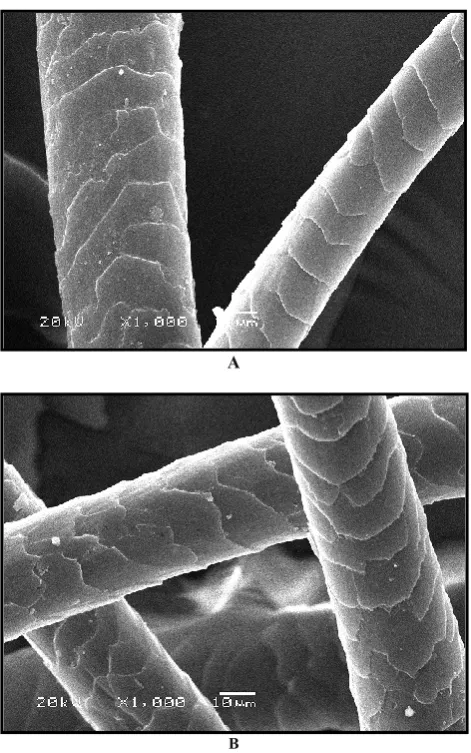
The wool samples were scanned using scanning electron microscope for studying the effects of each of the following treatments; washing and bleaching and the protease enzyme. The results have been evaluated using the Scanning Electron Microscope (SEM) to evaluate the effect of the proteases on the surface of the wool fibers. The results indicated that there are no changes on wool surface morphology after the pre-treatments (surfactant and bleaching processes) as in (Figure 1A and 1B) and these results are in agreement with Silva et al., (2005). There are many fragments on the surface of the crude wool. The fragments were removed by keratinolytic protease treatment for 3, 6, 9, and 12 hrs and increased with time hence, the surface of wool fibers were modified into smooth surface. Scanning electron microscope proved the effectiveness of the keratinolytic protease enzyme on the wool fibers compared
with wild wool without treatment. The wool became smooth with increasing the time treatment and reach to maximum after 12 hrs. The enzymes showed high activity with stability at 60°C so; the potential results after treatment of wool fibers
A
[image:3.595.316.552.49.426.2]B
Figure 1. SEM of wool fibers at 1000X (A) indicates to the wild wool before processing while (B) indicates to the crude wool after
washing and bleaching processes
with keratinolytic protease obtained from B. amyloliquefaciens
MA20 were obtained after treatment at 60°C for 12 hrs and these results were better than treatment at 50°C (Figure 2, 3). Amara and serour described the effect of proteases enzymes which produced by Bacillus licheniformis and and Geobacillus sp. on wool fibers and showed that the enzymes improved the surface of wool by smoothing the wool fibers outer layer
(Amara and Serour, 2008).
B
C
[image:4.595.328.539.37.713.2]D
Figure 2. SEM of wool fibers after treatment with keratinolytic
protease enzyme produced by B. amyloliquefaciens MA20 for
intervals time at 50°C (A) wool fibers treated for 3 hrs, (B) wool fibers treated for 6 hrs, (C) wool fibers treated for 9 hrs, and (D)
wool fibers treated for 12 hrs
In addition, the wool fibers which were treated with protease enzyme for 24 hrs were almost degraded because the enzyme was diffused into the inner part of fibers as reported before by
Jus et al., (2007). Therefore, the time of the wool fiber
exposure to the proteases is a critical step. These results suggested that the bio-finishing of wool fibers with different temperatures according to the industrial needed.
A
B
C
[image:4.595.43.284.52.614.2]D
Figure 3. SEM of wool fibers after treatment with keratinolytic
protease enzyme produced by B. amyloliquefaciens MA20 for
intervals time at 60°C (A) wool fibers treated for 3 hrs, (B) wool fibers treated for 6 hrs, (C) wool fibers treated for 9 hrs, and (D)
Tensile strength test of wool fibers
[image:5.595.308.557.90.245.2]One of the important parts in manufacturing process involves making wool fibers is strong enough, particularly for the warp. Cai et al., (2011) showed that the produced protease using keratinous wastes was capable of degrading the cuticle layers of wool fibers alone without any alteration in inner part of fibers. In addition, the results of some previous literatures showed that protease enzyme removed the fragment scales of wool fibers but there is no change in tensile characteristic of treated wool fibers by protease enzymes (Kim et al., 2005). On the other hand, the results of this study exhibit that the tensile strength of wool fibers was significantly increased compared to the wild wool. The tensile strength of untreated and treated wool with keratinolytic protease enzyme were measured using tensile machine. The tensile strength of wool fibers increased after treatment with the enzymes and indicated that it was increased against time revealed that keratinolytic proteases affected the surface wool fibers only and the impurities were removed and left pure wool fibers. The treated wool fibers were compared with crude wool fibers (reference sample 1) and wool after washing and bleaching (reference sample 2). Max force which is the expression of strength was obtained and it was 115.93 N (Newton) for wool treated with the enzymes from B. amyloliquefaciens MA20after 12 hrs at 50°C while the max force was 125.78 N after 12 hrs at 60°C (Figure 4, 5). The results of tensile strength were approved with the results of SEM. The polypeptides and amino acids which degraded during treatment of wool fibers with keratinolytic protease diffused into wool fibers and attached to surface of fibers caused significantly increase in tensile strength.
Figure 4. Tensile strength summary of wool after treatment with
keratinolytic protease enzyme produced by B. amyloliquefaciens
MA20 at 50°C for intervals time
Some researchers used mixture of polypeptides from keratin for utilizing their affinity to repair hair via forming film which made it very elastic consequently, the polypeptides can be used in improvement surface of fibers and their physical characteristic such as elasticity (Cai et al., 2007; Benson et al., 2009). In this study, the treatment of wool fibers was carried out using keratinolytic protease enzymes and the releasing polypeptides from hydrolyzed keratin in the same time. It is recommended to investigate the physical of wool fibers in all treatment steps for obtaining true results because the results
[image:5.595.38.289.415.577.2]which were depend on morphology of wool fibers only need to further examination.
Figure 5. Tensile strength summary of wool after treatment with
keratinolytic protease enzyme produced by B. amyloliquefaciens
MA20 at 60°C for intervals time
Water uptake percentage of wool fibers
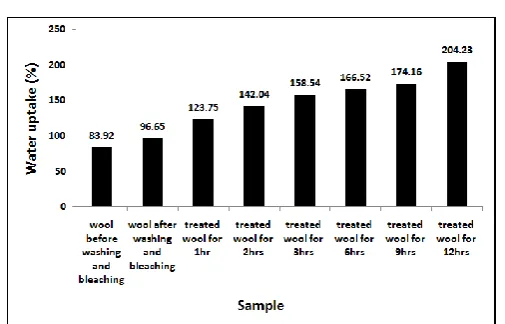
The protease enzymes from Bacillus sp. was applied to improve wool quality and their results indicated that increasing the time of wool treatment by protease led to enhancement the dye uptake of wool fibers as well as, the surface of wool became smoother due the removing scales of wool (Cai et al., 2007). In wool industry, the wool fibers stain with dyes for different clothes colour which acts as important step in industry. The treated wool with keratinolytic protease enzymes produced by B. amyloliquefaciens MA20 was tested for studying the ability of the dye to penetrate to the inner part of wool. This test was carried out by calculating the percentage of water uptake that wool can absorb and retain it. The water uptake (percentage) was 200.75% (w/w) for wool fibers treated with enzymes for 12 hrs at 50°C and was 204.23% (w/w) for wool fibers incubated with enzymes for 12 hrs at 60°C. The water uptake percentage indicated to increasing the water uptake of wool after treatment (figures 6, 7). In recent studies, extracting polypeptides from wool degraded by keratinolytic protease was conducted to modify the surface of wool fibers and the results showed improvement of dye uptake with a high level of shrink resistant after and before dying (Smith and Shen, 2011).
Figure 6. Water uptake percentage of wool after treatment with
keratinolytic protease enzyme produced by B. amyloliquefaciens
MA20 at 50°C for intervals time
[image:5.595.308.562.578.725.2]Figure 7. Water uptake percentage of wool after treatment with
keratinolytic protease enzyme produced by B. amyloliquefaciens
MA20 at 60°C for intervals time
Parvinzadeh, (2007) showed the ability of protease enzymes to make the wool fibers susceptible to dyes with high level compared to the untreated fibers. The water uptakes of wool fibers increased after keratinolytic protease treatment and these results were direct proportion with exposure time to enzyme. The ability of wool fibers treated with keratinolytic protease enzyme from B. amyloliquefaciens MA20 to reserve the absorbed water was increased significantly.
Conclusion
This study showed the important of protease enzyme in textiles industry. The presented results in this research demonstrated the pre-treatment process of wool fibers using triton X100 and hydrogen peroxide to promote the hydrolytic effect of keratinolytic protease enzymes. The keratinolytic protease which was investigated its effect on wool fibers was produced by Bacillus amyliquifacins in presence of wool due to enzyme specificity. The scales of wool fibers were removed and exhibited smooth after treatment with keratinolytic protease. The scan electron microscope proved the effect of enzymes without damage of the fibers and the tensile strength increased after incubation with enzymes for 12 hrs. In addition, the water uptake of fibers was increased significantly. These promising results caused by treatment with keratinolytic enzyme and polypeptides of wool hydrolysis in the same time. The traditional method for wool fibers treatment is Chlorine– Hercosett process which has severe effect in the environment through the effluent of hazard materials in water and they will need to forward the efforts to waste water treatment. The treatment process of wool fibers with keratinolytic protease and polypeptides could be conducted as a substitution to use Chlorine–Hercosett process. Eventually, it is recommended to use this cheap and potential process in wool industry.
REFERENCES
Alessandro, R., Silvia, O. and Adriano, B. 2003. Dehairing activity of extracellular proteases produced by keratinolytic bacteria. J. Chem. Technol. Biotechnol., 78, 855–859. Amara, A. A. 2013. Back to natural fiber: wool color
influences its sensitivity to enzymatic treatment. ScientificWorld J., 2012, 356239.
Amara, A. A. and Serour E. A. 2008. Wool quality improvement using thermophilic crude proteolytic microbial enzymes. American- Eurasian Journal of Agricultural & Environmental Sciences, 3, 554–60. Amara, A. A., Hassan, M. A., Abulhamd, A. T. and Haroun B.
M. 2013. Non-mucoid P. aeruginosa aiming to safe production of protease and lipase. Inter. Sci. and Invest. j., 2, (5), 103-113.
Benson, R. E., Fahnestock, S. R., Hamilton, P., Obrien, J. P. and Wang, H. 2009. New dyed-hair-binding peptides having specified amino acid sequences for forming peptide-based hair reagent and hair care composition, useful for applying conditioner or colorant to dyed hair or forming protective layer on dyed hair surface. US: US2009074694-A1.
Brack, N., Lamb, R., Pham, D. and Turner, P. 1999. Nonionic surfactants and the wool fibre surface. Colloids and Surfaces A: Physicochemical and Engineering Aspects, 146, 405–15.
Brandelli, A. 2008. Bacterial keratinases: useful enzymes for bioprocessing agroindustrial wastes and beyond. Food Bioprocess Technol., 1, 105–116.
Cai, S. B., Huang, Z. H., Zhang, X. Q., Cao, Z. J., Zhou, M. and Hong, F. 2011. Identification of a keratinase-producing bacterial strain and enzymatic study for its improvement on shrink resistance and tensile strength of wool- and polyester-blended fabric. Applied Biochemistry Biotechnology, 163, 112-26.
Cai, S., Huang, Z., Cao, Z., Zhang, X. Q. and Zhou, M. 2008. Inducement and preparation of Stenotrophomonas maltophilia DHHJ keratinase and method for sorting wool by using the same. Patent: CN101265470.
Cai, T., Zhao, Y. and Yang C. 2007. A study on hair care of feather keratin. Flavour FragranceCosmetics (in Chinese with English abstract), 5, 14-6.
Gupta, R. and Ramnani, P. 2006. Microbial keratinases and their prospective applications: an overview. Appl. Microbiol. Biotechnol., 70, 21–33.
Gupta, R., Rajput, R., Sharma, R. and Gupta N. 2013. Biotechnological applications and prospective market of microbial keratinases. Applied Microbiolology Biotechnology, 97, 9931-9940.
Gushterova, A., Vasileva-Tonkova, E., Dimova, E., Nedkov, P. and Haertlé, T. 2005. Keratinase production by newly isolated Antarctic actinomycete strains. World J. of Microbi. & Biotech., 21, 831–834.
Hassan, M. A., Haroun, B. M., Amara, A. A. and Serour E. A. 2013. Production and characterization of keratinolytic protease from new wool-degrading Bacillus species isolated from Egyptian ecosystem. Biomed Research International, 2013, 175012.
Heine, E. and Hocker H. 1995. Enzyme treatments for wool and cotton. Review Progress Coloration, 25, 57–63. Hossain, K. M. G., Juan, A. R. and Tzanov, T. 2008.
Simultaneous protease and transglutaminase treatment for shrink resistance of wool. Biocatalysis and Biotrans., 26, 405-11.
production for microbial processing of fabrics. Wolrd J. Microbiol. Biotechnol., 26, 1047–1052.
Jus, S., Schroeder, M., Guebitz, G. M., Heine, E. and Kokol, V. 2007. The influence of enzymatic treatment on wool fibre properties using PEG-modified proteases. Enzyme and Microbial Technology, 40, 1705–11.
Kim, S., Cha, M., Oh, E. T., Kang, S., So, j. and Kwon, Y. 2005. Use of protease produced by Bacillus sp. SJ-121 for improvement of dyeing quality in wool and silk. Biotechnology and Bioprocess Engineering, 10, 186-91. Lenting, H. B., Schroeder, M., Guebitz, G. M., Cavaco-Paulo,
A. and Shen J. 2006. New enzyme-based process direction to prevent wool shrinking without substantial tensile strength loss. Biotechnology Letter, 28, 711-6.
Liu, B., Zhang, J., Xiangru-Liao, B. L., Du, G. and Chen, J. 2013. Expression and characterization of extreme alkaline, oxidation-resistant keratinase from Bacillus licheniformis in recombinant Bacillus subtilis WB600 expression system and its application in wool fiber processing. World J. Microbiol. Biotechnol., 29(5), 825–832.
Lo Nostro, P., Fratoni, L., Ninham, W. B. and Baglioni P. 2002. Water Absorbency by Wool Fibers: Hofmeister Effect. Biomacromolecules, 3, 1217-1224
Lv, L. X., Sim, M. H., Li, Y. D., Min, J., Feng, W. H., Guan, W. J. and Li, Y. Q. 2010. Production, characterization and application of a keratinase from Chryseobacterium L99 sp. nov. Process Biochem., 45(8), 1236–1244.
Noriyuki, K., Shoko, Y., Etsuji, C., Michio, K., Shuji, Y. and Yoshiaki, I. 2003: Keratinase. Patent: JP2003070461. Parvinzadeh, M. 2007. Effect of proteolytic enzyme on dyeing
of wool with madder. Enzyme and Microbial Technology, 40, 1719–1722.
Philippe, B., Franccois, L., Maria, U. and Bernard, V. 1999. Purification and Characterization of a Keratinolytic Serine Proteinase from Streptomyces albidoflavus. Appl. Environ. Microbiol., 65, 2570–2576.
Plowman, J. E. 2003. Proteomic database of wool components', J. of chromatography. B, Analytical technologies in the biomedical and life sciences, 787, 63-76.
Prakasham, R. S., Rao, C. S. and Sharma, P. N. 2006. Green gram husk—an inexpensive substrate for alkaline protease production by Bacillus sp. in solid-state fermentation. Bioresource Technol., 97, 1449–1454
Roberta, C. S. T., Samanta, O. G., Florencia, C. O. and Adriano, B. 2006. Optimization of protease production by Microbacterium sp. in feather meal using response surface methodology. Process Biochem., 41, 67–73
Shrinivas, D. and Naik, G. R. 2011. Characterization of alkaline thermostable keratinolytic protease from thermoalkalophilic Bacillus halodurans JB 99 exhibiting dehairing activity. International Biodeterioration & Biodeg., 65, 29-35.
Silva, C. J. S. M., Prabaharan, M., Guebitz, G. M. and Cavaco-Paulo, A. 2005. Treatment of wool fibres with subtilisin and subtilisin-PEG. Enzyme and Microbial Technology, 36, 917–22.
Silva, C. J. S. M., Zhang, Q., Shen, J. and Cavaco-Paulo, A. 2006. Immobilization of proteases with a water soluble– insoluble reversible polymer for treatment of wool. Enzyme and Microbial Technology, 39, 634–40.
Smith, E. and Shen J. 2011. Surface modification of wool with protease extracted polypeptides. J. Biotechnology, 156, 134-40.
Sousa, F., Jus, S., Erbel, A., Kokol, V., Cavaco-Paulo, A. and Gubitz, G. M. 2007. A novel metalloprotease from Bacillus cereus for protein fibre processing. Enzyme Microb. Technol., 40, 1772–1781.
Vasconcelos, A., Silva, C. J. S. M., Schroeder, M., Guebitz, G. M. and Cavaco-Paulo, A. 2006. Detergent formulations for wool domestic washings containing immobilized enzymes. Biotechnology Letter, 28, 725-731.
Zambare, V. P., Nilegaonkar, S. S. and Kanekar, P.P. 2007. Production of an alkaline protease by Bacillus cereus MCM B-326 and its application as a dehairing agent. World J. Microbiol. Biotechnol., 23, 1569–1574.