ISSN Online: 1947-394X ISSN Print: 1947-3931
DOI: 10.4236/eng.2018.1011056 Nov. 20, 2018 805 Engineering
Simulation of a Mathematical Model Minimizing
Energy Consumption in SDN Type Networks
Lagasane Kra
1, Bi Tra Gooré
1, Manlandon Koffi
1, Olivier Asseu
1,21Institut National Polytechnique F. Houphouët Boigny (INP-HB), Yamoussoukro, Côte d’Ivoire
2Ecole Supérieure Africaine des TIC (ESATIC), Abidjan, Côte d’Ivoire
Abstract
Several works by the authors have shown that energy consumption in com-munication networks does not only depend on the traffic load but on all connected equipment in the network. We have contributed a new mathemat-ical model and a new energy saving strategy with Software Defined Network (SDN) technology [1]. Our Model solution is based on the Modified SPRING Protocol (MSP). In this paper, we simulated our work and compared it to that of the authors [2] and [3]. The OMNET++ simulator was used for our work. Thus, the results of the simulations gave a delay that tends to zero, a packet loss of the order of 10% and a constant jitter of 4% better than the previous authors.
Keywords
SPRING, Protocol, Simulator, OMNET++, Graph, Mathematical Model
1. Introduction
In Wael Zouaoui’s thesis, which was defended on January 15, 2016, the authors showed that, following recent advances in the technological fields, the energy bill has continued to grow. This is due to the interconnections of computer equip-ment. These devices are increasingly bulky with high computing power (see Figure 1).
In our previous work accepted for publication in [1], we mentioned the au-thors of [5] and [6]. In this work, a study has shown that ICTs alone consume 2% to 10% of global consumption [5] and a consummation of 6 Twh/an to USA in hubs, Switch, Routers [6]. It was necessary to find a mathematical model that is able to minimize the consumption of energy.
We have proposed a mathematical model that minimizes energy and its re-levance has been shown by an algebraic resolution. In this paper, we will
How to cite this paper: Kra, L., Gooré, B.T., Koffi, M. and Asseu, O. (2018) Simu-lation of a Mathematical Model Minimiz-ing Energy Consumption in SDN Type Networks. Engineering, 10, 805-813.
https://doi.org/10.4236/eng.2018.1011056
Received: September 28, 2018 Accepted: November 17, 2018 Published: November 20, 2018
Copyright © 2018 by authors and Scientific Research Publishing Inc. This work is licensed under the Creative Commons Attribution International License (CC BY 4.0).
http://creativecommons.org/licenses/by/4.0/
DOI: 10.4236/eng.2018.1011056 806 Engineering Figure 1. Number of global users [4].
simulate our approach proposal. The work will consist in presenting in Section 2 the previous works. Section 3 will present our mathematical model and its con-straints (delay, packet loss and jitter) in which we will explain our algorithmic approach. We present in Section 4 the results of our simulations. In Section 5, we will compare our work with that of previous authors. The conclusion will come in Section 6.
2. Previous Work
In this section, we present the results of the simulations of different authors on energy consumption in SDN networks.
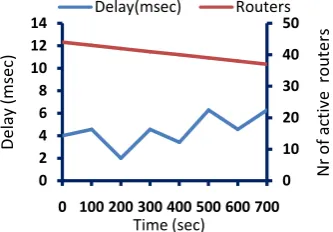
Several simulation works have been processed in the optimization of energy consumption in communication networks. This is the case for citing the authors [2] and [3]. In [2], the authors used a software approach based on an automatic On/Off control system to enable and disable router links. This is a test-bed that has been done in conventional networks. The authors chose in their network topology paths supported by the Cognitive Packet Network (CPN) protocol. It has been found that non-protocol defined routes are not degraded. The results of their approach gave 10% to 20% extinction of energy-saving links with QoS de-gradation (see figures below). These works of the authors, we reproduced them [2] (Figure 2).
Figure 2 showed that disabling some routers at instants 100 s, 300 s, 500 s, 700 s caused a delay. This is due to the fact that each time the links or routers are shut down, the CPN routing protocol looks for new favorable paths. And these paths being the shortest paths (instants 200 s, 400 s, 600 s) are quickly saturated. Only long paths are borrowed. Some packages are lost. In the authors’ expe-rience, the packets use in their header the extinction strategy based on the Cog-nitive Packet Network (CPN) protocol. Routers have become mere rest areas or roads for future destinations. This is where packages with experience look for favorable destinations.During shutdown, packets in the queue are destroyed (Figure 3).
DOI: 10.4236/eng.2018.1011056 807 Engineering Figure 2. Delay-first experience.
Figure 3. Packet loss-first experience.
maximum) beyond, the packets are destroyed to allow others to make their way. The successive extinction of the routers or the maximum number of links in-creases the delay due to congestion in the network thus causing packet losses that reach 20% (Figure 4).
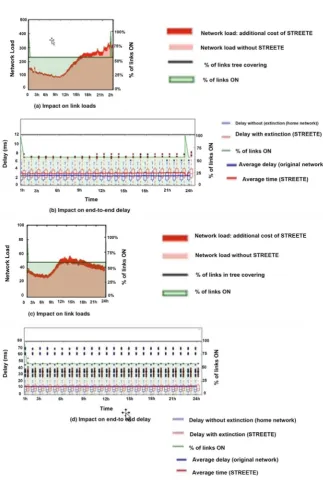
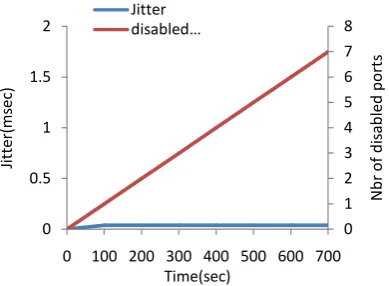
Here, the jitter does not vary. The delay follows the same rhythm. Its value is constant of 0.08 (or 8%). We present now the simulations of the work of the au-thors of [3]. In [3], the authors proposed a software approach using the SPRING protocol to turn off links when they are not used. Their approach shows in the simulations that it was possible to turn off 44% of the links to save energy that we present below through captures:
Figure 5 simulations Results in Germany 50 (top) and Giant (bottom) net-works [3]
In this work [3], we report their results on three points:
Impact on the network load: it creates an additional cost of 18.56%. The paths on which packets are routed are not the shortest. But this extra cost is quickly canceled when the links are lit (Figure 5(a) and Figure 5(c)).
Impact on end-to-end delay: the increase was 37% with Germany 50 while in most cases it is 20%.
Impact on packet loss: no loss of packets with the algorithm used by the authors based on the Spring Protocol.
We used the idea of the authors of [3] to improve the work of the authors [2]. Our approach is software. It allowed us to disable the maximum of routers ports. Ports are disabled for adjacent routers. It is better than those of the previous
0 10 20 30 40 50 0 2 4 6 8 10 12 14
0 100 200 300 400 500 600 700
N r o f ac tiv e ro ut ers De lay (m se c) Time (sec) Delay(msec) Routers 0 10 20 30 40 50 0 0.1 0.2 0.3 0.4 0.5
0 100 200 300 400 500 600 700 N
DOI: 10.4236/eng.2018.1011056 808 Engineering Figure 4. Jitter-first experience.
Figure 5. Simulations results in Germany 50 (top) and giant (bottom) networks [3]. 0
10 20 30 40 50
0 0.5 1 1.5 2
0 100 200 300 400 500 600 700
N
br o
f ac
tiv
e
ro
ut
ers
Jitter
(m
sec
)
[image:4.595.208.532.225.706.2]DOI: 10.4236/eng.2018.1011056 809 Engineering ones. Because it offers us a double saving of energy saving (in ports and links). Our simulations will demonstrate them. Well before we remember our mathe-matical model and then follow our simulations.
3. Model Presentation
In this section, we present our mathematical model under constraint of delay, packet loss and jitter. We showed the principle of the extinction of the ports of the routers by our Modified SPRING Protocol [3] on a tree covering minimum weight.
Our model was obtained using the convexity theorem. Thus, the objective function obtained is:
( )
(
)
(
)
(
(
)
(
( )
)
)
( ) , ( )
(
(
)
)
min , min , ,
i n t ch ij n t
f n t t C Cp a t b f k i tj
∈ ∈
= − + +
∑
+∑
(1)Under Constraint of:
( )
(
( ) ( ) ( )
)
(
, , , ,)
(
( )
)
,( )
( )
q f t R F t n t k t t ≤Q f t f t ∈F t and:
( )
i j,( )
( )
f t C f t F t
∑ ≤ ∈ and Max
( )
t <λmax{ }
0,1k∈
When the routers are turned on, only one port on each router is activated and the (n-1) others are turned off. The packets have at least one path on each rou-ter. This approach will influence the delay of transmission unlike that of the au-thors [2] and [3]. So we define our delay based on the number of disabled ports called Dℓ(t). Our delay will be obtained from the data of the work of [2].
So, we have:
( )
Delay( )
Max n
D t
t
=
(2)
where Dℓ(t): delay when ℓ(t) ports are disabled.
Delayn: Normal delay (value obtained from those of [2]. Maxℓ(t): Maximum number of ports off on each router. The ratings: (Table 1)
We have found our mathematical model which minimizes, so we present our simulations on the basis of our Modified SPRING Protocol (MSP).
4. Our Simulation Results
Our extinction principle approach by Modified SPRING protocol are described in our algorithms and simulation results are presented in Algorithm 1 and Al-gorithm 2.
Algorithm 1. Centralized SDN: <Reroute And Router Off>.
Data: List-of-Ports:[(0-4),(2-6)..] and the news/*Supplied by <Select Portsto Off> and Compute New Routes> respectively
1) Begin
DOI: 10.4236/eng.2018.1011056 810 Engineering Continued
4) Routers 0.1.3... send an (ACK) to the controller after the task is executed; 5) The SDN controller identifies the lit ports and turns off the others;
6) All routers apply the change to the forward tables for redirection by other ports; 7) Nodes 0, 1, 2... stop sending IGP packets;
8) Ports (0 - 1, 2 - 5...) stop and enter sleep mode to be turned off;
Algorithm 2. Main loop.
1) While energy efficient traffic engineering is active do 2) Initialization of the selected ports to the number of lit ports; 3) If new roads and all ports are on then
4) <turn off the links to avoid circuits>; 5 ) List of ports ← list of links;
[image:6.595.208.539.299.544.2]6) If the new routes (all ports turned on) then 7) <Reroute And Router Off> (List-Of-Ports);
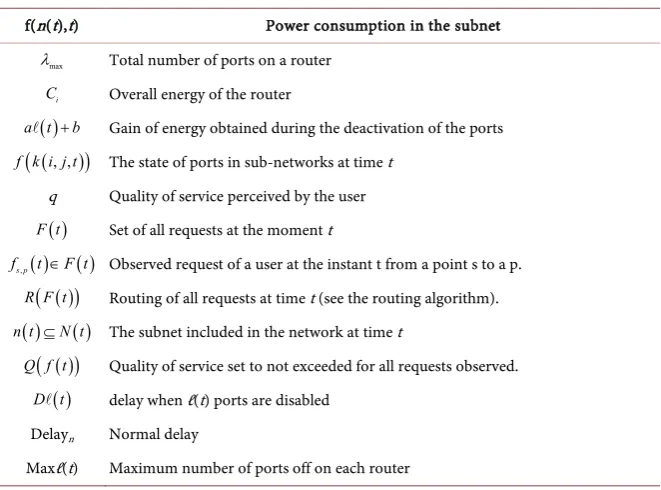
Table 1. Summary of the ratings.
f(n(t),t) Power consumption in the subnet
max
λ Total number of ports on a router
i
C Overall energy of the router
( )
a t b + Gain of energy obtained during the deactivation of the ports
( )
(
, ,)
f k i j t The state of ports in sub-networks at time t q Quality of service perceived by the user
( )
F t Set of all requests at the moment t
( ) ( )
,
s p
f t ∈F t Observed request of a user at the instant t from a point s to a p.
( )
(
)
R F t Routing of all requests at time t (see the routing algorithm).
( ) ( )
n t ⊆N t The subnet included in the network at time t
( )
(
)
Q f t Quality of service set to not exceeded for all requests observed.
( )
D t delay when ℓ(t) ports are disabled
Delayn Normal delay
Maxℓ(t) Maximum number of ports off on each router
We have the results of our simulations and a comparative study of these re-sults with the previous ones based on our algorithmic approach in OMNET ++ has been done (see Figure 6).
In this diagram, as we disable the ports of the routers, the delay decreases or even tends to zero. This is explained by our approach. There is at least one port on, thus establishing a link between different routers avoiding the waste of time finding a path (Figure 7).
Figure 7 is the consequence of that (Figure 6). The delay decreases, resulting in a decrease in packet loss (relatively low). In our case, it is 10% (Figure 7).
DOI: 10.4236/eng.2018.1011056 811 Engineering Figure 6. Delay based on the number of disabled ports.
Figure 7. Loss of package based on the number of dis-abled ports.
Figure 8. Jitter based on the number of ports disabled.
Given these results, a comparison of our model with that of the authors cited in our work is necessary.
5. Performance Evaluation
In this section, we compare our results with those of the authors cited in this paper.
We find that the results of the authors [3] are much better than that of the authors [2]. We recall that the authors of [2] worked in classical networks. The
0 2 4 6 8 0 2 4 6 8 10 12 14
0 100 200 300 400 500 600 700
Nbr o f di sa bl ed po rt s Del ay (ms ec ) Time(sec) Delay (msec) disabled ports 0 1 2 3 4 5 6 7 8 0 0.1 0.2 0.3 0.4 0.5
0 100 200 300 400 500 600 700
N br o f d isa bl ed p or ts pa ck et lo ss Time(sec) Packet loss disabled ports 0 1 2 3 4 5 6 7 8 0 0.5 1 1.5 2
0 100 200 300 400 500 600 700
[image:7.595.278.473.425.568.2]DOI: 10.4236/eng.2018.1011056 812 Engineering efficiency in the work of [3] lies in the importance of SDN technology. The fact that the SDN has a global view of the network facilitates the definition of effec-tive rules. The use of the SPRING algorithm with SDN allowed the authors of [3] to obtain better results. Ours view of the different figures, is still interesting than the previous two. Our Modified SPRING Protocol (MSP) -based approach mi-nimizes energy with good quality of service (QoS) in terms of delay, packet loss and jitter. We achieved better packet forwarding times with less congestion, thus minimizing losses. Just like the authors of [3], we can also say that the loss of packets in our simulations are the same. We cannot minimize without degrada-tion. It (packet loss) is 20% in [3], [2] and 10% in ours. Our delay is much better than previous authors.
6. Conclusions
We simulated our mathematical model with the OMNET++ simulator. The re-sults show that the ports of the routers, when deactivated according to our ener-gy saving strateener-gy, have a good quality of service (QoS) in terms of delay that tends to zero, packet loss of the order of 10% and constant jitter of 4%.
The quality of service degradation can be related to several factors: network connectivity difficult at times, over-provisioning of the network causing confi-guration rules and correct routing problems. Because the size of the memory (TCAM) in which the rules used by SDN devices are stored is small. This orien-tation is interesting and could be developed in our future work. The advent of SDN by the programmability thus brings flexibility and good results in the management of the network.
Acknowledgements
The authors would like to thank the anonymous referee for his/her comments that helped us improve this article. The authors also wish to thank the Higher School of ICT (ESATIC) and the Doctoral School Polytechnic Institute F. H. Boigny of Yakro (INP-HB).
Conflicts of Interest
The authors declare no conflicts of interest regarding the publication of this pa-per.
References
[1] Kra, L., Gondo, Y., Gooré, B.T. and Asseu, O. (2018) Contribution to the Optimiza-tion of the Energy ConsumpOptimiza-tion in SDN Networks. Journal of Sensor Technology, 8, 1-9. https://doi.org/10.4236/jst.2018.83005
[2] Gelenbe, E. and Silvestri, S. (2009) Optimisation of Power Consumption in Wired Packet Networks. In: Bartolini, N., Nikoletseas, S., Sinha, P., Cardellini, V. and Ma-hanti, A., Eds., Telecommunications Engineering, Springer Berlin Heidelberg, 717-729. [3] Carpa, R., Glück, O., Lefèvre, L. and Mignot, J.-C. (2015) STREETE: Traffic
DOI: 10.4236/eng.2018.1011056 813 Engineering [4] Project, R.T.S. (2014) Internetlivestats.
http://www.internetlivestats.com/internet-users-by-country/2014/
[5] Chiaraviglio, E.L. and Mellia, M. (2009) How Much Can Internet Be Greened? Green Comon.
![Figure 1. Number of global users [4].](https://thumb-us.123doks.com/thumbv2/123dok_us/9250622.413341/2.595.214.538.77.225/figure-number-of-global-users.webp)