Evaluation of Different Electronic Product Code Discovery
Service Models
Su Mon Kywe, Jie Shi, Yingjiu Li, Raghuwanshi Kailash
School of Information Systems, Singapore Management University, Singapore City, Singapore Email: {monkywe.su.2011, jieshi, yjli, kailashr}@smu.edu.sg
Received December 21,2011; revised January 19, 2012; accepted February 4, 2012
ABSTRACT
Electronic Product Code Discovery Service (EPCDS) is an important concept in supply chain processes and in Internet of Things (IOT). It allows supply chain participants to search for their partners, communicate with them and share product information using standardized interfaces securely. Many researchers have been proposing different EPCDS models, considering different requirements. In this paper, we describe existing architecture designs of EPCDS systems, namely Directory Service Model, Query Relay Model and Aggregating Discovery Service Model (ADS). We also briefly mention Secure Discovery Service (SecDS) Model, which is an improved version of Directory Service Model with a secure attribute-based access control mechanism. Then, we analyze the strengths and limitations of these models, by comparing based on non-functional features such as data ownership, confidentiality, business relationship independ- ence, availability, reliability, implementation complexity, visibility, and scalability. From the analysis results, we have a better understanding of which model is more suitable in what kinds of situations or scenarios. Moreover, we suggest possible improvements and identify possible future add-on applications to SecDS model in the paper.
Keywords: EPC Discovery Service; Supply Chain; Access Control; Comparison
1. Introduction
Supply chain is a process of transforming natural re- sources or raw materials into finished goods, by passing through suppliers, manufacturers, wholesalers, retailers, customers and other supply chain partners [1]. When various supply chain partners work together to deliver the right amount of goods to the right customers at right time and right place, good coordination and information sharing are critical.
Lack of information sharing among supply chain part- ners can lead to a lot of negative consequences. For in- stance, when downstream retailers are not willing to share their end customer information (e.g. for security and privacy reasons), upstream suppliers and manufac- turers have no idea about the customers. The manufac- turers predict the customer demand from wholesalers’ orders, while wholesalers predict the customer demand from the retailers’ orders. This lack of information trans- parency can lead to “bullwhip effect” where each up- stream supply chain participant observes greater demand variation and greater need for safety stocks, consequently bearing greater costs [2]. The whole supply chain can suffer as it becomes less responsive to demand fluctua- tions.
Therefore, in today’s market where competition is
very intense, it becomes increasingly important to have a structured way of fast and secure information sharing among supply chain partners. Standardized systems and communication methods, which can be used uniformly across different organizations around the globe, are re- quired to be developed.
As such, EPCglobal organization [3], which is respon- sible for standardization of Electronic Product Code (EPC) technology [4], created EPCglobal Network [5] for sharing RFID information. EPCglobal Network is implemented, using standards from EPCglobal Architec- ture Framework [6]. It has four components, namely Ob- ject Naming Service (ONS), EPC Discovery Services (EPCDS), EPC Information Services (EPCIS) and EPC Security Services [5]. In this paper, we focus mainly on EPCDS models, since standardization of EPCDS design is still an open research question [6].
Section 6 and finally we conclude the paper in Section 7 with the role of EPCDS in future Internet of Things (IOT) [7].
2. Background
2.1. EPCDS
Electronic Product Code Discovery Service (EPCDS) is a service that allows users to find supply chain partners who possess a given product. A user just need to key in a particular EPC number, such as RFID number of the product, to search for EPC Information Services (EPCIS) provided by the related supply chain partners within the network.
EPCDS can be compared to telephone directory or search engines of the internet. To request information about a particular EPC, a supply chain participant needs to have knowledge of who are its supply chain partners and their network addresses or URLs that should be que- ried. This is like the need to know the phone numbers before contacting each other. Then, EPCDS acts like a telephone directory or yellow page where the contacts or addresses of EPC information providers or repositories are aggregately stored and returned to the appropriate queries accordingly, as shown in Figure 1 [8].
Basically, EPCDS supports two operations, publishing operation and querying operation. Publishing operation is for EPCIS to publish their information on EPCIS whereas querying operation is for supply chain users, who want to find published EPCIS addresses.
2.2. EPCIS
In this context, EPC Information Service (EPCIS) can simply be viewed as a database or repository owned by a supply chain participant. It stores event information of supply chain products, where each product is uniquely identified by an EPC number. EPC event information includes product information, product location, date and time of product arrival and departure, involved business processes, and other important business information [6].
[image:2.595.58.286.609.719.2]To share its critical business information with its trusted supply chain partners, EPCIS provides a querying
Figure 1. EPCDS as a directory of EPCIS.
interface for its repository. However, EPCIS may main- tain access control mechanisms to ensure that only au- thorized users can access its sensitive information. With EPCIS querying service, any authorized users, who know the address of EPCIS service, can get access to its EPC repositories or databases easily.
2.3. Definition of Terms
In our paper, the terms “users” or “clients” is used for supply chain participants who want to get EPC event information from EPCIS. EPCIS company (owner), da- tabase and its services are collectively mentioned as “EPCIS”, “resource”, “EPCIS resource” “EPCIS reposi- tory” or “EPCIS company”.
3. Existing Discovery Service Models
BRIDGE (Building Radio frequency identification for the Global Environment) project has modeled and ana- lyzed eight possible high level designs of EPCDS in 2007. After considering each model’s feasibility, BRIDGE selected the two models of EPCDS, called Directory Service Model and Query Relay Model [8]. Although there are a lot of variations of these two models, our pa- per only use basic models suggested in BRIDGE docu- ment for simplicity purpose. The third EPCDS design is Aggregating Discovery Service (ADS) Model, proposed by Hasso Plattner Institute for IT Systems Engineering in 2010 [9].
3.1. Directory Service Model
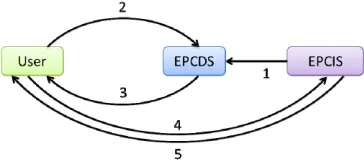
In Directory Service Model, EPCDS stores a directory of EPC numbers and corresponding EPCIS addresses. Fig-ure 2 illustrates the steps of this Directory Service Model.
Step 1: An owner of an EPCIS first registers at EPCDS with the details on which EPC numbers they are handling, together with its service address or URL. EPCDS stores the pairs of EPC numbers and EPCIS addresses in its lookup table.
Step 2: User sends query to EPCDS with a specific EPC number or a range of EPC numbers as parameters.
[image:2.595.332.514.637.717.2]Step 3: EPCDS uses lookup table to look up queried EPC numbers, finds corresponding EPCIS addresses and returns them to the user.
Step 4: With the returned addresses, the user queries directly to EPCIS repositories to get the desired required EPC event information.
Step 5: EPCIS repositories return the required EPC event information to the user.
One of the main problems of Directory Service Model is that EPCDS returns all the related EPCIS addresses to every user who queries. Access control mechanisms are not specified in detail.
Based on the query result, every user knows exactly which EPCIS repositories are handling which EPC num- bers. Availability of EPCIS addresses indicates owner- ship of product information in that EPCIS companies. Therefore, many companies, who consider their posses- sion of items as confidential or sensitive information, do not want to expose their EPCIS addresses and are reluc- tant to publish them on EPCDS.
3.2. Query Relay Model
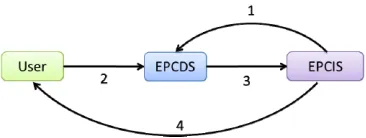
In the query relay model, EPCDS does not return the service addresses of EPCIS repositories immediately upon request. Instead, it redirects the query to corre- sponding EPCIS repositories which have their own ac- cess control mechanisms. As shown in Figure 3, query relay model has the following steps.
Step 1: An owner of an EPCIS first registers at EPCDS with the details on which EPC numbers they are handling, together with its service address or URL. Then, EPCDS stores the pairs of EPC numbers and EPCIS addresses in the lookup table.
Step 2: User sends query to EPCDS with a specific EPC number or a range of EPC numbers as well as user’s credentials as parameters.
Step 3: EPCDS uses lookup table to look up queried EPC numbers, finds corresponding EPCIS addresses and relays user’s query and credentials to those EPCIS re- sources.
Step 4: Each EPCIS resource checks user’s credentials against its own access control database and returns the query result to the authenticated user directly.
[image:3.595.81.264.647.716.2]Actually, in query relay model, user query can be of two types. The first one is a full query, directly request- ing EPCIS to return the full EPC event information. The second query type is a resource query, where EPCIS re- turns only the service address that user should query to
Figure 3. Steps in query relay model.
get required EPC event information.
3.3. Aggregating Discovery Service (ADS)
Aggregating Discovery Service (ADS) model is based on the query relay model. In this model, instead of returning EPC event information directly to user, each EPCIS re- turns the result back to EPCDS. Only after getting replies from different EPCIS repositories, EPCDS aggregates their information and sends them back to the user. Fig- ure 4 shows the steps of aggregating discovery service model.
Step 1: An owner of an EPCIS first registers at EPCDS with the details on which EPC numbers they are handling, together with its service address or URL. Then, EPCDS stores the pairs of EPC numbers and EPCIS addresses in the lookup table.
Step 2: User sends query to EPCDS with a specific EPC number or a range of EPC numbers as well as user’s credentials as parameters.
Step 3: EPCDS uses lookup table to look up queried EPC numbers, finds corresponding EPCIS addresses and relays user’s query and credentials to those EPCIS re- sources.
Step 4: Each EPCIS resource checks user’s credentials against its own access control database and returns the query result to EPCDS.
Step 5: EPCDS aggregates the results and relays them back to the user.
4. Secure Discovery Service Model
Secure Discovery Service model (SecDS) is based on Directory Service Model.
As described in Section 3.1, Directory Service Model has a critical problem due to the lack of access control system in EPCDS. Sensitive business information may be leaked, since EPCDS returns related EPCIS addresses to every user query.
In SecDS model, the basic Directory Service Model is improved by implementing a secure access control me- chanism inside EPCDS. Access control mechanism in EPCDS makes sure that it does not release EPCIS ad- dresses to any unauthorized users. Confidentiality of im- portant EPC information is preserved.
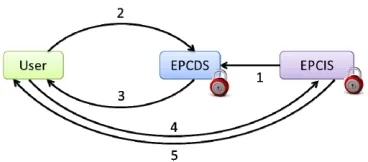
[image:3.595.313.529.651.716.2]As shown in Figure 5, steps in SecDS model are the same as steps in Directory Service Model, except that in
step 1, access control policies are sent together with EPC numbers and EPCIS address from EPCIS. In addition to lookup table of EPCIS addresses, EPCDS maintain a database on access control policies in SecDS model.
Moreover, EPCDS provides interfaces for adding, de- leting and modifying access control policies. EPCIS owners can use these interfaces to synchronize access control polices between EPCDS and EPCIS.
[image:4.595.80.264.450.531.2]4.1. Architecture of SecDS Model
Figure 6 describes the overview EPCDS architecture of SecDS model with attribute-based access control system [10].
4.1.1. Data Storage
Data storage component contains event information re- lated to EPC numbers. The attributes of the table are EPC number, EPCIS address, Published Date and Time, as well as other Publisher information. These attributes can be used to define access control polices in EPCDS.
4.1.2. Policy Storage
Policy storage component contains two types of access control policies for EPCDS. One is for publishing and another is for querying.
[image:4.595.56.288.561.717.2]Policies for publishing determine who can publish ac- cess control policies in EPCDS and are managed by se- curity administrators of EPCDS. On the other hand, poli- cies for querying are defined by security administrators
Figure 5. Steps in secure discovery service model.
Figure 6. Architecture of EPCDS in SecDS model.
of each EPCIS and are used to control who is able to query its EPC event information. Complexity of SecDS model lies in managing policies for querying because attribute-based access control is needed for querying us- ers. The policies for publishing are simple Role-Based Access Control (RBAC).
4.1.3. Policy Management
Policy management component provides an interface for EPCIS owner to publish, update or delete their policies on EPCDS. It performs syntax analysis, semantic analysis and policy transformation before saving the policies in policy storage database.
Syntax and semantic analysis checks the syntax and semantic of submitted policies while policy transforma- tion transforms attribute-based access control policies into fine-grained access control policies. The purpose of transformation is to improve the efficiency of querying. However, the trade-off is the increased complexity of maintaining the policies.
4.1.4. Policy Services
Policy service component supports query modification component. Whenever there is a query, policy service component searches for related fine-grained access con- trol predicates, combines them into one access control policy and returns it to query modification component.
4.1.5. Query Modification
Query modification component changes normal queries into modified queries that comply with the access control policies.
4.1.6. Result Aggregation
Result aggregation component returns the aggregated EPCIS addresses to the user. With the returned EPCIS addresses, user can then query to EPCIS companies di- rectly to get EPC information. User may also store the EPCIS addresses and in the future, query to EPCIS re- positories without the need to interact with EPCDS again.
4.2. Attribute-Based Access Control of SecDS Model
The main contribution of SecDS model lies in its secure attribute-based access control system, where each EPCIS owner can set his own access control policies based on certain attributes. Attribute-based access control (ABAC) is chosen, despite its complexity, because it is more flexible than other access control systems and fulfills the business needs and requirements of supply chain infor- mation sharing.
tribute of the users (e.g. a manufacturer, wholesaler or retailer) and/or the time attribute of EPC events (e.g. af- ter 5/11/2011). Generally, there are three types of attrib- utes with which an EPCIS can define access control poli- cies.
Subject Attribute: Subject attributes are properties related to user companies such as Company ID, Com- pany Name, Company Role, Company Location (Coun- try, City, etc).
Object Attribute: Object attributes are properties of EPC events such as EPC Number, Time, and Business Process.
Visibility Attribute: Three types of visibility attrib- utes can be used, namely whole-stream, up-stream and down-stream attribute.
In whole-stream policy, information related to an EPC number can be accessed by users of any companies who also publish event information about the same EPC num- ber. Intuitively, it means that companies which handle the same product along the whole supply chain are al- lowed to access information about that product.
In up-stream policy, the information related to an EPC number can be accessed by users of any companies who handle the same EPC number before the publishing EP- CIS does. For example, in a supply chain of supplier, manufacturer, distributor, wholesaler and retailer, the distributor’s EPC information can be accessed by the supplier and the manufacturer of the same product.
In down-stream policy, the information related to an EPC number can be accessed by users of any companies who handle the same EPC number after the publishing EPCIS does. In the above supply chain, the distributor’s information can be accessed by the wholesaler and the retailer of the same product.
These attribute-based access control policies are main- tained in EPCIS companies and synchronized with EPCDS all the time.
5. Comparison of Different EPCDS Models
There have been research papers on the comparisons of different EPCDS models using different requirements. In [11], basic requirements for EPCDS design are identified to compare Directory Service Model and Query Relay model. The requirement features include data ownership, security (confidentiality, reliability and availability), busi- ness relationship independent design, organic growth, scalability and quality of service.
[9] uses the same requirements from [11] but they suggested Aggregating Discovery Service model and included it in the comparison. [12] compares scalability of Direcotry Service model and Query Relay model us- ing supply chain simulation. [13] provides a consolidated comparison of Discovery Service architecture designs of
EPCglobal [6], BRIDGE project [8], Afilias [14], ID@URI naming system [15] and Distributed Hash Table DHT- based Discovery Service [16], based on the requirements from the ISO/IEC 9126 [17] standard, BRIDGE project [8] as well as [11].
Our paper reuses the basic requirements described in [11] and adds in more features to evaluate Query Relay model, Aggregating Discovery Service model and SecDS model. Since SecDS model is an improvement of Direc- tory Service model, we do not include the latter in our comparison.
The requirements are rated as “high”, “medium” or “low”, indicating that the model highly fulfills, moder- ately fulfills or almost does not fulfill the requirements.
5.1. Data Ownership
Data ownership is defined as the right to determine data usage privileges to other companies and as the ability to track the actual usage. EPCIS companies should have complete control over its data such as EPCIS address, EPC event information, business data as well as the set- tings of access control rights.
In [10], it is assumed that data ownership is lost once EPCIS delegates access controls to EPCDS. However, in our analysis, we assume that EPCDS is trusted and al- ways acts in the way that it is supposed to. It does not expose the EPCIS addresses, returned results or pub- lished policies to any unauthorized persons.
5.1.1. Right to Determine Data Usage Privileges Query Relay Model: This requirement is highly ful- filled since EPCIS manages its own access control poli- cies and has local control over its EPC event information. It can also determine who can access to its EPCIS ad- dress.
Aggregating Discovery Service Model: Like query relay model, this requirement is also fulfilled in ADS model because EPCIS manages its own access control policies and possesses the ability to determine who has access to its EPC event information.
Secure Discovery Service Model: In SecDS model, EPCIS needs to publish some of its data attributes on EPCDS to support attribute-based access control policies. However, EPCIS can set the access control polices in EPCDS for their data. This requirement is fulfilled, as- suming that access control policies in EPCDS works perfectly and that EPCDS is completely secured and trusted, in a sense that no unauthorized persons has ac- cess to the EPC event information.
5.1.2. Ability to Track Data Usage
dress and data.
Aggregating Discovery Service Model: This require- ment is completely fulfilled since every query is handled by EPCDS in ADS model.
Secure Discovery Service Model: This requirement is only partially fulfilled in SecDS model. The reason is that EPCIS can track who is querying what EPC event information but EPCIS does not know who is given its EPCIS address until the user issues a query to the re- source.
Although EPCIS has published policies on who can access its EPCIS address, this only ensures the confiden- tiality of EPCIS address. It does not support any tracta- bility of who is given EPCIS address.
5.2. Confidentiality
Confidentiality is defined as preventing information from unauthorized access. In the following analysis, we as- sume that communication channel is secure and no ad- versary can eavesdrop or perform traffic analysis on the network channels. The only potential adversaries are users or EPCIS resources.
5.2.1. Client Confidentiality
Client confidentiality refers to unrevealing of any user query to irrelevant resources. Client confidentiality is important because user query reflects the strategic inten- tions or aims of the user. Client’s query for EPC event information should be treated as sensitive information.
Query Relay Model: In query relay model, EPCSD relays client queries directly to EPCIS resources. The user does not have a chance to check the EPCIS ad- dresses. Therefore, the user’ interested EPC numbers as well as query details may be released to unrelated EPCIS resources. Client confidentiality is low in this model.
Aggregating Discovery Service Model: Like query relay model, EPCDS relays user query directly to the registered EPCIS resources. Therefore, client confidenti- ality is also low in ADS model.
Secure Discovery Service Model: In SecDS model, the user can get the EPCIS addresses first and check if the addresses are in user’s blacklist which contains ad- dresses of competitors and dubious resources. Only if they are not in the blacklist, user can direct its queries to them. Client confidentiality of SecDS model can be rated as medium as there are still chances that client queries are leaked to irrelevant resources which are not in the blacklist.
5.2.2. Resource Confidentiality
Resource confidentiality refers to unrevealing of EPC event information and EPCIS addresses to unauthorized users. Resource confidentiality is assured in all three
models since they all do not release EPCIS address and EPC event data to unauthorized users.
5.3. Availability and Reliability
Availability is defined as a system’s immediate readiness for usage whereas reliability refers to continuity of ser- vice over a prolonged period of time.
Query Relay Model: When resources query is used in query relay model, EPCIS address is returned to the user. Whenever user needs to query EPCIS, user can just reuse the address from cache. User does not need any help from EPCDS to get the desired result. So, even when EPCDS is down, user’s request can be fulfilled by EPCIS. Therefore, availability and reliability is high in query relay model.
Aggregating Discovery Service Model: In this model, EPCDS is a single point of failure. Once EPCDS is un- available, users have no way of communication with EP- CIS resources as users do not have any information about EPCIS addresses. So, we can conclude that availability and reliability of this model is lower than that of query relay model and SecDS model.
Secure Discovery Service Model: Since SecDS model returns EPCIS addresses to user, like query relay model, the same argument from query relay model goes for high availability and reliability in SecDS model.
5.4. Complexity
Complexity refers to difficulty of implementing and main- taining a system. It indicates time and effort that should be put in to use the services provided by the system.
5.4.1. Client Complexity
Client complexity is the implementation effort that client needs to put in to be able to get the required EPC event information.
Query Relay Model: Normally, firewall matches the returning addresses with outbound addresses. However, in query relay model, request is sent to EPCDS while a number of EPCIS replies to the user. So, client needs a proxy which allows incoming traffic from unknown ad- dresses. Client also needs to inspect the response by checking the session identifier.
Moreover, since client has no information on the num- ber of relevant EPCIS resources, it does not know how many responses will be. Therefore, client query needs to maintain an open connection state and waits for a certain period of time before time out. This asynchronous con- nection makes client complexity high in query relay model.
Secure Discovery Service Model: In SecDS model, complexity is medium as EPCDS only provides services to find the EPCIS addresses. Client itself needs to im- plement a system to query to EPCIS resources and ag- gregate the results to get the required information.
5.4.2. EPCDS Complexity
EPCDS complexity refers to the development and main- tenance effort of EPCDS.
Query Relay Model: Implementation in EPCDS is less complex in query relay model. This is because EPCDS only needs to maintain a lookup table and relay any query accordingly.
Aggregating Discovery Service Model: Complexity level of EPCDS in ADS model is high. It needs to main- tain a number of connections or states of queries while connecting to a number of EPCIS. Furthermore, EPCDS needs to aggregate the results before sending back to the user. The cost for query processing and maintaining a number of connections is high.
Secure Discovery Service Model: In SecDS model, complexity of maintaining fine-grained access control policy is very high. With every update, delete or publish activity, a lot of processing is needed to transform from attribute-based access control to fine-grained access con- trol.
5.4.3. Resource Complexity
Resource complexity is the effort that EPCIS resource needs to maintain.
Query Relay Model: EPCIS resource only needs to maintain its own access control policies and returns EPC event information to authorized users. Therefore, resource complexity is medium in query relay model.
Aggregating Discovery Service Model: It is the same as query relay model.
Secure Discovery Service Model: Resource complex- ity is relatively high, compared to query relay model and ADS model. The reason is that in addition to maintaining its own access control database, each EPCIS resources needs to make sure that its access control policies are du- plicated at the EPCDS level. Whenever there are changes in business relationship, access control polices need to be updated and synchronized in EPCDS.
5.5. Scalability
Scalability refers to the ability to handle large amount of user queries and data. EPCDS should be able to support increasing network traffic in terms of both user volume and data volume. The scalability of EPCDS is highly correlated with the complexity of managing EPCDS.
Query Relay Model: Scalability is not much of an is- sue in query relay model. Data volume and query proc-
essing can increase gradually with the increased number of users.
Aggregating Discovery Service Model: Scalability is one of the main problems of ADS model. As the number of user queries increases, EPCDS needs to handle a lot more increased connections to EPCIS resources and processing of the results.
Secure Discovery Service Model: Scalability is also an issue in SecDS model. With the increased EPCIS re- sources registering at EPCDS, a lot more fine-grained access control policies need to be stored. These policies should be retrieved and processed for each query. More- over, as the queries need to be modified according to the access control policies, processing load will increase significantly with increased number of queries.
5.6. Independence of Business Relationship
In supply chain where business relationships and part- nerships are unstable, it is important to have EPCDS mechanisms which are independent of those business relationships.
Query Relay Model: In query relay model, EPCDS is independent on the business relationships of supply chain participants. Change in business relationships affects only the local access control policies of EPCIS resources.
Aggregating Discovery Service Model: The same ar- gument goes for ADS model.
Secure Discovery Service Model: SecDS model is dependent on business relationships. Every time there is a change in partnerships, access control policies in EPCDS should also be updated immediately.
5.7. Quality of Service
Quality of service can be measured as the completeness and correctness of the result returned to the user.
Query Relay Model: In query relay model, EPCDS does not give user any information about the total num- ber of EPCIS resources that is relevant to the user query. Consequently, if an EPCIS does not reply due to error or unavailable service for a short period, user may just as- sume that that EPCIS does not exist. Therefore, com- pleteness of query result is not assured in this model.
Aggregating Discovery Service Model: In ADS model, EPCDS replies the aggregated query result to the user, including the EPCIS resources which are relevant to user query but cannot return information to the query due to error or unavailable service. Even though user cannot get the complete result this time, user can still query again later to get complete information.
which EPCIS does not response and query again later.
5.8. Visibility
Visibility refers to the amount of observation and as- sessment that an EPCDS can make on the performance of the overall system. It is important for EPCDS to make sure registered EPCIS resources are really fulfilling user’s information need. High visibility on the whole system can leads to improved service fulfillment as well as qual-ity assurance.
Query Relay Model: The visibility of EPCDS is low in query relay model because EPCDS just relays the query to EPCIS and EPCIS itself replies the results to the user directly. EPCDS has no clue on whether an EPCIS address is still working and replying to user queries or whether the service is really fulfilled.
Aggregating Discovery Service Model: In ADS model, EPCDS has high visibility as EPCDS is responsible for aggregating query results for the users. EPCDS can even track the up and down times of EPCIS resources as well as their performance and efficiency in replying user que- ries.
Secure Discovery Service Model: Like query relay model, SecDS model also returns the EPCIS addresses only. SecDS model does not know whether an EPCIS address is still valid and working. EPCDS cannot track if the users actually get the information that is needed. Therefore, the visibility is low in SecDS model.
[image:8.595.61.539.526.714.2]6. Discussion
Table 1 below provides a summarized comparison be- tween query relay model, aggregating discovery service (ADS) model and SecDS model.
Query relay model performs well in all areas, except
its high client complexity, low client confidentiality, low EPCDS visibility and low quality of service. This model is generally good for both EPCDS and EPCIS companies because it provides less implementation complexity and high scalability for EPCDS as well as great data owner- ship and confidentiality for EPCIS. The only potential problem is that EPCDS may not be able to track its ser- vice fulfillment. Nonetheless, the user may be reluctant to use the service of this model since it requires user’s complex system implementation but does not guarantee user’s confidentiality and completeness of query result.
On contrary to query relay model, Aggregating Dis- covery Service (ADS) model has high quality service for user and high visibility for EPCDS. It also provides high data ownership and confidentiality of EPCIS companies. Nevertheless, client confidentiality is not assured and EPCDS is a single-point-of-failure in this model. EPCDS also needs to bear high maintenance cost and scalability is an issue for EPCDS.
SecDS model is generally good in terms of data own-ership and confidentiality for all EPCIS companies and users. Like query relay model, it provides reliable service with good quality and high visibility. However, it has high complex implementation for users, EPCIS as well as EPCDS. As a result, scalability is a big issue in SecDS model.
7. Possible Future Improvements to SecDS
Model
7.1. Policy Synchronization
In SecDS model, access control policies should be du- plicated and synchronized perfectly between EPCIS and EPCDS.
However, in the current implementation, only the pol-
Table 1. Summary of requirement analysis.
Assessed Features Query Relay Model ADS Model SecDS Model
Data Ownership: Right to Determine Data Usage Privileges High High High
Data Ownership: Ability to Track the Usage High High Medium
Client Confidentiality Low Low Medium
Resource Confidentiality High High High
Availability and Reliability High Low High
Client Complexity* High Low Medium
EPCDS Complexity* Low High High
Resource Complexity* Medium Medium High
Scalability High Low Low
Independent of Business Relationship High High Low
Quality of Service Low High High
Visibility Low High High
*
Although “High” indicates positive assessment in features like data ownership and confidentiality, “High” level of implementation complexity stands for nega-ve evaluation of the feature.
ti
icy administrator in EPCIS can publish policies to EPCDS while normal publisher cannot. This indicates that there may be some delay in publishing EPC event data and policies. In this delayed time window, any users can query the EPC event information. The formal implemen- tation of SecDS model will enable that every normal publisher of EPC information can also publish related policies immediately.
Moreover, as policy publishing and data publishing are two separate operations in SecDS model, there is still a risk of resource forgetting to publish access control poli- cies after publishing data. This can also lead to exposing sensitive information to random users. SecDS model should make it mandatory for every user who publishes event data to simultaneously publish related access con- trol policies.
7.2. Improved Tractability and Data Ownership
As mentioned in Section 5.1.2. , the current implementa- tion of SecDS model does not provide any traceability functions for EPCIS resources to track who has queried its EPCIS address. It would be nice to have such feature, where EPCDS informs resources, every time EPCIS ad-dress is given to any authorized user.
7.3. Client Application
Current functions in EPCDS of SecDS model are mainly implemented as services. As a result, users need to im- plement their own systems to query EPCIS resources and aggregate the results. In order to reduce complexity for users, it would be good to develop a sample secure client application which stores EPCIS addresses, queries to EPCIS resources and aggregate the results efficiently. As such, those users, who do not implement their own sys- tem, can use this application to get the required EPC event information.
7.4. Load Balancing and Clustering
As mentioned in Section 5.5., SecDS model might have problem of supporting increased number of user queries and EPCIS resources. To solve this problem of scalabil- ity, load balancing and clustering techniques can be con- sidered. Clustering a few servers when load-balancing between them can increase the efficiency of access con- trol policy processing. However, co-currency control should be taken care of when there is more than one run- ning server.
7.5. Other Security Measures
EPCDS is considered as trusted and reliable agent be- tween user and EPCIS resources. To use EPCDS in prac- tical business world, there are many security measures to
be considered and implemented.
7.5.1. Authentication
Current SecDS model does not implement any public key based authentication schemas for users and resources. In reality, there should be a certificate authority which can verify the authenticity of publishing and querying com- panies and their roles in supply chain.
7.5.2. Integrity
To ensure integrity of the messages communicated, every message should be signed with the private keys of the sender.
7.5.3. Availability
Denial-of-service attacks should also be prevented by limiting the number of queries for each user and pub- lisher.
8. Future Direction of EPCDS
In the future, it is expected that EPCDS will be used for “Internet of Things (IOT)” [7]. IOT is a network of phy- sical objects, expected to be implemented in near future. In IOT, most physical objects in the world will have RFID or barcode tags and become uniquely identifiable and connected to the Internet via RFID, sensor, and net- work technology. Either they are moving in certain di- rections or standing still in specific places, the physical objects will be tracked by respective owners and that information may be shared with relevant individuals, business partners or even the public. In IOT, EPCDS will play a critical role as a search engine, like Google in the current Internet.
9. Acknowledgements
This work is partly supported by A*Star SERC under grant number 082 101 0022 in Singapore.
REFERENCES
[1] Wikipedia, “Supply Chain,” 2011. http://en.wikipedia.org/wiki/Supply_chain [2] Wikipedia, “Bullwhip Effect,” 2011.
http://en.wikipedia.org/wiki/Bullwhip_effect [3] Wikipedia, “EPCglobal,” 2010.
http://en.wikipedia.org/wiki/EPCglobal [4] Wikipedia, “Electronic Product Code,” 2011.
http://en.wikipedia.org/wiki/Electronic_Product_Code [5] Wikipedia, “EPCglobal Network,” 2010.
http://en.wikipedia.org/wiki/EPCglobal_Network
[6] EPCGlobal, “The EPCglobal Architecture Framework,” 2010.
ecture_1_4-framework-20101215.pdf [7] Wikipedia, “Internet of Things,” 2012.
http://en.wikipedia.org/wiki/Internet_of_Things
[8] University of Cambridge, AT4 Wireless, BT Research, SAP Research (BRIDGE project), “High Level Design for Discovery Services,” 15 August 2007.
http://www.bridge-project.eu/data/File/BRIDGE%20WP0 2%20High%20level%20design%20Discovery%20Service s.pdf
[9] J. Muller, J. Oberst, S. Wehrmeyer, J. Witt, A. Zeier and H. Plattner, “An Aggregating Discovery Service for the EPCglobal Network,” Proceedings of the 43rd Hawaii International Conference on System Sciences, Hawaii, 5-8 January 2010, pp. 1-9.
[10] S. Jie, D. Sim and L. Yingjiu, “SecDS: A Secure EPC Discovery Services System in EPCglobal Network,” 2nd ACM Conference on Data and Application Security and Privacy (CODASPY), San Antonio, 7-9 February 2012, pp. 267-274.
[11] C. Kürschner, C. Condea, O. Kasten and F. Thiesse, “Discovery Service Design in the EPCglobal Network: Towards Full Supply Chain Visibility,” Proceedings of the 1st International Conference on the Internet of Things,” Zurich, 26-28 March 2008, pp. 19-34.
[12] E. Polytarchos, S. Eliakis, D. Bochtis and K. Pramatari, “Evaluating Discovery Services Architectures in the Con- text of the Internet of Things,” Unique Radio Innovation for the 21st Century, Part 3, 2010, pp. 203-227.
[13] E. Sergei, F. Benjamin, K. Steffen and S. Nina, “Com-parison of Discovery Service Architectures for the Inter-net of Things,” Proceedings of the 2010 IEEE International Conference on Sensor Networks, Ubiquitous, and Trust-worthy Computing, Newport Beach, 7-9 June 2010, pp. 237-244. doi:10.1109/SUTC.2010.22
[14] Afilias, “Finding Your Way in the Internet of Things,” 2008. http://www.afilias.info/webfm_send/11
[15] K. Framling, M. Harrison and J. Brusey, “Globally Uni- que Product Identifiers—Requirements and Solutions to Product Lifecycle Management,” Proceedings of 12th IFAC Symposium on Information Control Problems in Manu- facturing (INCOM), Ecole des Mines, Saint Etienne, 17- 19 May 2006, pp. 17-19.
[16] B. Fabian, “Implementing Secure P2P-ONS,” Proceedings IEEE International Conference on Communications, Dres-den, 14-18 June 2009, pp. 988-992.