ISSN Online: 2328-4919 ISSN Print: 2328-4900
DOI: 10.4236/cus.2018.64029 Dec. 20, 2018 532 Current Urban Studies
Theories and Methods of Urban Development
Programming: “Identifying Urban Development
Programming Methodologies”
Safiullah Rohani, Wenjun Ma
*Architecture Department, School of Design, Shanghai Jiao Tong University, Shanghai, China
Abstract
Urban development programming counted one of the major important stages of planning and design. Urban projects process still has not enough consider-ation to urban development programming stage. This step sometimes missed in urban development projects or confused with tasks of urban development planning. It has been slow to achieve full existence. Methodology and strate-gies of urban development do not set clear the limits to the mission of urban development programming. The knowledge about the urban programming process and skilled programmers, architects or planners is one of the major issues of these days. This research investigates the concept of urban develop-ment programming in urban projects, to indicate the separation of architec-tural programming and urban programming tasks, and additionally, obtain-ing to innovate a new methodology and analyze the challenges and implemen-tation. This methodology is determining the urban development programming task as well as strategies for implementation. The process of urban develop-ment programming and methods could give opportunities to programmers, planners, users, developers and urban authorities to implement this major important phase in urban projects. The research explicitly explains that urban development programming is a part of urban development planning and simplifying the process of planning.
Keywords
Urban Development Programming, Methodology, Strategies, Challenges, Implementation, Urban Projects, Architectural Programming
1. Introduction
1.1. Background of Study
For decades, programming has been performed by the designer as part of a
*Corresponding author. How to cite this paper: Rohani, S., & Ma,
W. J. (2018). Theories and Methods of Urban Development Programming: “Iden-tifying Urban Development Programming Methodologies”. Current Urban Studies, 6, 532-558.
https://doi.org/10.4236/cus.2018.64029
Received: November 22, 2018 Accepted: December 17, 2018 Published: December 20, 2018
Copyright © 2018 by authors and Scientific Research Publishing Inc. This work is licensed under the Creative Commons Attribution International License (CC BY 4.0).
http://creativecommons.org/licenses/by/4.0/
DOI: 10.4236/cus.2018.64029 533 Current Urban Studies
package that included the design projects, however, since the late 1960s, there has been a tendency toward delineating programming as separate service (Po-pov, 2004). In the same time, United States scientists worked in the field of “de-sign methodologies”, especially in the field of public participation in the de“de-sign process, following that, in 1966 contemporary architectural programming pub-lished by American Institute of Architecture (AIA), like a separate discipline (Kumlin, 1995, cited by Faatz, 2009). Finally, in 1990s programming officially approved by the American Institute of Architects as a professional service with the separate fee, this meant that architects are counting programming as an area that falls within their purview (Popov, 2004). The concept of architectural pro-gramming originated when Caudill Rowley Scott, Architects William Pena, and William Caudill published an article titled “Architecture Analysis-Overture of a Good Design” in the “Architectural Record” (Cherry, 1999, cited by Ma, 2015). Besides, some other researches state that programming comes from United States in the late 17th century and the development of modern programming has
its roots in the post-world war II era (Faatz, 2009). Likewise, the expansion of programming has improved as separate professional service of the design phase in all around the world through different names but with the same principles and policies; in (1987) German architect “Gunter Henn” carried the program-ming method to Europe and conformed to the European circumstances(Henn,
2009). The programming researches and investigation have been started in the
early of the 19th century in China (Ma, 2015). The process of providing the
in-formation to the decision-making is efficient and sustainable support of the project in the United Kingdom (UK) known as “brief elicitation” (Faatz, 2009). Furthermore, in Japan, the programming process has been known as “Plan” in-stead of the programming word (Ma, 2015). Also, the process of programming is known as “Brief” and commonly used in Hong Kong (Yu, Shen, Kelly, &
Hunt-er, 2006). However, the programming process has been confirmed in the 17th
century and has been working with a considerable influence on the outcomes of projects. The programming part is essential alongside other planning stage. The significance and importance of this stage have played a significant role in plan-ning and design.
DOI: 10.4236/cus.2018.64029 534 Current Urban Studies
Xu, 2011). Also, the field of programming is widespread, and an accurate
elabo-ration demands an interdisciplinary approach. Beside the technical disciplines, the scope of programming reaches into the fields of sociology, political sciences, anthropology or psychology (Faatz, 2009). The programming can be imple-mented in a simple or complex method. Usually, the complexity of ordinary process returns to the project scale and other characteristics of projects. In 1999, Hershberger noted that “the programming process for achieving the require-ment of a simple project like a small house or for a couple, the hopes, dreams, and requirement of the client may be completely articulated in one or two meetings, and get satisfied in solution achieved in minimal programming cost to the client or architect”. In another hand, the number of requirement in any project depends on the project scale and the complexity of project function. For instance, large-scale projects that have a complex function would require the identification of an extensive set of project requirements (Van der Voordt & Van Wegen, 2005, cited by Hussanian & Juaim, 2013). Furthermore, we can employ the programming process in the architectural design of buildings in general in order to reach optimal solutions to design problems, but the practical approach-es of programming can be applied in the multi fields of profapproach-essional within other types of projects, as projects of landscape, master plan projects, urban planning, project design new products (Alomari, Al-Sheikh, & Younis, 2012).
However, there is significant researches, books, articles have been publishing in the programming field. Important to realize, some part of programming has been neglect, and there is no significant data. Urban development programming is one of the significant parts of programming that there is no significant data in this part. In other hands, the significant of programming, market demand, alongside other issues that are presenting needs of programming in urban projects. This part of programming needs a comprehensive investigation and research. This article is expressing a general concept of urban development pro-gramming and exploring the differences to create a basis for further investiga-tion and researchers as well as innovate a new methodology for urban project.
1.2. Aim and Objectives of the Research
The research aims to describe and determine the necessary role of urban devel-opment programming in urban develdevel-opment projects, which can thus highlight one of the significant issues of planning and design. Due to the urban program-ming processes; research conducts to comprehensive investigation and analysis of interdisciplinary programming practices that every project has to experience. This interdisciplinary approach displays the considerable importance of urban development programming activities and describes/innovate new methodologies for programmers, planner, users, clients, developers, city governments and who may need to involve in the project’s process. The following points are the specif-ic objectives of this research:
DOI: 10.4236/cus.2018.64029 535 Current Urban Studies To express the significance of urban development programming.
To show the differences in urban development programming, Architectural
programming, and urban planning tasks.
To examine and explore the influence of urban programming on the
imple-mentation of large-scale urban projects.
To determine the influence of urban programming and planning for a proper
design in urban projects.
To realize the components of an innovative methodology for urban
devel-opment programming.
To suggest/advocate further research and investigations in this area.
1.3. Methodology
The research methodology undertaken in this article is using the combined be-tween qualitative and quantitative process. The qualitative method of this re-search insights into; the development on urban development programming me-thodology, the process of urban programming in the case study, and evaluating data through the literature analysis, as well as the hypothesis for potential the quantitative research of this paper. The quantitative research method in this pa-per; documented and structured the urban programming development pro-gramming methodology as well as structured a propro-gramming proposal the data in the case study of Shanghai Hongqiao central business district. To accomplish the objective of this research the following activities were carried out:
Literature review: addressing the background study and describing the
pro-gramming, architectural programming as well as urban planning.
Hypothesis: addressing the urban development programming stage.
Theoretical analysis: determining the differences between architectural programming, Urban planning, Urban development programming.
Investigating: the current practices of urban development programming to express the strategies, challenges, and the significance of the urban develop-ment programming phase and its effect on the final performance of urban projects.
Synthesizing: the available knowledge sources into a new tool to endeavor an outline/methodology in urban development programming, that program-mers can adopt in their professional practice of developing the urban pro-gram.
Implementation: using this new methodology of urban development pro-gramming on Hongqiao central business district (CBD) case study in Shang-hai, China.
2. The General Concept of Urban Development
Programming
DOI: 10.4236/cus.2018.64029 536 Current Urban Studies
of urban development programming is derivative from the urban development planning and design. Indeed, programming provides us with a way to find a correlation between objects, analyzes potential possibilities, and assesses the present situation, namely, it decides what to do, how to do when to do, and whom to do, in advance (Li & Xu, 2011). Besides, the programming process such as this requires considerable attention to defining the scope and approach of the project (Hussain, 2015). The programming is a comprehensive part of planning which including the significant factors in all process of the project, enhancement the quality of development and affecting the outcome of the projects. In another word, El Reifi, Emmittand, & Ruikar (2014) stated “It is the stage where project requirements are exposed, articulated, understood, defined and managed.” The research describes how urban development programming is applicable to all types of urban projects. As an illustration, urban programming is one of the sig-nificant stages of planning and design that plays an important role in design as well as in outcomes and consequences of projects. This part of research intended to determine urban development programming concept as well as the differenc-es between urban planning, architectural programming and urban program-ming. Indeed, research describing some significant topics; “Urban planning” “Architectural programming”, “Urban development programming”, to under-standing clearly the concept of programming.
2.1. Architectural Programming
Architectural programming began when architecture began. Mittleman & Daniel (1995) state that “history of the architectural programming, which means the list of space requirements for the users of the building, goes back the antiquity” (cited by Dundar, 2016). Architectural programming has been working in a broad field of study. For this reason, the architectural programming published books, articles, magazines, and topics in a wide range of study, in different me-thodologies, to express the concept of architectural programming.
ques-DOI: 10.4236/cus.2018.64029 537 Current Urban Studies
tionnaire, investigation, interview, discussions (Ma, 2015). That is to say, archi-tectural programming is the process of describing the real condition, gathering the information, client’s requirements, uncover the design problem, analysis, synthesis the relevant data of project which clarifies the objectives, to facilitate the design decision making (Goldman & Peatross, 1992; Palmer 1981; Preiser, 1993; Faatz, 2009; Deng & Poon, 2013; Sanoff, 1992; Van der Voordt & Van Wegen, 2005; Hussanian & Juaim, 2013).
The architectural programming phase presented in various methodologies
(White, 1972; Kumlin, 1995; Pena & Parshall, 2001; Li & Xu, 2011; Neiler, 2015). These methods and processes significantly covers all aspects of architectural programming, but these methods do not describe a clear framework for all types of projects.
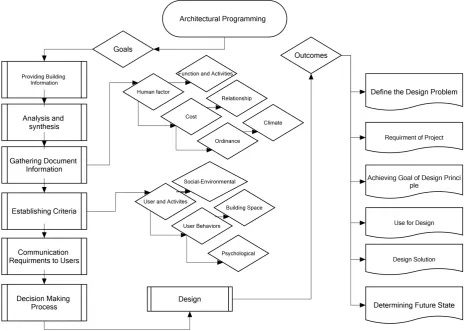
[image:6.595.66.534.367.698.2]Architectural programming goal is aimed directly at design; to provide accu-rate and reliable data building vocabulary can be directly used for the design (Kumlin, 1995; Cherry & Petronis, 2009, cited by Hussanian & Juaim, 2013; Hershberger, 1999; Pena & Parshall, 2001; Ma, 2015; Deng & Poon, 2013). In-deed, the process of architectural programming works to increase the quality of the buildings and development as well as a proper design. The concept of archi-tectural programming is clearly described in Figure 1.
DOI: 10.4236/cus.2018.64029 538 Current Urban Studies
2.2. Urban Development Programming
To clarify the definition of urban development programming, we need to have a clear understanding of relevant concept including “urban development,” “pro-gramming” and “urban planning,” afterward, we can define the urban develop-ment programming.
2.2.1. Urban Planning
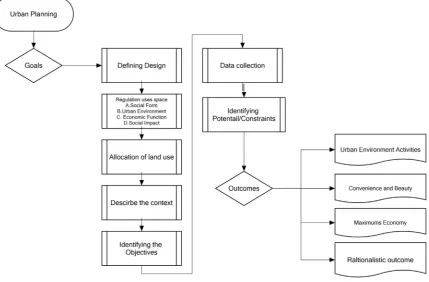
According to “Delhi” Urban Planning can be defined as the design and regula-tion of the uses of space that focus on the physical form, economic funcregula-tions, and social impacts of the urban environment and the location of different activi-ties within it (Susan, 2014) (The general concept of urban planning framework described in Figure 2).
2.2.2. Urban Development
The result of careful planning by civil and design engineers, project managers, architects, environmental planners, and surveyors. The integration of these dis-ciplines is known as urban development (Brooks, 2017).
2.2.3. Programming
[image:7.595.110.540.420.702.2]Programming is the preliminary phase of planning made by the programmer for a particular purpose. According to Palmer (1981), programming is the gather-ing, organizgather-ing, analyzgather-ing, interpretgather-ing, and presenting of the information rele-vant to design.
DOI: 10.4236/cus.2018.64029 539 Current Urban Studies
According to James et al. (2007, p. 91) expressed the programming:
Once a site selected for development or redevelopment, its future uses can be
determined or programmed in more detail.
Programming typically expressed in term of the quantity of spaces needed to
meet anticipated future needs.
Programming occurs over a range of spatial scale, from the entire site down
to individual building on the site.
2.2.4. Urban Development Programming Definitions
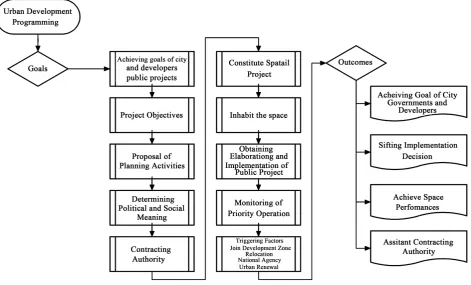
The urban development programming can be defined clearly in this method; according to Froncois Meunier (2010), “urban programming determines the po-litical and social meaning which the contracting authority assigns to the urban project. It constitutes the counterpart to the spatial project (architecture and ur-ban planning) by investigating primarily what will ‘inhabit the space’ and the performances which space will have to achieve in order to receive it”. Further-more, Ma Wenjun (2017) defined the urban development programming; “urban development programming is to achieve the development goal of the city gov-ernment or developers of public projects, as well as to achieve the objectives of the project and the overall idea, proposal and a series of planning activities. The results of the project programming are the basis for the city government and developers, in sifting projects and implementation decisions”.
Urban development Programming analyzes the existing needs and policies in a given country for urban development mission by the using these data; identi-fies opportunities and scope of a project in order to achieve a consistent and ef-fective urban development approach. In other words, Urban programming is a procedure, it covers the process of elaboration and implementation of urban projects from the triggering factor (Joint Development Zone project, relocation, National Agency of Urban Renewal application) to the monitoring of priority operations in the capacity of assistant to the contracting authority (Meunier, 2010).
The urban development programming phase will serve to assess; whether and in what form of urban development cooperation, should consider in planning and design. Therefore, this is the initial step in making sure that the possible impact and outcome of a project in urban development planning. Thus, the eventual agreement for cooperation in urban development achieved during the programming phase would provide a framework and a base for supporting the design phase to make opportunities for developers, users, and authorities related to the projects to have a clear understanding of the projects. Furthermore, Urban development programming is interdisciplinary, principles, methods, and nature of a project, that could usefully bring about an evolution/problem-solving in planning and design. The general concept of urban development programming expressed in Figure 3.
DOI: 10.4236/cus.2018.64029 540 Current Urban Studies Figure 3. General concept of urban development programming. Author: Rohani.
investigating and evaluating different interests in it, afterward, analyzing the scope of the site and make sure the basic for next step which is design. Important to realize, according to Francois (2010), “urban programming could usefully bring about an evolution in methods of planning (Development and Planning Project of the Local Urbanism Plan, Territorial Coherence Plan...)”.
The urban development programming goals depend on the level and nature of the projects. The research investigated the primary goal of urban development programming:
Improving the efficiency of the planning and development process. Improving the quality of public projects development.
To achieve the development objective of city developers and city
govern-ment.
To achieve the maximum and efficient information of the project’s
objec-tives.
DOI: 10.4236/cus.2018.64029 541 Current Urban Studies
2.3. Differences between Urban Development Programming and
Architectural Programming
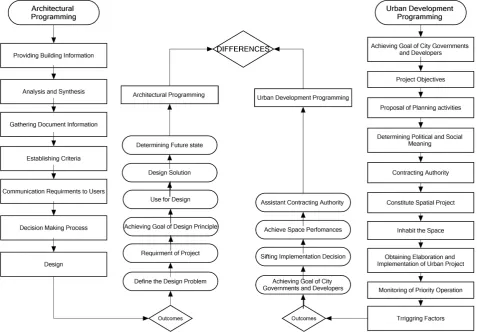
Theoretical analysis of this research presenting the differences between urban development programming and architectural programming (see Figure 4).
2.4. Differences between Urban Development Programming and
Planning
The urban development programming is a part of urban planning and differ-ences is clearly analyzed and presenting in this research (see Figure 5).
3. The Significance of Urban Development Programming
[image:10.595.61.539.362.694.2]Urban development programming has a significant role in the projects conse-quences, project implementation decisions, project goals and improving the quality of development. Furthermore, all types of projects need the relevant, comprehensive information in the extraction, clarification of resources with all aspects of planning and design, analyzing the scope and positioning of the projects, all these are a fundamental data of design, and the process of extraction and coordination of these data resource on urban project is urban programming.
DOI: 10.4236/cus.2018.64029 542 Current Urban Studies Figure 5. Differences between urban development programming and urban planning. Author: Rohani.
Even though, the urban development programming not only focuses on site analysis but also giving the strategies and achieving the objective of city authority and developers. Besides, how to get these data and how to employ in a feasible way to urban projects, all refer to urban development programming.
The accomplish necessity of the need for urban development programming in urban professional life, originate for many reasons related to social, economic and environmental accelerated changes, as well as increased with different pro-fessional discipline involved in the design process, the complexity of the process of the implementation and the complexity of the methods of urban develop-ment, the need for sufficient information has become more critical. Indeed, to specify the extent of the urban project’s complexity is clear in planning and de-sign. Francois (2010)noted that “realizing the extent of the urban project’s com-plexity, whether it is a renovation or the creation of a site, urban projects are dif-ficult for a master plan.” The research analyzing the need for urban development programming in the following paragraphs:
3.1. When to Do Urban Development Programming
de-DOI: 10.4236/cus.2018.64029 543 Current Urban Studies
velopment plan and any existing supplementary planning guidance do not cover adequately site-specific issues which need to addressed before the submission of a planning application. In this case, the programming process implementation is applicable and follows the strategies and methods to implement the process.
3.2. Minimizing Uncertainty and Improving Efficiency
The urban programming process explicitly shows the nature of adequate plan-ning and clarified a planplan-ning process. As well as, rational urban programming can make clear what is likely to be acceptable and what is unacceptable, where there is flexibility and where are requirements of the project. With this in mind, this stage minimizing uncertainty and improving efficiency of urban project. At the present time, minimizing uncertainty through urban development pro-gramming preparation; which is one of the primary goal in urban development programming to gain the developers and city governments objectives. For this reason, the preparation of urban development programming illustrates the cer-tainty to city governments and developers.
3.3. Enhancement the Quality of Development
Urban development programming through the role of interpreting development plan policy and planning regulation can influence the design of a site. When the urban programming process has done by appropriately interpreted and skilled people, it can attract the attention of the developers, city governments and au-thorities on the unique characteristics of the site and improve the quality of de-velopment. The process of urban development programming in the determina-tion of development quality dedicates a profound role.
3.4. Understanding the Urban Authority’s Goals
Indeed, all stages of urban development programming are linked to the devel-opment plan of a city. Urban develdevel-opment programming to understand the goal of city governments or urban authorities contains a series of programming and planning activities. These series of activities are helping to find out the goals of city governments concerning public projects. By all means, the need for an un-derstanding of urban authority’s goals causing is to simplify the implementation decisions.
3.5. Market Demand
develop-DOI: 10.4236/cus.2018.64029 544 Current Urban Studies
ment programming and demand for skilled programmer, planner, or architects that could implement the process efficiently. The professional programmers or skilled planners/architects could implement the process spotless.
Furthermore, the other most crucial preparations to maintain during the pro-gramming process is the skill and experience of the programmer in all stage of the programming. The skill of the programmer put forward one step clear in the design (Francois, 2010; Neiler, 2015; Ma, 2015; La Gro et al., 2001). According to
Tustler et al. (1993: p. 233), a successful programmer:
Communicates the proposed process to all involved.
Does not lock in preconceived solutions.
Reconciles subcomponent needs with overall organizational goals and re-sources.
Frequently tests and reviews design concepts, as functional and space models explored.
Further emphasize, according to Zeisel and Max (1993), comment on the role of the programmer: “The programmer must be an expert not only at synthesiz-ing disparate and often seemsynthesiz-ingly unrelated user data but also at translatsynthesiz-ing these data into practical, ‘designer-friendly’ information” (p. 260). In other words, programming requires an interactive collaboration between developers, programmers, and planner, the technical knowledge and interpersonal skills of the programmer help users define needs, identify the relationship, and visualize future opportunities (Hussain, 2015).
The significance of urban development programming described the impor-tance and need for this stage. This part of urban development planning (pro-gramming) is pay attention to contributes the planning process.
4. Urban Development Programming Challenges
This part of the research, describing some general challenge of urban develop-ment programming. Before to describe the challenges, research reveals that; in most of the urban projects, the process of programming not only have some challenges but wholly neglected. Only a minimal number of projects apply to the programming to practices. The reasons why urban programming neglected from urban projects is explained in the following points;
Mixing the urban programming task with another stage of planning and de-sign.
Programming avoids the creation of the planner/architects.
The cost expenses of the programming stage.
The programming may not be applicable to urban projects.
DOI: 10.4236/cus.2018.64029 545 Current Urban Studies
is no complete comprehensive process and strategies for urban development programming, even if there is; the process is inefficient. In other words, lack of a systematic and comprehensive framework for identifying and communicating applications/users and developer/authorities with design team (Kelly et al., 2003; Shen & Chung 2006; Bogers et al., 2008 cited by Hussanian & Juaim, 2013). Fur-thermore, according to Yu et al. (2006), Bogers et al. (2008), “current program-ming practices are still considered to be inadequate”. In other words, there no educational system for urban programming in most of the educational institu-tions. Furthermore, the procedure between project establishment and architec-ture design, the policy of charging, and also the pressure of the deadline in pro-gramming turned to a big challenge (Su, 2002, cited by Li & Xu, 2011; Hussanian & Juaim, 2013).
Indeed, unskillful knowledge about programming process and influence on the outcome of the projects made the client and developers to do not invest in this process (Faatz, 2009). Furthermore, one of the main characteristics in cur-rent challenges is increasing the complexity of the projects, the planning process, however, it is still separated into different specializations that are working sepa-rately, the programming phase still an exception (Achammer, 2009 cited by
Faatz, 2009). In the same time, how to get useful information, how to employ
them, and how to evaluate before applied in the projects (Alomari et al., 2012). In other words, gathering the useful and vital information represents the starting base of a good program, the challenge is how to separate the useful data out of a large amount of possible information.
To sum up, in this part of the research, urban development programming is facing to a significant amount of challenges and there is also lack of capacity to understand the programming stage. Since, there are not clear strategies, theories, and method. Besides, the educational system, planning system, authorities related to the urban project, planners and programmers, urban development policies and other parts related to urban projects have to pay attention in this valuable stage.
5. Urban Development Programming Strategies
The strategies of urban development programming should be based on the poli-cies and regulations of the urban development plan of cities. The investigations showed that some urban development programming strategies do not state effi-ciently. Consequently, their expectations were vague. Possibly they were inade-quately addressed at the outset. An explicit /clear strategy is crucial because they influence the whole programming process. The statement of why the urban pro-gramming has been prepared and precisely what it seeks to achieve is funda-mental to the urban development programming success.
5.1. Strengthen the Urban Development Planning Activities
DOI: 10.4236/cus.2018.64029 546 Current Urban Studies
urban planning activities. These strategies which seek to promote urban devel-opment have distinct characteristics. These strategies not only amplification the developers and city governments interests, but also covers different issues of ur-ban development. For example; to understanding this enhancement of the mix-use development is one of the critical strategies nowadays as well as scholars and researchers encouraged this method. The urban development programming strategies also pay attention to attract the developers, city governments and us-ers.
5.2. Identifying Constraints
The urban development programming stage activities contributes to identify the constraints of projects. In other hand, due to the sensibility and high risk of pub-lic projects; one of the primary Strategies of urban development programming is identifying constraints.
5.3. Promoting the Participation in the Development
Describing the participation in urban development programming is visible light. Certainly, one of the primary strategies of urban development programming is to induct the participation process in urban development projects. The pro-gramming is based on a combination of interviews and work sessions (Pena &
Parshall, 2001). The programming stage is known before as participation
process. The urban projects or public project directly or indirectly involve the participation. This does not make seedy the strategies of urban development programming.
5.4. Provides the Design Guidance
Preparation and implementation of urban development programming in a pro-fessional way could usefully bring an afford for the design stage. Indeed, the ur-ban development programming stage works for have a proper design. In other hands, according to James A et al. (2007), “design guidelines may address a va-riety of site components that have significant effects on a project’s economic success and environmental impact” (p. 102). In particular, urban projects often involving and implementing by different designers or a team of designers this is a qualified advantage to have design guide in the project.
5.5. Enhancement the Quality of Urban Projects
DOI: 10.4236/cus.2018.64029 547 Current Urban Studies
urban. The technical reason, analyze of urban development programming deter-mining the critical objectives of projects and realizing the priorities of urban projects which is vital for urban development and urban design.
5.6. Prove the Feasibility of Urban Projects
Urban development programming is proposing a series of planning activities in a feasible way for developers and city governments. The outcome of urban de-velopment programming gives opportunities to city governments and developers as well as users a feasible way to implement the projects. The urban development programming strategies consider to discover a feasible way to implement the project in an affordable and sustainable method to have a proper design.
6. Urban Development Programming Implementation
In general, urban development programming can be implemented in different level (Macro-Micro) as well as it is related to the strategies, regulations, and pol-icy of the urban planning and design. The implementation of urban develop-ment programming following the strategies is given to the project, through the characteristics of the project. The adoption of the urban programming does not mark the end of its role in the project development process. The program-mer/the team responsible for preparing the programming should have been aware, from the outset, how the programming was to be used to influence the project development process. The programming will be prepared before a plan-ning application is submitted. The process of urban development programming did not definite a clear framework. Somehow, the process of programming ap-plying alongside other parts of planning and design.
6.1. Which Considers to the Participation
All the process of the implementation follows the strategies of urban develop-ment programming. The impledevelop-mentation of the urban developdevelop-ment program-ming has to follow the entice of consent. The concept of participation is one of the primary strategies in urban development programming. This part of urban development programming does not mean; the participation of the us-ers/application involved because urban projects are public. The strategy of urban development determining to involve the users and cooperation of them are needed. Furthermore, according to Hussain (2015), concepts of human needs and responses must become an integral part of the program and the project budgeting process for every building. It is essential that the members of the partnerships development link with the relevant urban authorities, developers, users and work in full transparency.
6.2. Which Needs for Further Analysis
DOI: 10.4236/cus.2018.64029 548 Current Urban Studies
and work. Nevertheless, if some further work is needed on a specific issue before the planning application is submitted, this is the responsibility of programming process should make it clear. That is why programming should always be linked up as early as possible for the use of the available resources in the obtained time.
In summary, the implementation process is related to many factors that take a comprehensive part in urban development programming. The following points describing some characteristics which should be part of the approach in the im-plementation of the urban development programming;
Social, cultural, and gender issues should be considered at all level of urban
development programming.
Public applications should have enough knowledge of the programming
process.
The supporters of the project have to be confirmed before the implementa-tion of the programming in urban.
Public support for the urban project is essential and can significantly alter the implementation of the process.
The associations and urban authorities related to the project have to be aware of the process of implementation
7. Urban Development Programming Methodology
Case Study of Shanghai Hongqiao Central Business District
(HQCBD)
Shanghai Hongqiao central business district as a first-class global business hub, and the only transportation hub in China that integrates local, regional, and in-ternational connection (Dai & de vires, 2017). The (HQCBD) is marked as ama-jor urban development planning project and consist; a mix of functions, such as offices, hotels, cinemas, shopping malls, and residential (Figure 6). The whole Central Business District (CBD) concerns an urban redevelopment covering 86 km2 (Dai & de vires, 2017).
The advantage (geographical, transportation, late-development, policies, rela-tive cost) of (HQCBD) referred a modern service industry concentration district of Shanghai, a new platform for the construction of Shanghai international trade center, a gathering place for the headquarters of enterprises and trading organs, a high-end business service serving the Yangtse Delta Area, Yangtse valley, and the whole country.
DOI: 10.4236/cus.2018.64029 549 Current Urban Studies Figure 6. Map of shanghai Hongqiao central business district. Source: Shanghai Hong-qiao business district.
Figure 7. Urban development programming methodology. Author: Rohani.
Hypothesis: An assumed, or real condition is taken as a basis for inference from which to conclude. If we put the urban programming based on the differ-ences, concept, strategies, and implementation, from the three variables: Urban programming, Urban planning, and Architectural programming, then, the re-search can get an integrated urban programming methodology for the Urban project (in this case, Shanghai Hongqiao CBD, 2016).
[image:18.595.208.539.334.574.2]DOI: 10.4236/cus.2018.64029 550 Current Urban Studies
environment, the historical and cultural environment, the natural environment, the social environment, the municipal public utility system, the urban land ap-plication, the economic environment, the market survey, and the user needs survey and so on.
Analysis: The analysis can be divided into two points of view; the environ-mental analysis and feasibility analysis, and the theoretical analysis which the theories analysis progress mainly includes urban planning theory, urban eco-nomics theory, and marketing theory.
Target: In general, for specific urban development planning projects, there will be different target system, but in general all from the policy objectives, legal objectives, planning objectives, market goals, and financial goals are five aspects used to develop the target system.
Result and implementation: The purpose of urban planning implementation is to rationally allocate urban space resources so that urban economic, social and construction activities can be carried out efficiently, orderly and continuously.
Evaluation: Evaluation of the implementation is an essential part of the entire urban planning process. The objective is to evaluate the implementation of the plan that has implemented for a period and whether the result of the plan and the original plan compilation has been implemented.
SWOT Analysis of (HQCBD)
Strengthen
HQCBD integrated transport hub.
Traffic conditions are extremely convenient. Large flow of people.
New area, land resources are not limited.
Conducive to urban development control and management. Weaknesses
Traffic noise affectation for resident Height limitation/restriction.
Opportunities
Industrial transfer worldwide.
Economic development of the Yangtze River Delta to open service-oriented
development.
Integration of urban development in the Yangtze River.
Hongqiao transport hub will drive the development of the surrounding in-dustries.
The surrounding town has a certain population and industrial base.
Threats
Peripherally related industries are not maturing enough to form the devel-opment of linked industries.
Difficult to compete with other large shopping center in Shanghai.
DOI: 10.4236/cus.2018.64029 551 Current Urban Studies
Evaluation
This case allows the establishment of what extent plans and physical develop-ments contribute to urban vitality.
The plans and the physical environment might be seen as necessary pre-conditions for place-making, but are by no means sufficient conditions.
The actual use by people and businesses will determine whether HQCBD will become a high-quality place.
Hongqiao CBD can be considered an outlier case.
It has characteristics that are not encountered to such an extent on the broad-er population.
The political culture is within the municipality of Shanghai—with more de-centralization and openness to non-governmental actors than in most parts of China.
It creates different, and arguably, more favorable conditions for creating place quality.
It allows us to gain insight into deviating conditions of institutional capacity that seemingly relate to better place quality.
8. Conclusion
The research is presenting the main concept of urban development program-ming through the literature research and analysis of differences between urban planning, architectural programming and urban development programming. The significance of urban development programming is expressing through the strategies, challenges and implementation. Additionally, the research innovated a new methodology of urban development programming. This methodology is applicable to urban development projects. Indeed, the research implemented this methodology for Shanghai Hongqiao central business district. Consequently, this theory and methodology can determine the task of urban development pro-gramming and can be useful for developers, urban authorities and users, and al-so is an opportunity for the researcher and students for further investigation in this area. In the final analysis, the research presents the outcome of investiga-tions in some key points:
The theory and method of urban development programming.
The significance of this research explored a part of planning which is the most critical part in planning and design and recommending that still a wide range of investigations/research is needed.
The researched explicitly explained that architectural and urban program-ming is different and each of these has critical significance in their majors.
The research expressed the urban development programming which is a part of planning through the differences between planning and programming.
Significance of urban development programming expressed that
DOI: 10.4236/cus.2018.64029 552 Current Urban Studies The need for urban development programming and why urban development
programming has to be part of planning clarified through the significance of urban development programming.
The research investigated the current challenges of urban development pro-gramming. Also, it explored why urban development programming has been ignored and neglected in planning and design. Furthermore, it recommended that some urban development programming challenges are baseless.
The hypothetical analyses of strategies and implementation of urban devel-opment programming in this research present the important role of pro-gramming in planning and design.
The research innovated a new methodology through determining the steps
and implementing on case study.
The research explicitly explained that urban development programming is a part of urban development planning and simplifying the process of planning.
9. Recommendation for Further Research
The research that has been undertaken for this paper has highlighted a number of topics which further research would be beneficial.
Several areas where information is lacking were mentioned in the literature review and studies undertaken for this research. Whilst some of these were ad-dressed by the research in this paper, others remain. In particular, there is a lack of urban development data in the different area of this step, in planning and de-sign.
The research undertaken studies of programming and planning of Shanghai Hongqiao CBD as a major urban development project in Shanghai. There are several further types of research this paper considered in this project. The paper considers the integration of architecture planning and urban planning of (HQCBD). This integration concept developed in this research can be used for connecting different new studios or analysis about urban planning and design (For example vertical green infrastructure, low carbon, architecture elements) in a programming phase. The continuing future research in urban development programming is going to be the evaluation methodology/framework for plan-ning and design in central business districts after constructed. The urban pro-gramming process could investigate the ecological objectives and evaluation. The project is a valuable example of the urban development programming process.
Conflicts of Interest
The authors declare no conflicts of interest regarding the publication of this paper.
References
Achammer, C. M. (2009). Schlüssel fürnachhaltige Gebäude. In Zeno 01/09 (pp. 46-49).
DOI: 10.4236/cus.2018.64029 553 Current Urban Studies
Alomari, H. R., Al-Sheikh, S., & Younis, G. M. (2012). Architecture Programming Ap-proaches in Practical Research of Fifth-Year Thesis—Specialists of Local Architecture Department. Procedia-Social and Behavioral Sciences, 102, 368-385.
https://doi.org/10.1016/j.sbspro.2013.10.752
Bogers, T., Van Meel, J. J., & Van der Voordt, T. J. M. (2008). Architects about Briefing: Recommendations to Improve Communication between Clients and Architects. Facili-ties, 26, 109-116. https://doi.org/10.1108/02632770810849454
Brooks, A. (2017). What Is Urban Development? Bizfluent.
https://bizfluent.com/about-4728387-what-urban-development.html
Cherry, E. (1999). Programming for Design; from Theory to Practice. New York: John Willey & Sons, Inc.
Cherry, E., & Petronis, J. (2009). Architectural Programming. Whole Building Design Guide. Washington DC: National Institute of Building Science.
Dai, G., & de Vires, J. (2017). Place Making in Shanghai Hongqiao Business District: An Institutional Capacity Perspective. Urban Policy and Research.
Deng, Y., & Poon, S. W. (2013). Professional Practice in Programming Large Public Building in China: A Questionnaire Survey. Frontiers of Architectural Research, 2,
222-233. https://doi.org/10.1016/j.foar.2013.04.002
Dundar, M. (2016). Post-Occupancy Evaluations in Architectural Programming Process; a Case Study of Educational Buildings. Nishinomiya: Bahcesehir University, Mukogawa Women’s University.
El Reifi, M. H., Emmittand, S., & Ruikar, K. (2014). Exploring the Learn Briefing Processes for Effective Design Management. Oslo: Proceeding IGLC.
Faatz, S. (2009). Architectural Programming: Providing Essential Knowledge of Project Participants Needs in the Pre-Design Phase. Technology and Management in Con-struction.
Goldman, M., & Peatross, F. D. (1992). Planning for a Captive Audience: Approaches and Problems in Programming Correctional Facilities. In W. F. E. Preiser (Ed.), Profession-al Practice in Facility Programming (pp. 357-380). New York: Van Nostrand Reinhold. Henn, G. (2009). Methoden/Programming. http://www.henn.com/#en/methoden Hershberger, R. (1999). Architectural Programming and Predesign Manager. London:
Routledge. https://www.taylorfrancis.com/books/9781317292876
Hongqiao CBD Ready to Take Off? http://www.knightfrank.com.cn Hussain. (2015). Programming—The Third Dimension.
https://healthcarearchitecture.in/programming-the-third-dimension-2/#tc-comment-ti tle
Hussanian, M. A., & Juaim, M. N. (2013). Modeling Knowledge for Architectural Pro-gramming. American Society of Civil Engineers.
https://doi.org/10.1061/(ASCE)AE.1943-5568.0000099
Kelly, J., Shen, Q. P., Hunter, K., & Yu, A. (2003). The Development of a Theoretical Framework for Briefing Using a Value Management Approach. In RICS Foundation Construction and Building Research Conference (pp. 328-337). London: Univ. of Wolverhampton.
Kumlin, R. R. (1995). Architectural Programming; Creative Techniques for Design Pro-fessionals. New York: McGraw-Hill, Inc.
La Gro Jr., J. A. (2001). Site Analysis; a Contextual Approach to Sustainable Land
DOI: 10.4236/cus.2018.64029 554 Current Urban Studies
Li, L. Y., & Xu, Y. G. (2011). Innovative Landscape Architectural Programming. Wuhan: IEEE.
Ma, J. (2014). Architectural Programming and Architectural Design. Xi’an University of Architecture and Technology.
Ma, W. J. (2015). Urban Development Programming (2nd Edition). Beijing: China Ar-chitecture & Building Press.
Meunier, F. (2010). Adopting the Approach of Urban Programming. France: Courrier International.
Mittleman, L., & Daniel, D. (1995). Architectural Programming Toolbox: Using Group Support Systems Technology to Increase the Effectiveness of User Participation in Architectural Programming. Tucson, AZ: University of Arizona.
Neiler, E. (2015). Architectural Programming, a Necessary Stage in All Projects.
https://www.tinkarch.com/single-post/2015/10/06/Architectural-Programming-a-neces
sary-Nujaidi, D., & Hazim, R. (1992). Architectural Design Methodology. Department of Ar-chitecture University of Technology.
Palmer, M. A. (1981). The Architect’s Guide to Facility Programming. Washington DC: The American Institute of Architects.
Pena, W. M., & Parshall, S. A. (2001). Problem Seeking; an Architectural Programming Primer. New York: John Willey & Sons, Inc.
Popov, L. (2004). The Market for Facility Programming: A Study of Client Preferences and Decision-Making (115 Paragraphs). Qualitative Social Research, 5, 37.
http://nbn-resolving.de/urn:nbn:de:0114-fqs0402375
Preiser, W. F. E. (1993). Professional Practice in Facility Programming. New York: Van Nostrand Reinhold.
Sanoff, H. (1992). Integrating Programming, Evaluation and Participation in Design: A Theory Z Approach. Aldershot; Brookfield, VT: Avebury.
Shanghai Hongqiao CBD (2016). Why Hongqiao CBD.
http://en.shhqcbd.gov.cn/2016-03/31/c_50614.htm
Shen, G. Q. P., & Chung, J. K. H. (2006). A Critical Investigation of the Briefing Process in Hong Kong’s Construction Industry. Facilities, 24, 510-522.
https://doi.org/10.1108/02632770610705284
Su, S. (2002). Modern Masterminding. Beijing: Party School of the CPC Press. (In Chi-nese)
Susan, S. F. (2014). Urban Planning.
https://www.britannica.com/contributor/Susan-S-Fainstein/6152
Tustler, W. H., Zilm, F., Hannon, J. T., & Newman (1993). Programming the Third Di-mension. New York: Van nostrand Reinhold.
Van der Voordt, D. J. M., & Van Wegen, H. B. R. (2005). Architecture in Use: An Intro-duction to the Programming, Design and Evaluation of Buildings. Oxford: Architec-tural Press.
White, E. T. (1972). Introduction to Architectural Programming. Tucson, Ariz., Archi-tectural Media.
Yu, A. T. W., Shen, Q., Kelly, J., & Hunter, K. (2006). An Empirical Study of the Variables Affecting Construction Project Briefing/Architectural Programming. International Journal of Project Management, 25, 198-212.
DOI: 10.4236/cus.2018.64029 555 Current Urban Studies
DOI: 10.4236/cus.2018.64029 556 Current Urban Studies
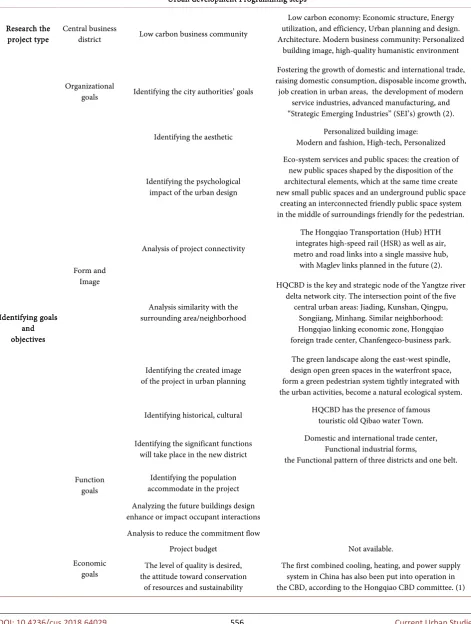
Appendix 1
Table A1. Urban development programming steps. (Author: Rohani).
Urban development Programming steps
Research the
project type Central business district Low carbon business community
Low carbon economy: Economic structure, Energy utilization, and efficiency, Urban planning and design. Architecture. Modern business community: Personalized
building image, high-quality humanistic environment
Identifying goals and objectives
Organizational
goals Identifying the city authorities’ goals
Fostering the growth of domestic and international trade, raising domestic consumption, disposable income growth, job creation in urban areas, the development of modern
service industries, advanced manufacturing, and “Strategic Emerging Industries” (SEI’s) growth (2).
Form and Image
Identifying the aesthetic Modern and fashion, High-tech, Personalized Personalized building image:
Identifying the psychological impact of the urban design
Eco-system services and public spaces: the creation of new public spaces shaped by the disposition of the architectural elements, which at the same time create new small public spaces and an underground public space
creating an interconnected friendly public space system in the middle of surroundings friendly for the pedestrian.
Analysis of project connectivity
The Hongqiao Transportation (Hub) HTH integrates high-speed rail (HSR) as well as air, metro and road links into a single massive hub,
with Maglev links planned in the future (2).
Analysis similarity with the surrounding area/neighborhood
HQCBD is the key and strategic node of the Yangtze river delta network city. The intersection point of the five
central urban areas: Jiading, Kunshan, Qingpu, Songjiang, Minhang. Similar neighborhood: Hongqiao linking economic zone, Hongqiao foreign trade center, Chanfengeco-business park.
Identifying the created image of the project in urban planning
The green landscape along the east-west spindle, design open green spaces in the waterfront space, form a green pedestrian system tightly integrated with the urban activities, become a natural ecological system.
Identifying historical, cultural HQCBD has the presence of famous touristic old Qibao water Town.
Function goals
Identifying the significant functions will take place in the new district
Domestic and international trade center, Functional industrial forms,
the Functional pattern of three districts and one belt. Identifying the population
accommodate in the project Analyzing the future buildings design enhance or impact occupant interactions Analysis to reduce the commitment flow
Economic goals
Project budget Not available.
The level of quality is desired, the attitude toward conservation
of resources and sustainability
DOI: 10.4236/cus.2018.64029 557 Current Urban Studies
Continued
Management goals
Time project to be employed About 95 percent of the 352 buildings in the zone’s core area will be completed by the end of 2016, according to the committee. (1) Type of development in the
next five, ten, fifteen years Major function area and Expansion area.
Time goals owner, clients, programmer, or architect]. Refers to the circumstances of the
Gathering and analysis facts National and geographical factors
Topography Determine the physic characteristics of the land.
Location and transportation Transportation concept: Road system, improve the pedestrian traffic, bicycle sharing system, promote the public traffic, Light Rail Transit (LRT).
Vicinity analysis (land use, transportation)
The strategic location of (HQCBD) integrating: Hongqiao transportation Hub (HTH), Hongqiao High-speed
train station and airport, bus, Maglev, metro line. Land use: mix use, Commercial, and finance, Culture and Entertainment,
Business and office, Building and plaza. The land use proportion: residential, public buildings, Hub buildings,
Airport interior buildings, storage logistics.
Social factors
Population (quality and number of
talents, consumption level, demand) Not available.
Environment analysis (green, low carbon, eco-friendly)
One of the zone’s key development concepts includes a focus on achieving low carbon emissions during their construction phase. All buildings within the CBD’s
core area have been certified with a two-star rating by the National Green Building Evaluation Standards, while
more than 50 percent of the buildings have received three stars. Some buildings even have a Leadership in
Energy and Environment Design qualification.1
Economic factors
World or national industrial development trend
High tech-industry and service are main industry Yangtze River Delta important gateway to the world; Shanghai serves
the commerce and trade platform of the whole country and the Yangtze River Delta, An Important Carrier of Shanghai’s
Construction of an International Trade Center and an Important Pole of Shanghai’s Multi-core CBD Structure.
Industrial position analysis
Core Industries - Mobility for the Modern Business Trade Services, Extending Industries - Modern Business Services
Based on “Business,” Supporting Industry - Services for Business and Commercial Services.
Identifying the economic goals of the project
Fostering the growth of domestic and international trade, raising domestic consumption, and placing greater emphasis
towards producing2 value-added products and services as China’s rising labor costs and technical expertise
move the country up the global supply chain.
Political factors Shanghai’s industry policies Zoning, national and According to the Shanghai policy:
1A World-class business zone in Shanghai, China ... (n.d.). Retrieved from
http://www.chinadaily.com.cn/kindle/2016-09/05/content_26702998.htm.
2Hongqiao Cbd: Ready To Take Off? Content.knightfrank.com. (n.d.). Retrieved from
DOI: 10.4236/cus.2018.64029 558 Current Urban Studies Continued Analysis and concept disclosure Implementation
of low-carbon urban planning, and design, traffic Energy utilization, architecture,
Energy utilization: improve the efficiency of local energy, development, and innovation of emission reduction technologies, new energy, clean energy development, and promotion. Architecture: shape coefficient of the building, insulation of the wall, sun shading system, roof garden,
ventilation. Urban planning and design: mix use, maximize the land use, walkable, sustainable design, microclimate, landmark and high density, high-quality public green, safety and unobstructed of the public space.
Traffic: encourage pedestrian traffic, encourage bicycle traffic, promote public traffic, reduce private car traffic.
Implements a modern
business district
Personalized building image Modern building image symbolizes the corporate the building image.
High-quality and humanistic environment
The image and mode park as a business area: high green ratio no less than 30%, humanistic and specialized landscape
setup, diversified place arrangement, flexible layout.
Convenient service facilities walkways, parking facilities, commercial facilities.Public service facilities, underground pedestrian
Implements industry layout
Modern service industry Financial service industry, cultural industry, information service industry, modern logistics industry, exhibition and touristic industry, professional service industry.
High tech-industry Semiconductor illumination, biological technology, new energy recourses, new materials.
Advance manufactory Pillar industry, equipment industry, strategic industry.
Need determining and quantitative requirements Cost requirements Construction cost (for building and site work)
The project cost is not available. Amounts for architect’s fees
Contingency, Communications
Topological surveys, and any other costs
Schedule of
construction Major function area, Expansion area.
Significant function area completion year: Hongqiao transportation hub (HTH) (2011), core phase
1 (2014-2015), core area-south section (2015-2020). Expansion area completion year: west Hongqiao Qingpu
(under redevelopment), south Hongqiao Minhang (under redevelopment), north Hongqiao Jiading
(under redevelopment).