Supporting change in
homelessness and related
services
Published by
Homeless Link First Floor
10-13 Rushworth St London
SE1 ORB 020 7960 3010
www.homeless.org.uk `
Authors
Joy MacKeith, Sara Burns and Kate Graham Triangle Consulting
26 Sparsholt Road London, N19 4EL 020 7272 8765
www.triangleconsulting.co.uk
In this second edition of the Outcomes Star, the tool itself – the scales and Star Chart – remain unchanged. However, this version incorporates improvements to the introductory text and guidance made possible by feedback from a wide range of organisations who have implemented the Outcomes Star and helped develop good practice. It also incorporates the on-line version, the Outcomes Star System, which streamlines the number of documents and further improves aspects of the design.
This version is published by Homeless Link who now manage www.homelessoutcomes.org.uk where the Outcomes Star is published. Homeless Link is responsible for its promotion within the
homelessness sector.
Original design concept copyright (CC) 2006 Jellymould Creative 2006.
This second edition has been designed by Homeless Link.
Copyright
Copyright (CC) 2008 London Housing Foundation and Triangle Consulting
You are free to share, to copy, distribute and transmit the work under the following conditions:
You must attribute the work in the manner specified by the above (but not in any way that ●
suggests that they endorse you or your use of the work) You may not use this work for commercial purposes
●
No Derivative Works. You may not alter, transform, or build upon this work
●
For any reuse or distribution, you must make clear to others the license terms of this work. The
●
best way to do this is with a link to www.homelessoutcomes.org.uk
Any of the above conditions can be waived if you get permission from the copyright holder
●
Nothing in this license impairs or restricts the author’s moral rights.
●
This is a Creative Commons licence, a fair way between the extremes of copyright control and uncontrolled exploitation. For more information about Creative Commons visit:
Foreword from Homeless Link
We are very pleased to have been asked by the London Housing Foundation to take on the outcomes programme they have developed since 2003. We would like to pay tribute to the vision of
St Mungo’s in initiating the Outcomes Star and to Triangle Consulting for their work in its development.
We see this as a major opportunity to promote the value of an outcomes approach in helping services to focus on the needs, potential and development of each individual person. Our ambition is to see our country free from homelessness. We see the amazing work that our members do to change lives by providing the right support to the people they serve. This outcomes tool will help them provide the evidence of their impact and success to commissioners, partners and their staff. Most importantly it supports informed discussion between the person using services and their support worker over a plan that works for them as an individual and enables a shared understanding of progress and remaining challenges. We at Homeless Link also look forward to joining up information at a national strategic level to build evidence of what works to support the case for intelligent investment in homelessness and housing related support.
Jenny Edwards, Chief Executive, Homeless Link
Foreword from Triangle Consulting
We have been delighted and overwhelmed by the level of interest in the Outcomes Star. We are very pleased that Homeless Link is now taking the lead role in promoting the Star within the homelessness sector and hope that this new, improved version meets the need for a practical, usable outcomes tool even better than the previous edition.
We believe the Outcomes Star and the new Outcomes Star System for on-line completion and analysis have enormous potential to support change and develop evidence of effectiveness. We are
committed to continuing the development and promotion of the Star for the benefit of the sector
and ultimately the people who use its services.
Joy MacKeith, Sara Burns and Kate Graham, Triangle Consulting
Acknowledgements
We are aware that we would not have been able to publish such an accessible and effective tool without an enormous amount of feedback and input along the way from managers, workers and clients in many organisations: people who have enthusiastically participated in developing and testing versions of the Star and made many helpful suggestions for improvements.
We would particularly like to thank St Mungo’s for their role in developing the original Star. Without their energy and vision the Outcomes Star may never have been born at all.
Other organisations that have embraced, tested and contributed include Thames Reach, The Passage, Single Homeless Project, Rochdale Council’s Supporting People Team and SP funded service providers in Rochdale. We would also like to thank the Mental Health Providers Forum and its members, who, by commissioning a mental health version of the Star, provided a rich new forum for developing the
Star and made a significant contribution to the improvements.
Lastly we would like to thank the London Housing Foundation for initiating the Impact through Outcomes Programme which made the development of the Star possible, and for commissioning and
Contents
Introduction
5What is the Outcomes Star? 5
How was it developed? 7
Homelessness Star resources 8
Using the Star with Service Users
9Before you use the Star 9
Introducing the Star 10
Using the ladders and detailed scales 10
Completing the Star Chart and Action Plan 12
Revisiting the Star at reviews 13
When service users move on 14
How the Star helps to improve keywork 14
Guidance for working with people at different stages on their journey 15
Frequently Asked Questions 16
Implementing the Star in Your Project or Organisation
20Lead the implementation from the top 20
Review your reasons for introducing the Star 21 Assess the suitability of the Star for your service 21
Run a pilot 22
Integrate the Star into your ways of working, paperwork and IT 23
Train staff to use the Star 24
Ensure quality and consistency in the use of the Star 25
Analyse and interpret the data 25
Share and act on the data 31
Appendix One: Homelessness Star Training
35Introduction
What is the Outcomes Star?
The Outcomes Star for the homelessness sector (referred to as the Star throughout this document) is a tool for supporting and evidencing change when working with adults who are homeless, formerly homeless or at risk of becoming homeless.
The Star is an outcomes tool, which means that it enables organisations to measure and summarise change across a range of service users and projects. It is also a keywork tool, which means that it supports the service user in making changes by providing him or her with a map of the journey of change and a way of plotting his or her progress, and planning the actions he or she needs to take.
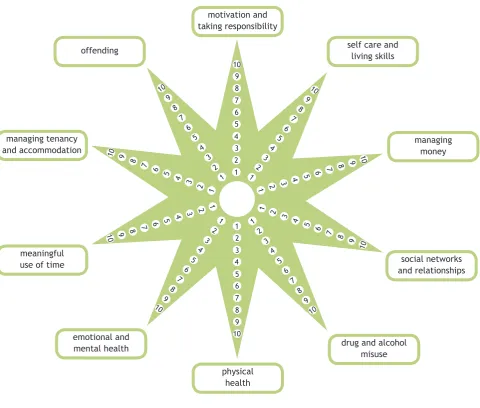
The Star focuses on ten core areas that have been found to be critical to supporting people in the move away from homelessness:
Motivation and taking responsibility
●
Self-care and living skills
●
Managing money and personal administration
●
Social networks and relationships
●
Drug and alcohol misuse
●
Physical health
●
Emotional and mental health
●
Meaningful use of time
●
Managing tenancy and accommodation
●
Offending
●
The Star measures the relationship the service user has with any difficulties they are experiencing in
each of these areas and where they are on the journey towards addressing them. It does not directly
measure the severity of the difficulty (e.g. the level of drinking for someone with an alcohol misuse
problem). It also does not directly measure their level of support need as the need for support can increase as well as decrease as the service users makes progress towards their end goal.
The Homelessness Star is one of a growing suite of Stars designed to support and measure change in people who are in contact with support agencies. The Recovery Star is a version for adults with mental health issues and a version for young people with substance misuse issues will be available in early 2009. Other versions, including a ‘pick and mix’ version that will enable organisations to tailor-make their own Star are under development or planned.
All versions of the Star are underpinned by the assumption that positive growth is a possible and realistic goal for all service users and are designed to support as well as measure this growth by
focussing on people’s potential rather than their problems. They are all based on the same five
stage model of the process by which people make changes in areas of their life that are not working
for them. The five stages are Stuck, Accepting help, Believing, Learning and Self-reliance. The full
Figure One: The Outcomes Star
“We wanted to use something our clients could engage with and which could involve clients right from the word go. The Star is one of the few tools that are useful for both clients and staff and helps us demonstrate what we're doing - it ticks a lot of boxes! It is person-centred and whole life.”
How was it developed?
The original version of the Star, called the St Mungo’s Star, was developed by Triangle Consulting in 2003 for St Mungo’s, a London based charity providing a wide range of services to homeless
people. Consultations took place with over 80 staff in a wide range of projects for vulnerable homeless adults to identify the intended outcomes of the services together with the journey that service users travelled towards achieving them. This prototype Star was piloted in St. Mungo’s, then adapted and piloted in a range of projects in 10 further organisations. The feedback and suggestions
for improvement were then used to develop the first official version of the Star, called the Outcomes
Star, which was published by the London Housing Foundation in 2006.
Over the subsequent two years the Star has been applied in a wide range of settings resulting in further feedback about how it works in practice. In addition Triangle Consulting has worked with the Mental Health Providers Forum and some of its members to develop the Mental Health Recovery Star. This new edition of the tool for the homelessness sector incorporates the learning from the
application of the Star in the mental health and homelessness sectors and beyond.
The bottom-up process of development has ensured that the tool is rooted in a real understanding of the nature of change and is meaningful to both service users and workers as well as providing robust
outcomes data that reflects the true aims of services.
“I felt fully involved; it was clear and easy to understand and focused on me as a whole person, not just as a problem. It felt like a conversation; felt like the first time someone had really listened to me. You can really get to know someone and know things about someone [using the Star] - even though you may think you know them well.”
Service user, Tulip Day centre
About this guide
This Organisation Guide sets out guidance on the use of the Star in keywork and its
implementation across an organisation. It contains two main sections. The first is aimed at
Star resources
As well as this Organisation Guide, there are a number of other resources:
1. The User Guide
The Star tool is published in the User Guide, which contains:
An introduction to the tool for service users, including a description of the ladder of
•
change that underpins the tool
Ladders and detailed scales describing a ten step journey for each of the ten outcome
•
areas covered by the tool The Star Chart and Action Plan
2. The Star Chart and Action Plan
These are the forms for completion with service users. They include:
The Star Chart itself on which the scores for each of the ten outcome areas are plotted
•
The Star Notes page for recording comments relating to each of the scores
•
An Action Plan for recording specific goals and actions to achieve them arising out of the •
process of completing the Star
3. The One-day Training Course
This is a complete off-the-shelf course aimed at keyworkers and managers that can be
delivered by a lead worker in your organisation to train colleagues to use the Star. It includes: Timetable and content for the day
•
Guidance on how to run each session
•
All handouts needed for participants
•
4. The Outcomes Star System
The Outcomes Star System is a resource for on-line completion of the Star and analysis of data. This Outcomes Star System will:
Immediately display an individual’s Star which can be printed off for the user and/or the
•
case file
Calculate the change for the individual
•
Collate results for services
•
Allow benchmarking and participation in learning across and within organisations (the
•
data remains confidential as only a service user number is used)
See
• http://test.outcomesstarsystem.org.uk for a demonstration or www.outcomesstarsystem.org.uk to register to use the System.
Please see back page for further details about resources.
“We absolutely love it! The manager of our young people’s service says it is a
fantastic tool to illustrate, motivate and demonstrate change. We have seen benefits for service users and workers through improved key work, for line managers in supervision, for senior management and in our reputation with our funders. We are a massive fan.”
1. Using the Star with Service Users
The Star is designed to be used as an integral part of the keywork process and should therefore be completed by the service user and keyworker1 together. It is not meant to be a quick exercise, but
a thoughtful, reflective process.
The Star is a flexible tool that keyworkers should use in a way that responds to the needs and
preferences of each service user, rather than mechanically following a set of instructions. For this reason the instructions below are guidelines for use rather than a step by step manual and we strongly recommend that all workers receive a one day training in the use of the Star, as well as follow up support and line management (Details of the training are in Appendix 1.)
Before you use the Star
Before you use the Star you should:
Have a good understanding of the underlying journey of change
● described on pages 15 and
16 of the tool. The Journey of Change is similar to the Prochaska and DiClemente’s Cycle of Change2: Pre-contemplation (equates to Stuck), Contemplation (equates to Accepting Help),
Preparation (Believing), Action (Learning) and Maintenance (Self-reliance). If you are familiar
with this model you may find these linkages helpful.
Be familiar with the 10 ladders and detailed scale point descriptions.
● Practise using the
ladders by thinking of one or two service users you have worked with and work out in your own mind where you would place them on each scale. It’s best if you can do this together with a colleague who has experience of using the Star to check your understanding with theirs Know how to introduce the Star to a service user
● . The introduction at the beginning of the
tool highlights all the areas that you need to cover. You could try running through it in your head or out loud beforehand. It is really important that the service user understands how the
tool works so that they can participate properly and benefit fully
Know how the Star
● is being used in your organisation. When is it first completed with new
service users and when are second or third readings taken? What happens to the form once completed and to the data? What should you do if you need help with any aspect of using the Star? If your organisation is using the Outcomes Star System then you may need to be familiar with how to use this system as well.
1 The keyworker could be the project worker or the support worker or may have another name in your project. It is the person who is assigned special responsibility for working with that service user – assessing their needs, agreeing goals and providing support and referrals to help them meet those goals.
Introducing the Star
The process of completing the Star is intended to be helpful to the service user as well as providing useful outcomes data for the project.
In order to participate properly in the process of completing the Star it is important that the service user fully understands the tool and the Journey of Change in particular. This can take a little time to explain and so we recommend that wherever possible the Star is introduced to service users before
the first session in which it is completed. This can be done a couple of days or longer before in one of
a number of ways:
-By talking the service user through the points in the introduction at the beginning of the User
●
Guide during a keywork session
If you have a number of new service users starting around the same time or if you are
●
introducing the Star for the first time to existing service users, you could introduce the Star in a
group setting.
By inviting a service user who has already completed the Star and found it a positive
●
experience to describe the process to the new service user
By giving the service user a copy of the User Guide to read before the session.
●
Whichever approach or combination of approaches you take it is important that you check with each service user individually that they understand the tool and why it is being used.
Using the ladders and detailed scales
Looking at the ten ladders with the service user is the heart of the process of completing the Star. Exactly how this is done is an art rather than a science and will depend on the service user and where they are on their journey of change.
Responses to the ladders vary from person to person. Some people like the visual representation and enjoy speaking about themselves with the help of this format. Others consider the material covered by some of the scales an intimate matter and
feel vulnerable and exposed. Yet others may initially find it difficult to engage with the material but gradually find that the ladders prompt them to talk much
Of course all these responses are valid and you will need to be sensitive in adjusting your approach to the person involved. The following are some pointers:
Let the service user decide which scale to start on
● or, if they are not sure, choose one you
think will be easier to discuss. Although the Motivation and Taking Responsibility ladder is
central to the Star, it can be difficult to start with this one and something that is more concrete
such as Self Care and Living Skills may be easier. It can be encouraging to start with an area where the person has already made progress or has few issues
You may find it helpful to
● have an open discussion about each area before even looking at the ladder. How does the person feel about this area of their life? Is it working well for them or are there problems? What do they wish was different? Where would they like to be in three or six month’s time?
Having had that discussion, you could then
● invite the person to look at the ladder and say where they feel they are. It can be helpful to work out which of the five stages they are in
first and then fine tune to a particular score. If they struggle to identify where they are or if
you feel they are being unrealistic, you could say where you think they are and give your reasons and let them respond to your thoughts.
In some cases you may find that the ladders get in the way rather than help your discussion. In this
case you may want to use the Star chart only and guide the service user as to the meaning of the different points on the scale based on your own understanding of the Journey of Change
People often find that it takes longer to complete the first Star. Follow-up Stars are generally quicker
because the service user is then familiar with the tool. If necessary the Star can be completed over two sessions, though they should take place within a week or so of each other in order to provide a snapshot of a particular point in time.
Choosing a score
It can take a little while to feel confident about deciding where you feel a service user is on the
different ladders. Sometimes it is clear and simple, but at other times you may feel that the person
fits several of the descriptions.
In this situation the important thing to focus on is the service user’s relationship with that area of their life. For example is the person willing to engage in a conversation about this area of life? If
difficulties are evident, do they acknowledge them? If the answer to either of these questions is ‘no’
then they are at the ‘Stuck’ stage.
It is important to recognise that the Star does not directly measure the severity of a person’s issue. For example someone might have a very serious medical condition but if they were managing the condition well and did not currently need any support in linking with appropriate community health services then they would score ‘10’ on the physical health scale. In contrast, someone with a less serious condition who was completely ignoring the problem and letting it get worse would score a ‘1’
Completing the Star Chart and Action Plan
Once you have talked through each of the ladders in turn and agreed where the service user is on their journey in each of those areas, the next steps are to:
Record each score on the Star Chart or Outcomes Star System
●
Use the Star Notes (part of the Star Chart and Action Plan) to record any points from your
●
discussion that you want to keep on paper. You may want to record the reason for the score,
or a significant insight the service user had or, if you and the service user had a difference of
opinion, the reason for this. These notes are optional but can be useful to look at when re viewing the Star some months down the line, particularly if the member of staff has changed.
Look at the overall shape of the Star
● – this is the service user’s own individual Star for this particular point in time. You and the service user might want to think about:
What does the overall shape tell them?
•
Which aspects of their life are working well?
•
Which are holding them back?
•
What are the areas they would like to address?
•
Prioritise the areas that they would like to work on
● and think about:
What is their goal in that area?
•
What does the journey of change tell them about what the next step in their journey
•
might be?
What needs to happen next?
•
What will they do and what will the keyworker do and by when?
•
Complete the Star Action Plan
● (or your organisation’s own action planning documentation). How service users engage with this process and the kinds of actions and interventions that are likely to be most helpful will depend on where the person is on their journey for that area of their life. See the table on page 26 for guidance on keywork and action planning at different stages of the journey of change.
“We now make a clear link in our guidance and training between where someone is on the Star and the kind of interventions that are most appropriate. For example, if someone is right at the beginning of the journey, they are not likely to engage in formal keywork so it is more appropriate to engage them informally when
opportunities arise. We stress the importance of giving a realistic score. Before we delivered the new training staff would sometimes suggest a higher score because they didn’t want to seem too judgemental. In the training we stress that it isn’t about judging someone - it is about making sure that they get the kind of intervention that is going to work for them.”
Revisiting the Star at Reviews
You will need to complete the Star with a service user at regular intervals during their stay with you. Your project will develop guidelines for how frequently this happens. It usually makes sense to do a new Star every time you hold a support plan review and complete a new Action Plan. For most projects this is every 3-6 months but in short-stay projects the time interval may be smaller.
Key steps at review are:
Agree where the service user is on each scale.
● Do this without reference to the previous
readings. This way their previous Star will not influence how you and the service user decide
where they are at the review point.
Write scores on a new Star Chart and Action Plan form.
● It is also helpful to draw them on the
first Star Chart as well and join up the dots in a different colour so you can see how their shape
has changed.If you are using the Outcome Star System this will be done for you automatically when you generate the Star chart
Discuss the new Star shape and how it compares to the previous one.
● Specific questions for
you and the service user at this point include:
What has changed – both positively and negatively?
•
How does the service user feel about what they see?
•
Does what they see on the Star fit with their own sense of how they have changed? •
In the light of the changes they have made, what new goals would they like to set
•
themselves for the coming weeks and months?
Agree the next areas to work on, complete a new Action Plan, file forms and enter data as
●
required.
When positive change occurs, reviews can be very helpful in encouraging and motivating both the service user and the worker as the Star makes progress very evident. Change is hard; particularly around the ‘believing’ and ‘learning’ stages people can get overwhelmed by the challenges or feel low when things go wrong. Seeing progress on the Star can help to encourage people and reinforce change as they start to try out new ways of doing things. You can use your discussions with your service user to help point this out.
When negative change occurs, workers are sometimes concerned that seeing this so clearly on the Star will de-motivate the person. Usually, the service user is only too aware that they have moved
further away from their goal and acknowledging this can be a helpful first step in reversing the trend. It can be helpful to remind people that change is difficult and that it isn’t a linear process – it is
normal for people to go backwards as well as forwards on their journey. You could remind them of previous lapses that they have recovered from. It is also possible that a service user may self-score lower in a review than initial assessment. This can be a positive step, showing greater self-awareness and trust in their keyworker.
“The Star is helpful. It shows how far I have come. It is a very different shape now. It has helped to motivate me. It gives me a sense of direction – that I can do it. Seeing it visually helps, to see that I am changing, that things are happening, that there is a light at the end of the tunnel.”
When service users move on
It is a good idea to complete a final Star when the service user moves on, to provide the service with
a snapshot of the service user at the end of their stay, and to review with the service user the outcomes they have achieved in their time with your service.
If the service user is moving to other supported accommodation then it is also a good idea to share
this final Star with the new project, especially if they use the Star as well. This will provide valuable
continuity, enabling the project and service user to continue to look at their progress. Even if the new service does not use the Star, the service user may want to take a copy of their Star with them.
How the Star helps to improve keywork
Using the Star is likely to have quite a significant impact on the way that you work with service users.
Triangle Consulting interviewed 25 organisations that had been using the Star for up to two years or longer1. All of those who had implemented it said that keywork had improved as a result. The ways in
which it was reported that the Star enhanced keywork were:
Increasing service user engagement
● because it provided a clear focus for conversation Demonstrating and reinforcing progress
● – seeing the change set out in a visual way was very encouraging to service users and workers
Helping with goal-setting
● because the Journey of Change helps to break change down into small manageable steps
Creating a more holistic approach
● because the Star requires conversations about all aspects
of someone’s life. It can also help break the ice when there are areas that feel difficult to
touch on
Increased focus in keywork
● because the Star sets out the key areas that the project is there to help the service user with
More systematic and consistent keywork
● because the Star creates a consistent framwork for the keywork sessions.
“Using the Star has led to a fundamental change in casework. It means that we look at the clients holistically – rather than just talking about the things that are easy to talk about we look at everything. This was difficult for workers at first because they didn’t feel comfortable asking about the more difficult areas but the result has been very
positive. The services are more service user-focussed because the Star makes us think about the service user and what is changing for each individual. Because it helps to pin-point where service users are making progress and where they are not it has helped staff to start thinking creatively about how to get greater improvements as well.”
Single Homeless Project
“The Star shows both improvement and where people need more support; it reinforces to staff the progress made and helps engage service users in their own process. It helped us develop and improve our needs assessment and reinforced to staff the importance of really engaging with service users.”
Croftlands Trust
Guidance for working with people at different stages on
their journey
Stuck
People at this stage are unlikely to be interested in or able to talk about change in this area of their life. You may perceive that they are at points 1 or 2 on the ladder and they may say they
are at points 9 or 10. This is fine, just part of what it is like to be in the ‘stuck’ stage. You can
explain your reasons and record your different views. The goals for keyworking with someone at this stage are preventing or minimising harm to self and others and containing the person and their situation to avoid things from getting any worse. You will also want to build on the occasional moments when the service user has a sense of dissatisfaction with how things are to open up a discussion about change and gradually build trust, moving the person closer to the next stage.
Accepting help
People in the accepting help stage will discuss this area of their life but may not be feeling very hopeful or have a clear sense of what it is they want to work towards. They just know they don’t like how things are. The goal of keyworking at this stage is to improve their situation in practical
ways and give support. This may build their hope that things can be better and they will benefit
from the practical improvements. It is important not to have unrealistic expectations. At this stage people won’t be taking the initiative so they may want to be accompanied for any external
referrals and prefer to be involved in activities or services that are available within the project. As the practical circumstances of their life improve the service user may show signs of greater
self-confidence and of being ready to take more initiative. It is important to build on these
moments by offering opportunities for them to take more of a lead.
Believing
At this stage people are likely to be engaged in discussing this part of their life. There is a feeling that this person is really on board with making changes. They may be quite excited and thinking about goals for the future; they may also be extremely nervous about change. The goal of keywork at this stage is to support this inner shift and help the person to translate the new momentum into
specific goals and small, practical, achievable steps towards them. Although the person can start
to do things on their own initiative now, it is quite likely that they may need even more support because doing new things can be scary as well as exciting. But the support is now more about encouragement and helping them to plan what they are going to do, rather than doing it for them. As they try new things there will be successes and failure, which will provide opportunities for
learning and reflection. By taking time to look at what has worked and why, you will help them
move to the next stage of the journey.
Learning
help the person reflect on their experiences and support their learning. What can they learn from the things that went well, and from the difficulties they experienced? How will they apply this learning
over the coming weeks and months? The emphasis at this stage should be on supporting the person to
deal with the difficulties themselves and building their self-knowledge and resilience. This will help them move to the fifth and final stage.
Self-reliance
At this stage a service user’s need for support is reduced. To all intents and purposes they are able to manage this area of their life on their own. However at the beginning of this stage it is helpful for
there to be continued support just in case a difficulty arises that the person can’t deal with on their
own. The goal of keywork at this stage is to continue to reinforce the learning that has taken place, to help the person build support networks outside the project and ensure that they know how to
spot for themselves the warning signs that they might need help in this area. Some people may find
it hard to let go of professional help, even when they don’t really need it any longer. In this case it
is important to support the growth of self-confidence and give people practice in drawing on other,
more informal sources of support.
Frequently Asked Questions
Using the Star may mean working with service users in a different way. Some people find it more natural and easy than others. In our experience of training people to use the Star, we find that
most workers feel a lot more comfortable with it once they have tried using it and warm to it more with experience. The following questions are most frequently asked in training. If you have a question that isn’t answered here, or you have concerns, raise them with your manager - it is important that you have the chance to discuss them. The Star will only work well for you and your service users if you feel comfortable with it.
What if the service user won’t engage with the Star?
If the service user is not engaged in keywork, they are unlikely to engage with the Star. As
already discussed, those at points one and two of the journey of change are likely by definition to be unwilling to engage meaningfully in a discussions about their difficulties. If this is the case you
have the option of assessing for yourself where the service user is on the Star and recording that
in the service user file and information system. You can then use this as a baseline for later
sessions when the service user is more engaged. You may wish to share your reading with the service user at a later date.
Stuck
Accepting help
Stuck
Accepting help
Believ
ing
What if the service user doesn’t want to discuss certain areas?
It is possible that the person you are working with will feel that some of the scales are not relevant to them because they do not have an issue in that area. This is most likely to
happen with the Drug and Alcohol use and Offending scales. If you also feel that this area poses no problems for that person then you can agree that it is not applicable to them. The way this is recorded on the Star is by giving a score of ‘10’.
If you feel that there are issues in that area that are holding the person back then you can have a discussion about your different perspectives as outlined in the next FAQ below. If after the
discussion the service user still says an area is not an issue for them but you think it is, record ‘10’ for the service user’s view and also record the score that you feel is appropriate, clearly labelling which score is which. See OSS guidance for the online system of recording.
What if we don’t agree about where the service user is on his/her
journey?
Part of the process of making changes in an area that isn’t working for us is developing a realistic picture of how we are doing at the moment. People can be held back both when they think they are further on than they really are and when they underestimate their abilities and achievements. So discussing differences of view is an important process that should contribute towards the service user’s growth. Here are some pointers for doing this:
Make sure you listen carefully to what the person has to say – it will help you under
●
stand their perceptions and also they may have information that you are not aware of that will change your view
Present the reasons why you see things differently. This will work best if you already
●
have built up some trust and understanding in the relationship and if you present them
with evidence rather than just general statements, describing specific behaviour and
not the person as a whole. For example, “you missed both your appointments last week” rather than “you’re not very reliable at the moment”. The same applies if the person is underestimating their progress. It is important to provide them with clear evidence of their achievements. For example “it was you who decided you wanted to do that course and found out the information”
Take into account the service user’s current situation. In the early part of the journey,
●
the person is likely to be less self-aware and this can result in a higher personal rating. There can also be a honeymoon period when a service user joins a new project in which they feel much more positive about their life.
Everyone is different. Surely we can’t fit everyone into a few boxes?
We are all different, but there are some well documented common patterns to the way that service users describe the journey of change.
The Ladder of Change describes the common aspects of change, but each person will do it in their own particular way. The Star does not assume that people start at the bottom of the scale or that people will move in only one direction on up the scale. People may move up and down the scales many times. Also, each stage may look very different for different people. The Star describes underlying change of attitudes and approach to different aspects of life, not detailed behaviours.
I can’t work out where this person is on the scale – they fit into
several boxes at once
Sometimes working out where someone is on a scale can be difficult. It may be that they are
doing lots of things for themselves (indicating that they are high up the scale) but are also unsure of what they want in that area of their life (indicating they are lower down the scale). Or they
may change a lot from day to day. Here are some tips for dealing with difficulties:
Look at the detailed scale descriptions and see if that helps
●
The Star does not measure the severity of a problem but the person’s overall
●
relationship with that area of their life so it is possible that someone with a milder problem could be lower on the scale than someone with a more severe problem. For example, someone with a severe physical health problem such as cancer might be high on the scale if they are engaging with treatment and managing the illness as well as is possible. Someone with a less severe physical health problem might be scoring lower if they are not acknowledging or dealing with that problem. Go back to the description of the journey of change and use this as your guide. It is the person’s overall relationship with that area of their life which should be your primary guide as to where they are on the ladder
Another important point is that the Star does not directly measure someone’s level of
●
support need as this can increase as well as decrease as someone makes progress along the ladder. Someone in the ‘Stuck’ stage is likely to accept very little support, despite there being a clear need. In contrast someone at the ‘Believing’ stage may need a lot of support; both emotional and practical, because the challenge of making changes
can seem overwhelming at this stage and the temptation to go back to the old way of doing things can be considerable. So it is perfectly possible for someone to move up the ladder and need more support
If things are very changeable then think about where the person has been at most of
●
the time over the last week or so
Discuss the issue with a colleague or manager to get another perspective.
Some of these scales cover very sensitive issues – don’t we risk opening
up a can of worms?
If you have decided to use the Star, it is very likely that your project is aiming to help service users change in all (or most) of the areas covered by the Star. This means that it is relevant for these areas to be discussed in keywork and the Star can provide a helpful, focused way to raise issues for discussion. Of course, it is also the case that keyworkers may want to judge when the
right time is to open a discussion on sensitive issues. Your project’s policy about when to first use
the Star with service users should allow workers some freedom in making this judgement.
If our service users don’t make progress will my performance be in
question?
The purpose of the Star is to help service users see where they have come from and where to go next and to help give your project an overview of where it is helping service users make positive changes and which areas may need further attention. It is not about judging the work of individual members of staff.
When people do not make progress on the Star there are many possible explanations. There are some plateau points for people in their journeys and it may be that it is important for service users to consolidate their progress by staying in the same place – so this could be a successful outcome for that person at that time. Equally, it could be a useful pointer to the need for a new way of working, different interventions or new environments to enable the service user to move
to the next step. In some cases it may indicate that you have a particularly difficult caseload that
you may want to discuss with your manager. It could also indicate that the people you are
working with are not suitable for the project or that you need further training in specific issues.
2. Implementing the Star in your Project
or Organisation
Lead the implementation from the top
Our experience of supporting organisations to use the Star and other outcomes measurement tools
is that managers usually find it has wide and far-reaching implications for the way the service is
delivered and managed. The Star will:
Provide service-wide information which can help to demonstrate effectiveness, highlight areas
●
for improvement
Lead to greater clarity about what the service is trying to achieve
●
Help to clarify the process of change for service users and key workers, resulting in better,
●
more focussed key work
Raise questions about what information is required by whom within the organisation and reveal
●
duplication or unnecessary paperwork
Provide a focus for discussion with Commissioners about the role and contribution of the service
●
in the wider local strategic context.
Using the Star has implications for the way that keyworking is carried out, documented and
supervised. It has implications for the way that information is recorded and how it is used. Once Star data has been collected and analysed it allows for learning that has implications for service
development and in time, for negotiations with commissioners.
Because of this, implementing the Star effectively and achieving the full benefits of using it can take
some time. It requires on-going attention and a commitment to follow the process through and address issues as they arise. For these reasons we strongly recommend that the implementation of the Star is led from the top of the organisation – by the Chief Executive and Senior Management. Only
in this way will the Star receive the profile and backing it requires for developments to be
co-ordinated across the organisation.
“My advice to anyone who is thinking about using the Outcomes Star is to see the implementation as a change management process. It is vital to communicate to keyworkers how it will help them to do their job, and also that it will help the organisation as a whole to make its case to the outside world. It is also vital to
integrate the Star fully into keywork processes and training. It has taken us a while to do all this but now we have we are really starting to see the benefits.”
St Mungo’s
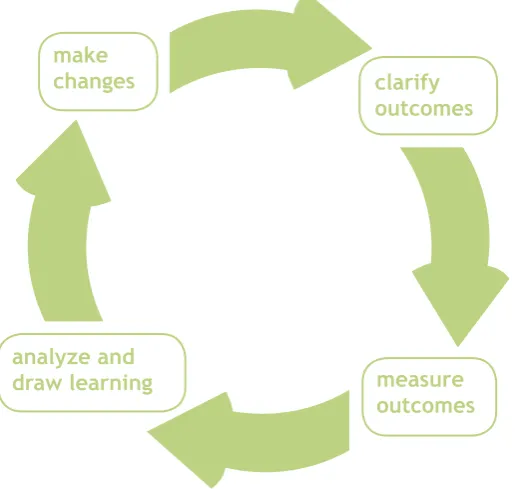
There are eight steps to introducing the Star in your organisation:
Review your reasons for introducing the Star 1.
Assess the suitability of the Star for your service 2.
Run a pilot 3.
Integrate the Star into your current systems and paperwork 4.
Start using the Star/ Train staff to use the Star 5.
Analyse and interpret the data 7.
Share and act on the learning 8.
A case study of what it is like to implement the Star in practice is included in Appendix Two.
1. Review your reasons for introducing the Star
Organisations may decide to introduce the Star for a number of reasons:
For internal reasons:
Because they want to take an outcomes approach to their work, i.e. they want to be able to a)
measure success for individual service users, for projects and for the organisation as a whole, to use this to inform their service delivery
Because they feel it will improve keywork b)
For external reasons:
To demonstrate the value of the service to funders or commissioners c)
Because a funder or commissioner is requiring that they use the Star as a condition of contract d)
In the current environment, you may, at least in part, be considering using the Star in response to external pressures. In research with 25 organisations that were using the Star, satisfaction with how the Star was being used was a lot higher in organisations that were motivated primarily by the desire to improve keywork or learn about what works than in those motivated by the need to verify their outcomes externally. For this reason we strongly recommend that you recognise and capitalise on the
internal benefits as these are only realised if your organisations adopts the tool in the spirit of
learning and service improvement.
2. Assess the suitability of the Star for your service
How do you know if the Star is suitable for assessing the outcomes of your service? The following checklist is designed to help you to decide.
Do you have an on-going keywork relationship with service users?
The Star is designed to be used in situations where a service user and worker are engaged in a key working relationship over a period of time. We would suggest at least six weeks, as a guide. If you only see a service user once or twice for a short period of time or have a drop-in service with little or no one-to-one contact, then it is probably not suitable for your service
Are you aiming to help service users to make changes in their attitudes and
behaviour?
The Star is designed to help you and your service user assess changes that they are making in their attitudes and behaviour that will move them away from homelessness. If this is not a goal of your service then the Star is not suitable for you.
Do you work holistically with service users?
emotional and mental health, meaningful use of time, managing tenancy and accommodation, offending and motivation and taking responsibility)
If your project only works on one or two aspects of a person’s life (for example just meaningful use of time or just self-care and living skills) the Star will not be suitable as it is a holistic tool covering many aspects of a person’s life. However it may be suitable if you are aiming to help service users with most but not all the areas described in the Star. For example your project may not accept anyone who has an addiction problem. If this is the case then you can simply score all service users as a ‘10’ on that scale.
It is also possible that you are aiming to help your service users make changes in areas that are not included in the Star – for example Parenting Skills. If this is the case you may wish to assess service users’ progress towards this goal in another way. See the back page for links that will give
information about other versions of the Star that might meet your needs better.
Does the Journey of Change describe the journey your project helps its service
users to take?
The journey of change described in the Star User Guide is a key feature of the Star and underpins the
scales for each outcome area. If this journey does not fit with your understanding of the steps you
are helping people to take towards independent living then the Star is not suitable for your service.
Some services concentrate on one or two parts of the journey. For example a short-stay direct access hostel may focus on the ‘stuck’ and ‘accepting help’ stages and refer people to other kinds of service when they move into the ‘believing’ and ‘learning’ parts of the journey.
It is helpful to have a sense of which part of the journey your service or services focus on. If you only work with service users on a very small part of the journey, say at the ‘learning’ and ‘self-reliance’
stages, you may find that the Star doesn’t pick up the small and subtle changes people make within
one stage. In this case you may want to supplement the Star with some additional measures.
If you have answered yes to these four questions, it is likely that the Outcomes Star will be
appropriate for your service. If you have answered no to one or more it may not be. You may wish to contact Homeless Link or Triangle Consulting to discuss how to proceed.
3. Run a pilot
Even if you have answered yes to all the questions, it is often advisable to pilot the Star in one or
more services before rolling it out through the whole organisation. This has a number of benefits:
It enables you to test how the tool works for you in practice
●
It helps you to answer the practical questions set out below about how to integrate the Star
●
into your ways of working prior to full implementation
If it goes well it creates a demonstration project and staff with experience of using the tool
●
who can enthuse and train others
If there are problems, these can be addressed before it is rolled out across the organisation.
●
Taking time to allow people to realise the benefits
● so that keyworkers saw the Star as some
thing that was going to make their job easier and better, rather than just another burden. Some did this through formal training, some through discussions in team meetings
Allowing people to express reservations and ask questions.
● The Star represents a
significantly new way of working and some respondents found that staff needed to have their
concerns and questions heard – in one case where this didn’t happen, resistance to the Star persisted for quite some time but disappeared when a full discussion took place
A flexible approach at first.
● Organisations who allowed the more enthusiastic workers to ‘just give it a try’ found that this approach worked very well. These workers came back to the team with very positive experiences which then enthused others and feedback from their service
users provided concrete evidence of the benefits and popularity of the Star
Involving service users in the process.
● Organisations who did this found that not only did it mean that service users understood and have a say in what was happening, but their support also added to the credibility and legitimacy of the tool within the service.
“Workers were unsure at first but my approach was to give the Star to those workers likely to be most open and encourage them to just have a go with it in their own way. Almost immediately, positive feedback from those workers and their service users encouraged others to try it too. Now I can guarantee that whenever I visit a project, one or more of the service users will pull out their completed Star to show me the progress they have made.”
Croftlands Trust
4. Integrate the Star into your ways of working, paperwork and IT
The Star should be used as an integral part of the keywork process with Star readings taking place at the point when assessment and action planning would normally take place in your service. It is important that the Star is fully incorporated into this process so that it does not duplicate other discussions or paperwork.
When to use the Star
We recommend that organisations plan to use the Star for the first time at the point of working with the service user to develop a support plan. For most organisations this means using it within the first
four weeks of the person entering the service. However, it is up to your organisation to set policy on
when a new service user should complete the Star and how that fits with other processes such as risk
assessment. There is a balance between getting to know the service user and allowing the service user to settle in, and the need to record an accurate picture of where the service user is at the start of their time with you. If the service user has already made progress before the Star is used, this progress will not be recorded.
If the service user does not want to or is not able to engage in keywork or with the Star in their first
month with the service your organisation may decide to ask keyworkers to complete a Star without the service user in order to have a clear base-line for when they began with the service.
Your organisation may also want to complete a Star when the service user leaves the service.
Comparing the first and last Star will give a clear picture of the outcomes for that person. As with the first Star, if it is not possible to complete the final Star with the service user you may want
keyworkers to do this on their own in order to complete your record of outcomes for that service user.
Can it replace other paperwork?
The Star is not intended to increase the amount of paperwork an organisation requires service users
and key workers to complete. Services may find that the Star Chart and Star Action Plan can replace
their existing Needs Assessment and Action or Support Plans although a separate Risk Assessment is usually still needed. If your organisation decides to continue to use existing Action Plans it is not necessary to complete the Star Action Plan as well.
How will the information be recorded and summarised?
It is advisable to ask keyworkers to keep a copy of each Star reading and Star Notes in the service
user’s keywork file. Service users may also want their own copy. It is also necessary to enter the Star
readings onto some kind of database so that the information can be summarised and analysed for a whole project or group of projects.
We strongly recommend that you use the Outcomes Star System for this. This is a specially designed system for recording and analysing and presenting data from the Star. It produces an individual Star chart for each service user (which you may want to print out and give to them rather than producing a hand drawn Star) and also summarises the data for all service users within the project and allows benchmarking and participation in learning across and within organisations.
5. Train staff to use the Star
The Star will only be as good as the key workers who use it, so it is vital that all members of staff are trained to use the tool. Homeless Link runs open training on the Star for keyworkers and managers, which is designed to equip managers (or lead workers) to train their own staff, and both Homeless Link and Triangle Consulting can provide in-house training. An outline training day is included in Appendix 1 of this guide. The full details of the one-day training course with trainers’ notes and all the handouts are in a separate document – details on the back page of this guide.
Before training takes place, use your usual communication channels (for instance team meetings and newsletters) to keep staff informed about why the Star is being implemented, when it will happen
and how it will affect them. You might find it helpful to set up a Steering Group made up of
managers, key workers, and in some cases service users, to oversee the introduction of the Star.
It is also important to make it clear how it fits with other initiatives and training that they have
received. For example if your organisation uses Motivational Interviewing and the Cycle of Change it will help workers if you can show how these theories of change link to the Star.
Good use of the Star requires that key workers have well developed keywork skills. Introducing the Star may be an opportunity to review the training needs of your staff in this area and address any outstanding concerns.
“We set out to use the Star to measure outcomes because we wanted to gather outcomes data. We have ended up with an improved keywork system!”
6. Ensure quality and consistency in the use of the Star
Star data will only provide an accurate picture of the progress of service users if the staff have a good understanding of the tool and apply the scales consistently. We recommend that you ensure this happens in the following ways:
Staff supervision
When discussing a worker’s caseload, review each service users’ Star. This will help managers to ensure that the readings are being carried out when they should be and that they are appropriate for that service user. It can also help the supervision process by providing the manager with a quick overview of the worker’s caseload.
File auditing
As part of the normal process of auditing files, managers should ensure that Star records are present and accurate and stored confidentially.
Team meetings
When discussing service users in team meetings, look at their Stars and couch your discussion in terms of where they are on the Journey of Change. This enables the team to develop a shared understanding of how to use the scales and the Journey of Change and will help staff to become familiar with using this framework.
Data Quality
Users of the Outcomes Star System will need to confirm that the quality of the data being entered
is ensured through these measures, or that plans are in place to do this. Only real data should be added.
“Early on we found that some service users had very high scores on the Star and realised that this was because some service users were not making very realistic assessments of where they were and staff were just agreeing with the service user assessment rather than entering into a discussion and sharing their own perceptions. However, training has helped considerably, as has the new version of the Outcomes Star that is much easier to use. Staff now find it much easier to understand the underlying journey of change and scoring. It has also been important to ensure that the Star is discussed regularly within teams. Now we find that scoring on the Star is more accurate, consistent and realistic.”
Croftlands Trust
7. Analyse and interpret the data
You can draw on your Star data in two ways:
As part of the routine monitoring of the service
●
To carry out in-depth research into the effectiveness of services
Routine monitoring
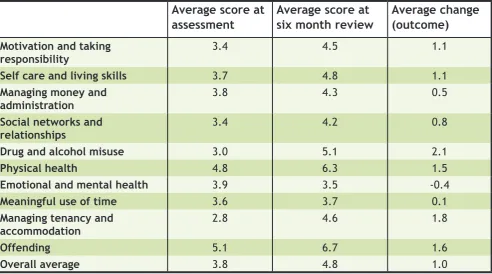
We recommend that for routine monitoring purposes you compare the initial service user reading
[image:26.595.62.555.274.548.2]with their most recent reading, or the first and second readings, or the most recent reading and the one before that. The following table provides mock data for a fictional hostel. It shows the data for the first and most recent readings for current service users.
Table 1: Average increase and decrease in scores
This table shows the average level of need of the service users as recorded on the Star during their
first month in the project (column one) and their most recent reading (column two). Column three
shows the difference between the two scores – the outcome of the project for those service users at this point in time.
Average score at
assessment
Average score at
six month review
Average change
(outcome)
Motivation and taking
responsibility 3.4 4.5 1.1
Self care and living skills 3.7 4.8 1.1
Managing money and
administration 3.8 4.3 0.5
Social networks and
relationships 3.4 4.2 0.8
Drug and alcohol misuse 3.0 5.1 2.1
Physical health 4.8 6.3 1.5
Emotional and mental health 3.9 3.5 -0.4
Meaningful use of time 3.6 3.7 0.1
Managing tenancy and
accommodation 2.8 4.6 1.8
Offending 5.1 6.7 1.6
Overall average 3.8 4.8 1.0
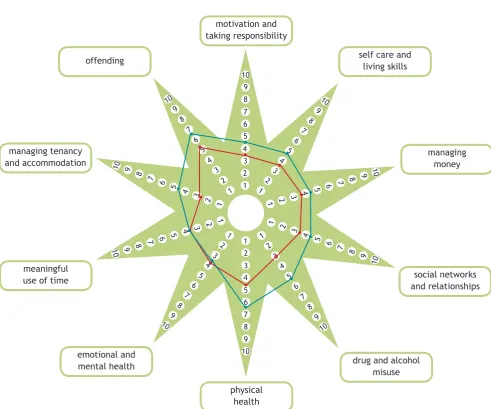
In the figure on the next page the same data is presented as a Star for the whole project. The red line shows the first reading and the turquoise line the most recent reading. The Star shows very
graphically the overall progress service users at this project have made.
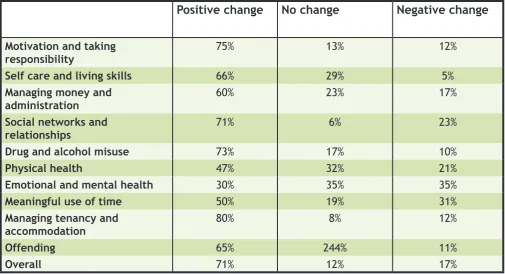
It can also be useful to present the data for a whole project in terms of the percentage of service users making positive progress, negative progress or staying the same in each outcome area. Table 2, on page 28, presents this data.
“The Outcomes Star measurement system has generated a considerable amount of interest within the sector and we view it as an example of positive practice in relation to tracking individual development and progress against multiple vulnerabilities.”
Figure 1: Star for fictional hostel
first reading
Table 2: Percentage of service users showing change
This table shows the percentage of service users who have made a positive or a negative change or stayed the same in each outcome area .
Positive change
No change
Negative change
Motivation and taking
responsibility 75% 13% 12%
Self care and living skills 66% 29% 5%
Managing money and
administration 60% 23% 17%
Social networks and
relationships 71% 6% 23%
Drug and alcohol misuse 73% 17% 10%
Physical health 47% 32% 21%
Emotional and mental health 30% 35% 35%
Meaningful use of time 50% 19% 31%
Managing tenancy and
accommodation 80% 8% 12%
Offending 65% 244% 11%
Overall 71% 12% 17%
What does the data show?
Level of need when service users arrive
Does the data show that people are entering the project with an appropriate level of need?
●
If service users have fewer needs or more needs than your project intends to meet, then it might be necessary to review your referral routes and selection process. Alternatively you might decide to review your ideas about who the project is intended for.
The data presented above indicates that people are joining the hostel at the ‘accepting help’ stage. This may well be appropriate for a hostel. However the average starting point is higher for offending
and physical health. This is probably because a significant number of service users do not have issues
in these two areas and hence have higher starting scores. This would then raise the overall average.
Level of progress service users make
What does the data show about the progress service users make whilst they are with the
●
project?
Are they making the level of progress you would expect? They are likely to be making more
●
progress in some areas than others.
Does the data show a pattern you would expect or are there any figures that concern you? ●
Does the data show negative outcomes? Why might that be?
The data presented above indicates that service users are progressing well at the project. In many of the outcome areas the average score has moved from around 3 - the ‘accepting help’ stage to around
5 - the ‘believing’ stage. This is a very significant step.
Service users are making particularly good progress in Drug and Alcohol Misuse, Offending and
Physical Health. But Emotional and Mental Health has declined overall and Meaningful Use of Time is
not showing any significant progress. The data in table 2 shows that 35% of service users have
experienced a decline in mental health and a further 35% have not changed at all.
One interpretation of this data is that the hostel is being very effective in helping service users tackle their substance misuse and that improvements in physical health and offending are linked to
this. It may be, however, that for a significant number of service users the substance misuse was linked to mental health or emotional difficulties that are now coming to the fore. Also, with
reduced substance misuse and reduced offending, service users may now be very much in need of more constructive things to do with their time. If this interpretation is correct then the project should celebrate its success in addressing substance misuse, and take action to put in place more support on mental health issues and use of time.
The data also shows very good improvements in Managing Tenancy and Accommodation but less improvement on Managing Money and Personal Administration. The project could consider whether the lack of progress on money was something it wanted to address. It might decide that this area was less of a priority for their client group as they were still some way away from independence, or it might put in place additional measure to help people with this aspect of their lives
Comparing projects
If your organisation has a number of different projects providing a similar service, you might want to compare the outcomes they achieve. This kind of comparison raises interesting questions for further exploration.
Why does one project consistently achieve more positive change than another?
●
Why is one project taking in service users at an earlier stage on the journey of change?
●
Why does one project help service users make significant improvements in their self-care whilst ●
others do not?
Many factors contribute to the outcomes a project achieves. Some of them such as the quality of keywork and management are within the control of the project. Others, like the quality of the accommodation, the availability of specialist services such as addiction specialists or counselling are outside the project’s control. For this reason, outcomes information from the Star should not be used on its own to judge a project as successful or unsuccessful, but should be used as a basis for
discussion and further exploration.
Benchmarking with other organisations
Staff performance
We do not recommend that you use the Star to assess the performance of workers. This is partly because many factors outside the worker’s control affect service user progress and also because it could distort their relationship with the service user and introduce incentives to manipulate the scoring system, which may be harmful to service users.
However, as outlined in the section on ensuring quality and consistency of Star data, we do
recommend that the Star be used within staff supervision. Reviewing the Stars of service users can provide managers and their staff with a simple way of reviewing a caseload. How are service users progressing? Does the keyworker have a manageable caseload or do they have a very high
proportion of service users at an early stage in the journey of change? Are they making good assessments of where a service user is on each scale based on observable behaviour? Is the Star and journey of change understood and used consistently?
In-depth research
As well as routine monitoring, experience indicates that it is very valuable to take an in-depth look at the data you have collected – say every one or two years. When looking in depth you can:
Identify particular groups of service users, for example women or people under the age of 25
●
or a particular ethnic minority and look at whether their outcomes are any different from the service user population as a whole
Explore whether certain kinds of need are associated with positive or negative progress. For
●
example do people with low scores on the addictive behaviour scale do less well than the service user population as a whole?
Look at service users’ typical journey in different projects. For example do people tend to
●
make rapid progress in the first six months and then plateau?
Benchmark your project’s outcomes with those of similar projects in other organisations
●
There are many other ways to analyse the data. The best way to start is to develop some
●
hypotheses about the factors affecting your service user outcomes and then use the data to put them to the test.
www.homelessoutcomes.org.uk has more information and advice about carrying out an in-depth analysis of your outcomes data or you could contact Homeless Link directly.