The Journal of Experimental Biology
ABSTRACT
Bite-force performance is an ecologically important measure of whole-organism performance that shapes dietary breadth and feeding strategies and, in some taxa, determines reproductive success. It also is a metric that is crucial to testing and evaluating biomechanical models. We reviewed nearly 100 published studies of a range of taxa that incorporate direct in vivomeasurements of bite force. Problematically, methods of data collection and processing vary considerably among studies. In particular, there is little consensus on the appropriate substrate to use on the biting surface of force transducers. In addition, the bite out-lever, defined as the distance from the fulcrum (i.e. jaw joint) to the position along the jawline at which the jaws engage the transducer, is rarely taken into account. We examined the effect of bite substrate and bite out-lever on bite-force estimates in a diverse sample of lizards. Results indicate that both variables have a significant impact on the accuracy of measurements. Maximum bite force is significantly greater using leather as the biting substrate compared with a metal substrate. Less-forceful bites on metal are likely due to inhibitory feedback from mechanoreceptors that prevent damage to the feeding apparatus. Standardization of bite out-lever affected which trial produced maximum performance for a given individual. Indeed, maximum bite force is usually underestimated without standardization because it is expected to be greatest at the minimum out-lever (i.e. back of the jaws), which in studies is rarely targeted with success. We assert that future studies should use a pliable substrate, such as leather, and use appropriate standardization for bite out-lever.
KEY WORDS: Bite force, In vivoperformance, Lever mechanics, Lizards, Jaws, Teeth, Mechanoreceptors
INTRODUCTION
A fundamental goal of measuring animal performance is to obtain maximum voluntary performance so that comparisons among individuals and/or taxa are meaningful (Losos et al., 2002). Bite force has become an increasingly common measure of performance and, in terms of published works, is second only to measures of performance related to locomotion. If recorded reliably, the quantification of bite force has potential for testing hypotheses in behavioral ecology and evolutionary biology. Bite-force performance can facilitate or limit dietary breadth, as well as influence feeding strategy, such as dictating the amount of time RESEARCH ARTICLE
1Biological Sciences Department, California State Polytechnic University, Pomona, CA 91768-2553, USA. 2School of Earth and Environmental Sciences, The University of Adelaide, SA 5005, Australia. 3Research Department of Cell and Developmental Biology, Anatomy Building, UCL, University College London, Gower Street, London, WCIE 6BT, UK. 4Herpetology, South Australian Museum, North Terrace, Adelaide, SA 5000, Australia.
*Author for correspondence ([email protected])
Received 7 April 2014; Accepted 19 October 2014
required to immobilize and reduce food items (e.g. Herrel et al., 1999; Verwaijen et al., 2002; Erickson et al., 2003). It also has been demonstrated that, for animals that use their jaws as the primary weapon during fighting, dominance in staged interactions largely can be determined by bite-force performance relative to opponents (Lailvaux et al., 2004; Husak et al., 2006). Furthermore, it can be a powerful predictor of reproductive success in natural populations, even more so than body size (Lappin and Husak, 2005; Husak et al., 2009). Variation in bite force is often associated with differences in head shape and thus can provide insight into morphological evolution (e.g. Lappin et al., 2006b). Bite force also provides a means of comparing performance in wild and captive animals that show visible differences in phenotype (e.g. Erickson et al., 2004). Finally, bite force is becoming increasingly important for ‘validating’ computer-based biomechanical models that are used to predict strain distribution, assess skull strength and evaluate form and function (e.g. Curtis et al., 2010a; Gröning et al., 2013).
Bite force has been measured from conscious non-human animals in almost 100 published studies focusing on a range of taxa including cartilaginous and bony fishes, crocodilians, finches, hyenas, bats and rodents (Dessem and Druzinsky, 1992; Binder and Van Valkenburgh, 2000; Dumont and Herrel, 2003; Erickson et al., 2004; van der Meij and Bout, 2004; Huber et al., 2005; Santana and Dumont, 2009; Becerra et al., 2011; Erickson et al., 2012; Grubich et al., 2012; Erickson et al., 2014). Many studies have focused on ontogenetic scaling (Erickson et al., 2003), sexual dimorphism (Herrel et al., 1999; Lappin et al., 2006b), display and signaling (Lappin et al., 2006a), reproductive output and fitness (Lappin and Husak, 2005; Husak et al., 2009), skull biomechanics and model testing (Curtis et al., 2010a; Becerra et al., 2013) and feeding behavior and diet (Binder and Van Valkenburgh, 2000; Measey et al., 2011) within a single species. In several studies multiple species have been compared, including some analyses of over 15 species (Herrel et al., 2002; Aguirre et al., 2002; van der Meij and Bout, 2004; Santana and Dumont, 2009; Vanhooydonck et al., 2010; Santana et al., 2010; Freeman and Lemen, 2010). The majority of research has been conducted on lepidosaurs (lizards and tuatara) (Herrel et al., 1999; Lappin and Husak, 2005; Anderson et al., 2008; Jones and Lappin, 2009; D’Amore et al., 2011; Cameron et al., 2013), in part because of their diversity of feeding and reproductive biology, as well as their experimental tractability.
In vivo bite-force performance data usually are collected using calibrated equipment that includes two parallel bite plates that are placed into the specimen’s mouth. Typically, three or five defensive bites are recorded for each animal, with a rest period of a minute or more between bites (e.g. Herrel et al., 1999; Lappin et al., 2006b). Defensive bites are almost always measured, rather than bites associated with feeding, because defensive bites are more easily elicited. Importantly, defensive bites are more likely to represent maximum voluntary performance, assuming that the threat of being killed by a predator will provoke a maximum voluntary effort. Despite
Reliable quantification of bite-force performance requires use of
appropriate biting substrate and standardization of bite out-lever
The Journal of Experimental Biology
the great number of published studies, critical aspects of the methods used to collect the data are not consistent and are rarely discussed in sufficient detail to enable reproducibility or application to other studies. Here, we systematically survey the methods used in previous bite force studies and, using a diverse sample of lizards, experimentally test two crucial aspects of data collection. First, we focus on the type of substrate used as the biting surface on force transducers. We hypothesized that harder, less naturalistic substrates would hinder the realization of maximum voluntary bite-force performance and that this effect would be consistent among individuals and species. Our rationale was that extremely hard substrates (e.g. metal) would be likely to cause discomfort and possibly physical damage, for example to the teeth, and that this would result in reduced motivation to bite with maximum effort. Second, we examine the effect of failing to account for variation in bite out-lever (i.e. distance from fulcrum/jaw joint to position along jawline at which jaws engage transducer) among trials and specimens when measuring bite force. Based on lever mechanics (i.e. law of the lever), we hypothesized that failure to record bite out-lever and incorporate it into analyses of bite force typically results in underestimation of true maximum voluntary bite force, as well as an overall reduction in measurement accuracy.
RESULTS
Review of published studies
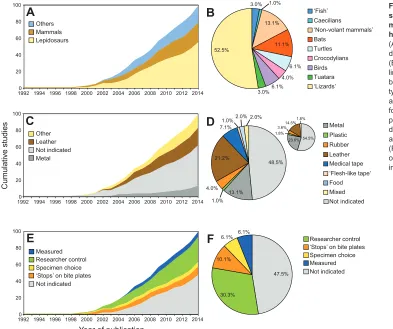
Ninety-nine studies of voluntary bite force in conscious non-human vertebrates have been published in peer-reviewed journals since the first study appeared over 20 years ago (supplementary material Table S1). Over the past 10 years there has been a steady addition of 5 to 10 studies a year (Fig. 1A,C,E). In total there have been 55
studies on lepidosaurs, 24 on mammals and 20 on other taxa (Fig. 1A), such as turtles and birds (Fig. 1B). Many of the studies involving mammals are on bats (n=10, Fig. 1B).
Biting substrate
There is no consensus as to what kind of substrate should be used to cover the biting surface of force transducers or even if any covering should be used at all (Fig. 1C,D). A number of studies explicitly state that specimens bit directly onto metal bite plates during trials (N=13). Problematically, almost half do not indicate that any covering was used (N=48). Some do cite publications in which the biting substrate was metal and, in general, no mention of biting substrate might suggest that no covering was used over the metal bite plates. However, this assumption is not reliable; for example, in Marshall et al. (Marshall et al., 2012) biting substrate is not explicitly described, but in a picture of a bite-force trial it appears that a non-metallic covering was used [see Fig. 1 in Marshall et al. (Marshall et al., 2012)]. Many studies clearly report covering the bite plates with a non-metallic material (N=38). However, the type of covering used is variable and has included leather (N=21) (e.g. Erickson et al., 2004; Lappin and Husak, 2005), medical tape (N=7) (e.g. Dumont and Herrel, 2003), flesh-like tape (N=1) (Cameron et al., 2013), rubber (N=4) (e.g. Binder and Van Valkenburgh, 2000), plastic (Noble et al., 2014) and even some type of food (N=2) (e.g. La Croix et al., 2011; Fig. 1C,D). In three publications on mammals, based on specimen size, substrates consisted of combinations of metal, hard plastic and leather (e.g. Freeman and Lemen, 2008). In one case (Henningsen and Irschick, 2012), the authors state that the specimens bit on the padded ends of steel bite plates but do not indicate what material comprised the
Plastic Metal
Rubber
Medical tape
‘Flesh-like tape’
Food
Not indicated Mixed
47.5%
30.3% 10.1%
6.1% 6.1%
1992 1994 1996 1998 2000 2002 2004 2006 2008 2010 20120 20
40 60 80 100
2014
E
Researcher control Specimen choice ‘Stops’ on bite plates Not indicated Measured
C
Cumulative studies
1992 1994 1996 1998 2000 2002 2004 2006 2008 2010 2012 0
20 40 60 80 100
2014 Other
Leather Not indicated Metal
48.5%
1.0% 4.0%
21.2% 7.1%
2.0% 2.0%
‘Fish’
Caecilians
‘Non-volant mammals’
Bats
Turtles
Crocodylians
Birds
Tuatara
‘Lizards’
B
D
F
Researcher control‘Stops’ on bite plates Specimen choice Measured Not indicated 3.0% 1.0%
13.1%
11.1%
6.1%
4.0%
6.1% 3.0% 52.5%
1992 1994 1996 1998 2000 2002 2004 2006 2008 2010 2012 0
20 40 60 80 100
2014 Others
Mammals Lepidosaurs
A
54.5% 23.6% 1.8%
3.6% 14.5%
Leather
13.1%
1.0% 1.8%
Year of publication
Fig. 1. Quantitative representation of
[image:2.612.45.438.404.733.2]The Journal of Experimental Biology
pads. Specified reasons for using a covering include protection of the animal’s teeth (N=25), to provide a non-skid surface (N=8), to record the location of biting (N=11), to encourage biting (N=5), to provide a natural texture (N=1) and to protect the equipment (N=4).
We found that the substrate used on the transducer bite plates has a major effect on performance. The two-way ANOVA model showed significant effects on bite force of substrate (F=10.97, d.f.=2, P=0.0002) and genus (F=9.09, d.f.=7, P=0.0001). The interaction between substrate and genus was not significant (F=1.94, d.f.=14, P=0.0577). Pairwise comparisons (Tukey HSD) of the effect of substrate on bite force indicated that bite force is significantly greater using either leather or wood than it is with metal (leather versus metal, P=0.0002; wood versus metal, P=0.0115). Notably, bite-force performance was greater on leather than on metal by an average of nearly one and a half times (bite force on leather as per cent of bite force on metal: mean ± s.d.=143.4±47.8%, maximum=291.3%, minimum=83.3%, N=25). This is consistent with our observations that most lizards showed a strong tendency to bite more vigorously on leather than on metal. In addition, when lizards bit on metal, damage to the teeth was often clearly audible.
When only Crotaphytus collaris and Eublepharis macularius were included in the ANOVA model, the effect of substrate on bite force was significant (F=15.66, d.f.=2, P<0.0001), but there was no effect of genus (F=1.05, d.f.=1, P=0.3266). In contrast to the model including all genera, the substrate by genus interaction was significant (F=12.48, d.f.=2, P=0.0002). Pairwise comparisons (Tukey HSD) of the effect of substrate on bite force indicated that bite force is significantly greater with leather than with either wood (P=0.0034) or metal (P<0.0001), but bite force did not differ when using wood or metal. The significant substrate by genus interaction reflects a distinctive difference between C. collaris and E. maculariusin the effect of substrate on bite force, with the effect being far greater in C. collaris(Fig. 2). For C. collaris, bite force on leather was greater than on metal by an average of nearly two times (bite force on leather as the percentage of bite force on metal: 190.3±50.7%, max=291.3%, min=133.7%, N=6). For E. macularius, however, bite force on leather and metal were similar (bite force on leather as percentage of bite force on metal: 106.1±18.7%,
max=139.4%, min=83.3%, N=6). When separate ANOVA models were run for C. collaris and E. macularius with substrate and individual as the independent variables, the substrate effect was significant for C. collaris(F=22.37, d.f.=2, P<0.0001; Tukey HSD, leather versus wood: P=0.0235; wood versus metal: P=0.0096; leather versus metal: P<0.0001) but not for E. macularius(F=2.61, d.f.=2, P=0.1222; Fig. 2).
Bite out-lever
We define the bite out-lever as the distance from the jaw joint to the position along the jawline that engages the biting surface of the transducer. About half of the studies (N=47) do not describe whether or how bite out-lever is taken into account. Studies that do so typically take one of two approaches. Many report that the location in the jaws at which the bite is applied was somehow consistent (n=46), either by researcher control (n=30), by specimen choice (n=6) or by ‘stops’ on the transducer that prevent posterior bites (n=10) (Fig. 1E,F). A minority describe recording which part of the jaws are applied to the transducer with respect to the location of the jaw joint during each trial so that bite out-lever can be calculated post hoc(n=6) (Fig. 1E,F).
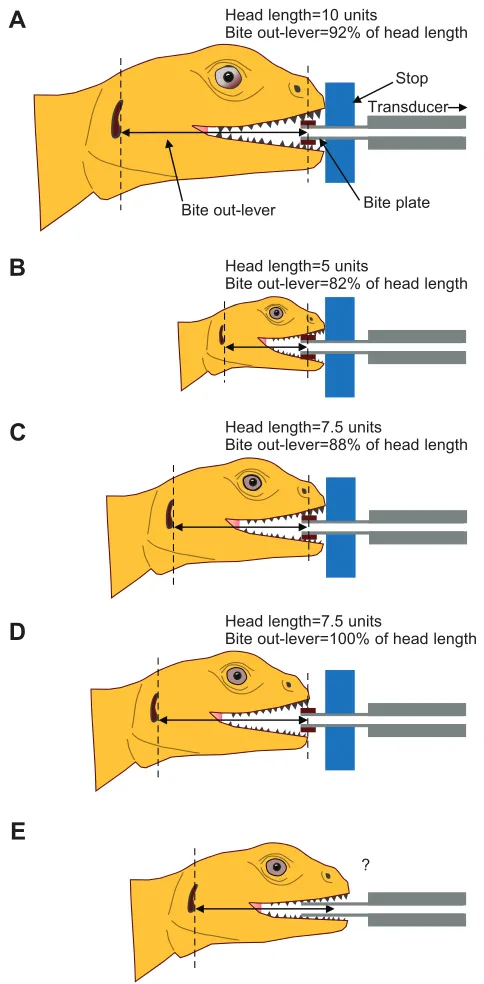
Researcher control involves constraining the bite out-lever by carefully positioning the bite plates in a specific part of the specimen’s mouth (e.g. using particular teeth as landmarks) such that the bite point is homologous among trials and specimens (e.g. Erickson et al., 2003; Dumont and Herrel, 2003). In contrast, specimen choice involves the specimens biting with a consistent part of the jaws by their own choice (Binder and Van Valkenburgh, 2000; van der Meij and Bout, 2004; van der Meij and Bout, 2006). Standardization using ‘stops’ placed near the bite plates that limit how far the jaws can reach over the plates during a trial also has also been attempted (e.g. Herrel et al., 1999; Marshall et al., 2012). This results in bites consistently being measured at anterior bite points (Fig. 3A–D; Fig. 4).
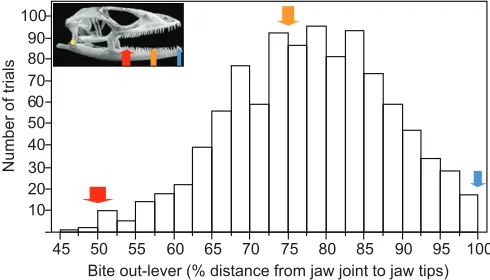
Our experimental results show that of all sets of bite-force trials in the present study (i.e. 360 sets where one set equals three trials in sequence on one individual), we found that in 25.5% of sets the trial that produced the maximum raw bite force (i.e. no bite out-lever correction) did not match the trial that produced the greatest actual bite force (i.e. with bite out-lever correction). This mismatch may
0 5 15 20 25 30 35 40
10 45
Bite force (N)
C. collaris E. macularis
Specimen
Cc04 Cc13 Cc12 Cc01 Cc09 Cc08 Eum02 Eum01 Eum06 Eum05 Eum04 Eum03
Fig. 2. Effect of biting substrate on bite-force performance.Comparison of bite force (standardized for a bite out-lever of 75%) using leather (brown), wood
The Journal of Experimental Biology
be more likely in taxa that have a relatively long tooth row because the range of potential bite forces is predicted to be greater in such taxa than in taxa that have a relatively short tooth row (Table 1). For the species with the longest tooth row relative to head length (Anolis equestris), bite force at the most posterior teeth is predicted to be 260% of that at the jaw tips. In contrast, for the species with the relatively shortest tooth row (Eumeces schneideri), bite force at the most posterior teeth is predicted to be 181% of that at the jaw tips.
DISCUSSION Biting substrate
Our results indicate that bite-force performance is greater on more pliable substrates, in line with our observations that most lizards showed a strong tendency to bite more vigorously on leather than on metal. This is consistent with studies on human subjects that test the effect of biting substrate hardness on voluntary bite force (Paphangkorakit and Osborn, 1998). This constraint on bite force probably arises via inhibitory feedback from mechanoreceptors that serve to limit risk of damage to the jaws and teeth during loading (Paphangkorakit and Osborn, 1998; Serra and Manns, 2013). Correspondingly, humans can bite more forcefully under local anesthesia (Orchardson and MacFarlane, 1980). In humans and other mammals, such mechanoreceptors that are sensitive to local mechanical stimuli (e.g. encoding information on the hardness and stiffness of an item being bitten) are found in the periodontal ligament that surrounds the tooth root and suspends it in the socket (Hannam, 1969; Yamaguchi et al., 2012; McCormack et al., 2014). Lizards do not possess a periodontal ligament, but similar mechanoreceptors are almost certainly present in the dentine (Dong et al., 1985; Dong et al., 1993; Kieser et al., 2009; Kieser et al., 2011) and less certainly in the pulp cavity (Paphangkorakit and Osborn, 1997; Paphangkorakit and Osborn, 1998), jaw joints (Curtis et al., 2010b), skull sutures (Jones et al., 2011), bones (Jacobs and van Steenberghe, 1993) and soft tissues of the mouth, such as the tongue (Paphangkorakit and Osborn, 1998).
Leather is clearly superior to metal as a biting substrate for obtaining maximum voluntary bite-force performance. As previously stated (e.g. Lappin and Husak, 2005; Anderson et al., 2008; Becerra
D
Head length=7.5 unitsBite out-lever=100% of head length
C
Head length=7.5 unitsBite out-lever=88% of head length
A
Head length=10 unitsBite out-lever=92% of head length
Bite out-lever
Stop
Bite plate Transducer
B
Head length=5 unitsBite out-lever=82% of head length
E
?
Fig. 3. Use of stops on transducer plates accounts for neither effects of
variation in head size nor potential variation in bite position due to
willingness to bite.(A,B) Specimen A has a head that is twice as long as
[image:4.612.51.293.58.550.2]specimen B. When stops are used to constrain how far over the bite plates the jaw tips can go, the bite out-lever is artifactually decreased for the smaller specimen, which results in an overestimate of its true bite-force performance relative to the larger specimen. (C,D) Specimen D is biting the bite plates before its jaw tips contacted the stops, as is likely to be common with aggressive, visually oriented species. This increases the bite out-lever, resulting in an underestimate of the actual bite-force performance of specimen D relative to specimen C. If the stops are placed even farther back on the bite plates, measurement error due to variation in head size or shape, as well as failure to contact the stops, is increased. Stops placed such that bites are restricted to the jaw tips (as in the figure) guarantees that all measurements will underestimate maximum voluntary bite force, which will be attained more posteriorly on the jawline. (E) Most studies do not use stops and even fewer use pads of biting substrate. As such, numerous teeth along the jawline contact the bite plates, thus making it problematic to estimate bite out-lever or ensure that trials are comparable.
Table 1. Taxonomic variation in potential range of maximum bite-force performance due to variation in the length of the tooth row relative to head length
Species mean Range among Species N ± s.d. (%) individuals (%)
Crotaphytus collaris 6 218±3.2 212–221
Eublepharis macularius 6 195±4.7 190–202
Elgaria multicarninata 3 193±3.1 190–196
Gambelia wislizenii 2 219±1.4 218–220
Gekko gecko 2 209±1.4 208–210
Gekko badenii 1 237 –
Anolis equestris 1 260 –
Anolis garmini 1 228 –
Crotaphytus bicinctores 1 240 –
Eumeces schneideri 1 181 –
Uromastyx maliensis 1 224 –
Species means combined 219±23.1 181–260
[image:4.612.313.566.95.237.2]The Journal of Experimental Biology
et al., 2013), leather has the advantage of providing a substrate that teeth can grip. In addition, it is not surprising that its use greatly reduces the risk of damage to the teeth and jaws, given that the average Young’s modulus (stiffness) of 307 stainless steel at 185 GPa (n=12) is over 40 times greater than that of leather (N=12) and 27 times greater than that of balsa wood (N=12) (Table 2). Furthermore, the Young’s modulus of stainless steel is at least six times greater than that of bone, which ranges from 3 to 29 GPa (Zysset et al., 1999) and is often modelled as 17 GPa (e.g. Kupczik et al., 2009); thus when a lizard’s teeth contact bone during a bite, the potential for dental trauma is expected to be much lower than if the teeth forcefully engage stainless steel. The maximum stiffness we measured for leather was greater than the minimum we found for balsa wood, but the standard deviations of the two sample means do not overlap. The greater performance elicited by using leather may reflect the benefits of using a naturalistic material. A substrate that is similar to what an animal may encounter in nature, such as the integument of an attacking predator, is likely to elicit greater biting effort than a substrate, which is, on average, an order of magnitude more stiff than bone.
The highly significant effect of biting substrate on bite force in C. collarisbut not in E. maculariusmay be a result of differences in dentition and the expression of corresponding behavioral characteristics to protect the teeth. Indeed, when lizards bit on metal, albeit at a lower force than on leather for most species, damage to the teeth was often clearly audible. The teeth of crotaphytids are large, few in number, and complex compared with those of eublepharine geckos (Hollenshead and Mead, 2006; Nikitina and Ananjeva, 2009), and tooth replacement rate is lower in the former given the relative frequencies of worn tooth tips, replacement teeth and resorption pits (Fig. 5). The energetic cost of producing relatively large teeth combined with the potential negative effects of tooth damage on behaviors such as prey capture and processing, male–male combat and defense against predators may be more substantial in C. collaris. As such, behavioral tendencies that protect teeth from damage during biting may be manifest to a greater degree in C. collaris than in E. macularius. Interestingly, variation in motivation to bite has been reported among highly similar congeners; for example, compare the descriptions for Uromastyx lizards in Porro et al. (Porro et al., 2014) with Herrel et al. (Herrel et al., 2014). Importantly, if biting substrate is not explicitly reported it is not possible to exclude substrate differences as a contributing factor to motivational variation. Finally, the difference in substrate effect we observed between C. collarisand E. maculariusindicates that a general correction factor cannot be applied to compare data collected using different biting substrates.
Bite out-lever
The bite out-lever should be measured in parallel to the anteroposterior axis of the head to avoid the potentially confounding effects of angular measurements. We use the center of the pads adhered to the outer surface of each bite plate, as viewed laterally during a trial, to determine the point along the jawline that engages
the biting surface of the transducer. Without the pads, regardless of substrate type, it is not possible to accurately identify the bite point, because teeth at various positions along the jawline would contact the bite plates (Fig. 3E). The pads also help to ensure that the point at which the jaws engage the transducer corresponds to the point where the device was calibrated. The most common type of bite-force transducer, a double-cantilever beam, is calibrated by hanging weights from a filament placed at a precise point on the active bite plate (see Anderson et al., 2008). When the point(s) of jaw engagement does not correspond to that used for calibration measurement, significant error is introduced.
Constraining bite out-lever via researcher control (e.g. Erickson et al., 2003; Dumont and Herrel, 2003) can work for some taxa, for example if behavioral tendencies permit repeated accurate placement of the transducer. This approach has been applied successfully to crocodilians (e.g. Erickson et al., 2003) and bats (e.g. Dumont and Herrel, 2003). These taxa are suitable for this technique because the heterodont dentition of most of these species facilitates the use of a specific tooth as a landmark. Crocodilians also open the mouth as a defensive response and, importantly, usually do not close their jaws until the transducer is allowed to contact the tooth. In contrast, many animals will aggressively bite a transducer in response to visual or other sensory input, which can make it difficult or even impossible to maintain precision among trials and subjects to account for variation in bite out-lever. Notably, aggressive taxa that voluntarily and vigorously exhibit defensive biting are also those that are the best suited for bite-force experimentation in the first place.
[image:5.612.45.298.73.151.2]Some subject animals consistently prefer to bite with a particular part of their jaws. Taking advantage of such behavioral characteristics (here termed specimen choice) will result in a repeatable bite out-lever. However, even among highly similar taxa, Table 2. Material testing results for Young’s modulus
Leather Wood Metal
N 11 12 12
Mean (GPa) 4.6 6.8 185.3
Min 3.4 4.5 172.0
Max 5.6 9.9 195.7
Median 4.4 6.2 185.8
s.d. 0.6 1.6 6.4
45 50 55 60 65 70 75 80 85 90 95 100
Number of
trials
10 20 30 40 50 60 70 80 90 100
Bite out-lever (% distance from jaw joint to jaw tips)
Fig. 4. Variation in bite out-lever during bite-force trials. Histogram shows
[image:5.612.316.561.419.559.2]The Journal of Experimental Biology
there can be behavioral differences in which part of the jaws are used when biting. For example, van der Meij and Bout (van der Meij and Bout, 2006) report that finches will bite a force transducer with only their beak tip, whereas Herrel et al. (Herrel et al., 2005) describe positioning the metal bite plates towards the posterior of the beak during trials. Therefore, if the specimen choice method is to be used, the focal taxon/taxa should be carefully assessed for biting behavior that produces a reliably consistent bite out-lever. Specimen choice appears to be an inappropriate method for comparing lizards because of considerable variation in bite out-lever during voluntary bites (Fig. 4).
Standardization also has also been attempted using ‘stops’ adhered to the bite plates that limit how far the jaws can reach over the plates during a trial (e.g. Herrel et al., 1999; Marshall et al., 2012) (Fig. 3A–D). This approach does reduce variation in bite location by preventing bites being made with the middle or posterior of the jawline. However, variation in bite position can also occur at the front of the jaws, with its degree and effects influenced by specimen head size and shape (Fig. 3). Moreover, given that maximum bite force at the front of the jaws is only about half that possible at the posterior part of the jaws (e.g. Gröning et al., 2013) (Table 1), raw measurements from the front do not represent maximum performance (Figs 4, 6). Studies recording bite force only at various anterior bite points thus cannot be used to infer limitations on diet for animals that use their middle or posterior dentition during feeding. This problem is especially pronounced for species that have a relatively long tooth row (Table 1).
We recommend that bite-force experiments are video recorded from lateral view so that the bite out-lever can be measured for each trial using digitizing software (e.g. ImageJ) (Jones and Lappin, 2009). The fulcrum of the lever, the jaw joint, can be identified in some taxa with external landmarks. For example, in most lizards the position of the quadrate-articular joint is externally landmarked by the ventral extent of the tympanum. If a reliable external landmark is not available (e.g. many mammals and birds), other approaches may be feasible, such as using careful reference to skeletal material in combination with video recordings
to estimate jaw joint location. Recording each bite with video so that bite out-lever can be measured takes time, but it represents the most thorough approach. A video record facilitates post hoc analyses, such as calculation of the bite force at any point along the jawline (Fig. 6). This could be used, for example, in feeding studies where knowledge of bite force at specific jaw positions can be used to make meaningful inferences with respect to prey processing behavior that involves characteristic oral positioning of food items. Explicit data on bite out-lever broadens the potential application of bite-force analysis to a variety of questions in biomechanics and ecomorphology.
Further considerations
Variation in gape angle may also affect bite force because of associated differences in muscle fiber orientation relative to the jaws
Tooth gaps
A
B
Replacement teeth
Rounded / worn tooth tips
5 mm
5 mm
Fig. 5. Differences in tooth size, complexity and replacement rate.
Anterior part of the right mandible of (A) Crotaphytus collaris(SAMA R66679) and (B) Eublepharis macularius(SAMA R60196) in lingual view. Compared with E. macularius, the teeth of C. collarisare larger, fewer in number, more complex and show evidence of a lower replacement rate.
A
B
Fig. 6. Standardization of bite out-lever.(A) A knight anole (Anolis
The Journal of Experimental Biology
(Curtis et al., 2010c), streptostyly (Smith, 1980) and muscle length–tension properties (Gidmark et al., 2013). Some studies report controlling for gape by adjusting the distance between the two biting surfaces (e.g. Dumont and Herrel, 2003; Herrel and Holanova, 2008; Herrel et al., 2009; Santana et al., 2010; Measey et al., 2011; Vanhooydonck et al., 2011; Marshall et al., 2012; Becerra et al., 2013; Chazeau et al., 2013). However, the details of executing this approach successfully are not explained. It is sometimes unclear as to whether the adjustment is carried out for every subject or only for ‘larger individuals’ of unspecified size (e.g. Herrel and Holanova, 2008; Vanhooydonck et al., 2011). Depending on the design of the device, adjusting it between specimens also may require that it be re-calibrated after each re-adjustment. Also, on the rare occasion that a preferred gape angle is reported, differences are evident [e.g. ‘about 30 degrees’ (Santana and Dumont, 2009); ‘~10°’ (Becerra et al., 2013); ‘10±5°’(Herrel et al., 2007)]. In any case, for such an approach to be accurate, video recording of trials is essential. The lack of control for gape angle in our study is not a significant issue because our hypotheses and statistical analysis are such that the comparisons are made within individuals, not among individuals or species, as is the case in most studies.
In addition to peak bite-force performance, other aspects of in vivobite force are readily measureable and can be of potentially valuable application. By using an A/D system to record real-time bite force, characteristics that can quantified include, for example, rate of force generation and decay, relative frequency and amplitude of repeated bites, fatigability and capacity to maintain a degree of biting force between repeated peak bites (e.g. D’Amore et al., 2011). Performance characteristics such as these have the potential for application to questions involving feeding biomechanics, combat that employs the jaws as a weapon and other behaviors that hinge on bite-force performance (e.g. excavation in some bats and rodents).
Bite-force performance is one form of in vivodata that has been used to evaluate predictions made by computer-based biomechanical models (e.g. Curtis et al., 2010a; Gröning et al., 2013). Our results demonstrate that variations in methods for quantifying bite force, such as choice of biting substrate and whether bite out-lever is incorporated, can lead to significantly different and perhaps misleading in vivoresults. Nevertheless, it seems widely assumed that in vivoresults represent inherently accurate empirical data, to the extent that if model predictions match the in vivodata then the model is considered to be ‘validated’ (e.g. Rayfield, 2007; Kupczik et al., 2009; Curtis et al., 2010a; Gröning et al., 2013). In reality, when biomechanical models and empirical data correspond, it may
be through chance alone (Niklas, 1992; Alexander, 2003). Moreover, if predictions do not match in vivodata there are three possibilities prima facie: the model is in error, the in vivodata are in error or both are in error. Methods used to collect in vivo data require a comparable degree of scrutiny to that applied to biomechanical modeling.
MATERIALS AND METHODS Literature survey
We surveyed the peer-reviewed literature for studies reporting empirical data on in vivo voluntary bite-force performance in non-human vertebrates (supplementary material Table S1). We excluded studies where animals were anesthetized. Relevant peer-reviewed publications were identified using a variety of search engines (e.g. Google Scholar, Web of Science, PubMed) and search terms (e.g. bite, force, performance, jaws, teeth, transducer) during several intensive literature search sessions between 2009 and 2014. Reference lists of those publications already located were also examined for previously unidentified publications. We included chapters in edited books but not abstracts or unpublished theses. From this body of literature (97 references describing 99 taxon-focused studies) we compiled a table recording three aspects of method: (1) taxa involved, (2) biting substrate (i.e. material used to cover biting surface of transducer) and (3) approach used to account for bite out-lever (i.e. distance from the jaw joint to the position along the jawline that engages the biting surface of the transducer). When details such as biting substrate were not explicitly stated they were scored as ‘not indicated’. For an interactive, up-to-date compilation of information on published studies of voluntary bite force in non-human vertebrates see: http://biteforce.cloud.ersa.edu.au/.
Specimens
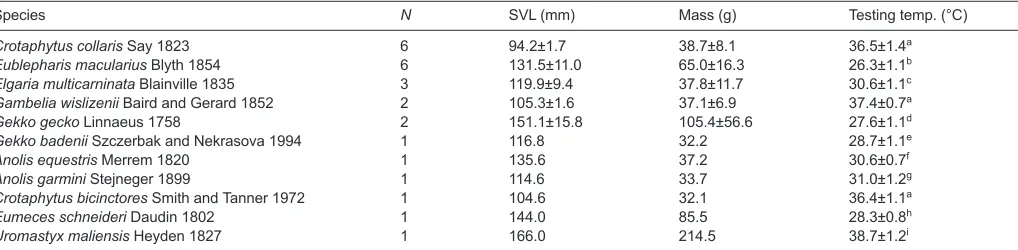
We used a phylogenetically diverse sample of lizards comprising 26 individuals representing 11 species in 9 genera and 7 families (Table 3). For each specimen, we recorded body mass and snout-vent length as measures of body size. In addition, given that the sample of specimens represents diverse thermal physiology, we reviewed the literature for data on field-active body temperature. This information was used to determine the body temperature at which bite force was measured for each specimen (Table 3).
Equipment
[image:7.612.49.558.574.699.2]As in the vast majority of previous studies of bite-force performance, measurements were made using a custom-built double-cantilever beam force transducer. The components include a piezoelectric isometric force transducer (type 9203, Kistler, Switzerland) connected to a charge amplifier (type 5995, Kistler, Switzerland). The transducer is custom fitted with two stainless steel bite plates arranged around a pivot so that compression on the bite plates produces tension on the transducer (see Herrel et al., 1999). The dimensions of the terminal end of each bite plate are 25 mm wide×1.25 mm thick (Lappin and Husak, 2005). For these experiments the distance between
Table 3. Taxa, body size and testing temperature for lizards sampled
Species N SVL (mm) Mass (g) Testing temp. (°C)
Crotaphytus collarisSay 1823 6 94.2±1.7 38.7±8.1 36.5±1.4a
Eublepharis maculariusBlyth 1854 6 131.5±11.0 65.0±16.3 26.3±1.1b
Elgaria multicarninataBlainville 1835 3 119.9±9.4 37.8±11.7 30.6±1.1c
Gambelia wislizeniiBaird and Gerard 1852 2 105.3±1.6 37.1±6.9 37.4±0.7a
Gekko geckoLinnaeus 1758 2 151.1±15.8 105.4±56.6 27.6±1.1d
Gekko badeniiSzczerbak and Nekrasova 1994 1 116.8 32.2 28.7±1.1e
Anolis equestrisMerrem 1820 1 135.6 37.2 30.6±0.7f
Anolis garminiStejneger 1899 1 114.6 33.7 31.0±1.2g
Crotaphytus bicinctoresSmith and Tanner 1972 1 104.6 32.1 36.4±1.1a
Eumeces schneideriDaudin 1802 1 144.0 85.5 28.3±0.8h
Uromastyx maliensisHeyden 1827 1 166.0 214.5 38.7±1.2i
The Journal of Experimental Biology
lower surface of upper bite plate and upper surface of lower bite plate was1.5 mm. Thus, the distance between the two outer leather surfaces is ~5.5 mm.
Amplifier output was calibrated using a series of weights suspended by fishing line on the bite plate that produces tension on the Kistler transducer when the plates are squeezed together, as during a bite-force trial. Specifically, the fishing line was suspended at the center of a leather strip adhered to the outer surface of the bite plate (see Fig. 6). Once calibrated, the bite plates of the device were not in any way moved or adjusted (e.g. distance between bite plates changed) for the duration of the experiments.
To test for the effects of biting substrate on bite-force performance, pads measuring 26×9×1 mm were constructed from three different materials (leather, wood, metal). The width of the pads (i.e. 9 mm) was intentionally greater than that we have used in previous publications on similarly-sized lizards, such as Crotaphytus, in which pads measuring 3 mm wide were used (e.g. Lappin and Husak, 2005; Husak et al., 2006; Lappin et al., 2006a). For the present study, we chose a 9 mm width because we did not want to risk injuring lizards by having them bite on narrow metal pads. Bites on narrow metal pads would produce high pressures on small parts of the jawline, which conceivably could result in injury as severe as a broken jaw. For each treatment, a pad was adhered to the outer surface of the upper and lower bite plates using double-sided tape. This proved sufficient to prevent any movement of the pads during trials. The leather used was soft deertan-style cowhide (ArtMinds Leather, Michaels Stores, Inc., USA). For the leather treatment, the 1-mm-thick strip was adhered to the bite plate by its smooth side, such that the unfinished side was presented to specimens during trials. The wood used was standard thick balsa, and the metal was 1-mm-thick 307 stainless steel. The Young’s modulus (stiffness) of the three substrates was quantified using a Nanoindentation tester (NHT, CSM Instruments) at the University of Hull.
Experimental design and data acquisition
Multiple measurements were obtained from each lizard for each biting substrate. To minimize potential effects of experience, the order of substrate was systematically varied. For C. collaris, E. macularius and E.
multicarinata, 54 measurements (Fig. 7) were obtained with 18 on each biting substrate. These bites were divided into six rounds of three sets with each set consisting of three trials on one substrate, with 60 s of rest between trials. Each set was separated by at least 3 h. For the remaining taxa, 27 bites were obtained from each specimen (i.e. three sets of three trials for nine bites on each substrate; Fig. 7).
To prepare specimens for bite-force trials, terraria with heating lamps were used to warm lizards to their field-active body temperature (Table 3). A cloacal thermometer (Miller & Weber, NY, USA) was used to record body temperature prior to each set of bites. The lizards were held with their heads
near the bite-plates and, if necessary, encouraged to gape by tapping on the snout. Once a lizard’s mouth was open the bite plates were placed inside its mouth whereupon the lizards would bite voluntarily (Fig. 6).
All trials were recorded from a lateral view with a Canon Vixia HFS10 camcorder. From the videos, the position of the strips (leather, wood, or metal) along the jaw line was recorded in lateral view, and the parasagittal distance from the center of the pads to the quadrate-articular joint (bite out-lever) was measured using ImageJ v1.47 on a PC (Fig. 6). Standardized bite force (i.e. standardized for bite out-lever) was then calculated for each trial by applying the Law of the Lever (in-force×in-lever=out-force×out-lever), where in-force is raw bite force, in-lever is the distance from the fulcrum (quadrate-articular jaw joint) to the bite point on the jaw line during the bite-force trial, out-lever is the distance from the fulcrum to the point on the jaw line for which the researcher wants to standardize bite force for bite out-lever, and out-force is bite force standardized for bite out-lever (Fig. 6). For each individual, the greatest standardized bite-force among all trials performed using a given substrate, assumed to represent maximum voluntary bite-force performance for that substrate (see Losos et al., 2002), was used in the statistical analysis.
Statistical analysis
Statistical analyses were performed using JMP version 11.0.0 for Windows (SAS Institute). To account for size variation of the head among specimens, residuals were calculated from a regression of log bite force (i.e. log of bite force standardized for bite out-lever) on the log of the geometric mean of the three head measurements (length, width, depth). Residuals were used as independent variables in ANOVA models (below) and in all cases were normally distributed.
To test the hypothesis that biting substrate has a significant effect on bite force, we ran a two-way ANOVA with residual bite force as the dependent variable. The independent variables were biting substrate, genus, and the interaction between biting substrate and genus. Individual nested in genus was included as a random effect. We then performed an equivalent ANOVA but included only the two species represented by six individuals each (Crotaphytus collaris and Eublepharis macularius), such that all permutations of substrate order were conducted with them (Fig. 7).
To evaluate the effect of failing to standardize bite force for bite out-lever, such as a tendency to underestimate maximum voluntary bite force, we constructed a count histogram showing the cumulative distribution of raw bite out-lever for all trials. This allows examination of how much raw bite out-lever (i.e. actual levers during trials) is apt to differ from a standardized bite lever. Comparing the raw bite lever distribution with a bite out-lever standardized for 50% of the distance from the jaw joint to the jaw tips illustrates the tendency to underestimate maximum voluntary bite force, expected at or near the position of the most posterior teeth. In addition, we
Subject Round 1 Round 2 Round 3 Round 4 Round 5 Round 6
A M - W - L W - M - L L - W - M M - L - W W - L - M L - M - W
B L - M - W M - W - L W - M - L L - W - M M - L - W W - L - M
C W - L - M L - M - W M - W - L W - M - L L - W - M M - L - W
D M - L - W W - L - M L - M - W M - W - L W - M - L L - W - M
E L - W - M M - L - W W - L - M L - M - W M - W - L W - M - L
F W - M - L L - W - M M - L - W W - L - M L - M - W M - W - L
1 set of 3 trials on wood 1 set of 3 trials on metal
1 set of 3 trials on leather
54 trials divided among 3 substrates
Fig. 7. Experimental design.Each letter represents a set of three
The Journal of Experimental Biology
estimated the potential range of bite-force performance for each species bymeasuring the length of the tooth row from lateral view and expressing bite force at the most posterior teeth as a percentage of bite force at the jaw tips [i.e. bite force at posterior teeth=bite force at jaw tips×head length/(head length–tooth row length)]. Lizards with long tooth rows, relative to head length, are expected to exhibit a greater range of potential bite forces.
Acknowledgements
We thank Mike Brown (Cal Poly BioTrek) for access to animals, Marci Hollenshead, Margit Lappin, Sue Taft (University of Hull) and Amy Woolfson for assistance during data acquisition, David Moriarty (Cal Poly Pomona) for guidance on experimental design and statistical analysis, Paul Stokes (South Australian Museum) for assistance with photography, eResearchSA (http://www.eresearchsa.edu.au/) for constructing the online database, Brett Goodman (University of Adelaide), Marci Hollenshead and Edward Snelling (University of Adelaide), Andrew Biewener and two anonymous reviewers for providing constructive comments on earlier versions of the manuscript. This work is dedicated to the memory of Jules Kieser (University of Otago) who encouraged the interest of M.E.H.J. in teeth and mechanoreceptors.
Competing interests
The authors declare no competing financial interests.
Author contributions
A.K.L. and M.E.H.J. each made significant and substantial contributions to this study in terms of the conception, design, experimental procedures, data collection and analysis, and interpretation of results, as well preparing the manuscript. Both authors agreed to submit the manuscript for consideration for publication in JEB.
Funding
This research was conducted with support from a Bogue Fellowship Award, University College London (2009), a Discovery Early Career Researcher Award DE130101567 (Australian Research Council), a Biotechnology and Biological Sciences Research Council grant BB/E007465/1 (awarded to Susan E. Evans, UCL), and the Biological Sciences Department at California State Polytechnic University.
Supplementary material
Supplementary material available online at
http://jeb.biologists.org/lookup/suppl/doi:10.1242/jeb.106385/-/DC1
References
Aguirre, L. F., Herrel, A., van Damme, R. and Matthysen, E. (2002). Ecomorphological analysis of trophic niche partitioning in a tropical savannah bat community. Proc. Biol. Sci.269, 1271-1278.
Alexander, R. M.(2003). Modelling approaches in biomechanics. Philos. Trans. R. Soc. B358, 1429-1435.
Anderson, R. A., McBrayer, L. D. and Herrel, A.(2008). Bite force in vertebrates: opportunities and caveats for use of a nonpareil whole-animal performance measure. Biol. J. Linn. Soc. Lond.93, 709-720.
Angilletta, M. J., Jr, Montgomery, L. G. and Werner, Y. L. (1999). Temperature preference in geckos: diel variation in juveniles and adults. Herpetologica55, 212-222.
Becerra, F., Echeverría, A., Vassallo, A. I. and Casinos, A.(2011). Bite force and jaw biomechanics in the subterranean rodent Talas tuco-tuco (Ctenomys talarum) (Caviomorpha: Octodontoidea). Can. J. Zool.89, 334-342.
Becerra, F., Casinos, A. and Vassallo, A. I.(2013). Biting performance and skull biomechanics of a chisel tooth digging rodent (Ctenomys tuconax; Caviomorpha; Octodontoidea). J. Exp. Zool. A319, 74-85.
Binder, W. J. and Van Valkenburgh, B. V.(2000). Development of bite strength and feeding behaviour in juvenile spotted hyenas (Crocuta crocuta). J. Zool. (Lond.)252, 273-283.
Cameron, S. F., Wynn, M. L. and Wilson, R. S.(2013). Sex-specific trade-offs and compensatory mechanisms: bite force and sprint speed pose conflicting demands on the design of geckos (Hemidactylus frenatus). J. Exp. Biol.216, 3781-3789.
Chazeau, C., Marchal, J., Hackert, R., Perret, M. and Herrel, A.(2013). Proximate determinants of bite force capacity in the mouse lemur. J. Zool. (Lond.)290, 42-48.
Curtis, N., Jones, M. E. H., Lappin, A. K., O’Higgins, P., Evans, S. E. and Fagan, M. J.(2010a). Comparison between in vivo and theoretical bite performance: using multi-body modelling to predict muscle and bite forces in a reptile skull. J. Biomech.
43, 2804-2809.
Curtis, N., Jones, M. E. H., Evans, S. E., O’Higgins, P. and Fagan, M. J.(2010b). Feedback control from the jaw joints during biting: an investigation of the reptile Sphenodon using multibody modelling. J. Biomech.43, 3132-3137.
Curtis, N., Jones, M. E. H., Evans, S. E., Shi, J., O’Higgins, P. and Fagan, M. J.
(2010c). Predicting muscle activation patterns from motion and anatomy: modelling the skull of Sphenodon (Diapsida: Rhynchocephalia). J. R. Soc. Interface7, 153-160.
D’Amore, D. C., Moreno, K., McHenry, C. R. and Wroe, S.(2011). The effects of biting and pulling on the forces generated during feeding in the Komodo dragon (Varanus komodoensis). PLoS ONE6, e26226.
Dessem, D. and Druzinsky, R. E.(1992). Jaw-muscle activity in ferrets, Mustela putorius furo. J. Morphol.213, 275-286.
Dong, W. K., Chudler, E. H. and Martin, R. F.(1985). Physiological properties of intradental mechanoreceptors. Brain Res.334, 389-395.
Dong, W. K., Shiwaku, T., Kawakami, Y. and Chudler, E. H.(1993). Static and dynamic responses of periodontal ligament mechanoreceptors and intradental mechanoreceptors. J. Neurophysiol.69, 1567-1582.
Du, W.-G., Yan, S.-J. and Ji, X.(2000). Selected body temperature, thermal tolerance, and thermal dependence of food assimilation and locomotor performance in adult blue-tailed skinks, Eumeces elegans. J. Therm. Biol.25, 197-202.
Dumont, E. R. and Herrel, A.(2003). The effects of gape angle and bite point on bite force in bats. J. Exp. Biol.206, 2117-2123.
Erickson, G. M., Gignac, P. M., Lappin, A. K., Vliet, K. A., Brueggen, J. D. and Webb, G. J. W.(2014). A comparative analysis of ontogenetic bite-force scaling among Crocodylia. J. Zool. (Lond.)292, 48-55.
Erickson, G. M., Lappin, A. K. and Vliet, K. A.(2003). The ontogeny of bite-force performance in American alligator (Alligator mississippiensis). J. Zool. (Lond.)260, 317-327.
Erickson, G. M., Lappin, A. K., Parker, T. and Vliet, K. A.(2004). Comparison of bite-force performance between long-term captive and wild American alligators (Alligator mississippiensis). J. Zool. (Lond.)262, 21-28.
Erickson, G. M., Gignac, P. M., Steppan, S. J., Lappin, A. K., Vliet, K. A., Brueggen, J. D., Inouye, B. D., Kledzik, D. and Webb, G. J. W.(2012). Insights into the ecology and evolutionary success of crocodilians revealed through bite-force and tooth-pressure experimentation. PLoS ONE7, e31781.
Freeman, P. W. and Lemen, C. A.(2008). Measuring bite force in small mammals with a piezo-resistive sensor. J. Mammal.89, 513-517.
Freeman, P. W. and Lemen, C. A.(2010). Simple predictors of bite force in bats: the good, the better and better still. J. Zool. (Lond.)282, 284-290.
Gidmark, N. J., Konow, N., Lopresti, E. and Brainerd, E. L.(2013). Bite force is limited by the force-length relationship of skeletal muscle in black carp,
Mylopharyngodon piceus. Biol. Lett.9, 20121181.
Gröning, F., Jones, M. E. H., Curtis, N., Herrel, A., O’Higgins, P., Evans, S. E. and Fagan, M. J. (2013). The importance of accurate muscle modelling for biomechanical analyses: a case study with a lizard skull. J. R. Soc. Interface10, 20130216.
Grubich, J. R., Huskey, S., Crofts, S., Orti, G. and Porto, J.(2012). Mega-bites: extreme jaw forces of living and extinct piranhas (Serrasalmidae). Sci. Rep.2, 1009.
Hannam, A. G.(1969). The response of periodontal mechanoreceptors in the dog to controlled loading of the teeth. Arch. Oral Biol.14, 781-791.
Henningsen, J. P. and Irschick, D. J.(2005). An experimental test of the effect of signal size and performance capacity on dominance in the green anole lizard. Func. Ecol.19, 3-10.
Herrel, A. and Holanova, V. (2008). Cranial morphology and bite force in Chamaeleolis lizards – adaptations to molluscivory? Zoology111, 467-475.
Herrel, A., Spithoven, L., Van Damme, R. and De Vree, F. (1999). Sexual dimorphism of head size in Gallotia galloti: testing the niche divergence hypothesis by functional analyses. Funct. Ecol.13, 289-297.
Herrel, A., O’Reilly, J. C. and Richmond, A. M.(2002). Evolution of bite performance in turtles. J. Evol. Biol.15, 1083-1094.
Herrel, A., Podos, J., Huber, S. K. and Hendry, A. P.(2005). Bite performance and morphology in a population of Darwin’s finches: implications for the evolution of beak shape. Funct. Ecol.19, 43-48.
Herrel, A., McBrayer, L. D., and Larson, P. M. (2007). Functional basis for sexual differences in bite force in the lizard Anolis carolinensis. Biol. J. Linn. Soc. Lond.91, 111-119.
Herrel, A., Andrade, D. V., de Carvalho, J. E., Brito, A., Abe, A. and Navas, C.
(2009). Aggressive behavior and performance in the Tegu lizard Tupinambis merianae. Physiol. Biochem. Zool.82, 680-685.
Herrel, A., Castilla, A. M., Al-Sulaiti, M. K. and Wessels, J. J.(2014). Does large body size relax constraints on bite-force generation in lizards of the genus
Uromastyx? J. Zool. (Lond.)292, 170-174.
Hollenshead, M. G. and Mead, J. I.(2006). Early pliocene crotaphytus and gambelia (Squamata: Crotaphytidae) from the panaca formation of Southeastern Nevada. J. Herpetol.40, 566-569.
Huber, D. R., Eason, T. G., Hueter, R. E. and Motta, P. J.(2005). Analysis of the bite force and mechanical design of the feeding mechanism of the durophagous horn shark Heterodontus francisci. J. Exp. Biol.208, 3553-3571.
Husak, J. F., Lappin, A. K., Fox, S. F. and Lemos-Espinal, J. A.(2006). Bite-force performance predicts dominance in male venerable collared lizards (Crotaphytus antiquus). Copeia2006, 301-306.
Husak, J. F., Lappin, A. K. and Van Den Bussche, R. A. (2009). The fitness advantage of a high-performance weapon. Biol. J. Linn. Soc. Lond.96, 840-845.
Jacobs, R. and van Steenberghe, D.(1993). Comparison between implant-supported prostheses and teeth regarding passive threshold level. Int. J. Oral Maxillofac. Implants8, 549-554.
Jones, M. E. H. and Lappin, A. K. (2009). Bite-force performance of the last rhynchocephalian (Lepidosauria: Sphenodon). J. R. Soc. N. Z.39, 71-83.
The Journal of Experimental Biology
Kieser, J. A., Tkatchenko, T., Dean, M. C., Jones, M. E. H., Duncan, W. and Nelson,N. J.(2009). Microstructure of dental hard tissues and bone in the Tuatara dentary,
Sphenodon punctatus(Diapsida: Lepidosauria: Rhynchocephalia). In Comparative Dental Morphology (Frontiers of Oral Biology), Vol. 13 (ed. T. Koppe, G. Meyer and K. W. Alt), pp. 80-85. Basel: Karger.
Kieser, J. A., He, L.-H., Dean, M. C., Jones, M. E. H., Duncan, W. J., Swain, M. V. and Nelson, N. J.(2011). Structure and compositional characteristics of caniniform dental enamel in the tuatara Sphenodon punctatus (Lepidosauria: Rhynchocephalia). N. Z. Dent. J.107, 44-50.
Kingsbury, B. A.(1993). Thermoregulatory set points of the eurythermic lizard Elgaria multicarinata. J. Herpetol.27, 241-247.
Kupczik, K., Dobson, C. A., Crompton, R. H., Phillips, R., Oxnard, C. E., Fagan, M. J. and O’Higgins, P.(2009). Masticatory loading and bone adaptation in the supraorbital torus of developing macaques. Am. J. Phys. Anthropol.139, 193-203.
La Croix, S., Zelditch, M. L., Shivik, J. A., Lundrigan, B. L. and Holekamp, K. E.
(2011). Ontogeny of feeding performance and biomechanics in coyotes. J. Zool. (Lond.)285, 301-315.
Lailvaux, S. P., Herrel, A., Vanhooydonck, B., Meyers, J. J. and Irschick, D. J.
(2004). Performance capacity, fighting tactics and the evolution of life-stage male morphs in the green anole lizard (Anolis carolinensis). Proc. Biol. Sci.271, 2501-2508.
Lappin, A. K. and Husak, J. F.(2005). Weapon performance, not size, determines mating success and potential reproductive output in the collared lizard (Crotaphytus collaris). Am. Nat.166, 426-436.
Lappin, A. K., Brandt, Y., Husak, J. F., Macedonia, J. M. and Kemp, D. J.(2006a). Gaping displays reveal and amplify a mechanically based index of weapon performance. Am. Nat.168, 100-113.
Lappin, A. K., Hamilton, P. S. and Sullivan, B. K.(2006b). Bite-force performance and head shape in a sexually dimorphic crevice-dwelling lizard, the common chuckwalla (Sauromalus ater(= obesus)). Biol. J. Linn. Soc. Lond.88, 215-222.
Losos, J. B. (1990). Ecomorphology, performance capability, and scaling of West Indian Anolis lizards: an evolutionary analysis. Ecol. Monogr.60, 369-388.
Losos, J. B., Douglas, A. C. and Schulte, J. A., II(2002). Cautionary comments on the measurement of maximum locomotor capabilities. J. Zool. (Lond.)258, 57-61.
Marshall, C. D., Guzman, A., Narazaki, T., Sato, K., Kane, E. A. and Sterba-Boatwright, B. D.(2012). The ontogenetic scaling of bite force and head size in loggerhead sea turtles (Caretta caretta): implications for durophagy in neritic, benthic habitats. J. Exp. Biol.215, 4166-4174.
McCormack, S. W., Witzel, U., Watson, P. J., Fagan, M. J. and Gröning, F.(2014). The biomechanical function of periodontal ligament fibres in orthodontic tooth movement. PLoS ONE9, e102387.
Measey, G. J., Rebelo, A. D., Herrel, A., Vanhooydonck, B. and Tolley, K. A.(2011). Diet, morphology and performance in two chameleon morphs: do harder bites equate with harder prey? J. Zool. (Lond.)285, 247-255.
Nikitina, N. G. and Ananjeva, N. B.(2009). Characteristics of dentition in gekkonid lizards of the genus Teratoscincusand other Gekkota (Sauria, Reptilia). Biol. Bull.
36, 193-198.
Niklas, K. J.(1992). Plant Biomechanics: An Engineering Approach to Plant Form and Function. Chicago, IL: University of Chicago Press.
Noble, D. W. A., Fanson, K. V. and Whiting, M. J.(2014). Sex, androgens, and whole-organism performance in an Australian lizard. Biol. J. Linn. Soc. Lond.111, 834-849.
Orchardson, R. and MacFarlane, S. H.(1980). The effect of local periodontal anaesthesia on the maximum biting force achieved by human subjects. Arch. Oral Biol.25, 799-804.
Paphangkorakit, J. and Osborn, J. W.(1997). The effect of pressure on a maximum incisal bite force in man. Arch. Oral Biol.42, 11-17.
Paphangkorakit, J. and Osborn, J. W.(1998). Effects on human maximum bite force of biting on a softer or harder object. Arch. Oral Biol.43, 833-839.
Porro, L. B., Ross, C. F., Iriarte-Diaz, J., O’Reilly, J. C., Evans, S. E. and Fagan, M. J.(2014). In vivo cranial bone strain and bite force in the agamid lizard Uromastyx geyri. J. Exp. Biol.217, 1983-1992.
Rayfield, E. J.(2007). Finite element analysis and understanding the biomechanics and evolution of living and fossil organisms. Annu. Rev. Earth Planet. Sci.35, 541-576.
Santana, S. E. and Dumont, E. R.(2009). Connecting behaviour and performance: the evolution of biting behaviour and bite performance in bats. J. Evol. Biol.22, 2131-2145.
Santana, S. E., Dumont, E. R. and Davis, J. L.(2010). Mechanics of bite force production and its relationship to diet in bats. Funct. Ecol.24, 776-784.
Serra, C. M. and Manns, A. E.(2013). Bite force measurements with hard and soft bite surfaces. J. Oral Rehabil.40, 563-568.
Sievert, L. M. and Hutchison, V. H.(1988). Light versus heat: thermoregulatory behavior in a nocturnal lizard (Gekko gecko). Herpetologica44, 266-273.
Smith, K. K.(1980). Mechanical significance of streptostyly in lizards. Nature283, 778-779.
Toro, E., Herrel, A., Vanhooydonck, B. and Irschick, D. J.(2003). A biomechanical analysis of intra- and interspecific scaling of jumping and morphology in Caribbean
Anolislizards. J. Exp. Biol.206, 2641-2652.
van der Meij, M. A. A. and Bout, R. G.(2004). Scaling of jaw muscle size and maximal bite force in finches. J. Exp. Biol.207, 2745-2753.
van der Meij, M. A. A. and Bout, R. G.(2006). Seed husking time and maximal bite force in finches. J. Exp. Biol.209, 3329-3335.
Vanhooydonck, B., Cruz, F. B., Abdala, C. S., Azócar, D. L. M., Boniono, M. F. and Herrel, A.(2010). Sex-specific evolution of bite performance in Liolaemuslizards (Iguania: Liolaemidae): the battle of the sexes. Biol. J. Linn. Soc. Lond.101, 461-475.
Vanhooydonck, B., Boistel, R., Fernandez, V. and Herrel, A.(2011). Push and bite: trade-offs between burrowing and biting in a burrowing skink (Acontias percivali).
Biol. J. Linn. Soc. Lond.102, 91-99.
Verwaijen, D., Van Damme, R. and Herrel, A.(2002). Relationships between head size, bite force, prey handling efficiency and diet in two sympatric lacertid lizards.
Funct. Ecol.16, 842-850.
Wilms, T. M., Wagner, P., Shobrak, M., Rödder, D. and Böhme, W.(2011). Living on the edge? On the thermobiology and activity pattern of the large herbivorous desert lizard Uromastyx aegyptiamicrolepis Blanford, 1875 at Mahazat as-Sayd Protected Area, Saudi Arabia. J. Arid Environ.75, 636-647.
Yamaguchi, M., Nakajima, R. and Kasai, K.(2012). Mechanoreceptors, nociceptors, and orthodontic tooth movement. Semin. Orthod.18, 249-256.