OPENING DOORS
training modules
training module 3: the legalities
What this module includes:
■ the legal context and how it affects your work
■ rights to housing benefit and council tax benefit
■ rights to homelessness assistance in England
■ rights to the allocation of local authority accommodation in England
■ differences between allocation of HA and LA accommodation.
[See chapter 4 of the CIH/JRF guide. This module updates Appendix 3 of the guide.]
The need for caution in giving advice
The rules regarding eligibility for welfare benefits, assistance under homelessness provisions and the allocation of local authority accommodation are complex and what follows is only a summary. A key message is to be cautious in giving advice or making
judgments about eligibility. Never make assumptions about the law as these may reflect value judgements as to what is ‘fair’ and will often be the wrong answer. Here are some examples of beliefs that are fairly commonly held but which are false:
‘Housing associations are not allowed to allocate property which
has been built with public subsidy to new migrants.’
‘Housing associations cannot legally give a tenancy to an asylum seeker.’
‘A8 nationals are only entitled to housing assistance after they have been working for one year.’
Differences in the law between local authorities and housing
associations
Local authorities are subject to complex rules governing their ability to help migrants, depending on their immigration status. The rules which this module describes are those that apply in England as at 1
April 2007.
Housing associations, including those created from stock transfer, are independent from government and are not governed by the same rules. In fact they have a duty to treat all applicants equally and not discriminate against anyone because of their immigration status. To do so would open them to challenge under race relations legislation.
nomination agreements
Local authorities may have nomination agreements with housing associations. The local authority, subject to the law on eligibility, decides who will be put forward to tenancies under these
agreements. Housing associations determine who they will house in any remaining lettings, if they have them (see the note to Table A).
common housing registers or lettings agreements
These should not inadvertently constrain associations in the
scheme to the same rules that apply to any local authority partners. Some applicants may be eligible for housing by an association who would not be eligible for council housing.
housing benefit Some new migrants are not allowed to receive housing benefit, at
least initially. An applicant that fulfils the letting criteria and who is able to pay the rent (for example, from wages) should be
considered in the same way as any other.
stock transfers Particular issues arise, especially with whole stock transfers.
Associations need to be clear whether they are running an allocations policy on contract from the local authority (so the
eligibility rules apply) or are now running the allocations themselves (possibly in consultation with the authority) in which case the eligibility rules do not apply and they need to develop their own, non-discriminatory policies.
Eligibility for assistance
The tables explain eligibility in detail. Below are some introductory notes on each category of person dealt with in the tables.
Definitions of the EEA (European Economic Area) and countries within it, including the (A8 and A2) accession states, were given in module 2.
British nationals, Irish Citizens, and others with a right of abode
British citizens have the right of abode (table B) in the UK, the Republic of Ireland, the Isle of Man and the Channel Islands (collectively known as the common travel area). British citizens are eligible for assistance if they are habitually resident in the common travel area.
Certain categories of British nationality, other than British citizenship, do not give the right of abode in the UK. A British national who is not a British citizen but who has the right of abode will have this fact stated in their passport.
asylum seekers and refugees
Applicants seeking asylum are not entitled to social housing assistance and benefits (except through the government’s asylum support arrangements) while their asylum claim is processed. Those that have received a positive decision on their claim or who have been granted permission to stay for humanitarian or other, discretionary, reasons are entitled to benefits and housing assistance.
refugees and others and the local connection rule
In addition to the rules on eligibility, where a person who has been housed as an asylum seeker under the government’s dispersal programme applies for homelessness assistance, a different rule on local connections applies: this affects which local authority has the duty to house them.
The rule is that, in addition to any local connections the applicant may have because of family, work or previous residence, they have a local connection with the last area where they were housed in
asylum support accommodation.
non EEA nationals including family migrants
Most nationals from countries not in the EEA are subject to immigration control and require ‘leave’ to enter the UK (table B). Most applicants who are granted limited leave (ie for a fixed period) will be subject to a ‘no recourse to public funds’ condition (a fact that will show in their passport) and not be entitled to housing assistance and certain benefits. .
Some migrants, joining family members settled in the UK (table B), are granted leave on the understanding that they will be maintained and accommodated by their family member. Where their sponsor has signed a written agreement (an undertaking) to support them they will not normally be entitled to housing assistance and certain benefits for five years (table A).
Other non-EEA nationals who have a right of abode or who have settled status (table B) are entitled to assistance, subject to their being habitually resident.
EEA nationals EU citizens have rights to live and work in Britain. The European
Economic Area (EEA) extends these rights to citizens of three non-EU countries and another agreement covers Swiss nationals. . Restrictions on working and associated rights apply to citizens of the EU accession states (see below). All restrictions which apply to nationals of these states may be lifted after five years’ membership of the EU.
In general, EEA nationals are free to come to Britain to work without any restrictions. They can also come to Britain to live for up to three months for any reason but this right does not entitle them to claim assistance. In certain circumstances EEA nationals who start work in the UK but whose employment is temporarily disrupted (eg unemployment or sickness) are still treated as workers and so entitled to assistance (table C).
EEA nationals (except those affected by accession rules) who enter the UK seeking work can claim income-based jobseeker’s
allowance, which means they can also claim housing benefit (but are not entitled to local authority housing).
All other economically-inactive EEA nationals (such as students) have a right to reside provided they have comprehensive medical insurance and have sufficient resources to maintain themselves and their family. Some claims for homelessness assistance or means-tested benefits may be treated as indicating that these people are no longer self-sufficient.
Family members of those with rights to reside also have the right
to reside as long as the person is exercising those rights. These include husbands, wives, civil partners, children under 21 (or over 21 if dependent) and other direct descendants or ascendants if dependent. EEA nationals have these rights automatically, but non-EEA nationals will normally apply for a residence document. .
accession states Special rules apply though to accession state nationals – people
from certain countries which joined the EU recently (but not Malta or Cyprus, which are treated the same as the rest of the EEA) – when they come to the UK to work.
As pointed out in module 2, there are two special groups of
accession states (note, however the restrictions about these groups
donotapply to the self-employed):
A8 nationals A8 nationals are EEA nationals with the same rights as others in all
respects except when they come to work in the UK. They are required to register on the Workers Registration Scheme within 30 days of starting work.
In the first 30 days, and while registered and working on the
scheme, they are entitled to benefits, housing assistance, etc. After completing 12 months employment in registered work, A8 nationals are entitled to assistance under the same terms as other EEA nationals whether in or out of work. But while looking for or out of work before having worked the 12 months, they are not entitled to assistance.
A2 nationals A2 nationals have limited rights to take up paid employment in the
UK. Most can only take up employment in work which is ‘authorised’ (see table D for exceptions). Authorised work is limited to certain occupations, and the worker must meet certain other requirements. Those in authorised or exempted work (table D) are eligible for assistance.
The significance of habitual residence
Most applicants for housing or means tested benefits will need to prove they are habitually resident in the common travel area. The test is intended to exclude non-UK residents from being eligible for assistance immediately on their arrival in the UK – an example might be a person who has British Citizenship but who has never lived in the UK.
Some people are exempt from this test including:
■ EEA nationals who are covered by the rules about working or self employment (including some who are no longer working, etc)
■ refugees or people granted humanitarian protection
■ people granted exceptional leave to remain or discretionary leave.
These are identified in table A where they arise.
There is no set period over which a person who has lived in the UK will acquire habitual residence, which is a test of where the
[image:5.612.98.525.463.722.2]applicant has a ‘centre of interest’, although people who have lived in the UK for at least two years will be treated as habitually resident. For guidance on how to apply this test see the Housing Benefit Guidance manual, chapter C4
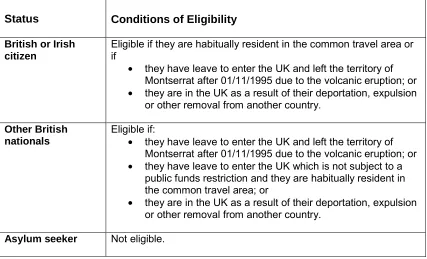
Table A: Entitlement to homelessness assistance, allocation of local authority accommodation and housing benefit/council tax benefit
Status Conditions of Eligibility
British or Irish citizen
Eligible if they are habitually resident in the common travel area or if
• they have leave to enter the UK and left the territory of Montserrat after 01/11/1995 due to the volcanic eruption; or
• they are in the UK as a result of their deportation, expulsion or other removal from another country.
Other British nationals
Eligible if:
• they have leave to enter the UK and left the territory of Montserrat after 01/11/1995 due to the volcanic eruption; or
• they have leave to enter the UK which is not subject to a public funds restriction and they are habitually resident in the common travel area; or
• they are in the UK as a result of their deportation, expulsion or other removal from another country.
Refugee Eligible (together with their dependents) without further conditions while they have leave to remain in the UK.
Humanitarian protection, discretionary or exceptional leave
Eligible without further conditions but only if their leave is granted without the condition that there is no recourse to public funds.
Non EEA nationals
(who are not in any of the classes above or below)
Eligible only if they have been granted indefinite leave and are habitually resident in the common travel area and:
• are not the subject of an undertaking to maintain them; or
• they are a sponsored immigrant subject to an undertaking and at least five years have passed since they entered the UK or the undertaking was made (whichever is the later); or
• they are habitually resident in the common travel area and they are subject to an undertaking but all those who signed the agreement have since died; or
• (in respect of housing benefit and council tax benefit only) they have limited leave but their funds from abroad are temporarily disrupted and there is a reasonable expectation they will resume within three months. They are entitled to HB/CTB for up to 42 days in any one period of leave.
EEA nationals (who
are not in any of the classes above or below)
Eligible if:
• they are self-employed in the UK (including a person who is temporarily unable to work due to sickness or injury);
• they are currently in paid work in the UK;
• they were previously working in the UK but have retained their worker status whilst temporarily out of work (table C);
• they are a retired worker who has acquired a right of permanent residence (table C);
• they have lawfully resided in the UK for a period of five years;
• they are economically inactive and do not fall into any of the categories above but are self-sufficient and habitually resident in the common travel area.
A8 nationals Eligible if:
• they are self-employed in the UK (including a person who is temporarily unable to engage in their business due to sickness or injury); or
• they have previously worked in the UK for a uninterrupted period of at least 12 months whilst on the worker
registration scheme and are now covered by the EU rules on workers; or
• they are currently working whilst on the worker registration scheme or are within the first 30 days of starting their job; or
• they have some other right to reside in the UK, and, where appropriate, can also pass the habitual residence test; • they have indefinite leave to remain in the UK;
A2 nationals Eligible if:
• they are a person who is currently self-employed in the UK;
• they are a person who is working who is subject to worker authorisation who has a worker authorisation document and who is working in accordance with the conditions set out in that document;
• they are a person who is working who is exempt from worker authorisation;
• they have previously worked in the UK for an uninterrupted period of 12 months while authorised or exempted and are now covered by the EU rules on workers;
• they have some other right to reside in the UK, and, where appropriate, can also pass the habitual residence test;
• they have indefinite leave to remain in the UK;
• they are the family members of any of the above.
Nationals of Turkey, Croatia or Macedonia
Eligible (in respect housing benefit or council tax benefit only) if they have been granted leave or temporary admission on arrival by the immigration authorities which has not expired; and they are habitually resident in the common travel area.
Notes on table A:
1. Table A does not include persons who may have other transitional or preserved rights to housing or benefits arising from legislation which was in force before 1 January 2007.
2. A person will be considered to be allocated local authority housing if they: • are selected to be a new local authority introductory or secure tenant; or
• transfer from an existing secure or introductory tenancy granted before these rules were in force (this does not apply to mutual exchanges); or
• are nominated by the local authority to be an assured or assured shorthold tenant of a registered social landlord (whether under a voluntary arrangement or otherwise).
There is no eligibility test for the allocation of housing to existing tenants of secure, introductory or assured tenancies allocated by a local authority.
3. Other persons entitled to housing benefit and/or council tax benefit
In addition to the rules for eligibility in table A above a person will be entitled to housing benefit and/or council tax benefit (but not housing assistance or local authority allocation) regardless of their immigration status if they are in receipt of either:
• income-based jobseeker’s allowance;
• income support; or
• state pension credit.
A claimant is also still entitled if they were entitled to anyone of those benefits
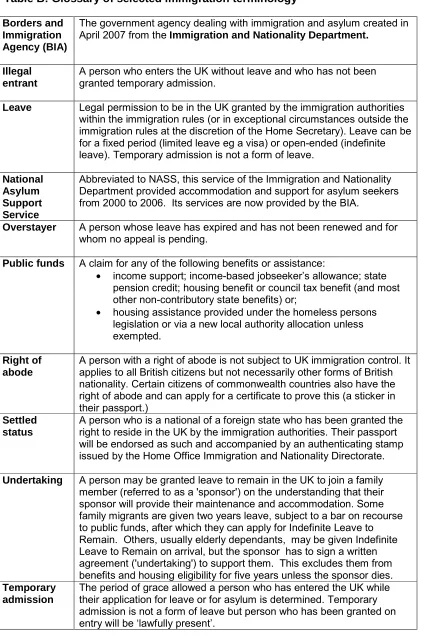
Table B: Glossary of selected immigration terminology
Borders and Immigration Agency (BIA)
The government agency dealing with immigration and asylum created in April 2007 from the Immigration and Nationality Department.
Illegal entrant
A person who enters the UK without leave and who has not been granted temporary admission.
Leave Legal permission to be in the UK granted by the immigration authorities
within the immigration rules (or in exceptional circumstances outside the immigration rules at the discretion of the Home Secretary). Leave can be for a fixed period (limited leave eg a visa) or open-ended (indefinite leave). Temporary admission is not a form of leave.
National Asylum Support Service
Abbreviated to NASS, this service of the Immigration and Nationality Department provided accommodation and support for asylum seekers from 2000 to 2006. Its services are now provided by the BIA.
Overstayer A person whose leave has expired and has not been renewed and for
whom no appeal is pending.
Public funds A claim for any of the following benefits or assistance:
• income support; income-based jobseeker’s allowance; state pension credit; housing benefit or council tax benefit (and most other non-contributory state benefits) or;
• housing assistance provided under the homeless persons legislation or via a new local authority allocation unless exempted.
Right of abode
A person with a right of abode is not subject to UK immigration control. It applies to all British citizens but not necessarily other forms of British nationality. Certain citizens of commonwealth countries also have the right of abode and can apply for a certificate to prove this (a sticker in their passport.)
Settled status
A person who is a national of a foreign state who has been granted the right to reside in the UK by the immigration authorities. Their passport will be endorsed as such and accompanied by an authenticating stamp issued by the Home Office Immigration and Nationality Directorate.
Undertaking A person may be granted leave to remain in the UK to join a family
member (referred to as a 'sponsor') on the understanding that their sponsor will provide their maintenance and accommodation. Some family migrants are given two years leave, subject to a bar on recourse to public funds, after which they can apply for Indefinite Leave to Remain. Others, usually elderly dependants, may be given Indefinite Leave to Remain on arrival, but the sponsor has to sign a written agreement ('undertaking') to support them. This excludes them from benefits and housing eligibility for five years unless the sponsor dies.
Temporary admission
Table C: Economically inactive EEA nationals who have the right to reside in the UK following a period of work and /or residence
Category Conditions of eligibility
Workers temporarily unemployed or unable to work due to sickness
An EEA national (including an A8 or A2 who has completed their one year qualifying period in authorised or registered work) who was previously working in the UK but who is temporarily out of work will retain their worker status (and so entitlement to assistance) if they are a person who:
• is temporarily unable to work as a result of illness or accident;
• is currently registered as a jobseeker; and who
o was employed for one year or more before becoming
unemployed; or
o has been unemployed no more than six months; or o can provide evidence that they are seeking employment
and have genuine chance of being engaged;
• is involuntarily unemployed and has started vocational training;
• has voluntarily stopped working and has started vocational training related to their previous employment.
Note: in the cases above reference to voluntary or involuntary employment is determined by reference to whether the person is still genuinely in the labour market and not to the circumstances in which in which they ceased to be employed.
Retired workers
(incapacity or old age)
An EEA national (including an A8 or A2 who has completed their one year qualifying period in authorised or registered work) will acquire a right of permanent residence if they are a person who:
• has retired after working (including self employment) in the UK for at least 12 months prior to reaching age 65 (60 for a woman) and they have continuously resided in the UK for more than three years;
• has taken early retirement as an employee after working in the UK for at least 12 months and has continuously resided in the UK for more than three years;
• has retired from work (including self employment) after reaching age 65 (60 for a woman) and their spouse or civil partner is a UK national;
• has taken early retirement as an employee and their spouse or civil partner is a UK national;
• ceases working (including self-employment) as a result of permanent incapacity; and
o is entitled to UK incapacity benefit or industrial injuries
benefit, or
o has continuously resided in the UK for more than two
years; or
o has a spouse or a civil partner who is a UK national; or o the incapacity arose from an accident at work or an
Note 1: Where one of the conditions above requires a minimum period of work: then any period of inactivity which is due to sickness or injury; any period of unemployment during which they are registered as a jobseeker; or any other period of inactivity for ‘reasons not of their making’; will be deemed to be a period of work.
Note 2: Once acquired this right of residence is only lost after absence from the UK for a period exceeding two years.
Others with a permanent right of residence
An EEA National who has lawfully resided in the UK for a continuous period of five years.
Note: Once acquired this right of residence is only lost after absence from the UK for a period exceeding two years.
Table D: Accession state nationals who are allowed to work without restrictions
A8 Nationals who are not subject to worker registration
(a) a person who had leave to enter the UK on the 30/04/04 which was not subject to any condition restricting their employment;
(b) An A8 national who has indefinite leave to remain or other leave to remain with no work restrictions (e.g. as a spouse);
(c) a person who has been in registered or exempted work in the UK for an
uninterrupted period* of 12 months (whether that period started on, before or after 1
May 2004);
(d) a person who is also a national of the UK or another EEA state, other than an A8 or A2 state (i.e. has dual nationality);
(e) a person who is a family member** of an EEA national (other than an accession national who is subject to worker registration or worker authorisation who has not yet completed their one year qualifying period of work ) who has a right to reside in the UK;
(f) a person who has been posted to work in the UK by an organisation that is based in another EEA member state.
A2 Nationals who are not subject to worker authorisation
(a) a person who has leave to enter the UK who is not subject to any restricting their employment;
(b) a person who has worked (with authorisation or exempted) in the UK for an uninterrupted period* of 12 months (whether that period started on, before or after
1January 2007);
(c) a person who is also a national of the UK or another EEA state, other than Bulgaria or Romania (i.e. has dual nationality);
(d) a person whose spouse or civil partner is either a UK national or a person with settled status;
(f) a person meets the Home Office criteria to enter the UK under the highly skilled migrant programme and who holds a registration certificate that includes a statement that they have unrestricted access to the UK labour market;
(g) a person who has been posted to work in the UK by an organisation that is based in another EEA member state;
(h) a student who has registered as such and has permission to access the labour market for a prescribed maximum number of hours per week.
Notes:
* any intervening periods within the 12 months in which that person was not in work are ignored provided they do not together exceed 30 days.
** family member includes spouse, civil partner and any direct descendants up the age of 21 and certain other relatives.