INTRODUCTION
Spider major ampullate silk is a promising biomaterial, combining high strength and elasticity (Gosline et al., 1986). Furthermore, silk is biocompatible (Allmeling et al., 2006; Gellynck et al., 2006). Potential applications range from artificial tendons and ligaments (Kluge et al., 2008) to microspheres for drug delivery (Lammel et al., 2008). However, large amounts of spider silk are hard to obtain. Researchers are therefore working to produce synthetics fibers based on spider major ampullate silk (Vendrely and Scheibel, 2007). However, in contrast to most known materials, silk supercontracts under mild conditions (when humidity rises above ~70%) (Work, 1977). During supercontraction, water infiltrates the silk and causes it to shrink, up to half its dry length (Work, 1977).This process also generates high stresses if the fiber is restrained. Supercontraction could play a critical role in the production of dragline silk by spiders by allowing spiders to ‘tailor’ silk properties (Guinea et al., 2005a). Although it can hinder certain applications of silk, it can also lead to new uses that involve silk moving objects rather than simply resisting loads (Agnarsson et al., 2009b). Thus, there is a crucial need to understand the mechanisms of supercontraction.
Supercontraction is relatively well documented among orb-weaving spiders such as Araneidae and Nephilidae (Grubb and Ji, 1999; Savage et al., 2004; van Beek et al., 2002; Work, 1981), and was also found in the Pisauridae (Shao and Vollrath, 1999) and Theridiidae (Shao and Vollrath, 1999; Work, 1981). Whether silk from other taxa supercontracts, in particular silk from ‘basal’ taxa such as tarantulas and haplogynes (e.g. daddy long leg and spitting spiders), remains uninvestigated. The current molecular model for
supercontraction (Eles and Michal, 2004; Termonia, 1994) and the possible functions proposed for supercontraction (Guinea et al., 2003; Guinea et al., 2005a; Lewis, 1992; Work, 1981) are largely based on our knowledge of silk composition and web ecology of members of the Araneidae and Nephilidae, a small fraction of all existing spiders (~10% of spiders species). Understanding the supercontraction behavior of silk from other taxa, with different ecologies and silk composition, provides a crucial test of the proposed mechanisms and functions of supercontraction. Here, we present the first comprehensive study of supercontraction in a wide range of spiders and use a phylogenetic perspective to understand the origin and function of supercontraction in spider major ampullate silk.
Spider major ampullate silk is composed of proteins containing repeated amino acid motifs, i.e. short, stereotyped amino acid sequences that form specific secondary structures. The major ampullate silk of the Orbiculariae contains poly-alanine and glycine–alanine motifs that form -sheet crystals (Jelinski et al., 1999; Kümmerlen et al., 1996; Simmons et al., 1994; Xu and Lewis, 1990), glycine–glycine–X motifs that form 310helices (Bram et al., 1997; van Beek et al., 2002) and glycine–proline–glycine motifs (Ayoub et al., 2007; Hayashi and Lewis, 1998; Hayashi et al., 1999; Hinman et al., 2000; Hinman and Lewis, 1992). There is no consensus as to what structures are formed by the glycine–proline– glycine motifs. They have been described as helical fractions (Vollrath and Porter, 2009), proline-rich network chains (Savage and Gosline, 2008a), -spirals (Hayashi and Lewis, 1998; Hayashi et al., 1999) and various types of -turns (Ohgo et al., 2006). In The Journal of Experimental Biology 213, 3505-3514
© 2010. Published by The Company of Biologists Ltd doi:10.1242/jeb.046110
Evolution of supercontraction in spider silk: structure–function relationship from
tarantulas to orb-weavers
Cecilia Boutry* and Todd Alan Blackledge
Department of Biology and Integrated Bioscience Program, University of Akron, Akron, OH 44325-3908, USA *Author for correspondence ([email protected])
Accepted 22 July 2010
SUMMARY
Spider silk is a promising biomaterial with impressive performance. However, some spider silks also ‘supercontract’ when exposed to water, shrinking by up to ~50% in length. Supercontraction may provide a critical mechanism to tailor silk properties, both for future synthetic silk production and by the spiders themselves. Several hypotheses are proposed for the mechanism and function of supercontraction, but they remain largely untested. In particular, supercontraction may result from a rearrangement of the GPGXX motif within the silk proteins, where G represents glycine, P proline and X is one of a small subset of amino acids. Supercontraction may prevent sagging in wet orb-webs or allow spiders to tailor silk properties for different ecological functions. Because both the molecular structures of silk proteins and how dragline is used in webs differ among species, we can test these hypotheses by comparing supercontraction of silk across diverse spider taxa. In this study we measured supercontraction in 28 spider taxa, ranging from tarantulas to orb-weaving spiders. We found that silk from all species supercontracted, except that of most tarantulas. This suggests that supercontraction evolved at least with the origin of the Araneomorphae, over 200 million years ago. We found differences in the pattern of evolution for two components of supercontraction. Stress generated during supercontraction of a restrained fiber is not associated with changes in silk structure and web architecture. By contrast, the shrink of unrestrained supercontracting fibers is higher for Orbiculariae spiders, whose silk contains high ratios of GPGXX motifs. These results support the hypothesis that supercontraction is caused by a rearrangement of GPGXX motifs in silk, and that it functions to tailor silk material properties.
this paper, we will simply refer to these motifs as GPGXX motifs, where G represents glycine, P proline and X any one of a small subset of amino acids.
Currently, supercontraction is hypothesized to result from rearrangements of the non-crystalline fractions formed by the GPGXX motifs and the 310helices within the silk fiber (Blackledge et al., 2009a; Eles and Michal, 2004; Termonia, 1994). When the silk is dry, these non-crystalline regions are maintained parallel to the fiber axis by hydrogen bonds. However, when the humidity rises, water disrupts these hydrogen bonds, allowing the non-crystalline regions to rearrange to lower energetic configurations, driving supercontraction (Eles and Michal, 2004; Savage and Gosline, 2008b; Yang et al., 2000). This rearrangement leads to the shrinking and thickening of the fiber and, at the molecular level, to an observed loss of orientation (Grubb and Ji, 1999; Parkhe et al., 1997).
If supercontraction is induced by a rearrangement of the glycine– glycine–X or GPGGXX motifs, then there should be a positive relationship between abundance of these motifs in the silk and strength of supercontraction. Major ampullate silk contains one or two types of proteins, both termed major ampullate spidroins or MaSp for short (Hinman and Lewis, 1992; Xu and Lewis, 1990). Mygalomorphs (tarantulas) lack clearly differentiated silk glands (Palmer, 1985; Palmer et al., 1982). Their silk proteins contain long repeats, rich in alanine and serine (Garb et al., 2007). Major ampullate glands appeared with the Araneomorphae spiders, which include haplogyne spiders such as daddy long leg spiders, and entelegyne spiders. Haplogyne major ampullate silk is composed of long repeat units rich in alanine, serine and glycine (Gatesy et al., 2001). These proteins differ from the major ampullate spidroins found in the sister taxon to the haplogyne, the entelegyne spiders, which include most common spiders, such as orb-weavers and wolf spiders. Entelegynes possess a MaSp1-like protein, rich in poly-alanine and glycine–poly-alanine repeats that form -sheets, as well as glycine–glycine–X helices (Gatesy et al., 2001; Pouchkina-Stantcheva and McQueen-Mason, 2004) (but see Tian et al., 2004). The second protein, MaSp2, includes GPGXX motifs (Hinman and Lewis, 1992) acting as molecular nanosprings (Becker et al., 2003). MaSp2 is known to be produced by the Orbiculariae (orb-weaving spiders and their relatives) but is probably absent from all other taxa (see Materials and methods). Therefore, if supercontraction results from the rearrangement of GPGXX motifs, silk containing MaSp2 proteins (i.e. Orbiculariae silk) should supercontract more than silk lacking MaSp2.
Such a phylogenetically based approach may also provide insight into the two functions proposed for supercontraction: tailoring of silk properties during fiber spinning and tightening of orb webs loaded with water.
According to the tailoring hypothesis, silk is in a supercontracted state at the beginning of the spinning process, when it is first drawn from a liquid solution. The extent to which the supercontracted silk is stretched during spinning determines molecular alignment, and thereby, the properties of the fiber after extrusion and drying (Guinea et al., 2005a). The tailoring hypothesis predicts that supercontraction was selected for in spiders that use major ampullate silk in diverse ecological contexts. For instance, members of basal spider taxa, such as tarantulas, largely use sheets of silk to line burrows or to construct ‘simple’ brushed sheet webs on the substrate. Discrete major ampullate silk threads are first used in webs of haplogyne spiders. However, their webs tend to be relatively simple and constructed close to the substrate. Examples include the ‘lampshade’ web of
Hypochilus and the disorganized sheet webs of Kukulcania.
Entelegynes, the sister taxa of haplogynes, include, among others,
two clades that dramatically shifted how they use dragline silk. Most RTA (retrolateral tibial apophysis) clade species, such as jumping spiders and wolf spiders, do not spin capture webs and only lay a trail of dragline silk as they walk. By contrast, members of the Orbiculariae not only use draglines, but also spin a diversity of complex webs composed of distinct architectural elements, such as orb-webs and cobwebs. These webs are suspended in the air and have multiple discrete elements made of major ampullate silk (e.g. radii, frame and mooring guys in orb-webs). These elements serve distinct functions that place different demands on the threads in terms of mechanical performance. Orbicularian spiders may thus need to spin silk threads with different material properties depending on the threads’ function. Therefore, the ability to tailor silk properties may have been selected for in the Orbiculariae. By contrast, species that do not use silk in webs (many tarantulas and RTA clade spiders) may have less need to modulate silk properties. If tailoring of silk is achieved through supercontraction (Guinea et al., 2005a), then higher supercontraction shrink and stress should have been selected for in Orbiculariae compared with other taxa.
The second hypothesized function of supercontraction is to prevent orb-webs from sagging under the weight of dew drops by tensing threads (Guinea et al., 2003; Lewis, 1992; Work, 1981). This hypothesis predicts that supercontraction has been selected for in species that spin aerial orb-webs in contrast to non-orb-weaving species. Orb-webs are spun only by members of the Orbiculariae. Furthermore, several derived families of Orbiculariae spin different web types, such as the cobwebs of the Theridiidae (Coddington and Levi, 1991; Eberhard et al., 2008). Planar orb webs contain major ampullate radii that only are in contact at the center of the web. By contrast, in cobwebs, each major ampullate support thread contacts many other threads, forming a complex, seemingly disorganized, network. Since cobweb threads connects with many other threads, loads may be better distributed between threads than they are in orb webs, which may allow cobwebs to resist loads better than orb-webs. Therefore, unlike orb-webs, cobwebs may not need high tension to resist the load of dew drops. Hence, if supercontraction has been selected for web tightening, supercontraction may have been secondarily lost in the Orbiculariae that lost the orb-web.
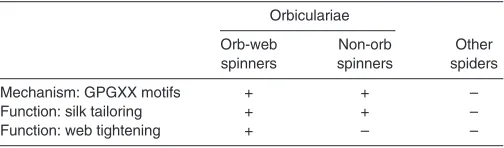
[image:2.612.315.567.673.747.2]To summarize, if supercontraction is caused by GPGXX motifs, then all spiders producing silk rich in MaSp2 should spin major ampullate silk that supercontracts more, so that all Orbiculariae should exhibit higher supercontraction than all other taxa. The same pattern is predicted if supercontraction evolved under selection for tailoring silk properties. By contrast, if supercontraction functions to tighten wet orb-webs, then orb-weaving species within the Orbiculariae should spin silk that supercontracts more than non-orb-weaving species, whether these are Orbiculariae or not (Table1). Under this hypothesis, we predict that non-orb-weaving Orbiculariae lost supercontraction as they switched to three-dimensional webs because supercontraction did not yield any advantage for web protection from water drops in these species, thereby relaxing selection for it.
Table 1. Predicted levels of supercontraction for different spider taxa as a function of the proposed hypotheses on supercontraction
mechanisms and function
Orbiculariae
Orb-web Non-orb Other
spinners spinners spiders
Mechanism: GPGXX motifs + + –
Function: silk tailoring + + –
However, it is also possible that supercontraction was somewhat maintained as it is associated with a desirable property of silk. We tested these hypotheses by investigating supercontraction in 28 species from 21 families of the order Araneae.
Finally, we examined two different aspects of supercontraction across spiders. Unrestrained fibers shrink as they contract whereas restrained fibers instead develop tension. These two aspects of supercontraction may have evolved under different selective forces. By measuring supercontraction in many diverse taxa, this study can begin to separate the different evolutionary pressures that shaped both aspects of supercontraction.
MATERIALS AND METHODS Spider maintenance and silk collection
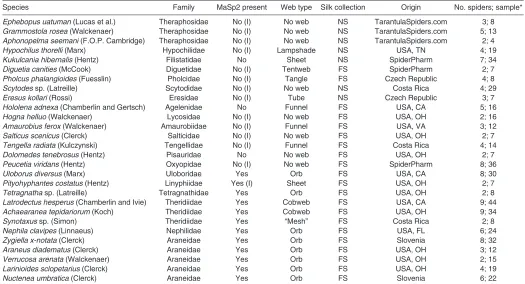
Most spiders were wild caught but some were purchased from either SpiderPharm (Yarnell, AZ, USA) or TarantulaSpiders.com (FL, USA). Spiders were housed in a variety of cages, depending upon their web spinning behaviors, and maintained in the laboratory at 24°C under a 15h:9h light:dark cycle. Spiders were silked within a week after entering the laboratory. Table2 presents the taxa used in this study, as well as their origin, silk collection method and numbers of individuals and thread samples used.
Silk was mainly collected using forcible silking. The spider was anesthetized with carbon dioxide and taped down, ventral side facing up, on a Petri dish. Major ampullate silk was manually reeled off the spinnerets at ~10cms–1, and collected on cut-out cards across 15.3mm gaps. The silk was glued on either side of the gap using cyanoacrylate glue (Superglue®) (Blackledge et al., 2005b). During the process, the spinnerets and silk threads were observed under a stereomicroscope, to ensure the silk collected came from the major
ampullate spigot. Three to four samples were collected and tested for each individual spider.
For a few taxa, it was impossible to collect silk by forcible silking. In this case, naturally spun silk was collected. The spider was allowed to run across a fan-shaped piece of cardboard. As it ran, the spider laid a trail of dragline silk across the peaks of the cardboard, which was collected onto cut-out cards. As with forcibly obtained silk, the threads were glued on each side of the 15.3mm gap with cyanoacrylate glue, and three to four samples were collected per spider. Dragline silk is composed of major ampullate silk strands, sometimes accompanied by thinner minor ampullate silk strands. The samples were observed under a microscope, and all samples that contained thin, minor ampullate, strands were discarded. Thus, the samples we used were made of one or two strands of major ampullate silk only.
Naturally spun silk tends to be more compliant and weaker than forcibly-obtained silk, probably because of its decreased molecular orientation (Guinea et al., 2005b; Madsen and Vollrath, 1999; Perez-Rigueiro et al., 2001). However, the silks that were naturally spun did not drastically differ in their supercontraction behavior from the silks that were forcibly-obtained from related species (see below). Therefore, we think that differences in collection methods per se had only minor effects on our results.
[image:3.612.43.568.80.364.2]Tarantulas lack well-differentiated silk glands and therefore do not produce major ampullate silk. However, tarantulas use their silk for functions analogous to major ampullate silk, such as lining burrows. Furthermore, as tarantulas belong to the Mygalomorphae, the sister group to the clade of spiders producing major ampullate silk, their silk is ideal for an outgroup comparison.
Table 2. Taxa used in this study with indications of the spidroins present in the silk and the type of web
Species Family MaSp2 present Web type Silk collection Origin No. spiders; sample*
Ephebopus uatuman (Lucas et al.) Theraphosidae No (I) No web NS TarantulaSpiders.com 3; 8
Grammostola rosea (Walckenaer) Theraphosidae No (I) No web NS TarantulaSpiders.com 5; 13
Aphonopelma seemani (F.O.P. Cambridge) Theraphosidae No (I) No web NS TarantulaSpiders.com 2; 4
Hypochilus thorelli (Marx) Hypochilidae No (I) Lampshade NS USA, TN 4; 19
Kukulcania hibernalis (Hentz) Filistatidae No Sheet NS SpiderPharm 7; 34
Diguetia canities (McCook) Diguetidae No (I) Tentweb FS SpiderPharm 2; 7
Pholcus phalangioides (Fuesslin) Pholcidae No (I) Tangle FS Czech Republic 4; 8
Scytodes sp. (Latreille) Scytodidae No (I) No web NS Costa Rica 4; 29
Eresus kollari (Rossi) Eresidae No (I) Tube NS Czech Republic 3; 7
Hololena adnexa (Chamberlin and Gertsch) Agelenidae No Funnel FS USA, CA 5; 16
Hogna helluo (Walckenaer) Lycosidae No (I) No web FS USA, OH 2; 16
Amaurobius ferox (Walckenaer) Amaurobiidae No (I) Funnel FS USA, VA 3; 12
Salticus scenicus (Clerck) Salticidae No (I) No web FS USA, OH 2; 7
Tengella radiata (Kulczynski) Tengellidae No (I) Funnel FS Costa Rica 4; 14
Dolomedes tenebrosus (Hentz) Pisauridae No No web FS USA, OH 2; 7
Peucetia viridans (Hentz) Oxyopidae No (I) No web FS SpiderPharm 8; 36
Uloborus diversus (Marx) Uloboridae Yes Orb FS USA, CA 8; 30
Pityohyphantes costatus (Hentz) Linyphiidae Yes (I) Sheet FS USA, OH 2; 7
Tetragnatha sp. (Latreille) Tetragnathidae Yes Orb FS USA, OH 2; 8
Latrodectus hesperus (Chamberlin and Ivie) Theridiidae Yes Cobweb FS USA, CA 9; 44
Achaearanea tepidariorum (Koch) Theridiidae Yes Cobweb FS USA, OH 9; 34
Synotaxus sp. (Simon) Theridiidae Yes “Mesh” FS Costa Rica 2; 8
Nephila clavipes (Linnaeus) Nephilidae Yes Orb FS USA, FL 6; 24
Zygiella x-notata (Clerck) Araneidae Yes Orb FS Slovenia 8; 32
Araneus diadematus (Clerck) Araneidae Yes Orb FS USA, OH 3; 12
Verrucosa arenata (Walckenaer) Araneidae Yes Orb FS USA, OH 2; 15
Larinioides sclopetarius (Clerck) Araneidae Yes Orb FS USA, OH 4; 19
Nuctenea umbratica (Clerck) Araneidae Yes Orb FS Slovenia 6; 22
If the presence of MaSp2 had not been investigated in the spider’s family and we inferred presence or absence of MaSp2 from the phylogeny, ‘(I)’ was added in column 3.
FS, forcible silking; NS, naturally spun.
Silk diameter measurements and supercontraction tests Three pictures were taken of each sample using polarized light microscopy at 1000⫻ (Blackledge et al., 2005a). Each strand diameter was measured using ImageJ (http://rsb.info.nih.gov/ij/) and the total cross-sectional area calculated.
Two different aspects of supercontraction were measured: the stress generated in restrained fibers and the degree to which unrestrained silk shrank when exposed to water. Previous studies measured supercontraction as the degree of fiber shrinking (e.g. Work, 1981). However, the stress generated during supercontraction by the fiber is also important, as it will affect the performance of structures made of silk (webs or potentially, man-made silk structures). Supercontraction tests were carried out on a Nano Bionix tensile tester (MTS Corp., Oakridge, TN, USA) equipped with a humidity chamber, as described in Agnarsson et al. (Agnarsson et al., 2009a). The relative humidity inside the chamber could be set to any value between ~1% and ~95%. Silk samples were mounted at room humidity (5–15%) and pulled on at 0.1% strain, until just taut (Savage et al., 2004). Following the terminology adopted by Blackledge et al. (Blackledge et al., 2009a), the tests performed were WS0.1% tests (strained at 0.1% then wetted). Fig.1 is a diagram of the supercontraction test. Humidity was ramped up from ambient humidity to over 75% within 2min. When supercontraction critical humidity was reached, the hydrogen bonds were disrupted, freeing the molecules to move to lower energy states. However, the fiber was unable to shrink because it was held by the grips. Thus, stress instead developed within the fiber. We refer to this as supercontraction stress (SS) and calculated it using engineering stress as:
SSF/A, (1)
where Fis the force generated by the sample and Ais the area of the sample.
The fiber was then relaxed to half its original length (l0) so that it was completely slacked, and immediately pulled at 0.01mms–1 to twice its original length, while the load was recorded. If the fiber had been unrestrained when the humidity was increased, it would have shrunk from l0 to a post-supercontraction length l1. When the slacked fibers were stretched to this post-supercontraction length l1, a stress developed within the fiber. This allowed us to measure l1. Percentage of shrink (PS), which is the proportion by which the fiber shrinks when supercontracting, was then calculated as:
PS (l0– l1) / l0. (2)
For certain silks, fibers were still under tension after relaxing to half their original length. In these cases, the fibers were relaxed further. The samples that still presented a stress before the beginning of the pull were discarded.
Correlation between SS, PS and preload tension Samples with a high preload tension, that is samples with a high tension within the sample prior to supercontraction, exhibited no SS even though they supercontracted, as evidenced by their positive PS. This suggested that preload tension influenced SS. This was a particularly important issue because supercontraction tests were performed at constant 0.1% strain, which could result in variable preload tensions across samples. To test for a correlation between preload tension and supercontraction, 15 silk samples from each of
two L. hesperus individuals were collected. These samples were
mounted at different preload tensions, ranging from 0 to 170MPa. Supercontraction tests were then run as described above, and SS
and PS were recorded. For each individual, SS and PS were regressed
versus preload tension.
Spider phylogeny
Phylogenetic relationships may influence supercontraction of silk. For instance, the level of supercontraction of silk from closely related taxa may be more similar than that of distant taxa simply because of phylogenetic inertia. Independent contrasts (IC) were used to correct for the non-independence of related species (see Statistical analysis). No existing phylogeny includes all of the species in our study, but we estimated species relationships using Coddington’s Araneae phylogeny (Coddington, 2005) with additions from Raven (Raven, 1985) for tarantulas and Blackledge et al. (Blackledge et al., 2009b) for apical relationships within Orbiculariae (Fig.2).
Web ecology and silk proteins
This study tried to relate supercontraction to the spinning of orb webs and the presence of MaSp2 silk proteins. Table1 describes the type of webs spun by each taxon and the presence or absence of MaSp2 in the silk of each taxon. The presence or absence of MaSp2 in silk was inferred from cDNA data from Garb et al. and Gatesy et al. (Garb et al., 2007; Gatesy et al., 2001) for mygalomorphs; Tian et al. (Tian et al., 2004) for Kukulcaniasp.; Gatesy et al., Pouchkina-Stantcheva and McQueen-Mason, Rising et al. and Tian et al. (Gatesy et al., 2001; Pouchkina-Stantcheva and McQueen-Mason, 2004; Rising et al., 2007; Tian et al., 2004) for RTA clade species (Hololena,Amaurobius,Hogna,Dolomedes and
Tengella); Gatesy et al. (Gatesy et al., 2001) for Tetragnathidae;
Hinman and Lewis, Sponner et al. and Xu and Lewis (Hinman and Lewis, 1992; Sponner et al., 2005; Xu and Lewis, 1990) for Nephilidae; Gatesy et al. and Guerette et al. (Gatesy et al., 2001; Guerette et al., 1996) for Araneidae; and Ayoub et al., Ayoub and Hayashi and Gatesy et al. (Ayoub et al., 2007; Ayoub and Hayashi,
Low humidity High humidity (>70%)
Shrink=l0–l1
l0 l
1 Stress
S
tre
ss
Time Supercontraction
2008; Gatesy et al., 2001) for Theridiidae. For RTA clade spiders, Rising et al. (Rising et al., 2007) suggested the presence of a protein somewhat similar to MaSp2, but much poorer in GPGXX motifs. Additionally, Gatesy et al. (Gatesy et al., 2001) did not find any MaSp2-like sequence in RTA clade spiders. Therefore, we considered the taxa from the RTA clade to lack MaSp2. The silk proteins of many of the taxa used here have not yet been characterized. In this case, the phylogeny was used to infer whether their silk likely contained MaSp2. MaSp2 is known in several Orbiculariae, including Nephilidae, Uloboridae and Araneidae, but is not found in the RTA clade. RTA clade spiders and Orbiculariae are all higher Entelegyne sensuCoddington and Levi (Coddington and Levi, 1991). Therefore, we considered all RTA clade spiders and all sister taxa to the higher Entelegyne to be lacking MaSp2, and all taxa derived from the RTA clade to have MaSp2.
Among the taxa that possess MaSp2, the proportion of MaSp2 in the silk may affect silk properties and behavior (Liu et al., 2008b; Savage and Gosline, 2008a). However, data on the percentage of MaSp2 in the silk of various species are generally lacking. Therefore, we only used presence or absence of MaSp2 as a criterion in this study.
Statistical analysis
The average SS and PS per species were used in all the analyses. The analyses compared supercontraction between species with or without MaSp2 in their silk, and between species that spin or do not spin orb webs. A series of standard ANOVAs, with either SS or PS as the dependent variable, and either presence of MaSp2 or type of web (orb-web vsnon-orb-web or no web) as the independent variable, were conducted. When testing the effect of web type, analyses were conducted both with all taxa and only within Orbiculariae species. The non-independence of phylogenetically related taxa was accounted for by following Garland et al.’s independent contrasts method (Garland et al., 1993). Using PDSIMUL and PDANOVA from the PDAP package; Fdistributions were created, taking into account the phylogeny and assuming no relation between SS or PS and presence of MaSp2 or web type. ANOVAs were run using PDSINGLE, with either SS or PS as the dependent variable, and either presence of
MaSp2 or type of web (orb-web vsnon-orb-web or no web) as the independent variable. The Fvalues from the ANOVA were compared with the critical values obtained from the simulated Fdistributions.
Hogna helluowas removed from our data set for SS since stress data
could not be collected for this species.
RESULTS
Correlation between SS, PS and preload tension Supercontraction stress was strongly correlated with preload tension in the silk from both individuals of L. hesperus tested (linear regression: first individual, P0.0206; second individual, P<0.0001), but percentage of shrink was independent of preload tension (linear regression, first individual, P0.2073, second individual, P0.2602; Fig.3). A similar pattern was observed for Nephila clavipes and
Peucetia viridans(data not shown).
Evolution of supercontraction in spiders in relation to protein composition and web type
The silk from nearly all spiders species investigated showed some form of supercontraction (Fig.4). We considered that silk supercontracted when the 95% confidence interval for the mean for both SS and PS did not include zero. For both Ephebopus uatuman
and Aphonopelma seemani(Theraphosidae), the average SS and PS
95% confidence interval included zero. Therefore, we considered that they do not exhibit any supercontraction. For all the other species both SS and PS were greater than zero, therefore there was some level of supercontraction.
Across all species, PS was greater for species with MaSp2 in their silk (standard ANOVA, P<0.0001, N28, IC ANOVA, P0.0118, N27) and also for species that spin orb-webs (standard ANOVA, P<0.0001, N28, IC ANOVA, P0.0014, N27). Within the Orbiculariae though, PS was not different between orb-weaving Aphonopelma seemani
Ephebopus uatuman Grammostola rosea
Hypochilus thorelli
Kukulcania hibernalis
Diguetia canities Scytodes sp. Eresus kollari
Salticus scenicus Hololena adnexa Amaurobius ferox Tengella radiata
Dolomedes tenebrosus Hogna helluo Peucetia viridans
Uloborus diversus Pityohyphantes costatus Tetragnatha sp. Latrodectus hesperus Achaearanea tepidariorum Synotaxus sp.
Nephila clavipes Zygiella x-notata Araneus diadematus Verrucosa arenata Larinioides sclopetarius Nuctenea umbratica Pholcus phalangioides Mygalomorphae
Haplogyne
RTA clade
Orbiculariae
Araneidae Nephilidae
Fig.2. Phylogeny of the taxa used in this study. Major clades are indicated
by different colors. 0
20 40 60 80 100 120 0 2 4 6 8 10 12 14 16
P
ercent
a
ge of
s
hr
ink (P
S
, %)
Preload tension (MPa)
Su
percontr
a
ction
s
tre
ss
(
SS
, MP
a
)
A
B
0 20 40 60 80 100 120 140 160 180
species and derived taxa that do not spin orb-webs (standard ANOVA, P0.0750, N12, IC ANOVA, P0.1991, N11). After accounting for phylogeny, supercontraction stress was independent of the presence of MaSp2 (IC ANOVA, P0.4187, N28) and the type of web spun (IC ANOVA, P0.2020, N28). However, if phylogenetic relations were ignored, supercontraction stress was greater in species whose silk contains MaSp2 (standard ANOVA, P0.0224, N28) and who spin orb-webs (standard ANOVA,
P0.0136, N28). Because SS is strongly correlated with the preload tension in the sample at the beginning of the test, we consider PS to be a more reliable indicator of supercontraction capacity.
DISCUSSION
Evolutionary history of supercontraction in spiders The major ampullate silk of nearly all the species investigated supercontracts to some degree. However, the degree of supercontraction varies greatly. For instance, major ampullate silk from the zebra jumper Salticus scenicusshrank by only 1.2% when wetted whereas silk from the bridge orb-weaver Larinioides
sclopetarius shrank by 53%. Supercontraction stress varied from
3MPa for the ladybird spider Eresus kollari to 145MPa for the green lynx spider Peucetia viridans. Moreover, we found no direct correlation between SS and PS. These two responses can therefore be considered as distinct components of supercontraction.
There is no consensus on what constitutes a threshold response for supercontraction. For instance, Work (Work, 1981) observed that dragline silk from RTA clade species shrank by about 5% when exposed to humidity. Yet, he decided that this was too low and that this silk did not supercontract. By contrast, Shao and Vollrath (Shao and Vollrath, 1999) found that silk from the RTA clade Pisauridae shrank by as much as 15% and considered that their silk did supercontract. We used 95% confidence intervals to identify non-null PS and SS, thus providing an unbiased definition of supercontraction. If we follow this method, silk from only two tarantulas (Mygalomorphae) does not supercontract. This suggests that supercontraction evolved very early in the evolutionary history of spiders. Since supercontraction exists in all Araneomorphae, it must have appeared at least 225 million years ago, with the origin of Araneomorphae (Selden et al., 1999). Supercontraction seems rare in Mygalomorphae, and may have appeared later in certain species. Furthermore, non-orbicularian silk typically shrink by less than 20% whereas orbicularian silk contracts by 30–50%. However, in contrast to PS, there was no obvious difference in SS between non-Orbiculariae and Orbiculariae.
In general, silk from Orbiculariae supercontracted more than silk from non-Orbiculariae. Within Orbiculariae, non-orb-weaving species did not statistically differ from orb-weaving species in term of supercontraction ability. These results support the idea that supercontraction is due to GPGXX motifs and serves a tailoring function.
Selective pressure on supercontraction stress Although both PS and SS originate with basal araneomorph spiders, the evolutionary pathways of these two aspects of supercontraction differ. Although PS increased in Orbiculariae, changes in SS were not associated with either the presence of MaSp2 or the spinning of orb-webs. Supercontraction stress was not correlated with percentage of shrink but depended upon preload tension prior to supercontraction.
In addition, SS correlates with PS within RTA clade spiders (multiple linear regression, PS: P0.0030, N7) but not in Orbiculariae (linear regression, PS: P0.3865, N10; Fig.5). Why is the relation between SS and PS clade specific? RTA clade spiders spin stiffer silk, in general, than Orbiculariae (Swanson et al., 2006). This difference may result from the high proportion of GPGXX motifs in the MaSp2-rich silk of Orbiculariae (Liu et al., 2008b). Regardless, silks that are stiff should produce stronger stresses when restrained than silks that are compliant since, by definition, stiffer silks produce higher stresses for a given strain, or shrink in our case. This explains why the silk of RTA clade
0 10 20 30 40 50 60
P
ercent
a
ge of
s
hr
ink (
P
S
, %)
EuGr AsHt KhPpDcSc EkHaHhAfSsTr DtPv UdPcTeLh AtSyNcZx AdVaLsNu
A
0 20 40 60 80 100 120 140 160 180
EuGr Ht KhPpDcSc EkHaAfSsTr Dt Pv UdPcTeLh AtSyNcZx AdVaLsNu
Su
percontr
a
ction
s
tre
ss
(
SS
, MP
a
)
As
B
spiders produce strong SS even though they do not contract much. By contrast, orbicularian silk produce fairly low SS despite considerable shrink, such that no correlation between SS and PS was found.
It is worth noting that silks from Nephilaand Latrodectus, which have a low proportion of MaSp2 (Liu et al., 2008b), behave similarly to those of RTA clade spiders, with high SS for relatively low PS. If SS depends in part on silk stiffness, which itself may come from silk molecular orientation, selection may not have been able to act on SS as much as it has acted on PS. However, it is also possible that PS has been under stronger selection than SS because it is more important. For instance, if the function of supercontraction is to modulate silk properties, what really matters are wet silk properties, such as extensibility, which correlate with PS (multiple linear regression, extensibility: P<0.0001, N23) but not with SS (multiple linear regression, extensibility: P0.5265, N23).
Molecular mechanism of supercontraction
The presence of MaSp2, rich in GPGXX motifs, is associated with an increased capacity of major ampullate silk to supercontract. This is congruent with Eles and Michal’s model for supercontraction (Eles and Michal, 2004), which states that, as relative humidity increases, water disrupts the hydrogen bonds that hold the GPGXX motifs and 310helices within the silk parallel. The GPGXX motifs and helices then rearrange to a lower energetic state and the fiber loses its orientation. According to this hypothesis, silk containing GPGXX motifs should supercontract more.
Liu et al. (Liu et al., 2005; Liu et al., 2008a) found that, at the intraspecific level, silk that shrinks more when exposed to water is also stronger, stiffer, less extensible and better able to recover after being stretched, all characteristics generally associated to a more oriented fiber. This also supports Eles and Michal’s model, in which the loss of orientation of GPGXX motifs causes supercontraction. However, at the interspecific level, there is, if anything, a negative correlation between strength or stiffness of the silk and supercontraction, although silk that supercontracts more still recovers better after stretching. For instance, the silk of RTA clade spiders exhibit lower supercontraction than that of Araneidae, and it is also stiffer (Swanson et al., 2006). This is because interspecific variation in supercontraction is driven primarily by the amount of GPGXX motifs in silk whereas intraspecific variations probably result from differences in the orientation of relatively similar proportions of GPGXX chains.
Since GPGXX motifs are also thought to be involved in silk compliance and extensibility, fewer GPGXX motifs result in stiffer and less extensible silk, in addition to silk that contracts less (Fig.6).
It is worth noting that all the spiders tested spun major ampullate silk that supercontracted, except for some tarantulas. Although thorough research on the molecular structure of non-orbicularian silk is lacking, the little data available suggest that these silks completely lack GPGXX motifs. Thus, although our study suggests a clear association between the presence of GPGXX motifs and enhanced supercontraction, it is clearly possible for silk with few or no GPGXX motifs to still supercontract. In this case, other molecular structures, such as 310helices (Kümmerlen et al., 1996) formed by glycine–glycine–X motifs that are present in MaSp1 proteins, may be involved in supercontraction (Blackledge et al., 2009a). These structures may represent the molecular basis upon which natural selection operated during the evolutionary increase in the supercontraction capacity of orb-weaving spider silk.
Selective pressure on supercontraction shrink: function of supercontraction
Supercontraction is hypothesized to tense the orb web thereby preventing it from sagging under the weight of dew drops (Guinea et al., 2003; Lewis, 1992; Work, 1981). When Orbiculariae species that spun orb-webs were compared to all taxa, including some derived Orbiculariae that did not spin orb-webs, orb-weaving species spun silk that supercontracted more, consistent with the ‘tightening’ hypothesis. Silk from non-orb-weaving Orbiculariae species exhibit reduced supercontraction compared with that of orb-weaving Orbiculariae species, but higher supercontraction than that of non-Orbiculariae species (Table3). Non-Orbiculariae species do not spin webs (e.g. P. viridans, Scytodes sp.), spin ‘loose’ webs (e.g. P. phalangioides), or spin webs attached to the substrate (e.g.
K. hibernalis, H. adnexa). Therefore, the web tightening function
0 20 40 60 80 100 120 140
0 10 20 30 40 50 60
Percentage of shrink (PS, %)
Su
percontr
a
ction
s
tre
ss
(
SS
, MP
a
)
Fig.5. The relationship between supercontraction stress and percentage of shrink for RTA clade spiders (blue diamonds) and Orbiculariae (red diamonds).
Percentage of shrink
Elastic recovery Extensibility and compliance Protein sequence
(less crystalline regions) Interspecific
Spinning effects (higher molecular
orientation) Intraspecific
+
–
+
+
+ +
Supercontraction stress +
–
+
of supercontraction may not be needed in these species. Supercontraction may have been selected for in Orbiculariae as they started spinning planar orb-webs, which explains why non-orbicularian silk supercontracts less than non-orbicularian silk. When some Orbiculariae switched from orb-webs to three-dimensional webs, the supercontraction capacity of the silk decreased, but partially remained as an ancestral character.
Recently, Guinea et al. (Guinea et al., 2005a) proposed that supercontraction facilitates tailoring of silk properties during fiber spinning. Within the spider’s spinning duct, silk is initially in a supercontracted state and is thus as compliant as possible. Stretching of the silk thread during spinning controls molecular orientation and hence, the material properties of the fiber. Such fine control may not be needed by non-orbicularian species. In effect, the capture webs of these species, if spun at all, are poorly differentiated and lack distinct web elements. In the case of tarantulas, webs are not even composed of distinct threads, whereas non-orbicularian araneomorph species use discrete threads within their webs (Blackledge et al., 2009b). By contrast, orbicularian webs are composed of diverse elements, each spun from major ampullate silk, which meet different mechanical challenges. For instance, orb-webs contain radii that absorb energy during prey capture, frame threads that support the orb and mooring guys that attach the web to the substrate. Cobwebs contain supporting threads that maintain web architecture and hold sticky gumfooted threads that are used for prey capture. The silk from these different elements may have varied material properties (Boutry and Blackledge, 2009). This could lead to selection for increased plasticity of major ampullate silk properties in Orbiculariae, in contrast to other taxa. If supercontraction serves a tailoring function, then we could expect supercontraction to be higher in Orbiculariae than in non-Orbiculariae araneomorphs, and to be even lower in mygalomorphs than in any araneomorphs. This is exactly what is seen in our data set.
If supercontraction allows spiders to better modulate silk properties (i.e. the tailoring hypothesis), then species characterized by high supercontraction should exhibit greater intra-individual variability in material properties of major ampullate silk. Therefore, the tailoring hypothesis can be tested in the future by comparing silk plasticity in species with high and low supercontraction, although one should account for confounding factors such as silk biochemical composition. Guinea et al.’s (Guinea et al., 2005a) tailoring hypothesis and Work’s (Work, 1981) web tightening hypothesis are not mutually exclusive. Supercontraction may have
been selected for in Orbiculariae both because of its web tightening and its silk tailoring functions.
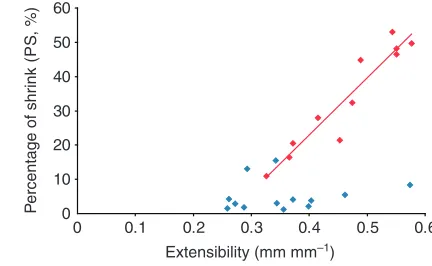
Within the Orbiculariae, high PS is not confined solely to taxa that spin orb-webs, even though non-orb-weaving Orbiculariae exhibit slightly reduced supercontraction. Yet, non-orb-weaving Orbiculariae do not need their webs to remain tight under humid condition (web tightening function of supercontraction). Supercontraction may remain in non-orb-weaving species because it serves a tailoring function, which is needed to spin different elements within cobwebs, for instance. Still, because web tightening is not needed in these species, selection for high supercontraction may be lower. Supercontraction may also be associated to a desirable property. The same GPGXX motifs that allow supercontraction through their rearrangement, according to Eles and Michal’s model (Eles and Michal, 2004), are thought to enhance silk extensibility (Gosline et al., 1986; Hayashi et al., 1999; Termonia, 1994). Thus, since supercontraction and extensibility are probably affected by the same molecular structure (GPGXX motifs), supercontraction may have been preserved in non-orb-weaving Orbiculariae as a byproduct of selection on silk extensibility. In fact, within the Orbiculariae, there is a positive relation between supercontraction PS and extensibility (linear regression, P<0.0001, N11; Fig.7). It is possible that the appearance of complex, planar orb-webs in the Orbiculariae created the selective pressures for initial increase in supercontraction, and the origin of MaSp2 and GPGXX motifs in silk is the mechanism that allowed this higher supercontraction. In other words, MaSp2 may have been selected for in the Orbiculariae because MaSp2 enhances supercontraction, which itself allows better tailoring of silk properties for complex web building and tightening of orb-webs.
CONCLUSION
[image:8.612.56.272.70.203.2]Supercontraction is widespread among spiders and evolved early in their evolutionary history, probably with the origin of araneomorph spiders, 225 million years ago. However, the degree to which silk supercontracts varies strongly among species. Supercontraction includes two aspects: shrink of unrestrained fibers (PS) and development of stress within restrained fibers (SS). These two different responses to water evolved independently. Variation in SS is randomly distributed with respect to spider phylogeny, unlike shrink (PS), which is higher in the Orbiculariae. The measurement of supercontraction stress depends upon preload tension. Increased supercontraction in Orbiculariae agrees with Eles and Michal’s model (Eles and Michal, 2004), which states that GPGXX motifs play an essential role in supercontraction. However, the presence of supercontraction in non-orbicularian species, which lack GPGXX motifs, suggests that other molecular structures,
Table 3. Average supercontraction stress and percentage of shrink for comparison within the various phylogenetic and behavioral
groups
SS (MPa) PS (%)
Non-Orbiculariae 38±9 4.8±1.1
Orbiculariae 66±10 32.2±5.5
Orb-web spinners 75±11 40.0±6.0
Non-orb spinners 51±23 18.5±8.0
All non-orb spinning species 41±8 7.5±2.0
(Orbiculariae + other taxa)
SS, supercontraction stress; PS, percentage of shrink. Values are means ± s.e.m.
P
ercent
a
ge of
s
hr
ink (
P
S
, %)
Extensibility (mm mm–1) 0
10 20 30 40 50 60
0 0.1 0.2 0.3 0.4 0.5 0.6
[image:8.612.314.568.99.181.2]such as glycine–glycine–X 310 helices, are also involved in supercontraction.
Our results are congruent with Guinea et al.’s (Guinea et al., 2005a) functional hypothesis that supercontraction helps spiders tailor silk properties during fiber spinning, although we cannot discard Work’s web tightening functional hypothesis (Work, 1981). Finally, supercontraction shrink may also have been selected for because of its association with desirable material properties such as extensibility.
ACKNOWLEDGEMENTS
We would like to thank the following people for providing spiders or giving advice on species to use: T. C. Jones, D. Ubick, C. Hayashi, J. Coddington, M. Kuntner, L. Rayor, J. Bond, A. Sensenig, M. Rezác. Chad Rooks and Ingi Agnarsson helped with silk collection. Two anonymous reviewers provided helpful comments. This research was funded by National Science Foundation awards DEB-0516038, DBI-0521261 and IOS-0745379 to T.A.B. and a University of Akron Integrated Bioscience award to C.B. This is publication no. 26 of the Bath Nature Preserve.
LIST OF SYMBOLS
IC independent contrasts MaSp major ampullate spidroin PS percentage of shrink RTA retrolateral tibial apophysis SS supercontraction stress
REFERENCES
Agnarsson, I., Boutry, C., Wong, S. C., Baji, A., Dhinojwala, A., Sensenig, A. T. and Blackledge, T. A.(2009a). Supercontraction forces in spider dragline silk depend on hydration rate. Zoology112, 325-331.
Agnarsson, I., Dhinojwala, A., Sahni, V. and Blackledge, T. A.(2009b). Spider silk as a novel high performance biomimetic muscle driven by humidity. J. Exp. Biol. 212, 1989-1993.
Allmeling, C., Jokuszies, A., Reimers, K., Kall, S. and Vogt, P. M.(2006). Use of spider silk fibres as an innovative material in a biocompatible artificial nerve conduit. J. Cell. Mol. Med.10, 770-777.
Ayoub, N. A. and Hayashi, C. Y.(2008). Multiple recombining loci encode MaSp1, the primary constituent of dragline silk, in widow spiders (Latrodectus: Theridiidae). Mol. Biol. Evol.25, 277-286.
Ayoub, N. A., Garb, J. E., Tinghitella, R. M., Collin, M. A. and Hayashi, C. Y. (2007). Blueprint for a high-performance biomaterial: full-length spider dragline silk genes. PLoS ONE2, 154-166.
Becker, N., Oroudjev, E., Mutz, S., Cleveland, J. P., Hansma, P. K., Hayashi, C. Y., Makarov, D. E. and Hansma, H. G.(2003). Molecular nanosprings in spider capture-silk threads. Nat. Mater.2, 278-283.
Blackledge, T. A., Cardullo, R. A. and Hayashi, C. Y.(2005a). Polarized light microscopy, variability in spider silk diameters, and the mechanical characterization of spider silk. Invertebr. Biol.124, 165-173.
Blackledge, T. A., Summers, A. P. and Hayashi, C. Y.(2005b). Gumfooted lines in black widow cobwebs and the mechanical properties of spider capture silk. Zoology 108, 41-46.
Blackledge, T. A., Boutry, C., Wong, S. C., Baji, A., Dhinojwala, A., Sahni, V. and Agnarsson, I.(2009a). How super is supercontraction? Persistent versus cyclic responses to humidity in spider dragline silk. J. Exp. Biol.212, 1980-1988. Blackledge, T. A., Scharff, N., Coddington, J. A., Szuts, T., Wenzel, J. W.,
Hayashi, C. Y. and Agnarsson, I.(2009b). Reconstructing web evolution and spider diversification in the molecular era. Proc. Natl. Acad. Sci. USA106, 5229-5234.
Boutry, C. and Blackledge, T. A.(2009). Biomechanical variation of silk links spinning plasticity to spider web function. Zoology112, 451-460.
Bram, A., Branden, C. I., Craig, C., Snigireva, I. and Riekel, C.(1997). X-ray diffraction from single fibres of spider silk. J. Appl. Crystallogr.30, 390-392. Coddington, J. A.(2005). Phylogeny and classification of spiders. In Spiders of North
America: an Identification Manual (ed. D. Ubick, P. E. Cushing and P. Paquin), pp. 18-24. American Arachnology Society.
Coddington, J. A. and Levi, H. W.(1991). Systematics and evolution of spiders (Araneae). Annu. Rev. Ecol. Syst.22, 565-592.
Eberhard, W. G., Agnarsson, I. and Levi, H. W.(2008). Web forms and the phylogeny of theridiid spiders (Araneae: Theridiidae): chaos from order. System. Biodivers.6, 1-61.
Eles, P. T. and Michal, C. A.(2004). Strain dependent local phase transitions observed during controlled supercontraction reveal mechanisms in spider silk. Macromolecules37, 1342-1345.
Garb, J. E., DiMauro, T., Lewis, R. V. and Hayashi, C. Y.(2007). Expansion and intragenic homogenization of spider silk genes since the Triassic: evidence from Mygalomorphae (tarantulas and their kin) spidroins. Mol. Biol. Evol.24, 2454. Garland, T., Jr, Dickerman, A. W., Janis, C. M. and Jones, J. A.(1993).
Phylogenetic analysis of covariance by computer simulation. System. Biol.42, 265-292.
Gatesy, J., Hayashi, C., Motriuk, D., Woods, J. and Lewis, R.(2001). Extreme diversity, conservation, and convergence of spider silk fibroin sequences. Science 291, 2603-2605.
Gellynck, K., Verdonk, P., Almqvist, F., Van Nimmen, E., De Bakker, D., Van Langenhove, L., Mertens, J., Verbruggen, G. and Kiekens, P.(2006). A spider silk supportive matrix used for cartilage regeneration. In Medical Textiles and Biomaterials for Healthcare (ed. S. C. Anand, J. F. Kennedy, M. Miraftab and S. Rajendran), pp. 350-354. Cambridge: Woodhead Publishing Limited. Gosline, J. M., Demont, M. E. and Denny, M. W.(1986). The structure and
properties of spider silk. Endeavour10, 37-43.
Grubb, D. T. and Ji, G.(1999). Molecular chain orientation in supercontracted and re-extended spider silk. Int. J. Biol. Macromol.24, 203-210.
Guerette, P. A., Ginzinger, G. D., Weber, B. H. F. and Gosline, J. M.(1996). Silk properties determined by gland-specific expression of a spider fibroin gene family. Science272, 112-115.
Guinea, G. V., Elices, M., Perez-Rigueiro, J. and Plaza, G.(2003). Self-tightening of spider silk fibers induced by moisture. Polymer44, 5785-5788.
Guinea, G. V., Elices, M., Pérez-Rigueiro, J. and Plaza, G. R.(2005a). Stretching of supercontracted fibers: a link between spinning and the variability of spider silk. J. Exp. Biol.208, 25-30.
Guinea, G. V., Elices, M., Real, J. I., Gutierrez, S. and Perez-Rigueiro, J.(2005b). Reproducibility of the tensile properties of spider (Argiope trifasciata) silk obtained by forced silking. J. Exp. Zool. A Comp. Exp. Biol.303A, 37-44.
Hayashi, C. Y. and Lewis, R. V.(1998). Evidence from flagelliform silk cDNA for the structural basis of elasticity and modular nature of spider silks. J. Mol. Biol.275, 773-784.
Hayashi, C. Y., Shipley, N. H. and Lewis, R. V.(1999). Hypotheses that correlate the sequence, structure, and mechanical properties of spider silk proteins. Int. J. Biol. Macromol.24, 271-275.
Hinman, M. B. and Lewis, R. V.(1992). Isolation of a clone encoding a second dragline silk fibroin. J. Biol. Chem.267, 19320-19324.
Hinman, M. B., Jones, J. A. and Lewis, R. V.(2000). Synthetic spider silk: a modular fiber. Trends Biotechnol.18, 374-379.
Jelinski, L. W., Blye, A., Liivak, O., Michal, C., LaVerde, G., Seidel, A., Shah, N. and Yang, Z.(1999). Orientation, structure, wet-spinning, and molecular basis for supercontraction of spider dragline silk. Int. J. Biol. Macromol.24, 197-201. Kluge, J. A., Rabotyagova, U., Leisk, G. G. and Kaplan, D. L.(2008). Spider silks
and their applications. Trends Biotechnol.26, 244-251.
Kümmerlen, J., van Beek, J. D., Vollrath, F. and Meier, B. H.(1996). Local structure in spider dragline silk investigated by two-dimensional spin-diffusion nuclear magnetic resonance. Macromolecules29, 2920-2928.
Lammel, A., Schwab, M., Slotta, U., Winter, G. and Scheibel, T.(2008). Processing conditions for the formation of spider silk microspheres. Chemsuschem1, 413-416. Lewis, R. V.(1992). Spider silk: The unraveling of a mystery. Acc. Chem. Res.25,
392-398.
Liu, Y., Shao, Z. Z. and Vollrath, F.(2005). Relationships between supercontraction and mechanical properties of spider silk. Nat. Mater.4, 901-905.
Liu, Y., Shao, Z. Z. and Vollrath, F.(2008a). Elasticity of spider silks. Biomacromolecules9, 1782-1786.
Liu, Y., Sponner, A., Porter, D. and Vollrath, F.(2008b). Proline and processing of spider silks. Biomacromolecules9, 116-121.
Madsen, B. and Vollrath, F.(1999). Mechanics and morphology of silk drawn from anesthetized spiders. Naturwissenschaften87, 148-153.
Ohgo, K., Kawase, T., Ashida, J. and Asakura, T.(2006). Solid-state NMR analysis of a peptide (Gly-Pro-Gly-Gly-Ala)6-Gly derived from a flagelliform silk sequence of Nephila clavipes. Biomacromolecules7, 1210-1214.
Palmer, J. M.(1985). The silk and silk production system of the funnel-web mygalomorph spider Euagrus (Araneae, Dipluridae). J. Morphol.186, 195-207. Palmer, J. M., Coyle, F. A. and Harrison, F. W.(1982). Structure and cytochemistry
of the silk glands of the mygalomorph spider Antrodiaetus unicolor (Araneae, Antrodiaetidae). J. Morphol.174, 269-274.
Parkhe, A. D., Seeley, S. K., Gardner, K., Thompson, L. and Lewis, R. V.(1997). Structural studies of spider silk proteins in the fiber. J. Mol. Recogn.10, 1-6. Perez-Rigueiro, J., Elices, M., Llorca, J. and Viney, C.(2001). Tensile properties of
Argiope trifasciata drag line silk obtained from the spider’s web. J. Appl. Polymer Sci.82, 2245-2251.
Pouchkina-Stantcheva, N. N. and McQueen-Mason, S. J.(2004). Molecular studies of a novel dragline silk from a nursery web spider, Euprosthenops sp. (Pisauridae). Comp. Biochem. Physiol. B Biochem. Mol. Biol.138, 371-376.
Raven, R. J.(1985). The spider infraorder Mygalomorphae (Araneae) – Cladistics and systematics. Bull. Am. Mus. Nat. Hist.182, 1-175.
Rising, A., Johansson, J., Larson, G., Bongcam-Rudloff, E., Engstrom, W. and Hjalm, G.(2007). Major ampullate spidroins from Euprosthenops australis: Multiplicity at protein, mRNA and gene levels. Insect Mol. Biol.16, 551-561. Savage, K. N. and Gosline, J. M.(2008a). The effect of proline on the network
structure of major ampullate silks as inferred from their mechanical and optical properties. J. Exp. Biol.211, 1937-1947.
Savage, K. N. and Gosline, J. M.(2008b). The role of proline in the elastic mechanism of hydrated spider silks. J. Exp. Biol.211, 1948-1957.
Savage, K. N., Guerette, P. A. and Gosline, J. M.(2004). Supercontraction stress in spider webs. Biomacromolecules5, 675-679.
Selden, P. A., Anderson, J. M., Anderson, H. M. and Fraser, N. C.(1999). Fossil araneomorph spiders from the Triassic of South Africa and Virginia. J. Arachnol.27, 401-414.
Shao, Z. Z. and Vollrath, F.(1999). The effect of solvents on the contraction and mechanical properties of spider silk. Polymer40, 1799-1806.
Sponner, A., Schlott, B., Vollrath, F., Unger, E., Grosse, F. and Weisshart, K. (2005). Characterization of the protein components of Nephila clavipes dragline silk. Biochemistry44, 4727-4736.
Swanson, B. O., Blackledge, T. A., Summers, A. P. and Hayashi, C. Y.(2006). Spider dragline silk: correlated and mosaic evolution in high-performance biological materials. Evolution60, 2539-2551.
Termonia, Y.(1994). Molecular modeling of spider silk elasticity. Macromolecules27, 7378-7381.
Tian, M., Liu, C. and Lewis, R.(2004). Analysis of major ampullate silk cDNAs from two non-orb-weaving spiders. Biomacromolecules5, 657-660.
van Beek, J. D., Hess, S., Vollrath, F. and Meier, B. H.(2002). The molecular structure of spider dragline silk: folding and orientation of the protein backbone. Proc. Natl. Acad. Sci. USA99, 10266-10271.
Vendrely, C. and Scheibel, T.(2007). Biotechnological production of spider-silk proteins enables new applications. Macromol. Biosci.7, 401-409.
Vollrath, F. and Porter, D.(2009). Silks as ancient models for modern polymers. Polymer50, 5623-5632.
Work, R. W.(1977). Dimensions, birefringences, and force-elongation behavior of major and minor ampullate silk fibers from orb-web-spinning spiders. The effects of wetting on these properties. Text. Res. J.47, 650-662.
Work, R. W.(1981). A comparative study of the supercontraction of major ampullate silk fibers of orb-web-building spiders (Araneae). J. Arachnol.9, 299-308. Xu, M. and Lewis, R. V.(1990). Structure of a protein superfiber: spider dragline silk.
Proc. Natl. Acad. Sci. USA87, 7120-7124.