
Face Recognition Techniques: A Survey
Ms. Jayashree S. Somani1, Prof. Vaishali L. Kolhe2 1, 2
Computer Engineering Department, Savitribai Phule Pune University, Pune
Abstract:In recent time, people use the face recognition techniques in di erent areas like person identification, authentication,
gender classification, person counting and so on. The motif of face recognition method is to point out that who is that person from the person’s image or video. Identification of any person is a rigid task in videos and does not give correct prediction result. To identify that the person is a male or female is an effortless task for us (human) to recognize but it is very di cult for a
machine or robot to identify. For identification of faces there is no lack of recognition approaches. In this paper we have presented a survey on the approaches such as Local Binary Pattern (LBP), Principle Component Analysis (PCA), Elastic Bunch Graph Matching, Linear Discriminant Analysis (LDA) and Histogram of Oriented Gradient (HOG) which are used for face recognition.
Keywords: Face Recognition, PCA, LBP, Elastic Bunch Graph Matching, LDA, HOG
I. INTRODUCTION
Human is a community based animal. Without society human cannot live. The face of each and every person is different from other. Thus, it provides the identity of the person. Nowadays, the human’s face has becomes a key to security for biometric face recognition technology which has received great attention for a variety of applications in both law enforcement and non-law enforcement.
After comparing with other biometric techniques like finger print and iris, face recognition is the best biometric technique. Because in finger print and iris recognition, the persons have to give the input one by one to the recognition system. So, these methods needs more time. In face recognition approach, the faces of more than one person can be captured by the camera simultaneously and can recognize them in less time as compared to other biometric techniques. Also, face recognition is advantageous because of its non-contact process. In this, a camera which is installed at a particular distance captures the images of the person. In this way the person can be recognized. So, this type of recognition approach does not require any contact with the person.
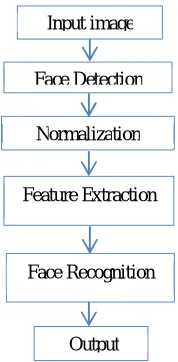
Following are the main steps of Face Recognition System (FRS):
A. Face Detection
B. Normalization
C. Feature extraction
D. Face Recognition
Face Detection
Normalization
Feature Extraction
Face Recognition Input image
[image:1.612.245.334.520.701.2]The figure 1 indicates a logical sequence of face recognition system. Each of these steps poses very significant challenges to the successful operation of a FRS. These steps depend on each other.
A. Face Detection
Face detection means to identify that is there any face in the video/image. Humans can easily point out the face from the image/video. But, for machines it is not facile job to point out the face. The system has to classify the pixels in the image under two headings i.e. face and non-face. In the passport photo, if the background is clear then it is easy to detect, but if the background is filled with untidy collection of objects then it is very difficult to detect. Traditionally, methods that focus on facial landmarks were used to detect faces. Nowadays, we can use Haar Cascade classifier to detect the face from the image.
B. Normalization
After pointing out the face from the image, then the stage comes where the face is converted into the standard format. So, to convert the face into standard format is known as normalization. Normalization means to standardize the face in terms of size, pose, illumination, etc. relative to the image in gallery of referenced dataset.
C. Feature Extraction
After normalization, the facial features are extracted. Feature extraction means mathematical representation of features called bio-metric template or bio-bio-metric reference, which is stored in database. These extracted features are then used at the time of face recognition. There are many different techniques for feature extraction.
D. Face Recognition
After extracting the features, these features are then matched with the extracted features of the tested image. If they matched, then the face is recognized otherwise not recognized.
II. LITERATURESURVEY
Face recognition technology has received significant attention in the past several years due to its potential for a wide variety of applications. Face recognition technique is used in different areas like person identification, authentication, gender classification, person counting, etc. Most of the existing face recognition systems differ in the technique used for feature extraction. This section gives the literature review of the various feature extraction techniques used for face recognition.
Xiang et al.[1] proposed Face Recognition Based on HOG and Fast PCA Algorithm. In this paper, a new method was proposed to solve the problem of low accuracy of face recognition under non - restrictive conditions. Firstly, the Haar feature classier is used to extract the background interference data in the original data preprocessing stage. Then, the feature data of the face is extracted by the method of HOG feature extraction. Then the PCA dimension reduction is processed and the SVM algorithm is used to recognize the face. In this paper, the traditional PCA algorithm is improved by using fast-PCA method to solve the eigenvalues and eigenvectors of the sample matrix.
Jiwen et al.[2] proposed Learning Compact Binary Face Descriptor for Face Recognition. In this he proposed a compact binary face descriptor feature learning method for face recognition. In this, firstly, PDVs of the local patches are calculated. Then it learns a feature mapping to project these PDVs into low-dimensional binary vectors. Then these binary codes are clustered for histogram representation. Also, a Coupled Compact Binary Face Descriptor was proposed for heterogeneous face recognition.
Zen et al.[3] proposed Learning Discriminant Face Descriptor. He proposed a method to learn discriminant face descriptor which learns the most discriminant local features that minimize the difference of the features between images of the same person and maximize that between images from different people.
P. Beham et al.[4] presented a survey on A Review on Face Recognition Method. In this survey paper he categorized the different severe conditions of face recognition into meaningful approaches, viz. appearance based, feature based and soft computing based. And a comparative study of merits and demerits of these approaches were presented.
Huang et al.[5] presented a survey on Local Binary Patterns and Its Application to Facial Image Analysis: A Survey. This paper presents a survey on LBP and its variations. The different variations of LBP allows it to enhance its discriminative ability, to improve its robustness on noisy images, changes the scale of LBP to provide other categories of local information, etc.
Timo et al.[7] proposed Face Description with Local Binary Patterns: Application to Face Recognition. This paper describes the detailed working of LBP algorithm for face recognition. The facial image is divided into local regions and texture descriptors are extracted from each region independently. The descriptors are then concatenated to form a global description of the face.
Tathe et al.[8] proposed Face Detection and Recognition in Videos. In this system face was detected by Haar features and was recognized by using Eigen and Gabor filter in videos.
III. FACERECOGNITIONTECHNIQUES
A. HOG (Histogram of Oriented Gradient ) Feature Extraction[1]
For object detection, Histogram of Oriented Gradients is used. The intensity of the gradients and the edge directions describes the appearance of the local object and the shape within an image. For improved accuracy, the local histograms can be contrast-normalized by calculating a measure of the intensity distribution of the gradients across a major region of the image, called a block, and then using this value to normalize all cells within the block. This results of normalization in better invariance to changes in illumination and shadowing. The computational complexity of the HOG feature is much less than that of the original data. The processing steps are as follows:
1) A 64 * 128 pixel window is divided by 8 * 8 pixel cell, forming 8 * 16 = 128 cells, as shown in Fig. 2. The gradient components of each pixel (x, y) in horizontal and vertical directions are calculated by below formula.
Gx(x, y) = I(x+ 1, y) - I(x – 1, y) ………..(1) Gy(x, y) = I(x, y +1) - I(x, y - 1) ………..….(2)
and the gradient magnitude and gradient direction of each pixel point are calculated by formula (3) and formula (4). (Gx(x,y))2 +(Gy(x,y))2 ………..………… (3)
θ(x, y) = arc tan ( , )
( , ) ………...(4)
2) A block of 16 * 16 pixels is composed of 2 * 2 = 4 cells, and 7 * 15 = 105 blocks are composed. The block step size of 8 pixels, the number of blocks in the horizontal direction is (64−16)/8 + 1 = 7, and the number of blocks in the vertical direction is (128−16)/8 + 1 = 15.
[image:3.612.203.409.436.565.2]3) Take a histogram of 9 gradient directions for each cell. Such a block has 4 * 9 = 36 feature vectors, and then 105 blocks of feature vectors are connected in series to form an image of 36 * 105 = 3780 HOG features.
Fig. 2: Window division process in HOG Descriptor [1]
B. PCA(Principle Component Analysis) Dimensionality Reduction[6]
C. LDA(Linear Discriminant Analysis)[3]
[image:4.612.194.448.226.344.2]Linear Discriminant Analysis identifies faces of unknown individuals on the basis of the training set of the known individuals. The technique finds the vectors that maximize the difference between the different individuals and minimize the difference between the images of the same person. If this can be achieved then the algorithm can recognize the individuals in some varying conditions like minor variation in expression, rotation, illumination, etc. The figure 3 shows large difference between the individuals and minimum difference between the different poses of the same individual. To recognize the individuals correctly, the algorithm must have an appropriate training set. The database must contain plenty of examples of face images for each individual in the training set and at least one example in the test set. These examples should represent different frontal views with different expressions, different lighting and background conditions along with different poses with and without glasses of the same individual. An increase in the number of varying samples of the same person will allow the algorithm to optimize the variance between classes and therefore become more accurate. But, this may be a serious limitation in some contexts (also known as the small sample size problem).
Fig. 3: Example of variation between and within classes [3]
D. Elastic Bunch Graph Matching (EBGM)[6]
The real face images have many nonlinear characteristics that are not addressed by the linear analysis methods such as PCA and LDA—such as variations in illumination, pose, and expression. So, to address these nonlinear characteristics of the face images, we have Elastic Bunch Graph Matching (EBGM) method. It places small blocks of numbers (called “Gabor filters”) over small areas of the image, multiplying and adding the blocks with the pixel values to produce numbers (referred to as “jets”) at various locations on the image. These locations can then be adjusted to accommodate minor variations. The success of Gabor filters is that they remove most of the variability in images due to variation in lighting and contrast. At the same time they are robust against small shifts and deformations. The Gabor filter representation increases the dimensions of the feature space (especially in places around key landmarks on the face such as the eyes, nose, and mouth) such that salient features can effectively be discriminated.
Fig. 4: The object-adaptive grids for difference poses. Now the vertices are positioned automatically by elastic bunch graph matching and are located at special facial landscapes. One can see that, in general, the matching finds the fiducial points quite
accurately, but still with some miss-positioning[6].
E. LBP Based Face Descriptor
[image:4.612.122.519.496.582.2]Fig. 5: Basic LBP operator [7]
IV. CONCLUSIONS
Face recognition technique has been used in many areas like person counting, gender classification, authentication, person identification, etc. The steps of face Recognition i.e. face detection, normalization, feature extraction and recognition were studied. Most of the existing approaches of face recognition vary in the techniques used for feature extraction. Also the various methods which are used for feature extraction in face recognition such as LBP, PCA, Elastic Bunch Graph Matching, LDA and HOG were studied.
REFERENCES
[1] Xiang-Yu Li and Zhen-Xian Lin “Face Recognition Based on HOG and Fast PCA Algorithm”, Springer, Proceedings of the Fourth Euro-China Conference on Intelligent Data Analysis and Applications, Advances in Intelligent Systems and Computing 682, Sep. 2017.
[2] Jiwen Lu, Venice Erin Liong, Xiuzhuang Zhou, Jie Zhou “Learning Compact Binary Face Descriptor for Face Recognition”, IEEE Transactions on Pattern Analysis and Machine Intelligence, Volume: 37 , Issue: 10, pages 2041-2056, Oct. 2015.
[3] Zhen Lei, Matti Pietika inen, Stan Z. Li. “Learning Discriminant Face Descriptor”, IEEE Transactions on Pattern Analysis and Machine Intelligence, Volume: 36 , Issue: 2, pages 289-302, Feb. 2014.
[4] M. Parisa beham, s. Mohamed mansoor roomi “A review of face recognition methods”, International Journal of Pattern Recognition and Artifcial Intelligence, Vol. 27, No. 4, August 2013.
[5] DiHuang,CaifengShan,MohsenArdebilian,YunhongWang,andLiming Chen “Local Binary Patterns and Its Application to Facial Image Analysis: A Survey”, IEEE Transactions on Systems, Man, and Cybernetics, Part C, Applications and Reviews, pages 765-781, Volume: 41 , Issue: 6 , Nov. 2011.
[6] A report on ”Face Recognition” by Wei-Lun Chao.
[7] Timo Ahonen, Abdenour Hadid, Matti Pietikainen “Face Description with Local Binary Patterns: Application to Face Recognition”, IEEE Transactions on Pattern Analysis and Machine Intelligence, Volume: 28 , Issue: 12, pages 2037-2041, Dec. 2006.
![Fig. 2: Window division process in HOG Descriptor [1]](https://thumb-us.123doks.com/thumbv2/123dok_us/1239249.649778/3.612.203.409.436.565/fig-window-division-process-hog-descriptor.webp)
![Fig. 3: Example of variation between and within classes [3]](https://thumb-us.123doks.com/thumbv2/123dok_us/1239249.649778/4.612.122.519.496.582/fig-example-variation-classes.webp)
![Fig. 5: Basic LBP operator [7]](https://thumb-us.123doks.com/thumbv2/123dok_us/1239249.649778/5.612.96.492.94.199/fig-basic-lbp-operator.webp)