
©IJRASET: All Rights are Reserved
1765
Computer Generated Reality – Opportunities and
Challenges
D. Raja
1, P. Karthikeyan
21PG Scholar, Dept. of MCA, Siddharth Institute of Engineering & Technology, Puttur, A.P. 2Associate Professor, Dept. of MCA, Siddharth Institute OF Engineering & Technology, Puttur, A.P.
Abstract: In today’s world, we tend to are encircled by blends of technologies. We’ve non heritable majorities of those technologies into our everyday lives. More and more, these varied technologies are becoming integrated to produce US with new talents and services.
And most frequently a pc is that the heart of such integration. This is often the case with video game a therefore referred to as technology that truly may be a terribly subtle integration of variety of technologies. Video game may be a technology supported pc that assimilates specialized input and output devices by permitting the user to move with and skill a man-made created surroundings as if they were within the universe.
A video game system is additionally permitting the user to go looking and move with a 3 dimensional virtual or artificial surroundings created by the designer. Within the virtual world, the user will do all things just like routine as throwing a ball or as glorious as flying through house. And every one these items is created to occur solely owing to a hand gesture or a nod.
Augmented Reality is a three dimensional PC based intelligent condition which recreate reality. Computer generated Reality can bring us into a fictional universe which shows up precisely like our very own reality. For planning an augmented experience framework, one need to manages thoughts of spatial connections and PC designs which thus are subsidiary to science, material science, expressions and furthermore human brain science. In these virtual or manufactured conditions, one need to consider different material science laws like gravity, air obstruction, and speed and so on.
Keywords: Virtual Reality, Computer based technology, Virtual Environment, Artificial Environment, Second life, Augmented Reality.
I. INTRODUCTION
Augmented Reality (VR) innovation is ending up increasingly impeccable and immerging with the guide of PC equipment, programming and virtual world joining innovation, which can demonstrate this present reality progressively. These advances can make response as indicated by people’s structure, language, etc following a continuous correspondence is framed among individuals and virtual world. Henceforth, for recent years such innovation has get up to speed much consideration of analysts and organizations. Augmented Reality (VR) can be characterized as utilization of PC demonstrating and recreations which help an individual in interfacing with fake 3D condition. This 3 D fake condition demonstrates reality with assistance of some intelligent gadgets which can send and get data and are worn in type of goggles, headsets, gloves or body suits and so on. As such, augmented experience can be characterized as utilization of PC designs to mimic nearness physically in fake or virtual condition and to make a reasonable looking world. Augmented Reality is a continuous and intuitive innovation; which implies that the PC is created to naturally recognize inputs given by client and can adjust promptly the virtual world.
©IJRASET: All Rights are Reserved
1766
II. LITERATURE REVIEW
Bharath et al. exhibited their paper on "Significance and Applications of Virtual Reality in building area". In this paper; Virtual the truth is characterized as an immerging innovation that can gives ability to acknowledge genuine workplace. Further, exchanges are made on methodologies expected to acknowledge computer generated reality. Paper likewise investigates significance and use of computer generated reality in building division like structure, fabricating, examination, and tooling, get together, prototyping and so forth. In addition; benefits, costs, constraints and dangers related while embracing VR are likewise secured and featured.
Radharamanan et al. spoken to their paper on "A study of computer generated reality innovations, it’s applications and constraints". In this paper different advancements that are utilized for computer generated reality are featured like Head Mounted Display (HMD) , Caves , Hand Gloves, 3D Mouse, Space ball, Full body suits, Video camera and sensor and so forth. What's more; specialized parts of augmented reality techno-logiest are likewise secured. Finally points of interest and impediments of utilizing computer generated reality in present and for future are likewise condensed.
III. NEED OF VIRTUAL REALITY
Because of expanding headway in innovations and to satisfy developing need of clients; Virtual the truth is currently multi day's consider most immerging and productive techno-logiest human life less difficult and simpler. A portion of the developing needs of computer generated reality are as per the following:
A. Mimic this present reality continuously by usage of PC programming, hardware and virtual world joining progresses.
B. Can profess to have physical nearness in spots in reality just as in fictional universes.
C. With no genuine risk; we can be a piece of the activity on the virtual safe condition.
[image:2.595.211.404.410.505.2]D. Computer generated reality can assist us with visualizing working condition where individuals can't go particularly defaces or low temperature and make them feel same physical nearness.
Fig - 1: Use of virtual reality technology (HMD) for gaming purpose [1]
Fig - 2: Need of virtual reality technology (Oculus Rift CV1) for training [2]
IV. WORKING PRINCIPLE OF VIRTUAL REALITY
The Virtual Reality system works on the following principle:
A. It first tracks the physical developments in reality, at that point a PC redraws the virtual world to mirror those developments. The refreshed virtual world is sent to the out-put (to the client in reality).
B. For this situation, the yield is sent back to a head mounted showcase. Thus, the client feels "drenched" in the virtual world as though they are in the virtual world itself as everything they can watch is their rendered developments in virtual condition.
[image:2.595.227.420.538.634.2][image:3.595.203.401.109.290.2]
©IJRASET: All Rights are Reserved
1767
Fig - 3: Virtual Reality hardware structure
V. TYPES OF VIRTUAL REALITY
There are many types of Virtual Reality, considering the following:
1) Enhanced Virtual Reality.
2) Immersive Virtual Reality.
3) Quick Time Virtual Reality.
4) Immersive Virtual Reality.
5) Desktop Virtual Reality.
6) Hybrid Virtual Reality.
A. Immersive Virtual Reality
1) A vivid framework replaces our certifiable view with the pictures created by PC that connect to the position and introduction of the client's head.
2) Here, the client has no visual contact with the physical world.
3) Headed Mounted Display (HMD) can be utilized to see such condition.
4) In a totally vivid framework, the client genuine partner feels some portion of the earth (encounters a sentiment of essence)
Fig - 4: Immersive virtual reality [5]
B. Non Immersive Virtual Reality
1) Then again, non-vivid framework leaves the client outwardly mindful of this present reality yet ready to watch the virtual world through some showcase gadget like designs workstation and so forth. It is additionally called as semi vivid framework.
[image:3.595.207.409.507.639.2][image:4.595.201.395.110.217.2]
©IJRASET: All Rights are Reserved
1768
[image:4.595.199.390.251.379.2]Fig - 5: Non Immersive virtual reality [6]
Fig - 6: Non Immersive virtual reality.
C. Hybrid Virtual Reality
1) Such frameworks are additionally called as "Aug-stamped computer generated reality frameworks".
[image:4.595.197.406.438.560.2]2) It enables the client to see this present reality with virtual pictures superimposed over this view.
Fig - 7: Hybrid virtual reality [6]
©IJRASET: All Rights are Reserved
1769
[image:5.595.148.457.128.274.2]Architecture for Virtual Reality
Fig - 9: Architecture for virtual reality [1]
VI. TECHNICAL ASPECTS OF VR
Various technical aspects of virtual reality technologies are:
1) Input Process
2) Simulation Process
3) Rendering Process
A. Input Process
1) This procedure controls the info gadgets like console, joystick, 3D position trackers (glove, wand, and body suit), voice acknowledgment framework and so on. Some glove frameworks can likewise include signal acknowledgment.
2) The goal is to get the organized information from the info gadgets to the remainder of the framework.
B. Simulation Process
1) Visual Rendering is identified with the PC designs and activitys. This procedure is likewise alluded to as rendering pipeline process.
2) It comprises of a progression of sub forms that are included to produce each casing.
3) It starts with data of the world, the items, lighting and camera (eye) area on the planet space.
4) The items get their geometries changed into the eye arrange framework. At that point, the calculations and real pixel rendering is finished.
VII. DEVICES USED FOR VR TECHNOLOGIES
here are discrete rendering forms like Visual Rendering Auditory Rendering Devices that are utilized for computer generated reality are Haptic Rendering as pursues:
1) Head Mounted Display Cave
2) Gloves
3) 3D Mouse
4) Space Ball
5) Video camera and shadows
6) Voice recognition Biological sensors
7) Full body suits
A. Head Mounted Display (HMD)
1) HMD is a gadget like head protector or a face mark that holds the visual and sound-related presentations. In HMD, projector beam's feeds ongoing pictures to little screens connected inside head protector that the client wears.
©IJRASET: All Rights are Reserved
1770
[image:6.595.224.400.152.247.2]3) HMD gives virtual pictures by persistently following the position and introduction of the client's head. This enables watcher to glance around and stroll through the encompassing virtual condition. How-ever, HMDs have links which confine our development.
Fig - 11: Head Mounted Display (HMD)
B. Cave
1) The Cave Automatic Virtual
2) Condition (CAVE) is a vivid computer generated simulation office intended for the investigation of and collaboration with spatially captivating situations.
3) Essentially, the CAVE‟s includes four projection surfaces on which pictures are anticipated with extraordinarily vivid plan.
4) What's more, including projection on the roof gives a more full feeling of being encased in the virtual world.
[image:6.595.195.422.383.525.2]5) Besides, projection on each of the six surfaces of a room enables clients to pivot and look every which way. This encourages client to interface with virtual condition with better feeling of full submersion.
Fig - 12: CAVE [2] 3 Pinch Gloves
C. 3D Mouse
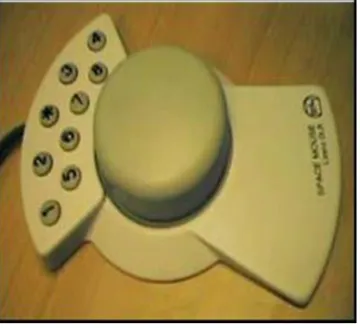
1) A 3D mouse has two sections as vertical and flat part. Each part has a few catches. With various blends of these catches the client can deliver contrast lease positions in the 3D condition.
Fig - 13: 3D Mouse [6] ‘
[image:6.595.193.373.578.742.2]
©IJRASET: All Rights are Reserved
1771
VIII. APPLICATIONS OF VIRTUAL REALITY
Computer generated reality now daily's utilized in wide scope of utilizations, some of essential territory of utilization is as per the following:
1) Business
2) Training
3) Engineering and design
4) Medical
5) Entertainment
6) Education and conferencing
7) Architecture design and prototyping
8) Competitive sports application
9) Virtual Manufacturing system
10) Military Applications
11) Mobile and gaming applications
12) Defense industry
13) Ergonomics and human factor analysis
14) Museum and art design
15) Design Evaluation (Virtual Prototyping)
16) Planning & Maintenance Concept & Data visualization Sales & Marketing
17) Operations in hazardous Environments
18) Entertainment, Leisure etc.
A. Business
1) Computer generated reality is being utilized in various ways by the business network which include:
2) Virtual voyages through a business domain Training of new workers.
[image:7.595.227.408.592.672.2]3) A 360 Degree view of any product.
Fig - 15: Business [2]
B. Training and Simulation
1) Computer generated reality situations have been utilized for preparing test systems.
2) The use of VR in a preparation point of view is to permit proficient lead preparing in a virtual domain where they can enhance their aptitudes without the military.
Fig16: Training & Simulation [1]
C. Engineering and Design
1) Computer generated Reality is most prominently utilized in building and planning process.
2) It gives better comprehension of the plan and help to encourage changes wherever essential.
3) It lessens the time and cost factor.
[image:8.595.214.384.110.198.2]
©IJRASET: All Rights are Reserved
1772
Fig - 17: Engineering & Design [4]
D. Entertainment
1) Media outlets is a standout amongst the most excited supporters of computer generated reality, most observably in diversions and virtual universes.
[image:8.595.225.411.251.397.2]2) A model incorporates virtual historical center, gaming, virtual amusement parks, and intelligent shows and so on.
Fig - 18: Entertainment [5]
E. Education and Conferencing
1) The upside of this is it empowers substantial gatherings of understudies to cooperate with one another just as inside a three dimensional condition.
2) It can introduce complex information in an open method to understudies which is both simple to learn and fun.
3) Furthermore these understudies can communicate with the items in that condition so as to find increasingly about them.
4) Best model where computer generated reality can be progressively valuable is for restorative understudies to create medical procedure recreations or 3D pictures of human body where understudies can investigate pleasantly without risk.
[image:8.595.223.402.496.602.2]5) This sort of innovation is for the most part utilized in UK and abroad
Fig - 19: Education [1]
F. Digital Prototyping
1) Computerized prototyping is likewise famous region of research where augmented reality is generally utilized now a day's.
Fig - 20: Digital Prototyping [6]
©IJRASET: All Rights are Reserved
1773
G. Assembly Verification
[image:9.595.209.391.149.268.2]1) After gathering of part is done, to confirm whether segments are appropriate ly collected of not computer generated reality and computerized prototyping is utilized.
Fig - 21: Assembly Verification [4]
H. Inspection
Virtual assessment utilizes the VR innovation to reproduce the review procedure, and the physical properties of the investigation hardware. Its motivation is to contemplate assessment philosophies, crash location, investigation plans , factor influencing the accu-shocking of examination process.
I. Layout Planning
1) Office format configuration has for quite some time been perceived as a standout amongst the most basic and troublesome plan assignments in assembling ventures. It might influence numerous other essential operational attributes like throughput time, creation volumes, quality, cost and representative assurance.
2) Customary design techniques that give the client a twodimensional (2D) perspective on the office can't completely take care of the complex spatial format issues. Because of the prerequisite of a more brilliant processing plant arranging , VR can be a valuable device to improve the comprehension of the plans and to help interdisciplinary discourses.
3) Virtual condition give a visual, three dimensional space in which a client can investigate the space prerequisite, stockpiling territory , office spaces and different clearances before structure the genuine plant.
J. Machining
1) Virtual machining for the most part manages cutting procedures, for example, turning, processing, boring and crushing and so forth.
2) In the virtual condition, a client can mount a work piece on the processing machine, pick an apparatus and perform direct machining activities, for example, pivotal developments or predefined successions.
3) The VM innovation is utilized to think about the elements influencing the quality, machining time of the material
IX. CHALLENGES
In the same way as other profitable advances ; other than circumstances , applications , second life , there dependably exist unavoidable difficulties and detriments too . Actually utilization of computer generated reality advancements offer both specialized and social difficulties. We can attempt our dimension best to limit this difficulties as opposed to endeavoring to totally evade it. Reasons of these unavoidable difficulties are:
A. Technical Challenges
©IJRASET: All Rights are Reserved
1774
mindfulness must be made among the general population by leading free courses and showing. Notwithstanding proper web data transfer capacity and interfacing charges, there are a few enrollment charges as well. For ex : For virtual learning, premium record is important to buy land and to make supported and safe learning condition for the understudies. High amazing PC frameworks or PC frameworks having high ground-breaking processor are required for making appropriate virtual condition.
B. Cultural Challenges
Obligation issues are still inquiry in virtual world. As we realize that private land should be obtained for virtual learning and this private land are confined to just approved users.However clients in open region may need to endure viciousness or disruptiveness.There are numerous unsolved legitimate issues encompassing like virtual savagery, inappropriate behavior , virtual attack .Everyday billions of individuals associate in these universes to mingle , shop and learn. Lamentably, numerous laws breaker likewise joined this virtual world and numerous crimes are taking put. basic criminal cases which are happening regular are tax evasion , inappropriate behavior , trading of kid misuse condition and psychological oppressor assault etc.Inventory misfortune issues is as yet present ; stock misfortune in which things in clients stock including those things which have been paid for can vanish abruptly or enter a state where they will neglect to enter in a world when mentioned ( Giving a " object is missing " database blunder ). This misfortune is albeit significantly less in past years, yet it's current.
X. CONCLUSION
Computer generated Reality future relies upon the presence of frameworks that address issues of „large scale‟ virtual enviro -nments. In the coming years, as more research is done we will undoubtedly observe VR become as backbone in our homes and at work. As the PCs become quicker, they will most likely make increasingly sensible realistic pictures to recreate reality better. It will intrigue perceive how it upgrades counterfeit reality in the years to come. It might likewise be conceivable that later on we will speak with virtual telephones. Nippon Telephone and Tele-diagram (NTT) in Japan are building up a framework which will enable one individual to see a 3D picture of the other utilizing VR systems. Along these lines, what's to come is in augmented reality and its advantages will likewise stay endless. Increasingly more research has demonstrated its need both from developmental and progressive viewpoint for giving better client impedance and empowering beforehand incomprehensible application. Applications region which are profited by utilization of augmented reality innovations are therapeutic, plan, building, assessment, get together, excitement and so on.
REFERENCES
[1] Bharath V G , Dr. Rajashekar Patil ; “Importance & Applications of Virtual Reality in Engineering sector”; International Journal of Scientific Research and Development (IJSRD) ; Volume 3 Issue 2 ; 2016.
[2] R Radharamanan ; “A survey of Virtual reality technologies” , applications and limitations ; International Journal of Virtual Reality (IJVR) ; Volume 14(2) ; 2015.
[3] Xi Junjie , H. S. Elian ; “Research on Virtual Manufacturing and System Structure of Complex Products”; 3rd International Conference on Information Management , Innovation Management and Industrial Engineering ; 2010.
[4] Naoufel Kraiem ; “Virtual spaces and virtual manufacturing” ; IEEE ; 2001. [5] Saadoun M. ; “Virtual Manufacturing & its implication”; Laval ; France ; 1999.
[6] Mujber M. , Hashmi M. ; “ Virtual Reality applications in manufacturing process” ; Journal of material processing technology ; Issue 4 ; pp. 1834-1839 ; 2014.
ABOUT AUTHOR
Mr. D. Raja is currently pursuing MCA dept, in Siddharth Institute of Engineering & Technology, Puttur, and Andra Pradesh, India.
![Fig - 1: Use of virtual reality technology (HMD) for gaming purpose [1]](https://thumb-us.123doks.com/thumbv2/123dok_us/1245004.650830/2.595.227.420.538.634/fig-use-virtual-reality-technology-hmd-gaming-purpose.webp)
![Fig - 4: Immersive virtual reality [5]](https://thumb-us.123doks.com/thumbv2/123dok_us/1245004.650830/3.595.203.401.109.290/fig-immersive-virtual-reality.webp)
![Fig - 9: Architecture for virtual reality [1]](https://thumb-us.123doks.com/thumbv2/123dok_us/1245004.650830/5.595.148.457.128.274/fig-architecture-virtual-reality.webp)
![Fig - 15: Business [2]](https://thumb-us.123doks.com/thumbv2/123dok_us/1245004.650830/7.595.227.408.592.672/fig-business.webp)
![Fig - 18: Entertainment [5]](https://thumb-us.123doks.com/thumbv2/123dok_us/1245004.650830/8.595.225.411.251.397/fig-entertainment.webp)
![Fig - 21: Assembly Verification [4]](https://thumb-us.123doks.com/thumbv2/123dok_us/1245004.650830/9.595.209.391.149.268/fig-assembly-verification.webp)