717
©IJRASET: All Rights are Reserved
Machine Learning for Automated Pothole
Detection
Akib Maredia
1, Ashutosh Mishra
2, Rishabh Mishra
3, Ms. Prachi Janrao
41, 2, 3, 4Computer Engineering, Thakur College of Engineering and Technology, Kandivali(E), Mumbai 400101
Abstract: Road conditions during the rains are aggravated, even after frequent reconstruction and maintenance, and are not repaired on time due to lack of information. Potholes cause problems such as over-inflated tires, wheel damage, damage to the underside of the vehicle, collisions and serious accidents. Therefore, accurate detection of potholes is a necessary task to determine the appropriate system of road management strategies. Several efforts have been made to overcome this problem. In this study, a pothole detection method that takes 2D images into account proposes a pothole detection system which uses convolutional neural networks which increased the accuracy significantly and is cost efficient. The information extracted from the proposed method is used to determine the preliminary maintenance of a road management system and to take immediate action on repair and maintenance.
Keywords: Machine learning, convolutional neural networks(CNN), potholes, image processing.
I. INTRODUCTION
A pothole is defined as a depression in the surface of the pavement and its minimum dimension in the plane is 15 cm. With climate change, like heavy rains in India, damaged pavements like potholes increase. Thus, complaints and prosecutions for pothole accidents increase. Potholes have internal causes, such as the degradation of the pavement material and external causes, such as the lack of management of quality and construction. The potholes are an important indication of the structural defects of the paved road and their precise detection is a crucial task in determining the proper road maintenance and rehabilitation strategies. However, manual detection and evaluation methods are expensive and time-consuming. Therefore, several efforts have been made to develop a technology capable of detecting and automatically recognizing potholes, which could help improve the efficiency of the survey and the quality of the pavement through previous research. The existing methods for the detection of potholes can be divided into methods based on vibrations, three-dimensional methods (3D) and methods of reconstruction. These models are not profitable, nor does this method effectively inform the authorities for road repair. In general, these systems are mounted on very expensive cars and do not involve potential road repairs. The proposed system uses machine learning to learn the patterns of a pothole and the images and videos of traffic cameras to detect potholes. Once these holes are detected using the location of the camera, the maintenance and administration authorities are informed of the highway of the cutting road and its location to take the necessary measures.
II. LITERATURESURVEY
The detection of potholes is necessary for the safety of the itinerant population. (Hyunwoo Song and et al) have proposed a low-cost 3D roadmap analysis model, which uses a low-cost kinetic sensor that provides direct depth measurements, which reduces computational costs. Lin and Liu have proposed a pothole detection method based on SVM (Support Vector Machine).
718
©IJRASET: All Rights are Reserved
III.PROPOSEDWORK
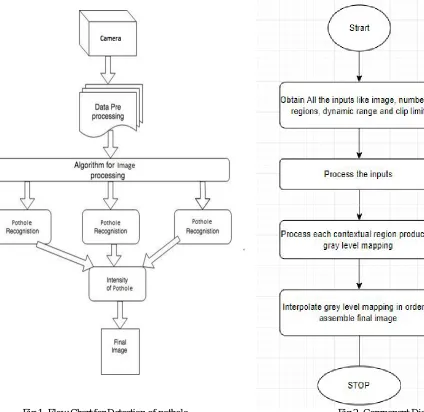
A pothole detection system is designed to collect images of the road through a camera and detect a pothole from the data collected using the proposed algorithm. The camera collects data about potholes and the collected data is sent to a pothole detection algorithm. The pothole detection algorithm works based on CNN.
CNN:
The proposed methodology can be divided into three stages:
A. Segmentation of the image. B. Extraction of the region of interest.
C. Decision
First, a histogram and the operation of closing a morphological filter are used to extract the dark regions for the detection of holes. Therefore, the candidate regions of a hole are extracted using different characteristics, such as size and compactness. Finally, it is decided whether the candidate regions are unequal or not by comparing the characteristics of the hole and the bottom with the pothole data set. The segmentation phase consists of separating a region from the hole of the background region by transforming an original color image into a binary image using the histogram of an input image.
[image:2.595.312.525.309.735.2][image:2.595.64.488.319.731.2]
719
©IJRASET: All Rights are Reserved
IV.RESULTSANDDISCUSSION
The paper proposed a new pothole detection system with an optical camera and a unique pothole detection algorithm. The convolutional neural network algorithm is simulated on a desktop computer and uses the inputs of an optical camera.
The proposed pothole detection CNN algorithm is designed and implemented taking into account the limited computing capacity of existing systems. Experimental results potentially show that the proposed algorithm can correctly eliminate different types of similar objects, such as patches, records, tents and moving vehicles. By doing so, the regions of the hole are detected correctly. The general sensitivity and accuracy is approximately 90% to 99%, respectively. As a result, the CNN algorithm is considerably robust for similar objects. In some cases, however, the proposed system does not detect particularly bright or flat holes. When the intensity of sunlight changed rapidly, false detections occurred. We intend to improve this algorithm with a minimum increase in the complexity of the system in general.
Therefore, the CNN algorithm remains a bit problematic. However, we confirm that a pothole detection system using a typical traffic camera can be potentially used as an automated and intelligent pothole maintenance system for road maintenance authorities.
Implementation Details:
A. Software and tools: Python 3.7.0, Git 2.21.0, Anaconda.
B. Editor: Jupyter.
C. Libraries: Tensorflow, Mobilenet CNN.
MobileNet is a a small efficient convolutional neural network. "Convolutional" just means that the same calculations are performed at each location in the image. We used a pre-trained convolutional neural network Mobilenet 0.5_224 for our system. The system uses Python’s TensorFlow library for machine learning. We got our pothole dataset from Cranfield University’s Online Research Data(CORD) to train our system.
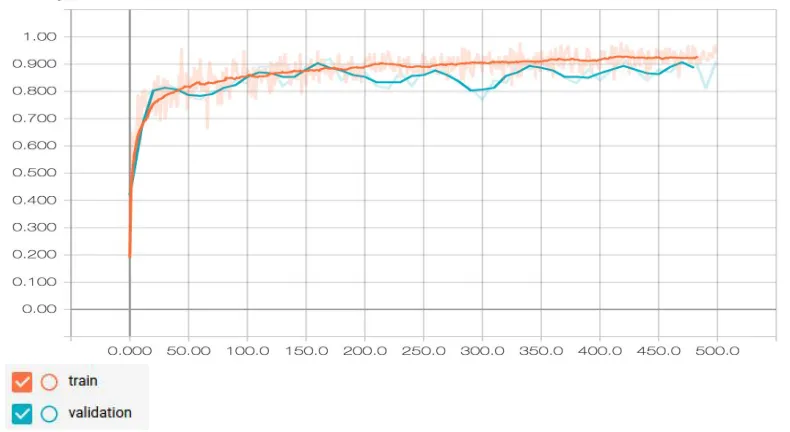
1) Training: We train our dataset on top of the Mobilenet convolution neural network. The input resolution we take is 224 pixels in order to increase the data accuracy. The relative size of model is 0.5 to the original image in terms of fraction to reduce the input size. Also the dataset is trained according to colors, edges, features, curves, shape etc. We do the training in 500 steps that is we run a testing image on top of the CNN for 500 times in order to increase the accuracy. The training runs all the images on top of the convolution neural network and checks for validation accuracy, train accuracy, cross entropy. The bottleneck files are created for all the images.
[image:3.595.41.251.524.704.2] [image:3.595.337.546.531.711.2]2) Testing: Once we train our classifier in order to recognize a pothole, we input test cases and the bottleneck of this image is tested against the bottle neck of all the bottleneck dataset that was stored and the closest bottlenecks are selected. Thus we can determine the images fractional participation as per the available dataset. This fraction determines the existence of pothole in the image.
720
[image:4.595.71.516.104.318.2]©IJRASET: All Rights are Reserved
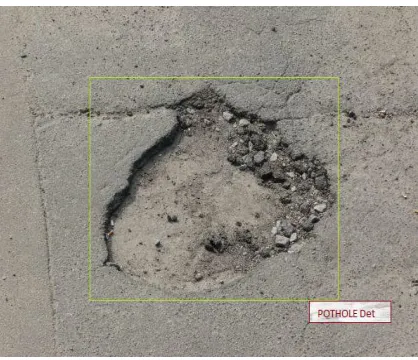
Fig 5 Pothole Detected
V. CONCLUSIONANDFUTURESCOPE
In this article, we propose a unique pothole detection system with an optical camera, and we have also implemented a CNN algorithm. The algorithm was simulated on a desktop computer and using the inputs of an optical camera.
The proposed pothole detection algorithm was designed and implemented taking into account the limited computing capacity of existing systems. The experimental results show that the proposed algorithm can correctly eliminate different types of similar objects, such as patches, registers, stores and moving vehicles. By doing so, the regions of the hole can be detected correctly. The general sensitivity and precision reached 60% and 90% respectively. Therefore, the algorithm is considerably robust for similar objects. In some cases, however, the proposed system did not detect particularly bright or flat holes.
Extensive research is needed in a variety of climatic conditions. In addition, we will collect more video data from holes in later evaluations. When the intensity of sunlight changed rapidly, false detections occurred. We intend to improve this algorithm with a minimum increase in the complexity of the system in general.
Therefore, the proposed terrain detection algorithm remains problematic. However, we are confident that a well detection system using a new system has the potential to be used as an automated and intelligent pothole detection system.
[image:4.595.107.502.509.725.2]721
©IJRASET: All Rights are Reserved
A. In the Future, the System
1) It can be integrated with the surveillance system present in cities.
2) It can be integrated into any CCTV camera.
3) It can be more integrated with car cameras.
4) Can be trained to recognize roads vulnerable to flooding.
5) Can be integrated with drones and other optical devices.
B. Driving Social Benefits Such As
1) Decrease the number of traffic accidents.
2) Bring transparency to government business.
3) Reduce the risk of flooding in the future.
4) It will influence in maintaining the aesthetics of the roads.
VI. ACKNOWLEDGEMENT
The creation of this paper required participation and direction of various individuals. We hence think of it as our prime obligation to thank everybody who have helped us through this endeavor. It is our monstrous delight to offer our thanks to Mr. A. J. Mishra(Govt. Officer) and Mr. V. Chavan(MCGM Road Dept.) for giving us help and positive criticism. We are appreciative to our companions for their consolation and recommendations. We are likewise grateful to our folks who dependably wish the best for us.
REFERENCES
[1] Pothole Detection using Machine Learning, “Pothole Detection using Machine Learning”, SERSC Advance Science and Technology Letters, Proceedings, International Conference, Ho Chi Minh, Vietnam, February 2018
[2] Aniket Kulkarni , Nitish Mhalgi , SagarGurnani& Dr. Nupur Giri, “Pothole Detection System using Machine Learning on Android”, International Journal of Emerging Technology and Advanced Engineering, Vol. 4, Issue 7, July 2014
[3] Hsiu-Wen Wang, Chi-Hua Chen, Ding-Yuan Cheng, Chun-Hao Lin, and Chi-Chun Lo, ”A Real-Time Pothole Detection Approach for Intelligent Transportation System”, Hindawi Journals, Volume 2015
[4] Jinting Ren& Duo Liu, “PADS: A Reliable Pothole Detection System Using Machine Learning”, First International Conference, Smart Com 2016, Shenzhen, China, December 2016.
[5] Kwok Yu Mak, Valentin Siderskiy& Lamia Iftekhar, ”Detachable Pothole Detection and Warning System”, Final Project Report, NYU Polytechnic, Spring 2008.
[6] https://github.com/tensorflow/hub/blob/master/examples/image_retraining/retrain.py