Causes of Delay in Highway Construction Projects
using Relative Importance Index Method
Sultan Ahmad1, Dr. Rajeev Kansal2
1
PG student, 2Professor, Civil Engineering Department, Madhav Institute of Technology and Science, Gwalior, (M.P.) India
Abstract: The objective of this paper is to assess the causes of delays in the completion of highway construction projects due to the failures of employer, consultant and contractor during the construction phase. Delays in highway construction projects are inevitable and may results in disputes, litigation, claims among different parties and adversely impact on project success in terms of time, quality, & cost.
This research proposes a framework for contractor to analyze the delay factors before the bidding stage of the project by utilizing the relative importance index (RII) method. For this purpose a questionnaire has been developed after identifying 63 delay factors, categorized into 8 groups through a detailed literature review process as well as interviews with experts from highway construction industry.
The ranking of factors and groups have been demonstrated according to their importance level on delay. And finally some suggestions & recommendations have made to minimize and control delays in highway construction projects.
Author Keywords: Highway Construction Projects; Delay Factors; Relative Importance Index; Ranking of Delay Factors; Suggestion & Recommendations.
I. INTRODUCTION
The highway construction is an integral component of a nation’s infrastructure & plays an significant role in economic development through multiple effects on other sector of economy. A construction project is commonly considered as successful, when it is completed within its budget, time, and targeted quality (Olawale and Sun 2013).
Construction delay defined as “the time overrun beyond completion date specified in the contract, or beyond the date that parties agreed upon for delivery of a project” (Assaf and Al-Hejji 2006). Delays in highway construction projects are considered to be one of the most recurring problems and usually accompanied by cost overrun. Delay may have negative effects to the project related parties.
The negative effects of delay are increase in cost & time of completion of project & decreases quality and productivity, disputes, and termination of contracts (Majid 2006; Mahamid et al. 2012). Delay for Owner means loss of revenue through lack of production facilities or a dependence on present facilities. Delay for contractor means higher overhead costs because of longer construction period, and higher material & labour costs due to inflation. Contractor should carefully quantify & analyses the delay factors for the purpose of securing project success.
II. OBJECTIVES OF RESEARCH
This research addresses the delay analysis in construction of highway projects with a focus on delay factors identification and ranking of delay factors. The main objective of this research include the following-
A. To identify & categorize causes of delay in highway construction projects.
B. To determine the relative importance of delay factors & groups, & demonstrate the ranking of delay factors and groups according to their level of importance on delay by using relative importance index method.
C. Demonstrate the factors and groups that are most likely to cause delay.
III. RESEARCH METHODOLOGY
A. Methodology Flow
1) Step 1: Identification of delay factors
Total 63 delay factors were identified through literature review and discussion with highway construction experts. A questionnaire form is prepared in following format-
Table: 1 Questionnaire Form
Sr. No
Factors Causing delays Respondent
Score 1 Poor site management and supervision
2 Inadequate contractor experience 3 Rework due to errors
4 Ineffective project planning and scheduling by contractor 5 Conflict between contractor and other parties
6 Difficulties in financing the project by contractor 7 Frequent change of sub contractor
8 Inappropriate construction method / Obsolete technology
9 Lack of coordination and communication b/w contractor & other parties 10 Delay in site mobilization /shifting of existing utilities
11 Delay in approving major changes in scope of work by consultant /Frequent design change 12 Delay in performing inspection and testing
13 Inflexibility (rigidity) of consultant
14 Inaccurate site investigation / pre design data
15 Lack of experience of consultant in construction project 16 Late in reviewing and approving design document by consultant
17 Lack of coordination and communication b/w consultant and other parties 18 Change order during construction
19 Delay in progress payment by owner 20 Suspension of work by owner
21 Delay in revising & approving design documents 22 Delay/slowness in decision making process
23 Delay in site delivery to contractor(land acquisition) 24 Unrealistic time estimation
Identification of Delay Factors & Groups
Linguistic Definition
Questionnaire Survey
Determinations of Relative Importance of Delay Factors using RII method
2) Step 2: Linguistic Definition
After identification of delay factors a meeting was arranged with highway construction experts working on NH-234 (from Etawah to Kannauj, India) to define linguistic terms. The linguistic term of importance of each delay factors are “Very High”, “High”, “Medium”, “Low”, “Very Low”. Meaning of each linguistic term associated to all delay factors are given below.
25 Financial difficulties of owner/fund constraints 26 Conflict between joint ownership
27 Lack of coordination and communication b/w owner and other parties 28 Labor shortage
29 Low labor productivity
30 Inexperienced /unqualified labors
31 Personal conflicts among labors and management team 32 Labors absenteeism
33 Fluctuation of prices of materials
34 Late delivery of material and equipment( soil, aggregate etc) 35 Poor procurement of construction material
36 Shortage of construction material in market 37 Unreliable suppliers
38 Frequent equipment breakdown
39 Low productivity & efficiency of equipment
40 Change in material types and specifications during construction 41 Mistakes and discrepancies in design document
42 Delay in producing design document
43 Insufficient data collection and survey before design / Improper project feasibility study 44 Misunderstanding of owner's requirement by design engineer
45 Inadequate design team experience
46 Poor use of advanced engineering design software
47 Design changes by owner OR his agent during construction 48 Original contract duration is too short
49 Ineffective delays penalties
50 legal dispute between project participants 51 Unfavorable contract clauses
52 Tender winning prices are unrealistically low (suicide tendering) /L1 model 53 Project complexity
54 Accidents during construction
55 Unforeseen ground conditions (e.g high water table , soil )
56 Delay in obtaining clearance (permits / NOC ) from concern authority 57 Change in government regulations and laws
58 Global financial crisis
59 Force majeure (flood, earthquake )
60 Loss of time by traffic control and restriction at job site 61 Unfavorable weather condition
Table: 2 Linguistic Definition of delay factors importance Linguistic Term Delay in project duration Very High Important (VH) % project delay > 20
High Important (H) 15 < % project delay < 20 Medium Important (M) 10 < % project delay < 15 Low Important (L) 5 < % project delay < 10 Very Low Important (VL) % project delay < 5
Table: 3 Crisp Rating used in questionnaire
3) Step 3: Questionnaire Survey
Delay analysis is done through Questionnaire survey. Total 33 questionnaire forms in online and offline mode in above questionnaire format (Table: 1) were filled by highway construction experts. Respondent profile is given in Table:
Table: 4 final respondents profile
Figure: 1 Pie Chart representing Total Respondents and Average Experience
4) Step 4: Determinations of Relative Importance of Delay Factors using RII method
After performing questionnaire survey, responses from questionnaire are unified using Relative Importance Index Method to determine the relative importance of the each cause of delays, which is given by
-RII = ∑W
A∗N
Where ∑ = Sum of responses i.e. sum of crisp rating of factor given by respondents A = Maximum value of crisp rating which is 5.
N = No. of respondents.
0 < RII ≤ 1, higher the RII higher the importance of delay factor.
RII is calculated on the basis of owner, consultant, contractor and overall responses.
Linguistic term Crisp Rating
Very Low Important (VL) 1
Low Important (L) 2
Medium Important (M) 3
High Important (H) 4
Very High Important (VH) 5
Sr.No Respondents Category Total Respondents Average Experience
1 Owner /Clients 14 21.07
2 Contractor 10 16.6
5) Step 5: Ranking of Delay Factors using RII values
Ranking of delay factors is done on the basis of RII values from owner, consultant, contractor and overall responses.
a) Step 5.1: Rank Correlation
The Spearman’s method is used for rank correlation, that indicate the agreement level on the ranking among different groups of respondents (i.e. owner, consultant, & contractor & overall) participating in the questionnaire survey. It is mathematically represented as
= 1− 6∗ ∑d
(N −N)
Where = Agreement level between different respondents groups (0 ≤ ≤ 1).
d = difference of the ranking of a delay factor.
N = total number of pairs in rank (in this case 63, as the no. of delay factors).
IV. RESULTS & DISCUSSION
A. Reliability of Questionnaire data
Before starting of questionnaire data analysis, Reliability of questionnaire data is checked. That means degree of stability and internal consistency of data collected in the questionnaire survey is assessed by using Cronbach’s alpha formula which is widely used that shows the internal consistency of data i.e. how much a set of data is closely related. These reliability results in term of cronbach’s alpha are determined by using SPSS software Table 4.1 shows results of reliability test.
Table: 5 Data reliability test results
From the above results of cronbach’s alpha according to the questionnaire filled by owner, contractor, consultant, & overall. The questionnaire data have excellent internal consistency. As shown in Table: 5, the reliability coefficient results are in the range from 0.850 to 0.968 this is considerably higher than the modest reliability in the range 0.50 - 0.60. The result ensures that the questionnaire data is reliable so we can further proceed to the next step of data analysis.
B. Data Analysis
The RII is calculated for each delay factor to identify the most and least important delay factors in the construction of highway projects. On the basis of calculated RII values from responses of consultant, contractor, owner, & overall, these delay factors are ranked. There are overall 35 responses that we have got through interviews as well online surveys of highway construction experts, in which 33 are found to be correct. Out of these 33 responses, 14 responses are from Owners, 10 responses are from contractors & 9 responses are from consultants.
The RII value had a range from 0 to 1 (0 not inclusive), higher the value of RII, more important is the cause of delays.
Table: 5 show factors of schedule delay, according to consultant, contractor, owner, & overall with computed RII’s, and ranks.
Table: 5 Ranking of Factors Causing Delays according to Consultant, Contractor, Owner & Overall Responses Sr.
No
Factors Causing Delays Owner Contractor Consultant Owner
∑W RII RANK∑W RII RANK ∑W RII RANK ∑W RII RANK 1 Poor site management and supervision 56 0.800 3 28 0.56 27 31 0.689 22 115 0.697 11 2 Inadequate contractor experience 51 0.729 10 30 0.6 22 34 0.756 15 115 0.697 11 3 Rework due to errors 36 0.514 56 28 0.56 27 36 0.8 10 100 0.606 30 4 Ineffective project planning and scheduling by
contractor
54 0.771 6 41 0.82 3 41 0.911 2 136 0.824 3
5 Conflict between contractor and other parties 45 0.643 23 29 0.58 23 39 0.867 4 113 0.685 15 6 Difficulties in financing the project by 56 0.800 3 36 0.72 8 41 0.911 2 133 0.806 4 7 Frequent change of sub contractor 34 0.486 59 25 0.5 45 33 0.733 17 92 0.558 46
Respondents Category Owner Contractor Consultant Overall
8 Inappropriate construction method / Obsolete technology
43 0.614 32 26 0.52 42 29 0.644 33 98 0.594 33
9 Lack of coordination and communication b/w contractor & other parties
42 0.600 34 23 0.46 50 29 0.644 33 94 0.57 41
10 Delay in site mobilization 45 0.643 23 31 0.62 16 31 0.689 22 107 0.648 23 11 Delay in approving major changes in scope of
work by consultant /Frequent design change
48 0.686 16 31 0.62 16 39 0.867 4 118 0.715 8
12 Delay in performing inspection and testing 46 0.657 20 27 0.54 36 29 0.644 33 102 0.618 26 13 Inflexibility (rigidity) of Consultant 36 0.514 56 20 0.4 58 21 0.467 52 77 0.467 58 14 Inaccurate site investigation / pre design data 49 0.700 14 27 0.54 36 36 0.8 10 112 0.679 17 15 Lack of experience of consultant in
construction project
46 0.657 20 25 0.5 45 25 0.556 46 96 0.582 38
16 Late in reviewing and approving design document by consultant
49 0.700 14 28 0.56 27 33 0.733 17 110 0.667 20
17 Lack of coordination and communication b/w consultant and other parties
41 0.586 39 26 0.52 42 20 0.444 54 87 0.527 54
18 Change order during construction 50 0.714 12 37 0.74 6 29 0.644 33 116 0.703 9 19 Delay in progress payment by owner 47 0.671 18 40 0.8 4 27 0.6 40 114 0.691 14 20 Suspension of work by owner 42 0.600 34 33 0.66 13 19 0.422 55 94 0.57 41 21 Delay in revising & approving design 43 0.614 32 31 0.62 16 24 0.533 48 98 0.594 33 22 Delay/slowness in decision making process 45 0.643 23 28 0.56 27 23 0.511 49 96 0.582 38 23 Delay in site delivery to contractor(land
acquisition)
59 0.843 1 44 0.88 1 42 0.933 1 145 0.879 1
24 Unrealistic time estimation 41 0.586 39 31 0.62 16 19 0.422 55 91 0.552 48 25 Financial difficulties of owner/fund 56 0.800 3 35 0.7 11 38 0.844 6 129 0.782 5 26 Conflict between joint ownership 44 0.629 27 27 0.54 36 30 0.667 25 101 0.612 27 27 Lack of coordination and communication b/w
Owner and other parties
39 0.557 49 23 0.46 50 23 0.511 49 85 0.515 55
28 Labor shortage 46 0.657 20 28 0.56 27 36 0.8 10 110 0.667 20
29 Low labor productivity 41 0.586 39 27 0.54 36 30 0.667 25 98 0.594 33 30 Inexperienced /unqualified labors 42 0.600 34 21 0.42 55 18 0.4 58 81 0.491 57 31 Personal conflicts among labors and
management team
25 0.357 63 17 0.34 63 15 0.333 62 57 0.345 63
32 Labors absenteeism 31 0.443 60 18 0.36 61 16 0.356 60 65 0.394 61 33 Fluctuation of prices of materials 42 0.600 34 29 0.58 23 17 0.378 59 88 0.533 51 34 Late delivery of material and equipment( soil,
aggregate etc)
50 0.714 12 27 0.54 36 35 0.778 13 112 0.679 17
35 Poor procurement of construction material 54 0.771 6 23 0.46 50 33 0.733 17 110 0.667 20 36 Shortage of construction material in market 47 0.671 18 31 0.62 16 35 0.778 13 113 0.685 15 37 Unreliable suppliers 41 0.586 39 19 0.38 59 16 0.356 60 76 0.461 59 38 Frequent equipment breakdown 44 0.629 27 29 0.58 23 30 0.667 25 103 0.624 24 39 Low productivity & efficiency of equipments 40 0.571 45 23 0.46 50 38 0.844 6 101 0.612 27 40 Change in material types and specifications
during construction
29 0.414 62 18 0.36 61 15 0.333 62 62 0.376 62
41 Mistakes and discrepancies in design 48 0.686 16 39 0.78 5 32 0.711 20 119 0.721 7 42 Delay in producing design document 38 0.543 52 26 0.52 42 30 0.667 25 94 0.57 41 43 Insufficient data collection and survey before
design / Improper project feasibility study
54 0.771 6 37 0.74 6 37 0.822 8 128 0.776 6
44 Misunderstanding of owner's requirement by design engineer
39 0.557 49 21 0.42 55 28 0.622 37 88 0.533 51
45 Inadequate design team experience 38 0.543 52 19 0.38 59 34 0.756 15 91 0.552 48 46 Poor use of advanced engineering design
software
36 0.514 56 25 0.5 45 27 0.6 40 88 0.533 51
47 Design changes by owner OR his agent during construction
48 Original contract duration is too short 39 0.557 49 36 0.72 8 28 0.622 37 103 0.624 24 49 Ineffective delays penalties 45 0.643 23 28 0.56 27 26 0.578 43 99 0.6 32 50 legal dispute between project participants 54 0.771 6 32 0.64 14 30 0.667 25 116 0.703 9 51 Unfavorable contract clauses 42 0.600 34 22 0.44 54 30 0.667 25 94 0.57 41 52 Tender winning prices are unrealistically low
(suicide tendering) /L1 model
51 0.729 10 34 0.68 12 30 0.667 25 115 0.697 11
[image:7.612.27.588.76.343.2]53 Project complexity 37 0.529 54 25 0.5 45 22 0.489 51 84 0.509 56 54 Accidents during construction 30 0.429 61 21 0.42 55 21 0.467 52 72 0.436 60 55 Unforeseen ground conditions (e.g high water
table , soil )
44 0.629 27 36 0.72 8 32 0.711 20 112 0.679 17
56 Delay in obtaining clearance (permits / NOC ) from concern authority (Railway, municipal,
58 0.829 2 43 0.86 2 37 0.822 8 138 0.836 2
57 Change in government regulations and laws 44 0.629 27 29 0.58 23 19 0.422 55 92 0.558 46 58 Global financial crisis 41 0.586 39 28 0.56 27 28 0.622 37 97 0.588 36 59 Force majeure (flood, earthquake ) 41 0.586 39 28 0.56 27 31 0.689 22 100 0.606 30 60 Loss of time by traffic control and restriction
at job site
37 0.529 54 32 0.64 14 26 0.578 43 95 0.576 40
61 Unfavorable weather condition 40 0.571 45 31 0.62 16 30 0.667 25 101 0.612 27 62 Delay in providing services from utilities
(such as water ,electricity)
40 0.571 45 24 0.48 49 26 0.578 43 90 0.545 50
63 Public agitation demanding other facilities/ Law and order problem
44 0.629 27 28 0.56 27 25 0.556 46 97 0.588 36
C. Rank Correlation Results
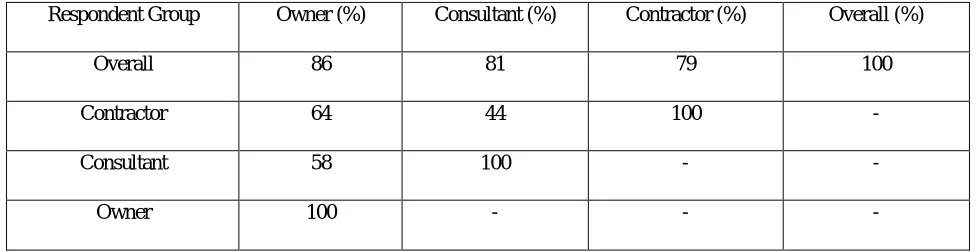
The Spearman’s method is used for rank correlation that indicate the agreement level on the ranking among different groups of respondents (i.e. owner, consultant, & contractor & overall) participating in the questionnaire survey. Table: 7 showing the results of Spearman’s rank correlation.
Table: 6 Spearman’s rank correlation between different groups of respondents
1) The highest correlation (86%) is found in between owner responses & overall responses. This signify that the owner “really understand the overall/general situation in construction of highway projects, & owner alone can provide fairly accurate enough initial results in future pilot studies (regarding the highway construction industry at large ), saving time , recourses, & efforts otherwise required for a full case study. This is an important methodological observation and a valuable” suggestion for future researches.
2) The second highest correlation (81%) is found in between the consultant representatives & overall respondents, who strongly agreed with each other.
3) The poorest correlation (44%) is found in between design consultant respondents & contractor respondents. Consultant admits that their Professional output is not sufficient & is responsible for delay in construction of highway projects. They consider that a root cause of this is the low budget they receive, which do not motivate them to produce high quality designs that affect the quality of their work.
4) Similarly, the other correlations among various respondent groups are in range of 44-86%.
Respondent Group Owner (%) Consultant (%) Contractor (%) Overall (%)
Overall 86 81 79 100
Contractor 64 44 100 -
Consultant 58 100 - -
[image:7.612.62.550.432.558.2]Top 15 Most Important Factors Causing Schedule delay According to Overall Responses
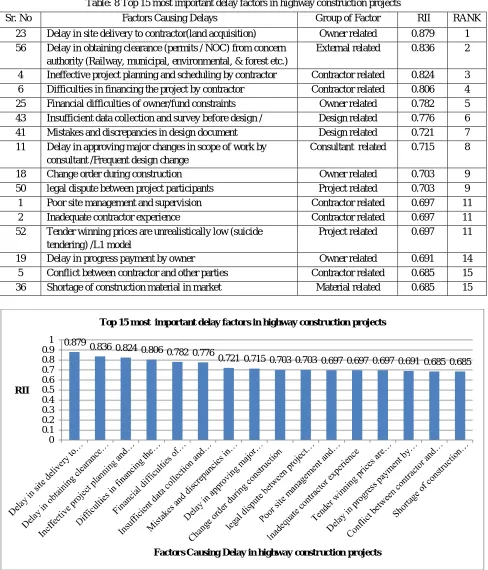
[image:8.612.63.551.133.703.2]Based on above overall ranking, the top fifteen (15) most significant factors that cause schedule delay in construction of highway projects are shown in Table: 8. & graphical representation of top 15 factor causing delay is shown in figure 2.
[image:8.612.74.552.142.451.2]Table: 8 Top 15 most important delay factors in highway construction projects
Figure. 2 Column Bar Chart Showing Top 15 Factors Causing Delays In Highway Construction Projects 0.879 0.836 0.824 0.806 0.782 0.776
0.721 0.715 0.703 0.703 0.697 0.697 0.697 0.691 0.685 0.685
0 0.1 0.2 0.3 0.4 0.5 0.6 0.7 0.8 0.9 1
RII
Factors Causing Delay in highway construction projects Top 15 most important delay factors in highway construction projects
Sr. No Factors Causing Delays Group of Factor RII RANK
23 Delay in site delivery to contractor(land acquisition) Owner related 0.879 1 56 Delay in obtaining clearance (permits / NOC) from concern
authority (Railway, municipal, environmental, & forest etc.)
External related 0.836 2
4 Ineffective project planning and scheduling by contractor Contractor related 0.824 3 6 Difficulties in financing the project by contractor Contractor related 0.806 4 25 Financial difficulties of owner/fund constraints Owner related 0.782 5 43 Insufficient data collection and survey before design /
Improper project feasibility study
Design related 0.776 6 41 Mistakes and discrepancies in design document Design related 0.721 7 11 Delay in approving major changes in scope of work by
consultant /Frequent design change
Consultant related 0.715 8
18 Change order during construction Owner related 0.703 9
50 legal dispute between project participants Project related 0.703 9 1 Poor site management and supervision Contractor related 0.697 11 2 Inadequate contractor experience Contractor related 0.697 11 52 Tender winning prices are unrealistically low (suicide
tendering) /L1 model
Project related 0.697 11
19 Delay in progress payment by owner Owner related 0.691 14
V. CONCLUSION & RECOMMENDATION
The aim of this research was to analyze the delay causing factors in highway construction projects. In this research 63 delay factors were identified through literature review and discussion with highway construction experts and a questionnaire survey was conducted among owners, contractors and consultants to elicit the information about the importance level of each delay factor in terms of crisp rating. To unify questionnaire responses Relative Importance Method (RII) method is used. Ranking of delay factors is done on the basis of RII values of delay factors to compare the relative importance of delay factors. The highway construction stakeholders have to focus on these research findings to avoid delay in the construction of highway project, considering the factors contributing most to the delays. According to research findings, by considering the list of the 15 most significant factors causing delays (Table 4.1), the following suggestions & recommendations can be made as to minimize and control delays in highway construction projects:
A. Delays in site delivery to contractor (land acquisition), is the most important delay factor that caused by owners. The site should be handed over to the contractors on time after awarding the project. That should be free from legal hurdles.
B. Delay in obtaining clearance (permits / NOC) from concern authority (Railway, municipal, environmental, & forest etc.) is the second most important delay factor. The owner should facilitate the contractor to obtain clearance from the concern authority. This should be done on priority base otherwise the project may delay very badly.
C. Ineffective project planning and scheduling by contractor is the third most important delay factor caused by contractor. The robust attention should be paid by contractors for effective planning and scheduling. Scheduling and planning may be revised during construction, if necessary.
D. Poor financial management by contractors in highway construction projects also affect the time of completion of the construction of highway projects. For proper financial management contractors are required to decide financing sources using scientific methods before the starting of construction of highway projects.
E. Financial difficulties of owner/fund constraints that leads to delay in construction of highway projects. Owners should open their budget in front of contractor & consultant for project financing and owners are required to keep the projects specifications within their budget.
F. Insufficient data collection and survey before design / Improper project feasibility study is also the most important delay factor that leads to delay in construction of highway projects. The owner should conduct some accurate preliminary survey with design consultancy for project feasibility requirement.
G. Mistakes and discrepancies in design document also leads to delay in construction of highway projects. The design consultancy should design the detailed design project reports with great efficiency and accuracy that avoid discrepancies in design documents.
H. Delay in approving major changes in scope of work by consultant also leads to delay in construction of highway projects. Approval of design documents should not be late, which may hinder the progress of work.
I. Change order during construction may leads to delay, claims &“disruption of work due to improper analysis of the project from its initial stages. Therefore, contract conditions related to change orders should be carefully evaluated. Clients should also consider their adverse effects on projects critical activities.
J. Legal dispute between project participants may also leads to delay in highway construction projects. Legal disputes can be mitigated or avoided by clearing the project’s terms and condition through legal documentations.
K. Poor site management and supervision may also hinder the project progress. The contractor should made site supervision and management properly, & make the necessary arrangements to complete the projects within specific time limits while satisfying quality and cost requirements.
L. Tender winning prices are unrealistically low /L1 model may also leads to delay the project. Owner should conduct both technical and financial bid among contractors to evaluate composite score of each contractor. The contractor having highest composite score should be awarded the project. This process is called as best value selection.
M.Delay in progress payment by owner may also hinder the project progress. The owner should make the necessary arrangements so that contractor could be paid timely on basis of completed work.
Delays in highway construction projects can be mitigated or avoided when their causes are clearly identified. After the identification of most important delay factors a robust delay mitigation response strategy can be developed. A joint effort based on teamwork is required to mitigate delays in highway construction projects.
REFERENCES
[1] Sadi A. Assaf & Sadiq Al-Hejji (2005) “Causes of delay in large construction projects” International Journal of Project Management.
[2] M. E. Abd EI-Razek & A. M. Mobarak (2008) “Causes of delay in building construction projects in Egypt” Journal of Construction Engineering &
Management.
[3] N. Hamzah & M. A. Khoiry (2011) “Causes of construction delay-theoretical framework” Published by Elsevier Ltd.
[4] Hementa Doloi & K. C. Iyer and (2011) “Analysing factors affecting delays in Indian construction projects” International Journal of Project Management.
[5] Ibahim Mahamid, Amund Bruland & Nabil Damaidi (2012) “Causes of delay in road construction projects” Journal of Management in
Engineering.
[6] Yehiel Rosenfeld (2013) “Root-cause analysis of construction cost overruns” Journal of Construction Engineering & Management.
[7] Murat Gundaz, Yasemin Nielsen & Mustafa Ozdemir (2013) “Quantification of delay factors using the relative importance index method for
construction projects in turkey” Journal of Construction Engineering & Management.