Design and Implementation of Clinical Document
Architecture for Health Information Exchange
based on Cloud Computing
Sharyu C. Kale1, Prof. Mahip M. Bartere2, Dr. H. R. Deshmukh3 1, 2
Computer Science and Engineering Department, G.H. Raisoni Amravati.
Abstract: Fruitful arrangement of Electronic Health Record enhances quiet security and nature of consideration, however it has the essential of interoperability between Health Information Exchange at various doctor's facilities. The Clinical Document Architecture developed by Health Level-7 is Clinical Document Architecture Release 2 was approved by American Nation Standards Institute in May 2005. Sadly, healing facilities are hesitant to embrace interoperable Health Information System because of its sending cost aside from in a modest bunch nations. An issue emerges notwithstanding when more healing facilities begin utilizing the CDA report group in light of the fact that the information scattered in various records are difficult to oversee. In this proposed system, record generation and coordination Open API administration based on distributed computing, through which doctor's facilities are empowered to advantageously create CDA records without purchasing exclusive programming. It will generate report mix framework incorporates various CDA archives per tolerant into a solitary CDA report and doctors and patients can scan the clinical information in sequential request. Our arrangement of CDA record era what's more, combination depends on distributed computing and the administration is offered in Open API. Engineers utilizing diverse stages along these lines can utilize our framework to improve interoperability.
I. INTRODUCTION
II. LITERATURE SURVEY
1) S. Lee et.al. [15] Numerous Clinical Document Architecture (CDA) referrals and answer records have been collected for patients since the arrangement of the Health Information Exchange System (HIES) in Korea. Clinical information were scattered in numerous CDA archives and this set aside an excess of time for doctors to peruse. Doctors in Korea invest just constrained energy per tolerant as protections in Korea pursue an expense for-benefit demonstrate. In this manner, doctors were not permitted adequate time for settling on restorative choices, and follow-up consideration benefit was obstructed. To address this, we created CDA Integration Template (CIT) and CDA Integration System (CIS) for the HIES. The clinical things incorporated into CIT were characterized mirroring the Korean Standard for CDA Referral and Reply Letters and demands by doctors.
2) Dolin et.al.[16] CDA R2, being the second arrival of a standardizing ANSI-endorsed HL7 particular, speaks to a steady stage for the trading of clinical reports. The basic plan limits the specialized boundaries to selection while giving a movement pathway toward logically more extravagant PC processable substance. CDA R2 offers a rich semantic model, and it is foreseen that a superior comprehension of the yield of a clinician collaboration with an electronic wellbeing record will prompt new thoughts in UI plan CDA R2 give a lavishness of articulation that may surpass the abilities of a portion of the present electronic wellbeing record applications.
3) Robert H. [17]The CDA document standards from HL7 take us a major step forward by standardizing the contents of health records. Standards for data representation will progressively enable two different computer Applications to speak the same language and thereby hold an intelligent conversation, where each application correctly interprets the utterings of the other. The HL7 Clinical Document Architecture (CDA) is a document markup standard that specifies the structure of exchanged clinical documents. A CDA document is a defined and complete Information object that can include text, images, sounds, and other multimedia content, and that can be transported within an HL7 message.
III. DESCRIPTION OF THE PROPOSED WORK
CDA archive age framework that creates CDA records on various creating stages and a CDA report coordination framework that incorporates numerous CDA archives scattered in various healing centers for every patient. To start with, the framework is available through an Open API and designers can keep chipping away at their engineer stages they work in, for example, Java. Healing center frameworks can essentially expand their current framework instead of totally supplanting it with another framework. Second, it ends up pointless for clinics to prepare their work force to create, coordinate, and view standard-consistent CDA records. The cloud CDA age benefit produces records in the CDA organize endorsed by the National Institute of Standards and Technology.
A. Modules
1) CDA Generation System Module
2) CDA Integration System Module
3) Template manager Module
4) Doctor Registration
5) Create CDA Document
6) Upload CDA Document
7) Download / View CDA Document
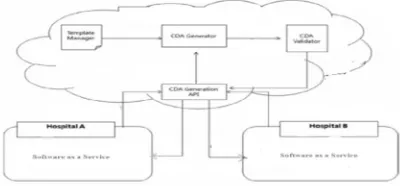
[image:2.612.202.402.626.719.2]B. System Architecture
Fig. 1 indicates plan of CDA. Healing facility An and Hospital B are shown to demonstrate that it is anything but difficult to produce CDA reports on an assortment of stages.
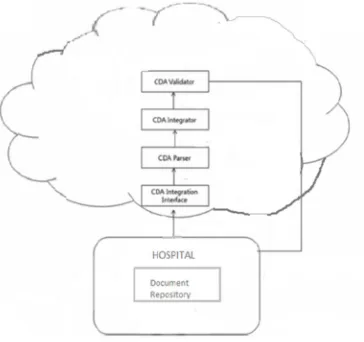
Fig. 2. CDA integration system
Fig. 2 shows one in CDA Document Integration System. Chronic patients especially are very likely to have been consulted by multiple physicians in different hospitals. In this case, CDA documents may be scattered in different locations. Therefore, multiple CDA how multiple CDA documents are integrated into documents needs to be integrated into single CDA document.which converts each input CDA document to JSON .
IV. RESULT
This snapshots show that home page through which user will give user id and password in order to login into the account and make use of the services provided through this application.
[image:3.612.198.418.383.529.2] [image:3.612.198.419.568.711.2]Above snapshots show that , admin panel. This panel include request, manage clinic, request CDA.
Above snapshots shows that , hospital registration form for new user . new user fill up information for registration.
Above snapshots shows that, hospital login form. Only Register hospital can login.
1) This graph shows the latency time, or time taken by the web service to retrive CDA document i.e in json/xml format and return it back to the client.
2) This graph shows the time taken by parser to parse the CDA document which is in json/xml format respectively.
3) This graph shows the time taken by web service to locate and access the respective CDA document from the disk drive location, respectively.
V. CONCLUSION
REFERENCES
[1] Y. Kwak, “International standards for building electronic health record (ehr),” in Proc. Enterprise Netw. Comput. Healthcare Ind.,pp. 18–23, Jun. 2005. [2] M. Eichelberg, T. Aden, J. Riesmeier, A. Dogac, and Laleci, “A survey and analysis of electronic healthcare record standards,” ACM Comput. Surv., vol. 37,
no. 4, pp. 277–315, 2005.
[3] T. Benson, Principles of Health Interoperability HL7 and SNOMED.New York, NY, USA: Spinger, 2009.
[4] J. L€ahteenm€aki, J. Lepp€anen, and H. Kaijanranta, “Interoperability of personal health records,” in Proc. IEEE 31st Annu. Int. Conf.Eng. Med. Biol. Soc., pp. 1726–1729, 2009.
[5] R. H. Dolin, L. Alschuler, C. Beebe, P. V. Biron, S. L. Boyer,D. Essin, E. Kimber, T. Lincoln, and J. E. Mattison, “The HL7 Clinical Document Architecture,” J. Am. Med. Inform. Assoc., vol. 8,pp. 552–569, 2001
[6] R. H. Dolin, L. Alschuler, S. Boyer, C. Beebe, F. M. Behlen, P. V.Biron, and A. Shabo, “The HL7 Clinical Document Architecture,”J. Am. Med. Inform. Assoc., vol. 13, no. 1, pp. 30–39, 2006
[7] M. L. M€uller, F. Ǖckert, and T. B€urkle, “Cross-institutional data exchange using the clinical document architecture (CDA),” Int. J.Med. Inform., vol. 74, pp. 245–256, 2005
[8] H. Yong, G. Jinqiu, and Y. Ohta, “A prototype model using clinical document architecture (CDA) with a japanese local standard:designing and implementing a referral letter system,” Acta Med Okayama, vol. 62, pp. 15–20, 2008.
[9] K. Huang, S. Hsieh, Y. Chang, F. Lai, S. Hsieh, and H. Lee,“Application of portable CDA for secure clinical-document exchange,” J. Med. Syst., vol. 34, no. 4, pp. 531–539, 2010.
[10] Gorp, P. V., Comuzzi, M., Fialho, A., & Kaymak, U. (2012). Addressing health information privacy with a novel cloud-based PHR system architecture. 2012 IEEE International Conference on Systems, Man, and Cybernetics (SMC). doi:10.1109/icsmc.2012.637800
[11] Narayanan, H. A. J., & Gunes, M. H. (2011). Ensuring access control in cloud provisioned healthcare systems. 2011 IEEE Consumer Communications and Networking Conference (CCNC). doi:10.1109/ccnc.2011.5766466
[12] Paterson, G. I., Shepherd, M., Xiaoli Wang, Watters, C., & Zitner, D. (n.d.). Using the XML-based Clinical Document Architecture for exchange of structured discharge summaries. Proceedings of the 35th Annual Hawaii International Conference on System Sciences. doi:10.1109/hicss.2002.994069
[13] Lee, S.-H., Song, J. H., & Kim, I. K. (2016). CDA Generation and Integration for Health Information Exchange Based on Cloud Computing System. IEEE Transactions on Services Computing, 9(2), 241–249. doi:10.1109/tsc.2014.2363654
[14] M. Armbrust, A. Fox, R. Griffith, A. D. Joseph, R. Katz, A. Konwinski, G. Lee, D. Patterson, A. Rabkin, I. Stoica, and M. Zahari [15] S. Lee, J. Song, and I. Kim,proposed clinical document architecture integration system to support patient referral and reply letters
[16] Dolin, R. H., Alschuler, L., Boyer, S., Beebe, C., Behlen, F. M., Biron, P. V., & Shabo (Shvo), A. (2006). HL7 Clinical Document Architecture, Release 2. Journal of the American Medical Informatics Association, 13(1), 30–39. doi:10.1197/jamia.m1888
[17] Robert H. Dolin, Liora Alschuler, Sandy Boyer, Calvin Beebe. “An Update on HL7’s XML-based Document Representation Standards”, Proc. of the AMIA 2000 Annual Symposium November 4-8, 2000, Los Angelos, California.