Recent Advances in Palm Vein Recognition using
Minutiae-Based and Texture-based Feature
Extraction Methods
Vandana S. Bujare1, Jayamala K. Patil2 1
P.G.Scholor, 2Associate Porf. Dept.of Electronics and Telecommunication Engineering, Bharati Vidyapeeth’s College of Engineering, Shivaji University, Kolhapur, India.
Abstract: Biometric system is highly used for security purpose in many recent applications. Texture based, Line based, Appearance based, Code based methods are used for feature extraction. Mainly, two methods are used for palm vein feature extraction which are minutiae-based and texture descriptor-based. Many researchers are attracted by Texture based approaches during the last years compared to minutiae based approach which segment veins first and then extract the information of singular point. This facilitated use of texture features in palm vein detection. The study presented in this paper is an extensive survey of the Minutiae-based and Texture-based feature extraction for palm vein recognition.
Keywords: Palm vein, feature extraction, Minutiae-based, Texture-based
I. INTRODUCTION
Security is the most vital aspect in various applications like, ATM transactions, border crossing control and door access control etc. Many authentication parameters are used for security systems which are password, keys, card etc. Every individual has specific biometric features which facilitate the use of biometric parameters for security. Hence biometric systems are preferred than other security systems. The later have different problems like forgotten password, lost keys and cards duplication. But in biometric system the person himself/herself is required for authentication process. Hence biometric systems are free from the problems like duplication, forgotten, lost etc [1]. Biometric systems are divided into two main types i.e. Physiological and Behavioral system. Physiological system consists of fingerprint/vein, palmprint/vein, facial, iris, hand geometry and Behavioral system consists of voice, signature and keystrokes. The Physiological system proved most useful in many applications. The security systems based on face recognition technique has various features based on illuminations and facial expressions but performance of face recognition is highly dependent on illumination conditions and facial expressions. The security systems based on Iris recognition techniques have a better accuracy but devices used for capturing patterns are more expensive as compared to other biometric systems [2]. Hence to get ride of the above limitations, vein pattern recognition system is widely preferred. In a Physiological Biometric system, vein pattern have more accuracy than other bio- parameters such as fingerprint, palmprint, face and iris. In fingerprint and palmprint technique, user’s finger and palm surface are laid on the surface of input sensor. This captures significant finger and palm prints and then these are provided to relevant systems which extract features from prints and uses for further security reasons. This system may have limitation of less accuracy in situations where finger and palm surface are with sweat, dryness, dirt, oiliness etc because skin distortion can degrade recognition accuracy.Finger have small surface area as compared to the palm surface hence palm vein pattern gives better result than finger vein pattern. The security system based on palm vein pattern needs Preprocessing, Feature extraction and Feature matching as major processing steps as shown in figure 1.
The Preprocessing step consists of two phases such as (i) Hand segmentation (ii) ROI (Region of Interest) detection and Enhancement. The Feature extraction stage is used to extract many features using various Texture based, Line based, Appearance based, Code based feature extraction methods. The final step of security system is Feature matching, in which features are matched using different algorithms.
Mainly, two methods are used for palm vein feature extractions which are Minutiae-based and Textured-based. Section 2 and 3 gives brief information of work done by earlier researches in the field of palm vein recognition using Minutiae- based, Texture-based feature extraction methods respectively and section 4 presents conclusion of the study.
II. MINUTIAE-BASED FEATURE EXTRACTION METHOD A. Basics of Minutiae-Based Feature
In fingerprint and palmprint biometric system, fingerprint and palmprint patterns may be characterized by a number of significant points. These significant points are ridge endings and ridge bifurcation. These points are also known as “Minutiae Points” which are extensively used as features to match a fingerprint and palmprint pair. Similarly the set of minutiae points is also used in vein patterns representation and recognition. Figure 2 shows an image showing minutiae points [3]. Addition to these significant points, Branching points and Ending points are used for vein pattern extraction [4].
Fig.2 Palmprint image with Minutiae, Ridges and Singular Points
To extract the Minutiae points from the vein pattern images, the skeleton structure of the vein pattern needs to be obtained. The 3x3 region mask shown in figure 3 can be used to find the junction points from the skeleton structure of vein patterns. The resultant of pixel-wise operation between this 3x3 region is known as “Cross Number (CN)”.
Fig.3 3x3 Region
In figure 3, point P0 will be seen as Bifurcation point (BP) when the value of P0 is 1 and Ntrans is greater or equal to 6. When Ntrans
is equal to 2, then it will be referred as Ending point (EP). Here number of transition (Ntrans) denotes the alternate changing
frequency 0 to 1. Mathematically, it is represented by using equation (1).
N =∑ |P −P | When P9=P1 (1)
B. Study of Earlier Research Based on Minutiae-Based Features
Lingyu wang et.al [4] proposed system for infrared hand vein pattern. The hand vein patterns are analyzed by using minutiae feature method. Minutiae feature extraction is applied on back hand vein patterns. This technique includes feature points like bifurcation points and ending points. The vein patterns geometric shape is identify by using these feature points. Each vein pattern image contains 13 minutiae points, including 7 bifurcation and 6 ending points. To compute the discriminating power of these minutiae point for person verification modified Hausdorff distance algorithm is used. The Equal Error Rate (EER) of this system reaches to 0%. It is noted that this is a time-consuming process and data collection of vein pattern is expensive.
B. Prasanalakhsmi et.al [5] developed system for palm vein Biometrics which is used for generating secure cryptosystem in smart card. Irrevocable cryptographic key is generated by using biometric template and smart card is authenticated by using this key. Developed system generated patterns which are extracted by minutiae point. The palm images are collected from using Fijitsu’s website. The accuracy of this system is high. If the similar technique is applied on another database then high accuracy results may obtain. The proposed system is used for multi level authentication with biometric, key and card.
D. Hartung et.al [6] developed system for vein pattern recognition using spectral minutiae. Minutiae feature includes end points and branch points. For distinguish individual’s image the skeletonised vein images are used for extracting the end points and branch points. Vein minutiae are extracted from images and converted these images into a fixed-length. This proposed system is implemented with three different databases of palm dorsal and wrist samples. The spectral minutiae is introduced as complex when orientation is used in addition to minutiae location. To solve this problem fast convolution method is proposed in this system with minutiae orientation extraction algorithm. As compared to other point-to-point-based approaches this proposed system has better performance.
Tjokorda Agung Budi Wirayuda [7] proposed system for recognizing the palm veins using Minutiae feature. ROI is extracted using CHDV algorithm. Maximum curvature is used as a preprocessing step. Palm vein texture features are extracted by using minutiae feature vector and finally weighted Euclidean score is used for feature matching. Maximum curvature technique creates the veins pattern of palm. Accuracy of 91.00% is obtained by the developed system usinghistogram equalization.
III. TEXTURE-BASED FEATURE EXTRACTION METHOD A. Basics of Texture-Based Feature
In pattern recognition texture features plays a vital role. Texture is defined in terms of some properties such as coarseness, smoothness and regularity. Statistical, structural and spectral are the three principal approaches used to describe the texture of region. Palm print follows a structure of vein patterns. Hence use of Texture based features for palm vein recognition gives better result compared to other image features. Number of different Texture-based features are available which includes Local Binary Pattern (LBP), Gabor filter, Gray-level co-occurrence matrix (GLCM), Auto correlation, Edge frequency, Primitive length etc. Earlier researchers found that Local Binary Pattern (LBP) texture feature is more effective in recognition system as compared to other texture features. The different variants of LBP are tested by researchers for such applications which include Uniform Local Binary Pattern (LBPU) [8], Local Line Binary Pattern (LLBP) [9] and Diagonal Cross Local Binary Pattern (DCLBP) [10].
1) Local Binary Pattern (LBP): Local Binary Pattern (LBP) is widely used for texture feature extraction. LBP operator requires grayscale image and it creates 8 digit binary patterns which is referred as ‘Local Binary Pattern’. 3X 3 neighborhood of pixel is used to generate LBP value as shown in figure 4. Here the middle pixel is called as “central pixel (CP)” whose value is compared with neighboring pixels.
Fig.4 LBP structure
LBP(p ) = δ(f −f )2 (2)
( ) = 1,0, < 0≥0 (3)
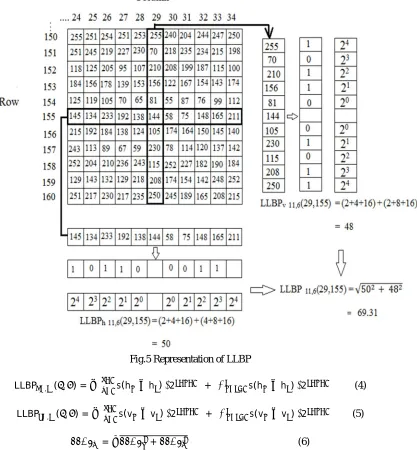
[image:4.612.116.533.209.659.2]2) Local Line Binary Pattern (LLBP): The advance method of Local Binary Pattern (LBP) is Local Line Binary Pattern (LLBP). It is noted that [9] LLBP texture feature is more effective than LBP in the palm vein images having indistinct veins patterns. LLBP includes two components such as 1) Vertical component (LLBPv) and 2) Horizontal component (LLBPh) as shown in figure 5. The resultant value of LLBP is computed using equation (4), (5) and (6).
Fig.5 Representation of LLBP
LLBP , ( , ) = s(h −h )∙2 + ∑ s(h −h )∙2 (4)
LLBP , ( , ) = s(v −v )∙2 + ∑ s(v −v )∙2 (5)
= + (6)
Fig.6 Representation of DCLBP
, (N ) =
∑| | ,| | × ∈
(7)
B. Study of Earlier Research Based on Texture-Based Features
Alicia Aglio-Caballero et.al [8] developed system for palm vein recognition with two feature extraction methods which are Local Binary Pattern (LBP) and Uniform Local Binary Pattern (LBPU). These two methods are analyzed for palm vein pattern recognition. The contact-less palm veins image database is collecting from CASIA Multi-spectral Palmprint Image Database V1.0. This system includes mainly three steps: 1) Pre-processing, 2) Feature extraction and 3) Matching. Pre-processing is done with a) Hand segmentation, b) Meaningful points detection, c) ROI detection and Enhancement. In a second step LBP and LBPU are used for palm vein texture extraction. And in a final step Distance-Based Matching technique is used for matching process. As per analysis the performance of LBP is slightly better than LBPU. Jayanti Yusmah Sari et.al [9] developed Local line binary Pattern (LLBP) texture feature operator for palm vein recognition system. In the palm vein recognition system segmentation is important term and it depends on the clarity of the image. When palm vein image is clear then, this image is segmented properly. To overcome this problem, authors developed system with LLBP feature for vein patterns recognition. It is found that the developed method gives better results even if vein pattern images are indistinct. The system is developed in four steps. Finding Region of Interest (ROI) of palm vein image, preprocessing palm vein image feature extraction using LLBP operator and feature matching using Fuzzy K-NN classifier are the four steps. CASIA multi spectral image database is used for the proposed system. The accuracy of 97.3% is obtained by implemented LLBP system. It is found that in the palm vein recognition system LLBP feature extraction method is more reliable than LBP feature extraction method. Dini Fronitasari et.al [10] proposed Local Binary Pattern (LBP) feature extraction method. The image is preprocessed to select Region of Interest (ROI). Proposed system used LBP operator for vein extraction and Neural Network (PPN) algorithm is used for matching purpose. Palm vein recognition accuracy is improved by this implemented system. The modified LBP i.e. diagonal cross local binary pattern (DCLBP) is also used to extract the palm vein pattern and it provides better accuracy than the basic local binary pattern (LBP).
Wenxiong Kang et.al [12] developed system for contactless palm vein recognition using mutual foreground-based Local Binary Pattern (LBP) technique. LBP operator is widely used for representing the texture pattern and it has ability to provide better results. But when palm vein images have sparse texture patterns then performance is low, in a particularly cases like contactless palm vein matching system. To overcome this problem the proposed systems using mutual foreground Local Binary Pattern method is used for improving the matching results for recognition system. To suppress the noise and improve the accuracy & robustness, the K-means method and the principal curvature algorithm are used for texture extraction. The contactless palm vein images are collected from CASIA multi spectral palmprint image database V1.0. The low equal error rate of 0.267 % is obtained by this developed system. It is found that the proposed system is effective and feasible for recognition of contactless palm vein patterns.
tested for palm vein pattern recognition technique. The developed method is implemented on CASIA multi-spectral palmprint image database V1.0. LBP and LDP operators are proved to be well adapted in computational simplicity and efficiency for palm vein recognition. It is found that LDP operator give higher performance than LBP operator. And recognition performance of LDP and LBP operator compared with combination of these operators. As per comparisons LDP gives better performance than LBP operator and fusion of LBP, LDP operator.
IV. CONCLUSION
Paper presents study of two approaches extensively used in palmprint/vein recognition. The study presented in section 2 reveals that the accuracy of recognition systems based on Minutiae points is 91.00% [7]. Also it is found that vary less number of feature points i.e.13 are extracted by this method which reduced flexibility of recognition process. Further it is found that more time is required for this process. The study presented in section 3 revels that the recognition accuracy obtained by texture based features like Local Binary Pattern (LBP) and its variants is high as compared to Minutiae-Based feature. Local Line Binary Pattern (LLBP) provided 97.3% of recognition accuracy [9] which indicates that Texture-Based methods are superior to minutiae points based recognition methods. Hence there is wide scope for developing various recognition methods based on LBP and its variants
REFERENCES
[1] Mouad .M.H.Ali, “Study Of Edge Detection Methods Based On Palmprint lines”, International Conference on Electrical,Electronics, and Optimization Techniques (ICEEOT) – 2016.
[2] R. Rizal Isnanto, Risma Septiana, Ajub Ajulian Zahra, Ilina Khoirotun Khisan Iskandar, Galih Wicaksono, “Comparison Analysis between Implementation of Principal Components Analysis and Haar Wavelet as Feature Extractors in Palmprint Recognition System”, Dept. of ComputerEngineering Diponegoro University Semarang, Indonesia.
[3] Hand-Based Biometric Identification using Energy Compaction in Transform Domain including New Multi-resolution Hybrid Wavelet, 2010-2013, pp.12-25.
[4] Lingyu Wang, Graham Leedham, David Siu-Yeung Cho, “Minutiae feature analysis for infrared hand vein pattern biometrics”,Pattern Recognition Society. Published by Elsevier Ltd. All rights reserved.doi:10.1016/j.patcog.2007.07.012.
[5] B.Prasanalakshmi, A.Kannammal, “Secure Cryptosystem from Palm Vein Biometrics in Smart Card”, 2010 IEEE, pp. 653-657.
[6] D. Hartung, M. Aastrup Olsen, H. Xu, H. Thanh Nguyen, C. Busch, “Comprehensive analysis of spectral minutiae for vein pattern recognition ”, IET Biometrics, 2012, Vol. 1, Iss. 1, doi: 10.1049/iet-bmt.2011.0013, pp. 25–36.
[7] Tjokorda Agung Budi Wirayuda, “Palm Vein Recognition Based-on Minutiae Feature and Feature Matching”, The 5th International Conference on Electrical Engineering and Informatics 2015 August 10-11, 2015, Bali, Indonesia, pp.350-355.
[8] Alicia Aglio-Caballero, Belen Rios-Sanchez, Carmen Sanchez-Avila, Maria Jose Melcon de Giles, “Analysis Of Local Binary Patterns And Uniform Local Binary Patterns For Palm Vein Biometric Recognition”, 2017 IEEE.
[9] Jayanti Yusmah Sari, Chastine Fatichah, and Nanik Suciati, “Local Line Binary Pattern For Feature Extraction On Palm Vein Recognition”, Journal of Computer Science and Information, Volume 8, Issue 2, June 2015, DOI: 10.21609/jiki.v8i2.309, pp.116-123.
[10] Dini Fronitasari, Dadang Gunawan, “ Palm Vein Recognition by using modified of Local Binary Pattern (LBP) for Extraction Feature”, 2017 15th Intl. Conf. QiR: Intl. Symp. Elec. and Com. Eng, pp.18-22.
[11] Jayamala K.Patil, Raj Kumar, “Comparative Analysis of Content Based Image Retrieval using Texture Features for Plant Leaf Diseases”, International Journal of Applied Engineering Research ISSN 0973-4562 Volume 11, Number 9 (2016) pp6244-6249.
[12] Wenxiong Kang, Qiuxia Wu, “Contactless Palm Vein Recognition Using a Mutual Foreground-Based Local Binary Pattern” , IEEE Transactions On Information Forensics And Security, Vol. 9, No. 11, November 2014, pp.1974-1985.