Study the Behavior of Y, Cb and Cr of Ycbcr on
Blurred Image Segmentation using Local
Thresholding
Amit Kumar Mandal1, Achinta Saikia2, Satish Das3
1
Department of Computer Science, Moridhal College, Dhemaji, Assam, India
2
Department of Statistics, Dibrugarh University, Dibrugarh, Assam, India
3
Department of Computer Science & Engineering, Rajiv Gandhi University, Arunachal Pradesh, India
Abstract: Defocus blur is undesirable. In this paper, we studied the effect of luminous (Y), chromium blue (Cb) and chromium red (Cr) components of YCbCr on defocus blurred image while segmenting using loca thresholding technique. There are different techniques for blur detection and segmentation. But there are very few works which are based on YCbCr. In this paper, RGB image is transformed into YCbCr color space and then the transformed image is split into three different components based on luminance and chrominance. Subsequently local thresholding is applied separately for all three components for segmentation. Then we made a comparative study of segmented results.
Keywords: Defocus, blur, YCbCr, luminous, chromium blue, chromium red, segmentation, local threshold.
I. INTRODUCTION
An image can contain lots of useful information. To understand the image and to extract information from the image, there are different image processing operations. The first step is image segmentation. Image segmentation, in digital image processing, is a process of partitioning an image into multiple meaningful segments. These segments are often based on the characteristics of the pixels in the image, such as color, texture, intensity, etc. Image segmentation is generally used to detect objects and boundaries in the image. There are two segmentation techniques: contextual segmentation and non-contextual segmentation. The non-contextual techniques do not take the account of spatial relationships between features present in an image and group of pixels together on the basis of some global attribute, e.g. grey level or color. On the other hand contextual techniques additionally exploit these relationships, e.g. group together pixels with similar grey levels and close spatial locations. Our interest is non-contextual segmentation technique as it is simple technique compared to the contextual.
Thresholding is one of the simplest non-contextual segmentation techniques. It is used separate foreground from the background. There are mainly two categories of thesholding: global thresholding and local thresholding. In the global thresholding, a single threshold value is used in the whole image. In the local thresholding, a threshold value is assigned to each pixel to determine whether it belongs to the foreground or the background pixel using local information around the pixel. When the intensity distribution of objects and background pixels are sufficiently distinct, global thesholding is preferred. But the images whose intensity distributions are not distinct require local thresholding as the threshold value at any point depends on the properties of neighborhood of that point.
A. Local Thresholding
In local thresholding, a threshold is computed at every point (x,y) in the image based on one or more specified properties computed in a neighborhood of (x,y). Local thresholding can be done using standard deviation and mean of the pixels in a neighborhood of every point in an image. These two quantities are useful for determining the local thresholds because they are descriptors of local contrast and average intensity.
Let бxy and mxy denote the standard deviation and mean value of the set of pixels contained in a neighborhood, Sxy, centered at coordinates (x,y) in an image. The following are common forms of variable, local thresholds :
Txy = a бxy + b mxy
where a and b are non negative constants, and Txy = a бxy + b mG
The Segmented image is computed as
g(x,y) = 1 if f(x,y) >Txy 0 if f(x,y) <=Txy Where f(x,y) is the input image.
This equation is evaluated for all pixel locations in the image, and a different threshold is computed at each location (x,y) using the pixels in the neighborhood Sxy.
B. YCbCr Color Space
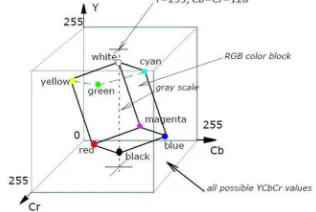
[image:2.612.227.385.255.361.2]YCbCr is a color space. It is not a absolute color space; it is way to encode RGB information. It represents color as brightness and two color difference signals. It has three components: luminance (Y), chromium blue (Cb) and chromium red (Cr). Cb means blue minus luminance and Cr means red minus luminance. In general, RGB is not efficient for object specification and recognition of color. In contrast to RGB, the YCbCr color space is lumma-independent, resulting in better performance. The luminance component can be used for separately for storage in high resolution and Cb and Cr can separately be considered for improving the performance.
Fig. 1: RGB cube in the YCbCr color space
To convert from RGB to YCbCr, one variant of this color space (according to ITU-R BT.709): Y = 0.2126 *red+0.7152*green+0.0722*blue
Cb = 0.5389*(blue-Y) Cr = 0.6350*(red-Y)
Most of the images usually contain two types of the regions: blurred and sharp. Blur is a phenomenon in which an image is out of focus and edges are not sharp. It is a degradation problem and is mainly due to incorrect focus. Blur makes image signals lose a lot
of clear details globally or locally. Blur can be categorized mainly into two types: defocus blur, which is caused by the optical
imaging system and motion blur, which is caused by the relative motion between camera and scene objects. There are different research works on detection and separation of blurred area and objects. Here we studied and learnt the effect of different components of YCbCr on the blurred area of image
II. RELATED WORK
Packyanathan et al. proposed a system that segmented satellite image based on YCbCr color space and Fuzzy. In 2016 X. Yi proposed sharpness metric based on local binary patterns and a robust segmentation algorithm to separate in- and out-of-focus image regions. Using this metric together with image matting and multi-scale inference, they obtained high quality sharpness maps. In 2018 DJ Chen et al. proposed a learning-based approach to this new and-shoot scenario of interactive segmentation. The tap-and-shootinteraction provided useful latent information about the scene, and their approach could learn to extract the selection and defocus cues for segmenting the target object.
III. THE ALGORITHM
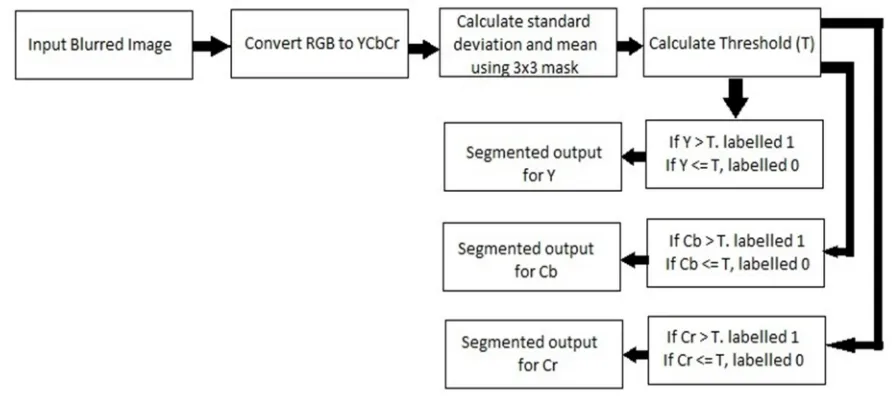
First we take a blurred image as an input. Here the image pixels are considered as a one-dimensional array. Then we compute the RGB value of each pixel in the image. The RGB values are then converted to YCbCr color space. It is done by using the following transformation:
Y = 0.2126 *red + 0.7152*green +0.0722*blue Cb = 0.5389*(blue-Y)
Cr = 0.6350*(red-Y)
These values of Y, Cb, Cr are used for further calculations.
For the computation a 3x3 mask has been selected. It should be kept small. This mask slides all over the image and place the centre of the mask on the pixel for which we need to calculate the threshold. The algorithm then computes the mean and standard deviation of the pixels in the neighborhood of the specified pixel.
The general form for calculating the Mean and Standard Deviation value are as shown below:
Mean: = ∑ ∑ ( , )
Standard Deviation: = ∑ ∑ [ ( , )− ]2
Where M = Number of rows of the image N = Number of columns of the image.
The calculation of Standard Deviation and Mean is taken into account varying number of pixels. This is because for some of the pixels in the extreme boundary of the image, some portion of the mask will go outside the image region. So we need to take only those regions of the mask which are inside the image. The calculated standard deviation and mean are then used to calculate the threshold value for that pixel. The following expression is used for calculating the threshold:
T= a*бxy+b*mxy ,
where a and b are non negative constants.
[image:3.612.79.526.506.705.2]The values of Y, Cb and Cr of the pixel are then compared with the threshold value. If the value of Y, Cb and Cr is greater than the threshold the pixel is labeled as 1 .Otherwise if the value is less than or equal to the threshold than the pixel is labeled as 0.
IV. EXPERIMENT AND ANALYSIS
We implemented the above algorithm using Java 12.0.1 programming language in Windows 10 environment. These were implemented in Quad-core machine having 2.6 GHz and 2GB main memory.
We have tested the system with various images. For that we used two sets of images: 1) sharp image and 2) blurred image with linear motion blur having length (l) = 25 and angle (a) = 0. Then again we categorized them into: 1) images which have sufficiently distinct objects from the background and 2) images which have different objects and they were not distinct from the background. We tested almost 150 jpeg images.
Fig. 3: (a) Sharp image with distinct foreground and background (b) Y component (c) Cb component (d) Cr component
Fig. 4: (a) Blurred image (l = 25, a = 0) with distinct foreground and background (b) Y component (c) Cb component (d) Cr component
Fig. 2: (a) Sharp image with semi distinct foreground and background (b) Y component (c) Cb component (d) Cr component
Fig. 2: (a) Blurred image (l = 25, a = 0) with semi distinct foreground and background (b) Y component (c) Cb component (d) Cr component
Fig. 2: (a) Sharp image with indistinct foreground and background (b) Y component (c) Cb component (d) Cr component
[image:4.612.76.536.171.234.2] [image:4.612.74.537.353.427.2] [image:4.612.76.539.455.528.2] [image:4.612.65.532.569.630.2] [image:4.612.71.532.660.710.2]From the experiment, it is shown that the luminous component (Y) gives the better segmented results compared to the chromium blue (Cb) and chromium red (Cr) component. In case of blurred image, lots of small information is missing from the segmented image. As a result some areas, separated by small differences, grouped together to form a larger area. From the Fig. 3, Fig. 4, Fig. 7, Fig. 8, it is shown that Cb component gives the better segmentation than the Cr component. But Cb component in Fig. 5 and Fig. 6 gives better segmented image than the Cr component. From these, we came to learn that may be Cr component works comparatively well when there is high color contrast. Y always gives better segmentation in both sharp and blurred cases.
V. CONCLUSION
In this paper we have made a comprehensive study to learn the effects of luminous, chromium blue and chromium red components on blurred defocus image segmentation while using local thresholding technique. Generally RGB color space is not efficient for object specification and recognition of color. Further, there are luminance and chrominance components and it becomes difficult to determine specific color in RGB color space. So we need to transform RGB to YCbCr. Moreover, blurred image holds fewer details to get satisfactory segmented result. We used threholding as it is easy to compute and implement. From our experiment we learnt that different components of YCbCr behave differently on different situation.
REFERENCES
[1] C. Swain, T. Chen, Defocus-based image segmentation, Acoustics, Speech and Signal Processing, 1995, 4, 2403-2406.
[2] J. H. Elder and S. W. Zucker, Local Scale Control for Edge Detection and Blur Estimation, IEEE Transactions On Pattern Analysis And Machine Intelligence, 1998, 20(7), 699-716.
[3] J. D. Rugna and H. Konik. Automatic blur detection for metadata extraction in content-based retrieval context. SPIE, 2003, 5304, 285–294.
[4] H. Tong, M. Li, H. Zhang, and C. Zhang, Blur detection for digital images using wavelet transform, Proceedings of IEEE International Conference on Multimedia&Expo, 2004, 17–20.
[5] Y.C. Chung, J. M. Wang. R. R Bailey and S.W. Chen, A non-parametric blur measure based on edge analysis for image processing applications, Proceedings of the 2004 IEEE Conference on Cybernetics and Intelligent Systems, Singapore, 2004, 356-360.
[6] R. Liu, Z. Li, and J. Jia, Image partial blur detection and classification, IEEE Conference on Computer Vision and Pattern Recognition, 2008.
[7] B. Su, S. Lu and C. L. Tan, Blurred image detection and classification, Conference: Proceedings of the 19th International Conference on Multimedea 2011, USA, 2011
[8] V. Power, A. Jahagirdar and S. Sirsikar, Skin Detection in YCbCr Color Space, International Journal of Computer Applications, 2011, 1 – 4.
[9] A. K. Mandal and D. K. Baruah, Image Segmentation Using Local Thresholding and YCbCr Color Space, International Journal of Engineering Research and Application, 2013, 3(6), 511-514.
[10] G. E. Suji, Dr. Y. V. S. Lakshmi, and Dr. G. W. Jiji, MRI Brain Image Segmentation based on Thresholding, International Journal of Advanced Computer Research, 2013, 3(1), 97 – 101.
[11] J. Shi, L. Xu and J. Jia, Just Noticeable Defocus Blur Detection and Estimation, IEEE Conference on Computer Vision and Pattern Recognition, 2015, [12] G. Packyanathan, R. Veeraraghavalu, B. S. Satish and V. Kalist, Satellite Image Segmentation Based on YCbCr Color Space, Indian Journal of Science and
Technology, 2015, 8(1), 35- 41.
[13] X. Yi and M. Eramian, LBP-Based Segmentation of Defocus Blur, IEEE Transactions on Image Processing, 2016, 25(4).
[14] A. Alvaro, A. Jose, G. Flipe and G. Sergio, Image Segmentation Using Fuzzy InferenceSystem on YCbCr Color Model, Advances in Science, Technology and Engineering Systems Journal, 2017, 2(3), 460-468.