Efficient Street Light System
P. Sreevardhan1, p. Arun raj2, a. Snigdha3
1, 2, 3
Bachelor of Technology - Electronics and Communication EngineeringGeethanjali College of Engineering and Technology
Abstract: This Project work presents a new economical solution for street light control systems. Today street lights system is not flexible most of the controlling is done manual by whereas some are automated based on environment parameters. Biggest problem is to handle remote area locations. Manual mistakes result into power wastage. So there is a need of efficient street light system to provide wireless access for controlling it. The project deals with the issue caused due to underutilization of resources and also overcome the negligence of common workers. The implemented system has facilities like:
1) Lights will be turned ON only during dark hours typically (6pm to 6am).
2) Lights can be made ON/OFF as per required timing
3) Lights can also be turned ON/OFF using by IR Sensors based on the movement of vehicles.
The control system consists of a control circuitry and the electrical devices. This also includes client server mechanism where user can directly interact with web based application to control the Street lights from any place with the help of Web page. This ranges from controlling a circuit of street lights and/or individual light, with android application and network operating protocols. This includes sending and receiving instructions via separate data network. Proposed system controls all the street lights using Web pages. All the street lights are generally connected to a junction. These junctions are controlled by an android application/Web page and as per the need, street lights can be switched ON/OFF. The main aim is to provide IP to every junction which can be controlled through internet. The primary objective is to develop efficient Street Light System.
To provide wireless access for handling it.
Need some Server which can be used to monitor whole city’s street lights. Low-cost Internet technology can be used for remote access.
Controlling the street lights based on the traffic intensity only during the nights.
Keyword: Traffic Intensity, Web based application, IR Sensor, IP, client server mechanism
I. INTRODUCTION
Street lights are the key factor of any city to make it smart city. But we have seen such situation where our street lights are ON in presence of daylight. So we want to develop such a system which will operate street lights of the city at any time. The motivation of this project is to design a smart lighting system which targets the energy saving and autonomous operation which is economical and affordable for the streets.
Design a smart lighting system with modular approach design, which makes the system scalable and reliable. Design a smart lighting system which is compatible and scalable with other commercial product and automation systems, which might include more than one lighting systems.
This project presents a new economical solution for street light control systems. The control system consists of a control circuitry and the electrical devices. This also includes client server mechanism where user can directly interact with web based application to control the Street light from any place with
the help of web application. A street light control system has been developed to control and reduce energy consumption of a town’s public lighting system.
This ranges from controlling a circuit of street lights and/or individual light with web application and network operating protocols. This includes sending and receiving instructions via separate data networks, at high frequency over the top of the low voltage supply or wireless. Street lights are connected to the junction.
There are multiple junctions each junction covering some particular part of the city.
The main aim is to provide IP to every junction which can be controlled through internet. The main motivation behind implementing project is to save energy. It is an automated system designed to increase the efficiency and accuracy on automated time control, governed and also on traffic density basis.
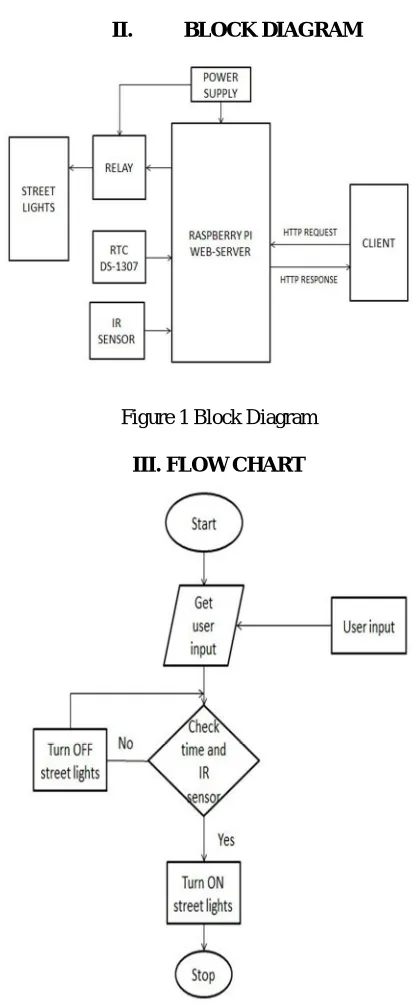
II. BLOCK DIAGRAM
Figure 1 Block Diagram
III. FLOW CHART
Figure 2 Algorithms / Flow Chart
III. OPERATING PROCEDURE
In this project we use four functional components. Those are Raspberry pi zero w, Real Time Clock, IR sensor and Relays. Here we are using Raspberry pi zero w for controlling the operation of street lights.
native library to keep track of time and interact with our JavaScript code. The express.js library accepts and processes the HTTP requests and also responds to the requests by serving a specified web page.
That web page is responsible for accessing and controlling the street lights.
This web page has a form, which is to filled by the end user, that form contains timing inputs and after hitting the submit button the client sends the timing information’s which has to be processed at the server side.
Since the information is encoded and encapsulated in the body of the webpage that has to be processed by the server by using a dependency called “body-parser”. The body-parser filter the information from the client at the server, all the information obtained at the server is in string format this has to be converted to integral format type or int data type to process the timing information. The Real Time Clock is interfaced with the raspberry pi to keep track of time since the raspberry pi zero w doesn’t have an inbuilt timer, to keep track of time .The real time clock used here is DS1307.
Along with this there is also an IR sensor, which detects the obstacles or objects and performs a specific operation; in this case it turns on the street light at a specific time when the traffic intensity is low.
The Raspberry Pi Zero W listens to the HTTP requests at a specified port. When a user makes a request or hits the Static IP address in the browser along with the port number, the Pi zero W process this requests and serves the client a web page form. Here the Raspberry Pi Zero W acts as Server and the end user as the Client.
The client enters the specific time intervals from which the street lights has to turn on and when they should be turned off and also a delay time. The delay time specifies the duration amount till which the street light has to be on.
The web page has four turn on times t1, t2, t3 and t4. The street light will be turned on from interval t1 to t2 and t3 to t4 and will be turned off during the rest of the intervals.
The Street lights will be turned off from the interval t2 to t3, here the IR Sensor will come into picture, the IR Sensor is placed strategically at specific check point where traffic intensity is likely to be high or that check point could be the entry point for a specific location. During the period t2 to t3, the IR Sensor detects the Vehicle movement and turns on the street lights. The raspberry pi zero w doesn’t turn on the street lights they have to be coupled with relays to turn on the street lights.
The raspberry pi provides the control signal to the relays which turn on and turn off the street lights. The raspberry pi has to be provided with external backup power supply.
The raspberry pi has to be provided with the static IP address, this address is given to the user and the IP address along with port number is hit in the browser the client connects to the server, provided the client has access to the internet. The web server or raspberry pi zero w has to be in the same network as of the client and the client will be able to connect to the server.
Execution Procedure:
Connect to Raspberry pi via VNC Viewer or any other Remote Desktop application Then open the terminal and type the following commands:
“cd Desktop/fp/final-mod-light” and then hit enter “node app.js”, hit enter
Then a port number will be displayed in the terminal which is already pre-configured by the user to which they have to connect. A web page will be displayed through which the street lights will be controlled. The first two timings specify the interval during which the lights should be ON and so do the second two timing inputs also.
The time duration between the first and the second time limits specify when they should be OFF and the street lights operation is controlled by IR Sensor. Street lights are on when the vehicle movement is detected
IV. RESULTS
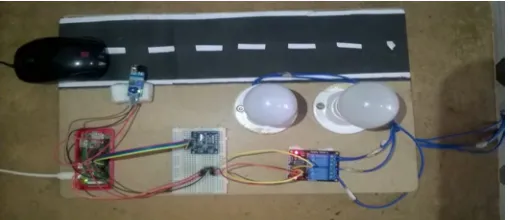
The project aims were to reduce the side effects of the current lighting system and find a solution to save power. In this project the first thing to do is to prepare the inputs and outputs of the system to control the lights. The project shown in the figure has been implemented and works as expected and will prove to be very useful.
Hence, such systems are very much useful for the government to reduce the utilization of conventional power. Therefore, such systems are once implemented on a large scale can bring significant reduction of the power consumption caused by street lights. This initiative will help the government to save this energy and meet the domestic and industrial needs.
Figure 3 Before the detection of the vehicle
[image:4.612.173.440.214.339.2]Figure 4 After detection of the vehicle the street lights are turned ON
Figure 5 Webpage served to the client
VI. APPLICATIONS
A. Smart City
There is a growing demand for efficient solutions in different areas. The improvement of the quality of service and the reduction of resource waste is the goal of new solutions. Smart city needs technologies like street lighting system which reduces the consumption of energy and supports the economic growth of city leads to economic growth of country.
B. Energy Efficiency
Saving energy using need-based lighting management in homes and offices: By collecting and identifying real time data about occupants, incident sunlight and light-field sensing, smart lighting system can optimize the required light output in both day and night.
C. Remote Areas
VII. CONCLUSIONS
The smart Street lighting system integrate new technologies offering ease of maintenance and energy savings, this is a cost effective, practical, eco-friendly and the safest way to save energy. And this system has scope in various other applications like for providing lighting in industries, campuses and parking lots of huge shopping malls. This can also be used for surveillance in corporate campuses and industries.
REFERENCES
[1] Fabio Leccese, Marco Cagnetti and Daniele Trinca (2014), “A Smart City Application: A Fully Controlled Street Lighting Isle Based on Raspberry-Pi Card, a ZigBee Sensor Network and Wi-Max”, Sensors 2014
[2] Noriaki yoshiura and Naoya Ohta (2013), “Smart Street Light System Looking like usual street Light based on Sensor Networks”,IEEE international symposium on Communication and Information Technology
[3] Wu yue, shi chang hong (2010), “Design of New Intelligent Street Light Control System”,IEEE international Conference on Automation [4] Saravanan V,Karthikeyan M (2014), “Cloud Based Automation Street Light Monitoring system”