A Comprehensive Review Report on Wireless Power
Transmission
Abhishek Gandhar1, Shashi Gandhar2, Lalit Bisht3, Sahil Goel4
1
Associate Professor , EEE Department, Bharati Vidyapeeth’s College Of Engineering, New Delhi 2
Assistant Professor, EEE Department, Bharati Vidyapeeth’s College Of Engineering, New Delhi 3,4
Under graduate Research ScholarEEE Department, Bharati Vidyapeeth’s College Of Engineering, New Delhi
Abstract: In present time, each individual requires a remote framework, yet at the same time for control transmission of low power gadgets we are utilizing the wired gadget consistent power supply is one of the significant issues with the reason for utilization of remote innovation. Be that as it may, in remote sensor systems (WSN) control frameworks, the battery has an extremely constrained life expectancy and has not been changed by some other persistent power framework up until this point. Envisioning a future in which remote power exchange is conceivable: we can charge PDAs, residential robots, MP3 players, smart phones other compact hardware that are never connected to, so we show the idea of energy transmission without utilizing wires i.e. transmitting power as microwave to get expanded effectiveness and diminish cost, transmission and appropriation misfortunes. Common WPT is a point to-point control transmission. For the WPT, we would be advised to focus energy to recipient. It was demonstrated that the power transmission productivity can approach near 100%.
Keywords: WSN, PDA, NMPT, WPT
I. INTRODUCTION
Wireless power Transfer (WPT) is the transmission of electrical power from a power source to an expending gadget without utilizing discrete synthetic conveyors. Scientists have built up a few strategies for moving power over long separation without wires. Some exist just as speculations or models yet others are now being used. This Publications gives the strategies used to remote power transmission. It is a nonexclusive term that alludes to various diverse power transmission advancements that utilization time-differing electromagnetic fields. Remote transmission is valuable to control electrical gadgets on the off chance that where interconnecting wires are badly designed, dangerous, or are impractical. For instance the life of WSN is its hub which comprise of a few gadget controllers, memory, sensors, actuators, handsets and battery and battery. The handset can work in four states, i.e 1) Transmit 2) Receive 3) Idle and 4) Sleep. The real vitality issue of a transmitter of a hub is its accepting out of gear state, as in this state it is continually being prepared to get, expending awesome measure of energy. In any case, the player has a short lifetime and in addition in a few improvements inferable from both for all intents and purposes and monetarily infeasible or may include huge opposes to human life. That is the reason vitality gathering for WSN in substitution of battery is the main and one of a kind arrangement. In remote power exchange, a transmitter gadget source, for example, the mains control line, transmits control by electromagnetic fields over an interceding space to at least one recipient gadgets, where it is changed over back to electric power and used. In correspondence the objective is the transmission of data, so the measure of energy achieving the collector is insignificant as long as it is sufficient that flag to clamor proportion is sufficiently high that the data can be gotten coherently. In remote correspondence advances, for the most part, just minor measures of energy achieve the recipient. By differentiate, in remote power, the measure of energy got is the critical thing, so the productivity (part of transmitted power that is gotten) is the more huge parameter.
A. Field Regions
contingent upon remove. Drange from the antenna[7]. Diverse advances are utilized for transmitting power: Near-field or non-radiative district This implies the region inside about wavelength (λ) of the antenna.
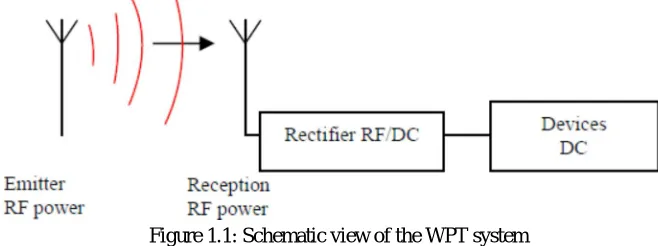
Figure 1.1: Schematic view of the WPT system
In this region the oscillating electric and attractive fields are discrete and power can be exchanged by means of electric fields by capacitive coupling (electrostatic acceptance) between metal terminals, or by means of attractive fields by inductive coupling(electromagnetic enlistment) between loops of wire[5][6]. The scope of these fields is short, and relies upon the size and state of the "recieving wire" gadgets, which are typically loops of wire. The fields, and hence the power transmitted decline exponentially with separate, so if the separation between the two "reception apparatuses" Drange is considerably bigger than the measurement of the "recieving wire" Dant next to no power will be received.Therefore,these procedures can't be utilized for long separation power transmission. Reverberation, for example, thunderous inductive coupling, can expand the coupling, can build the coupling between the radio wires enormously, permitting proficient transmission at fairly more prominent separation, despite the fact that the fields still reduction, in spite of the fact that the fields still diminishing exponentially. Hence the scope of close fields gadgets is routinely isolated into two classes: Short range-up to around one radio wire breadth: Drange ≤ Dant.This is the range over which conventional non-thunderous capacitive or inductive coupling can exchange molecule measures of power.Mid-run up to 10 times the reception apparatus width: extend ≤ 10 Dant. This is run over which standard non-resounding capacitive or inductive coupling can exchange reasonable measure of power. Far-field or radiative district: Beyond around 1 wavelength(λ) of recieving wire, the electric and attractive fields opposite to each other and spread as an electromagnetic wave; illustration are radio waves, microwave,or light waves. This piece of the energy is radiative, which means it leaves the reception apparatus regardless of whether there is a collector ingests it. The segment of energy which does not strike the getting radio wire is dispersed and lost to the framework. The measure of power produced as electromagnetic waves by a recieving wire relies upon the proportion of the radio wire's size Dant to the wavelength of waves λ, which is controlled by the recurrence f where the recurrence: λ=c/f. At low frequencies f where the radio wire is substantially littler than the measure of the waves, Dant << λ, next to no power is emanated. Along these lines the close field gadgets above, which utilize bring down frequencies, emanate none of their energy as electromagnetic radiation. Radio wires about an indistinguishable size from the wavelength Dant ≈ λ, for example, monopole or dipole recieving wires emanate power effectively, yet the electromagnetic waves are transmitted every which way. so if the accepting recieving wire is far away, just a little measure of the radiation will hit it. Therefore, these can be utilized for shorter range wasteful power transmission however not for short range transmission but rather for long range transmission. In any case, not at all like fields, electromagnetic radiation can be engaged by reflection or refraction into bars. By utilizing a high pick up recieving wire or optical framework which amasses the radiation into a restricted pillar went for the collector, it can be utilized for long range power transmission. From the Rayleigh foundation, to deliver the important to center a lot of the energy on a far off beneficiary, a recieving wire must be significantly bigger than the wavelength of the wave utilized Dant >> λ = c/f. Functional pillar power gadgets require wavelength in the centimeter locale or beneath in the relating to frequencies over 1GHz , in the microwave run.
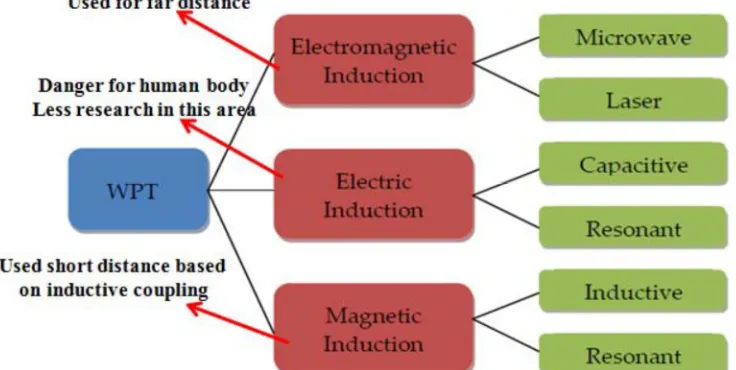
B. Classification of WPT :
gadgets like counterfeit heart pacemaker, and inductive powering or charging of electric vehicles like prepares or transports. Fig .1.2 demonstrates the grouping of WPT.
[image:3.612.132.500.165.350.2]2) Radiative (Far-field techniques): In radiative or Far-field systems, additionally called power radiating, power is transmitted by light emissions radiation, similar to microwaves or laser pillars. These procedures can transport energy longer separations yet should be gone for the recipient. Proposed application for this compose is sunlight based power satellites, and wireless powered automaton flying machine.
Figure 1.2: Classification of wireless power transmission.
II. LITERATURE REVIEW A. History
In 1826 Andre-Marie Ampere built up ampere's circuital law demonstrating that electric current delivers an attractive field. Michael Faraday built up Faraday's law of enlistment in 1831, portraying the electromagnetic power instigated in a conductor by a period differing attractive flux. In 1862 James Clerk Maxwell incorporated these and different perceptions, trials and conditions of power, attraction and optics into a steady hypothesis, inferring Maxwell's conditions. This arrangement of fractional differential conditions frames the reason for present day electromagnetic including the wireless transmission of electrical energy.
B. Tesla’s Experiment
Tesla exhibiting wireless power transmission in an address at Columbia College, New York, in 1891.The two metal sheets are associated with his Tesla loop oscillator, which applies a high recurrence swaying voltage. The swaying electric fields between the sheets ionizes the low weight gas in the two long Geissler tubes he is holding, making them shine by fluorescence, like neon lights. Examination in full inductive exchange by Tesla at Colorado Springs 1899.The curl is in reverberation with Tesla's amplifying transmitter adjacent, powering the light at base. Innovator Nikola Tesla played out the main tests in wireless power transmission in wireless power transmission at the turn of the twentieth century, and may have accomplished more to promote the thought than some other person. In the period 1891 to 1904 he tried different things with transmitting power by inductive and capacitive coupling utilizing sparkle energized radio recurrence full transformer, now Called Tesla curls, which created high AC voltages. With these he could transmit power for short separations without wires. In exhibits before the American Institute of Electrical Engineers and the 1893 Columbian Exposition in Chicago he lit lights from over a phase. He discovered he could expand the separation by utilizing an accepting LC circuit tuned to reverberation with the transmitter's LC circuit, utilizing thunderous inductive coupling. At his Colorado springs research center amid 1899-1900, by utilizing voltages of the request of 10 megavolts produced by a huge loop. He could light three radiant lights at a separation of an around one hundred feet. The resounding inductive coupling which Tesla spearheaded is presently a well-known innovation utilized all through gadgets and is right now being broadly connected to short-go wireless power systems[1][2].
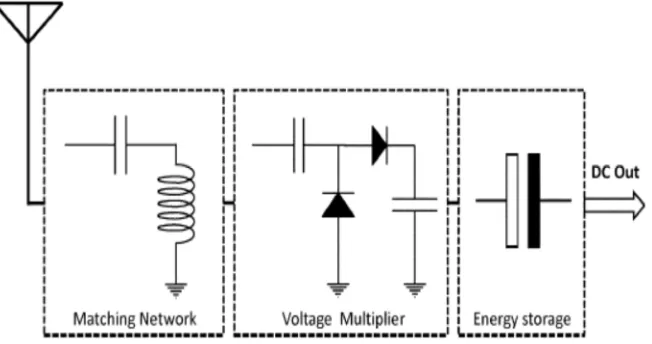
W.C. Brown, the pioneer in wireless power transmission innovation, has planned, built up a unit and exhibited to indicate how power can be exchanged through free space by microwave. The idea of wireless power transmission framework is clarified with useful piece chart appeared in Fig.2.1 In the transmission side, the microwave power source produces microwave power and the yield power is controlled by electronic control circuits. The waveguide ferrite circulator which shields microwave source from reflected power is associated with the microwave power source through the persuade waveguide connector. The tuner coordinates the impedance between the transmitting reception apparatus and the microwave source. The lessened signs will be then isolated in light of the heading of flag engendering by Directional Couplers by Directional Coupler. The transmitting radio wire emanates the power consistently through free space to the rectenna. In the recieving side, a rectenna gets the transmitted power and changes over the microwave power into DC power.
Figure 3.1: Functional Block Diagram of Wireless Power Transmission System.
The impedance matching circuit and filter is provided to setting the output impedance of a signal source equal to the rectifying circuit. The rectifying circuit consists of schottky barrier diodes converts the received microwave power into DC power [3].
D. Energy Harvesting
With regards to wireless power, energy harvesting, likewise called power harvesting or energy searching, is changing natural energy to electric power, to power little self-governing wireless electronic gadgets. Surrounding energy dissemination may originate from electrical power, essentially to power little independent wireless electronic gadgets. Surrounding energy may originate from radio waves with runaway electrical or attractive field or motor energy as speed, light, warm energy. In spite of the fact that the change limit is for the most part low and power assembled is frequently tiny (process watts or smaller scale sections), yet little miniaturized scale power, for example, remote sensors might be adequate to run or energize wireless gadgets, which are by and large required in numerous regions. This new innovation is being produced to wipe out the requirement for substitution of batteries or charging of such wireless gear, with the goal that they can work completely self-sufficiently.
[image:4.612.154.480.548.720.2]III. ADVANTAGES, DISADVANTAGES & BIOLOGICAL IMPACTS OF WPT AND ISSUWA IN WPT: A. Advantages
1) Eliminating the need for a power cord or battery replacement, making the equipment more convenient and thus more desirable for buyers.
2) Light failure due to short circuit and fault on the cable will never be present in the transmission.
3) Reduced e-waste by reducing the requirement of electric wires.
4) Wireless charging offers no corrosion as the electronics are all enclosed, away from water or oxygen in the atmosphere [2].
B. Disadvantages
1) The capital cost of implementing WPT particles is very high.
2) WPT may be the reason for interference with current communication systems.
3) Less efficiency compared to traditional charging.
C. Biological Impacts
General beliefs are fear of the effect of microwave radiation. But studies have shown that the level of microwave radiation will not exceed the dose received when opening the microwave oven door, which means that it is slightly more.
D. Issues in WPT
One of the real issue in power system is the misfortunes happens amid the transmission and dispersion of electrical power. As the request builds step by step, the power age increments and the power misfortune is likewise expanded. The real measure of power misfortune happens amid transmission and dissemination. The level of loss of power amid the transmission and appropriation is approximated as 26% [4]. The fundamental purpose behind power misfortune amid transmission and dispersion is the protection of wires utilized for matrix. The effectiveness of power transmission can be enhanced to certain level by utilizing high quality composite over head conductors and underground links that utilization high temperature super conductor. Be that as it may, the transmission is as yet wasteful. As indicated by World Resources Institution (WRI), India's power matrix has the most astounding transmission and dissemination misfortunes on the planet an incredible 27% . Numbers distributed by different Indian government organizations put that number at 30%,40% and more noteworthy than 40%. This is ascribed to specialized misfortunes (lattice's wasteful aspects) and burglary [4]. The above talked about issue can be fathomed by pick an elective alternative for power transmission which could give considerably higher effectiveness, low transmission cost and stay away from power burglary. Microwave Power Transmission is one of the promising advances and might be the honorable option for proficient power transmission.
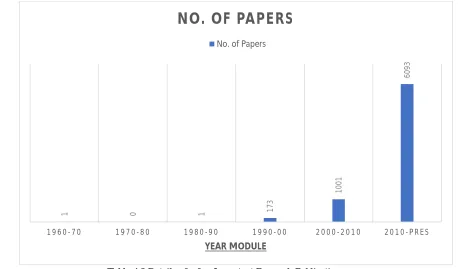
IV. YEAR WISE ASSESSMENT OF RESEARCH PUBLICATIONS ON WIRELESS POWER TRANSMISSION
Table 4.1 Number of research Publications published till date.
S.No Year Module No. of Publications/Work done(in IET &IEEE journals)
1. 1960-1970 1
2. 1970-1980 0
3. 1980-1990 1
4. 1990-2000 173
5. 2000-2010 1001
Table 4.2 Details of a few Important Research Publications:
S.no. Title Author Focused Area Publication Date
1. FREE-SPACE TRANSMISSION W. C. Brown
Raytheon Company
Microwave energy
can be generated at
power levels for
some applications of
wireless power
transfer.
October , 1964
2. WIRELESS TRANSMISSION
OF POWER AND
INFORMATION THROUGH
ONE HIGH-FREQUENCY
RESONANT AC LINK
INVERTER FOR ROBOT
MANIPULATOR APPLICATIONS
A. Kawamura
K. Ishioka
J. Hirai
A prototype of a wireless transmission system of power and information (WTPI system) was built [7].
May,1996
3. POWER CONTROL AND
CAPACITY ANALYSIS FOR
A PACKETIZED INDOOR
MULTIMEDIA DS-CDMA
NETWORK
S. Manji This Publications
proposes a
packetized indoor
wireless system
using
direct-sequence
code-division
multiple-access (DS-CDMA) protocol [9].
May,2000
4. MAGNETIC COUPLING Dragos Niculae Focus is to highlight May,2011
1 0 1 17
3
1
0
0
1
6
0
9
3
1 9 6 0 - 7 0 1 9 7 0 - 8 0 1 9 8 0 - 9 0 1 9 9 0 - 0 0 2 0 0 0 - 2 0 1 0 2 0 1 0 - P R E S YEAR MODULE
NO. OF PAPERS
ANALYSIS IN WIRELESS
TRANSFER ENERGY Mihai Iordache
Lucia Dumitriu
some aspects
regarding wireless
power transfer and
the necessary
conditions of this process [8].
5. WIRELESS POWER
TRANSFER SYSTEM FOR
CAPSULE ENDOSCOPY
BASED ON STRONGLY
COUPLED MAGNETIC
RESONANCE THEORY
Xuelin Fang
Hao Liu
Guiyang Li
Capsule endoscopy is a new technique. The wireless power
transfer system
consists of four coils, an excitation source and a load [10].
Aug,2011
6. PROPOSAL OF
SWITCHED-MODE
MATCHING CIRCUIT IN
POWER SUPPLY FOR
WIRELESS POWER
TRANSFER USING
MAGNETIC RESONANCE
COUPLING
Keisuke Kusaka
Jun-ichi Itoh
This Publications
discusses on the
matching circuit in the power supply for
wireless power
transfer using a
magnetic resonance coupling (MRC). For
Industry Science
Medical (ISM) bands such as 13.56 MHz [11].
Feb,2012
7. GRID SIDE REGULATION
OF WIRELESS POWER
CHARGING OF PLUG-IN ELECTRIC VEHICLES
Clifford P. White
Omer C. Onar
John M. Miller
Conductive charger regulation of vehicle regenerative energy
storage system
(RESS) in
coordination with the
vehicles battery
management system (BMS) [12].
Sept,2012
8. WIRELESS POWER
TRANSFER: AN APPLICATION TO CELL PHONE BATTERY RECHARGING
Md. Atiqur Rahaman Khan
Abir Ahmed
Md. Rafiqul Islam
A simple prototype
wireless power
transfer (WPT)
system has been
practically
implemented to
explore the
possibility of cell
phone battery
recharging [13].
9. VAMPIRE: A
MAGNETICALLY
SELF-POWERED SENSOR NODE
CAPABLE OF WIRELESS
TRANSMISSION
Jinyeong Moon
John Donnal
Jim Paris
Power electronic
topology for
providing a vibration monitor with in-situ
magnetic energy
harvesting [14].
Mar,2013
10. AN OVERVIEW OF
TECHNICAL
CHALLENGES AND
ADVANCES OF
INDUCTIVE WIRELESS
POWER TRANSMISSION
Tobias Dräger
Peterspies
Iker Mayordomo
Actual technical
challenge addressed
in the field of
inductive magnetic
coupling at
low-frequency (LF) and high-frequency (HF) bands for wireless power transfer [15].
Apr,2013
11. LOAD MONITORING AND
OUTPUT POWER CONTROL OF A WIRELESS POWER
TRANSFER SYSTEM
WITHOUT ANY WIRELESS COMMUNICATION
FEEDBACK
Jian Yin
Deyan Lin
Chi Kwan Lee
In this project, a
new method is
proposed to
determine the load impedance and load power without using
any direct output
feedback [16].
Sept,2013
12. REVIEW OF WIRELESS
CHARGING TECHNOLOGIES FOR ELECTRIC VEHICLES
T. W. Ching
Y. S. Wong
This Publications
aims to review
current wireless
power transfer
(WPT) technologies on electric vehicle charging [17].
Dec,2013
13. MULTILAYER CERAMIC
COIL FOR WIRELESS
POWER TRANSFER
SYSTEM BY PHOTO
RESIST FILM PROCESS
T. Nishi
M. Kaneko
M. Takato
A multilayer ceramic coil for a wireless
power transfer
system that
fabricated by a photo resist film process [18].
April,2014
14. INVESTIGATION OF
DUAL-BAND COIL
MODULE FOR
NEAR-FIELD WIRELESS POWER TRANSFER SYSTEMS
Ming-Lung Kung
Ken-Huang Lin
A dual-band coil
module for near-field
resonant wireless
power transfer
(WPT). It provides
additional channel
either for more
power transfer or
higher data transmission [19].
15. RADIO ALIGNMENT FOR
INDUCTIVE CHARGING OF ELECTRIC VEHICLES
Wei Ni
Iain B. Collings
Xin Wang
A high-precision
wireless ranging and misalignment
estimation scheme
[20].
Feb,2015
16. WIRELESS POWER
TRANSFER FOR MOBILE
DEVICES WITH
CONSIDERATION OF
GROUND EFFECT
Chang Won Jung
Seok Hyon Kang
Van Thuan Nguyen
In this study, a
wireless power
transfer (WPT)
system including
three coils and
working at 6.78
MHz is investigated [21].
May,2015
17. MAX–MIN FAIR
WIRELESS ENERGY
TRANSFER FOR
MULTIPLE-INPUT MULTIPLE-OUTPUT WIRETAP CHANNELS Wei Wu Xueqi Zhang Shaohang Wang
The Publications aim
to maximise the
minimum harvested energy among the
multiple
multi-antenna energy
receivers [22].
April,2016
18. DESIGN OF
MULTI-FREQUENCY COIL FOR CAPACITOR-LESS
WIRELESS POWER
TRANSFER USING HIGH ORDER SELF-RESONANCE OF OPEN END COIL
Takehiro Imura
Yoichi Hori
Koichi Furusato
Available frequency for wireless power transfer (WPT) is
limited by the
industrial, scientific, and medical (ISM) radio bands in MHz band [23].
May,2016
19. A LOW SAMPLING
FREQUENCY SWITCHED
CAPACITOR LOW-PASS
FILTER FOR WIRELESS RECEIVERS
Krzysztof Siwiec
Lukasz Wiechowski
Jakub Kopanski
This Publications
presents a low-pass filter with variable gain for use in direct conversion wireless receivers [24].
June,2016
20. INVESTIGATION OF
RECEIVING POT CORE
EFFECT ON MAGNETIC
FLUX DENSITY IN
INDUCTIVE
COUPLING-BASED WIRELESS POWER
Mohammad Haerinia
Ebrahim S. Afjei
An inductive-based
wireless power
transfer system for
low power
applications at short distances [25].
TRANSFER
21. WIRELESS POWER
TRANSFER SYSTEM
BASED ON HIGH-INDEX DIELECTRIC
RESONATORS
WIRELESS POWER
TRANSFER SYSTEM
BASED ON HIGH-INDEX DIELECTRIC
RESONATORS
P. V. Kapitanova
M. Song
P. A. Belov
Demonstrated two
magnetic resonant
wireless power
transfer (WPT)
systems based on
dielectric spherical
and disk resonators
implemented with
ceramics [26].
July,2016
22. A LOOSELY COUPLED
CAPACITIVE POWER
TRANSFER SYSTEM WITH
LC COMPENSATION
CIRCUIT TOPOLOGY
Hua Zhang
Fei Lu
Heath Hofmann
A double-sided LC compensated
capacitive power
transfer (CPT)
system, which is the
dual of the
conventional
series-series (SS)
compensated
inductive power
transfer (IPT) system [27].
Sept,2016
23. EDUCATION FOR THE
COLLEGE STUDENT
THROUGH STUDY OF
WIRELESS POWER
TRANSMISSION (WPT)
Tamami Maruyama Studies of wireless power transmission
(WPT) draws
attention from
college student of National Institute of
Technology (NIT)
for this research area [28].
Mar,2017
24. MAXIMUM POWER AND
EFFICIENCY
TRANSMISSION USING
PARALLEL ENERGY
STORAGE LOAD FOR
WIRELESS POWER
TRANSFER SYSTEMS
Zhongping Yang
Fei Lin
Yuyu Geng
A control strategy is proposed to not only
meet the
requirements of the
system energy
output, but also
maintain the high
efficiency of the
system [29].
May,2017
25. COMPARISON OF TWO
STRUCTURAL MAGNETIC
COILS FOR WIRELESS
POWER TRANSFER
Gong Li Jiao
Li Xin Heng
Comparison of two
structural coils
(solenoid and planar
spiral coil) for
Li Yang wireless power
transfer (WPT)
system [30].
V. APPLICATION OF WPT
A. Moving targets such as fuel free airplanes, fuel free electric vehicles, moving robots and fuel free rackets.
B. Automatic wireless charging for mobile robots, cordless tools and instrument which eliminates complex mechanisms, and labour intensive manual recharging and battery replacement.
C. Another application of WPT are solar power satellites, energy to remote areas, broadcast energy globally. D. WPT are used for Ubiquitous power source, RF power Adaptive Rectifying Circuits (PARC).
VI. FUTURE SCOPE
Witricity is building a close field remote charging mechanical assembly for buyer gadgets with the assistance of the Haier gathering, a Chinese hardware maker. Witricity showed this innovation by remote powering a 32 inch TV at a separation of six feet. Delphi Automotives is working with Witricity to build up a remote charging system for electric autos. The noteworthy innovation will empower to car producer to coordinate remote surging into the outline of crossover and electric vehicles. There is another standard convention for charging cell phone started by the Wireless Power Consortium [6].
VII. CONCLUSION
The idea of wireless power transmission gives more noteworthy potential to electrical power transmission with irrelevant misfortune. Over the long haul, it can diminish the reliance of our general public on the battery, which is at present substantial and costly. As the wireless innovation is getting to be mainstream, the interest for batteries is likewise diminishing. Long separation power transmission power can be sent from the source to the collector without wires, to decrease the cost. Batteries should be energized or in the long run supplanted, so the wireless power transmission will prove to be useful in every one of the territories.
REFERENCES
[1] Nikola Tesla,“The Transmission of Electrical Energy Without Wires as a Means for Furthering Peace,” Electrical World and Engineer. Jan.7, p. 21, 1905 [2] https://en.wikipedia.org/wiki/Inductive_charging/ Inductive charging, Wireless charging homepage on Wikipedia
[3] W.C Brown, J.R Mims and N.I Heenan, “An Experimental Microwave-Powered Helicopter” 965 IEEE International Convention Record Vo. 13, Part 5, Pp. 225-235
[4] http://cleantechindia.wordpress.com/2008/07/16/indiase leletricity-transmission-and-distribution-losses/
[5] http://www.hometoys.com/content.php?post_type=1958
[6] http://witricity.com/pages/companyhtml/ The Witricity website. [7] https://en.m.wikipedia.org/wiki/Wireless_power_transfer
[8] N. D. Wilson, R. Ganesh, K. Joseph, D. Raychaudhuri, "Packet CDMA versus dynamic TDMA for multiple access in an integrated voice/data PCN", IEEE J. Select. Areas Commun., vol. 11, pp. 870-884, Aug. 1993
[9] http://ieeexplore.ieee.org/document/5985662/ WIRELESS POWER TRANSFER SYSTEM FOR CAPSULE ENDOSCOPY BASED ON STRONGLY
COUPLED MAGNETIC RESONANCE THEORY
[10] http://ieeexplore.ieee.org/document/6165888/ PROPOSAL OF SWITCHED-MODE MATCHING CIRCUIT IN POWER SUPPLY FOR WIRELESS POWER TRANSFER USING MAGNETIC RESONANCE COUPLIN
[11] http://ieeexplore.ieee.org/document/6342814/ GRID SIDE REGULATION OF WIRELESS POWER CHARGING OF PLUG-IN ELECTRIC VEHICLE [12] http://ieeexplore.ieee.org/document/6509769/ WIRELESS POWER TRANSFER: AN APPLICATION TO CELL PHONE BATTERY RECHARGING [13] J. Donnal, U. Orji, C. Schantz, J. Moon, S. Leeb, "VAMPIRE: Accessing a Life-Blood of Information for Maintenance and Damage Assessment," in Proc.
American Society of Naval Engineers, Feb. 2012
[14] P. Curty, N. Joehl, C. Dehollain, M. Declercq, "Remotely powered addressable UHF RFID integrated system", IEEE J. Solid-State Circuits, vol. 40, no. 11, pp. 2193-2202, Nov. 2005
[15] W. Ko, S. Liang, and C. F. Fung, "Design of radio-frequency powered coils for implant instruments," Medical and Biological Engineering and Computing, vol. 15, pp. 634-640, 1977/11/01 1977
[16] http://ieeexplore.ieee.org/document/6828235/ REVIEW OF WIRELESS CHARGING TECHNOLOGIES FOR ELECTRIC VEHICLE
[17] MULTILAYER CERAMIC COIL FOR WIRELESS POWER TRANSFER SYSTEM BY PHOTO RESIST FILM PROCES
[18] U. Jow and M. Ghovanloo, "Optimization of data coils in multiband wireless link for neuroprosthetic implantable devices," IEEE Trans. Biomed. Circuits Syst., vol. 4, no. 5, pp. 301-310, Oct. 2010
[19] http://ieeexplore.ieee.org/document/7035092/ RADIO ALIGNMENT FOR INDUCTIVE CHARGING OF ELECTRIC VEHICLE
[20] WIRELESS POWER TRANSFER FOR MOBILE DEVICES WITH CONSIDERATION OF GROUND EFFECT
[22] http://ieeexplore.ieee.org/document/7498858/ DESIGN OF MULTI-FREQUENCY COIL FOR CAPACITOR-LESS WIRELESS POWER TRANSFER USING HIGH ORDER SELF-RESONANCE OF OPEN END COI
[23] L. Wiechowski, K. Siwiec, J. Kopanski, W. A. Pleskacz, "Simulink model of GFSK demodulator based on time-to-digital converter", Mixed Design of Integrated Circuits Systems (MIXDES), pp. 338-341, 2014
[24] http://ieeexplore.ieee.org/document/7525947/ INVESTIGATION OF RECEIVING POT CORE EFFECT ON MAGNETIC FLUX DENSITY IN INDUCTIVE COUPLING-BASED WIRELESS POWER TRANSFE
[25] S. Y. R. Hui, W. Zhong, C. K. Lee, "A critical review of recent progress in mid-range wireless power transfer", IEEE Trans. Power Electron., vol. 29, pp. 4500-4511, 2014
[26] J. Dai, D. Ludois, "A survey of wireless power transfer and a critical comparison of inductive and capacitive coupling for small gap applications", IEEE Trans. Power Electron., vol. 30, no. 11, pp. 6017-6029, Aug. 2015
[27] http://ieeexplore.ieee.org/document/7912833/ EDUCATION FOR THE COLLEGE STUDENT THROUGH STUDY OF WIRELESS POWER TRANSMISSION (WPT
[28] G. A. Covic, J. T. Boys, "Modern Trends in Inductive Power Transfer for Transportation Applications", Emerging & Selected Topics in Power Electronics IEEE Journal of 1, vol. 1, pp. 28-41, 2013