Original Article
Hypertension does not influence response to EGFR
targeted therapy in patients with advanced
non-small-cell lung cancer
Kejun Liu1, Weiwei Zhang2, Qinquan Tan1, Guanming Jiang1, Jun Jia1
1Department of Oncology, Dongguan Institute for Clinical Cancer Research, Dongguan People’s Hospital,
Southern Medical University, Dongguan, Guangdong, China; 2Department of Oncology, The Fifth People’s Hospital of Chengdu, Chengdu, Sichuan, China
Received December 30, 2018; Accepted April 9, 2019; Epub June 15, 2019; Published June 30, 2019
Abstract: Hypertension is prevalent in patients with epidermal growth factor receptor (EGFR) mutated non-small-cell lung cancer (NSCLC). The aim of this study was to illuminate the impact of hypertension on first-line targeted therapy in patients with advanced NSCLC. A total of 102 patients with EGFR mutations were included in this study. Patients were retrospective divided into two groups according to the status of hypertension. All patients received EGFR tar-geted therapy on standard dose as recommended by clinical guidelines. The primary end point was progression-free survival (PFS). Secondary end points were objective response rate (ORR), disease control rate (DCR) and toxicity. The relationships between different groups and patients characteristics were performed using Pearson’s Chi-square test or Fisher’s exact test. Logistic regression was performed between patient characteristics and treatment ef-ficacy. Estimates of PFS and OS were calculated using the Kaplan-Meier method and two-sided 95% confidence interval were obtained. A two-sided log-rank test was used to compare PFS between the two study groups. The clini-cal characteristics for first-line EGFR-TKIs treatment were well balanced between NSCLC patients with or without hypertension. The objective response rate (ORR) in hypertension patients was 62.9%, median progression-free survival (PFS) was 9.4 months (95% CI, 7.3 to 11.6 months) and a 1-year PFS rate was 31.4%, similar to that of or-dinary NSCLC patients. Toxicities were generally manageable in the two groups, which seldom produced grade 3 or higher adverse events. Therefore, hypertension did not decrease the therapeutic efficacy or increase the toxicity of EGFR-TKIs for patients with advanced NSCLC. Further studies are suggested to identify the impact of hypertension on such circumstance.
Keywords: Hypertension, targeted therapy, first-line therapy, non-small-cell lung cancer (NSCLC)
Introduction
Non-small-cell lung cancer (NSCLC) is one of the most common cancers worldwide [1]. As patients diagnosed with advanced NSCLC are primarily at an elder age and are often heavy smokers, other common diseases such as hypertension are usually coexisted in the same patient population [2]. In addition, the preva-lence of hypertension in patients with advanced NSCLC was similar to that in the ordinary popu-lation [3].
The presence of hypertension prior to treat-ment may predict poor prognosis of cancer patients, due to increased risk of myocardiopa-thy caused by chemotherapeutic drugs and
angiogenesis inhibitors [4, 5], which further increase blood pressure during consecutive treatment among such patients [6]. To date, there have been many reports concerning the relationship between treatment-related hyper-tension and antitumor efficacy in advanced NSCLC. One report revealed that early treat-ment-related blood pressure increases did not predict clinical benefit from bevacizumab based on efficacy outcomes, nor did it have any prog-nostic importance for patients with advanced NSCLC [7].
and afatinib [11], with a median progression-free survival (PFS) of 9-13 months and a medi-an overall survival (OS) of 2-3 years. The side effects of EGFR-TKIs are different from chemo-therapy and anti-angiogenesis chemo-therapy [12]. If hypertension could decrease the efficacy of tar-geted therapy, or increase the toxicity of EGFR-TKIs, it would be unfortunate for NSCLC patients. Hence, to investigate the clinical con-nection of hypertension and EGFR-TKIs treat-ment is meaningful.
The targeted therapeutic drugs of advanced NSCLC referred above is extensively used in the clinic, which exhibit almost the same treatment
alysis. Patients whose clinical information could not be completely obtained were also excluded from this study.
Treatment
[image:2.612.92.349.82.542.2]This study was approved by local ethics com-mittees and was conducted according to the Declaration of Helsinki. Patients provided informed written consent. A total of 102 patients with EGFR mutations were included in this study. Patients were retrospective divided into two groups according to the status of hypertension, regardless of age, sex, physical scores, or treatment agents. 35 patients were
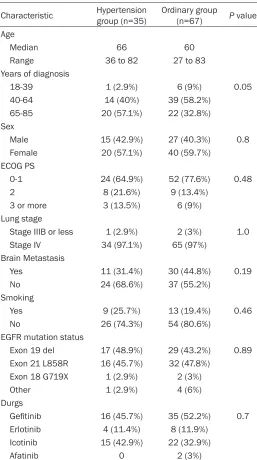
Table 1. Patient Characteristics
Characteristic Hypertension group (n=35) Ordinary group (n=67) P value Age
Median 66 60
Range 36 to 82 27 to 83
Years of diagnosis
18-39 1 (2.9%) 6 (9%) 0.05
40-64 14 (40%) 39 (58.2%)
65-85 20 (57.1%) 22 (32.8%)
Sex
Male 15 (42.9%) 27 (40.3%) 0.8
Female 20 (57.1%) 40 (59.7%)
ECOG PS
0-1 24 (64.9%) 52 (77.6%) 0.48
2 8 (21.6%) 9 (13.4%)
3 or more 3 (13.5%) 6 (9%)
Lung stage
Stage IIIB or less 1 (2.9%) 2 (3%) 1.0
Stage IV 34 (97.1%) 65 (97%)
Brain Metastasis
Yes 11 (31.4%) 30 (44.8%) 0.19
No 24 (68.6%) 37 (55.2%)
Smoking
Yes 9 (25.7%) 13 (19.4%) 0.46
No 26 (74.3%) 54 (80.6%)
EGFR mutation status
Exon 19 del 17 (48.9%) 29 (43.2%) 0.89 Exon 21 L858R 16 (45.7%) 32 (47.8%)
Exon 18 G719X 1 (2.9%) 2 (3%)
Other 1 (2.9%) 4 (6%)
Durgs
Gefitinib 16 (45.7%) 35 (52.2%) 0.7
Erlotinib 4 (11.4%) 8 (11.9%)
Icotinib 15 (42.9%) 22 (32.9%)
Afatinib 0 2 (3%)
effect [13, 14]. Hence, the effica-cy of EGFR-TKIs for patients with hypertension in our hospital was retrospectively analyzed, with the aim to illuminate the relationship of hypertension and targeted ther-apy in advanced NSCLC.
Patients and methods
Eligibility
diagnosed with hypertension before targeted treatment. All patients received EGFR-TKIs on standard dose as recommended by clinical guidelines, before unendurable toxicity or dis-ease progression occurred.
Data collection
The clinical data of patients in our studies was collected carefully. All patients had an ECOG PS of 0 to 3. Patient history, physical examination and complete blood work were recorded at baseline and before EGFR-TKIs treatment. Tumor response was evaluated by computed tomography scans according to Response Evaluation Criteria in Solid Tumors (RECIST) cri-teria. Disease control was defined as complete remission (CR), partial response (PR) or stable disease (SD). Patients who had a progression disease caused by EGFR-TKIs treatment were defined as progression disease (PD). Toxicities were recorded and classified in the light of the National Cancer Institute Common Terminology Criteria for Adverse Events (NCI-CTCAE) version 3.0.
Statistical Analysis
The primary end point was PFS, defined as time between the start of the treatment and disease progression or death, with censoring for patients alive without progression at last con-tact. The secondary end points were objective response rate (ORR), disease control rate (DCR) and toxicity. The cutoff date for PFS data was June 28, 2018, when the last patient had
initi-ated his treatment for 6 months. By that time, enough data was collected to analyze the effi-cacy and toxicities of study arms.
Statistical analysis was performed by Statistical Product and Service Solutions (SPSS) 22.0 software. Relationships between different groups and patients characteristics were per-formed using Pearson’s chi-square test or Fisher’s exact test. Logistic regression was per-formed between patient characteristics and treatment efficacy. Estimates of PFS and OS were calculated using the Kaplan-Meier meth-od and two-sided 95% confidence interval were obtained. A two-sided Log-rank test was used to compare PFS between the two study groups. Results
Patient characteristics and treatment
The clinical characteristics of these patients for first-line EGFR-TKIs treatment are detailed
in Table 1. There were no statistically
signifi-cant differences between hypertension pa- tients and ordinary patients with advanced NSCLC. The median age of hypertension patients was 66 years (range, 36-82 years) and 57.1% patients were women, and that of ordi-nary patients free of hypertension were 60 years (range, 27-83 years) and 59.7%. Most of the patients in two groups had a performance status of 0-1 score (64.9% versus 77.6%) and stage IV disease (97.1% versus 97%). In addi-tion, the majority of the patients were never smokers (74.3% versus 80.6%) and had
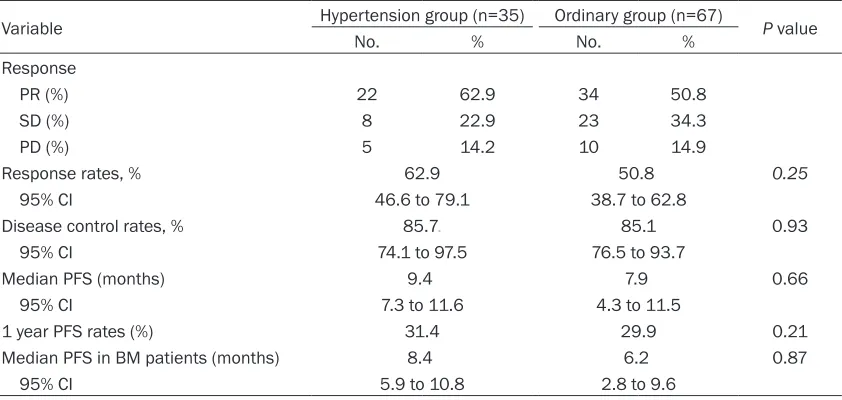
sensi-Table 2. Efficacy Results
Variable Hypertension group (n=35) Ordinary group (n=67) P value
No. % No. %
Response
PR (%) 22 62.9 34 50.8
SD (%) 8 22.9 23 34.3
PD (%) 5 14.2 10 14.9
Response rates, % 62.9 50.8. 0.25
95% CI 46.6 to 79.1 38.7 to 62.8
Disease control rates, % 85.7. 85.1 0.93
95% CI 74.1 to 97.5 76.5 to 93.7
Median PFS (months) 9.4. 7.9. 0.66
95% CI 7.3 to 11.6 4.3 to 11.5
1 year PFS rates (%) 31.4 29.9 0.21
Median PFS in BM patients (months) 8.4. 6.2. 0.87
[image:3.612.92.513.86.286.2]tive EGFR gene mutations (97.1% versus 94%). The most common mutation was the L858R mutation in exon 21 and deletion in exon 19, about 74.3% and 80.6% in the two groups, respectively. All patients had never received any antitumor therapy before the initial therapy. In the study, these patients received EGFR-TKIs, gefitinib (250 mg/day), erlotinib (150 mg/ day), icotinib (375 mg/day) or afatinib (40 mg/ day), until disease progression, unacceptable toxicity or economic factors. Computed tomog-raphy (CT) and magnetic resonance imaging (MRI) were conducted routinely to evaluate the efficacy of EGFR-TKIs treatment.
Efficacy
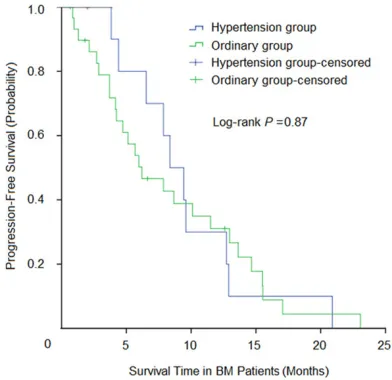
As is illustrated in Table 2, objective responses of EGFR-TKIs therapy were observed in 22 of 35 patients in the hypertension patients arm (62.9%; 95% CI, 46.6 to 79.1) and in 34 of 67 patients in the ordinary patients arm (50.8%; 95% CI, 38.7 to 62.8) (P=0.25). DCR of these two groups were 85.7% (95% CI, 74.1 to 97.5) and 85.1% (95% CI, 76.5 to 93.7) (P=0.93), respectively. The median PFS was 9.4 months (95% CI, 7.3 to 11.6 months) in the hyperten-sion patients arm and 7.9 months (95% CI, 4.3 to 11.5 months) in the counterpart arm (P=0.66) (Figure 1). The 1-year PFS rate were 31.4% and 29.9%, respectively (P=0.21) (Table 2). For patients with brain metastasis (BM), the median PFS of such patients was 8.4 months (95% CI, 5.9 to 10.8 months) and 6.2 months (95% CI, 2.8 to 9.6 months) (P=0.87) (Figure 2), respectively. On the whole, there were no sta-tistically differences in therapeutic efficacy of the two patient groups.
Adverse events
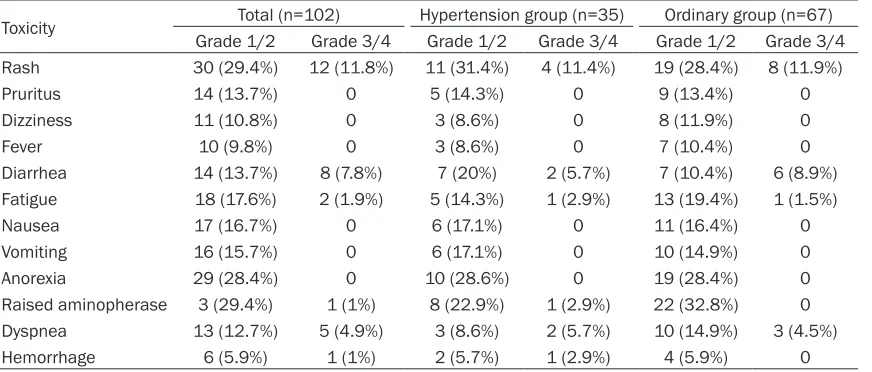
The main toxicities possibly related to therapy are listed in Table 3. Adverse events of EGFR-TKIs were generally mild, ranging from grade 1 to grade 2. No patients in the study had severe adverse events. The most common grade 1/2 adverse events of both groups were non-hema-tologic toxicities, including rash, raised ami-nopherase, anorexia and fatigue. There were 11 episodes of grade 3/4 adverse events in the hypertension patients arm, as compared with 18 episodes in the ordinary patients arm (P= 0.27). Grade 3/4 hematologic toxicities observed in the study were rash (11.4%), diar-rhea (5.7%), dyspnea (5.7%), raised aminopher-ase (2.9%), fatigue (2.9%) and hemorrhage (2.9%) in the hypertension patients arm and rash (11.9%), diarrhea (8.9%), dyspnea (4.5%) and fatigue (1.5%) in the counterpart arm. Discussion
Standard first-line treatment for patients with EGFR mutated advanced NSCLC was mainly single agent such as gefitinib, erlotinib or ico-tinib. In the majority of studies concerning EGFR targeted therapy, little attention is payed to those patients with hypertension, as com-pared in the antiangiogenic therapy of advanced NSCLC [15, 16]. As hypertension and lung
can-Figure 1. Kaplan-Meier curves for progression-free survival (PFS).
[image:4.612.91.285.72.258.2] [image:4.612.90.286.311.501.2]cer share some similar risk factors, hyperten-sion is very prevalent in patients diagnosed with advanced NSCLC. So far, treatment-relat-ed hypertension has been investigattreatment-relat-ed exten-sively, due to the same wide use of angiogene-sis inhibitors such as bevacizumab [17, 18]. However, there are fewer studies concerning the efficacy of EGFR-TKIs in cancer patients who already suffered from hypertension. In this study the relationship between hyper-tension and therapeutic efficacy in treatment naïve NSCLC patients with EGFR gene muta-tion was evaluated. This study showed encour-aging findings in hypertension patients, with ORR 62.9%, median PFS 9.4 months and 1-year PFS rate 31.4%, which is similar to that of ordinary NSCLC patients who did not suf-fered from hypertension simultaneously (Table 2 and Figure 1). Toxicities were also manage-able, which rarely produced grade 3 or higher adverse events, nor did increased side effect be observed in the hypertension group (Table 3). All results were consistent with previous studies of EGFR mutated advanced NSCLC patients. As the number of patients in this study was relatively small, additional studies are needed to further illuminate the efficacy of EGFR-TKIs in hypertension patients.
Patients with brain metastasis (BM) were also investigated in this retrospective analysis sep-arately. About 20-40% patients with advanced NSCLC will develop brain metastasis [19], with a median overall survival only about 3-6 months before the era of precision medicine.
The poor prognosis is mainly caused by blood-brain barrier [20], which limited influx of antitu-mor drugs such as chemotherapeutic agents, angiogenesis inhibitors and even EGFR-TKIs. However, some studies showed that the integ-rity of blood-brain barrier was disrupted in patients with brain metastasis and that cere-bral vessels were dilated and dividing endothe-lial cells were detected [21]. Coincidently, dys-function of vascular endothelium in hyperten-sion patients were revealed in previous studies [22, 23], which also showed morphology altera-tion in endothelial and vascular smooth muscle cells during hypertension development.
As the role of EGFR-TKIs for NSCLC patients with hypertension and brain metastasis is still uncertain, elaboration of the relationship between the efficacy of targeted therapy and such special patients is necessary and impor-tant. In the study, a total of 41 appropriate NSCLC patients were analyzed, with 11 hyper-tension cases. The median PFS of such patients was 2.2 months longer than that of ordinary NSCLC patients, yet did not showed any statisti-cal significance among the two different patient groups (Table 2 and Figure 2). One probable reason was that the number of patients enrolled in this study was too small. Therefore, further study is needed to evaluate the efficacy of EGFR-TKIs in the treatment of brain metastatic NSCLC with hypertension prior to antineoplas-tic therapy.
[image:5.612.92.528.87.273.2]In conclusion, this study is the largest investiga-tion to date to compare the efficacy and toxicity
Table 3. Treatment related toxicities in the two treatment groups.
Toxicity Total (n=102) Hypertension group (n=35) Ordinary group (n=67) Grade 1/2 Grade 3/4 Grade 1/2 Grade 3/4 Grade 1/2 Grade 3/4
Rash 30 (29.4%) 12 (11.8%) 11 (31.4%) 4 (11.4%) 19 (28.4%) 8 (11.9%)
Pruritus 14 (13.7%) 0 5 (14.3%) 0 9 (13.4%) 0
Dizziness 11 (10.8%) 0 3 (8.6%) 0 8 (11.9%) 0
Fever 10 (9.8%) 0 3 (8.6%) 0 7 (10.4%) 0
Diarrhea 14 (13.7%) 8 (7.8%) 7 (20%) 2 (5.7%) 7 (10.4%) 6 (8.9%)
Fatigue 18 (17.6%) 2 (1.9%) 5 (14.3%) 1 (2.9%) 13 (19.4%) 1 (1.5%)
Nausea 17 (16.7%) 0 6 (17.1%) 0 11 (16.4%) 0
Vomiting 16 (15.7%) 0 6 (17.1%) 0 10 (14.9%) 0
Anorexia 29 (28.4%) 0 10 (28.6%) 0 19 (28.4%) 0
Raised aminopherase 3 (29.4%) 1 (1%) 8 (22.9%) 1 (2.9%) 22 (32.8%) 0
Dyspnea 13 (12.7%) 5 (4.9%) 3 (8.6%) 2 (5.7%) 10 (14.9%) 3 (4.5%)
of EGFR-TKIs in advanced NSCLC patients with different blood pressure status when diagnos- ed. Hypertensive patients treated with EGFR-TKIs had similar response rate and PFS to ordi-nary NSCLC patients. Toxicities were also not aggravated. Importantly, for patients with brain metastasis, hypertension did not decrease the efficacy of EGFR-TKIs. These results may give hypertensive patients more confidence to ac- cept EGFR-TKIs treatment for advanced NSCLC. In the future, randomized studies are needed to eventually identify the impact of hypertension on targeted therapy of patients with advanced NSCLC.
Acknowledgements
We thank the doctors, nurses, patients and their family members engaged in this study for their kindness and support.
This study was funded by the Dongguan Social Science and Technology Development Project (grant no. 201750715001285).
Disclosure of conflict of interest None.
Abbreviations
NSCLC, non-small-cell lung cancer; PFS, pro-gression-free survival; EGFR, epidermal growth factor receptor; TKIs, tyrosine kinase inhibi- tors; ORR, objective response rate; RECIST, Response Evaluation Criteria in Solid Tumors; CR, complete response; PR, partial response; SD, stable disease; PD, progression disease; NCI-CTCAE, National Cancer Institute Common Terminology Criteria for Adverse Events; SPSS, Statistical Product and Service Solutions; AR- MS, the scorpion amplification refractory muta-tion system method; NGS, next-generamuta-tion se- quencing technology; ECOG, Eastern Cooper- ative Oncology Group; PS, physical score; CT, Computed tomography and MRI, magnetic res-onance imaging; BM, brain metastasis.
Address correspondence to: Jun Jia and Guanming Jiang, Dongguan Institute for Clinical Cancer Rese- arch, Dongguan People’s Hospital, Southern Me- dical University, 3 Wandao Road South, Dong- guan 523059, Guangdong, China. Tel: +86-0769-28637056; E-mail: [email protected] (JJ); Tel: +86-0769-28637057; E-mail: [email protected] (GMJ)
References
[1] Siegel RL, Miller KD, Jemal A. Cancer statistics, 2017. CA Cancer J Clin 2017; 67: 7-30. [2] Souza VB, Silva EN, Ribeiro ML, Martins Wde
A. Hypertension in patients with cancer. Arq Bras Cardiol 2015; 104: 246-52.
[3] Izzedine H, Ederhy S, Goldwasser F, Soria JC, Milano G, Cohen A, Khayat D, Spano JP. Management of hypertension in angiogenesis inhibitor-treated patients. Ann Oncol 2009; 20: 807-15.
[4] Yeh ET, Bickford CL. Cardiovascular complica-tion of cancer therapy. J Am Coll Cardiol 2009; 53: 2231-47.
[5] Suter TM, Ewer MS. Cancer drugs and the heart: importance management. Eur Heart J 2013; 34: 1102-11.
[6] Scartozzi M, Galizia E, Chiorrini S, Giampieri R, Berardi R, Pierantoni C, Cascinu S. Arterial hy-pertension correlates with clinical outcome in colorectal cancer patients treated with first-line bevacizumab. Ann Oncol 2009; 20: 227-30.
[7] Hurwitz HI, Douglas PS, Middleton JP, Sledge GW, Johnson DH, Reardon DA, Chen D, Rosen O. Analysis of early hypertension and clinical outcome with bevacizumab: results from sev-en phase III studies. Oncologist 2013; 18: 273-80.
[8] Perez-Soler R, Chachoua A, Hammond LA, Rowinsky EK, Huberman M, Karp D, Rigas J, Clark GM, Santabarbara P, Bonomi P. De- terminants of tumor response and survival with erlotinib in patients with non--small-cell lung cancer. J Clin Oncol 2004; 22: 3238-3247.
[9] Shi YK, Wang L, Han BH, Li W, Yu P, Liu YP, Ding CM, Song X, Ma ZY, Ren XL, Feng JF, Zhang HL, Chen GY, Han XH, Wu N, Yao C, Song Y, Zhang SC, Song W, Liu XQ, Zhao SJ, Lin YC, Ye XQ, Li K, Shu YQ, Ding LM, Tan FL, Sun Y. First-line ico-tinib versus cisplatin/pemetrexed plus peme-trexed maintenance therapy for patients with advanced EGFR mutation-positive lung adeno-carcinoma (CONVINCE): a phase 3, open-label, randomized study. Ann Oncol 2017; 28: 2443-2450.
[11] Wu YL, Zhou C, Hu CP, Feng J, Lu S, Huang Y, Li W, Hou M, Shi JH, Lee KY, Xu CR,Massey D, Kim M, Shi Y, Geater SL. Afatinib versus cispla-tin plus gemcitabine for first-line treatment of asian patients with advanced non-small-cell lung cancer harbouring EGFR mutations (LUX-Lung 6): an open-label, randomised phase 3 trial. Lancet Oncol 2014; 15: 213-22.
[12] Yang JC, Wu YL, Schuler M, Sebastian M, Popat S, Yamamoto N, Zhou C, Hu CP, O’Byrne K, Feng J, Lu S, Huang Y, Geater SL, Lee KY, Tsai CM, Gorbunova V, Hirsh V, Bennouna J, Orlov S, Mok T, Boyer M, Su WC, Lee KH, Kato T, Massey D, Shahidi M, Zazulina V, Sequist LV. Afatinib versus cisplatin-based chemotherapy for EGFR mutation-positive lung adenocarcinoma (LUX-Lung 3 and LUX-(LUX-Lung 6): analysis of overall survival data from two randomised, phase 3 trials. Lancet Oncol 2015; 16: 141-51.
[13] Burotto M, Manasanch EE, Wilkerson J, Fojo T. Gefitinib and erlotinib in metastatic non-small cell lung cancer: a meta-analysis of toxicity and efficacy of randomized clinical trials. On- cologist 2015; 20: 400-10.
[14] Shi YK, Zhang L, Liu XQ, Zhou CC, Zhang L, Zhang SC, Wang D, Li Q, Qin SK, Hu CH, Zhang YP, Chen JH, Cheng Y, Feng JF, Zhang HL, Song Y, Wu YL, Xu N, Zhou JY, Luo RC, Bai CX, Jin YN, Liu WC, Wei ZH, Tan FL, Wang YX, Ding LM, Dai H, Jiao SC, Wang J, Liang L, Zhang WM, Sun Y. Icotinib versus gefitinib in previously treated advanced non-small-cell lung cancer (ICOGEN): a randomised, double-blind phase 3 non-inferi-ority trial. Lancet Oncol 2013; 14: 953-61. [15] Sandler A, Gray R, Perry MC, Brahmer J,
Schiller JH, Dowlati A, Lilenbaum R, Johnson DH. Paclitaxel-carboplatin alone or with bevaci-zumab for non-small-cell lung cancer. N Engl J Med 2006; 355: 2542- 2550.
[16] Cohen MH, Gootenberg J, Keegan P, Pazdur R. FDA drug approval summary: bevacizumab (Avastin) plus Carboplatin and Paclitaxel as first-line treatment of advanced/metastatic re-current nonsquamous non-small cell lung can-cer. Oncologist 2007; 12: 713-718.
[17] Reck M, von Pawel J, Zatloukal P, Ramlau R, Gorbounova V, Hirsh V, Leighl N, Mezger J, Archer V, Moore N, Manegold C. Phase III trial of cisplatin plus gemcitabine with either pla-cebo or bevacizumab as first-line therapy for nonsquamous non-small-cell lung cancer: Avail. J Clin Oncol 2009; 27: 1227-1234. [18] Crino L, Dansin E, Garrido P, Griesinger F,
Laskin J, Pavlakis N, Stroiakovski D, Thatcher N, Tsai CM, Wu YL, Zhou C. Safety and efficacy of first-line bevacizumab-based therapy in ad-vanced non-squamous non-small-cell lung cancer (sail, mo19390): a phase 4 study. Lancet Oncol 2010; 11: 733-740.
[19] Yawn BP, Wollan PC, Schroeder C, Gazzuola L, Mehta M. Temporal and gender-related trends in brain metastases from lung and breast can-cer. Minn Med 2003; 86: 32-37.
[20] Grimm SA. Treatment of brain metastases: chemotherapy. Curr Oncol Rep 2012; 14: 85-90.
[21] Fidler IJ, Yano S, Zhang RD, Fujimaki T, Bucana CD. The seed and soil hypothesis: vascularisa-tion and brain metastases. Lancet Oncol 2002; 3: 53-57.
[22] Dinh QN, Drummond GR, Sobey CG, Ch- rissobolis S. Roles of inflammation, oxidative stress, and vascular dysfunction in hyperten-sion. Biomed Res Int 2014; 2014: 406960. [23] Zalba G, Fortuño A, San José G, Moreno MU,