Review Article
The influence of triamcinolone acetonide on glaucoma
surgery: a meta-analysis of randomized controlled trials
Linglong Mi, Aiming Wu, Xuewei Zhou
Department of Ophthalmology, Fenghua People’s Hospital, Ningbo, Zhejiang, China
Received May 1, 2018; Accepted December 9, 2018; Epub June 15, 2019; Published June 30, 2019
Abstract: Introduction: The impact of triamcinolone acetonide on glaucoma surgery remains controversial. We
con-ducted a systematic review and meta-analysis to explore the influence of triamcinolone acetonide on the success
rate of glaucoma surgery. Methods: We searched PubMed, Embase, Web of Science, EBSCO, and the Cochrane library databases through April 2018 for randomized controlled trials (RCTs) assessing the effect of triamcinolone acetonide on glaucoma surgery. Results: Four RCTs involving 230 patients are included in the meta-analysis.
Over-all, compared with the control group for glaucoma surgery, triamcinolone acetonide can significantly improve the
success rate (RR=1.27; 95% CI=1.05 to 1.53; P=0.01) and reduce intraocular pressure in 6 months (MD=-0.62; 95% CI=-1.09 to -0.15; P=0.01) but shows no important impact on intraocular pressure at 1 week (MD=-3.48; 95% CI=-9.43 to 2.48; P=0.25) or 1 month (MD=-3.69; 95% CI=-9.56 to 2.19; P=0.22), antiglaucoma medications at 1 year (MD=-0.46; 95% CI=-0.93 to 0.01; P=0.05), BCVA (MD=-0.11; 95% CI=-0.34 to 0.11; P=0.33), hypotony (RR=1.48; 95% CI=0.72 to 3.07; P=0.29), and choroidal detachment (RR=1.45; 95% CI=0.41 to 5.10; P=0.56).
Conclusions: Triamcinolone acetonide is associated with a significantly improved success rate and intraocular pres -sure control for glaucoma surgery.
Keywords: Triamcinolone acetonide, glaucoma surgery, success rate, randomized controlled trials, meta-analysis
Introduction
The prevention of wound healing is very crucial for the success of glaucoma surgery [1-3]. The process of wound healing involves the replace-ment and regeneration by collagen lay-down
from fibroblasts [4, 5]. The failure of glaucoma-filtering surgery can result in fibroblastic prolif
-eration and cellular inflammation [6-8].
In-traoperative antimetabolites are associated with an increase in the success of glaucoma
filtering surgery and the benefits of anti-inflam -matory medications in postoperative manage-ment [9, 10].
Topical corticosteroid is reported to reduce postoperative intraocular pressure and improve thin, cystic bleb formation after trabeculectomy surgery [11]. Few studies explore the role of intraoperative corticosteroid use during glau-coma surgery [12, 13]. Triamcinolone aceton-ide is known as a sterile, non-preserved inject-able corticosteroid ophthalmic suspension. The use of triamcinolone acetonide in ocular
sur-gery is well established in the form of intravit-real and sub-tenon injections. The intracameral injection of triamcinolone acetonide shows safe and positive results in the pediatric population
during cataract surgery, with no significant
postoperative intraocular pressure elevation [14-17].
The efficacy of triamcinolone acetonide on glau -coma surgery has not been well established. Recently, several studies on the topic have been published, and the results have been
con-flicting [13, 18, 19]. With accumulating evi -dence, we therefore performed a systematic review and meta-analysis of RCTs to investigate
the influence of triamcinolone acetonide injec -tion on glaucoma surgery.
Materials and methods
were conducted and reported in adherence to PRISMA (Preferred Reporting Items for Sys- tematic Reviews and Meta-Analyses) [20]. Search strategy and study selection
Two investigators independently searched the following databases (inception to April 2018): PubMed, Embase, Web of Science, EBSCO, and the Cochrane library databases. The electronic search strategy was conducted using the fol-lowing keywords: triamcinolone acetonide and glaucoma. We also checked the reference lists of the screened full-text studies to identify other potentially eligible trials.
The inclusive selection criteria were as follows: (i) population: patients with glaucoma surgery; (ii) intervention: triamcinolone acetonide; (iii) comparison: placebo; (iv) study design: RCT. Data extraction and outcome measures
We extracted the following information: author, number of patients, age, male, intraocular pres-sure, and detail methods in each group etc. The data were extracted independently by two investigators, and any discrepancies were re- solved by consensus. We also contacted the corresponding authors to obtain the data when
necessary. No simplifications or assumptions
were made.
The primary outcome is the success rate. Secondary outcomes include intraocular pres-sure at 1 week, 1 month and 6 months, anti-glaucoma medications in 1 year, best-correct-ed visual acuity (BCVA), hypotony, and choroidal
detachment. Success was defined as the
absence of: intraocular pressure above 21 mm Hg on 2 consecutive measurements or IOP lower than 6 mm Hg and no light perception, glaucoma surgery, or serious complications [18].
Quality assessment in individual studies
The methodological quality of the included studies was independently evaluated using the
modified Jadad scale [21]. There are 3 items in
the Jadad scale: randomization (0-2 points), blinding (0-2 points), dropouts and withdrawals (0-1 points). The Jadad Scale score varies from
0 to 5 points. An article with a Jadad score ≤2
is considered to be of low quality. If the Jadad
score ≥3, the study is thought to be of high
quality [22]. Statistical analysis
We estimated the mean difference (MD) with
a 95% confidence interval (CI) for continuous
outcomes (intraocular pressure at 1 week, 1 month and 6 months, antiglaucoma medica-tions at 1 year, and BCVA) and risk ratios (RRs) with 95% CIs for dichotomous outcomes (suc-cess rate, hypotony, and choroidal detach-ment). Heterogeneity was tested using the
Cochran Q statistic (P<0.1) and quantified with
the I2 statistic, which describes the variation of
effect size that is attributable to heterogeneity across studies. An I2 value greater than 50% indicates significant heterogeneity. The value of
the I2 statistic is used to select the appropriate pooling method: fixed-effects models are used
for I2<50% and random-effects models for
I2>50%. Whenever significant heterogeneity is
present, we search for potential sources of het-erogeneity via omitting one study in turn for the meta-analysis or performing a subgroup analy-sis. Publication bias is not evaluated because of the limited number (<10) of included studies. All statistical analyses are performed using Review Manager Version 5.3 (The Cochrane Collaboration, Software Update, Oxford, UK).
Results
Literature search, study characteristics and quality assessment
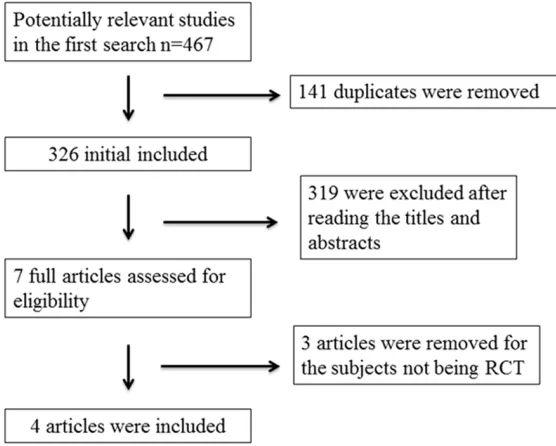
A detailed flowchart of the search and selection
results is shown in Figure 1. 467 potentially
rel-evant articles were identified initially. Finally,
The Jadad scores of the four included studies vary from 3 to 5, and all four studies are consid-ered to be high-quality ones according to the quality assessment.
Primary outcome: success rate
This outcome data is analyzed with the
fixed-effects model, and the pooled estimate of the three included RCTs suggested that compared to the control group for glaucoma surgery,
tri-amcinolone acetonide can significantly improve
the success rate (RR=1.27; 95% CI=1.05 to 1.53; P=0.01), with low heterogeneity among the studies (I2=26%, heterogeneity P=0.26)
(Figure 2).
Sensitivity analysis
Low heterogeneity is observed among the included studies for the primary outcome, so we did not perform a sensitivity analysis by omitting one study in turn to detect the heterogeneity.
Secondary outcomes
Compared to the control group for glaucoma surgery, triamcinolone acetonide shows no
substantial influence on intraocular pressure
at 1 week (MD=-3.48; 95% CI=-9.43 to 2.48; P=0.25; Figure 3), and 1 month (MD=-3.69; 95% CI=-9.56 to 2.19; P=0.22; Figure 4).
through the inhibition of wound healing [24].
The initial steps in wound healing are inflamma -tion and coagula-tion composed of biological events including cellular, hormonal, and growth
factor release which finally lead to scar tissue
formation [2, 13]. Mitomycin C is widely used to
inhibit fibroblast proliferation in trabeculectomy
and promote the formation of relatively
avascu-lar filtration blebs with less fibrovascuavascu-lar scar -ring and an increased success rate [25, 26]. Corticosteroids are found to reduce and
regu-late wound healing and inflammation through
the inhibition of macrophage functions, the release of enzymes like collagenase, plasmino-gen activators, and growth factors, as well as
vascular permeability and fibroblast prolifera -tion [25].
Topical corticosteroids are reported to signifi -cantly increase the success of trabeculectomy by inhibiting wound healing because of their
suppression of inflammation and fibroblast
proliferation [11]. Sub-tenon injection of triam-cinolone acetonide is widely accepted for treat-ing uveitis, diabetic macular edema, macular edema post-branch, and central retinal vein occlusion [27-29]. Direct injection of triamcino-lone acetonide into the sub-tenon area may inhibit wound healing and increase the success rate of glaucoma surgery through high-dose corticosteroid delivery [30]. Our meta-analysis suggests that triamcinolone acetonide injec-Figure 1. Flow diagram of the study searching and selection process.
Triamcinolone acetonide is
associated with significantly
reduced intraocular pressure at 6 months in patients with glaucoma surgery (MD=-0.62; 95% CI=-1.09 to -0.15; P= 0.01; Figure 5), but has no important impact on antiglau-coma medications at 1 year (MD=-0.46; 95% CI=-0.93 to 0.01; P=0.05; Figure 6), BCVA (MD=-0.11; 95% CI=-0.34 to 0.11; P=0.33; Figure 7), hypot-ony (RR=1.48; 95% CI=0.72 to 3.07; P=0.29; Figure 8), and choroidal detachment (RR= 1.45; 95% CI=0.41 to 5.10; P=0.56; Figure 9).
Discussion
[image:3.612.91.369.75.298.2]Table 1. Characteristics of the included studies
NO. Author
Triamcinolone acetonide group Control group
Jada scores Number (years)Age Male (n) pressure (mm Hg)Intraocular Methods Number (years)Age Male (n) pressure (mm Hg)Intraocular Methods
1 Koval 2014 37 68 (47-88),
median (range) 17 median (range)24.5 (13-40), Intracameral triamcinolone acetonide 0.1cc 40 median (range)69 (42-88), 23 median (range)23.8 (8.5-56), Matched placebo 3 2 Teixeira 2012 22 62.91±7.26 16 - 0.1 mL of triamcinolone acetonide (40 mg/
mL) was injected into the vitreous cavity 27 57.48±15.32 15 - Matched placebo 5 3 Yuki 2009 26 61.8±14.3 22 31.34±4.68 Trabeculectomy with intraoperative
sub-tenon injection of triamcinolone acetonide
27 59.1±13.9 19 34.30±10.94 Matched
placebo 4
4 Wang 1994 22 30.4±12.56 16 29.96±6.45 Subconjunctival injection of triamcinolone acetonide 12 mg
29 29.0±12.0 22 29.72±6.10 Matched
Figure 3. Forest plot for the meta-analysis of intraocular pressure at 1 week (mm Hg).
[image:5.612.91.521.300.366.2]Figure 4. Forest plot for the meta-analysis of intraocular pressure at 1 month (mm Hg).
Figure 5. Forest plot for the meta-analysis of intraocular pressure at 6 months (mm Hg).
Figure 6. Forest plot for the meta-analysis of antiglaucoma medications at 1 year.
[image:5.612.103.520.408.481.2]Figure 7. Forest plot for the meta-analysis of best-corrected visual acuity (BCVA).
[image:5.612.101.521.519.588.2] [image:5.612.97.520.628.696.2]tion can substantially improve the success rate in patients with glaucoma surgery.
Good intraocular pressure control is achieved after injecting triamcinolone acetonide (1.2
mg) into filtration blebs at the conclusion of tra -beculectomy such as tra-beculectomy, phaco- trabeculectomy, and needling [12]. Triamcin- olone acetonide (4 mg) injection
subconjuncti-vally before a trabeculectomy benefits through diffuse microcystic filtration blebs and the con -trol of intraocular pressure [31]. Better con-trol of intraocular pressure at 3 months is revealed by triamcinolone acetonide injection for glau-coma surgery based on the results of our
meta-analysis, but there is no significant influence of
intraocular pressure at 1 week and 6 months after triamcinolone acetonide injection and these intraocular pressures in 1 week and 6 months are both at normal levels. Some com-plications associated with the injection of tri-amcinolone acetonide have been previously reported and include ptosis, orbital fat pro-lapse, conjunctival ulceration, retinal and cho-roidal vascular occlusion, and cutaneous hypopigmentation etc. [32-34]. Our
meta-anal-ysis finds no increase in complications includ -ing after triamcinolone acetonide application for glaucoma surgery.
This meta-analysis has several potential limita-tions that should be taken into account. Firstly, our analysis is based on only four RCTs, and all of them have a relatively small sample size (n<100). More RCTs with large samples should
be conducted to confirm our findings. Next,
different methods of triamcinolone acetonide injection in the included RCTs are different,
which may have an influence on the pooling
results. Finally, some unpublished and missing data may lead to bias to the pooled effect. Conclusions
Triamcinolone acetonide can improve the suc-cess rate of glaucoma surgery.
Disclosure of conflict of interest None.
Address correspondence to: Linglong Mi, Depart- ment of Ophthalmology, Fenghua People’s Hospi- tal, 79 Xinming Road, Fenghua, Ningbo 315000, Zhejiang, China. Tel: 431-88782222; Fax: +86-431-88782222; E-mail: [email protected]
References
[1] Van de Velde S, Van Bergen T, Vandewalle E, Moons L and Stalmans I. Modulation of wound healing in glaucoma surgery. Prog Brain Res 2015; 221: 319-340.
[2] Zada M, Pattamatta U and White A. Modulation
of fibroblasts in conjunctival wound healing.
Ophthalmology 2018; 125: 179-192.
[3] Sharma A, Anumanthan G, Reyes M, Chen H, Brubaker JW, Siddiqui S, Gupta S, Rieger FG
and Mohan RR. Epigenetic modification pre -vents excessive wound healing and scar
for-mation after glaucoma filtration surgery. Invest
[image:6.612.93.520.76.146.2]Ophthalmol Vis Sci 2016; 57: 3381-3389.
Figure 8. Forest plot for the meta-analysis of hypotony.
[image:6.612.102.521.187.263.2][4] Yamanaka O, Kitano-Izutani A, Tomoyose K and Reinach PS. Pathobiology of wound
heal-ing after glaucoma filtration surgery. BMC
Ophthalmol 2015; 15 Suppl 1: 157.
[5] Kim M, Lee C, Payne R, Yue BY, Chang JH and
Ying H. Angiogenesis in glaucoma filtration sur -gery and neovascular glaucoma: a review. Surv Ophthalmol 2015; 60: 524-535.
[6] Addicks EM, Quigley HA, Green WR and Robin
AL. Histologic characteristics of filtering blebs
in glaucomatous eyes. Arch Ophthalmol 1983; 101: 795-798.
[7] Ji H, Zhu Y, Zhang Y, Jia Y, Li Y, Ge J and Zhuo Y. The effect of dry eye disease on scar formation
in rabbit glaucoma filtration surgery. Int J Mol
Sci 2017; 18.
[8] Masoumpour MB, Nowroozzadeh MH and Razeghinejad MR. Current and future tech-niques in wound healing modulation after
glaucoma filtering surgeries. Open Ophthalmol
J 2016; 10: 68-85.
[9] Hollo G. Wound healing and glaucoma surgery: modulating the scarring process with conven-tional antimetabolites and new molecules. Dev Ophthalmol 2017; 59: 80-89.
[10] Amoozgar B, Lin SC, Han Y and Kuo J. A role for antimetabolites in glaucoma tube surgery: cur-rent evidence and future directions. Curr Opin Ophthalmol 2016; 27: 164-169.
[11] Araujo SV, Spaeth GL, Roth SM and Starita RJ. A ten-year follow-up on a prospective, random-ized trial of postoperative corticosteroids after trabeculectomy. Ophthalmology 1995; 102: 1753-1759.
[12] Tham CC, Li FC, Leung DY, Kwong YY, Yick DW, Chi CC and Lam DS. Intrableb triamcinolone
acetonide injection after bleb-forming filtration
surgery (trabeculectomy, phacotrabeculecto-my, and trabeculectomy revision by needling): a pilot study. Eye (Lond) 2006; 20: 1484-1486.
[13] Yuki K, Shiba D, Kimura I, Ohtake Y and Tsubota K. Trabeculectomy with or without in-traoperative sub-tenon injection of triamcino-lone acetonide in treating secondary glauco-ma. Am J Ophthalmol 2009; 147: 1055-1060, 1060 e1051-1052.
[14] Cleary CA, Lanigan B and O’Keeffe M. Intracameral triamcinolone acetonide after pe-diatric cataract surgery. J Cataract Refract Surg 2010; 36: 1676-1681.
[15] Dixit NV, Shah SK, Vasavada V, Vasavada VA, Praveen MR, Vasavada AR and Trivedi RH. Outcomes of cataract surgery and intraocular lens implantation with and without intracam-eral triamcinolone in pediatric eyes. J Cataract Refract Surg 2010; 36: 1494-1498.
[16] Ventura MC, Ventura BV, Ventura CV, Ventura LO, Arantes TE and Nose W. Outcomes of
con-genital cataract surgery: intraoperative intra-cameral triamcinolone injection versus post-operative oral prednisolone. J Cataract Refract Surg 2014; 40: 601-608.
[17] Ventura MC, Ventura BV, Ventura CV, Ventura LO and Nose W. Congenital cataract surgery with intracameral triamcinolone: pre- and post-operative central corneal thickness and intra-ocular pressure. J AAPOS 2012; 16: 441-444. [18] Teixeira SH, Doi LM, Freitas Silva AL, Silva KD,
Paes AT, Higa FS, Mendonca M, Prata JA and Paranhos A. Silicone Ahmed glaucoma valve with and without intravitreal triamcinolone acetonide for neovascular glaucoma: random-ized clinical trial. J Glaucoma 2012; 21: 342-348.
[19] Koval MS, Moster MR, Freidl KB, Waisbourd M, Jain SG, Ichhpujani P, Myers JS and Pro MJ. Intracameral triamcinolone acetonide in glau-coma surgery: a prospective randomized con-trolled trial. Am J Ophthalmol 2014; 158: 395-401 e392.
[20] Moher D, Liberati A, Tetzlaff J, Altman DG; PRISMA Group. Preferred reporting items for systematic reviews and meta-analyses: the PRISMA statement. J Clin Epidemiol 2009; 62: 1006-1012.
[21] Jadad AR, Moore RA, Carroll D, Jenkinson C, Reynolds DJM, Gavaghan DJ and McQuay HJ. Assessing the quality of reports of randomized clinical trials: Is blinding necessary? Controlled Clinical Trials 1996; 17: 1-12.
[22] Kjaergard LL, Villumsen J and Gluud C. Reported methodologic quality and discrepan-cies between large and small randomized tri-als in meta-analyses. Ann Intern Med 2001; 135: 982-989.
[23] Wang NL, Ye TC and Zhou WB. A randomized controlled study of the anti-cicatricial effect of preoperative subconjunctival triamcinolone on
the filtering bleb. Zhonghua Yan Ke Za Zhi
1994; 30: 108-112.
[24] Skuta GL and Parrish RK 2nd. Wound healing
in glaucoma filtering surgery. Surv Ophthalmol
1987; 32: 149-170.
[25] Lama PJ and Fechtner RD. Antifibrotics and
wound healing in glaucoma surgery. Surv Ophthalmol 2003; 48: 314-346.
[26] Mohamed TH, Salman AG and Elshinawy RF. Trabeculectomy with Ologen implant versus mitomycin C in congenital glaucoma second-ary to Sturge Weber Syndrome. Int J Ophthalmol 2018; 11: 251-255.
[27] Ferrante P, Ramsey A, Bunce C and Lightman
S. Clinical trial to compare efficacy and
side-effects of injection of posterior sub-Tenon
[28] Bonini-Filho MA, Jorge R, Barbosa JC, Calucci D, Cardillo JA and Costa RA. Intravitreal injec-tion versus sub-Tenon’s infusion of triamcino-lone acetonide for refractory diabetic macular edema: a randomized clinical trial. Invest Ophthalmol Vis Sci 2005; 46: 3845-3849. [29] Asano S, Miyake K, Miyake S and Ota I.
Relationship between blood-aqueous barrier disruption and ischemic macular edema in pa-tients with branch or central retinal vein occlu-sion: effects of sub-tenon triamcinolone ace-tonide injection. J Ocul Pharmacol Ther 2007; 23: 577-584.
[30] Hosseini H, Mehryar M and Farvardin M. Focus on triamcinolone acetonide as an adjunct to
glaucoma filtration surgery. Med Hypotheses
2007; 68: 401-403.
[31] Giangiacomo J, Dueker DK and Adelstein E. The effect of preoperative subconjunctival
tri-amcinolone administration on glaucoma filtra -tion. I. Trabeculectomy following subconjuncti-val triamcinolone. Arch Ophthalmol 1986; 104: 838-841.
[32] Ideta S, Noda M, Kawamura R, Shinoda K, Inoue M and Tsubota K. Ptosis after sub-Ten-on’s capsule triamcinolone. Ophthalmology 2008; 115: 410-410 e411.
[33] Agrawal S, Agrawal J and Agrawal TP. Conjunctival ulceration following triamcinolone injection. Am J Ophthalmol 2003; 136: 539-540.