Adversarial Training for Cross-Domain Universal Dependency Parsing
Motoki Sato1 Hitoshi Manabe1 Hiroshi Noji1 Yuji Matsumoto1,2 1 Nara Institute of Science and Technology
2 RIKEN Center for Advanced Intelligence Project (AIP)
{sato.motoki.sa7, manabe.hitoshi.me0, noji, matsu }@is.naist.jp
Abstract
We describe our submission to the CoNLL 2017 shared task, which exploits the shared common knowledge of a language across different domains via a domain adaptation technique. Our approach is an extension to the recently proposed ad-versarial training technique for domain adaptation, which we apply on top of a graph-based neural dependency parsing model on bidirectional LSTMs. In our experiments, we find our baseline graph-based parser already outperforms the offi-cial baseline model (UDPipe) by a large margin. Further, by applying our tech-nique to the treebanks of the same lan-guage with different domains, we observe an additional gain in the performance, in particular for the domains with less train-ing data.
1 Introduction
In the CoNLL 2017 shared task (Zeman et al.,
2017), some language data is available in more than one treebanks typically from different anno-tation projects. While the treebanks differ in many respects such as the genre and the source of the text (i.e., original or translated text), the most no-table difference is that the size of the treebanks often varies significantly. For example, there are three variants of English treebanks: en, en lines, anden parunt, in which the largest dataseten con-tains 12,543 training sentences whileen linesand
en paruntcontain only 2,738 and 1,090 sentences, respectively.
In this paper, we describe our approach to improve the parser performance for the tree-banks with lesser training data (e.g.,en lines and
en parunt), by jointly learning with the dominant
treebank of the same language (e.g,en). We for-mulate our approach as a kind of domain adapta-tion, in which we treat the dominant treebank as the source domain while the others as the target domains.
Our approach to domain adaptation, which we callSharedGateAdvNet, is an extension to the re-cently proposed neural architecture for domain adaptation (Ganin and Lempitsky, 2015) with adversarial training (Goodfellow et al., 2014), which learns domain-invariant feature representa-tions through an adversarial domain classifier. We extend this architecture with an additional neural layer for each domain, which captures domain-specific feature representations. To our knowl-edge this is the first study to apply the adversarial training-based domain adaptation to parsing.
We utilize this architecture to obtain the rep-resentation of each token of a sentence, and feed it into a graph-based dependency parsing model where each dependency arc score is cal-culated using bilinear attention (Dozat and Man-ning, 2017). Specifically, we obtain the domain-specific and domain-invariant feature represen-tations for each token via separate bidirectional LSTMs (Bi-LSTMs), and then combine them via a gated mechanism.
Our baseline method is our reimplementation of the graph-based dependency parser with LSTMs (Dozat and Manning, 2017) trained with a sin-gle treebank. First, we observe that this model is already much stronger than the official baseline model of UDPipe (Straka et al.,2016) in most tree-banks. We then apply our domain adaptation tech-nique to the set of treebanks of the same language, and in most cases we observe a clear improvement of the scores, especially for the treebanks with lesser training data. We also try our architecture across multiple languages, i.e., a high-resource language with a large treebank, such as English,
and a low-resource language with a small data set. Interestingly, even though the mixed languages are completely different, we observe some score im-provements in low-resource languages with this approach. Finally we rank the 6th place on the main result of the shared task.
2 System overview
The CoNLL 2017 shared task aims at parsing Universal Dependencies 2.0 (Nivre et al., 2017). While its concern is parsing in the wild, i.e., from the raw input text, in this work we focus only on the dependency parsing layer that receives the to-kenized and POS tagged input text. For all pre-processing from sentence splitting to POS tagging, we use the provided UDPipe pipeline. For obtain-ing the trainobtain-ing treebanks, we keep the gold word segmentation while assign the predicted POS tags with the UDPipe.1
We did a simple model selection with the de-velopment data for choosing the final submitted models. First, we trained our baseline graph-based LSTM parsing model (Section3) indepen-dently for each treebank. Then for some languages with more than one treebank, or low-resource lan-guages with a small treebank alone, we applied our proposed domain adaptation technique (Section4) and obtained additional models. For treebanks for which we trained several models, we selected the best performing model on the development set in terms of LAS. For the other treebanks, we submit-ted our baseline graph-based parser.
For the parallel test sets (e.g., en pub) with no training data, we use the model trained on the largest treebank of a target language. We did not pay much attention to the surprise languages. For Buryat (bxr), we just ran the model of Russian (ru). For the other three languages, we ran the model of English (en).
3 Biaffine Attention model
Our baseline model is thebiaffineattention model (Dozat and Manning, 2017), which is an exten-sion to the recently proposed dependency parsing method calculating the score of each arc indepen-dently from the representations of two tokens ob-tained by Bi-LSTMs (Kiperwasser and Goldberg,
2016). For labeled dependency parsing, this model 1We were not aware of the jack-knifed training data pro-vided by the organizer at submission time.
first predicts the bestunlabeleddependency struc-ture, and then assigns a label to each predicted arc with another classifier. For the first step, receiv-ing the word and POS tag sequences as an input, the model calculates the score of every possible dependency arc. To obtain a well-formed depen-dency tree, these scores are given to the maximum spanning tree (MST) algorithm (Pemmaraju and Skiena,2003), which finds the tree with the high-est total score of all arcs. The overview of the bi-affine model is shown in Figure1.
Let wt be the t-th token in the sentence. As an input the model receives the word embedding
wt∈ Rdword and POS embeddingpt ∈Rdpos for each wt, which are concatenated to a vector xt. This input is mapped by Bi-LSTMs to a hidden vectorrt, which is then fed into an extension of bilinear transformation called a biaffine function to obtain the score for an arc fromwi(head) towj (dependent):
rt = Bi-LSTM(xt), (1)
h(iarc−head) = MLP(arc−head)(r
i),
h(jarc−dep) = MLP(arc−dep)(rj),
s(i,jarc) = hiT(arc−head)U(arc)h(jarc−dep)
+hT(i arc−head)u(arc),
where MLP is a multi layer perceptron. A weight matrix U(arc) determines the strength of a link fromwitowjwhileu(arc)is used in the bias term, which controls the prior headedness ofwi.
After obtaining the best unlabeled tree from these scores, we assign the best label for every arc according tos(i,jlabel), in which thek-th element corresponds to the score ofk-th label:
h(ilabel−head) = MLP(label−head)(ri),
h(jlabel−dep) = MLP(label−dep)(r
j),
hi,j(label) = hi(label−head)⊕h(jlabel−dep),
s(i,jlabel) = hiT(label−head)U(label)h(jlabel−dep)
+hT(i,jlabel)W(label)+u(label), whereU(label)is a third-order tensor,W(label)is a weight matrix, andu(label)is a bias vector.
4 Domain Adaptation Techniques with Adversarial Training
net-Bi−LSTMs
Input embedding
x1 x2 x3
MLP
Biaffine Biaffine
[image:3.595.309.524.65.186.2]Biaffine Biaffine
Figure 1: Overview of the biaffine model.
works both using adversarial training; the main difference between them is whether we use a domain-specific feature representation for each domain. The basic architecture with adversar-ial training (Section4.1) is an application of the existing domain adaptation technique (Ganin and Lempitsky, 2015) that does not employ domain-specific representations. We then extend this ar-chitecture to add a domain-specific component with a gated mechanism (Section4.2).
In Section 5we compare the empirical perfor-mances of these two approaches as well as several ablated settings.
4.1 Adversarial Training
Figure 2 describes the application of adversar-ial training (Ganin and Lempitsky, 2015) for the biaffine model. In this architecture all models for different domains are parameterized by the same LSTMs (Shared Bi-LSTMs), which output
rt (Eqn. 1) that are fed into the biaffine model. The key of this approach is a domain classifier, which also receivesrtand tries to classify the do-main of the input. During training the classifier is trained to correctly classify the input domain. At the same time, we train the shared BiLSTM lay-ers so that the domain classification task becomes harder. By thisadversarialmechanism the model is encouraged to find the shared parameters that are not specific to a particular domain as much as possible. As a result, we expect the target do-main model (with lesser training data) is trained to utilize the knowledge of the source domain effec-tively. Note that the domain classifier in Figure2
is applied for every token in the input sentence. This domain adaptation technique can be im-plemented by introducing the gradient reversal layer (GRL). The GRL has no parameters asso-ciated with it (apart from the hyper-parameter λ,
Domain 1
Shared LSTMs
Domain 2
Biaffine Predict Biaffine
Domain 1
Shared LSTMs
Domain 2
Biaffine Predict Biaffine
Gradient Reversal Layer
Domain 1
Domain 2 Domain classifier MLP
Figure 2: An application of the adversarial train-ing for the biaffine model. In this basic architec-ture all domains are modeled with a common sin-gle Bi-LSTM network (Shared Bi-LSTMs).
which is not updated with backpropagation). Dur-ing the forward propagation GRL acts as an iden-tity transform, while during the backpropagation GRL takes the gradient from the subsequent layer, multiplies it by λ and passes it to the preceding layer.
The parameterλcontrols the trade-off between the two objectives (the domain classifier and the biaffine model) that shape the feature representa-tion during training. The GRL layerRλ(x)for the forward and backward propagation is defined as follows:
Rλ(x) =x; dRdxλ =−λI.
4.2 Shared Gated Adversarial Networks
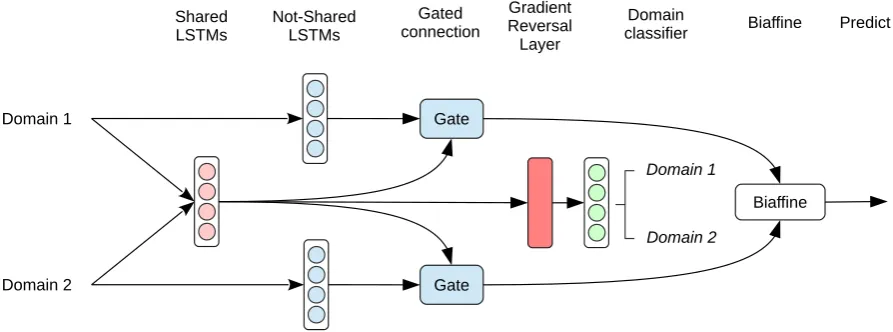
Now we present our extension to adversarial train-ing described above, which we call the shared gated adversarial networks (SharedGateAdvNet).
Figure 3 shows the overall architecture. The largest difference from Figure 2 is the existence of the domain-specific LSTMs (Not-shared Bi-LSTMs) that we expect to capture the representa-tions not fitted into the shared LSTMs and special-ized to a particular domain. The model comprises of the following three components.
Shared Bi-LSTMs As in the basic model with adversarial training (Figure 2), the shared Bi-LSTMs in this model try to learn the domain in-variant feature representation via a domain classi-fier, which facilitates effective domain adaptation.
[image:3.595.72.289.66.186.2]Domain 1
Shared
LSTMs Not-SharedLSTMs
Domain 2
Gate
Gate
Biaffine Gated
connection Predict
Gradient Reversal Layer
Biaffine
Domain 1
Domain 2
[image:4.595.74.521.63.229.2]Domain classifier
Figure 3: The architecture of SharedGateAdvNet. Each token in the input sentence is passed to the biaffine model through this network.
Bi-LSTMs. The domain-specific LSTMs exist on each domain. Figure 3shows the case when two treebanks (domains) are trained at the same time. When training with three treebanks, there exist three Bi-LSTMs, one for each domain.
Gated connection The gated connection selects which information to use between the domain-invariant and domain-specific feature represen-tations (the shared Bi-LSTMs and the domain-specific Bi-LSTMs). We get the combined repre-sentationrgatet from these two vectors as follows:
gt = σ(U(gate)(rtdom⊕rsharet ) +u(gate)),
rgatet = gt·rsharet + (1−gt)·rdomt ,
whereσis the sigmoid function. rshareis the out-put of the shared Bi-LSTMs whilerdomis the out-put of the domain-specific Bi-LSTMs.
5 Experiments 5.1 Settings
For the settings of the biaffine models, we fol-low the same network settings asDozat and Man-ning(2017): 3-layer, 400-dimentional LSTMs for each direction, 500-dimentional MLP for arc diction, and 100-dimentional MLP for label pre-diction. We use the 100-dimensional pre-trained word embeddings trained by word2vec (Mikolov et al.,2013) 2and the 100-dimensional randomly initialized POS tag embeddings. For the model 2The pre-trained word embeddings are provided by the CoNLL 2017 Shared Task organizers. These are trained with CommonCrawl and Wikipedia.
with adversarial training, we fixλto 0.5.3 We ap-ply dropout (Srivastava et al., 2014) with a 0.33 rate at the input and output layers. For optimiza-tion, we use Adam (Kingma and Ba,2014) with the batch size of 128 and gradient clipping of 5. We use early stopping (Caruana et al.,2001) based on the performance on the development set.
5.2 Preliminary Experiment
Before selecting the final submitted model for each treebank (Section 5.3) here we perform a small experiment on selected languages (English and French) to see the effectiveness of our domain adaptation techniques.
English experiment First, for English, we com-pare the performances of several domain adapta-tion techniques as well as the baselines without adaptation, to see which technique performs bet-ter. We compare the following six systems:
• UDPipe: The official baseline parser (Straka et al.,2016). This is a transition-based parser selecting each action using neural networks.
• Biaffine: Our reimplementation of the graph-based parser of Dozat and Manning (2017). We use Chainer (Tokui et al., 2015) for our implementation. We train this model inde-pendently on each treebank.
Method UASenLAS UASen linesLAS UASen partutLAS
UDPipe 83.83 80.13 79.00 74.68 78.26 74.23
Biaffine 86.19 82.45 81.94 77.64 80.01 75.52
Biaffine-MIX 86.19 82.28 82.23 76.95 83.34 78.02
Biaffine-MIX + Adv 86.05 82.36 82.47 77.45 83.38 78.37
SharedGateNet 86.17 82.42 82.67 78.28 84.06 80.09
[image:5.595.141.462.61.173.2]SharedGateAdvNet 86.27 82.47 82.69 78.27 84.32 80.35
Table 1: The result of our preliminary English experiment across multiple domains. UDPipe and Biaffine are trained separately for each language, while the other models are trained across all domains jointly.
Method UASenLAS UASen linesLAS UASen partutLAS UASfrLAS UASfr partutLAS UASfr sequoiaLAS Biaffine 86.19 82.45 81.94 77.64 80.01 75.52 90.39 88.11 86.79 83.70 87.20 84.90 Ours (domain) 86.27 82.47 82.69 78.27 84.32 80.35 90.26 88.06 88.71 86.18 87.64 85.27 Ours (domain, lang) 85.47 81.75 82.03 77.58 83.60 79.51 90.07 87.71 89.49 87.08 87.90 85.34 Table 2: The result of our preliminary experiment across different languages (English and French). Ours (domain) is trained for each language across multiple domains by SharedGateAdvNet. Ours (domain, lang) is trained with all six treebanks of two languages jointly. Joint training of two languages brings a small improvement on the smaller French treebanks (fr partut and fr sequoia).
this by removing the domain classification component in Figure2.
• Biaffine-MIX + Adv: The model in Figure
2, which shares the same parameters across multiple domains but adversarial training fa-cilitates learning domain-invariant represen-tations.
• SharedGateNet: A simpler version of our proposed architecture (Figure3), which does not have the adversarial component but has the gated unit controlling the strength of the two, domain-invariant and domain-specific Bi-LSTMs.
• SharedGateAdvNet: Our full architecture (Figure3) with both adversarial training and the gated unit.
The result is shown in Table 1. First, we find that our baseline biaffine parser already out-performs the official baseline parser (UDPipe) by a large margin (e.g., for English, 82.45 vs. 80.13 LAS), which suggests the strength of graph-based parsing with Bi-LSTMs that enable the model to capture the entire sentence as a context. By just mixing the training treebanks (Biaffine-MIX), we observe a score improvement for the domains with less data, en lines and en parunt, which only contain 2,738 and 1,090 sentences,
respectively. We also observe an additional small gain with adversarial training (Biaffine-MIX Adv). Comparing with this, our proposed archi-tectures (SharedGateNet and SharedGateAdvNet) perform better. This shows the importance of hav-ing the domain-specific network layers. Our fi-nal architecture SharedGateAdvNet slightly out-performs SharedGateNet, indicating that the ad-versarial technique also has its own advantage.
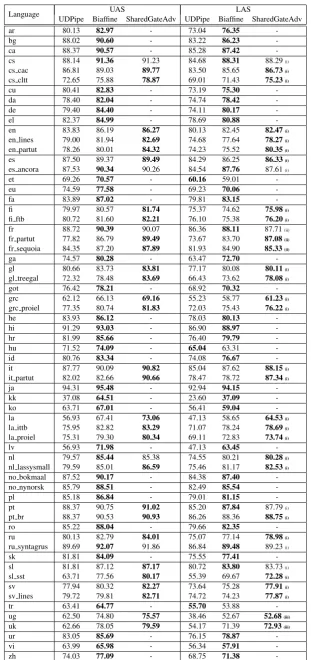
Since SharedGateAdvNet consitently outper-forms the others in English, we only try this method in the following experiments.
[image:5.595.80.518.221.279.2]Language UDPipe Biaffine SharedGateAdv UDPipe Biaffine SharedGateAdvUAS LAS
ar 80.13 82.97 - 73.04 76.35 -bg 88.02 90.60 - 83.22 86.23 -ca 88.37 90.57 - 85.28 87.42 -cs 88.14 91.36 91.23 84.68 88.31 88.29(i)
cs cac 86.81 89.03 89.77 83.50 85.65 86.73(i)
cs cltt 72.65 75.88 78.87 69.01 71.43 75.23(i)
cu 80.41 82.83 - 73.19 75.30 -da 78.40 82.04 - 74.74 78.42 -de 79.40 84.40 - 74.11 80.17 -el 82.37 84.99 - 78.69 80.88 -en 83.83 86.19 86.27 80.13 82.45 82.47(i)
en lines 79.00 81.94 82.69 74.68 77.64 78.27(i)
en partut 78.26 80.01 84.32 74.23 75.52 80.35(i)
es 87.50 89.37 89.49 84.29 86.25 86.33(i)
es ancora 87.53 90.34 90.26 84.54 87.76 87.61(i)
et 69.26 70.57 - 60.16 59.01 -eu 74.59 77.58 - 69.23 70.06 -fa 83.89 87.02 - 79.81 83.15 -fi 79.97 80.57 81.74 75.37 74.62 75.98(i)
fi ftb 80.72 81.60 82.21 76.10 75.38 76.20(i)
fr 88.72 90.39 90.07 86.36 88.11 87.71(ii)
fr partut 77.82 86.79 89.49 73.67 83.70 87.08(ii)
fr sequoia 84.35 87.20 87.89 81.93 84.90 85.33(ii)
ga 74.57 80.28 - 63.47 72.70 -gl 80.66 83.73 83.81 77.17 80.08 80.11(i)
gl treegal 72.32 78.48 83.69 66.43 73.62 78.08(i)
got 76.42 78.21 - 68.92 70.32 -grc 62.12 66.13 69.16 55.23 58.77 61.23(i)
grc proiel 77.35 80.74 81.83 72.03 75.43 76.22(i)
he 83.93 86.12 - 78.03 80.13 -hi 91.29 93.03 - 86.90 88.97 -hr 81.99 85.66 - 76.40 79.79 -hu 71.52 74.09 - 65.04 63.31 -id 80.76 83.34 - 74.08 76.67 -it 87.77 90.09 90.82 85.04 87.62 88.15(i)
it partut 82.02 82.66 90.66 78.47 78.72 87.34(i)
ja 94.31 95.48 - 92.94 94.15 -kk 37.08 64.51 - 23.60 37.09 -ko 63.71 67.01 - 56.41 59.04 -la 56.93 67.41 73.06 47.13 58.65 64.53(i)
la ittb 75.95 82.82 83.29 71.07 78.24 78.69(i)
la proiel 75.31 79.30 80.34 69.11 72.83 73.74(i)
lv 56.93 71.98 - 47.13 63.45 -nl 79.57 85.44 85.38 74.55 80.21 80.28(i)
nl lassysmall 79.59 85.01 86.59 75.46 81.17 82.53(i)
no bokmaal 87.52 90.17 - 84.38 87.40 -no ny-norsk 85.79 88.51 - 82.49 85.54 -pl 85.18 86.84 - 79.01 81.15 -pt 88.37 90.75 91.02 85.20 87.84 87.79(i)
pt br 88.37 90.53 90.93 86.26 88.36 88.75(i)
ro 85.22 88.04 - 79.66 82.35 -ru 80.13 82.79 84.01 75.07 77.14 78.98(i)
ru syntagrus 89.69 92.07 91.86 86.84 89.48 89.23(i)
sk 81.81 84.09 - 75.55 77.41 -sl 81.81 87.12 87.17 80.72 83.80 83.73(i)
sl sst 63.71 77.56 80.17 55.39 69.67 72.28(i)
sv 77.94 80.32 82.27 73.64 75.28 77.91(i)
sv lines 79.72 79.81 82.71 74.72 74.23 77.87(i)
tr 63.41 64.77 - 55.70 53.88 -ug 62.50 74.80 75.57 38.46 52.67 52.68(iii)
uk 62.66 78.05 79.59 54.17 71.39 72.93(iii)
ur 83.05 85.69 - 76.15 78.87 -vi 63.99 65.98 - 56.34 57.91 -zh 74.03 77.09 - 68.75 71.38
[image:6.595.143.455.59.721.2]negative, and these suggest our approach may be ineffective for a treebank that already contains suf-ficient amount of data.
Due to time constraints, we were unable to try many language pairs for joint training, but this re-sult suggests the parser may benefit from training across different languages. For the final experi-ment for model selection below, we try some other pairs for some languages, and select those models when they perform better.
5.3 Model Selection
As we summarize in Section2we perform a sim-ple model selection for each language with the de-velopment data in order to select the final submit-ted models. Besides a biaffine model with a single treebank, for some treebanks we additionally train other models with our SharedGateAdvNet. Our approach is divided into the following three strate-gies according to the languages:
(i) Training multiple domains within a single language. We try this for many languages, such as English (en), Czech (cs), Spanish (es), etc.
(ii) Training multiple domains across different languages. Based on the positive result of our preliminary experiment, we try this only for obtaining French models (training jointly with English treebanks).
(iii) Training two treebanks in different lan-guages. We only try this for two very small treebanks: Ukrainian (uk), which we train with en, and Uyghur (ug), which we train with Russian (ru) that we find performs better than training withen.
See Table 3 for the results. Again, our base-line biaffine parser outperforms UDPipe in most treebanks. Training multiple domains in one lan-guage often brings performance gains, in par-ticular for smaller treebanks, as in the case for English. For example, for Galician, LAS in
gl treegal largely improves from 73.63 to 78.08 with our joint training. The largest gain is obtained in Italian (it partut), from 78.72 to 87.34, about 10 points improvement in LAS.
From these results, for example, we select our SharedGateAdvNet model forcs cacwhile select the biaffine model for cs, which does not benefit from joint training.
Language UDPipe Ours Stanford UDPipe Ours StanfordUAS LAS ar 71.19 73.34 76.59 65.30 67.78 71.96 ar pub 53.55 55.66 58.87 43.14 45.56 49.50 bg 87.79 89.95 92.89 83.64 85.97 89.81 bxr 46.97 44.07 51.19 31.50 27.20 30.00 ca 88.62 90.59 92.88 85.39 87.47 90.70 cs 86.46 89.74 92.62 82.87 86.50 90.17 cs cac 86.49 90.09 93.14 82.46 86.41 90.43 cs cltt 76.26 81.10 86.02 71.64 77.14 82.56 cs pub 84.42 87.22 89.11 79.80 82.30 84.42 cu 69.68 72.19 77.10 62.76 65.13 71.84 da 76.94 80.90 85.33 73.38 77.08 82.97 de 74.27 78.43 84.10 69.11 74.04 80.71 de pub 73.64 77.20 80.88 66.53 70.74 74.86 el 83.00 85.48 89.73 79.26 81.79 87.38 en 78.87 80.96 84.74 75.84 77.93 82.23 en lines 77.39 81.87 85.16 72.94 77.53 82.09 en partut 77.83 83.17 86.10 73.64 79.10 82.54 en pub 82.74 84.75 88.22 78.95 81.18 85.51 es 84.84 87.80 90.01 81.47 84.25 87.29 es ancora 86.97 89.93 92.11 83.78 87.27 89.99 es pub 84.71 86.91 88.14 77.65 79.66 81.05 et 67.71 69.00 78.08 58.79 57.72 71.65 eu 74.39 77.94 85.28 69.15 70.71 81.44 fa 83.36 86.06 89.64 79.24 82.01 86.31 fi 77.90 80.17 87.97 73.75 74.71 85.64 fi ftb 78.77 80.43 89.24 74.03 74.42 86.81 fi pub 82.24 82.40 90.60 78.65 77.11 88.47 fr 84.13 85.88 88.57 80.75 82.43 85.51 fr partut 81.69 84.79 88.64 77.38 80.31 85.05 fr pub 78.62 80.32 83.45 73.63 75.20 78.81 fr sequoia 82.62 85.85 88.48 79.98 83.10 86.53 ga 72.08 73.29 78.50 61.52 62.25 70.06 gl 80.66 83.51 85.87 77.31 80.13 83.23 gl treegal 71.17 73.60 78.28 65.82 66.84 73.39 got 67.13 67.84 73.10 59.81 60.20 66.82 grc 62.74 68.85 78.42 56.04 61.28 73.19 grc proiel 70.42 74.33 78.30 65.22 69.23 74.25 he 61.54 64.16 67.70 57.23 59.56 63.94 hi 90.97 92.64 94.70 86.77 88.70 91.59 hi pub 63.43 65.29 67.24 50.85 52.81 54.49 hr 83.20 85.47 90.11 77.18 79.32 85.25 hsb 61.70 49.38 67.83 53.83 41.32 60.01 hu 71.46 71.87 82.35 64.30 60.30 77.56 id 80.91 83.11 85.17 74.61 76.50 79.19 it 88.03 89.93 92.51 85.28 87.39 90.68 it pub 87.04 88.61 91.08 83.70 85.30 88.14 ja 73.52 74.46 75.42 72.21 73.27 74.72 ja pub 77.13 77.65 78.64 76.28 76.78 77.92 kk 41.92 40.12 43.51 24.51 22.49 25.13 kmr 46.20 31.68 47.71 32.35 23.18 35.05 ko 66.40 71.48 85.90 59.09 64.46 82.49 la 54.35 63.60 72.56 43.77 52.19 63.37 la ittb 80.78 85.53 89.44 76.98 82.20 87.02 la proiel 63.50 67.68 73.71 57.54 61.34 69.35 lv 67.14 68.83 79.26 59.95 60.20 74.01 nl 74.94 79.16 85.17 68.90 73.22 80.48 nl lassysmall 81.37 87.74 89.56 78.15 85.03 87.71 no bokmaal 86.14 88.55 91.60 83.27 86.05 89.88 no nynorsk 84.88 87.22 90.75 81.56 84.39 88.81 pl 85.08 86.89 93.98 78.78 80.68 90.32 pt 85.77 87.70 89.90 82.11 84.35 87.65 pt br 87.75 90.06 92.76 85.36 87.73 91.36 pt pub 80.10 82.58 83.27 73.96 76.35 77.14 ro 85.50 87.28 90.43 79.88 81.66 85.92 ru 79.28 82.75 87.15 74.03 77.63 83.65 ru syntagrus 89.30 91.68 82.31 86.76 89.31 75.71 ru pub 75.67 77.93 94.00 68.31 70.51 92.60 sk 78.14 81.11 89.58 72.75 75.28 86.04 sl 84.68 87.35 93.34 81.15 84.06 91.51 sl sst 53.79 57.47 61.71 46.45 50.16 56.02 sme 46.06 37.74 51.13 30.60 23.54 37.21 sv 80.78 83.71 88.50 76.73 79.68 85.87 sv lines 79.18 81.49 86.51 74.29 76.63 82.89 sv pub 75.09 77.47 81.90 70.62 72.89 78.49 tr 60.48 62.48 69.62 53.19 51.44 62.79 tr pub 55.01 52.95 58.72 34.53 31.17 37.72 ug 53.58 51.45 56.86 34.18 33.19 39.79 uk 69.78 70.22 81.44 60.76 60.73 75.33 ur 83.67 86.40 87.98 76.69 79.38 82.28 vi 42.12 44.01 46.14 37.47 38.99 42.13 zh 61.50 63.87 68.95 57.40 59.99 65.88 AVG. 74.40 76.35 81.30 68.35 70.13 76.29
5.4 Evaluation on Test data
The main result of CoNLL 2017 shared task on the test data is shown in Table 4. In addition to the official baseline (UDPipe) and our system, we also report the scores of the winning system by the Stanford team. SeeZeman et al.(2017) for the overview of the other participating systems.
Our system outperforms UDPipe in many test treebanks, 69 out of 81 treebanks. We find many cases that UDPipe performs better are when the training teebank is very small, e.g., Kazakh (kk), Ukrainian (uk), and Uyghur (ug), or not available at all, i.e., surprise languages: Buryat (bxr), Kur-manji (kmr), Upper Sorbian (hsb), and North S`ami (sme), for which our approach is somewhat naive (Section 2) and UDPipe performs always better. We can also see that for some treebanks (e.g.,et,
fi pubandhu), our system performs better in UAS while worse in LAS. This may be due to the design of the baseline biaffine model, which determines the best unlabeled tree before assigning the labels (Section3), i.e., does not perform labeled parsing as a single task.
Our system (NAIST-SATO) achieves the over-all average LAS of 70.13, which is the 6th rank among 33 participants in the shared task. UDPipe (68.35) is the 13th rank.
6 Related Work
A related approach to us in parsing isAmmar et al.
(2016), where a single multilingual dependency parser parses sentences in several languages. Dif-ferently from our final architecture their model shares all parameters across different languages. In this study, we found the importance of model-ing language-specific syntactic features explicitly with the separate Bi-LSTMs.
Our network architecture for domain adaptation is an extension of Ganin and Lempitsky (2015), which applies adversarial training (Goodfellow et al., 2014) for the domain adaptation purpose. There is little prior work applying this adversarial domain adaptation technique to NLP tasks; Chen et al.(2016) use it for cross-lingual sentiment clas-sification, in which the adversarial component has a classifier that tries to classify the language of an input sentence. To our knowledge, this is the first study applying adversarial training for parsing. In addition to the simple application, we also pro-posed an extended architecture with the domain specific LSTMs and demonstrated the importance
of them.
7 Conclusion
We have proposed a domain adaptation technique with adversarial training for parsing. By apply-ing it on the recent state-of-the-art graph-based de-pendency parsing model with Bi-LSTMs, we ob-tained a consistent score improvement, especially for the treebanks having less training data. For the architecture design, we found the importance of preparing the network layer capturing the do-main specific representation. We also performed a small experiment for training across multiple lan-guages and had an encouraging result. In this work, we have not investigated incorporating in-formation on language families, so a natural future direction would be to investigate whether typolog-ical knowledge helps to select good combinations of languages for training multilingual models.
Acknowledgments
We thank two anonymous reviewers for helpful comments. This work was in part supported by JSPS KAKENHI Grant Number 16H06981.
References
Waleed Ammar, George Mulcaire, Miguel Ballesteros, Chris Dyer, and Noah A Smith. 2016. Many lan-guages, one parser. Transactions of the Association for Computational Linguistics (TACL)5:431–444. Rich Caruana, Steve Lawrence, and C. Lee Giles. 2001.
Overfitting in neural nets: Backpropagation, conju-gate gradient, and early stopping. In T. K. Leen, T. G. Dietterich, and V. Tresp, editors, Advances in Neural Information Processing Systems 13, MIT Press, pages 402–408.
Xilun Chen, Yu Sun, Ben Athiwaratkun, Claire Cardie, and Kilian Weinberger. 2016. Adversarial deep av-eraging networks for cross-lingual sentiment classi-fication.arXiv preprint arXiv:1606.01614.
Timothy Dozat and Christopher D Manning. 2017. Deep biaffine attention for neural dependency pars-ing. Proc. International Conference on Learning Representations (ICLR).
Yaroslav Ganin and Victor Lempitsky. 2015. Unsuper-vised domain adaptation by backpropagation. arXiv preprint arXiv:1409.7495.
Diederik Kingma and Jimmy Ba. 2014. Adam: A method for stochastic optimization. arXiv preprint arXiv:1412.6980.
Eliyahu Kiperwasser and Yoav Goldberg. 2016. Sim-ple and Accurate Dependency Parsing Using Bidi-rectional LSTM Feature Representations. Transac-tions of the Association for Computational Linguis-tics4:313–327.
Tomas Mikolov, Ilya Sutskever, Kai Chen, Greg S Cor-rado, and Jeff Dean. 2013. Distributed representa-tions of words and phrases and their compositional-ity. InAdvances in neural information processing systems. pages 3111–3119.
Joakim Nivre, ˇZeljko Agi´c, Lars Ahrenberg, et al. 2017. Universal Dependencies 2.0. LIN-DAT/CLARIN digital library at the Institute of For-mal and Applied Linguistics, Charles University, Prague. http://hdl.handle.net/11234/1-1983. Sriram Pemmaraju and Steven S Skiena. 2003.
Com-putational Discrete Mathematics: Combinatorics and Graph Theory with Mathematica⃝R. Cambridge
university press.
Nitish Srivastava, Geoffrey Hinton, Alex Krizhevsky, Ilya Sutskever, and Ruslan Salakhutdinov. 2014. Dropout: A simple way to prevent neural networks from overfitting. Journal of Machine Learning Re-search15:1929–1958.
Milan Straka, Jan Hajiˇc, and Jana Strakov´a. 2016. UD-Pipe: trainable pipeline for processing CoNLL-U files performing tokenization, morphological anal-ysis, pos tagging and parsing. In Proceedings of the Tenth International Conference on Language Resources and Evaluation (LREC’16). European Language Resources Association (ELRA), Paris, France.
Seiya Tokui, Kenta Oono, Shohei Hido, and Justin Clayton. 2015. Chainer: a next-generation open source framework for deep learning. InProceedings of Workshop on Machine Learning Systems (Learn-ingSys) in The Twenty-ninth Annual Conference on Neural Information Processing Systems (NIPS). Daniel Zeman, Martin Popel, Milan Straka, Jan
Hajiˇc, Joakim Nivre, Filip Ginter, Juhani Luotolahti, Sampo Pyysalo, Slav Petrov, Martin Potthast, Fran-cis Tyers, Elena Badmaeva, Memduh G¨okırmak, Anna Nedoluzhko, Silvie Cinkov´a, Jan Hajiˇc jr., Jaroslava Hlav´aˇcov´a, V´aclava Kettnerov´a, Zdeˇnka Ureˇsov´a, Jenna Kanerva, Stina Ojala, Anna Mis-sil¨a, Christopher Manning, Sebastian Schuster, Siva Reddy, Dima Taji, Nizar Habash, Herman Leung, Marie-Catherine de Marneffe, Manuela Sanguinetti, Maria Simi, Hiroshi Kanayama, Valeria de Paiva, Kira Droganova, Hˇector Mart´ınez Alonso, Hans Uszkoreit, Vivien Macketanz, Aljoscha Burchardt, Kim Harris, Katrin Marheinecke, Georg Rehm, Tolga Kayadelen, Mohammed Attia, Ali Elkahky, Zhuoran Yu, Emily Pitler, Saran Lertpradit, Michael