Is Uncertainty Reduction the Basis for
Perception? Errors in Norwich’s Entropy
Theory of Perception Imply Otherwise
Lance Nizami,
Member, IAENGAbstract— This paper reveals errors within Norwich et al.’s Entropy Theory of Perception, errors that have broad implications for our understanding of perception. What Norwich and coauthors dubbed their “informational theory of neural coding” [1] is based on
cybernetics, that is, control and communication in man
and machine. The Entropy Theory uses information theory to interpret human performance in absolute judgments. There, the continuum of the intensity of a sensory stimulus is cut into categories and the subject is shown exemplar stimuli of each category. The subject must then identify individual exemplars by category. The identifications are recorded in the Garner-Hake [2] version of the Shannon “confusion matrix” [3]. The matrix yields “H”, the entropy (degree of uncertainty) about what stimulus was presented. Hypothetically, uncertainty drops as a stimulus lengthens, i.e. a plot of H vs. stimulus duration should fall monotonically. Such “adaptation” is known for both sensation and firing rate. Hence, because “the physiological adaptation curve has the same general shape as the psychophysical adaptation curve” [4], Norwich et al. assumed that both have the same time course; sensation and firing rate were thus both declared proportional to H. However, a closer look reveals insurmountable contradictions. First, the peripheral neuron hypothetically cannot fire in response to a stimulus of a given intensity until after somehow computing H from its responses to stimuli of various intensities. Thus no sensation occurs until firing rate adapts, i.e. attains its spontaneous rate. But hypothetically, once adaptation is complete, certainty is reached and perception ends. Altogether, then, perception cannot occur until perception is over. Secondly, sensations, firing rates, and H’s are empirically not synchronous, contrary to assumption. In sum, the core concept of the cybernetics-based Entropy Theory of Perception, that is, that uncertainty reduction is the basis for perception, is irrational.
Index Terms—uncertainty, perception, Information Theory, neural adaptation.
Manuscript received January 29, 2010. Work supported by the author. L. Nizami is presently an Independent Research Scholar in Decatur, GA (404-299-5530; e-mail: [email protected]). Research commenced at Dept. of Psychology, University of Toronto in Mississauga, 3359 Mississauga Rd. N., Mississauga, ON, Canada, and continued at Center for Hearing Research, Boys Town National Research Hospital, Omaha, NE 68131, USA.
I. INTRODUCTION:PERCEPTION IN MAN AND MACHINE
Alan Turing [5] called computers “thinking machines”. They are designed from human thinking and inevitably emulate the brain to some degree, massive parallelism being one example. Men and machines are required to “learn”. Learning in man or machine is a process of reduction of uncertainty, achieved through perception. However, K.H. Norwich and co-authors have argued the converse: in their Entropy Theory of Perception, they model human perception as based upon uncertainty reduction. In the Norwichian approach, humans exist in uncertainty about their surroundings; the uncertainty is reduced by processing of sensory input by sensory receptors. Norwich’s theory was based upon cybernetics, defined by Wiener as “Control and communication in the animal and the machine” [6]. As such, the Norwich et al. approach might be applied to machines. In the animal, such as man, the control involves spiking neurons; in the machine, it involves pathways and processors in a control system.
II. BACKGROUND: THE ENTROPY THEORY OF PERCEPTION
The Entropy Theory of Perception [7] (1975-present) encourages us to imagine a psychophysical absolute identification experiment in which a subject is exposed to stimuli randomly chosen from a set of stimuli made, for simplicity’s sake, to vary in only one dimension of its sensory attributes (e.g. decibels SPL but not frequency; or brightness but not hue). The subject must then name the category into which the stimulus falls, from a set of non-overlapping continua previously explained to the subject. For a set of transmitted symbols “k”, the stimulus information IS is
( )
( )
∑
− =
k
k p log k p
IS (1)
where p(k) is the presentation probability of symbol “k”. The base of the logarithm is arbitrary; usually base 2 is used, giving information in “bits” (binary units) per symbol.
The human responses (whether pooled across all subjects, or over a single subject; both methods are used) are recorded in an array of category (intensity) vs. category (response), the information transmission or “confusion” matrix. The latter relates transmitted (source) symbols to received symbols [2]. From it is calculated the stimulus equivocation, called “H” or ES, the information-theory uncertainty or “entropy” [8] about
( )
k log p( )
k . p E j k j jS =−
∑∑
(2)The information transmitted, It, is
( )
( )
( )
k log p( )
k . p k p log k p E I I j k k j j S S t∑∑
∑
+ − = − = (3)The upper limit to the transmitted information It is IS, when
what is transmitted is identically received.
The confusion matrix is assembled as follows. Let Njk be
the number of times a symbol received as j was transmitted as k. Then Nj.is the total number of symbols received as j and N.k is the total number of symbols sent as k. Usually, the numbers of stimulus and response categories are the same, here called n. For simplicity, Norwich et al. assumed that the total number of symbols received overall equals the total number of symbols sent overall, called N. Hence altogether
,
N
N
N
n 1 k n 1 j kj
=
∑
=
∑
= =
.
. (4)
and
p(j) = Nj. /N = the probability of receiving j, p(k) = N. k/N = the probability of sending k,
pk(j) = Njk /N. k = the probability of receiving j if k is transmitted, and
pj(k) = Njk /Nj. = the probability of transmission of k, given j has been received.
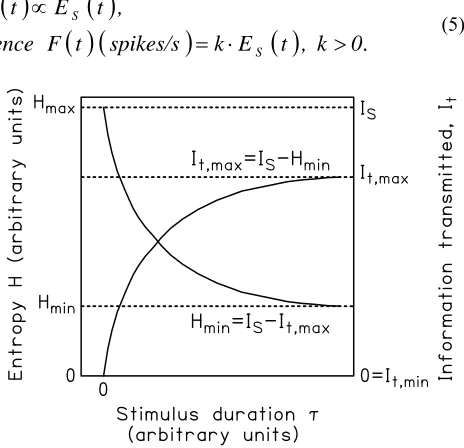
Entropy is a maximum Hmax when the stimulus is turned
on, and with time drops to a lowest value Hmin. The difference
Hmax - Hmin is the information transmitted. After that, the
subject gains no substantial information.
Early on, stimulus duration τ is just long enough to exceed sensory threshold, so that the subject can reliably tell that the stimulus is present, but assignment to the proper category is difficult. H is large, It is thus small. As the experiment is
[image:2.595.316.548.484.708.2]repeated, each time with a different τ, a set of data points {τ,H} builds up. This plot should fall monotonically and should resemble the drop in the perceived intensity of a maintained steady stimulus over time [4]. Indeed, Norwich [4, Fig. 1] refers to the plot of H vs. τ as “a psychophysical adaptation curve”, such that H represents sensation (also [9]). H does not drop to zero because even an infinitely long stimulus can be placed in the wrong category. Fig. 1 shows the supposed relations between H, IS, and It.
The confusion matrix looks like this:
Stimulus category
!
…
…
…
…
…
…
!
N
1.N
1n…
N
1k…
N
12N
111
3
=N
N
.n…
N
.k…
N
.2N
.1Column totals
N
n.N
nn…
N
nk…
N
n2N
n1n
N
j.N
jn…
N
jk…
N
j2N
j1j
!
…
…
…
…
…
…
!
N
2.N
2n…
N
2k…
N
22N
212
Response category Row totalsn
…
k
…
2
1
III. CONNECTION TO THE FIRING RATE OF PERIPHERAL
SENSORY NEURONS
Exposing the isolated receptor with its primary afferent to a long, steady stimulus causes the firing rate to adapt. From an initial maximum, the rate drops smoothly and monotonically to a steady minimum [4], an equilibrium rate. The physiological adaptation curve has the same general shape as the psychophysical adaptation curve (Norwich et al., various papers). Fig. 2 shows this relation. Let us replace τ with t, where t is time after stimulus onset. Neuronal firing rate F(t), and stimulus equivocation ES (t), were hypothesised
to obey
( )
( )
( ) (
t spikes/s)
k E( )
t , k 0.F hence , t E t F S S > ⋅ = ∝ (5)
Fig. 1. Entropy H and information transmitted It vs. stimulus duration τ (after Norwich et al.,
various papers). If It = 0 then Hmax = IS.
Information transmitted It is maximal when H
Fig. 2. Hypothetical adaptation curves (after Norwich et al., various papers). (Left) A psychophysical adaptation curve. (Right) A physiological adaptation curve. Norwich [4] noted the similarity in shape of the left and right curves, but supplied no time indices for the x-axes.
Eq. (5) implies that sensation and neuronal firing rate change synchronously. Fig. 3 shows the relation of F for physiological adaptation to H for psychophysical adaptation, for several values of k, according to Eq. (5).
The accumulation of certainty requires the eye, for example [10], or whatever the receptor [9], to have a memory. That memory will be finite, having a maximum that may not be big enough for F to reach zero [11].
Fig. 3. Hypothetical time-dependence of entropy H and firing rate F for three values of k: k =1, k =0.3, and k =3 (after Norwich et al., various papers).
IV. PROBLEMS WITH THE ENTROPY THEORY’S
INTERPRETATION OF PERIPHERAL SENSORY FIRING
A. What Role for the Neuronal Confusion Matrix?
A confusion matrix can be constructed from the firing of a neuron (e.g. [12]). Such a relation is not described in the Entropy Theory. Absolute identification by humans, which is
so intrinsic to the Entropy Theory, is in fact irrelevant when computing neuronal It or H from spike counts.
The neuronal Garner-Hake matrix is different from the psychophysical confusion matrix. The neuronal matrix requires the collection of firing rates in response to various levels of a stimulus; setting up the matrix requires the assignment of arbitrary criteria for neuronal response categories following the needed assumption of what particular aspect of firing constitutes the neuronal intensity code (e.g. [12]). Once the latter has been done, according to the Entropy Theory, the resulting computed H determines firing rates through F=kH. Thus either (i) the neuronal entropy, as computed from firing rates, is the same as the psychophysical entropy, as computed from absolute identifications, despite the differences in the ways in which the respective confusion matrices are in fact constructed, or (ii) the two kinds of entropies are unrelated. If the latter is true, then it is difficult to imagine how firing rate could be related to psychophysical entropy, but not to neuronal entropy.
B. No Firing Without Computing Entropy, No Computed Entropy Without Firing
If firing rate were to depend (according to Eq. (5)) on the computation of psychophysical H, then firing in response to a stimulus of a given duration could not occur until an absolute-identification experiment had been done for the given stimulus and duration - an experiment in which identification of stimuli would presumably be based upon the firing of sensory neurons! The time required to assemble the requisite confusion matrix and compute the entropy would be at least equal to the duration of the stimulus; as the stimulus duration increases, the time delay preceding firing will accordingly increase.
Regardless, the neuronal information transmitted cannot be computed until after the neuron has responded to a variety of stimulus levels, just as the psychophysical H and It cannot be
[image:3.595.77.262.424.636.2][9], [13]; that is, from Eq. (5), F=0 when H=0. Thus, if there is no plateau in physiological adaptation - if, empirically, firing rate (and thus its presumed correlate, sensation) drops, in time, to the spontaneous firing rate - then any stimulus long enough to produce complete adaptation was never perceived at all. That is, firing rate could not commence until the stimulus was over and the confusion matrix completed, at which point complete certainty was reached, because firing rate had adapted down to the spontaneous rate. Hence, firing rate cannot depend on the computation of an adaptation curve from an absolute judgment experiment in the manner described by Norwich et al. Nor can it depend on the computation of H from a neuronal confusion matrix, which requires the stimulus-evoked responses of the neurons.
C. Lack of Synchrony of Neuronal and Psychophysical Adaptation
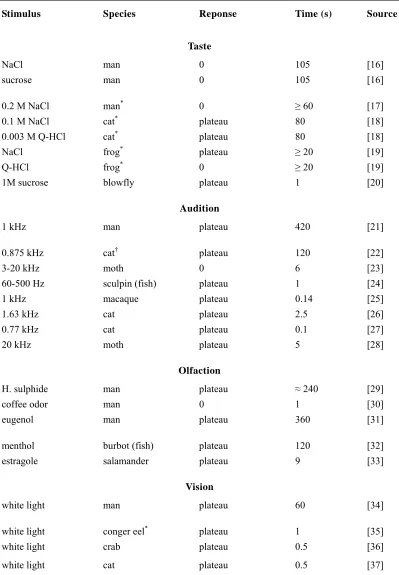
The Entropy Theory demands that entropy H, and sensation, and neuronal firing all adapt in synchrony. Table 1 shows the observed level of psychophysical adaptation in man and of primary afferent firing rate adaptation in man or in animals. A response of “0” for psychophysical adaptation indicates no remaining stimulus-evoked sensation, and a response of 0 for neuronal adaptation indicates that spontaneous firing rate was achieved. Most “plateaux” are very slow decreases.
Insofar as animal physiology can be taken as a model for man, Table 1 reveals a number of important differences between psychophysical and neuronal adaptation. For example, for the sense of taste, substances that evoke complete psychophysical adaptation in man can result in incomplete adaptation of firing rate in animals, such that adaptation across the species is hardly synchronous. In hearing and in vision, where response can adapt to a plateau, psychophysical adaptation in man can be much slower than adaptation of neuronal firing in animals. To generalize, then, sensation and neuronal firing need not adapt at the same pace, and one may adapt down to zero while the other may adapt to a nonzero plateau. Altogether, the Norwich et al. requirement of synchronous adaptation does not stand.
Regarding the entropy H, the present author knows of just one published comparison of the adaptation of H to that of firing rate or sensation. In a landmark study, Ward [14] examined how H changed for an auditory stimulus, a 1-kHz tone, and for a visual stimulus, a flash from a light-emitting diode. Time was represented by stimulus duration. H’s were computed from absolute judgments of stimuli of different durations, made by human subjects. Fig. 4 compares the change in H with the change in primary afferent firing rates; Ward took the latter from the literature. For both the auditory stimuli and the visual stimuli, firing rate adapted more slowly than did H. The lag of F relative to H (represented by the horizontal separation between the F and H plots) is not constant; note that the time scale in each panel is logarithmic. Again, the Norwich et al. requirement of synchronous adaptation is not confirmed.
V. CONCLUSIONS
Norwich’s Entropy Theory of Perception proposes that the rate of firing of sensory neurons, along with its psychophysical correlate, sensation, are both used by the human body as inputs to the internal computation of information transmitted, It, and entropy, H. The Entropy
Theory also posits that sensory-neuron firing and consequent sensations are both determined by It and H. Thus, firing and
[image:4.595.126.470.532.744.2]consequent sensation cannot happen until a series of just preceding neuronal firings and sensations has happened - but each of which, in principle, cannot happen until a series of just preceding neuronal firings and sensations has happened, and so on ad infinitum. That is, the Entropy Theory of Perception contains an inherent contradiction, which produces an infinity (and not the only infinity inherent in the theory; see [15]). All of this implies that the notion behind the contradiction, that of perception by uncertainty reduction, is unworkable and should be abandoned.
Table 1. Sensory adaptation (see text). Neuronal data are for single fibers unless noted as * for a
summated or whole-nerve response, or as † for a few-fiber recording.
Stimulus Species Reponse Time (s) Source
Taste
NaCl man 0 105 [16]
sucrose man 0 105 [16]
0.2 M NaCl man* 0 ≥ 60 [17]
0.1 M NaCl cat* plateau 80 [18]
0.003 M Q-HCl cat* plateau 80 [18]
NaCl frog* plateau ≥ 20 [19]
Q-HCl frog* 0 ≥ 20 [19]
1M sucrose blowfly plateau 1 [20]
Audition
1 kHz man plateau 420 [21]
0.875 kHz cat† plateau 120 [22]
3-20 kHz moth 0 6 [23]
60-500 Hz sculpin (fish) plateau 1 [24]
1 kHz macaque plateau 0.14 [25]
1.63 kHz cat plateau 2.5 [26]
0.77 kHz cat plateau 0.1 [27]
20 kHz moth plateau 5 [28]
Olfaction
H. sulphide man plateau ≈ 240 [29]
coffee odor man 0 1 [30]
eugenol man plateau 360 [31]
menthol burbot (fish) plateau 120 [32]
estragole salamander plateau 9 [33]
Vision
white light man plateau 60 [34]
white light conger eel* plateau 1 [35]
white light crab plateau 0.5 [36]
white light cat plateau 0.5 [37]
REFERENCES
[1] K.H. Norwich, C.N.L. Seburn, and E. Axelrad, “An informational approach to reaction times,” Bull. Math. Biol. 51, 1989, pp. 347-358.
[2] W.R. Garner and H.W. Hake, “The amount of information in absolute judgements,” Psych.Rev. 58, 1951, pp. 445-459.
[3] C.E. Shannon, “A mathematical theory of communication,” Bell Syst. Tech. J. 27, 1948, pp. 623-656.
[4] K.H. Norwich, “The magical number seven: making a “bit” of “sense”,”.Percept. Psychophys. 29, 1981, pp. 409-422.
[5] A.M. Turing, “Computing machinery and intelligence,” Mind 59, 1950, pp. 433-460.
[6] N. Wiener, Cybernetics or Control and Communication in the Animal and the Machine. New York: MIT Press and Wiley, 1948/1961.
[8] K.H. Norwich, “On the fundamental nature of perception,” Acta Biotheo. 39, 1991, pp. 81-90.
[9] K.H. Norwich and W. Wong, “Sensory function in extraterrestrial beings,” Ann. Fond. Louis de Broglie 22, 1997, pp. 161-168.
[10] K.H. Norwich, “An hypothesis on information, memory, and perception,” Med. Hyp. 4, 1978, pp. 156-164.
[11] K.H. Norwich, “On the information received by sensory receptors,”
Bull. Math. Biol. 39, 1977, pp. 453-461.
[12] D.V. Smith, E. Bowdan, and V.G. Dethier, “Information transmission in tarsal sugar receptors of the blowfly,” Chem. Senses 8, 1983, pp.
81-101.
[13] W. Wong and S. Figueiredo, “On the role of information and uncertainty in auditory thresholds,” Proc. 2002 Int. Conf. Aud. Disp.,
Kyoto, 2002, pp. ICAD02-1 – ICAD02-6.
[14] L.M. Ward, “Informational and neural adaptation curves are asynchronous,” Percept. Psychophys. 50, 1991, pp. 117-128.
[15] L. Nizami, “Sensory systems as cybernetic systems that require awareness of alternatives to interact with the world: analysis of the brain-receptor loop in Norwich’s Entropy Theory of Perception”, Proc.
2009 IEEE Int. Conf. Syst. Man Cyb., San Antonio TX, 2009, pp.
3477-3482.
[16] J.F. Gent and D.H. McBurney, “Time course of gustatory adaptation,”
Percept. Psychophys. 23, 1978, pp. 171-175.
[17] H. Diamant, B. Oakley, L. Strom, C. Wells, and Y. Zotterman, “A comparison of neural and psychophysical responses to taste stimuli in man,” Acta Physiol. Scand. 64, 1965, pp. 67-74.
[18] M.B. Wang and R.A. Bernard, “Adaptation of neural taste responses in cat,” Brain Res. 20, 1970, pp. 277-282.
[19] T. Sato, “Site of gustatory neural adaptation,” BrainRes. 34, 1971, pp. 385-388.
[20] V.G. Dethier and E. Bowdan, “Relations between differential threshold and sugar receptor mechanisms in the blowfly,” Behav. Neurosci. 98,
1984, pp. 791-803.
[21] J.W. Petty, W.D. Fraser, and D.N. Elliott, “Adaptation and loudness decrement: a reconsideration,” J. Acoust. Soc. Am. 47, 1970, pp. 1074-1082.
[22] A.J. Derbyshire and H. Davis, “The action potentials of the auditory nerve,” Am. J. Physiol. 113, 1935, pp. 476-504.
[23] P.T. Haskell and P. Belton, “Electrical responses of certain lepidopterous tympanal organs,” Nature 177, 1956, pp. 139-140.
[24] P. Enger, “Single unit activity in the peripheral auditory system of a teleost fish,” Acta Physiol. Scandin. 59, Supp. 210, 1963, pp. 8-48. [25] M. Nomoto, N. Suga, and Y. Katsuki, “Discharge pattern and inhibition
of primary auditory nerve fibers in the monkey,” J. Neurophysiol. 27, 1964, pp. 768-787.
[26] E. Young and M.B. Sachs, “Recovery from sound exposure in auditory-nerve fibers,” J. Acoust. Soc. Am. 54, 1973, pp. 1535-1543.
[27] B. Delgutte, “Representation of speech-like sounds in the discharge patterns of auditory-nerve fibers,” J. Acoust. Soc. Am. 68, 1980, pp. 843-857.
[28] M. Perez and F. Coro, “Physiological characteristics of the tympanic organ in noctuoid moths. II. Responses to 45 ms and 5 s acoustic stimuli,” J. Comp. Physiol. A156, 1985, pp. 689-696.
[29] G. Ekman, B. Berglund, U. Berglund, and T. Lindvall, “Perceived intensity of odor as a function of time of adaptation,” Scand. J. Psych.
8, 1967, pp. 177-186.
[30] O. Franzen, P. Osterhammel, K. Terkildsen, and K. Zilstorff, “What man’s nose tells man’s mind,” in Gustationand olfaction, G. Ohloff and A.F. Thomas, Eds. New York: Academic Press, 1971, pp. 87-91. [31] W.S. Cain, “Perception of odor intensity and the time-course of
olfactory adaptation,” Am. Soc. Refrig., Heat., & Aircon. Eng., Trans.
80, Part 1, 1974, pp. 53-75.
[32] K.B. Doving, “The influence of olfactory stimuli upon the activity of secondary neurones in the burbot (Lota lota L.),” ActaPhysiol. Scand.
66, 1966, pp. 290-299.
[33] T.V. Getchell, “Functional properties of vertebrate olfactory receptor neurons,” Physiol. Rev. 66, 1986, pp. 772-818.
[34] S.R. Wallace, “Studies in binocular interdependence. I. Binocular relations in macular adaptation,” J. Gen. Psychol. 17, 1937, pp.
307-322.
[35] E.D. Adrian and R. Matthews, “The action of light on the eye. Part I. The discharge of impulses in the optic nerve and its relation to the electric changes in the retina,” J. Physiol. 63, 1927, pp. 378-414. [36] H.K. Hartline and C.H. Graham, “Nerve impulses from single receptors
in the eye,” J. Cell. Comp. Physiol. 1, 1932, pp. 277-295.

![Fig. 4. Entropy H and firing rate F, for audition and for vision (after [14]).](https://thumb-us.123doks.com/thumbv2/123dok_us/1297985.659234/4.595.126.470.532.744/fig-entropy-h-firing-rate-f-audition-vision.webp)