A non-projective greedy dependency parser with bidirectional LSTMs
David Vilares
Universidade da Coru˜na LyS Group
Departamento de Computaci´on Campus de Elvi˜na s/n, 15071
A Coru˜na, Spain
Carlos G´omez-Rodr´ıguez
Universidade da Coru˜na FASTPARSE Lab, LyS Group Departamento de Computaci´on Campus de A Elvi˜na s/n, 15071
A Coru˜na, Spain
Abstract
The LyS-FASTPARSE team presents BIST-COVINGTON, a neural implementa-tion of the Covington (2001) algorithm for non-projective dependency parsing. The bidirectional LSTM approach by
Kiperwasser and Goldberg(2016) is used to train a greedy parser with a dynamic oracle to mitigate error propagation. The model participated in the CoNLL 2017 UD Shared Task. In spite of not using any ensemble methods and using the baseline segmentation and PoS tagging, the parser obtained good results on both macro-average LAS and UAS in the big treebanks category (55 languages), ranking 7th out of 33 teams. In the all treebanks category (LAS and UAS) we ranked 16th and 12th. The gap between the all and big categories is mainly due to the poor performance on four parallel PUD treebanks, suggesting that some ‘suf-fixed’ treebanks (e.g. Spanish-AnCora) perform poorly on cross-treebank settings, which does not occur with the correspond-ing ‘unsuffixed’ treebank (e.g. Spanish). By changing that, we obtain the 11th best LAS among all runs (official and unofficial). The code is made available at https://github.com/CoNLL-UD-2017/LyS-FASTPARSE
1 Introduction
Dependency parsing is one of the core structured prediction tasks researched by computational lin-guists, due to the potential advantages that ob-taining the syntactic structure of a text has in many natural language processing applications, such as machine translation (Miceli-Barone and
Attardi, 2015;Xiao et al., 2016), sentiment anal-ysis (Socher et al., 2013;Vilares et al., 2017) or information extraction (Yu et al.,2015).
The goal of a dependency parser is to analyze the syntactic structure of sentences in one or sev-eral human languages by obtaining their analy-ses in the form of dependency trees. Let w = [w1, w2, ..., w|w|] be an input sentence, a depen-dency treefor w is an edge-labeled directed tree T = (V, E)where V = {0,1,2, . . . ,|w|}is the set of nodes andE = V ×D×V is the set of labeled arcs. Each arc, of the form(i, d, j), cor-responds to a syntactic dependency between the wordswiandwj; whereiis the index of thehead
word,jis the index of thechildword anddis the dependency typerepresenting the kind of syntac-tic relation between them.1 We will writei −→d j as shorthand for(i, d, j)∈Eand we will omit the dependency types when they are not relevant.
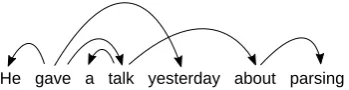
A dependency tree is said to be non-projective if it contains two arcs i −→ j and k −→ l where min(i, j) < min(k, l) < max(i, j) < max(k, l), i.e., if there is any pair of arcs that cross when they are drawn over the sentence, as shown in Figure 1. Unrestricted non-projective parsing allows more accurate syntactic represen-tations than projective parsing, but it comes at a higher computational cost, as there is more flexi-bility in how the tree can be arranged so that more operations are usually needed to explore the much larger search space.
Non-projective transition-based parsing has been actively explored in the last decade (Nivre and Nilsson, 2005; Attardi, 2006; Nivre,
2008, 2009;G´omez-Rodr´ıguez and Nivre, 2010;
G´omez-Rodr´ıguez et al., 2014). The success of neural networks and word embeddings for
pro-1Following common practice, we are using node0as a dummy root node that acts as the head of the syntactic root(s) of the sentence.
He gave a talk yesterday about parsing
Figure 1: A non-projective dependency tree
jective dependency parsing (Chen and Manning,
2014) also encouraged research on neural non-projective models (Straka et al., 2016). How-ever, to the best of our knowledge, no neural implementation is available of unrestricted non-projective transition-based parsing with a dynamic oracle. Here, we present such an implementation for theCovington(2001) algorithm using bidirec-tional long short-term memory networks (LSTM) (Hochreiter and Schmidhuber,1997), which is the main contribution of this paper.
The system is evaluated at theCoNLL 2017 UD Shared Task: end-to-end multilingual parsing us-ing Universal Dependencies(Zeman et al.,2017). The goal is to obtain a Universal Dependencies v2.0 representation (Nivre et al., 2016) of a col-lection of raw texts in different languages.
2 End-to-end multilingual parsing
Given a raw text, we: (1) segment and tokenize sentences and words, (2) apply part-of-speech (PoS) tagging over them and (3) obtain the depen-dency structure for each sentence.
2.1 Segmentation and PoS tagging
For these two steps we relied on the output pro-vided by UDpipe v1.1 (Straka et al.,2016), which was provided as a baseline model for the shared task.
2.2 TheBIST-COVINGTONparser
BIST-COVINGTONis built on the top of three core ideas: a non-projective transition-based parsing al-gorithm (Covington,2001;Nivre,2008), a neural scoring model with bidirectional long short-term memory networks as feature extractors that feed a multilayer perceptron (Kiperwasser and Gold-berg,2016), and a dynamic oracle to mitigate error propagation (G´omez-Rodr´ıguez and Fern´andez-Gonz´alez,2015).
2.2.1 TheCovington(2001) algorithm
The idea of Covington’s algorithm is quite intu-itive: any pair of wordswi,wjinwhave a chance
to be connected, so we need to consider all such
pairs to determine the type of relation that exists between them (i.e. i −→d j,j −→d iornone). One pair(i, j)is compared at a time. We will be refer-ring to the indexesiandj as thefocus words. It is straightforward to conclude that the theoretical complexity of the algorithm isO(|w|2).
Covington’s algorithm can be easily imple-mented as a transition system (Nivre,2008). The set of transitions used in BIST-COVINGTON and their preconditions is specified in Table 1. Each transition corresponds to a parsing configuration represented as a 4-tuple c = (λ1, λ2, β, A), such that:
• λ1, λ2 are two lists storing the words that have been already processed in previous steps. λ1 contains the already processed words for which the parser still has not de-cided, in the current state, the type of rela-tion with respect to the focus wordj, located at the top ofβ. λ2 contains the already pro-cessed words for which the parser has already determined the type of relation with respect tojin the current step.
• βcontains the words to be processed.
• Acontains the set of arcs already created.
Given a sentencewthe parser starts at an initial configurationcs =([0],[],[1, ...,|w|],{})and will
apply valid transitions until reaching a final con-figurationcf such thatcf =(λ1, λ2,[], A). Figure
2illustrates an intermediate parsing configuration for our introductory example.
He gave a talk yesterday about parsing 1 2 3 4 5 6 7
A = [(0,2), (2,1), (4,3), (2,5), (2,4)]
i j
λ1 λ2 β
Figure 2: A parsing configuration for our in-troductory example just before creating a non-projectiveRIGHT ARCtalk −→about.
2.2.2 A dynamic oracle for Covington’s algorithm (G´omez-Rodr´ıguez and Fern´andez-Gonz´alez,2015)
Given a gold dependency tree, τg, and a parser
[image:2.595.307.526.534.584.2]Transitions
LEFT ARC (λ1|i, λ2, j|β, A) (λ1, i|λ2, j|β, A∪ {(j, d, i)}) RIGHT ARC (λ1|i, λ2, j|β, A) (λ1, i|λ2, j|β, A∪ {(i, d, j)})
SHIFT (λ1, λ2, i|β, A) (λ1·λ2|i,[], β, A)
NO-ARC (λ1|i, λ2, β, A) (λ1·i|λ2, β, A)
Preconditions
LEFT ARC i >0and 6 ∃(k−→i)∈A and 6 ∃(i−→...−→j) RIGHT ARC 6 ∃(k−→j)∈A and 6 ∃(j−→...−→i)
NO-ARC i >0
Table 1: Set of transitions forBIST-COVINGTON as described inNivre(2008). a −→ ...−→ bindicates there is a path in the dependency tree that allows to reachbfroma
L(c, τg) that determines the minimum number of
missed arcs ofτg across the possible outputs (A)
of final configurations that can be reached fromc, i.e., the least possible number of errors with re-spect to τg that we can obtain from c. A static
(traditional) oracle is only defined on canonical transition sequences that lead to the gold tree, so thatL(c, τg) = 0at every step during the training
phase. However, during the test phase such train-ing strategy might end up in serious error propaga-tion, as it is difficult for the parser to recover from wrong configurations that it has never seen, result-ing from suboptimal transitions that increase loss. A dynamic oracle (Goldberg and Nivre,2012) ex-plores such wrong configurations during the train-ing phase to overcome this issue. Instead of al-ways picking the optimal transition during train-ing, the parser moves with probabilityxto an erro-neous (loss-increasing) configuration, namely the one with the highest score among those that in-crease loss.
To compute L for non-projective trees we used the approach proposed byG´omez-Rodr´ıguez and Fern´andez-Gonz´alez (2015, Algorithm 1). This dynamic oracle can be computed in O(|w|) although the current implementation in BIST -COVINGTON is O(|w|3). To choose the depen-dency type corresponding to the selected transition (in case it is aLEFTorRIGHT ARC), we look at the gold treebank.
2.2.3 TheBIST-parsers (Kiperwasser and
Goldberg,2016)
The original set of BIST-parsers is composed of a projective transition-based model using the arc-hybrid algorithm (Kuhlmann et al., 2011) and a graph-based model inspired in Eisner
(1996). They both rely on bidirectional LSTM’s (BILSTM’s). We kept the main architecture of the arc-hybrid BIST-parser and changed the parsing algorithm to that described in §2.2.1 and §2.2.2. We encourage the reader to consult Kiperwasser and Goldberg (2016) for a detailed explanation of their architecture, but we now try to give a quick overview of its use as the core part ofBIST -COVINGTON.2
In contrast to traditional parsers (Nivre et al.,
2006;Martins et al.,2010;Rasooli and Tetreault,
2015),BIST-parsers rely on embeddings as inputs instead of on discrete events (co-occurrences of words, tags, features, etc.). Embeddings are low-dimensional vectors that provide a continuous rep-resentation of a linguistic unit (word, PoS tag, etc.) based on its context (Mikolov et al.,2013).
Let w=[w1, ...,w|w|]be a list of word embed-dings for a sentence, letu=[u1, ...,u|w|]be the cor-responding list of universal PoS tag embeddings, t=[t1, ...,t|w|]the list of specific PoS tag embed-dings,f=[f1, ...,f|w|]the list of morphological fea-tures (“feats” column in the Universal Dependen-cies data format) ande=[e1, ...,e|w|]a list of exter-nal word embeddings; an inputxifor a wordwito BIST-COVINGTONis defined as:3
xi=wi◦ui◦ti◦fi◦ei
where◦is the concatenation operator.
Let LSTM(x) be an abstraction of a standard long short-term memory network that processes the sequence x = [x1, ...,x|x|], then a BILSTM encoding of itsith element, BILSTM(x, i) can be 2Including some additional capabilities that we included especially forBIST-COVINGTON.
defined as:
BILSTM(x, i)=LSTM(x1:i)◦LSTM(x|x|:i)
In the case of multilayer BILSTM’S (BIST -parsers allow it), givennlayers, the output of the BILSTMm is fed as input to BILSTMm+1. From
the BILSTM network we take a hidden vector h, which can contain the output hidden vectors for: thex leftmost words inβ, the rightmosty ofλ1, and thezleftmost andvrightmost words inλ2.
The hidden vectorhis used to feed a multilayer perceptron with one hidden layer and four output neurons that predicts which transition to take. The output is computed asW2·tanh(W·h+b) +b2, where W, W2, b andb2 correspond to the weight matrices and bias vectors of the hidden and output layer of the perceptron. Similarly, BIST-parsers (including BIST-COVINGTON) use a second per-ceptron with one hidden layer to predict the de-pendency type. In this case the output layer corre-sponds to the number of dependency types in the training set.
2.3 Postprocessing
BIST-COVINGTONas it is allows parses with mul-tiple roots, i.e., with several nodes assigned as children of the dummy root. This was not allowed however by the task organizers, as it is enforced by Universal Dependencies that only one word per sentence must depend on the dummy root. To overcome this, the output is postprocessed accord-ing to Algorithm1. Basically, we look for the first verb rooted at 0, or for the first word whose head is 0 if there is no verb, and reassign all other words to the selected term:
3 Experiments
We here describe the official treebanks used in the shared task (§3.1), the general setup used to train the models (§3.2) and some exceptions to said gen-eral setup that were applied to special cases (§3.3). We also discuss the experimental results obtained by our system in the shared task (§3.4).
3.1 CoNLL 2017 treebanks 3.1.1 Training/development splits
60 treebanks from 45 languages were released to train the models, based on Universal Dependen-cies 2.0 (Nivre et al., 2017a). Most of them al-ready contained official training and development splits. A few others lacked a development set. For these, we applied a training/dev random split
Algorithm 1Multiple to single node root
1: procedureTO SINGLE(V, E)
.Get the nodes rooted at zero (those whose head has to be reassigned)
2: RO←[] 3: foriinV do
4: ifhead(i) = 0then
5: append(RO, i)
.We select the first verb linked to the dummy root to remove multiple roots
6: iflen(RO)>1then
7: closest head←RO[0] 8: forr0in ROdo
9: ifutag(r0) =VERBthen
10: closest head←r0
11: break
.Reassign the head of the invalid nodes (rooted to the dummy root) toclosest head
12: forr0in ROdo
13: ifr06=closest headthen
14: head(r0)←closest head
(80/20) over the original training set. All devel-opment sets were only used to evaluate and tune the trained models. No development setwas used to train any of the runs, as specified in the task guidelines.
Additionally, foursurprise languages(truly low resource languages), were considered by the orga-nization for evaluation: Buryat, Kurmanji, North Sami and Upper Sorbian. For these, the organiz-ers only released a tiny sample set consisting of very few sentences annotated according to theUD guidelines.
3.1.2 Test splits
The organizers provided a test split for each of the treebanks released in the training phase, in-cluding the surprise languages. Additionally, they provided test sets corresponding to 14 parallel treebanks in different languages translated from a unique source. All of these test sets (Nivre et al.,
2017b) were hidden from the participating teams until the shared task had ended. Using the TIRA environment (Potthast et al., 2014) provided for the shared task, participants could execute runs on them, but not see the outputs or the results.
3.2 General setup
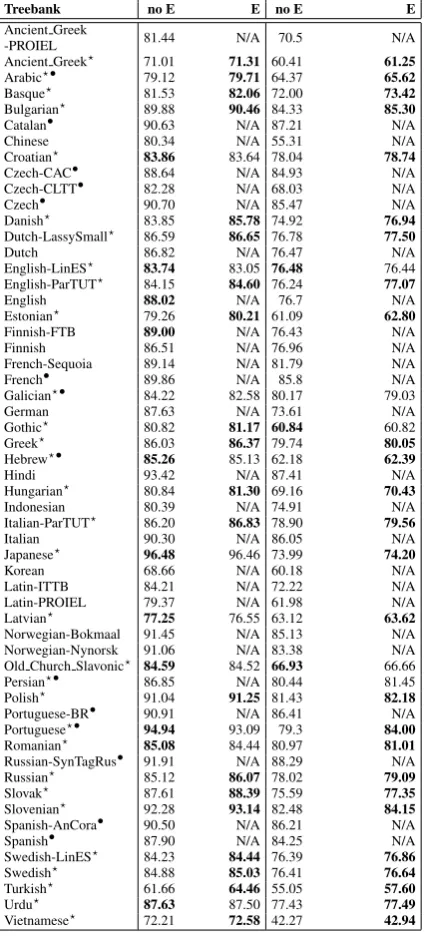
Embeddings: Word embeddings are set to size 100 and universal tag embeddings to 25. Language-specific tag and morphological feature embeddings are used and set to size 25, if they are available for the treebank at hand. Using external word embeddings seems to be beneficial to improve parsing performance (Kiperwasser and Goldberg, 2016), but it also makes models take more time and especially much more memory to train. The external word embeddings used in this work (the ones pretrained by the CoNLL 2017 UD Shared Taskorganizers4) are of size 100. Due to lack of enough computational resources, we only had time to train 38 models (mainly corre-sponding to the smallest treebanks) including this information. Models trained with external word embeddings are marked in Table3with?.
Parameters: Adam is used as optimizer (Kingma and Ba,2014). Models were trained for up to 30 epochs, except for the two smallest training sets (Kazakh and Uyghur), where models were trained for up to 100 epochs. The size of the output of the stacked BILSTM was set to 512. For very large treebanks (e.g. Czech or Russian-SyntagRus) or treebanks where sentences are very long (e.g. Arabic), we set it to 256, also to counteract the lack of physical resources to finish the task on time. These models are marked in Table 3 with
•. The number of BILSTM layers is set to 2. To choose a transition, BIST-COVINGTON looks at the embeddings of: the first word in β, the rightmost three words inλ1, and the leftmost and rightmost word inλ2 (i.e., following the notation in Section2.2.3, we setx = 1,y = 3,z = 1and v= 1).
Other relevant features of the setup: Aggressive exploration is applied to the dynamic oracle, as in the original arc-hybridBIST-PARSER.
3.3 Special cases
For some treebanks, we followed a different strat-egy due to various issues. We enumerate the changes below:
3.3.1 The Portuguese model
Surprisingly, the model trained on the Portuguese treebank suffered a significant loss with respect to the UDpipe baseline when parsing the full pre-dicted (segmentation and tagging) development
4http://hdl.handle.net/11234/1-1989
file. We first hypothesized this was due to a low accuracy on predicting the “feats” column in comparison to other languages, as they are pretty sparse. To try to overcome this, we trained a model without considering them, but it did not solve the problem. Our second option was to train a Por-tuguese model on its predicted training treebank.5 Additionally, despite being a relative large tree-bank, we included external word embeddings to boost performance. This helped us to obtain a per-formance similar to that reported by UDpipe.
3.3.2 Surprise languages
As training an accurate parser with so little data might be a hard task , especially in the case of data-hungrydeep learning models, we used other training treebanks for this purpose. We built a set of parsers inspired on the approach presented by
Vilares et al.(2016), who find that training a mul-tilingual model on merged harmonized treebanks might actually have a positive impact on parsing the corresponding monolingual treebank. In this particular case, we are assuming that a trained model over multilingual treebanks might be able to capture similar treebank structures for unseen languages.
In particular, we: (1) ran every trained mono-lingual model on the sample sets, (2) for each sur-prise language, we chose the top three languages where the corresponding models obtained the best performance and (3) trained a parser taking the first 2 000 sentences of the training sets corre-sponding to such languages and merging them.
Thus, we did not use the provided sample data for training, but only as a development set to choose suitable source languages for our cross-lingual approach.
3.3.3 Parallel (PUD) treebanks
The only information our models knew about the parallel treebanks during the testing phase was the language in which they were written. To parse these languages we follow a simplistic approach, using the models we had already trained on the provided training corpora: (1) if there is only one model trained on the same language we take that model, (2) else if there is more than one model trained on that language, we take the one trained over the largest treebank (in number of sentences),
otherwise (3) we parse the PUD treebank using the English model.6
3.4 Results
Official and unofficial results for our model and for the rest of participants on the test set can be found at the task website: http://universaldependencies. org/conll17/results.html, but in this section we detail the results obtained by BIST-COVINGTON.
3.4.1 Results onsmallandbigtreebanks categories
Table2shows the performance on the test sets for the treebanks where an official training set was re-leased.
In Table 3 we summarize our results on the development sets for those treebanks that pro-vided an official one. Although not shown for brevity and clarity reasons, it is easy to check for the reader that BIST-COVINGTON outperformed the baseline UDpipe7 for all these treebanks on the gold configuration (gold segmentation, gold tags). The same is true, except for Chinese (-0.69 decrease in LAS) and Portuguese (-0.09), in the fully predicted configuration (end-to-end pars-ing). It is easy to conclude from the table that including external word embeddings has a posi-tive effect in most of the treebanks we had time to try. This is especially true when performing end-to-end parsing, where only for three languages (English-LinES, Gothic and Old Church Slavonic) a negative effect was observed.8
Table4shows the top three selected languages for each surprise treebank, the performance of the monolingual and multilingual (merged) models on them on the sample set (used as dev set), and also shows the performance of the multilingual models in the official test sets.
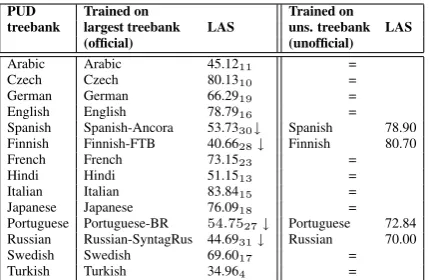
Table 5 shows our performance on the PUD treebanks (test sets). There are 4 PUD treebanks for which we obtained a poor performance: Span-ish, FinnSpan-ish, Portuguese and Russian. Average LAS loss with respect to the top system in the
cor-6This latter case should and did never happen, as the task organizers specified in advance that the parallel treebanks would correspond to languages with existing treebanks, but we included it as a fallback mechanism.
7http://universaldependencies.org/ conll17/baseline.html
8Due to not so rich embeddings and/or the model finishing earlier than expected during training. See§5.
Treebank LAS
Ancient Greek 67.85
8
-PROIEL
Ancient Greek 59.836
Arabic 66.5410
Basque 73.275
Bulgarian 85.766
Catalan 85.3718
Chinese 56.762
Croatian 77.9111
Czech-CAC 82.7116
Czech-CLTT 68.9223
Czech 83.7711
Danish 75.2711
Dutch-LassySmall 82.496
Dutch 71.897
English-LinES 73.4713
English-ParTUT 74.5012
English 76.0014
Estonian 61.797
Finnish-FTB 76.807
Finnish 76.118
French-ParTUT 72.0925
French-Sequoia 77.7723
French 79.8620
Galician-TreeGal 65.4217
Galician 79.2412
German 68.3522
Gothic 62.077
Greek 81.436
Hebrew 59.289
Hindi 86.8815
Hungarian 66.009
Indonesian 72.9423
Irish 58.0522
Italian 85.6016
Japanese 72.6817
Kazakh 16.2026
Korean 63.8514
Latin-ITTB 79.587
Latin-PROIEL 61.457
Latin 48.927
Latvian 63.057
Norwegian-Bokmaal 84.498
Norwegian-Nynorsk 83.107
Old Church Slavonic 67.214
Persian 77.6817
Polish 82.097
Portuguese-BR 86.749
Portuguese 80.9119
Romanian 80.5811
Russian-SynTagRus 87.559
Russian 76.988
Slovak 76.476
Slovenian-SST 43.8021
Slovenian 82.927
Spanish-AnCora 86.837
Spanish 83.248
Swedish-LinES 75.0410
Swedish 77.3313
Turkish 57.225
Ukrainian 61.2115
Urdu 78.319
Uyghur 27.9223
Vietnamese 38.3312
[image:6.595.355.481.76.711.2]Gold treebank LAS Predicted treebank LAS
Treebank no E E no E E
Ancient Greek 81.44 N/A 70.5 N/A -PROIEL
Ancient Greek? 71.01 71.31 60.41 61.25
Arabic?• 79.12 79.71 64.37 65.62
Basque? 81.53 82.06 72.00 73.42
Bulgarian? 89.88 90.46 84.33 85.30
Catalan• 90.63 N/A 87.21 N/A
Chinese 80.34 N/A 55.31 N/A Croatian? 83.86 83.64 78.04 78.74
Czech-CAC• 88.64 N/A 84.93 N/A
Czech-CLTT• 82.28 N/A 68.03 N/A
Czech• 90.70 N/A 85.47 N/A
Danish? 83.85 85.78 74.92 76.94
Dutch-LassySmall? 86.59 86.65 76.78 77.50
Dutch 86.82 N/A 76.47 N/A English-LinES? 83.74 83.05 76.48 76.44
English-ParTUT? 84.15 84.60 76.24 77.07
English 88.02 N/A 76.7 N/A Estonian? 79.26 80.21 61.09 62.80
Finnish-FTB 89.00 N/A 76.43 N/A Finnish 86.51 N/A 76.96 N/A French-Sequoia 89.14 N/A 81.79 N/A French• 89.86 N/A 85.8 N/A
Galician?• 84.22 82.58 80.17 79.03
German 87.63 N/A 73.61 N/A Gothic? 80.82 81.17 60.84 60.82
Greek? 86.03 86.37 79.74 80.05
Hebrew?• 85.26 85.13 62.18 62.39
Hindi 93.42 N/A 87.41 N/A Hungarian? 80.84 81.30 69.16 70.43
Indonesian 80.39 N/A 74.91 N/A Italian-ParTUT? 86.20 86.83 78.90 79.56
Italian 90.30 N/A 86.05 N/A Japanese? 96.48 96.46 73.99 74.20
Korean 68.66 N/A 60.18 N/A Latin-ITTB 84.21 N/A 72.22 N/A Latin-PROIEL 79.37 N/A 61.98 N/A Latvian? 77.25 76.55 63.12 63.62
Norwegian-Bokmaal 91.45 N/A 85.13 N/A Norwegian-Nynorsk 91.06 N/A 83.38 N/A Old Church Slavonic? 84.59 84.52 66.93 66.66
Persian?• 86.85 N/A 80.44 81.45
Polish? 91.04 91.25 81.43 82.18
Portuguese-BR• 90.91 N/A 86.41 N/A
Portuguese?• 94.94 93.09 79.3 84.00
Romanian? 85.08 84.44 80.97 81.01
Russian-SynTagRus• 91.91 N/A 88.29 N/A
Russian? 85.12 86.07 78.02 79.09
Slovak? 87.61 88.39 75.59 77.35
Slovenian? 92.28 93.14 82.48 84.15
Spanish-AnCora• 90.50 N/A 86.21 N/A
Spanish• 87.90 N/A 84.25 N/A
Swedish-LinES? 84.23 84.44 76.39 76.86
Swedish? 84.88 85.03 76.41 76.64
Turkish? 61.66 64.46 55.05 57.60
Urdu? 87.63 87.50 77.43 77.49
Vietnamese? 72.21 72.58 42.27 42.94
Table 3: BIST-COVINGTON results on the dev set, for those treebanks that have an offi-cial dev set (all treebanks except French-ParTUT, Irish, Galician-TreeGal, Kazakh, Slovenian-SST, Kazakh, Uyghur and Ukrainian). ? indicates the model was also trained with external word embed-dings (E). • indicates theBILSTM output dimen-sion was 256. The performance of some models is likely to be improved, as its training finished ear-lier than expected due to lack of time to finish it or memory issues (see also§5)
responding treebank was 32.47, which implied a LAS loss up to 1.60 points in the official global ranking. We hypothesized that taking the model
Surprise Top 3 Sample set Sample set Test set
language treebanks Monolingual Multilingual Multi
Buryat HindiGerman 36.6032.68 43.14 28.655
Korean 27.45
KurmanjiRomanianCzech 38.8437.19 39.26 32.0816
Slovenian 31.40
North Estonian 45.38 57.14 32.58
14
Finnish 40.82 Sami Finnish-FTB 40.14
Upper Slovenian 65.22 70.65 52.50
15
Slovak 64.78 Sorbian Bulgarian 61.09
Table 4: LAS on the surprise languages sample sets for: (1) top 3 best performing monolingual models for which there is an official training tree-bank and (2) a multilingual model trained on the first 2 000 sentences of each of such treebanks. For the multilingual models, the last column shows its performance on the test sets (subscripts indicate our ranking in that language)
trained on the largest treebank of the same lan-guage was the safest option to parse PUD texts, but in retrospective this clearly was not the optimal choice. Those four PUD treebanks were parsed with models trained on Universal Dependencies (UD) treebanks whose official name has a suffix (i.e. Spanish-Ancora, Finnish-FTB, Portuguese-BR and Russian-SyntagRus), which were larger than the unsuffixed UD treebank. However, we think such a poor performance surpasses what can be reasonably expected from an universal treebank written in the same language. From Table 5 it is reasonable to conclude that such suffixed tree-banks parse more than poorly on cross-treebank settings, in comparison to the model trained on the unsuffixed treebank (rightmost column). We won-der if this can be an indicator of those treebanks sharing universal dependency types, but diverging in terms of syntactic structures, which caused the low LAS scores in those cases.
[image:7.595.76.289.70.539.2]PUD Trained on
LAS Trained on LAS treebank largest treebank uns. treebank
(official) (unofficial)
Arabic Arabic 45.1211 =
Czech Czech 80.1310 =
German German 66.2919 =
English English 78.7916 =
Spanish Spanish-Ancora 53.7330↓ Spanish 78.90
Finnish Finnish-FTB 40.6628↓ Finnish 80.70
French French 73.1523 =
Hindi Hindi 51.1513 =
Italian Italian 83.8415 =
Japanese Japanese 76.0918 =
Portuguese Portuguese-BR 54.7527↓ Portuguese 72.84
Russian Russian-SyntagRus 44.6931↓ Russian 70.00
Swedish Swedish 69.6017 =
[image:8.595.75.290.61.201.2]Turkish Turkish 34.964 =
Table 5: LAS/UAS performance on the PUD tree-banks (test sets). The↓ symbol indicates a dras-tic gap in performance with respect the average performance ofBIST-COVINGTON. We show how parsing the PUD treebank with a model trained on the corresponding unsuffixed treebank clearly im-proves the LAS accuracy.
4 Discussion
BIST-COVINGTONworked very well on languages where official training/development sets were available, what the organizers named big tree-banks (55 treebanks), category where we ranked 7th out of 33 systems, both for LAS and UAS met-rics, in spite of not using any ensemble method and not performing custom tokenization, segmen-tation or tagging.
More in detail, we ranked in the top ten LAS for 35 languages, where 32 be-long to the category of big treebanks: Ara-bic (10th), Bulgarian (6th), Buryat (5th), Czech-PUD (10th), Old Church Slavonic (4th), Greek (6th), Spanish (8th), Spanish-Ancora (7th), Estonian (7th), Basque (5th), Finnish (8th), Finnish-ftb (7th), Gothic (7th), Ancient Greek (6th), Ancient Greek-PROIEL (8th), Hebrew (9th), Hungarian (9th), Latin (7th), Latin-ITB (7th), Latin-PROIEL (7th), Latvian (7th), Dutch (7th), Dutch-lassysmall (6th), Norwegian-Bokmaal (8th), Norwegian-Nynorsk (7th), Pol-ish (7th), Portuguese-BR (9th), Russian (8th), Russian-Syntagrus(9th), Slovak (6th), Slovenian (7th), Swedish-LinES (10th), Turkish (5th), Turkish-PUD (4th) and Ukrainian (9th).
We failed on a subset of the PUD treebanks. As previously explained, the main gap came from the Spanish, Russian, Portuguese and Finnish PUD treebanks. We analyzed those treebanks based on existing UD CoNLL treebanks. We parsed them
with the model trained on the largest treebank that shared the language. It turned out that those PUD treebanks that were parsed with suffixed treebanks (e.g. Spanish-Ancora or Russian-SynTagRus) ob-tained a very low performance, something that did not happen when parsing them with the model trained on the corresponding unsuffixed treebank (e.g. Spanish or Russian). In cases where there was only one UD treebank sharing the language, our approach worked reasonably well, in spite of the simplistic strategy followed (e.g. Turkish-PUD or Czech-Turkish-PUD).
We did not perform too well either on the set of small treebanks(French-ParTUT, Irish, Galician-TreeGal, Kazakh, Slovenian-SST, Uyghur and Ukrainian). This was somewhat expected for two reasons: (1) neural models that are fed with con-tinuous vector representations are usually data-hungry and (2) the submitted model was only trained on our training split; we did not include thead-hoc dev sets for those languages as a part of the final training data.
We believe that the cases where the parser did not work well were due to external causes (e.g. the chosen cross-treebank strategy), as shown in the case of the PUD treebanks. Unofficial results such as the ones in Table5show that this can be easily addressed to pushBIST-COVINGTONto ob-tain competitive results in those treebanks too.
5 Hardware requirements and issues Our models requiredDyNet(Neubig et al.,2017), which allocates memory when it is launched. We ran them on CPU. To train the models we used two servers with 128GB of RAM memory each. Es-timating the required memory to allocate to train each model was a hard task for us. Dynet does not currently have a garbage collector,9 so many models ran out of memory even before finishing their training, probably due to wrong memory es-timations to complete this phase, and our lack of resources to allocate memory for many treebanks at a time. We observed that models such as Arabic with external word embeddings could take up to 64GB during the training phase.
The performance on the dev set of our trained models was close, but not equal, in our train-ing machine and in TIRA. This might be caused by a serialization versioning issue: https://
github.com/clab/dynet/issues/84. To safely run a large trained model with exter-nal embeddings we recommend at least 32GB of RAM memory. We think a safe estimate to run any model without external embeddings would be something between 15 and 20GB.
The current version ofBIST-COVINGTONis not very fast. Average speed (tokens/second) over all test treebanks was 18.27. The fastest mod-els were Kazakh (66.36), Uyghur (54.11) and PUD (45.79) and the slowest ones Czech-CLTT (5.37), Latin-PROIEL (7.69) and Galician-TreeGal (8.19). To complete the testing phase of the shared task,BIST-COVINGTONtook around 28 hours. These times correspond to those of the offi-cial evaluation on the TIRA virtual machine. Sev-eral factors influence these speeds. Firstly, RNN approaches tend to be slower than feedforward approaches (e.g., reported speeds for the original transition-based BIST-parser by Kiperwasser and
Goldberg (2016) are an order of magnitude be-hind those ofChen and Manning(2014), although the latter is also much less accurate). Secondly, parsing UD data for different languages accurately requires using more linguistic information (e.g. feature embeddings), increasing the model size with respect to models evaluated on simpler set-tings like the English Penn Treebank. Finally, we are aware that Covington’s algorithm may be-come slower when sentences are too long due to its quadratic worst-case complexity, an issue that is likely to happen due to the predicted segmentation (the organizers actually informed that some tree-banks contained sentences of about 300 words).
6 Conclusion
This paper presented BIST-COVINGTON, a bidi-rectional LSTM implementation of the
Coving-ton(2001) algorithm for non-projective transition-based dependency parsing. Our model was evalu-ated on the end-to-end multilingual parsing with universal dependencies shared task proposed at CoNLL 2017. For segmentation and part-of-speech tagging our model relied on the official UDpipe baseline. The official results located us 7th out of 33 teams in thebig treebankscategory, in spite of not using any ensemble method.
As future work, there is room for improvement. Due to lack of resources to train the models and complete the task on time, we could not train all models using external word embeddings, which
has been shown to produce a significant over-all improvement. Jackniffing (Agi´c and Schluter,
2017) might be a simple way to improve the LAS scores. Finally, it would be interesting to im-plement the non-monotonic version of the Cov-ington transition system, together with approxi-mate dynamic oracles (Fern´andez-Gonz´alez and G´omez-Rodr´ıguez, 2017), shown to improve ac-curacy over the regular Covington parser.
Acknowledgments
David Vilares is funded by an FPU Grant 13/01180. Carlos G´omez-Rodr´ıguez has re-ceived funding from the European Research Coun-cil (ERC), under the European Union’s Hori-zon 2020 research and innovation programme (FASTPARSE, grant agreement No 714150). Both authors have received funding from the TELEPARES-UDC project from MINECO.
References
ˇZeljko Agi´c and Natalie Schluter. 2017. How (not) to train a dependency parser: The curious case of jack-knifing part-of-speech taggers. InThe 54th Annual Meeting of the Association for Computational Lin-guistics (ACL 2017).
Giuseppe Attardi. 2006. Experiments with a
mul-tilanguage non-projective dependency parser. In
Proceedings of the Tenth Conference on Compu-tational Natural Language Learning. Association for Computational Linguistics, pages 166–170. http://dl.acm.org/citation.cfm?id=1596276.1596307. Danqi Chen and Christopher Manning. 2014. A fast
and accurate dependency parser using neural
net-works. In Proceedings of the 2014 Conference
on Empirical Methods in Natural Language Pro-cessing (EMNLP). Doha, Qatar, pages 740–750.
http://www.aclweb.org/anthology/D14-1082.
Michael A Covington. 2001. A fundamental algorithm for dependency parsing. InProceedings of the 39th annual ACM southeast conference. Citeseer, pages 95–102.
Jason M Eisner. 1996. Three new probabilis-tic models for dependency parsing: An
explo-ration. In Proceedings of the 16th conference
on Computational linguistics-Volume 1. Associa-tion for ComputaAssocia-tional Linguistics, pages 340–345. https://arxiv.org/pdf/cmp-lg/9706003.pdf.
Yoav Goldberg and Joakim Nivre. 2012. A
dynamic oracle for arc-eager dependency
parsing. In COLING. pages 959–976.
http://www.aclweb.org/anthology/C12-1059.
Carlos G´omez-Rodr´ıguez and Daniel Fern´andez-Gonz´alez. 2015. An efficient dynamic
or-acle for unrestricted non-projective
pars-ing. Volume 2: Short Papers page 256. http://aclweb.org/anthology/P/P15/P15-2042.pdf. Carlos G´omez-Rodr´ıguez and Joakim Nivre.
2010. A transition-based parser for 2-planar
dependency structures. In Proceedings of the
48th Annual Meeting of the Association for Computational Linguistics. Association for Computational Linguistics, pages 1492–1501. http://aclweb.org/anthology/P/P10/P10-1151.pdf. Carlos G´omez-Rodr´ıguez, Francesco Sartorio, and
Giorgio Satta. 2014. A polynomial-time dy-namic oracle for non-projective dependency
parsing. In Proceedings of the 2014
Confer-ence on Empirical Methods in Natural Lan-guage Processing (EMNLP). pages 917–927.
http://aclweb.org/anthology/D/D14/D14-1099.pdf.
Sepp Hochreiter and J¨urgen Schmidhuber. 1997. Long short-term memory. Neural computation 9(8):1735–1780.
Diederik Kingma and Jimmy Ba. 2014.
Adam: A method for stochastic
opti-mization. arXiv preprint arXiv:1412.6980
https://arxiv.org/pdf/1412.6980.pdf.
Eliyahu Kiperwasser and Yoav Goldberg. 2016.
Simple and accurate dependency parsing
using bidirectional lstm feature
represen-tations. Transactions of the Association
for Computational Linguistics 4:313–327. http://transacl.org/ojs/index.php/tacl/article/view/885. Marco Kuhlmann, Carlos G´omez-Rodr´ıguez, and
Gior-gio Satta. 2011. Dynamic programming algo-rithms for transition-based dependency parsers. In Proceedings of the 49th Annual Meeting of the Association for Computational Linguistics: Hu-man Language Technologies-Volume 1. Associa-tion for ComputaAssocia-tional Linguistics, pages 673–682. http://aclweb.org/anthology/P/P11/P11-1068.pdf. Andr´e FT Martins, Noah A Smith, Eric P Xing,
Pedro MQ Aguiar, and M´ario AT Figueiredo. 2010. Turbo parsers: Dependency parsing by
approximate variational inference. In
Proceed-ings of the 2010 Conference on Empirical Meth-ods in Natural Language Processing. Associa-tion for ComputaAssocia-tional Linguistics, pages 34–44.
http://aclweb.org/anthology/D/D10/D10-1004.pdf.
Antonio Valerio Miceli-Barone and Giuseppe At-tardi. 2015. Non-projective dependency-based pre-reordering with recurrent neural network for ma-chine translation. In The 53rd Annual Meeting of
the Association for Computational Linguistics and The 7th International Joint Conference of the Asian Federation of Natural Language Processing. Tomas Mikolov, Ilya Sutskever, Kai Chen, Greg S
Corrado, and Jeff Dean. 2013. Distributed representations of words and phrases and their
compositionality. In Advances in neural
infor-mation processing systems. pages 3111–3119. https://papers.nips.cc/paper/5021-distributed- representations-of-words-and-phrases-and-their-compositionality.pdf.
Graham Neubig, Chris Dyer, Yoav Goldberg, Austin Matthews, Waleed Ammar, Antonios Anastasopou-los, Miguel Ballesteros, David Chiang, Daniel Clothiaux, Trevor Cohn, Kevin Duh, Manaal Faruqui, Cynthia Gan, Dan Garrette, Yangfeng Ji, Lingpeng Kong, Adhiguna Kuncoro, Gaurav Ku-mar, Chaitanya Malaviya, Paul Michel, Yusuke Oda, Matthew Richardson, Naomi Saphra, Swabha Swayamdipta, and Pengcheng Yin. 2017. Dynet: The dynamic neural network toolkit. arXiv preprint arXiv:1701.03980https://arxiv.org/abs/1701.03980. Joakim Nivre. 2008. Algorithms for
deter-ministic incremental dependency parsing.
Computational Linguistics 34(4):513–553. http://dl.acm.org/citation.cfm?id=1479205.
Joakim Nivre. 2009. Non-projective dependency
parsing in expected linear time. In
Proceed-ings of the Joint Conference of the 47th Annual Meeting of the ACL and the 4th International Joint Conference on Natural Language Process-ing of the AFNLP: Volume 1-Volume 1. Associa-tion for ComputaAssocia-tional Linguistics, pages 351–359. http://aclweb.org/anthology/P/P09/P09-1040.pdf.
Joakim Nivre, ˇZeljko Agi´c, Lars Ahrenberg, et al. 2017a. Universal Dependencies 2.0. LIN-DAT/CLARIN digital library at the Institute of Formal and Applied Linguistics, Charles Uni-versity, Prague, http://hdl.handle.net/ 11234/1-1983. http://hdl.handle.net/11234/1-1983.
Joakim Nivre, ˇZeljko Agi´c, Lars Ahrenberg, et al. 2017b. Universal dependencies 2.0 CoNLL 2017
shared task development and test data.
LIN-DAT/CLARIN digital library at the Institute of For-mal and Applied Linguistics, Charles University. http://hdl.handle.net/11234/1-2184.
Joakim Nivre, Marie-Catherine de Marneffe, Filip Ginter, Yoav Goldberg, Jan Hajiˇc, Christopher Manning, Ryan McDonald, Slav Petrov, Sampo Pyysalo, Natalia Silveira, Reut Tsarfaty, and Daniel Zeman. 2016. Universal Dependencies v1: A
multilingual treebank collection. In
Joakim Nivre, Johan Hall, and Jens Nilsson. 2006. Maltparser: A data-driven parser-generator for
de-pendency parsing. In Proceedings of LREC.
volume 6, pages 2216–2219. http://www.lrec-conf.org/proceedings/lrec2006/pdf/162 pdf.pdf. Joakim Nivre and Jens Nilsson. 2005.
Pseudo-projective dependency parsing. In
Proceed-ings of the 43rd Annual Meeting on Asso-ciation for Computational Linguistics. Associa-tion for ComputaAssocia-tional Linguistics, pages 99–106. http://aclweb.org/anthology/P/P05/P05-1013.pdf. Martin Potthast, Tim Gollub, Francisco Rangel, Paolo
Rosso, Efstathios Stamatatos, and Benno Stein. 2014. Improving the reproducibility of PAN’s shared tasks: Plagiarism detection, author
iden-tification, and author profiling. In Evangelos
Kanoulas, Mihai Lupu, Paul Clough, Mark Sander-son, Mark Hall, Allan Hanbury, and Elaine Toms, editors, Information Access Evaluation meets Mul-tilinguality, Multimodality, and Visualization. 5th International Conference of the CLEF Initiative (CLEF 14). Springer, Berlin Heidelberg New York, pages 268–299. https://doi.org/10.1007/978-3-319-11382-1 22.
Mohammad Sadegh Rasooli and Joel Tetreault. 2015. Yara parser: A fast and accurate
depen-dency parser. arXiv preprint arXiv:1503.06733
https://arxiv.org/pdf/1503.06733.pdf.
Richard Socher, Alex Perelygin, Jean Y Wu, Jason Chuang, Christopher D Manning, Andrew Y Ng, Christopher Potts, et al. 2013. Recursive deep models for semantic compositionality over a senti-ment treebank. InProceedings of the conference on empirical methods in natural language processing (EMNLP). volume 1631, page 1642.
Milan Straka, Jan Hajic, and Jana Strakov´a. 2016. Ud-pipe: Trainable pipeline for processing conll-u files performing tokenization, morphological analysis, pos tagging and parsing. InProceedings of the Tenth International Conference on Language Resources and Evaluation (LREC 2016). http://www.lrec-conf.org/proceedings/lrec2016/pdf/873 Paper.pdf. David Vilares, Carlos G´omez-Rodrıguez, and
Miguel A. Alonso. 2016. One model, two lan-guages: training bilingual parsers with harmonized
treebanks. In The 54th Annual Meeting of the
Association for Computational Linguistics. pages 425–431. http://aclweb.org/anthology/P/P16/P16-2069.pdf.
David Vilares, Carlos G´omez-Rodr´ıguez, and Miguel A Alonso. 2017. Universal, unsuper-vised (rule-based), uncovered sentiment analysis. Knowledge-Based Systems118:45–55.
Tong Xiao, Jingbo Zhu, Chunliang Zhang, and Tongran Liu. 2016. Syntactic skeleton-based translation. In Proceedings of the Thirtieth AAAI Confer-ence on Artificial IntelligConfer-ence, February 12-17,
2016, Phoenix, Arizona, USA.. pages 2856–2862.
http://www.aaai.org/ocs/index.php/AAAI/AAAI16/paper/view/11933.
Mo Yu, Matthew R Gormley, and Mark Dredze. 2015. Combining word embeddings and feature embed-dings for fine-grained relation extraction. In HLT-NAACL. pages 1374–1379.