A Statistical Method for Selecting Pattern
Descriptors of Textured 3D Models
Motofumi T. Suzuki *
Yoshitomo Yaginuma *
Haruo Kodama
∗Abstract—This paper describes a similarity re-trieval technique for 3D models with solid textures. Three dimensionally extended fractal based descrip-tors have been extracted from each 3D model in a database. Various sizes of fractal filters were used for extracting descriptors of the 3D models, and the descriptors were compared as indices of the 3D mod-els. Since the filter size used in the system affects retrieval performances, it is important to determine the correct size. In our experiment, portions of the database were marked as a learning data set, and the relationship between the descriptors and filter sizes was analyzed by multiple regression analysis using the learning data set. Our experimental system reflects the analysis results for choosing optimal filter size at each query for maximizing similarity retrieval perfor-mance. This preliminary experimental retrieval sys-tem has been implemented for searching for similar 3D models with solid texture patterns. The experi-mental results of our approach showed retrieval per-formance improvements in terms of recall-precision rates.
Keywords: 3D Model, Volumetric Data, Solid Texture, Similarity Retrieval,Pattern Descriptor
1
Introduction
In recent years, computation powers of both software and hardware for computer graphics have increased rapidly. Computer graphics applications which use 3D models are available for not only typical desktop computers but also for laptop computers, PDAs, and even graphical cellu-lar phones. Due to the increasing number of 3D models, search engines for 3D models are important applications today. Since 3D models are represented as sets of nu-merical data, retrieval indices are needed for the search engines. The indices could be keyword-based metadata or numerical descriptors. Since the indices play impor-tant roles in 3D model search engines, intensive research related to 3D model retrieval has been taking place since the late 1990s. Today over several hundred papers can be found related to research topics such as similarity re-trieval, shape descriptor extraction, and shape descriptor comparisons. In general, descriptors of the primitive
at-∗The Open University of Japan, 2-11 Wakaba, Mihama-ku,
Chiba-shi 261-8586, Japan. WEB: http://www.code.ouj.ac.jp/ Email: [email protected]; [email protected]
tributes for 3D models include (1) shapes, (2) colors and (3) textures. Most similarity retrieval research focuses on attributes related to the shapes of 3D models, however, there has been little research conducted on attributes re-lated to colors or textures. Details of the various types of shape descriptors can be found in several important survey papers and books [1] [2] [3].
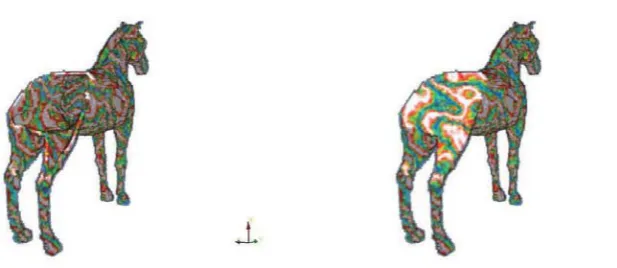
Although textures applied to 3D models influence the similarity evaluations of 3D models, descriptors for 3D models with textures have not been sufficiently investi-gated. One important pioneering work of a 3D model retrieval technique [4] demonstrated an intuitive solution to handle attributes including shapes, colors, and tex-tures using their web-based system. The system allows users to control weight values applied to each attribute, and 3D models were retrieved by the system reflecting which attributes were used dominantly. Some papers [5] [6] deal with color descriptors including material color or light information of 3D models including transparency and reflection. There are several view based type 3D model retrieval techniques which use various 2D images for capturing a 3D model from multiple viewpoints. This kind of method converts and captures three dimensional visual information including shapes, colors and textures into 2D images, thus it is possible to integrate these at-tributes for similarity retrievals. A paper [7] introduced a similarity retrieval technique for 3D models with 3D solid textures. The 3D solid textures are different in presen-tation compared to other 2D UV mapping type textures as shown in Figure 1. The paper described a technique for synthesizing a database of textured 3D models from both a 2D image database and a 3D model database. Descriptors for each textured 3D model were extracted using fractal based analysis using multiple sizes of fractal filters.
In our research, the similarity retrieval technique for the solid textured 3D models was examined using the fractal-based descriptor extraction technique in conjunction with a multiple regression analysis. Our preliminary experi-mental system can choose an adequate fractal descriptor filter size reflecting multiple regression analysis.
Figure 1: UV texture mapping (left) and solid texture mapping (right).
2
Similarity Retrievals of Textured 3D
Models
This section describes (1) a 3D model with multiple at-tributes, (2) the process required for similarity retrieval and (3) fractal descriptors.
2.1
3D Model with Multiple Attributes
When 3D model descriptors with multiple attributes are used in retrieval systems, several methods are used to handle these descriptors depending on software applica-tions. For instance, if shape descriptors are used for 0% and texture descriptors are used for 100%, the system can search for 3D models with similar textures regardless of the shapes of the 3D models. Oppositely, if shape descrip-tors are used for 100% and texture descripdescrip-tors are used for 0%, the system can search for 3D models with similar shape regardless of the textures of the 3D models. Also, it is possible to apply arbitrary weights to descriptors for mixing multiple attributes, and the system can search for 3D models with both similar shapes and similar textures by reflecting the weights.
Another approach for mixing multiple attributes can be performed in two stages. For the first stage, the system can search for 3D models based on shape descriptors and can obtain a sorted similarity list. For the second stage, the system can use the list for identifying identical shapes of 3D models and can apply search based on texture de-scriptors. When the database contains an extremely large number of 3D models, the system has a higher possibility of returning a larger number of 3D models with identi-cal shapes. In such a case, texture based descriptors can be used for retrieval of 3D models with these identical shapes for refining retrieval results.
In this research, the system is implemented for dealing with only texture descriptors. In other words, the sys-tem ignores shape descriptors of each 3D model, and the system retrieves 3D models with similar texture pattern regardless of the 3D model shapes. The system extracts
descriptors from inside of the 3D models, and descrip-tors are not extracted from the surface of the 3D models. Since the number of sampling points is different in each 3D model, the descriptors are normalized in consideration of the number of sampling points.
2.2
Process Required for Similarity
Re-trieval
Basically, the procedure is quite similar to the similarity retrieval of 2D images and 3D polygonal models. In our approach, three dimensional descriptors are used rather than two dimensional descriptors. Our three dimensional descriptor extraction technique allows a system to di-rectly obtain descriptors from the 3D models, and con-version of the 3D models into a series of 2D images is not necessary.
2.3
Fractal Descriptors
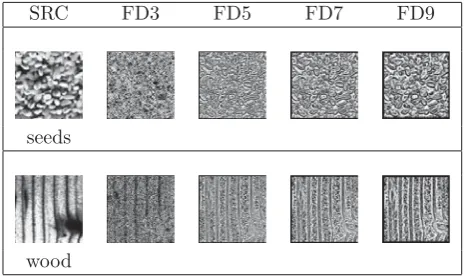
SRC FD3 FD5 FD7 FD9
seeds
[image:3.595.45.278.96.234.2]wood
Figure 2: Images generated by applying various sizes of fractal filters. A larger filter (FD9) can capture thick wood grain patterns, and a small filter (FD3) can capture thin wood grain patterns.
anisotropy should be carefully considered. In our exper-iments, multiple regression analysis was used for deter-mining the filter size. The analysis is used to learn about the relationship between several predictor variables and criterion variable. The portions of the database for the textured 3D models were marked as a learning data set. All the learning data sets were analyzed for extracting fractal descriptors (FD3, FD5, FD7, and FD9), and the similarity retrievals were conducted on the entire set of data for computing recall-precision rates. The averages of recall-precision rates and the averages of F-measure values for each texture type were computed. In the anal-ysis, filter size was set to criterion variable (3, 5, 7 and 9), and texture descriptors were set to predictor variables (FD3, FD5, FD7, and FD9; 20 descriptors×4).
3
Experiments and Results
This section describes (1) experimental databases of tex-tured 3D models, (2) similarity retrieval performances and (3) similarity retrieval using our approach.
3.1
Experimental Databases of Textured 3D
models
To test the method described in the previous section, a database of 3D solid textures was synthesized first, and then the synthesized data are applied to a database of 3D models. The solid textures can be synthesized in various ways. One of the most popular technique is a procedural texture approach [11], and noise functions are involved in the technique for synthesizing natural irregular pat-terns. In recent years, other types of techniques have been introduced for 3D solid texture synthesis [12] [13]. These new techniques have made it possible to synthe-size solid textures from 2D texture images. Since the 2D images are not limited to images synthesized by noise functions, various patterns of 3D solid textures can be obtained. Although these new techniques can synthesize realistic 3D solid texture patterns, some techniques
in-volve heavy computation of voxel searching and match-ing. Since our focus was synthesizing an experimental database that contains a large number of 3D solid tex-tures with various patterns, a simple and fast technique was applied which was used in paper [7]. The method is also similar to an interpolated texture method described in paper [14]. A database of 3D models was obtained from the Princeton Shape Benchmark (PSB)[15]. A database of 2D image textures was obtained from OUTEX [16] which is a set of texture benchmark data. Although the OUTEX benchmark data contain a large number of vari-ous types of textures, only a portion of the data was used for our experiment. 3D model data were voxelized using the software program called ’binvox’ [17] which imple-mented the currently available efficient voxelization algo-rithms [18]. In our experiments, voxel sizes of 128×128
×128 were specified, and the program was used for con-verting the 3D polygonal models onto the 3D voxelized models. A simple Boolean operation was used for map-ping the 3D solid texture onto the voxelized 3D model. Because of limitation of hard disk space, only 20% of the OUTEX 2D images were used for our experiments. The data were selected by skipping 5 data indices repeatedly, and thus 1276 solid textures were used. There are 319 classes of data and each class contains 4 data sets. The classes were grouped into 28 types, and the types of tex-tures are shown in Figure 4 in the next subsection.
3.2
Similarity Retrieval Performances
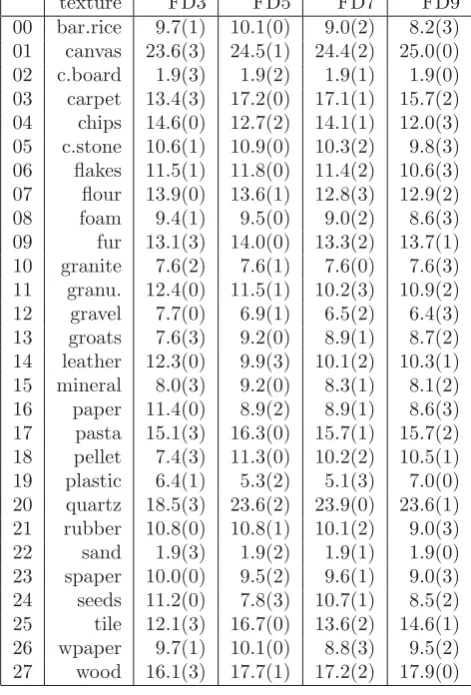
Similarity retrieval performances were evaluated using descriptors computed based on various fractal filter sizes (3, 5, 7, and 9), and corresponding descriptors (Fractal Dimension) are denoted as FD3, FD5, FD7 and FD9. Figure 3 shows a graph of recall-precision rates for each retrieval performance, and the lines in the graph indi-cate the retrieval performance computed using FD3, FD5, FD7 and FD9. In addition, F-measure values were com-puted from the recall-precision rates (Figure 4). In gen-eral, a larger F-measure value indicates better retrieval performance, and thus the similarity performance using FD5 was most optimal in this case.
3.3
Similarity Retrieval Performances using
our approach
In our approach, portions of experimental data were marked as learning data. In the experiments, 50% of the data items (638 items) were randomly marked as learn-ing data. The learnlearn-ing data set was used for findlearn-ing the relations between texture descriptors and filter size. The multiple regression analysis technique was applied, and the regression function was obtained which predicts the best filter size of descriptors to be used for each query. The R-square value for the analysis was 0.901, and it was an acceptable value for the use of the regression function. The R-square values which were an indicator of how the regression function prediction were correct. All of the 3D
0 0.1 0.2 0.3 0.4 0.5 0.6 0.7 0.8 0.9 1 1.1
0 0.1 0.2 0.3 0.4 0.5 0.6 0.7 0.8 0.9 1 1.1
[image:4.595.312.535.98.263.2]Precision Recall FD3 FD5 FD7 FD9
Figure 3: Recall-Precision graph (FD3, FD5, FD7, and FD9). Similarity retrieval performances were evaluated using descriptors computed based on various fractal filter sizes (3, 5, 7, and 9).
texture FD3 FD5 FD7 FD9
[image:4.595.55.278.109.274.2]00 bar.rice 9.7(1) 10.1(0) 9.0(2) 8.2(3) 01 canvas 23.6(3) 24.5(1) 24.4(2) 25.0(0) 02 c.board 1.9(3) 1.9(2) 1.9(1) 1.9(0) 03 carpet 13.4(3) 17.2(0) 17.1(1) 15.7(2) 04 chips 14.6(0) 12.7(2) 14.1(1) 12.0(3) 05 c.stone 10.6(1) 10.9(0) 10.3(2) 9.8(3) 06 flakes 11.5(1) 11.8(0) 11.4(2) 10.6(3) 07 flour 13.9(0) 13.6(1) 12.8(3) 12.9(2) 08 foam 9.4(1) 9.5(0) 9.0(2) 8.6(3) 09 fur 13.1(3) 14.0(0) 13.3(2) 13.7(1) 10 granite 7.6(2) 7.6(1) 7.6(0) 7.6(3) 11 granu. 12.4(0) 11.5(1) 10.2(3) 10.9(2) 12 gravel 7.7(0) 6.9(1) 6.5(2) 6.4(3) 13 groats 7.6(3) 9.2(0) 8.9(1) 8.7(2) 14 leather 12.3(0) 9.9(3) 10.1(2) 10.3(1) 15 mineral 8.0(3) 9.2(0) 8.3(1) 8.1(2) 16 paper 11.4(0) 8.9(2) 8.9(1) 8.6(3) 17 pasta 15.1(3) 16.3(0) 15.7(1) 15.7(2) 18 pellet 7.4(3) 11.3(0) 10.2(2) 10.5(1) 19 plastic 6.4(1) 5.3(2) 5.1(3) 7.0(0) 20 quartz 18.5(3) 23.6(2) 23.9(0) 23.6(1) 21 rubber 10.8(0) 10.8(1) 10.1(2) 9.0(3) 22 sand 1.9(3) 1.9(2) 1.9(1) 1.9(0) 23 spaper 10.0(0) 9.5(2) 9.6(1) 9.0(3) 24 seeds 11.2(0) 7.8(3) 10.7(1) 8.5(2) 25 tile 12.1(3) 16.7(0) 13.6(2) 14.6(1) 26 wpaper 9.7(1) 10.1(0) 8.8(3) 9.5(2) 27 wood 16.1(3) 17.7(1) 17.2(2) 17.9(0)
Figure 4: F-measure values for each texture. F-measure values computed from recall-precision graphs using the following equation: Fm = 2×((precisionrecall)÷ (preci-sion+recall)) 0 0.1 0.2 0.3 0.4 0.5 0.6 0.7 0.8 0.9 1 1.1
0 0.1 0.2 0.3 0.4 0.5 0.6 0.7 0.8 0.9 1 1.1
Precision
Recall
[image:4.595.44.278.353.717.2]Mix.Opt (FD3,FD5,FD7,FD9) Mix.Stat (FD3,FD5,FD7,FD9) FD5
Figure 5: Recall-Precision graph (FD5, FD-V[Mix.Stat] and the system optimal[Mix.Opt] )
models (1276 items) in the database were analyzed to de-termine whether the regression function can successfully predict correct filter size for each queried 3D model. In the experiments, 90% (1149 out of 1267) of the filters were selected by the system correctly.
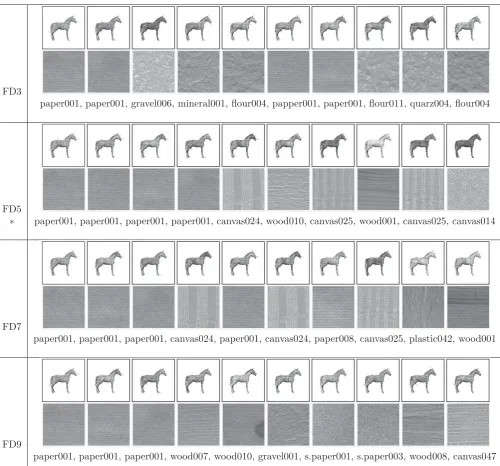
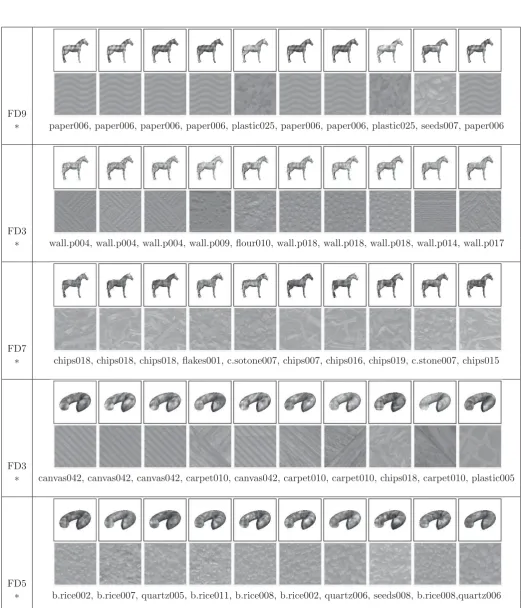
Figure 5 shows a graph of recall-precision rates for both FD5 and FD-V (FD with Various filter sizes) which is the method proposed in this research. In the figure, the FD-V shows good retrieval results compared to that of FD5. Figures 6 and 7 show examples of the similarity retrieval of textured 3D models. In each figure, the ten most similar 3D solid textures determined by the system are shown, and the left image shows the query key. In each textured 3D model, the corresponding 2D texture used to synthesize the 3D solid texture is shown. The re-trieval examples marked with asterisks ’*’ indicate that the retrieval uses the filter size recommended by our ex-perimental system.
4
Summary and Future Work
[image:4.595.43.279.370.718.2]FD3
paper001, paper001, gravel006, mineral001, flour004, papper001, paper001, flour011, quarz004, flour004
FD5
∗ paper001, paper001, paper001, paper001, canvas024, wood010, canvas025, wood001, canvas025, canvas014
FD7
paper001, paper001, paper001, canvas024, paper001, canvas024, paper008, canvas025, plastic042, wood001
FD9
[image:5.595.42.543.165.631.2]paper001, paper001, paper001, wood007, wood010, gravel001, s.paper001, s.paper003, wood008, canvas047
Figure 6: Examples of similarity retrievals. The ten most similar 3D solid textures determined by the system are shown, and the left image shows the query key. In each textured 3D model, the corresponding 2D texture used to synthesize the 3D solid texture is shown. The retrieval examples marked with asterisks∗indicate that the retrieval uses the filter size recommended by our experimental system. The preliminary system with a limited number of 3D model data can be accessed at the following web address: http://motosuzuki.air-nifty.com/blog/retrieval-system.html
FD9
∗ paper006, paper006, paper006, paper006, plastic025, paper006, paper006, plastic025, seeds007, paper006
FD3
∗ wall.p004, wall.p004, wall.p004, wall.p009, flour010, wall.p018, wall.p018, wall.p018, wall.p014, wall.p017
FD7
∗ chips018, chips018, chips018, flakes001, c.sotone007, chips007, chips016, chips019, c.stone007, chips015
FD3
∗ canvas042, canvas042, canvas042, carpet010, canvas042, carpet010, carpet010, chips018, carpet010, plastic005
FD5
[image:6.595.37.559.90.699.2]∗ b.rice002, b.rice007, quartz005, b.rice011, b.rice008, b.rice002, quartz006, seeds008, b.rice008,quartz006
Currently, our system is designed for analyzing 3D solid textures. The system will be extended to handle not only 3D solid textures but also UV mapping type textures. Other types of descriptors which can extract texture pat-terns from the 3D models will be investigated, and the similarity retrieval of those descriptors will be compared as a future work.
Acknowledgments
This research was supported by research grants from a grant-in-aid from the Ministry of Education, Science, Sports and Culture, Japan (Wakate-B-21700127).
References
[1] Yubin Yang, Hui Lin, Content-based 3D model re-trieval: a Survey, IEEE Transactions on Systems, Man and Cybernetics: Part C- Applications and Re-views, Vol.37(6), pp.1081-1098, 2007.
[2] J. W. H. Tangelder, R. C. Veltkamp, A Survey of Con-tent Based 3D Shape Retrieval Methods,Proceedings Shape Modeling International, pp.145-156, 2004.
[3] Jean-Luc Dugelay, Atilla Baskurt, Mohamed Daoudi, 3D Object Processing: Compression, Indexing and Watermarking,Wiley, ISBN: 978-0-470-06542-6, 2008.
[4] Eric Paquet, Marc Rioux: Nefertiti: a query by content system for three-dimensional model and im-age databases manim-agement, Image Vision Comput-ing, Vol.17, No.2, pp157-166, 1999.
[5] Wei Wei, Yubin Yang, Jinjie Lin and Jiabin Ruan, Color-based 3D Model Classification using Hopfield Neural Network, 2008 International Conference on Computer Science and Software Engineering, pp.883-886, 2008.
[6] Motofumi T. Suzuki and Yuji Y. Sugimoto, Person-alized Retrieval from Material Color Databases for 3D Polygonal Models, 6th International Conference on Virtual Systems and Multimedia (VSMM2000), pp.577-584, 2000.
[7] Motofumi T. Suzuki, Yoshitomo Yaginuma, Haruo Kodama, A Similarity Retrieval Technique for Tex-tured 3D Models, International Conference on In-formation Retrieval and Knowledge Management, (CAMP10), pp.131–137, 2010.
[8] J. C. Russ, Surface Characterization: Fractal Di-mensions, Hurst Coefficients, and Frequency Trans-forms, Journal of Computer Assisted Microscopy, Vol.2, No.3, pp.161-183. 1990.
[9] J. C. Russ, Processing images with a local Hurst operator to reveal textural differences, Journal of Computer Assisted Microscopy, Vol.2, 4, pp.249–257, 1990.
[10] J. C. Russ, Fractal Surfaces, ISBN: 978-0-306-44702-0, 1994.
[11] Ken Perlin, An image synthesizer, Computer Graph-ics, (SIGGRAPH 1985 Proceedings), Vol.19, pp.287-296, 1985.
[12] Y. Dong, S. Lefebvre, X. Tong, and G. Drettakis, Lazy solid texture synthesis, in Computer Graphics Forum (Proceedings of the Eurographics Symposium on Rendering), 2008.
[13] J. Kopf, C.-W. Fu, D. Cohen-Or, O. Deussen, D. Lischinski, and T.-T. Wong, Solid texture synthesis from 2d exemplars, ACM Transactions on Graphics (Proc. of SIGGRAPH 2007), vol. 26, no. 3, 2007.
[14] Ludovic Paulhac, Pascal Makris, Jean-Yves Ramel, A Solid Texture Database for Segmentation and Clas-sification Experiments, VISSAPP (2), pp.135-141, 2009.
[15] P. Shilane, et al, The Princeton Shape Benchmark, Shape Modeling International, pp.167-178, 2004.
[16] T. Ojala, T. Menp, M. Pietikinen, J. Viertola, J. Kyllnen, and S. Huovinen, Outex - new framework for empirical evaluation of texture analysis algorithms, Int. Conf. on Pattern Rec., pp.701706, 2002.
[17] Patrick Min, binvox (3D mesh voxelizer) http://www.google.com/search?q=binvox, 2004.
[18] Fakir S. Nooruddin and Greg Turk, Simplification and Repair of Polygonal Models Using Volumetric Techniques,IEEE Transactions on Visualization and Computer Graphics, vol.9, pp.191-205, 2003.