Abstract— In an increasingly competitive market, companies have the need to seek and implement best practices to continuously improve their processes. Recently, several quality management tools and quality improvement methodologies have emerged in literature. However, there is a gap between theory and practice. This study aims to assess to what extent the methodologies and tools cited in literature are used by industrial companies in Portugal. A questionnaire was developed to investigate both the importance, perceived by respondents, to each tool and methodology, and its level of use. The motivational factors and barriers to their implementation were also investigated. The questionnaire was sent to industrial companies of different sectors and 83 answers were analyzed based on descriptive statistics and statistical tests. Results show evidence about the perceived importance and implementation level of quality improvement practices in industries in Portugal. It also contributes to understand the factors that influence the use of such quality improvement techniques.
Index Terms— Continuous improvement, Quality improvement, Quality Tools, Questionnaires, Survey
I. INTRODUCTION
ver the years there has been an increase in global competition among various sectors as a result of fast, deep and frequent changes all over the world and, therefore a fast technological innovation and proliferation of offered products (particularly in terms of variety and possibility of customization). In this market context, to ensure competitiveness, companies have to continually seek best practices in order to improve processes, products and services and to achieve agile and flexible costumer services and competitive costs.
The quality of processes, products and services is an important factor in business strategies, and therefore has been changed to suit the reality that businesses face. Then, companies have to continually improve their processes through the implementation of adequate methodologies and tools. Several continuous improvement tools and methodologies appear in literature, and several application
Manuscript received March 06, 2011; revised March 29, 2011. I. S. Lopes is with the University of Minho, EE-DPS, Campus de Gualtar, 4710-057 Braga, Portugal (phone: 253604762; fax: +351-253604761; e-mail: [email protected]).
E. P. Nunes is with the University of Minho, EE-DPS, Campus de Gualtar, 4710-057 Braga, Portugal (e-mail: [email protected]).
S. D. Sousa is with the University of Minho, EE-DPS, Campus de Gualtar, 4710-057 Braga, Portugal (e-mail: [email protected]).
D. Esteves is with the University of Minho, EE-DPS, Campus de Gualtar, 4710-057 Braga, Portugal (e-mail: [email protected]).
cases are also found. However, comparative studies of these tools and methodologies are scarce [1].
Scott et al. [2] present a quantitative survey about continuous improvement programs adopted by the Canadian food industry, distinguishing companies by: ownership (private and publicly-traded), size (small, medium and big companies) and products (processed and non-processed). The study has revealed that 55.2% of respondents recognized using one or more continuous improvement methodology, and the larger is the size of the company, the larger is the percentage. The study also identifies the methodology used more often and the more important motivational factors considered by the companies that have implemented continuous improvement programs.
Terziovski and Sohal [3] present a study undertaken in Australian manufacturing companies as part of a wider international survey investigating continuous improvement practices in Australia, Denmark, Finland, Sweden, Netherlands, and UK. The study identifies the tools more often used by Australian companies and the issues addressed frequently in the continuous improvement process.
In Portugal, no similar study is known. However, this type of study allow to ascertain the current state of the practice of Quality continuous improvement programs in the country and identify the advantages of their implementation and the difficulties that arise in obtaining such advantages.
In order to investigate the continuous improvement practices used by manufacturing companies in Portugal, a questionnaire was developed with the following objectives: Find out the continuous improvement methodologies and tools known and more often used in Portuguese manufacturing companies;
Identify the motivational factors underlying their implementation;
Identify the factors that discourage companies to adopt quality improvement methodologies and the difficulties faced in the implementation stage;
Identify differences between companies with different sizes and between companies which have a certified quality management system and companies which do not have.
II.LITERATURE REVIEW
A.Quality improvement methods and tools
Quality improvement is the basis of modern quality management systems and a requirement of ISO 9001:2008. Quality improvement can be classified into “continuous improvement” and “discontinuous improvement”. These two types are also called “Continual Improvement” [4]. The
Quality Improvement Practices Adopted by
Industrial Companies in Portugal
Isabel S. Lopes, Eusébio P. Nunes, Sérgio D. Sousa, and Dina Esteves
PDCA cycle and Kaizen techniques are examples of the former which continuously seek for small improvements whereas, quality improvement projects and six-sigma projects are examples of the latest and seek for drastic improvements or innovations. Companies can use both types of quality improvement. Bunney and Dale [5] argue that “the use of quality tools and techniques (QTs) is a vital component of any successful improvement process” p.188. To increase the effectiveness and efficiency of quality improvement companies should use established QTs.
Many QTs are generally accepted by most authors and practitioners. For example, the seven basic quality tools and many others are described in [6] or [7]. However, organizations may not benefit from the use of every tool and there are some authors that suggest the way to select the appropriate tool [8].
Empirical data of Portuguese small and medium-sized enterprises (SMEs) [9] suggest that SMEs’ managers recognize the importance of QTs but only a few tools have a significant use. Terziovski and Sohal [3], concluded that organizations use more frequently the basic quality tools and less frequently techniques like FMEA (Failure Mode and Effect Analysis) or QFD (Quality Function Deployment). Tari and Sabater [10] also concluded that a small number of tools are used in each company, but the level of use was dependent of the organization sector and size. This suggests that there are factors that can motivate or hinder the use of such tools.
B.Motives and barriers for quality improvement
Quality improvement and QTs may be used within certified quality management systems, and some studies suggest that external factors are the main motive to adopt such quality improvement programs [11] while other studies argue that internal factors [3] are the main motives to adopt quality improvement.
Assuming the existence of successful reports of quality improvement (for example by quality gurus) and assuming the existence of several motives for its adoption by industries, there should be constraints that would not allow its generalized adoption.
Adebanjo and Kehoe [12] performed a study in the UK, to identify the problems associated with implementation of TQM in industries. The main factors were related to: Human Resources, materials and equipment, employees’ attitude, top management, financial resources, inappropriate training and inappropriate methods. [13] and [14] also confirm the above problems and other studies [15], add the cultural factor as a potential barrier to quality improvement. This work will complement and update a previous work performed in 2003 [9].
C.Hypotheses
The main objective of this work is to get empirical evidence about the current level of use of quality improvement programs and QTs of industries in Portugal. To determine the managers’ knowledge about quality improvement tools it is also an objective to ascertain the perceived importance of each quality tool. The first hypothesis is that industrial companies in Portugal use
quality improvement programs (H1a) and QTs (H1b). The level of perceived importance of each quality methodology/tool is higher than its level of use within companies (H2a/H2b). There are factors that can trigger the
adoption of QTs (H3a), and factors that can hinder such adoption (H3b). There are factors that can hinder the use of such quality improvement tools and techniques (H3c). The results of previous hypotheses may be affected by the type of company (i.e. if it is certified or non-certified) (set of H4
hypotheses) and may be dependent on company’s size (set of
H5 hypotheses).
III. METHODS
A.Questionnaire
A questionnaire was developed based on literature review. All the questions were organized in four sections. Section one includes general information about the respondents.
Section two intends to ascertain whether companies have quality improvement programs implemented and the importance attributed to each programs, such as: Total Quality Management (TQM), Six Sigma and Total Productive Maintenance (TPM). A four point scale was used for the level of implementation and for the level of importance (1-none, 2- low, 3- moderate, 4- high). The motivation for the adoption of quality programs was also ascertained in this section. The degree of agreement with the proposed motivational factors was registered based on a four point scale (1- strongly disagree, 2- disagree 3- agree, 4- completely agree).
In section three, several QTs are listed to investigate the frequency of use and the degree of importance considered by respondents for each tool.
In order to ascertain the barriers to the adoption of quality methodology, section four presents a list of barriers cited in literature. In the same section, another list for barriers on implementation of quality methodology was made to be answered by firms who have already implemented some methodology.
B.Sample
Before sending the questionnaire to companies, a pilot survey was made to test the validity of the questionnaire and to detect errors in the formulation of questions. The questionnaire was analyzed by experts in quality management and by nine practitioners. Based on the provided opinions, some changes were made to improve information gathering, mainly in some questions about the barriers of implementation/adoption and in the recommendation for filling. Then, the final version of the questionnaire was sent by email to one thousand companies selected randomly. After 5 days, telephone calls were made to companies who had not yet returned the questionnaire to improve the response rate. 83 completed questionnaires were returned, resulting in a response rate of 8.3%.
of respondents have their current positions for 2, 3 or 5 years and 14% for less than 2 years. By these results, it can be stated that most respondents have acquired sufficient experience and knowledge about the process of quality management in the company to respond coherently to the questionnaire.
Several sectors of activity are covered by the study: 27% of firms surveyed belong to the food sector, 20% belong to the metallurgical/mechanical engineering, 12% belong to the sector of components for the automotive industry, 11% for textile sector, 2% to the sector of wood products and, finally, 20% are from other sectors.
Information about firms dimension was also gathered. The study includes companies of different sizes: 42% of the surveyed companies have between 51 and 250 full-time employees, 35% have between 10 and 50 and 23% have more than 250. No surveyed company has fewer than 10 employees.
C.Data analysis
Data analysis was based on means for each response. The
t-test was also used to test hypotheses of differences in means. All t-tests performed use a significance level of 0.05.
Since it was supposed that firms certified by a quality management standard are more familiar with the methodologies and QTs than non-certified companies, the results obtained for the certified companies were compared with results for non-certified companies. From the returned questionnaire, it was noted that 80% of the surveyed companies have a certified quality management system.
It was also supposed that the size of the organization may influence the use of methodologies and tools, the motivational factors and the barriers to the adoption or implementation of quality programs. Therefore, the results for companies with different sizes were compared using t -test: companies that employ between 10 and 50 full-time employees (small companies), those that employs between 50 and 250 full-time employees (medium companies), and those with more than 250 employees (large companies).
IV. RESULTS AND DISCUSSION
In the following sections, the results and their analysis are presented in the order they appear in the questionnaire. The first section refers to the importance and use of quality improvement methodology and tests the differences in results between certified and non certified companies and between companies with different sizes.
In the section B, the same analysis is made for the
motivational factors that lead to the implementation of quality improvement practices (methodologies and tools).
Using the same approach, section C presents analysis of results for quality management tools and section D, analysis of results for the barriers in the adoption and during the implementation of quality Programs.
A.Quality Methodologies
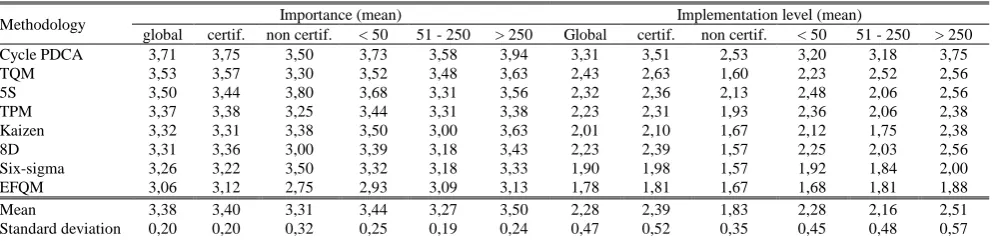
For each considered quality methodology the mean of the results was calculated for the perceived importance and implementation level (columns designated by “global” in Table I). The considered quality methodologies are listed in the first column of table I. The means of the results for certified and non certified companies, for small, medium and large companies are also presented.
From the analysis of the table, some conclusions can be drawn: (i) all the cited methodologies were considered important by companies (mean above 3), highlighting the PDCA methodology as the most important, (ii) the degree of implementation of these methodologies in business appears to be lower than the given importance - only the PDCA cycle has a mean value above 3, (iii) Six-sigma methodologies and EFQM are those with a lower level of implementation. These results may be related to the fact that these methodologies are more demanding in terms of implementation, requiring a higher level of quality maturity. Regarding the means for certified companies, it can be added that the methodology with the higher mean for the perceived importance and implementation is the PDCA cycle followed by TQM. This result is coherent since the quality management standard is based in TQM and in the PDCA cycle. For non-certified companies, the most important methodology is 5S followed by PDCA cycle which are also the most implemented methodologies.
For small companies, PDCA cycle and 5S are also the most important methodologies. For medium and large companies, the most important are PDCA cycle and TQM. For large companies, the same mean was obtained for TQM and Kaizen. Concerning the implementation, the PDCA cycle is highlighted for all size with mean values above 3.
Overall, the level of perceived importance is 3.38 and the implementation level is 2.28. Values greater than 2 indicate that the quality methodology is used.
TABLE I
IMPORTANCE AND USE OF QUALITY METHODOLOGIES
Methodology Importance (mean) Implementation level (mean)
[image:3.595.51.548.661.783.2]This suggests that there is no evidence to reject hypothesis
H1a, thus industrial companies in Portugal use some quality improvement methodology. Hypothesis H2a regarding the difference between the perceived importance and level of implementation was tested based on a t-test which indicates that the level of implementation is lower than the perceived importance.
To test differences between certified and non-certified companies, the following hypotheses are considered:
H4_i_m: the level of perceived importance of quality
methodology is the same for certified and non-certified companies; and H4_u_m: the level of use of quality
methodology is the same for certified and non-certified companies. Performed t-tests indicate that the level of use in certified companies is higher.
Similar analysis was made regarding company size considering the following hypotheses: H5_i_m_sm: the level of perceived importance of quality methodology is the same for small and medium-size companies; H5_i_m_sl: the level of perceived importance of quality methodology is the same for small and large-size companies; and H5_i_m_ml: the level of perceived importance of quality methodology is the same for medium and large-size companies. Similar hypotheses were performed for use (H5_u_m_sm; H5_u_m_sl; H5_u_m_ml). Performed t-tests indicate that there is no evidence of differences between companies with different sizes.
B.Motivational Factors
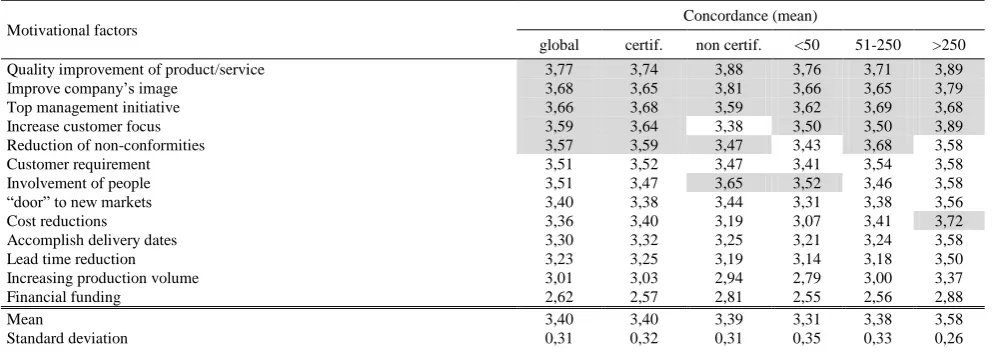
The bibliography identifies a set of motivational factors that guide the companies towards the adoption and implementation of quality improvement practices (methodologies and tools). The selected motivational factors considered in the questionnaire are listed in the first column of Table II. Table II shows the mean results for the level of concordance of respondents for each motivational factor, ordered by decreasing levels of concordance. The shadows in Table II identify the top five motivational factors. The mean level of concordance is 3.40.
Concerning certified and non-certified companies, the
following hypothesis was tested: H4_c_mf: the level of
concordance with motivational factors is the same for certified and non-certified companies.
T-test results indicate that H4_c_mf is not rejected. Similar analysis was made regarding company size considering the following hypotheses: H5_c_mf_sm: the level of concordance with motivational factors is the same for small and medium-size companies; H5_c_mf_sl: the level of concordance with motivational factors is the same for small and large-size companies; and H5_c_mf_ml: the level of concordance with motivational factors is the same for medium and large-size companies.
T-tests results indicate that only H5_c_mf_sl is rejected, suggesting that the level of concordance is higher in large companies compared to small ones.
C.Quality Tools
The QTs presented to respondents are listed in Table III. Table III also shows the mean for the perceived importance and implementation level of each quality tool. The list is ordered by decreasing level of QTs’ implementation. The most important QTs are also the ones with higher level of use. This reveals coherence in answers. Overall, the level of perceived importance is 3.36 and the implementation level is 2.68. This suggests that there is no evidence to reject hypothesis H1b, thus it can be supposed that industrial companies in Portugal use QTs. Hypothesis H2b regarding the difference between the perceived importance and level of implementation was tested based on a t-test Which indicates that the level of implementation is lower than the perceived importance.
To test differences between certified and non-certified companies, the following hypotheses are considered:
H4_i_qt: the level of perceived importance of QTs is the same for certified and non-certified companies; and
H4_u_qt: the level of use of QTs is the same for certified and non-certified companies. T-tests were performed, to test difference between means. Test results indicate that H4_i_qt is not rejected; H4_u_qt is rejected, indicating that the level of use of QTs is higher in certified companies.
TABLE II
MOTIVATIONAL FACTORS FOR THE IMPLEMENTATION OF QUALITY IMPROVEMENT PRACTICES
Motivational factors Concordance (mean)
global certif. non certif. <50 51-250 >250 Quality improvement of product/service 3,77 3,74 3,88 3,76 3,71 3,89
Improve company’s image 3,68 3,65 3,81 3,66 3,65 3,79
Top management initiative 3,66 3,68 3,59 3,62 3,69 3,68
Increase customer focus 3,59 3,64 3,38 3,50 3,50 3,89
Reduction of non-conformities 3,57 3,59 3,47 3,43 3,68 3,58
Customer requirement 3,51 3,52 3,47 3,41 3,54 3,58
Involvement of people 3,51 3,47 3,65 3,52 3,46 3,58
“door” to new markets 3,40 3,38 3,44 3,31 3,38 3,56
Cost reductions 3,36 3,40 3,19 3,07 3,41 3,72
Accomplish delivery dates 3,30 3,32 3,25 3,21 3,24 3,58
Lead time reduction 3,23 3,25 3,19 3,14 3,18 3,50
Increasing production volume 3,01 3,03 2,94 2,79 3,00 3,37
Financial funding 2,62 2,57 2,81 2,55 2,56 2,88
Mean 3,40 3,40 3,39 3,31 3,38 3,58
[image:4.595.51.548.575.753.2]TABLE III
PERCEIVED IMPORTANCE AND IMPLEMENTATION LEVEL OF QUALITY TOOLS
Similar analysis was made regarding company size considering the following hypotheses: H5_i_qt_sm: the level of perceived importance of QTs is the same for small and
medium-size companies, H5_i_qt_sl: the level of perceived
importance of QTs is the same for small and large-size companies, and H5_i_qt_ml: the level of perceived
importance of QTs is the same for medium and large-size companies. Similar hypotheses were performed for use (H5_u_qt_sm; H5_u_qt_sl; H5_u_qt_ml).
T-tests results indicate that H5_i_qt_sl and H5_u_qt_sl
are rejected, suggesting that the importance and level of use is higher in large companies compared to small ones. Based on t-tests H5_i_qt_ml and H5_u_qt_ml are rejected, indicating that the importance and level of use is higher in large companies compared to medium-sized companies.
D.Continuous improvement programs
Tables IV and V present the barriers to the adoption and implementation of quality improvement programs, respectively, and the results obtained in this study.
1) Barriers to adoption
Table IV shows the mean results for the level of concordance of each barrier to the adoption of continuous improvement programs (first column). Overall, the level of concordance with barriers to adoption is 2.32. Values greater than 2 indicate a concordance with presented barriers. So, there is no evidence to reject hypothesis H3a.
Concerning certified and non-certified companies, the following hypothesis was tested: H4_c_ba: the level of concordance with barriers to adoption continuous improvement programs is the same for certified and non-certified companies. A t-test was performed and result indicates that H4_c_ba is not rejected.
Similar analysis was made regarding company size comparing mean values with the following pairs: small and medium-size companies, small and large-size companies, and medium-size and large companies. T-tests were performed and the result indicates that there are no significant differences between the average values.
2)Barriers to implementation
Table V presents results identical to those presented in Table IV, obtained in this case for the barriers to the implementation of Quality improvement programs. From the analyses of these results (similar to those conducted with Table IV), we emphasize a significant difference of mean results between medium and large companies, verifying the highest mean value in medium-sized companies.
V.CONCLUSION
This study reveals that Portuguese companies recognize the usefulness of QTs and methodologies. However, its perceived importance is higher than its level of use. The perceived importance and the level of use of QTs and methodologies are higher in large-sized companies Quality Tools
Perceived Importance (mean) Implementation level (mean)
global certif. non
certif. <50 51-250 >250 Global certif. non
TABLE IV
BARRIERS TO THE ADOPTION OF QUALITY IMPROVEMENT TOOLS
TABLE V
BARRIERS TO THE IMPLEMENTATION OF QUALITY IMPROVEMENT TOOLS
compared to small and medium-sized companies. The level of use of QTs and methodologies is higher in certified companies. The study highlights the main motivational factors that lead to the implementation of quality improvement practices (methodologies and tools) and the main barriers for its adoption and faced during the implementation.
The PDCA cycle is generally the methodology considered the most important by companies and is also the mostly used. Its spread may be associated with the fact that standards such as OSHA 18000, ISO 14000 and ISO 9000 are based in PDCA cycle. This methodology is also simple to understand and explain, since it indicates a logical sequence. It can also be supposed that 5S is also a popular methodology for the same reason. Methodologies that require more investment in resources such as Six Sigma and EFQM are less implemented.
The performed survey allowed to draw some general conclusions, however some further analysis are required to understand the advantages and disadvantages (or limitations) considered by companies for the methodologies and tools. From this study, an interesting question arises: why companies prefer one tool or methodology instead another? Comparative study about quality tools and methodologies are scarce in literature.
REFERENCES
[1] Kumar, M., Antony, J., (2008), Comparing the Quality Management Practices in UK SMEs, Industrial Management and Data System, 108(9): 1153-1166
[2] Scott, B., Wilcock, and A., Kanetkar, V. (2009) A survey of structured continuous improvement programs in the Canadian food sector, Food control, 20: 209-217,
[3] Terziovski, M. and A. Sohal (2000). "The adoption of continuous improvement and innovation stategies in Australian manufacturing firms." Technovation 20: 539-550.
[4] Juran, J. M. and A. B. Godfrey (1999). Juran's Quality Handbook, McGraw-Hill.
[5] Bunney, H. and B. Dale (1997). "The implementation of quality management tools and techniques: a study." The TQM Magazine 9(3): 183-189.
[6] Mizuno, S. (1988). Management for Quality Improvement: The Seven New QC Tools, Productivity Press.
[7] Gustafsson, A. (1997). "The new quality tools." Total Quality Management 8(2&3): S167-S172.
[8] Arneson, T., M. Rys, et al. (1996). A guide to the selection of appropriate quality improvement tools. Proceedings of the 1st Annual International Conference on Industrial Engineering Applications and Practice, Huston, Texas.
[9] Sousa, S. D., E. Aspinwall, et al. (2005). "Performance measures and quality tools in Portuguese Small and Medium enterprises: survey results." Total Quality Management & Business Excellence 16(2): 277-307.
[10] Tari, J. J. and V. Sabater (2004). "Quality tools and techniques: Are they necessary for quality management? ." International Journal of Production Economics 92(3): 267-280.
[11] Tsiotras, G., Katerina Gotzamani, (1996) "ISO 9000 as an entry key to TQM: the case of Greek industry", International Journal of Quality & Reliability Management, 18(4): 64-76
[12] Adebanjo, D. and Dennis Kehoe, (1998) "An evaluation of quality culture problems in UK companies", International Journal of Quality Science, Vol. 3 Iss: 3, pp.275 - 286
[13] Amar, K., Zain, Z. M. (2002), “Barriers in the implementation of total quality management in Indonesian Manufacturing organizations”. The TQM Magazine,. 14(6): 367-372.
[14] Rahman, M. N. A., Zain, R. M., Ghani, J. A., Nopiah, Z. M., Ismail, A. R., Rahman, S. A. (2009), “Barriers to Implementing an Online SPC System in Malaysian Automotive Manufacturing Companies”. European Journal of Scientific Research, 2: 315-325.
[15] Jun, M., Cai, S., Peterson, R.T. (2004), “Obstacles to TQM Implementation in Mexico’s Maquiladora Industry”, Total Quality Management & Business Excellence, 15(1): 59-72.
Barriers Concordance (mean)
global certif. non certif. <50 51-250 >250
Employees resistance to change 2,76 2,68 3,06 2,74 2,89 2,56 High cost of the implementation 2,58 2,52 2,82 2,44 2,59 2,78 Low level of employee involvement 2,53 2,50 2,63 2,44 2,76 2,18 Low level of employee knowledge 2,37 2,29 2,69 2,26 2,50 2,28 Lack of top management commitment 2,33 2,29 2,47 2,30 2,43 2,17 Lack of Human Resources with specific knowledge on Quality 2,30 2,30 2,29 2,26 2,31 2,33 Low level of knowledge on Quality of top management 1,88 1,82 2,13 2,04 1,85 1,71 Not recognizing the advantages of implementing quality improvement
programs
1,82 1,73 2,18 1,81 2,03 1,44
Mean 2,32 2,27 2,53 2,29 2,42 2,18
Standard deviation 0,33 0,33 0,33 0,28 0,35 0,43
Barriers Concordance (mean)
global certif. non certif. <50 51-250 >250 Employees resistance to change 2,83 2,81 3,00 2,62 3,06 2,67 Implementation only in some company departments 2,60 2,61 2,57 2,28 2,78 2,61 Low level of employee involvement 2,53 2,51 2,67 2,57 2,71 2,17 Lack of communication between employees 2,48 2,42 2,89 2,38 2,67 2,28 Difficulty on monitoring processes 2,46 2,41 2,78 2,43 2,63 2,21 Low level of employee training 2,45 2,42 2,67 2,43 2,59 2,22 Low level of employee knowledge 2,40 2,33 2,89 2,33 2,50 2,29 Lack of top management commitment 2,08 2,10 2,00 1,86 2,31 1,95 Low level of knowledge on Quality of top management 1,74 1,75 1,67 1,71 1,84 1,61
Mean 2,40 2,37 2,57 2,29 2,57 2,22