Original Article
Prognostic value of hypoxia-responsive long non-coding
RNAs in gastric cancer: a meta-analysis
Jun Zhang*, Shuai Guo*, Zhe Dong, Zhi-Chao Zheng, Yue Wang, Yan Zhao
Department of Gastric Cancer, Liaoning Cancer Hospital and Institute (Cancer Hospital of China Medical University), Shenyang 110042, Liaoning Province, China. *Equal contributors.
Received April 24, 2018; Accepted September 13, 2018; Epub April 15, 2019; Published April 30, 2019
Abstract: Background: Considerable evidence has shown that the hypoxic tumor microenvironment is closely associ-ated with gastric cancer (GC) progression and prognosis. However, many of these studies included very few patients. Therefore, to improve the statistical relevance, this systematic review and meta-analysis was conducted to deter-mine a scientific conclusion. This study exadeter-mined the impact of hypoxia-responsive long non-coding RNAs (HRLs) on overall survival (OS) in gastric cancer. Methods: This study searched relevant published studies from Pubmed and Embase databases (up to December 2017). Standard meta-analysis methods were used to estimate the prog-nostic role of HRLs in patients with GC. Pooled hazard ratios (HRs), odds radio (OR) and their corresponding 95% confidence intervals (CIs) were calculated. Results: A total of 15 studies with 1,505 patients were identified and 5 long non-coding RNAs (lncRNAs (HOTAIR, H19, UCA1, GAPLINC, and MALAT1) were assessed in this meta-analysis. Elevated HOTAIR was predictive of poorer OS in GC (HR: 1.55; 95% CI: 1.21-1.88), as was high H19 and UCA1. Expression of GAPLINC and MALAT1 was not related to patient outcomes. Regarding clinicopathology, increased H19 was associated with positive lymph node metastasis (OR = 1.68, 95% CI: 1.02-2.76), deeper tumor invasion (OR = 3.53, 95% CI: 1.37-9.10), and advanced TNM stages (OR = 2.17, 95% CI: 1.33-3.56). Conclusion: Specific hypoxia-responsive lncRNAs may serve as novel prognostic markers in GC.
Keywords: LncRNA, gastric cancer, hypoxia, prognosis, meta-analysis, biomarker
Introduction
Despite the decline in global incidence of gas-tric cancer (GC) in recent years [1], this form of cancer is still the second most common and the second leading cause of cancer-related deaths in China [2]. Although treatment strate-gies have improved, the median overall survival (OS) of advanced GC is less than one year [3], with more than half of the patients experienc-ing recurrence within 5 years of surgery and adjuvant chemotherapy [1, 2]. As a result, it is vital to identify effective biomarkers that aid GC prognosis and therapy.
Considerable evidence has shown that the hypoxic tumor microenvironment is closely associated with cancer progression and metas-tasis [4, 5]. Hypoxia-induced factors (HIFs) HIF-1 and HIF-2 play a synergistic role in medi-ating the cellular response to low oxygen ten-sions [6]. Under hypoxic conditions, accumu-lated HIFs bind to the hypoxia response
signaling by lncRNA. These two kinds of lnc- RNAs are known as hypoxia-responsive lnc- RNAs (HRLs) [15]. There are strong indications that HRLs may play an important role in regulat -ing malignant phenotypes.
HRLs are involved in several biological func -tions, including epithelial-mesenchymal transi-tion (EMT), reprogramming of stem cells, and regulation of exosomes in different cancers [16-18]. In addition, some studies have focused on the prognostic significance of HRLs in GC [19-21]. Several meta-analyses have men-tioned sporadic HRLs in tumors [22-24]. How-ever, no specific meta-analyses have been con -ducted assessing the prognostic value of HRLs in GC. Therefore, this systematic review was conducted to identify the correlation between HRLs expression and GC prognosis.
Materials and methods
Search strategy
A computerized search of Pubmed and Embase databases was conducted to identify relevant articles published up to December 2017. The search strategy included the following key-words: names of hypoxia-responsive lncRNAs (HOTAIR, H19, UCA1, NUTF2P3-001, EFNA3, HINCUT-1, GAPLINC, lincRNA-p21, aHIF, MAL-AT1, NEMAL-AT1, lncRNA-SARCC, and WT1-AS), “stomach neoplasm”, “gastric cancer”, “prog-nostic”, and “prognosis”. Additional studies were obtained by manually screening reference lists.
The quality of included studies was assessed according to the Newcastle-Ottawa Scale (NOS). NOS ranged from 0 to 9. Studies with NOS scores of more than 5 were considered as high quality. NOS scores of all studies included in this meta-analysis ranged from 5 to 9, with a mean value of 7.9.
Data extraction
Data were extracted independently by two investigators. Primary extracted data included first author’s name, year of publication, coun -try, number of cases, follow-up duration, lnc- RNAs, assessment methods of lncRNAs expres-sion, cut-off values, clinicopathological param-eters, and HRs for OS, 95% CIs, and P values. If HRs and 95% CIs could not be extracted from the original study directly, these values were calculated using available numerical or graphi-cal data with the methods described by Parmar et al. [25] and Tierney et al. [26].
Statistical analysis
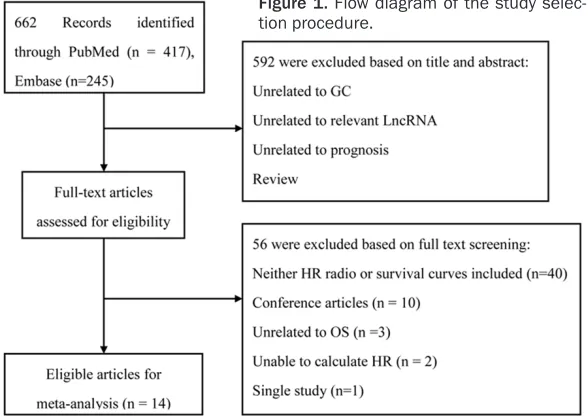
[image:2.612.91.385.74.284.2]This study pooled HRs (95% CI) using Stata 12.1 software (StatCorp, College Station, TX, USA). Heterogeneity was assessed using the Cochran Q test and Higgins I2 test. P-values less than 0.1 and I2 values > 50% indicated sig -nificant heterogeneity among studies. A fixed effects model was applied in the absence of inter-study heterogeneity (P > 0.1), while a ran-dom effects model was used when heterogene-ity was observed (P < 0.1). HR > 1 implies a worse survival for the group with elevated Figure 1. Flow diagram of the study
selec-tion procedure. Eligibility criteria
Studies were considered eligible if they met following inclusion criteria: a) Focus- ed on patients treated for GC; b) Measured lncRNA expression in human cancer tissues; and c) Analyzed the correlation between surviv-al outcomes and lncRNA expression. Studies were excluded if they were: a) Review articles, case repo- rts, or letters; b) Lacked suf -ficient data for calculation of HRs and 95% Cis; and c) Not in English.
lncRNA expression, while HR < 1 implies a worse survival for the group with decreased lncRNA expression. Funnel plots with Egger’s bias test were used to assess publication bias.
Results
Characteristics of included studies
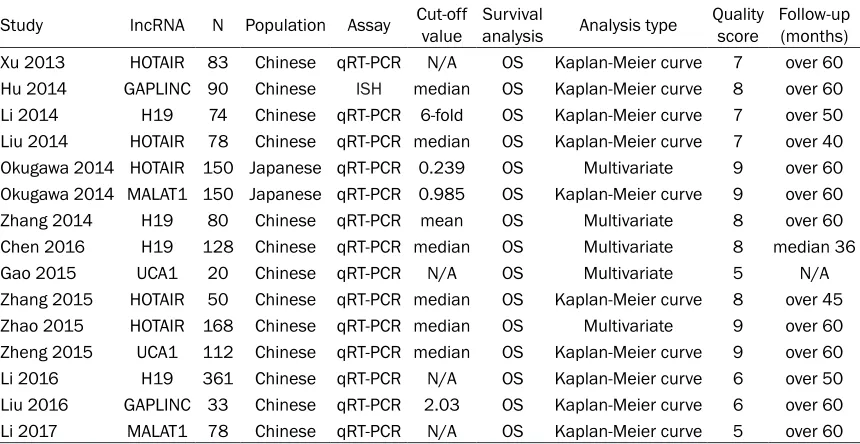
As shown in Figure 1, the initial search returned 662 publications. After assessing the titles and abstracts, 592 articles were excluded. An addi-tional 56 articles were excluded after reviewing the full text. Finally, 14 articles [19, 21, 27-38] with 1,505 GC patients and 5 different lncRNAs were evaluated. Detailed information and data are summarized (Table 1).
HOTAIR and GC prognosis
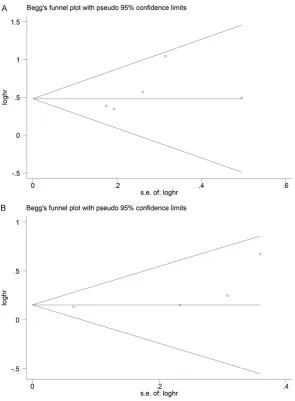
Five studies (n = 529) associated high tumoral expression of HOTAIR (HOX transcript antisense intergenic RNA) with poor OS in GC. Zhao et al. [27] only reported advanced gastric adenocar-cinoma (III-IV stage). Okugawa et al. [30] and Zhao et al. [27] used multivariate analyses. The pooled HR of the five studies was 1.55 (95% CI: 1.21-1.88) (Figure 2). No significant inter-study heterogeneity was observed (P = 0.576, I2 = 0%). There was no evidence of publication bias (Egger’s test, P = 0.302) (Figure 5A).
H19 and GC prognosis
Four studies (n = 643) reported that upregula-tion of H19 (the imprinted oncofetal long non-coding RNA) was associated with OS in GC. All patients included in these studies had resect-able tumors. Zhang et al. [19] and Li et al. [33] enrolled patients without perioperative therapy. A fixed-effects model revealed that elevated H19 expression was predictive of poorer OS (combined HR: 1.15; 95% CI: 1.01-1.29) (Figure 3). There was no significant publication bias (Egger’s test, P = 0.256) (Figure 5B).
UCA1 and GC prognosis
Two studies (n = 132) evaluated the impact of UCA1 (urothelial carcinoma associated 1) on prognosis of GC patients. None of the patients received preoperative chemotherapy prior to surgical resection. Gao et al. [35] performed multivariate analyses. Elevated UCA1 expres-sion was associated with shorter OS in GC, with the combined HR of 2.13 (95% CI 1.17-3.09). No significant heterogeneity was observed (I2 = 0, P = 0.749) (Figure 4).
GAPLINC and GC prognosis
[image:3.612.92.522.85.307.2]Two studies (n = 123) evaluated the effects of GAPLINC (gastric adenocarcinoma predictive Table 1. Main characteristics of enrolled studies
Study lncRNA N Population Assay Cut-off value Survival analysis Analysis type Quality score Follow-up (months)
Xu 2013 HOTAIR 83 Chinese qRT-PCR N/A OS Kaplan-Meier curve 7 over 60
Hu 2014 GAPLINC 90 Chinese ISH median OS Kaplan-Meier curve 8 over 60
Li 2014 H19 74 Chinese qRT-PCR 6-fold OS Kaplan-Meier curve 7 over 50
Liu 2014 HOTAIR 78 Chinese qRT-PCR median OS Kaplan-Meier curve 7 over 40
Okugawa 2014 HOTAIR 150 Japanese qRT-PCR 0.239 OS Multivariate 9 over 60
Okugawa 2014 MALAT1 150 Japanese qRT-PCR 0.985 OS Kaplan-Meier curve 9 over 60
Zhang 2014 H19 80 Chinese qRT-PCR mean OS Multivariate 8 over 60
Chen 2016 H19 128 Chinese qRT-PCR median OS Multivariate 8 median 36
Gao 2015 UCA1 20 Chinese qRT-PCR N/A OS Multivariate 5 N/A
Zhang 2015 HOTAIR 50 Chinese qRT-PCR median OS Kaplan-Meier curve 8 over 45
Zhao 2015 HOTAIR 168 Chinese qRT-PCR median OS Multivariate 9 over 60
Zheng 2015 UCA1 112 Chinese qRT-PCR median OS Kaplan-Meier curve 9 over 60
Li 2016 H19 361 Chinese qRT-PCR N/A OS Kaplan-Meier curve 6 over 50
Liu 2016 GAPLINC 33 Chinese qRT-PCR 2.03 OS Kaplan-Meier curve 6 over 60
Li 2017 MALAT1 78 Chinese qRT-PCR N/A OS Kaplan-Meier curve 5 over 60
Figure 2. Forest plot of HRs for the association between high tissue HOTAIR level and overall-survival.
Figure 3. Forest plot of HRs for the association between high tissue H19 level and overall-survival.
long intergenic non-coding RNA) on prognosis of GC patients. Hu et al. [37] enrolled patients without preoperative chemotherapy or radiotherapy and evalu-ated expression levels of GAPLINC by in situ hybrid-ization. A fixed effects mo-del indicated that expres-sion levels of GAPLINC were not predictive of OS, with the combined HR of 1.36 (95% CI: 0.08-2.64, I2 = 0, P = 0.940) (Figure 4).
MALAT1 and GC prognosis
Two articles (n = 228) as- sessed the association be- tween MALAT1 (metastasis-associated lung adenocarci-noma transcript 1) expres-sion and prognosis in GC, with results differing signifi -cantly. Okugawa et al. [30] calculated a univariate HR. A fixed-effects model show-ed that high MALAT1 was not predictive of poor OS (HR: 1.48; 95% CI: 0.56-2.40) (Figure 4).
Correlation between H19 expression and clinical characteristics
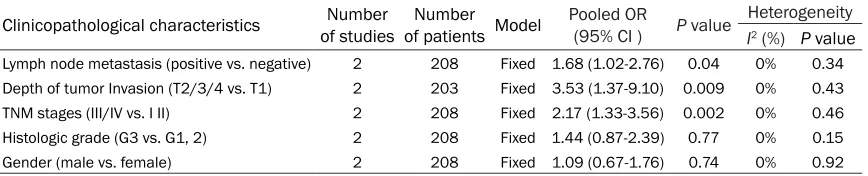
As shown in Table 2, meta-analyses results indicated that overexpressed H19 was correlated with positive lymph node metastasis (OR = 1.68, 95% CI: 1.02-2.76, P
= 0.04), deeper tumor inva-sion (OR = 3.53, 95% CI: 1.37-9.10, P = 0.009), and advanced TNM stages (OR = 2.17, 95% CI: 1.33-3.56, P = 0.002). No significant corre -lation was observed betw- een H19 expression and gender or histologic grade (P > 0.05).
In conclusion, specific hypo-xia-responsive lncRNAs may Figure 4. Forest plot of HRs for the association of high tissue GAPLINC, MALAT1,
[image:4.612.91.383.472.698.2]functional HRLs in tumori -genesis may reveal novel therapeutic and prognostic markers. With this objec-tive, addressing inconsis-tencies in current studies, this study conducted a sys-tematic review and meta-analysis of studies on the association of HRLs and GC. To the best of our knowl-edge, this is the first com -prehensive report focusing on this association, in which 14 studies involving 1,505 subjects were analyzed. A total of 5 HRLs (HOTAIR, H19, UCA1, GAPLINC, and MALAT1), potentially invo-lved in GC survival, were compared.
[image:5.612.91.386.70.471.2]Two previous meta-analy-ses studied the diagnostic potential of lncRNAs in GC [39, 40]. Another two stud-ied the association of SP- RY4-IT1 [41] and HOTAIR [42] with overall survival, but none have focused on the HRLs with prognostic relevance. The current me- ta-analysis discovered that overexpression of HOTAIR [21, 27-30], H19 [19, 31-33] and UCA1 [34, 35] was associated with poor sur-vival in GC patients, while Figure 5. Funnel plots of publication bias on the correlation between HOTAIR
expression and OS in GC (A). Funnel plots of publication bias on the correlation between H19 expression and OS in GC (B).
serve as novel molecular prognostic markers in GC and predict clinicopathological characteris-tics. Further studies are necessary to confirm these results.
Discussion
Over past decades, next generation sequenc-ing has made the diagnosis and prognosis of GC more accurate, based on the genome and transcriptome of individual tumors. Evidence from studies integrating lncRNA and gene expression profiles shows that transcriptional regulation is widely mediated by lncRNAs. In view of the indispensable role of the hypoxic tumor microenvironment in GC, analysis of
GAPLINC [36, 37] and MALAT1 [30, 38] did not affect prognosis. Although more than 10 lncRNAs have been reported to be associated with hypoxia or HIFs, information regarding association with GC survival has been either lacking or only identified by a single study (NEAT1). Only the five abovementioned HRLs were confirmed by more than one study.
fac-tor for various cancer types [22, 44, 45], which is consistent with present conclusions. Zhou et al. demonstrated an HIF-1α binding site in the promoter region that upregulated expression of HOTAIR in non-small cell lung cancer (NSCLC) [46]. It was the first report on the expression of HOTAIR in the tumor hypoxic microenvironment. One classical HIF-HOTAIR interaction mecha-nism is that HIF-1α can bind to hypoxia respon-se elements (HREs) prerespon-sent in the HOTAIR pro-moter under hypoxia. Bhan A et al. verified this hypothesis by showing an enrichment of his-tone methylase-transferase MLL1 and hishis-tone acetylase p300, along with a concomitant increase in methylation in, the HOTAIR promot-er, under hypoxia. In other words, they correlat-ed HIF1α with HOTAIR upregulation [47]. HOTAIR can also function as a competing endogenous RNA to regulate HER2, which has been closely associated with overall survival (OS) of GC [48] and may also be a potential target of HIF-1α [49, 50]expression in GC.
H19 was the first reported HRL [51]. It is the transcription product of imprinted oncofetal gene H19 [52] that is highly expressed in the embryonic stage and reappears in adult tissues only during tumorigenesis [53]. H19 overex-pression has been correlated with various as- pects of the malignant phenotype, such as angiogenesis, cell survival, and proliferation [52, 54]. H19 can also induce epithelial-to-mesenchymal transition (EMT) to promote me- tastasis in ovarian cancer [54] and GC [55]. In addition, recent evidence supports H19 as an oncogenic factor that is tightly correlated with aberrantp53 expression in bladder cancer [56] and GC [57]. Hypoxia induces H19 expression in p53 deficient cell lines via HIF-1α [58]. H19 has also been implicated in maintaining stem-like properties of tumor cells [51] and inducing P-glycoprotein expression under hypoxia [59]. In a recent study, H19 upregulated PDK1
expression and maintained glycolysis under hypoxia in a mouse xenograft tumor [17]. H19 acted as a competitive endogenous RNA (ceRNA) which, along with miRNA let-7, released HIF-1α leading to PDK1 overexpression. Finally, a role of H19 in apoptosis, precisely in the FADD/Caspase8/Caspase3 pathway, has been reported in GC [55].
UCA1 overexpression has been reported in bladder cancer cells. HIF-1α binding UCA1 pro -moter HREs were confirmed by electrophoretic mobility shift assay and chromatin immunopre-cipitation. Upregulated UCA1 inhibited apopto-sis and increased cell proliferation, migration, and invasion [60]. Bladder cancer cells secrete exosomes to remodel the hypoxic microenviron-ment. UCA1-enriched exosomes have been identified by transmission electron microscopy and nanoparticle tracking analysis. These hypoxia-induced exosomal UCA1 could pro-mote tumor growth and metastasis through EMT. UCA1-enriched exosomes are also abun-dantly expressed in the serum of bladder can-cer patients [18]. UCA1 is a potential diagnostic biomarker of triple-negative breast cancer (TNBC) since its expression is increased in patient plasma [61]. Overexpression of UCA1 contributes to tumor metastasis by degrading GRK2 [62] and promoting GC progression via AKT pathways [63, 64].
GAPLINC, a gastric cancer oncogenic factor, has been associated with copy number varia-tions (CNV) and oncogenic transcription fac-tors. It acts as a molecular decoy to target bind miR211-3p and then regulates expression of CD44 [36, 37]. Furthermore, Lei Liu et al. dem -onstrated via luciferase reporter and chromatin immunoprecipitation assays that HIF-1α also binds to the promoter region of GAPLINC and activates its transcription [36]. Although stud-ies have focused on the carcinogenic
mecha-Table 2. Meta-analyses of H19 expression stratified by clinicopathologic characteristics
Clinicopathological characteristics of studiesNumber of patients ModelNumber Pooled OR (95% CI ) P value Heterogeneity I2 (%) P value
Lymph node metastasis (positive vs. negative) 2 208 Fixed 1.68 (1.02-2.76) 0.04 0% 0.34 Depth of tumor Invasion (T2/3/4 vs. T1) 2 203 Fixed 3.53 (1.37-9.10) 0.009 0% 0.43
TNM stages (III/IV vs. I II) 2 208 Fixed 2.17 (1.33-3.56) 0.002 0% 0.46
Histologic grade (G3 vs. G1, 2) 2 208 Fixed 1.44 (0.87-2.39) 0.77 0% 0.15
Gender (male vs. female) 2 208 Fixed 1.09 (0.67-1.76) 0.74 0% 0.92
nisms of GAPLINC in GC [37, 65-67], its prog -nostic value remains ambiguous.
Michalik KM et al. [68] reported high MALAT1 expression under hypoxia, associating it with migratory endothelial cell phenotypes. Silencing or pharmacological inhibition of MALAT1 has reduced vascular growth in xenograft models. Subsequent studies have indicated a positive correlation between MALAT1 overexpression and HIF-2α in hepatocellular carcinoma (HCC) tissues and cells [69, 70]. MALAT1 disassoci -ated VHL and HIF binding and inhibited HIFs ubiquitination. The MALAT1/HIFs positive feed -back loop promoted tumor growth in vivo and increased the Warburg effect [70, 71]. Further- more, Tee AE et al. demonstrated that MALAT1 was also upregulated in human neuroblastoma cell lines under hypoxia, while silencing it inhib-ited endothelial cell migration and vasculature formation [72]. However, the precise molecular mechanisms of MALAT1, whether 1α or HIF-2α is the key regulated factor, under hypoxia remain unclear. Yuan P et al. [71] and Lelli A et al. [73] preferred the latter while Zhang ZC et al. [74] envisaged a MALAT1/mTOR/HIF-1α loop that induces angiogenesis in osteosarcoma (OS). Taken together, these contradictory data should be clarified in further studies.
Some limitations must be considered when interpreting results of the current study. First, the median value was used as a cut-off in six of the studies included. Only one study used means as a cut-off value while another used ROC curves. This diversity may have generated methodological heterogeneity. Second, the sample sizes of some articles were relatively small and 3 of the 5 meta-analyses contained only two records, which might have caused errors in the results. Therefore, large prospec-tive studies are necessary to increase analysis power. Third, the method of tissue preservation differed across studies (paraffin fixed or freshly frozen tumors), which may have led to differ -ences in the concentrations of lncRNAs mea-sured. Moreover, the normalization in qRT-PCR was also inconsistent. Though most studies used GAPDH as the internal control, some stud-ies chose β-Actin or TBP. Fourth, due to absence of data in some relevant articles, subgroup analysis based on related therapy and clinical characteristics could not be performed, which may have resulted in partial heterogeneity. Fifth, ten of the studies included in the
meta-analyses lacked HR ratios or other available numerical data. Therefore, this study extracted relevant data using Kaplan-Meier analysis, which might be less accurate compared to pri-mary data directly obtained from articles. Sixth, all studies included were derived from Asian studies. Since articles with positive results are more likely to be published, potential publica-tion bias might exist. It should be noted that some studies developed combined expression signatures of multiple lncRNAs, which provides a robust validation strategy. Hence, developing a new molecular signature by using diverse lncRNAs, investigating their efficacy, may be useful.
In conclusion, despite the limitations men-tioned above, the present meta-analysis reveals that HRLs, especially HOTAIR, H19, and UCA1, could be promising and convenient prog-nostic biomarkers in GC. However, due to limit-ed information available on HRLs, more high quality studies are required to coordinate pos-sible discrepancies, elucidating the value of these novel biomarkers.
Acknowledgements
Supported by Liaoning S&T Project: (201502-0269).
Disclosure of conflict of interest
None.
Address correspondence to: Dr. Yan Zhao, De- partment of Gastric Cancer, Liaoning Cancer Hospital and Institute (Cancer Hospital of China Medical University), No. 44 Xiaoheyan Road, Dadong District, Shenyang 110042, Liaoning Province, China. E-mail: [email protected]
References
[1] Siegel RL, Miller KD and Jemal A. Cancer sta -tistics, 2017. CA Cancer J Clin 2017; 67: 7-30. [2] Chen W, Zheng R, Baade PD, Zhang S, Zeng H,
Bray F, Jemal A, Yu XQ and He J. Cancer statis-tics in China, 2015. CA Cancer J Clin 2016; 66: 115-132.
placebo-controlled phase II trial. J Clin Oncol 2016; 34: 2728-2735.
[4] Loo JM, Scherl A, Nguyen A, Man FY, Weinberg E, Zeng Z, Saltz L, Paty PB and Tavazoie SF. Ex -tracellular metabolic energetics can promote cancer progression. Cell 2015; 160: 393-406. [5] Rankin EB and Giaccia AJ. Hypoxic control of
metastasis. Science 2016; 352: 175-180. [6] Wang GL, Jiang BH, Rue EA and Semenza GL.
Hypoxia-inducible factor 1 is a basic-helix-loop-helix-PAS heterodimer regulated by cellular O2 tension. Proc Natl Acad Sci U S A 1995; 92: 5510-5514.
[7] Maxwell PH, Pugh CW and Ratcliffe PJ. Activa-tion of the HIF pathway in cancer. Curr Opin Genet Dev 2001; 11: 293-299.
[8] Tohme S, Yazdani HO, Liu Y, Loughran P, van der Windt DJ, Huang H, Simmons RL, Shiva S, Tai S and Tsung A. Hypoxia mediates mitochon-drial biogenesis in hepatocellular carcinoma to promote tumor growth through HMGB1 and TLR9 interaction. Hepatology 2017; 66: 182-197.
[9] Laugier F, Delyon J, Andre J, Bensussan A and Dumaz N. Hypoxia and MITF regulate KIT onco -genic properties in melanocytes. Oncogene 2016; 35: 5070-5077.
[10] Zhai W, Sun Y, Jiang M, Wang M, Gasiewicz TA, Zheng J and Chang C. Differential regulation of LncRNA-SARCC suppresses VHL-mutant RCC cell proliferation yet promotes VHL-normal RCC cell proliferation via modulating androgen re-ceptor/HIF-2alpha/C-MYC axis under hypoxia. Oncogene 2016; 35: 4866-4880.
[11] Yang F, Zhang H, Mei Y and Wu M. Reciprocal regulation of HIF-1alpha and lincRNA-p21 modulates the Warburg effect. Mol Cell 2014; 53: 88-100.
[12] Kapranov P, Cheng J, Dike S, Nix DA, Duttagup-ta R, Willingham AT, SDuttagup-tadler PF, Hertel J, Hack-ermuller J, Hofacker IL, Bell I, Cheung E, Dren -kow J, Dumais E, Patel S, Helt G, Ganesh M, Ghosh S, Piccolboni A, Sementchenko V, Tam-mana H and Gingeras TR. RNA maps reveal new RNA classes and a possible function for pervasive transcription. Science 2007; 316: 1484-1488.
[13] Nelson BR, Makarewich CA, Anderson DM, Winders BR, Troupes CD, Wu F, Reese AL, McA -nally JR, Chen X, Kavalali ET, Cannon SC, Hous-er SR, Bassel-Duby R and Olson EN. A peptide encoded by a transcript annotated as long noncoding RNA enhances SERCA activity in muscle. Science 2016; 351: 271-275.
[14] Ponting CP, Oliver PL and Reik W. Evolution and functions of long noncoding RNAs. Cell 2009; 136: 629-641.
[15] Wu X, Tudoran OM, Calin GA and Ivan M. The many faces of long noncoding RNAs in cancer. Antioxid Redox Signal 2018; 29: 922-935.
[16] Li H, Wang X, Wen C, Huo Z, Wang W, Zhan Q, Cheng D, Chen H, Deng X, Peng C and Shen B. Long noncoding RNA NORAD, a novel compet -ing endogenous RNA, enhances the hypoxia-induced epithelial-mesenchymal transition to promote metastasis in pancreatic cancer. Mol Cancer 2017; 16: 169.
[17] Peng F, Wang JH, Fan WJ, Meng YT, Li MM, Li TT, Cui B, Wang HF, Zhao Y, An F, Guo T, Liu XF, Zhang L, Lv L, Lv DK, Xu LZ, Xie JJ, Lin WX, Lam EW, Xu J and Liu Q. Glycolysis gatekeeper PDK1 reprograms breast cancer stem cells un-der hypoxia. Oncogene 2018; 37: 1062-1074. [18] Xue M, Chen W, Xiang A, Wang R, Chen H, Pan
J, Pang H, An H, Wang X, Hou H and Li X. Hypoxic exosomes facilitate bladder tumor growth and development through transferring long non-coding RNA-UCA1. Mol Cancer 2017; 16: 143.
[19] Zhang EB, Han L, Yin DD, Kong R, De W and Chen J. c-Myc-induced, long, noncoding H19 affects cell proliferation and predicts a poor prognosis in patients with gastric cancer. Med Oncol 2014; 31: 914.
[20] Feng X and Huang S. Effect and mechanism of lncRNA HOTAIR on occurrence and develop-ment of gastric cancer. J Cell Biochem 2017; [Epub ahead of print].
[21] Liu XH, Sun M, Nie FQ, Ge YB, Zhang EB, Yin DD, Kong R, Xia R, Lu KH, Li JH, De W, Wang KM, Wang ZX. Lnc RNA HOTAIR functions as a competing endogenous RNA to regulate HER2 expression by sponging miR-331-3p in gastric cancer. Mol Cancer 2014; 13: 92-92.
[22] Wang S and Wang Z. Prognostic value of long noncoding RNA HOTAIR in digestive system malignancies. J Gastroenterol Hepatol 2015; 30: 1123-1133.
[23] Wang Y, Huang Y, Xiang P and Tian W. LncRNA expression and implication in osteosarcoma: a systematic review and meta-analysis. Onco Targets Ther 2017; 10: 5355-5361.
[24] Tian X and Xu G. Clinical value of lncRNA MALAT1 as a prognostic marker in human can -cer: systematic review and meta-analysis. BMJ Open 2015; 5: e008653.
[25] Parmar MK, Torri V and Stewart L. Extracting summary statistics to perform meta-analyses of the published literature for survival end-points. Stat Med 1998; 17: 2815-2834. [26] Tierney JF, Stewart LA, Ghersi D, Burdett S and
Sydes MR. Practical methods for incorporating summary time-to-event data into meta-analy-sis. Trials 2007; 8: 16.
[28] Xu ZY, Yu QM, Du YA, Yang LT, Dong RZ, Huang L, Yu PF and Cheng XD. Knockdown of long non-coding RNA HOTAIR suppresses tumor in-vasion and reverses epithelial-mesenchymal transition in gastric cancer. Int J Biol Sci 2013; 9: 587-597.
[29] Zhang ZZ, Shen ZY, Shen YY, Zhao EH, Wang M, Wang CJ, Cao H and Xu J. HOTAIR long noncod-ing RNA promotes gastric cancer metastasis through suppression of poly r(C)-binding pro-tein (PCBP) 1. Mol Cancer Ther 2015; 14: 1162-1170.
[30] Okugawa Y, Toiyama Y, Hur K, Toden S, Saigusa S, Tanaka K, Inoue Y, Mohri Y, Kusunoki M, Bo-land CR and Goel A. Metastasis-associated long non-coding RNA drives gastric cancer de-velopment and promotes peritoneal metasta-sis. Carcinogenesis 2014; 35: 2731-2739. [31] Li H, Yu B, Li J, Su L, Yan M, Zhu Z and Liu B.
Overexpression of lncRNA H19 enhances car-cinogenesis and metastasis of gastric cancer. Oncotarget 2014; 5: 2318-2329.
[32] Chen JS, Wang YF, Zhang XQ, Lv JM, Li Y, Liu XX and Xu TP. H19 serves as a diagnostic bio-marker and up-regulation of H19 expression contributes to poor prognosis in patients with gastric cancer. Neoplasma 2016; 63: 223-230.
[33] Li CY, Liang GY, Yao WZ, Sui J, Shen X, Zhang YQ, Peng H, Hong WW, Ye YC, Zhang ZY, Zhang WH, Yin LH and Pu YP. Integrated analysis of long non-coding RNA competing interactions reveals the potential role in progression of hu-man gastric cancer. Int J Oncol 2016; 48: 1965-1976.
[34] Zheng Q, Wu F, Dai WY, Zheng DC, Zheng C, Ye H, Zhou B, Chen JJ and Chen P. Aberrant ex-pression of UCA1 in gastric cancer and its clin-ical significance. Clin Transl Oncol 2015; 17: 640-646.
[35] Gao J, Cao R and Mu H. Long non-coding RNA UCA1 may be a novel diagnostic and predictive biomarker in plasma for early gastric cancer. Int J Clin Exp Pathol 2015; 8: 12936-12942. [36] Liu L, Zhao X, Zou H, Bai R, Yang K and Tian Z.
Hypoxia promotes gastric cancer malignancy partly through the HIF-1α dependent transcrip -tional activation of the long non-coding RNA GAPLINC. Front Physiol 2016; 7: 420.
[37] Hu Y, Wang J, Qian J, Kong X, Tang J, Wang Y, Chen H, Hong J, Zou W, Chen Y, Xu J and Fang JY. Long noncoding RNA GAPLINC regulates CD44-dependent cell invasiveness and associ-ates with poor prognosis of gastric cancer. Cancer Res 2014; 74: 6890-6902.
[38] Li J, Gao J, Tian W, Li Y and Zhang J. Long non-coding RNA MALAT1 drives gastric cancer pro -gression by regulating HMGB2 modulating the miR-1297. Cancer Cell Int 2017; 17: 44.
[39] Cui Z, Chen Y, Xiao Z, Hu M, Lin Y, Chen Y and Zheng Y. Long noncoding RNAs as auxiliary bio -markers for gastric cancer screening: a pooled analysis of individual studies. Oncotarget 2016; 7: 25791-25800.
[40] Hu QY, Zhao ZY, Li SQ, Li L and Li GK. A meta-analysis: The diagnostic values of long non-coding RNA as a biomarker for gastric cancer. Mol Clin Oncol 2017; 6: 846-852.
[41] Wang M, Dong X, Feng Y, Sun H, Shan N and Lu T. Prognostic role of the long non-coding RNA, SPRY4 Intronic Transcript 1, in patients with cancer: a meta-analysis. Oncotarget 2017; 8: 33713-33724.
[42] Da M, Ma J, Zhang Y, Yang J, Yao J, Huang B, Ma H and Ge L. High expression level of long non-coding RNA HOTAIR is associated with poor overall survival in gastric cancer patients: evidence from meta-analysis. J BUON 2017; 22: 911-918.
[43] Gupta RA, Shah N, Wang KC, Kim J, Horlings HM, Wong DJ, Tsai MC, Hung T, Argani P, Rinn JL, Wang Y, Brzoska P, Kong B, Li R, West RB, van de Vijver MJ, Sukumar S and Chang HY. Long non-coding RNA HOTAIR reprograms chromatin state to promote cancer metastasis. Nature 2010; 464: 1071-1076.
[44] Zhao W, An Y, Liang Y and Xie XW. Role of HO -TAIR long noncoding RNA in metastatic pro-gression of lung cancer. Eur Rev Med Pharma-col Sci 2014; 18: 1930-1936.
[45] Zhang S, Chen S, Yang G, Gu F, Li M, Zhong B, Hu J, Hoffman A and Chen M. Long noncoding RNA HOTAIR as an independent prognostic marker in cancer: a meta-analysis. PLoS One 2014; 9: e105538.
[46] Zhou C, Ye L, Jiang C, Bai J, Chi Y and Zhang H. Long noncoding RNA HOTAIR, a hypoxia-induc -ible factor-1alpha activated driver of malignan-cy, enhances hypoxic cancer cell proliferation, migration, and invasion in non-small cell lung cancer. Tumour Biol 2015; 36: 9179-9188. [47] Bhan A, Deb P, Shihabeddin N, Ansari KI,
Brot-to M and Mandal SS. HisBrot-tone methylase MLL1 coordinates with HIF and regulate lncRNA HO-TAIR expression under hypoxia. Gene 2017; 629: 16-28.
[48] Sheng WQ, Huang D, Ying JM, Lu N, Wu HM, Liu YH, Liu JP, Bu H, Zhou XY and Du X. HER2 sta -tus in gastric cancers: a retrospective analysis from four Chinese representative clinical cen-ters and assessment of its prognostic signifi -cance. Ann Oncol 2013; 24: 2360-2364. [49] Badowska-Kozakiewicz A, Sobol M and Patera
[50] Aghazadeh S and Yazdanparast R. Activation of STAT3/HIF-1alpha/Hes-1 axis promotes trastuzumab resistance in HER2-overexpress -ing breast cancer cells via down-regulation of PTEN. Biochim Biophys Acta 2017; 1861: 1970-1980.
[51] Wong TY, Solis MA, Chen YH and Huang LL. Molecular mechanism of extrinsic factors af-fecting anti-aging of stem cells. World J Stem Cells 2015; 7: 512-520.
[52] Matouk I, Raveh E, Ohana P, Lail RA, Gershtain E, Gilon M, De Groot N, Czerniak A and Hoch -berg A. The increasing complexity of the on-cofetal h19 gene locus: functional dissection and therapeutic intervention. Int J Mol Sci 2013; 14: 4298-4316.
[53] Raveh E, Matouk IJ, Gilon M and Hochberg A. The H19 Long non-coding RNA in cancer initia -tion, progression and metastasis - a proposed unifying theory. Mol Cancer 2015; 14: 184. [54] Matouk IJ, Raveh E, Abu-lail R, Mezan S, Gilon
M, Gershtain E, Birman T, Gallula J, Schneider T, Barkali M, Richler C, Fellig Y, Sorin V, Hubert A, Hochberg A and Czerniak A. Oncofetal H19 RNA promotes tumor metastasis. Biochim Bio-phys Acta 2014; 1843: 1414-1426.
[55] Ishii S, Yamashita K, Harada H, Ushiku H, Tana-ka T, Nishizawa N, Yokoi K, Washio M, Ema A, Mieno H, Moriya H, Hosoda K, Waraya M, Ka-toh H and Watanabe M. The H19-PEG10/ IGF2BP3 axis promotes gastric cancer progres-sion in patients with high lymph node ratios. Oncotarget 2017; 8: 74567-74581.
[56] Liu C, Chen Z, Fang J, Xu A, Zhang W and Wang Z. H19-derived miR-675 contributes to bladder cancer cell proliferation by regulating p53 acti-vation. Tumour Biol 2016; 37: 263-270. [57] Yang F, Bi J, Xue X, Zheng L, Zhi K, Hua J and
Fang G. Up-regulated long non-coding RNA H19 contributes to proliferation of gastric can-cer cells. FEBS J 2012; 279: 3159-3165. [58] Matouk IJ, Mezan S, Mizrahi A, Ohana P,
Abu-Lail R, Fellig Y, Degroot N, Galun E and Hoch -berg A. The oncofetal H19 RNA connection: hypoxia, p53 and cancer. Biochim Biophys Acta 2010; 1803: 443-451.
[59] Li W, Li J, Wang R, Xie H and Jia Z. MDR1 will play a key role in pharmacokinetic changes un-der hypoxia at high altitude and its potential regulatory networks. Drug Metab Rev 2015; 47: 191-198.
[60] Xue M, Li X, Li Z and Chen W. Urothelial carci -noma associated 1 is a hypoxia-inducible fac-tor-1alpha-targeted long noncoding RNA that enhances hypoxic bladder cancer cell prolifer-ation, migrprolifer-ation, and invasion. Tumour Biol 2014; 35: 6901-6912.
[61] Liu M, Xing LQ and Liu YJ. A three-long noncod -ing RNA signature as a diagnostic biomarker for differentiating between triple-negative and
non-triple-negative breast cancers. Medicine (Baltimore) 2017; 96: e6222.
[62] Wang ZQ, He CY, Hu L, Shi HP, Li JF, Gu QL, Su LP, Liu BY, Li C and Zhu Z. Long noncoding RNA UCA1 promotes tumour metastasis by induc-ing GRK2 degradation in gastric cancer. Can-cer Lett 2017; 408: 10-21.
[63] Li C, Liang G, Yang S, Sui J, Yao W, Shen X, Zhang Y, Peng H, Hong W, Xu S, Wu W, Ye Y, Zhang Z, Zhang W, Yin L and Pu Y. Dysregulat -ed lncRNA-UCA1 contributes to the progres-sion of gastric cancer through regulation of the PI3K-Akt-mTOR signaling pathway. Oncotarget 2017; 8: 93476-93491.
[64] Gu L, Lu LS, Zhou DL and Liu ZC. UCA1 pro -motes cell proliferation and invasion of gastric cancer by targeting CREB1 sponging to miR-590-3p. Cancer Med 2018; 7: 1253-1263. [65] Yang P, Chen T, Xu Z, Zhu H, Wang J and He Z.
Long noncoding RNA GAPLINC promotes inva -sion in colorectal cancer by targeting SNAI2 through binding with PSF and NONO. Oncotar-get 2016; 7: 42183-42194.
[66] Correction: long noncoding RNA GAPLINC regu -lates CD44-dependent cell invasiveness and associates with poor prognosis of gastric can-cer. Cancer Res 2015; 75: 3683.
[67] Li T, Mo X, Fu L, Xiao B and Guo J. Molecular mechanisms of long noncoding RNAs on gas-tric cancer. Oncotarget 2016; 7: 8601-8612. [68] Michalik KM, You X, Manavski Y,
Doddaballa-pur A, Zornig M, Braun T, John D, Ponomareva Y, Chen W, Uchida S, Boon RA and Dimmeler S. Long noncoding RNA MALAT1 regulates endo -thelial cell function and vessel growth. Circ Res 2014; 114: 1389-1397.
[69] Yuan P, Cao W, Zang Q, Li G, Guo X and Fan J. The HIF-2alpha-MALAT1-miR-216b axis regu -lates multi-drug resistance of hepatocellular carcinoma cells via modulating autophagy. Biochem Biophys Res Commun 2016; 478: 1067-1073.
[70] Luo F, Sun B, Li H, Xu Y, Liu Y, Liu X, Lu L, Li J, Wang Q, Wei S, Shi L, Lu X, Liu Q and Zhang A. A MALAT1/HIF-2alpha feedback loop contrib -utes to arsenite carcinogenesis. Oncotarget 2016; 7: 5769-5787.
[71] Luo F, Liu X, Ling M, Lu L, Shi L, Lu X, Li J, Zhang A and Liu Q. The lncRNA MALAT1, acting through HIF-1alpha stabilization, enhances ar -senite-induced glycolysis in human hepatic L-02 cells. Biochim Biophys Acta 2016; 1862: 1685-1695.
[73] Lelli A, Nolan KA, Santambrogio S, Goncalves AF, Schonenberger MJ, Guinot A, Frew IJ, Marti HH, Hoogewijs D and Wenger RH. Induction of long noncoding RNA MALAT1 in hypoxic mice. Hypoxia (Auckl) 2015; 3: 45-52.