Unsupervised Learning of the
Morphology of a Natural Language
John Goldsmith*
University of ChicagoThis study reports the results of using minimum description length (MDL) analysis to model
unsupervised learning of the morphological segmentation of European languages, using corpora
ranging in size from 5,000 words to 500,000 words. We develop a set of heuristics that rapidly
develop a probabilistic morphological grammar, and use MDL as our primary tool to determine
whether the modifications proposed by the heuristics will be adopted or not. The resulting grammar
matches well the analysis that would be developed by a human morphologist.
In the final section, we discuss the relationship of this style of MDL grammatical analysis to
the notion of evaluation metric in early generative grammar.
1. Introduction
This is a report on the present results of a study on unsupervised acquisition of morphology. 1 The central task of morphological analysis is the segmentation of words into the components that form the word by the operation of concatenation. While that view is not free of controversy, it remains the traditional conception of morphology, and the one that we shall employ here. 2 Issues of interface with phonol- ogy, traditionally known as morphophonology, and with syntax are not directly addressed. 3 While some of the discussion is relevant to the unrestricted set of languages, some of the assumptions made in the implementation restrict the use- ful application of the algorithms to languages in which the average number of affixes per word is less than what is found in such languages as Finnish, Hungarian, and Swahili, and we restrict our testing in the present report to more widely studied Eu- ropean languages. Our general goal, however, is the treatment of unrestricted natural languages.
* Department of Linguistics, University of Chicago, 1010 E. 59th Street, Chicago, IL 60637. E-mail: [email protected].
1 Some of the work reported here was done while I was a visitor at Microsoft Research in the winter of 1998, and I am grateful for the support I received there. A first version was written in September, 1998, and a much-revised version was completed in December, 1999. This work was also supported in part by a grant from the Argonne National Laboratory-University of Chicago consortium, which I thank for its support. I am also grateful for helpful discussion of this material with a number of people, including Carl de Marcken, Jason Eisner, Zhiyi Chi, Derrick Higgins, Jorma Rissanen, Janos Simon, Svetlana Soglasnova, Hisami Suzuki, and Jessie Pinkham. As noted below, I owe a great deal to the remarkable work reported in de Marcken's dissertation, without which I would not have undertaken the work described here. I am grateful as well to several anonymous reviewers for their considerable improvements to the content of this paper.
2 Sylvain Neuvel has recently produced an interesting computational implementation of a theory of morphology that does not have a place for morphemes, as described at http://www.neuvel.net. It is well established that nonconcatenative morphology is found in some scattered language families, notably Semitic and Penutian. African tone languages require simultaneous morphological analyses of the tonal and the segmental material.
Computational Linguistics Volume 27, Number 2
The program in question takes a text file as its input (typically in the range of 5,000 to 1,000,000 words) and produces a partial morphological analysis of most of the words of the corpus; the goal is to produce an output that matches as closely as possible the analysis that would be given by a h u m a n morphologist. It performs unsupervised learning in the sense that the program's sole input is the corpus; we provide the program with the tools to analyze, but no dictionary and no morphological rules particular to any specific language. At present, the goal of the program is restricted to providing the correct analysis of words into component pieces (morphemes), though with only a rudimentary categorical labeling.
The underlying model that is utilized invokes the principles of the m i n i m u m description length (MDL) framework (Rissanen 1989), which provides a helpful per- spective for understanding the goals of traditional linguistic analysis. MDL focuses on the analysis of a corpus of data that is optimal by virtue of providing both the most compact representation of the data and the most compact means of extracting that compression from the original data. It thus requires both a quantitative account whose parameters match the original corpus reasonably well (in order to provide the basis for a satisfactory compression) and a spare, elegant account of the overall structure.
The novelty of the present account lies in the use of simple statements of mor- phological patterns (called signatures below), which aid both in quantifying the MDL account and in constructively building a satisfactory morphological grammar (for MDL offers no guidance in the task of seeking the optimal analysis). In addition, the system whose development is described here sets reasonably high goals: the reformulation in algorithmic terms of the strategies of analysis used by traditional morphologists.
Developing an unsupervised learner using raw text data as its sole input offers several attractive aspects, both theoretical and practical. At its most theoretical, un- supervised learning constitutes a (partial) linguistic theory, producing a completely explicit relationship between data and analysis of that data. A tradition of consider- able age in linguistic theory sees the ultimate justification of an analysis A of any single language L as residing in the possibility of demonstrating that analysis A derives from a particular linguistic theory LT, and that that LT works properly across a range of languages (not just for language L). There can be no better w a y to make the case that a particular analysis derives from a particular theory than to automate that process, so that all the linguist has to do is to develop the theory-as-computer-algorithm; the application of the theory to a particular language is carried out with no surreptitious help.
From a practical point of view, the development of a fully automated morphology generator would be of considerable interest, since we still need good morphologies of many European languages and to produce a morphology of a given language "by hand" can take weeks or months. With the advent of considerable historical text avail- able on-line (such as the ARTFL database of historical French), it is of great interest to develop morphologies of particular stages of a language, and the process of auto- matic morphology writing can simplify this stage--where there are no native speakers available---considerably.
Goldsmith Unsupervised Learning of the Morphology of a Natural Language
Table 1
Some signatures from Tom Sawyer.
Signature Example Stem Count (type) Token Count
NULL.ed.ing betray betrayed betraying 69 864
NULL.ed.ing.s remain remained remaining remains 14 516
NULL.s. cow cows 253 3,414
e.ed.es.ing notice noticed notices noticing 4 62
The p r o b l e m , then, involves b o t h the d e t e r m i n a t i o n of the correct m o r p h o l o g i c a l split for i n d i v i d u a l words, a n d the establishment of accurate categories of stems based on the r a n g e of suffixes that they accept:
.
.
Splitting words: We w i s h to accurately analyze a n y w o r d into successive m o r p h e m e s in a fashion that c o r r e s p o n d s to the traditional linguistic analysis. Minimally, w e w i s h to identify the stem, as o p p o s e d to a n y inflectional suffixes. Ideally w e w o u l d also like to identify all the
inflectional suffixes on a w o r d w h i c h contains a stem that is followed b y t w o or m o r e inflectional suffixes, a n d w e w o u l d like to identify
derivational prefixes a n d suffixes. We w a n t to be told that in this corpus, the m o s t i m p o r t a n t suffixes are -s, -ing, -ed, a n d so forth, while in the next corpus, the m o s t i m p o r t a n t suffixes are -e, -en, -heit, -ig, a n d so on. Of course, the p r o g r a m is n o t a l a n g u a g e identification p r o g r a m , so it will n o t n a m e the first as "English" a n d the second as " G e r m a n " (that is a far easier task), b u t it will p e r f o r m the task of d e c i d i n g for each w o r d w h a t is stem a n d w h a t is affix.
Range of suffixes: The m o s t salient characteristic of a stem in the l a n g u a g e s that w e will consider here is the range of suffixes with w h i c h it can appear. Adjectives in English, for example, will a p p e a r w i t h s o m e subset of the suffixes -er, -est, -ity, -hess, etc. We w o u l d like to determine
automatically w h a t the range of the m o s t regular suffix g r o u p s is for the l a n g u a g e in question, a n d r a n k suffix g r o u p i n g s b y order of f r e q u e n c y in the corpus. 4
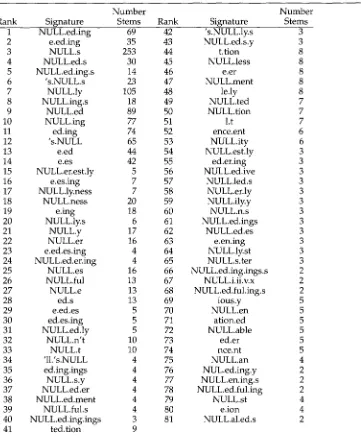
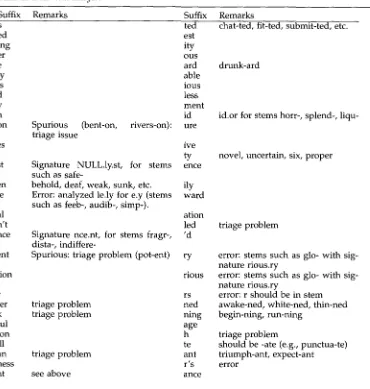
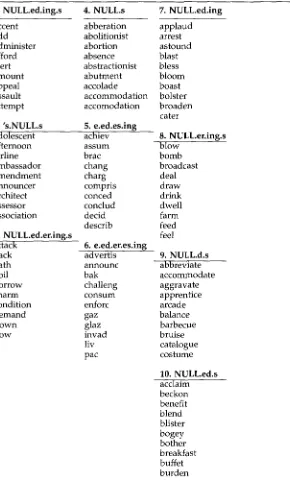
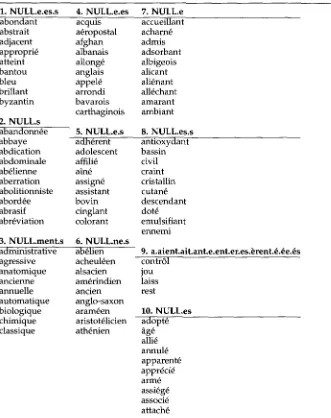
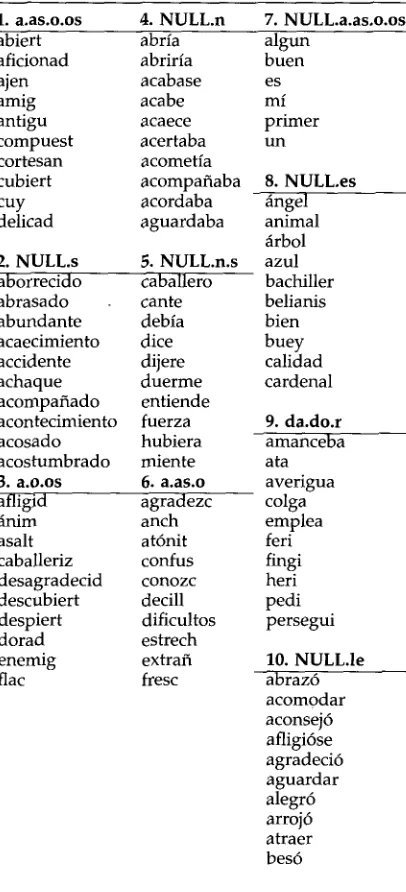
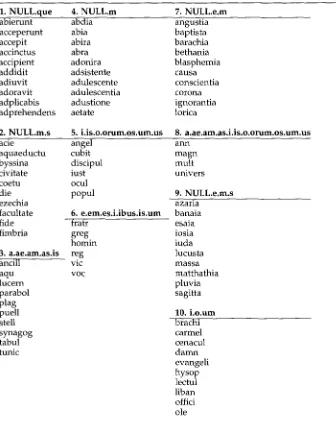
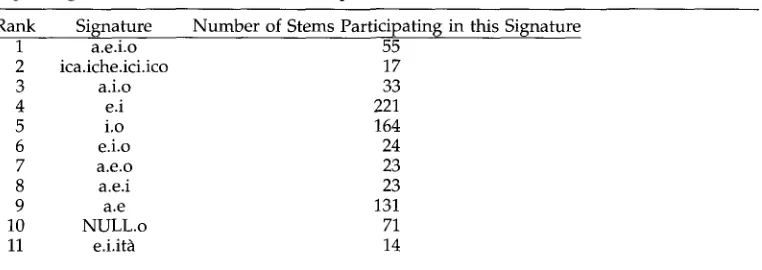
To give a sense of the results of the p r o g r a m , consider one aspect of its analysis of the novel The Adventures of Tom Sawyer--and this result is consistent, b y a n d large, regardless of the corpus one chooses. C o n s i d e r the t o p - r a n k e d signatures, illustrated in Table 1: a signature is an alphabetized list of affixes that a p p e a r with a particular stem in a corpus. (A larger list of these patterns of suffixation in English are given in Table 2, in Section 5.)
The present m o r p h o l o g y learning a l g o r i t h m is c o n t a i n e d in a C++ p r o g r a m called
Linguistica that runs on a d e s k t o p PC a n d takes a text file as its input. 5 A n a l y z i n g a
4 In addition, one would like a statement of general rules of allomorphy as well; for example, a statement that the stems hit and hitt (as in hits and hitting, respectively) are forms of the same linguistic stem. In an earlier version of this paper, we discussed a practical method for achieving this. The work is currently under considerable revision, and we will leave the reporting on this aspect of the problem to a later paper; there is a very brief discussion below.
Computational Linguistics Volume 27, Number 2
corpus of 500,000 words in English requires about five minutes on a Pentium II 333. Perfectly respectable results can be obtained from corpora as small as 5,000 words. The system has been tested on corpora in English, French, German, Spanish, Italian, Dutch, Latin, and Russian; some quantitative results are reported below. The corpora that serve as its input are largely materials that have been obtained over the Internet, and I have endeavored to make no editorial changes to the files that are the input.
In this paper, I will discuss prior work in this area (Section 2), the nature of the MDL model we propose (Section 3), heuristics for the task of the initial splitting of words into stem and affix (Section 4), the resulting signatures (Section 5), use of MDL to search the space of morphologies (Section 6), results (Section 7), the identification of entirely spurious generalizations (section 8), the grouping of signatures into larger units (Section 9), and directions for further improvements (Section 10). Finally, I will offer some speculative observations about the larger perspective that this work sug- gests and work in progress (Section 11).
2. P r e v i o u s R e s e a r c h in t h i s A r e a
The task of automatic word analysis has intrigued workers in a range of disciplines, and the practical and theoretical goals that have driven them have varied consider- ably. Some, like Zellig Harris (and the present writer), view the task as an essential one in defining the nature of the linguistic analysis. But workers in the area of data compression, dictionary construction, and information retrieval have all contributed to the literature on automatic morphological analysis. (As noted earlier, our primary concern here is with morphology and not with regular allomorphy or morphophonol- ogy, which is the study of the changes in the realization of a given morpheme that are dependent on the grammatical context in which it appears, an area occasionally confused for morphology. Several researchers have explored the morphophonologies of natural language in the context of two-level systems in the style of the model de- veloped by Kimmo Koskenniemi [1983], Lauri Karttunen [1993], and others.) The only general review of work in this area that I am aware of is found in Langer (1991), which is ten years old and unpublished.
Work in automatic morphological analysis can be usefully divided into four major approaches. The first approach proposes to identify morpheme b o u n d a r i e s first, and thus indirectly to identify morphemes, on the basis of the degree of predictability of the n + 1st letter given the first n letters (or the mirror-image measure). This was first pro- posed b y Zellig Harris (1955, 1967), and further developed by others, notably b y Hafer and Weiss (1974). The second approach seeks to identify bigrams (and trigrams) that have a high likelihood of being morpheme internal, a view pursued in work discussed below b y Klenk, Langer, and others. The third approach focuses on the discovery of patterns (we might say, of rules) of phonological relationships between pairs of related words. The fourth approach, which includes that used in this paper, is top-down, and seeks an analysis that is globally most concise. In this section, we shall review some of the work that has pursued these approaches--briefly, necessarily. 6 While not all of the approaches discussed here use n o prior language-particular knowledge (which
is the goal of the present system), I exclude from discussions those systems that are based essentially on a prior human-designed analysis of the grammatical morphemes of a language, aiming at identifying the stem(s) and the correct parsing; such is the
Goldsmith Unsupervised Learning of the Morphology of a Natural Language
case, for example, in Pacak a n d Pratt (1976), Koch, K~stner, a n d Riidiger (1989), and Wothke a n d Schrnidt (1992). With the exception of Harris's algorithm, the complex- ity of the algorithms is such as to m a k e i m p l e m e n t a t i o n for p u r p o s e s of c o m p a r i s o n prohibitively time-consuming.
At the heart of the first approach, d u e to Harris, is the desire to place b o u n d a r i e s b e t w e e n letters (respectively, p h o n e m e s ) in a w o r d based on conditional entropy, in the following sense. We construct a device that generates a finite list of words, o u r corpus, letter b y letter and w i t h u n i f o r m probability, in such a w a y that at a n y p o i n t in its generation (having g e n e r a t e d the first n letters 111213 • • • I n ) w e can inquire of it w h a t the e n t r o p y is of the set consisting of the next letter of all the continuations it m i g h t make. (In current parlance, w e w o u l d m o s t naturally think of this as a p a t h from the root of a trie to one of its terminals, inquiring of each n o d e its associated one-letter entropy, based on the continuations f r o m that node.) Let us refer to this as the prefix c o n d i t i o n a l e n t r o p y ; clearly w e m a y be equally interested in constructing a trie f r o m the right edge of words, w h i c h t h e n p r o v i d e s us w i t h a suffix c o n d i t i o n a l e n t r o p y , in mirror-image fashion.
Harris himself e m p l o y e d n o probabilistic notions, a n d the inclusion of e n t r o p y in the f o r m u l a t i o n h a d to await H a f e r and Weiss (1974); b u t allowing ourselves the anachronism, we m a y say that Harris p r o p o s e d that local peaks of prefix (and suffix) conditional e n t r o p y s h o u l d identify m o r p h e m e breaks. The m e t h o d p r o p o s e d in Harris (1955) a p p e a l e d to w h a t t o d a y w e w o u l d call an oracle for i n f o r m a t i o n a b o u t the lan- g u a g e u n d e r scrutiny, b u t in his 1967 article, Harris i m p l e m e n t e d a similar p r o c e d u r e on a c o m p u t e r a n d a fixed corpus, restricting his p r o b l e m to that of finding m o r p h e m e b o u n d a r i e s w i t h i n words. Harris's m e t h o d is quite g o o d as a heuristic for finding a g o o d set of candidate m o r p h e m e s , c o m p a r a b l e in quality to the m u t u a l i n f o r m a t i o n - based heuristic that I h a v e used, a n d w h i c h I describe below. It has the same p r o b l e m that g o o d heuristics f r e q u e n t l y have: it has m a n y inaccuracies, a n d it does not lend itself to a next step, a qualitatively m o r e reliable a p p r o x i m a t i o n of the correct solution. 7
H a f e r a n d Weiss (1974) explore in detail various w a y s of clarifying a n d i m p r o v i n g on Harris's algorithm while r e m a i n i n g faithful to the original intent. A brief s u m m a r y does not d o justice to their fascinating discussion, b u t for o u r p u r p o s e s , their results confirm the character of the Harrisian test as heuristic: w i t h Harris's proposal, a quan- titative m e a s u r e is p r o p o s e d (and H a f e r a n d Weiss d e v e l o p a r a n g e of 15 different measures, all of t h e m r o o t e d in Harris's proposal), a n d best results for m o r p h o l o g i c a l analysis are obtained in some cases b y seeking a local m a x i m u m of prefix conditional entropy, in others b y seeking a v a l u e a b o v e a threshold, a n d in yet others, g o o d results are obtained o n l y w h e n this m e a s u r e is p a i r e d with a similar m e a s u r e constructed in mirror-image fashion from the e n d of the w o r d - - a n d then some arbitrary thresholds are selected w h i c h yield the best results. While no single m e t h o d emerges as t h e best, one of the best yields precision of 0.91 a n d recall of 0.61 on a c o r p u s of a p p r o x i m a t e l y 6,200 w o r d types. (Precision here indicates p r o p o r t i o n of p r e d i c t e d m o r p h e m e breaks that are correct, a n d recall d e n o t e s the p r o p o r t i o n of correct breaks that are predicted.) The second a p p r o a c h that can be f o u n d in the literature is b a s e d o n the h y p o t h e s i s that local i n f o r m a t i o n in the string of letters (respectively, p h o n e m e s ) is sufficient to identify m o r p h e m e boundaries. This h y p o t h e s i s w o u l d be clearly correct if all mor- p h e m e b o u n d a r i e s were b e t w e e n pairs of letters 1 1 - 1 2 that n e v e r occur in that sequence
Computational Linguistics Volume 27, Number 2
morpheme internally, and the hypothesis would be invalidated if conditional proba- bilities of a letter given the previous letter were independent of the presence of an intervening boundary. The question is where real languages distribute themselves along the continuum that stretches between these two extremes.
A series of publications has explored this question, including Janssen (1992), Klenk (1992), and Flenner (1994, 1995). Any brief description that overlooks the differences among these publications is certain to do less than full justice to all of them. The procedure described in Janssen (1992) and Flenner (1994, 1995) begins with a training corpus with morpheme boundaries inserted by a human, and hence the algorithm is not in the domain of unsupervised learning. Each bigram (and the algorithm has been extended in the natural w a y to treating trigrams as well) is associated with a triple (whose sum must be less than or equal to 1.0) indicating the frequency in the training corpus of a morpheme boundary occurring to the left of, between, or to the right of that bigram. In a test word, each space between letters (respectively, phonemes) is assigned a score that is the sum of the relevant values derived from the training session: in the word
string,
for example, the score for the potential cut betweenstr
anding
is the sum of three values: the probability of a morpheme boundary aftertr
(giventr),
the probability of a morpheme boundary between r and i (givenri),
and the probability of a morpheme boundary beforein
(givenin).
That these numbers should give
some
indication of the presence of a morpheme boundary is certain, for they are the sums of numbers that were explicitly assigned on the basis of overtly marked morpheme boundaries. But it remains unclear how one should proceed further with the sum. As Hafer and Weiss discover with Harris's measure, it is unclear whether localpeaks
of this measure should predict morpheme boundaries, or whether a threshold should be set, above which a morpheme boundary is predicted. Flenner (1995, 64-65) and proponents of this approach have felt some freedom on making this choice in an ad hoc fashion. Janssen (1992, 81-82) observes that the French wordlinguistique
displays three peaks, predicting the analysislin-
guist-ique,
employing a trigram model. The reason for the strong, but spurious, peak afterlin
is thatlin
occurs with high frequency word finally, just asgui
appears with high frequency word initially. One could respond to this observation in several ways: word-final frequency should not contribute to word-internal, morpheme-final status; or perhaps frequencies of this sort should not be added. Indeed, it is not clear at all w h y these numbers should be added; they do not, for example, represent probabilities that can be added. Janssen notes that the other two trigrams that enter into the picture(ing
andngu)
had a zero frequency of morpheme break in the desired spot, and proposes that the presence of any zeros in the sum forces thesum
to be 0, raising again the question of what kind of quantity is being modeled; there is no scholarly tradition according to which the presence of zero in a sum should lead to a total of 0.I do not have room to discuss the range of greedy affix-parsing algorithms these authors explore, but that aspect of their work has less bearing on the comparison with the present paper, whose focus is on data-driven learning. The major question to carry away from this approach is this: can the information that is expressed in the division of a set of words into morphemes be compressed into local information (bigrams, trigrams)? The answer, I believe, is in general negative. Morphology operates at a higher level, so to speak, and has only weak statistical links to local sequencing of phonemes or letters, s
Goldsmith Unsupervised Learning of the Morphology of a Natural Language
The third a p p r o a c h focuses on the d i s c o v e r y of patterns explicating the o v e r t shapes of related forms in a p a r a d i g m . Dzeroski a n d Erjavec (1997) r e p o r t on w o r k that they h a v e d o n e o n Slovene, a South Slavic l a n g u a g e w i t h a c o m p l e x m o r p h o l o g y , in the context of a similar project. Their goal essentially was to see if an inductive logic p r o g r a m c o u l d infer the principles of Slovene m o r p h o l o g y to the p o i n t w h e r e it could correctly predict the n o m i n a t i v e singular f o r m of a w o r d if it w e r e given an oblique (nonnominative) form. Their project a p p a r e n t l y shares with the p r e s e n t one the r e q u i r e m e n t that the automatic learning algorithm be responsible for the decision as to w h i c h letters constitute the stem a n d w h i c h are part of the suffix(es), t h o u g h the details offered b y Dzeroski a n d Erjavec are sketchy as to h o w this is accomplished. In a n y event, they present their learning algorithm w i t h a labeled pair of w o r d s - - a base f o r m a n d an inflected form. It is not clear from their description w h e t h e r the base f o r m that they s u p p l y is a surface form from a particular p o i n t in the inflectional p a r a d i g m (the n o m i n a t i v e singular), or a m o r e articulated u n d e r l y i n g representation in a generative linguistic sense; the f o r m e r a p p e a r s to be their policy.
Dzeroski a n d Erjavec's goal is the d e v e l o p m e n t of rules c o u c h e d in traditional linguistic terms; the categories of analysis are d e c i d e d u p o n a h e a d of time b y the p r o g r a m m e r (or, m o r e specifically, b y the tagger of the corpus), a n d each i n d i v i d u a l w o r d is identified with regard to w h a t m o r p h o s y n t a c t i c features it bears. The f o r m
bolecina
is m a r k e d , for example, as a feminine n o u n singular genitive. In sum, their project thus gives the s y s t e m a g o o d deal m o r e i n f o r m a t i o n than the present project does. 9Two recent papers, Jacquemin (1997) a n d Gaussier (1999), d e s e r v e consideration here. 1° Gaussier (1999) a p p r o a c h e s a v e r y similar task to that w h i c h w e consider, a n d takes some similar steps. His goal is to acquire derivational rules f r o m an inflectional lexicon, thus insuring that his algorithm has access to the lexical category of the w o r d s it deals with (unlike the p r e s e n t study, w h i c h is allowed n o such access). Using the t e r m i n o l o g y of the p r e s e n t paper, Gaussier considers candidate suffixes if t h e y a p p e a r w i t h at least t w o stems of length 5. His first task is (in o u r terms) to infer p a r a d i g m s f r o m signatures (see Section 9), w h i c h is to say, to find a p p r o p r i a t e clusters of signa- tures. One e x a m p l e cited is
depart, departure, departer.
H e used a hierarchical agglomera- tive clustering m e t h o d , w h i c h begins with all signatures f o r m i n g distinct clusters, a n d successively collapses the t w o m o s t similar clusters, w h e r e similarity b e t w e e n stems is defined as the n u m b e r of suffixes that t w o stems share, a n d similarity b e t w e e n clusters is defined as the similarity b e t w e e n the t w o least similar stems in the respective clus- ters. H e reports a success rate of 77%, b u t it is not clear h o w to evaluate this figure. 11 The task that Gaussier addresses is d e f i n e d f r o m the start to be that of derivational morphology, a n d because of that, his analysis does not n e e d to address the p r o b l e m of inflectional m o r p h o l o g y , b u t it is there (front a n d center, so to speak) that the difficult clustering p r o b l e m arises, w h i c h is h o w to ensure that the signaturesNULL.s.'s
(for n o u n s in English) a n d the signatureNULL.ed.s
(orNULL.ed.ing.s)
are not assigned to single clusters. 12 That is, in English b o t h n o u n s a n d verbs freely occur with the suffixes9 Baroni (2000) reported success using an MDL-based model in the task of discovering English prefixes. I have not had access to further details of the operation of the system.
10 I am grateful to a referee for drawing my attention to these papers.
11 The analysis of a word w in cluster C counts as a success if most of the words that in fact are related to w also appear in the cluster C, and if the cluster "comprised in majority words of the derivational family of w." I am not certain how to interpret this latter condition; it means perhaps that more than half of the words in C contain suffixes shared by forms related to w.
Computational Linguistics Volume 27, Number 2
NULL
and -s, and while-ed
and -~s disambiguate the two cases, it is very difficult to find a statistical and morphological basis for this knowledge, lBJacquemin (1997) explores an additional source of evidence regarding clustering of hypothesized segmentation of words into stems and suffixes; he notes that the hypoth- esis that there is a common stem
gen
ingene
andgenetic,
and a common stemexpress
inexpression
andexpressed,
is supported by the existence of small windows in corpora containing the word pairgenetic...expression
and the word pairgene.., expressed
(as indicated, the words need not be adjacent in order to provide evidence for the rela- tionship). As this example suggests, Jacquemin's work is situated within the context of a desire for superior information retrieval.In terms of the present study, Jacquemin's algorithm consists of (1) finding sig- natures with the longest possible stems and (2) establishing pairs of stems that occur together in two or more windows of length 5 or less. He tests his results on 100 ran- dom pairs discovered in this fashion, placing upper bounds on the length of the suffix permitted between one and five letters, and independently varying the length of the w i n d o w in question. He does not vary the m i n i m u m size of the stem, a consideration that turns out to be quite important in Germanic languages, though less so in Ro- mance languages. He finds that precision varies from 97% when suffixes are limited to a length of one letter, to 64% when suffixes may be five letters long, with both figures assuming an adjacency window of two words; precision falls to 15% when a w i n d o w of four words is permitted.
Jacquemin also employs the term
signature
in a sense not entirely dissimilar to that employed in the present paper, referring to the structured set of four suffixes that appear in the two windows (in the case above, the suffixes are-ion, -ed; NULL,
-tic).
He notes that incorrect signatures arise in a large number of cases (e.g., good:optical control ~ optimal control; adoptive transfer ~ adoptively tranfer,
paralleled by bad:ear disease ~ early disease),
and suggests a quality function along the following lines: Stems are linked in pairs(adopt-transfer, ear-disease);
compute then the average length of the shorter stem in each pair (that is, create a set of the shorter member of each pair, and find the average length of that set). The quality function is defined as that average divided by the length of the largest suffix in the signature; reject any signature class for which that ratio is less than 1.0. This formula, and the threshold, is purely empirical, in the sense that there is no larger perspective that bears on determining the appropriateness of the formula, or the values of the parameters.The strength of this approach, clearly, is its use of information that co-occurrence in a small w i n d o w provides regarding semantic relatedness. This allows a more ag- gressive stance toward suffix identification (e.g.,
alpha interferon ~ alpha2 interferon).
There can be little question that the type of corpus studied (a large technical medical corpus, and a list of terms--partially multiword terms) lends itself particularly to this style of inference, and that similar patterns would be far rarer in unrestricted text such asTom Sawyer
or the Brown corpus. 1413 Gaussier also offers a discussion of inference of regular morphophonemics, which we do not treat in the present paper, and a discussion in a final section of additional analysis, though without test results. Gaussier aptly calls our attention to the relevance of minimum edit distance relating two potential allomorphs, and he proposes a probabilistic model based on patterns established between allomorphs. In work not discussed in this paper, I have explored the integration of minimum edit distance to an MDL account of allomorphy as well, and will discuss this material in future work.
Goldsmith Unsupervised Learning of the Morphology of a Natural Language
I laughed laughing laughs
walked walking walks
jumped jumping jumps J
(a) Word list with no internal structure Total letter count: 57 letters
walk ~ i
jump j
~g
(b) Word list with morphological structure Total letter count: 19 letters
Figure 1
Naive description length.
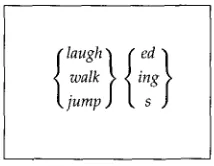
The f o u r t h a p p r o a c h to m o r p h o l o g y analysis is t o p - d o w n , a n d seeks a globally optimal analysis of the corpus. This general a p p r o a c h is based on the insight that the n u m b e r of letters in a list of w o r d s is greater than the n u m b e r of letters in a list of the stems a n d affixes that are p r e s e n t in the original list. This is illustrated in Figure 1. This simple observation lends h o p e to the n o t i o n that w e m i g h t be able to specify a relatively simple figure of merit i n d e p e n d e n t l y of h o w w e a t t e m p t to
find
analyses of particular data. This view, a p p r o p r i a t e l y elaborated, is part of the m i n i m u m description length a p p r o a c h that w e will discuss in detail in this paper.K a z a k o v (1997) presents an analysis in this f o u r t h approach, using a straightfor- w a r d m e a s u r e m e n t of the success of a m o r p h o l o g i c a l analysis that w e h a v e m e n t i o n e d , c o u n t i n g the n u m b e r of letters in the i n v e n t o r y of stems and suffixes that h a v e b e e n h y p o t h e s i z e d ; the i m p r o v e m e n t in this c o u n t o v e r the n u m b e r of letters in the origi- nal w o r d list is a m e a s u r e of the fitness of the analysis. 15 H e used a list of 120 French w o r d s in one experiment, and 39 forms of the same verb in a n o t h e r e x p e r i m e n t , a n d e m p l o y e d w h a t he terms a genetic algorithm to find the best cut in each w o r d . H e associated each of the 120 w o r d s (respectively, 39) w i t h an integer (between 1 a n d the length of the w o r d m i n u s 1) indicating w h e r e the m o r p h o l o g i c a l split was to be, a n d m e a s u r e d the fitness of that g r a m m a r in terms of its decrease in n u m b e r of total letters. H e does not describe the fitness function used, b u t seems to suggest that the
metric more complex than the familiar minimum edit distance, but no results are offered in support of the choice of the additional complexity.
[image:9.468.33.196.50.154.2] [image:9.468.32.139.209.292.2]Computational Linguistics Volume 27, Number 2
single t o p - p e r f o r m i n g g r a m m a r of each generation is p r e s e r v e d , all others are elim- inated, a n d the t o p - p e r f o r m i n g g r a m m a r is t h e n subjected to mutation. That is, in a case-by-case fashion, the split b e t w e e n stems a n d suffixes is m o d i f i e d (in some cases b y a shift of a single letter, in others b y an u n c o n s t r a i n e d shift to a n o t h e r location within the w o r d ) to f o r m a n e w grammar. In one e x p e r i m e n t described b y Kazakov, the p o p u l a t i o n was set to 800, a n d 2,000 generations w e r e m o d e l e d . On a P e n t i u m 90 a n d a v o c a b u l a r y of 120 items, the c o m p u t a t i o n took over eight hours.
Work b y Michael Brent (1993) a n d Carl de M a r c k e n (1995) has e x p l o r e d analyses of the f o u r t h t y p e as well. Researchers h a v e b e e n a w a r e of the utility of the information- theoretic n o t i o n of c o m p r e s s i o n f r o m the earliest d a y s of i n f o r m a t i o n theory, a n d there h a v e b e e n efforts to discover useful, f r e q u e n t c h u n k s of letters in text, such as Rad- h a k r i s h n a n (1978), b u t to m y k n o w l e d g e , Brent's a n d de Marcken's w o r k s w e r e the first to explicitly p r o p o s e the g u i d i n g of linguistic h y p o t h e s e s b y such notions. Brent's w o r k addresses the q u e s t i o n of d e t e r m i n i n g the correct m o r p h o l o g i c a l analysis of a c o r p u s of English w o r d s , g i v e n their syntactic category, utilizing the n o t i o n of m i n i m a l encoding, while d e Marcken's addresses the p r o b l e m of d e t e r m i n i n g the " b r e a k i n g " of an u n b r o k e n s t r e a m of letters or p h o n e m e s into c h u n k s that c o r r e s p o n d as well as pos- sible to o u r c o n c e p t i o n of w o r d s , i m p l e m e n t i n g a well-articulated algorithm c o u c h e d in a m i n i m u m description length f r a m e w o r k , a n d exploring its effects on several large corpora.
Brent (1993) aims at finding the a p p r o p r i a t e set of suffixes f r o m a corpus, rather than the m o r e c o m p r e h e n s i v e goal of finding the correct analysis for each w o r d , b o t h stem a n d suffix, a n d I think it w o u l d not be unfair to describe it as a test-of-concept trial o n a c o r p u s ranging in size from 500 to 8,000 words; while this is not a small n u m b e r of w o r d s , o u r studies b e l o w focus on c o r p o r a w i t h o n the o r d e r of 30,000 distinct words. Brent indicates that he places other limitations as well on the h y p o t h e s i s space, such as p e r m i t t i n g no suffix w h i c h e n d s in a sequence that is also a suffix (i.e., if s is a suffix, t h e n less a n d ness are not suffixes, a n d if y is a suffix, ity is not). Brent's observation is v e r y m u c h in line w i t h the spirit of the p r e s e n t analysis: " T h e i n p u t lexicons c o n t a i n e d t h o u s a n d s of n o n - m o r p h e m i c e n d i n g s a n d m e r e d o z e n s of m o r p h e m i c suffixes, b u t the o u t p u t c o n t a i n e d p r i m a r i l y m o r p h e m i c suffixes in all cases b u t one. Thus, the effects of n o n - m o r p h e m i c regularities are m i n i m a l " (p. 35). Brent's c o r p o r a w e r e quite different f r o m those u s e d in the e x p e r i m e n t s r e p o r t e d below; his w e r e b a s e d o n choosing the n m o s t c o m m o n w o r d s in a Wall Street Journal corpus, while the present s t u d y has u s e d large a n d h e t e r o g e n e o u s sources for corpora, w h i c h m a k e s for a considerably m o r e difficult task. In addition, Brent scored his a l g o r i t h m solely o n h o w well it s u c c e e d e d in identifying suffixes (or combinations of suffixes), rather than o n h o w well it s i m u l t a n e o u s l y a n a l y s e d stem a n d suffix for each w o r d , the goal of the present study. ~6 Brent m a k e s clear the relevance a n d i m p o r t a n c e of information-theoretic notions, b u t does not p r o v i d e a synthetic a n d overall m e a s u r e of the length of the m o r p h o l o g i c a l grammar.
Goldsmith Unsupervised Learning of the Morphology of a Natural Language
De Marcken (1995) addresses a similar but distinct task, that of determining the correct breaking of a continuous stream of segments into distinct words. This prob- lem has been addressed in the context of Asian (Chinese-Japanese-Korean) languages, where standard orthography does not include white space between words, and it has been discussed in the context of language acquisition as well. De Marcken describes an unsupervised learning algorithm for the development of a lexicon using a mini- m u m description length framework. He applies the algorithm to a written corpus of Chinese, as well as to written and spoken corpora of English (the English text has had the spaces between words removed), and his effort inspired the work reported here. De Marcken's algorithm begins b y taking all individual characters to be the baseline lexicon, and it successively adds items to the lexicon if the items will be useful in creating a better compression of the corpus in question, or rather, when the improve- ment in compression yielded by the addition of a new item to the codebook is greater than the length (or "cost") associated with the new item in the codebook. In general, a lexical item of frequency F can be associated with a compressed length of - log F, and de Marcken's algorithm computes the compressed length of the Viterbi-best parse of the corpus, where the compressed length of the whole is the sum of the compressed lengths of the individual words (or hypothesized chunks, we might say) plus that of the lexicon. In general, the addition of chunks to the lexicon (beginning with such high-frequency items as th) will improve the compression of the corpus as a whole, and de Marcken shows that successive iterations add successively larger pieces to the lexicon. De Marcken's procedure builds in a bottom-up fashion, looking for larger and larger chunks that are worth (in an MDL sense) assigning the status of dictionary entries. Thus, if we look at unbroken orthographic texts in English, the two-letter com- bination th will become the first candidate chosen for lexical status; later, is will achieve that status too, and soon this will as well. The entry this will not, in effect, point to its four letters directly, but will rather point to the chunks th and is, which still retain their status in the lexicon (for their robust integrity is supported by their appearance throughout the lexicon). The creation of larger constituents will occasionally lead to the elimination of smaller chunks, but only when the smaller chunk appears almost always in a single larger unit.
An example of an analysis provided by de Marcken's algorithm is given in (1), taken from de Marcken (1995), in which I have indicated the smallest-level constituent by placing letters immediately next to one another, and then higher structure with various pair brackets (parentheses, etc.) for orthographic convenience; there is no the- oretical significance to the difference between "( )" and "0", etc. De Marcken's analysis succeeds quite well at identifying words, but does not make any significant effort at identifying morphemes as such.
( [ t h e ] { ( [ u n i t ] e d ) ( [ s t a t ] e s ) } ) ( o f { a m e ( [ r i c ] ) a } ) (1)
Applying de Marcken's algorithm to a "broken" corpus of a language in which word boundaries are indicated (for example, English) provides interesting results, but none that provide anything even approaching a linguistic analysis, such as identifica- tion of stems and affixes. The broken character of the corpus serves essentially as an upper b o u n d for the chunks that are postulated, while the letters represent the lower bound.
Computational Linguistics Volume 27, Number 2
of the lexical items that have been hypothesized to form the lexicon of the corpus. It would certainly be natural to try using this figure of merit on words in English, along with the constraint that all words should be divided into exactly two pieces. Applied straightforwardly, however, this gives uninteresting results: words will always be divided into two pieces, where one of the pieces is the first or the last letter of the word, since individual letters are so much more common than morphemes. 17 (I will refer to this effect as peripheral cutting below.) In addition--and this is less obvious--the hierarchical character of de Marcken's model of chunking leaves no place for a qualitative difference between high-frequency "chunks," on the one hand, and true morphemes, on the other: str is a high-frequency chunk in English (as schl is in German), but it is not at all a morpheme. The possessive marker ~s, on the other hand, is of relatively low frequency in English, but is clearly a morpheme.
MDL is nonetheless the key to understanding this problem. In the next section, I will present a brief description of the algorithm used to bootstrap the problem, one which avoids the trap mentioned briefly in note 21. This provides us with a set of candidate splittings, and the notion of the signature of the stem becomes the working tool for determining which of these splits is linguistically significant. MDL is a framework for evaluating proposed analyses, but it does not provide a set of heuristics that are nonetheless essential for obtaining candidate analyses, which will be the subject of the next two sections.
3. Minimum Description Length Model
The central idea of m i n i m u m description length analysis (Rissanen 1989) is composed of four parts: first, a model of a set of data assigns a probability distribution to the sample space from which the data is assumed to be drawn; second, the model can then be used to assign a compressed length to the data, using familiar information-theoretic notions; third, the model can itself be assigned a length; and fourth, the optimal anal- ysis of the data is the one for which the sum of the length of the compressed data and the length of the model is the smallest. That is, we seek a minimally compact specification of both the model and the data, simultaneously. Accordingly, we use the conceptual vocabulary of information theory as it becomes relevant to computing the length, in bits, of various aspects of the morphology and the data representation.
3.1 A First Model
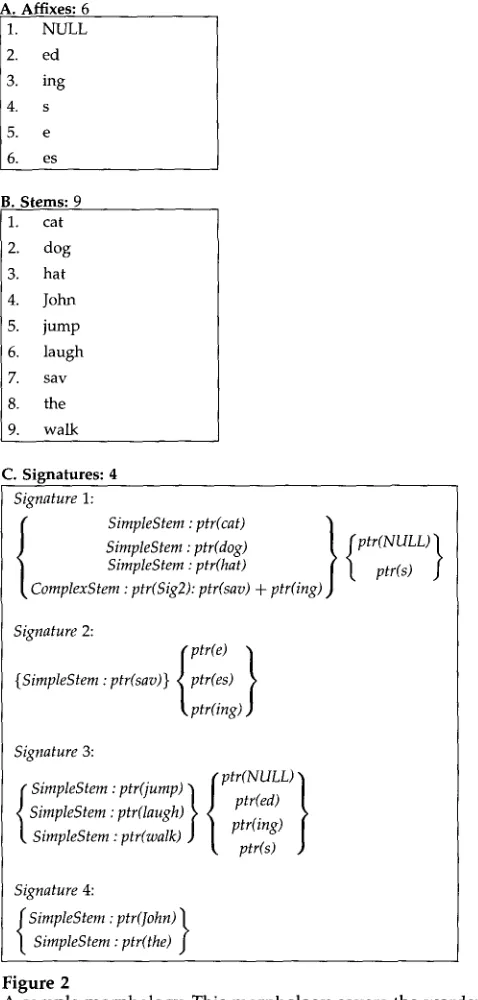
Let us suppose that we know (part of) the correct analysis of a set of words, and we wish to create a model using that knowledge. In particular, we know which words have no morphological analysis, and for all the words that do have a morphological analysis, we know the final suffix of the word. (We return in the next section to how we might arrive at that knowledge.) An MDL model can most easily be conceptualized if we encode all such knowledge by means of lists; see Figure 2. In the present case, we have three lists: a list of stems, of suffixes, and of signatures. We construct a list of the stems of the corpus defined as the set of the unanalyzed words, plus the material that precedes the final suffix of each morphologically analyzed word. We also construct a list of suffixes that occur with at least one stem. Finally, each stem is empirically associated with a set of suffixes (those with which it appears in the corpus); we call this set the stem's signature, and we construct a third list, consisting of the signatures that appear in this corpus. This third list, however, contains no letters (as the other
Goldsmith Unsupervised Learning of the Morphology of a Natural Language
A. Affixes: 6 1. NULL 2. ed 3. ing
4. s
5. e
i
6. es
B. Stems: 9 !1. cat
2. dog 3. hat 4. John 5. jump 6. laugh 7. sav 8. the 9. walk
C. Signatures: 4
Signature 1:
/
treat
SimpleStem : ptr(dog)
SimpleStem : ptr(hat) L ptr(s) J
ComplexStem : ptr(Sig2): ptr(sav) + ptr(ing)
Signature 2:
f ptr(e) ~ {SimpleStem:ptr(sav)} ~ptr(es) ~ ~, ptr(ing) )
Signature 3:
ptr(NULL) " f SimpleStem:ptr(jump) ~ ~ ptr(ed) ~ SimpleStem :ptr(laugh) ~ | ptr(ing) I, SimpleStem : ptr(walk) ) I, ptr(s)
Signature 4:
SimpleStem : ptr(John) SimpleStem : ptr(the) J
Figure 2
A sample morphology. This morphology covers the words: cat, cats, dog, dogs, hat, hats, save, saves, saving, savings, jump, jumped, jumping, jumps, laugh, laughed, laughing, laughs, walk, walked, walking, walks, the, John.
[image:13.468.34.273.52.552.2]Computational Linguistics Volume 27, Number 2
Since
stem, suffix,
a n dsignature
all b e g i n with s, w e opt for using t to represent a stem, f to represent a suffix, a n d cr to represent a signature, while the u p p e r c a s e T, F, E represent the sets of stems, suffixes, a n d signatures, respectively. The n u m b e r of m e m b e r s of such a set will be r e p r e s e n t e d (T) , (F/, etc., while the n u m b e r of occurrences of a stem, suffix, etc., will be r e p r e s e n t e d as [t], [f], etc. The set of all w o r d s in the c o r p u s will be r e p r e s e n t e d as W; h e n c e the length of the c o r p u s is [W], a n d the size of the v o c a b u l a r y is (W).N o t e the structure of the signatures in Figure 2. Logically a signature consists of t w o lists of pointers, one a list of pointers to stems, the other a list of pointers to suffixes. To specify a list of length N, w e m u s t specify at the b e g i n n i n g of the signature that N items will follow, a n d this requires just slightly m o r e t h a n log 2 N bits to d o (see Rissanen [1989, 33-34] for detailed discussion); I will use the n o t a t i o n A(N) to indicate this function.
A p o i n t e r to a stem t, in turn, is of length - l o g p r o b (t), a basic principle of i n f o r m a t i o n t h e o r y (Li a n d Vit8nyi 1997). H e n c e the length of a signature is the s u m of the (inverse) log probabilities of its stems, plus that of its suffixes, p l u s the n u m b e r of bits it takes to specify the n u m b e r of its stems a n d suffixes, using the A function. We will r e t u r n in a m o m e n t to h o w w e d e t e r m i n e the probabilities of the stems a n d suffixes; looking ahead, it will be the empirical frequency.
Let us consider the length of stem list T. As w e h a v e already observed, its length is ),((T))--this is the length of the i n f o r m a t i o n specifying h o w long the list i s - - p l u s the length of each stem specification. In m o s t of o u r w o r k , w e m a k e the a s s u m p t i o n that the length of a stem is the n u m b e r of letters in it, w e i g h t e d b y the factor log 26 c o n v e r t i n g to b i n a r y bits, in a language w i t h 26 lettersJ 8 The same reasoning h o l d s for the suffix list F: its length is
X((F))
plus the length of each suffix, w h i c h w e m a y take to be the total n u m b e r of letters in the suffix times log 26.We r e t u r n to the q u e s t i o n of h o w long the p o i n t e r ( f o u n d inside a signature) to a stem or suffix is. The probability of a stem is its (empirical) frequency, i.e., the total n u m b e r of w o r d s in the c o r p u s c o r r e s p o n d i n g to the w o r d s w h o s e analysis includes the stem in question; the probability of a suffix is d e f i n e d in parallel fashion. Using W to indicate all the w o r d s of the corpus, w e m a y say that the length of a p o i n t e r to a stem t is of length
a p o i n t e r to suffix f is of length
log [w]
[t] '
log
[%
K'
18 This is a reasonable, and convenient, assumption, but it may not be precise enough for all work. A more refined measure would take the length of a letter to be -1 times the binary log of its frequency. A still more refined measure would base the probability of a letter on bigram context; this matters for English, where stem final t is very common. In addition, there is information in the linear order in which the letters are stored, roughly equal to
n
~-~ log 2 k
k = l
Goldsmith Unsupervised Learning of the Morphology of a Natural Language
and a pointer to a signature cr is of length
[w]
log -[cr] "We have now settled the question of how to determine the length of our initial model; we next must determine the probability that the model assigns to each word in the corpus, and armed with that knowledge, we will be able to compute the com- pressed length of the corpus.
The morphology assigns a probability to each word w as the product of the prob- ability of w's signature times w's stem, given its signature, and w's suffix, given its signature: prob (w = t + f ) = prob (c 0 prob (t I or) prob (f ] or), where cr is the signa- ture associated with t: cr = sig(t). Thus while stems and suffixes, which are defined relative to a particular morphological model, are assigned their empirical frequency as their probability, words are assigned a probability based on the model, one which will always depart from the empirical frequency. The compression to the corpus is thus worse than would be a compression based on word frequency alone, 19 or to put it another way, the morphological analysis in which all words are unanalyzed is the analysis in which each word is trivially assigned its own empirical frequency (since the word equals the stem). But this decrease in compression that comes with morpho- logical analysis is the price willingly paid for not having to enter every distinct word in the stem list of the morphology.
Summarizing, the compressed length of the corpus is
Z [w](log
prob(cr(w)) +
logprob(t) +
logprob(f
] or(w))),w ~ t q - f
where we have summed over the words in the corpus, and or(w) is the signature to which word w is assigned. The compressed length of the model is the length of the stem list, the suffix list, and the signature list. The length in bits of the stem list is
&((T)) + ~
Ltypo(t)
t C S t e m s
and the length of the suffix list is
A((r)) +
L, po(f),
f ff S u f f i x e s
where
LtvpoO
is the measurement of the length of a string of letters in bits, which we take to be log 2 26 times the number of letters (but recall note 18). The length of the signature list isA((~,)) + Z L(¢),
c~ ff S i g n atures
where L(~) is the length of signature or. If the set of stems linked to signature a is T(~r) and the set of suffixes linked to signature a is F(a), then
+
+
S-" log [w]
+ fcr(¢)Z
log
[words(f) N words(cr)]"
Computational Linguistics Volume 27, Number 2
(The d e n o m i n a t o r in the last t e r m consists of the t o k e n c o u n t of w o r d s in a particular signature with the given suffix f , a n d w e will refer to this b e l o w m o r e simply as
in
cr].)It is no d o u b t easy to get lost in the formalism, so it m a y be helpful to p o i n t out w h a t the contribution of the additional structure accomplishes. We o b s e r v e d above that the MDL analysis is an elaboration of the insight that the best m o r p h o l o g i c a l analysis of a c o r p u s is o b t a i n e d b y counting the total n u m b e r of letters in the list of stems a n d suffixes according to various analyses, a n d choosing the analysis for w h i c h this s u m is the least (cf. Figure 2). This simple insight fails r a p i d l y w h e n w e observe in a l a n g u a g e such as English that there are a large n u m b e r of verb stems that e n d in t. Verbs a p p e a r with a null suffix (that is, in bare stem form), w i t h the suffixes -s,
-ed,
a n d-ing.
But once w e h a v e 11 stems e n d i n g in t, the naive letter-counting a p p r o a c h will j u d g e it a g o o d idea to create a n e w set of suffixes: -t,-ted, -ts,
a n d-ting,
because those 10 letters will allow us to r e m o v e 11 or m o r e letters f r o m the list of stems. It is the creation of the lists, n o t a b l y the signature list, a n d an i n f o r m a t i o n cost w h i c h increases as probability decreases, that o v e r c o m e s that problem. Creating a n e w signature m a y save some i n f o r m a t i o n associated w i t h the stem list in the m o r p h o l o g y , b u t since the length of pointers to a signature cr is - log freq (0), the length of the pointers to the signatures for all of the w o r d s in the c o r p u s associated w i t h the old signature (-O,-ed, -s, -ing)
or the n e w signature(-ts, -ted, -ting, -ts)
will be longer t h a n the length of the pointers to a signature w h o s e t o k e n c o u n t is the s u m of the t o k e n c o u n t of the t w o combined, i.e.,x l ° g ( ~ - ~ ) + y l ° g ( ~ ) ~ ( x + y ) l ° g ( x - ~ y ) •
3.2 Recursive Morphological Structure
The m o d e l p r e s e n t e d a b o v e is too simple in that it u n d e r e s t i m a t e s the gain a c h i e v e d b y m o r p h o l o g i c a l analysis in case the w o r d that is a n a l y z e d is also a stem of a larger w o r d . For example, if a c o r p u s contains the w o r d s
work
a n dworking,
t h e n m o r p h o l o g - ical analysis will allow us to dispense w i t h the f o r mworking;
it is m o d e l e d b y the stemwork
a n d the suffixes -O a n d-ing.
If the c o r p u s also includesworkings,
the analysisworking-s
additionally lowers the cost of the stemworking.
Clearly w e w o u l d like stems to be in t u r n analyzable as stems + suffixes. I m p l e m e n t i n g this suggestion involves the following modifications: (i) Each p o i n t e r to a stem (and these are f o u n d b o t h in the c o m p r e s s e d representation of each i n d i v i d u a l w o r d in the corpus, a n d inside the indi- v i d u a l signatures of the m o r p h o l o g i c a l model) m u s t contain a flag indicating w h e t h e r w h a t follows is a p o i n t e r to a simple m e m b e r of the stem list (as in the original model), or a triple p o i n t e r to a signature, stem, a n d suffix. In the latter case, w h i c h w o u l d be the case for the w o r d[work-ing]-s,
the p o i n t e r to the stem consists of a triple identical to the signature for the w o r dwork-ing.
(ii) The n u m b e r of w o r d s in the c o r p u s has n o w changed, in that the w o r d[work-ing]-s
n o w contains t w o w o r d s , not one. We will n e e d to distinguish b e t w e e n counts of a w o r d w w h e r e w is a freestanding w o r d , a n d counts w h e r e it is part of a larger w o r d ; w e shall refer to the latter class as secondary counts. In o r d e r to simplify c o m p u t a t i o n a n d exposition, w e h a v e a d o p t e d the con- v e n t i o n that the total n u m b e r of w o r d s remains fixed, e v e n w h e n n e s t e d structure is posited b y the m o r p h o l o g y , thus forcing the c o n v e n t i o n that counts are d i s t r i b u t e d in a n o n i n t e g r a l fashion o v e r the t w o or m o r e n e s t e d w o r d structures f o u n d in c o m p l e x words. We consider the m o r e c o m p l e x case in the appendix. 2°Goldsmith Unsupervised Learning of the Morphology of a Natural Language
We may distinguish between those words, like
work
orworking,
whose immediate analysis involves a stem appearing in the stem list (we may call theseWSIMPLE )
and those whose analysis, likeworkings,
involves recursive structure (we may call theseWCOMPLEX ).
AS we have noted, every stern entry in a signature begins with a flag indicating which kind of stem it is, and this flag will be of length[wl
log
[WsIMPLE ]
for simple stems, and of length
[w]
log[WcoMPrZX]
for complex stems. We also keep track separately of the total number of words in the corpus (token count) that are morphologically analyzed, and refer to this set as
WA;
this consists of all words except those that are analyzed as having no suffix (see item (ii) in (2), below).(2) Compressed length of morphology
(i)
(ii)
(ii)
(iii)
(iv)
hiT) + a(r) +
Suffixlist: fc
s~E
(/~*lf[ + lOg [WA]'~ ]Suffixlist: E
(l°g26*lengthOC)+l°g~ -~)
f ff Suffizes
Stem list: t~cT (lOg26*length(t) + log ( ~ ) )
Signature component
Stated once for the whole component:
(a) Signature list: E log [w]
For
each
signature:(b) Size of the count of the number of stems plus size of the count of the number of suffixes:
;~((stems(a))) + ~((suffixes(a)))
(c) A pointer to each stem, consisting of a simple/complex flag, and a pointer to either a simple or complex stem:
(i) Case of simple stem: flag of length
[w]
log[WsIMPLE]
Computational Linguistics Volume 27, Number 2
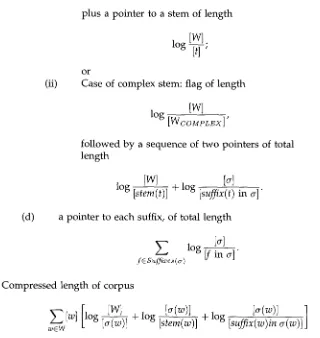
plus a pointer to a stem of length
log [w].
[t] '
(ii)
o r
Case of complex stem: flag of length
[w]
log [ W c o M P L E X ] "
followed b y a sequence of two pointers of total length
[w]
[~]
log
[stem(t)~-~ +
log
[suffix(t) in cr]"
(d) a pointer to each suffix, of total length
v'z_.
log ~ in
~]
f c suyfixe~ ( ~ )
(3) Compressed length of corpus
[w]
[~(w)]
[~(w)]
]
[image:18.468.62.382.47.385.2][w] log ~ + log + log
[stem(w)] [suffix(w)in a(w)]] w E W
MDL thus provides a figure of merit that w e wish to minimize, a n d w e will seek heuristics that m o d i f y the morphological analysis in such a fashion as to decrease this figure of merit in a large proportion of cases. In a n y given case, w e will accept a modification to our analysis just in case the description length decreases, a n d we will suggest that this strategy coincides w i t h traditional linguistic j u d g m e n t in all clear cases.
4. Heuristics for Word Segmentation
The MDL m o d e l designed in the preceding section will be of use only if we can provide a practical m e a n s of creating one or more plausible morphologies for a given corpus. That is, w e need bootstrapping heuristics that enable us to go from a corpus to such a morphology. As we shall see, it is not in fact difficult to come up w i t h a plausible initial morphology, b u t I w o u l d like to consider first an approach which, t h o u g h it m i g h t seem like the most natural one to try, fails, a n d for an interesting reason.
The problem we w i s h to solve can be t h o u g h t of as one suited to an expectation- maximization (EM) approach (Dempster, Laird, a n d Rubin 1977). Along such a line, each w o r d w of length N w o u l d be initially conceived of as being analyzed in N different ways, cutting the w o r d into stem + suffix after i letters, 1 K i < N, w i t h each of these N analyses being assigned probability mass of
[w]
Goldsmith Unsupervised Learning of the Morphology of a Natural Language
That probability mass is then s u m m e d over the resulting set of stems a n d suffixes, a n d on successive iterations, each of the N cuts into stem + suffix is weighted b y its probability; that is, if the ith cut of w o r d w, of length I, cuts it into a stem t of length i a n d suffix of length 1 - i, then the probability of that cut is defined as
pv(stem t = wl,i)pr(suffix f = Wi+l,l)
N
pr(stem t = Wl,k)pf(suffl"x f = Wk+l,l)
k=l
where ZOj,k refers to the substring of w from the jth to the kth letter. Probability mass for the stem a n d the suffix in each such cut is then a u g m e n t e d b y an a m o u n t equal to the frequency of w o r d w times the probability of the cut. After several iterations (approximately four), estimated probabilities stabilize, a n d each w o r d is analyzed on the basis of the cut w i t h the largest probability.
This initially plausible approach fails because it always prefers an analysis in which either the stem or (more often) the suffix consists of a single letter. More importantly, the probability that a sequence of one or more word-final letters is a suffix is very poorly m o d e l e d b y the sequence's frequency. 21 To p u t the point another way, even the initial heuristic analyzing one particular w o r d m u s t take into account all of the other analyses in a more articulated w a y than this particular approach does.
I will turn n o w to two alternative heuristics that succeed in producing an initial morphological analysis (and refer to a third in a note). It seems likely that one could construct a n u m b e r of additional heuristics of this sort. The point to emphasize is that the p r i m a r y responsibility of the overall m o r p h o l o g y is not that of the initial heuristic, b u t rather of the MDL model described in the previous section. The heuristics described in this section create an initial m o r p h o l o g y that can serve as a starting point in a search for the shortest overall description of the morphology. We deal w i t h that process in Section 5.
4.1 First H e u r i s t i c
A heuristic that I will call the take-all-splits heuristic, a n d which considers all cuts of a w o r d of length 1 into stem+suffix Wl,i -t- Wi+l,l, where 1 G i < 1, m u c h like the EM ap- proach m e n t i o n e d immediately above, works m u c h more effectively if the probability is assigned on the basis of a Boltzmann distribution; see (4) below. The function H(.) in (4) assigns a value to a split of w o r d w of length h w U + wi+l,l. H does not assign a proper distribution; we use it to assign a probability to the cut of w into w~,i + wi+u as in (5). Clearly the effect of this model is to encourage splits containing relatively long suffixes a n d stems.
H(Wl,i q- Wi+l,1)
= - ( / l o g freq (stem = W l , i ) q - ( l - i)log freq (suffix = wi+u)) (4)prob (w = Wl, i q- Wi+l,l) = le-H(w"i+Wi+l,l) (5)
z,
21 It is instructive to think about why this should be so. Consider a word such as diplomacy. If we cut the word into the pieces diplomac + y, its probability is freq (diplomac)* freq (y), and constrast that value with the corresponding values of two other analyses: freq (diploma)* freq (cy), and