Richard Power
∗Donia Scott
∗University of Brighton University of Brighton
Nadjet Bouayad-Agha
†University Pompeu Fabra
We argue the case for abstract document structure as a separate descriptive level in the anal-ysis and generation of written texts. The purpose of this representation is to mediate between the message of a text (i.e., its discourse structure) and its physical presentation (i.e., its organization into graphical constituents like sections, paragraphs, sentences, bulleted lists, figures, and foot-notes). Abstract document structure can be seen as an extension of Nunberg’s “text-grammar”; it is also closely related to “logical” markup in languages like HTML and La
TEX. We show that
by using this intermediate representation, several subtasks in language generation and language understanding can be defined more cleanly.
1. Introduction
When language is written, it appears as a collection of words set out on one or more (actual or virtual) pages. In fact, much of what we tend to call “text” has a strong graphical component (Schriver 1997; Scott and Power 2001). Not only are the words often accompanied by conventional graphics such as pictures or diagrams, but they themselves form graphical elements such as titles, headings, chapters, sections, cap-tions, paragraphs, and bulleted lists.
The overlay of graphics on text is in many ways equivalent to the overlay of prosody on speech. Just as all speech has prosody (even if it is a monotone), so too do all texts have layout (even if it is simple wrapped format, in a single face and font, and makes rudimentary use of white space). And just as prosody undoubtedly contributes to the meaning of utterances, so too does a text’s graphical presentation contribute to its meaning. However, although there is a long tradition and rich linguistic framework for describing and representing speech prosody (e.g., Halliday 1967; Chomsky and Halle 1968; Crystal 1969; Bolinger 1972; Pierrehumbert 1980; ’t Hart, Collier, and Cohen 1990; Ladd 1996), the same is not true for text layout. Perhaps not surprisingly, therefore, few natural language understanding (NLU) systems use graphical presentational features to aid interpretation, and few natural language generation (NLG) systems attempt to render the output texts in a principled way.
Of course, since all texts have a graphical dimension, all NLG systems will, by definition, produce laid-out texts. In all but a few recent cases (the ICONOCLAST sys-tem (Power 2000; Bouayad-Agha, Power, and Scott 2000; Bouayad-Agha, Scott, and Power 2001; Bouayad-Agha 2001) and the DArtbio system (Bateman et al. 2001)), this is achieved by mapping directly from the underlying discourse structure (Arens and
∗Information Technology Research Institute, University of Brighton, Lewes Road, Brighton BN2 4GJ, UK. Email:{firstname.lastname}@itri.bton.ac.uk.
Hovy 1990; DiMarco et al. 1995; Paris et al. 1995; Power and Cavallotto 1996; Lavoie and Rambow 1997; Mittal et al. 1998). In other cases, the text is mapped onto pre-determined genre-specific layout patterns—for example, for verbalizing mathematical proofs (Huang and Fiedler 1997) or producing letters for customers (Coch 1996). If we take, as most do, the level of discourse structure as representative of the underlying
message of a text, such systems are subject to a fundamental limitation. Simply put, for
each message there will be but one possible form of presentation.
As an illustration let us briefly consider the well-known consensus architecture for NLG systems proposed by Reiter (1994). This architecture, based on a survey of NLG systems from the 1980s and early 1990s, takes the form of a “pipeline” in which five modules are applied in sequence: content determination, sentence planning, surface generation, morphology, and formatting. Sentence planning maps “conceptual structures into linguistic ones . . . grouping information into clauses and sentences” (Reiter 1994, page 164), but formatting (specified, for example, by La
TEX markup) occurs only in the final formatting stage. In consequence, the organization of material into paragraphs, bulleted lists, etc., is considered only after the wording has been fixed.
Graphical presentation, however, clearly interacts with wording. For example, the section of a message that, at the level of discourse, is composed of a list relation, will be expressed differently depending on whether, at the presentational level, it is mapped onto a vertical or horizontal list. Consider a simple example like the following, taken from a patient information leaflet (PIL):
(1) Are you taking any of the following:
• Anticoagulants?
• Lithium?
• Methotrexate?
• Any other medicines which your doctor does not know about? (Voltarol leaflet, Geigy; from APBI 1997)
If the very same content were presented instead as a horizontal list, we would expect to get something like:
(2) Are you taking anticoagulants, lithium, methotrexate, or any other medicines which your doctor does not know about?
Now all the information is packed into one sentence, with some missing and addi-tional words, wildly different punctuation, and less generous use of upper-case letters.1 Mapping directly from discourse structure to graphical presentation during generation therefore limits not only the choice of possible layout, but also the choice of possible wording.
There have been some recent attempts to develop NLG systems that generate
doc-uments rather than just texts. Instead of producing text plans, they produce document plans. Typically these are the text plans of old (i.e., structures of ordered content
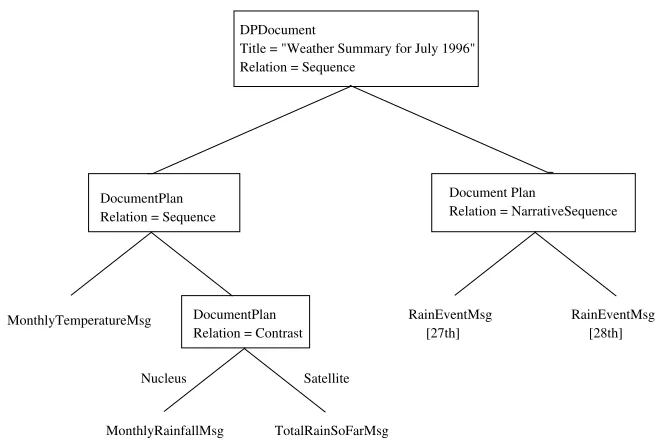
ele-ments represented in terms of rhetorical structure theory (Mann and Thompson 1986, 1987)), but extended to include pictures or diagrams as content elements, and with additional annotations for metalevel elements such as paragraph or sentence bound-aries. Figure 1 shows the type of document plan proposed by Reiter and Dale (2000).
still very depleted. Heavy rain fell on the 27th and 28th.
The month was slightly warmer than average with almost exactly the average rainfall, but rainfall for the year is
Weather Summary for July 1996
DocumentPlan Relation = Sequence
Document Plan
Relation = NarrativeSequence
RainEventMsg [28th] DocumentPlan
Relation = Contrast DPDocument
Title = "Weather Summary for July 1996" Relation = Sequence
RainEventMsg [27th] MonthlyTemperatureMsg
MonthlyRainfallMsg TotalRainSoFarMsg
[image:3.612.119.448.132.354.2]Nucleus Satellite
Figure 1
A document plan and associated text (Reiter and Dale 2000).
Although this approach allows for a more reasoned presentational format, by conflat-ing discourse and presentational features into one structure, the possible generated expressions of any given message are once again strongly limited relative to the set of all possible valid expressions.
We wish to argue the case for a separate descriptive level in the analysis and gen-eration of written texts, which we will call document structure. Informally, document structure describes the organization of a document into graphical constituents like sections, paragraphs, sentences, bulleted lists, and figures; it also covers some features within sentences, including quotation and emphasis. Although document structure applies equally to NLU and NLG, we will focus our attention here on its role in the generation of appropriate presentations (both wording and layout) of texts. As we will try to show, texts (unless they are fairly simple) cannot be produced to a satisfactory standard unless document structure is specified earlier in the process than suggested in previous works (e.g., Reiter 1994; Reiter and Dale 2000), so that interactions with meaning and wording are taken into account.
The plan of the article is as follows. In section 2 we explain more fully what we mean by document structure, acknowledging its origins in Nunberg’s (1990) work and text markup languages such as La
2. Defining Document Structure
2.1 Nunberg’s Text Grammar
Our point of departure has been the theory of text structure proposed by Nunberg (1990) in The Linguistics of Punctuation. This book introduces two crucial clarifications. First, it distinguishes text structure,2which is realized by punctuation and layout, from syntactic structure. Second, it distinguishes abstract features of text structure from the concrete (or graphical) features through which they are expressed.
The distinction between text structure and syntax can best be explained by consid-ering two interpretations of the word sentence. In linguistics, sentence is used mainly as a syntactic category, defined by phrase structure rules such as S→NP+VP. However,
a sentence can also be viewed orthographically as a portion of text starting with a capital letter and ending in a period; to distinguish this from the syntactic category, Nunberg calls it a text-sentence. Sometimes the two categories of sentence coincide, but often they do not. Thus in the following passage:
(3) He entered the office. Disaster. The safe was open and the money had gone.
the first text-sentence is also a syntactic sentence, but the second is merely a noun, and the third comprises two syntactic sentences (or three, if we count the whole as well as its parts). Nunberg argues that if we have two kinds of category, then we need
two kinds of grammar: he calls them the lexical grammar (we prefer syntactic gram-mar) and the text-grammar. In addition to text-sentence, the text-categories include text-clause, paragraph, and section, and the text-grammar allows us to formulate con-stituent structure rules such as
St →Ct+
meaning that a text-sentence comprises one or more text-clauses.
In introducing the concepts text-sentence, text-clause, etc., it is convenient to explain them in terms of their realization in punctuation and layout: thus a text-sentence starts with a capital letter and ends in a period; a text-clause ends in a semicolon; a paragraph begins on a new line with a tab. However, this is not strictly correct. In Nunberg’s theory, these concepts represent abstract structural properties of the text that may be realized differently according to context or convention. In the case of
paragraph this distinction is obvious, since we are all familiar with several devices for
expressing paragraph boundaries: instead of a new line with a tab, for example, an editor might prefer two new lines (or some other vertical space) with no tab. However, the abstract/concrete distinction also applies to the other text-categories. For example, the passage:
(4) The safe was open; the money had gone.
contains two text-clauses, but the second has no semicolon because its ending coincides with the closure of a larger unit, a text-sentence, which is marked by a period. Similarly, the stop at the end of a text-sentence is often dropped when the sentence is an item
in a vertical list, for instance, in a sequence of instructions: (5) To save the file:
1. Open the Save dialogue-box 2. Enter the filename
3. Click on the Save button
Thus text structure is realized by punctuation (and layout), but the two are not equiv-alent.
2.2 Markup Languages
Nunberg’s notion of text structure, or our wider notion of document structure, has an obvious connection to the markup languages (e.g., La
TEX, SGML) now in common use as a method for specifying layout in an ASCII source file. The common philosophy of these languages is that markup should abstract from the visual appearance of the document, using concepts like paragraph that might be realized graphically in different ways, depending on a separate style definition.
This approach has several advantages, of which the most obvious is flexibility. An exact specification of the desired spatial layout can yield only one printed form of the document; by employing abstract categories, definitions using La
TEX or SGML can produce a range of printed forms, depending on which style file is used. Less obviously, the markup language can be tailored to the genre of the document, so that, for example, a poem may have a constituent marked stanza, whereas a letter may have one marked address.
In practice, this separation of abstract structure from visual realization is not car-ried through consistently; for reasons of convenience, authors sometimes prefer to have direct control over appearance. Thus La
TEX, for example, allows both the abstract tagem, meaning emphasis, and the visual tagit, meaning italic face. Vertical separation is usually achieved through abstract tags likesection anditemize but may also be imposed directly using vspace. All these devices have counterparts in HTML: thus a typical reference guide to HTML (Ford and Dixon 1996) explicitly distinguishes “logical” tags such as<EM> from “visual” tags such as<I>.
More subtly, the markup languages in common use do not attempt to cover struc-tural units that are realized through punctuation rather than layout. Paragraphs may be marked (albeit implicitly in La
TEX), but lower units such as sentence and text-clause are not. No doubt there are good practical reasons for this approach, but some opportunities for stylistic variation are thereby lost. Consider, for example, the simple case of reported speech in example (6a). If this were marked up as a sentence contain-ing a quotation, it could be punctuated differently, with the period outside the closcontain-ing quotation mark (6b), perhaps, or using double quote (6c), or even using a dash with no quotation marks at all (6d) (as in James Joyce’s Ulysses):
(6)
(a) She said ‘Come up and see me sometime.’ (b) She said ‘Come up and see me sometime’. (c) She said “Come up and see me sometime.” (d) She said—Come up and see me sometime.
hand, some tags (e.g., italic face) are clearly visual and should not be included in abstract document structure at all. On the other hand, some abstract categories (e.g., text-sentence, quoted speech) are omitted from the tag set and thus cannot be realized in a range of different graphical styles.
Despite these compromises, markup languages are based on a key insight that is highly relevant to natural language analysis and generation: layout can be matched to
wording through the mediation of abstract document structure. Consider the following three
versions of a passage adapted from a patient information leaflet:
(7)
(a) Elixiris a white cream.
It is used in the treatment of cold sores.
It contains aliprosan. This is effective against a range of viral skin disorders. It should be used only on your lips and face.
(b) Elixiris a white cream.
It is used in the treatment of cold sores.
It contains aliprosan. This is effective against a range of viral skin disorders.
It should be usedonlyon your lips and face.
(c) Elixiris a white cream. It is used in the treatment of cold sores. It contains aliprosan. This is effective against a range of viral skin disorders. N.B. Elixir should be used only on your lips and face.
Suppose that example (7a) has been produced by author A, a novice in document design, and passed to a more experienced designer B for revision. The passage looks odd because it has four very short paragraphs, but short paragraphs are common in this genre, and B decides that the ugly appearance can be corrected simply by realizing paragraphs through a vertical space with no tab. In addition, B notices that boldface has been used for two different purposes: highlighting the product name and emphasizing only; this ambiguity is removed by changing emphatic boldface to small caps. Both these revisions, shown in version (7b), concern realization rather than abstract structure, and consequently they do not affect the validity of the wording.
For final checking the passage is then passed to a senior expert C, whose prefer-ences are more traditional: in particular, C dislikes short paragraphs and variations in typeface. Glaring at the waste of space in version (7b), C takes out the paragraph boundaries and removes the emphasis on only. These are not merely changes in graph-ical realization: they also affect the abstract document structure. In general, such changes
endanger the validity of the wording. Reading through the new version, C notices that the
pronoun it in the final sentence now seems to refer to aliprosan, not Elixir, so it has to be replaced by the product name. To reinstate the emphasis in this sentence, C also inserts the expression N.B. These changes lead to version (7c).
3. Document Structure and Rhetorical Structure
3.1 Form and Meaning
Logically there are four possible relationships between document structure (DS) and rhetorical structure (RS): either DS is part of RS, or RS is part of DS, or they partially overlap, or they are distinct from one another. Our view is that they should be distinct, just as syntax is distinct from semantics. Document structure, like syntax, describes the form of a (mainly) linguistic product. Rhetorical structure, like semantics, describes meaning, interpreting meaning in a broad sense that includes pragmatic features.
As an example, suppose that approve(fda, elixir)is a semantic formula meaning that the Food and Drug Administration (FDA) approves the medicine Elixir. This semantic formula can be realized (in English) through a range of syntactic forms, including
[S[NP[DETthe][NFDA]][VP[Vapproves][NPElixir]]]
which would yield ‘the FDA approves Elixir’; alternative syntactic forms could be obtained by replacing descriptions with pronouns, or by putting the whole sentence into the passive (e.g., ‘it is approved by the FDA’). Now, suppose that we add a second semantic formula contain(elixir, gestodene), and suppose that the author knows that gestodene is a controversial ingredient. On this basis, a rhetorical relation of concessionmight be applied to the two formulas:
concession(contain(elixir, gestodone), approve(fda, elixir))
where the second argument ofconcessionis the central one and is supported by the first argument.3 To realize this more complex message, we may need a linguistic form that cannot be described only by a syntactic phrase marker. In other words, we need to consider document structure as well as syntax. Ignoring possibilities for variations in the wording of the constituent propositions and assuming thatconcessionmay be marked with the discourse connectives although and however, we can choose among the following realizations of the whole message:
(8)
(a) Although Elixir contains gestodene, it is approved by the FDA.
(b) The FDA approves Elixir although it contains gestodene.
(c) Elixir contains gestodene; however, it is approved by the FDA.
(d) Elixir contains gestodene. However, it is approved by the FDA.
(e) Elixir contains gestodene.
However, it is approved by the FDA.
In versions (8a) and (8b), the rhetorical relationship is realized within a single syntactic sentence, although before adding punctuation we need to know that this syntactic sentence is also a text-sentence. In versions (8c)–(8e), the arguments of the concession relation are expressed in separate syntactic sentences, so that the rela-tionship is realized through document structure as well as syntax. In each case, the
units realizing the arguments are coordinated in document structure, satellite precedes nucleus, and the discourse connective however is placed within the nucleus.
Our claim, then, is that document structure combines with syntax in the real-ization of the meaning of a document, and that rhetorical structure should be re-garded as part of meaning, not part of document structure. However, as we will now show, this principle of clear separation of meaning and form has not always been observed.
3.2 Rhetorical Structure Theory
Rhetorical structure theory (Mann and Thompson 1986, 1987) was developed as a method of analyzing the rhetorical organization of texts. Formally, the theory is re-markably simple. It proposes that a text can be analyzed, by rhetorical function, into a set of nested spans, each span being represented by a node on an ordered tree. Each nonterminal node on this tree is labeled with a single term describing the relationship that holds among its constituents. These constituents may have equal importance, in which case the relation is said to be multinuclear, or one may be rhetorically subor-dinated to the other, in which case they are said to fulfill the roles of satellite and nucleus. Although this scheme is obviously intended as a first approximation, it has been widely adopted, not only by literary analysts, but also by computational linguists, especially in the NLG community.
One aspect of RST, perhaps more presentational than substantial, has led, in our view, to confusion: both in the text of their article and the accompanying diagrams, Mann and Thompson seem to assert that rhetorical relations hold between spans of text, rather than between the meanings of these texts. In other words, they treat rhetor-ical structure as part of document structure. Mann and Thompson assert this explicitly (1987, page 4):
Relations are defined to hold between two non-overlapping text spans, here called the nucleus and the satellite, denoted by N and S.
where
A text span is an uninterrupted linear sequence of text.
However, it is unclear whether their claim is intentional or simply the result of an informal style of presentation.
Would it make any sense to treat rhetorical relations as holding literally between text spans? For clearly pragmatic relations, such asrestatement, this seems a possible position. A text span, after all, is an instrument of the writer, so it makes sense to make a statement about the function that the instrument is supposed to serve. For clearly semantic relations, such as nonvolitional-cause, the position is harder to maintain. In a text like ‘Mary was sad because she lost her doll’, the causal relation plainly holds between two events, not between two spans of text.
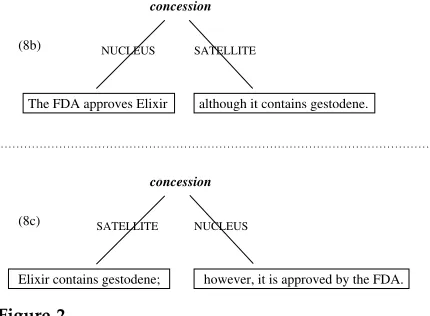
concession
NUCLEUS SATELLITE
however, it is approved by the FDA. Elixir contains gestodene;
concession
The FDA approves Elixir although it contains gestodene.
NUCLEUS SATELLITE
[image:9.612.106.321.87.245.2](8c) (8b)
Figure 2
RST analysis.
a document can be planned before the writer (or NLG system) has considered issues of wording or linear order.4
To illustrate this point, let us go back to example (8). Suppose that we want to show that versions (8b) and (8c) express the same argument.
(8b) The FDA approves Elixir although it contains gestodene.
(8c) Elixir contains gestodene; however, it is approved by the FDA.
Figure 2 shows RST annotations for these texts, on the assumption that rhetorical relations hold between text spans; note, incidentally, that since related spans must be consecutive, the discourse connectives although and however have to be included somewhat arbitrarily in one span or the other. These annotations fail to bring out that the two texts express the same argument, since at a textual level the spans in (8b) and (8c) are simply different, both in wording and position.
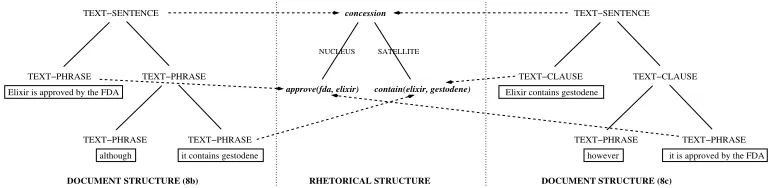
In Figure 3, instead, different document structures are specified for versions (8b) and (8c) and linked to a common rhetorical structure; the dotted arrows express the relation realizes, so that, for example, each text-sentence realizes the whole rhetori-cal structure governed by theconcessionrelation. Note that rhetorical structures are always unordered, whereas document structures are ordered trees. Thus the two un-ordered propositions in the rhetorical structure of Figure 3 are realized in different orders in the two document structures.
This distinction between rhetorical structure and document structure accounts for some of the difficulties encountered when RST is applied as an analytic tool. The core of the problem is that when faced with a text to analyze, the analyst applies the principles of RST analysis to the text itself rather than to the message underlying the text. What the analyst really needs to do is, in some way, to “get behind the text” to its constituent propositions and the rhetorical relations that hold between them (Scott and Paris 1995). But instead, by applying relations to text-spans, he or she is heavily constrained by the evident document structure of the text, and the result is a rhetorical structure that is isomorphic to the document structure. However, as we have
TEXT−SENTENCE
TEXT−PHRASE TEXT−PHRASE
TEXT−PHRASE although Elixir is approved by the FDA
it contains gestodene TEXT−PHRASE
TEXT−SENTENCE
TEXT−CLAUSE TEXT−CLAUSE Elixir contains gestodene
TEXT−PHRASE TEXT−PHRASE however it is approved by the FDA approve(fda, elixir) contain(elixir, gestodene)
SATELLITE
concession
NUCLEUS
[image:10.612.103.489.89.183.2]RHETORICAL STRUCTURE DOCUMENT STRUCTURE (8c) DOCUMENT STRUCTURE (8b)
Figure 3
Document structure realizes rhetorical structure.
seen from the above example, the underlying rhetorical structure is not necessarily isomorphic to the document structure;5 this means that the analysis obtained in this way is not necessarily an accurate representation of the actual discourse structure of the text. Consider, for example, the following excerpt from a patient information leaflet:
(9) IF you find your condition gets worse during treatmentA you may be allergic to the creamDor have a skin infectionE.
STOP USING THE CREAMB AND TELL YOUR DOCTOR AS SOON AS POSSIBLEC (Betnovate leaflet, Glaxo; from APBI 1997)
Careful reading of the text, combined with world knowledge, suggests that the following logical condition holds between the propositional content of A and the pair
B and C:
IF <condition of patient worsens during treatment> THEN <patient must stop taking cream>
AND <patient must tell patient’s doctor> ENDIF
In other words, the rhetorical relation ofcondition holds between A as satellite and the complex of B and C (joined by a listrelation) as nucleus. We learn additionally that the reason why the patient must carry out the imperative actions of B and C is that he or she may be either allergic to the cream (D) or have a skin infection (E). In other words, there is a causal relation between the complex of B and C (the effect) and complex of D and E (the cause). Representing all this in RST would yield the structure in Figure 4.
Most people would probably agree that what is depicted in the RST structure shown in Figure 4 captures the intended meaning of the text in the example, and that the text itself is of reasonable quality. However, a traditional RST analysis (i.e., of the text itself, as opposed to its underlying meaning) would not be able to produce the structure shown here. To explicate, let us go through what the typical RST analyst would do with this text.
The analyst would probably start by segmenting the text into elementary “text spans” (i.e., clauses); this would lead to the same assignment of A–E given above. The next step would focus on the first sentence: the discourse marker if clearly suggests the condition relation; similarly, the marker or suggests thealternative relation. So far so good. However, the next step would be to find a relation that holds among
PARAGRAPH
TEXT−SENTENCE
TEXT−PHRASE
TEXT−PHRASE TEXT−PHRASE TEXT−PHRASE TEXT−PHRASE
TEXT−SENTENCE
D E
B
C A
D E
C
list alternative cause
condition
A
B
S N
N S
[image:11.612.104.490.86.232.2] [image:11.612.104.211.280.397.2]RHETORICAL STRUCTURE DOCUMENT STRUCTURE
Figure 4
Document structure is not always isomorphic with rhetorical structure.
S N
list
N
N N N N
C D E
A
B
alternative condition
S
result
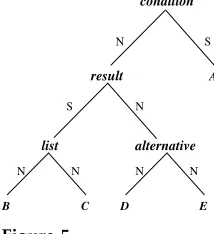
Figure 5
Analysis when RST is applied directly to text.
the text spans in the sentence; if this cannot be done, then according to the tenets of RST, the text is not coherent. Following this rule, the analyst is likely to make D and E the components of the identified (multinuclear)alternativerelation. Next he would attempt to assign the satellite and nucleus of the identified condition relation; the choice would be between A and the complex of D and E. Since the marker if must attach to the satellite ofcondition, the answer seems clear:
condition(alternative(D,E),A)
(corresponding to the RST structure shown in Figure 5). But it is also clearly wrong, since we know from our semantic analysis that what really holds is that shown in Figure 4:
condition(list(B,C),A)
Indeed, even the layout of the text reinforces, through the use of capital letters, the strong relationship between A and the pair B and C.
For instance, we can now produce not only the original text of example (9) (shown here with neutral layout):
(9b) If you find your condition gets worse during treatment, you may be allergic to the cream or have a skin infection. Stop using the cream and tell your doctor as soon as possible.
but also the following (in some contexts perhaps better) variant
(9c) If you find your condition gets worse during treatment, stop using the cream and tell your doctor as soon as possible; you may be allergic to the cream or have a skin infection.
Of course, NLG systems that ignore the level of document structure would still be able to produce the text in version (9b) from the RST structure in Figure 5, but they would not be able to produce version (9c). Moreover, they could also end up producing the following incorrect text:6
(9c) # Stop using the cream and tell your doctor as soon as possible because you may be allergic to the cream or have a skin infection if your
condition gets worse during treatment.
A number of other researchers have identified cases in which “orthodox” RST analysis of a text is problematic (e.g., Moore and Pollack 1992; Moser and Moore 1996; Knott et al. 2001). For example, Knott et al. (2001) report on texts from a corpus of museum labels that violate the RST principle of continuous constituency (i.e., adjacent units must be linked by a relation) but are nonetheless coherent. These are cases in which the satellite of a relation is not adjacent to its own nucleus in the text. In all the texts that Knott et al. discuss, the “dislocated” relation is elaboration, and they attribute the source of the problem to the relation itself:elaborationis not, they claim, a proper relation; it is a very weak relation that commands a different treatment from the other stronger ones.
Although there may well be a strong case to be made for the “demotion” of elaboration and for a special treatment of it in NLG systems, the phenomenon of dislocated satellites that Knott et al. (2001) describe is not, in fact, confined to elaboration. Indeed, it corresponds precisely to the problem we have just seen with example (9), which involves notelaboration, butcondition. We have also reported elsewhere other similar examples of nonisomorphic rhetorical and document structures (Bouayad-Agha, Power, and Scott 2000). In all cases that we have seen, the principles of RST (e.g., compositionality, nuclearity, continuous constituency) appear to be violated only because they are being applied (in the orthodox manner) to the surface text (i.e., at the level of document structure) rather than more properly to the underlying propositional structure of the text (i.e., at the level of rhetorical structure).
But why would one want to produce a text whose document structure is not iso-morphic with its rhetorical structure? One rather practical reason is that as a rhetorical structure becomes more complex, it becomes increasingly difficult for the writer to pro-duce a text that satisfies both the demands of coherence (as defined by theories such
as RST) and those of syntax. This happens quite frequently, for example, with condi-tionals: syntax dictates that expressions using the subordinating discourse marker if must have the antecedent and consequent in the same sentence. For example:
(10) If you eat too many sweets, you will become ill.
but not
(11) # If you eat too many sweets. You will become ill.
As the consequent or its antecedent becomes more complex, the chances of satis-fying the syntactic constraints are reduced. Here is a typical example from a PIL:
(12) If you get any of the following:
Stomach pain, indigestion, heartburn or feeling sick for the first time. Any sign of bleeding in the stomach or intestine, for example, passing black stools.
. . .
An unexpected change in the amount of urine produced and/or its appearance.
STOP taking the tablets and tell your doctor.
(Voltarol leaflet, Geigy; from APBI 1997)
Here the conditional is expressed within one big sentence that itself contains several other sentences—indeed, paragraphs—each describing a set of symptoms organized around areas of the body. In writing this text, the author has clearly chosen to remain faithful to the rhetorical structure at the expense of syntax.
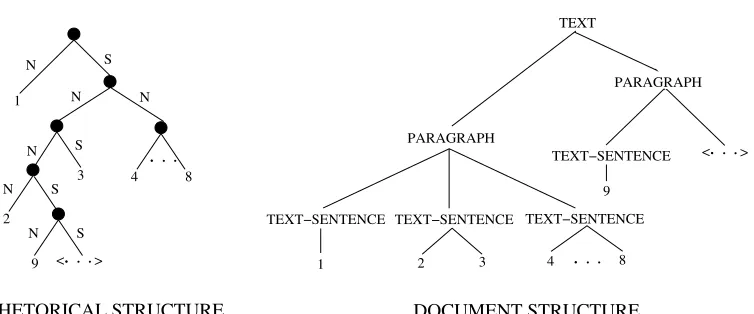
At other times, such as the example in Figure 6, taken from Knott et al. (2001), it is the rhetorical structure that loses out. In this case, the author has decided that the content of the satellite associated with (9) warrants its own paragraph (perhaps for reasons to do with its size).
4. Formal Theory of Document Structure
We will describe here the formal theory of document structure that we have developed as part of the ICONOCLAST system (Power 2000; Bouayad-Agha, Power, and Scott 2000; Bouayad-Agha 2000; Bouayad-Agha, Scott, and Power 2001), which generates multiple versions of the same message in different styles (i.e., with different wording and layout). In describing the theory, we will concentrate on units above the level of text-sentence; our treatment of the lower levels varies only slightly from that in Nunberg’s theory, which is described in great detail in Nunberg (1990).
4.1 Basic Hierarchy of Document Units
Informally it seems clear that units of document structure are ranked: sentences are grouped into paragraphs, paragraphs into sections, sections into chapters, and so forth. The hierarchy of categories differs from one document type to another, but there is always some hierarchy;7 there might for instance be subsubsections and subsections
2 3 .. . .
.. . .
.. . .
< >
.. . .
< > (1) In the women’s quarters the business of running the household took place.
(2) Much of the furniture was made up of chests (3) arranged vertically in matching pairs. ... (4) Female guests were entertained in these rooms, (5) which often had beautifully carved wooden toilet boxes (6) with fold−away mirrors and sewing boxes, (7) and folding screens, (8) painted with birds and flowers.
(9) Chests were used for storage of clothes. ...
1
N S
DOCUMENT STRUCTURE
4 8
TEXT
PARAGRAPH
TEXT−SENTENCE TEXT−SENTENCE
TEXT−SENTENCE
PARAGRAPH
1
N S
N N
4 8
TEXT−SENTENCE
9 3
RHETORICAL STRUCTURE
2
N S
N S
[image:14.612.113.490.174.331.2]9
Figure 6
Another example of nonisomorphic rhetorical and document structures.
between paragraphs and sections. As a basis for discussion, let us assume a hierarchy of six levels, which we will number from 0 (assumed to be the lowest possible level of document structure) to 5:8
0 text-phrase 1 text-clause 2 text-sentence 3 paragraph 4 section 5 chapter
The fundamental organizing principle of document structure is that a unit of a given level is composed of one or more units of the next level down. This observation could be expressed by a set of constituent structure rules, one for each level:
chapter → section+
section → paragraph+ (etc.)
Alternatively, we could generalize over this set of rules by introducing the symbol LN to denote a unit of level N (so that L0 means text-phrase, L1 means text-clause, etc.).
A single rule will now cover units of all levels:
LN→LN−1+ (N>0)
(a)
(b)
SECTION
PARAGRAPH TEXT−SENTENCE PARAGRAPH
PARAGRAPH PARAGRAPH
SECTION
[image:15.612.108.389.88.281.2] [image:15.612.112.376.178.279.2]TEXT−SENTENCE PARAGRAPH
Figure 7
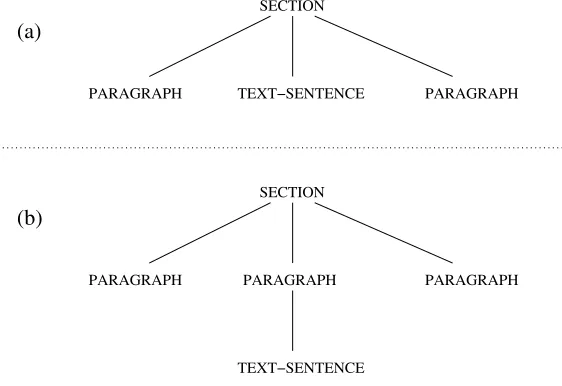
Ill-formed (a) and well-formed (b) document structures.
Two consequences of this rule should be noted. First, it disallows document struc-tures in which a unit contains a subunit of higher level—for instance, a text-sentence may not contain a paragraph. Second, it disallows document structures in which coordinated units have different levels. A section, for example, may not be formed by coordinating two paragraphs and a text-sentence, as in Figure 7(a); the sentence should be the only constituent of a further paragraph unit, as in Figure 7(b), so that when the abstract document structure is realized graphically, the sentence will be formatted with a paragraph break as well as with a capital letter and a period.
This deals with the basic organization of text into hierarchical document units; however, a full description should take account of many other patterns including headings, bulleted lists, footnotes, and figures. We cannot deal with all these pat-terns here, so we focus on what is probably the most complex problem: the treat-ment of indented structures such as quotations, bulleted lists, and enumerated lists.
4.2 Indented Document Units
At first sight it might seem that indentation is a feature of graphical realization rather than underlying structure: in other words, that it belongs to concrete rather than abstract document structure. We have several reasons for rejecting this view. First, it is at least suggestive that both La
TEX and HTML include tags for indented structures:
Pattern HTML tag LATEX tag
Quotation <QUOTE> \begin{quote}
Bulleted list <UL> \begin{itemize}
Enumerated list <OL> \begin{enumerate}
Description list <DL> \begin{description}
preserved:
(13) If you experience any of the following or any other unusual effects, tell your doctor:
Poor appetite or a slight sick feeling Mild abdominal pains or fullness Alterations in your sense of taste Diarrhoea
Itching or rash
Pain in your muscles or joints
If you notice yellowing of the skin or eyes, tell your doctor straight away.
(Lamisil, Sandoz; from APBI 1997)
Third, and most important of all, indented structures may introduce apparent viola-tions of the hierarchical ranking described in the last section: for instance, a sentence may contain a paragraph, provided that the paragraph is indented. We have already seen this in the case of complex conditionals in example (12). However, the phenomenon is much more widespread:
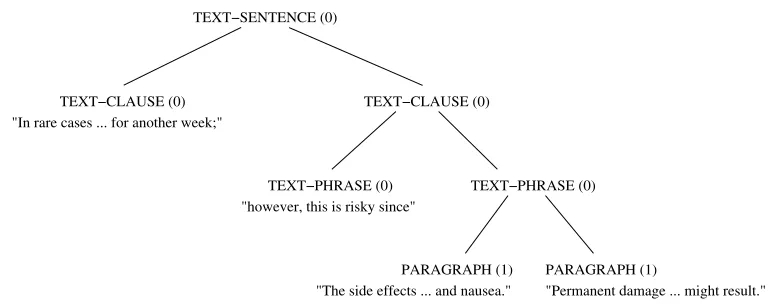
(14) In rare cases the treatment can be prolonged for another week; however, this is risky since
• The side-effects are likely to get worse. Some patients have reported severe headache and nausea.
• Permanent damage to the liver might result.
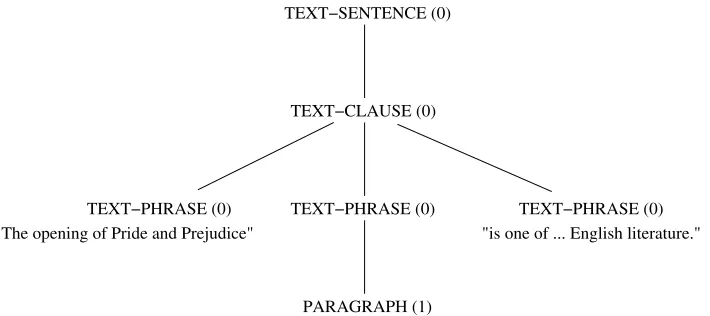
(15) The opening of Pride and Prejudice
It is a truth universally acknowledged, that a single man in possession of a good fortune, must be in want of a wife. However little known the feelings or views of such a man may be on his first entering a neighbourhood, this truth is so well fixed in the minds of the surrounding families, that he is considered as the rightful property of some one or other of their daughters.
is one of the most famous paragraphs in English literature.
In these examples, too, note that the important issue is not graphical indentation, but what we might call logical indentation. Thus in the case of the quotation, the logical indentation of the quoted paragraph might be shown without graphical indentation (e.g., by using a distinctive font or character size):
(16) The opening of ‘Pride and Prejudice’
It is a truth universally acknowledged, that a single man in possession of a good fortune, must be in want of a wife. However little known the feelings or views of such a man may be on his first entering a neighbourhood, this truth is so well fixed in the minds of the surrounding families, that he is considered as the rightful property of some one or other of their daughters.
is one of the most famous paragraphs in English literature.
"however, this is risky since" "In rare cases ... for another week;"
"Permanent damage ... might result." "The side effects ... and nausea."
TEXT−CLAUSE (0)
TEXT−SENTENCE (0)
TEXT−PHRASE (0) TEXT−PHRASE (0)
[image:17.612.99.485.83.236.2]PARAGRAPH (1) PARAGRAPH (1) TEXT−CLAUSE (0)
Figure 8
Indented document structure (example (14)).
to L5(chapter) or whatever hierarchy of units the author decides to employ; the
inden-tation is a value in the range I0. . .IMax, where I0means that the unit is not indented at
all, I1 means it is indented one place, and so forth, with IMaxrepresenting the deepest
embedding that the author is prepared to contemplate. The passages in examples 14–16 can then be described formally as unindented text-sentences (i.e., units with the cat-egory [L2, I0]), which have among their constituents indented paragraphs (units with
the category [L3, I1]). Such structures can be permitted if we change the basic rule of
the last section so that a unit of indentation IN always outranks a unit of indentation
IN+1, no matter what their respective levels may be. Instead of one general rule, we
now need two: the first for unindented constituents, the second for indented ones. Unindented constituents [LN, IM] → [LN−1, IM]+
Indented constituents [LA, IM] → [LB, IM+1]+
In the second rule, LAand LB are unrelated, so LB could represent a higher level than
LA (e.g., a paragraph inside a text-sentence). For most document types one would presumably prefer to set an upper limit on the level of an indented constituent (e.g., an indented chapter seems ridiculous); this could be done for instance by adding the constraint B<4.
Figures 8 and 9 give document structures for examples (14) and (15), respectively; the latter also describes example (16), which differs from (15) only in the graphical realization of the indented paragraph. One feature of these analyses might at first sight appear strange: they assign the minimal text level L0 to the node representing
the quotation or the bulleted list. How, one might ask, can a paragraph, or indeed a list of paragraphs, be regarded as a text-phrase? Should it not be a unit higher than the paragraph, perhaps some kind of section, or better, a new text category vertical list?
"is one of ... English literature." "The opening of Pride and Prejudice"
"It is a truth universally ... daughters." TEXT−SENTENCE (0)
TEXT−CLAUSE (0)
TEXT−PHRASE (0) TEXT−PHRASE (0)
[image:18.612.108.463.86.244.2]PARAGRAPH (1) TEXT−PHRASE (0)
Figure 9
Indented document structure (examples (15) and (16)).
it turns out that in their interactions with discourse connectives, vertical lists behave
like text-phrases, not like sentences, paragraphs, or higher units. Thus the vertical list in
Figure 8 is coordinated with the discourse connective since, which would not normally link constituents higher than text-phrases (we will discuss this constraint more fully in the next section).9
All these difficulties are removed by denying appearances and assigning the vertical-list node a text-level of L0. With this treatment, no new arbitrary level in the
hierarchy of units is needed, the basic rule of document structure holds (i.e., coordi-nated constituents have the same level), and the interaction of the unit with discourse connectives can be described using the same rules that hold for nonindented struc-tures. Note also that the difference in indentation between the node and its daughters is sufficient to identify it as a vertical list; any extra feature (such as a new value in the text-level hierarchy) would be redundant.
5. Methods of Document Structuring
5.1 Defining the Task
The aim of document structuring within NLG is to create a document structure that satisfactorily realizes a particular rhetorical structure. This can be achieved through a variety of architectures, as reflected in the RAGS framework.10 For example, systems aimed at generating technical abstracts or captions for graphics would probably need to specify a “one paragraph only” limit quite early on in the process; in such cases, document structuring would start before any rhetorical or syntactic decisions were made (e.g., the RAGS reimplementation of the Caption Generation System [Mellish et al. 2000]). Alternatively, systems that need to generate texts with rich layout might prefer to interleave document structuring with rhetorical structuring (e.g., Cahill et al. 2001).
For simplicity of presentation, we will assume here an NLG architecture in which a preliminary module selects simple propositions from a knowledge base and organizes them into some kind of argument; the document structurer distributes the various parts of this argument among units like paragraphs and text-sentences; a syntactic realizer takes over in order to determine the wording of the propositions; finally, a formatter decides how the abstract categories and features of document structure will be realized graphically (e.g., whether paragraphs will be marked by a tab on a new line, or by a vertical space). In the context of such an architecture, two issues are crucial: what input does the document structurer receive from the earlier planning module, and how does the output of the document structurer guide syntactic realization?
In ICONOCLAST, our initial assumption, following Scott and Souza (1990), was that the rhetorical structure would take the form of a graph in which terminal nodes represent simple propositions and nonterminal nodes represent rhetorical relation-ships. By organizing all propositions into a single hierarchy, such an input simplifies the task of the document structuring module; indeed, it could be argued that part of the work has been done already. An alternative assumption is that the rhetorical structure takes the form of a set of assertions, each describing a rhetorical relationship between two propositions (Marcu 1997). With this flat representation, the document structurer must take more responsibility for grouping the propositions. In this article, we will focus on the first of these methods (i.e, starting from a hierarchical rhetori-cal input). The second method (starting from a flat rhetorirhetori-cal input) is described in Bouayad-Agha (2001).
Regarding the interface between document structuring and syntax, the difficult issue is where the boundary should be drawn. Above the level of text-clause, it seems clear that syntax plays little part; however, at the level in which text-phrases combine to form text-clauses, there is an interplay between the “syntactic” grammar and the “text” grammar, as Nunberg (1990) has shown. As an example, consider the simple rhetorical structure discussed earlier (example (8) and Figure 2):
concession(contain(elixir, gestodene), approve(fda, elixir))
As mentioned earlier, this rhetorical-semantic input could be realized through a text-sentence comprising two text-clauses:
(8c) Elixir contains gestodene; however, it is approved by the FDA.
In this case it seems clear where the boundary should lie: the document structurer decides that approve(fda, elixir) should be expressed in the first text-clause, and that
contain(elixir, gestodene) should be expressed in the second, along with the
connec-tive however. It might also impose constraints on the clauses that will realize these propositions, for instance, by requiring declarative clauses rather than imperative or interrogative ones. The rest is left to the syntactic realizer, which must decide how the two propositions should be worded, and how the second clause should be combined with the connective. Several alternative versions might result, each having exactly the same document structure:
(8’) Elixir contains gestodene; the FDA, however, approves it.
(8”’) Gestodene is an ingredient of Elixir; Elixir is approved, however, by the FDA.
Suppose, however, that the document structurer decides to realize the two propo-sitions within the same text-clause, as in the following version:
(8””) Elixir is approved by the FDA although it contains gestodene.
Where now does the boundary lie? Should the document structurer create a text-sentence containing a single text-clause, leave instructions that this text-clause should express the whole concession relationship, and then wash its hands of the affair, leaving everything else to the syntactic realizer? Or should it trespass into the domain of syntactic realization by constructing a syntactic clause of the form S1 although S2, with
instructions that a subclause realizing approve(fda, elixir)should be inserted in position
S1and a second subclause realizing contain(elixir, gestodene) in position S2?
In ICONOCLAST we have found it more convenient to adopt the latter policy. The linguistic structure of a document is represented using a single tree in which nodes may be labeled both with document structure features and with syntactic features. The document structurer’s task is to build the upper part of this tree, extending from the root all the way down to the nodes that express simple propositions. In the upper reaches of the tree, nodes will be labeled with units like section and paragraph, and syntactic features will be irrelevant; lower down, the document structure may have to assign some syntactic features when constructing compound clauses. To simplify, we assume that conjunctive adverbs like however will always be placed at the beginning of a clause; this means that discourse connectives can be placed into the tree by the document structurer, thereby limiting the task of the syntactic realizer to the wording of the simple clauses that realize propositions.
Having clarified the document structurer’s task, we posed the following question: given a well-formed rhetorical structure, together with a set of formation rules for document structure and a set of discourse connectives for realizing rhetorical rela-tions, can we enumerate all document structures that correctly realize the rhetorical structure—and further, can we evaluate these document structures by some metric so that we can choose the best? The generation of many alternative solutions was es-sential to the project, which focused on the problem of controlling style in an NLG system: by varying a set of stylistic parameters, the user of the system can influence the evaluation metric that is applied to the set of potential solutions and so influence the type of solution that will be preferred.
As mentioned above, we have explored two methods of enumerating and evaluat-ing document structures, one (the focus of this article) assumevaluat-ing a hierarchical input, the other (described in Bouayad-Agha [2001]) assuming a nonhierarchical input. The two methods have much in common: they share the same formation rules for doc-ument structure, the same discourse connectives, and (mainly) the same constraints on the correct realization of rhetorical relationships. Before describing the hierarchical method in detail, it will be useful to review the constraints that they share; these con-straints will be needed, in some form or other, in any system that performs document structuring.
5.2 Constraints on Realizing Rhetorical Structure
In order to realize a rhetorical structure R(A1, A2) as a document structure, several
• What should be the level (e.g., section, paragraph, text-sentence) of the document unit that realizes the whole relationship R(A1, A2)?
• What should be the levels of the units realizing the arguments A1and A2?
• Should the units realizing A1 and A2 be indented items, or should they
have the same indentation as the unit realizing R(A1, A2)?
• In what linear order should the units realizing A1 and A2 occur?
• Should the rhetorical relation R be expressed using a discourse connective or left implicit?
• If a discourse connective is used, should it be linked to the span realizing A1 or the span realizing A2?
These decisions are closely related, as the following examples show:
• If R(A1, A2)is realized through a text-sentence, then the arguments A1
and A2 cannot be realized through a higher unit, such as a paragraph,
unless they are indented one place further than R(A1, A2). (This follows
from the formation rules for document structure.)
• If R is a nucleus-satellite relation rather than a multinuclear one, the arguments A1 and A2should not be realized through indented items.11
• If a subordinating conjunction like although is used to express the relation R, the arguments A1and A2 should be realized within the same
syntactic clause; hence they should be text-phrases, rather than
text-clauses or some higher unit. Moreover, although should be attached to the clause expressing A1 (assuming this is the satellite).
Constraints arising from the formation rules for document structure have already been covered; we will therefore focus here on constraints that concern the realization of rhetorical relations.
Leaving aside quotations for the time being, our first suggestion is that indentation should be employed only for the arguments of a multinuclear relation. Vertical lists are typically used when the items in the list play the same role in the discourse—for instance, they might be symptoms of a disease or potential side effects of a medicine. By definition, the arguments of a nucleus-satellite relation have different purposes; the nucleus makes the main point, whereas the satellite’s role is supportive. Consider, for example, the following rhetorical structure:
justify(list(tested(elixir), approve(fda, elixir)), safe(elixir))
which gives two reasons why Elixir is safe to use. The LIST relation is multinuclear, whereas JUSTIFYis nucleus-satellite; according to our rule, then, the document struc-tures in (17) and (18) should be avoided, whereas those in (19) and (20) should be
acceptable:
(17) • Elixir is safe to use
• because it has been carefully tested and is approved by the FDA.
(18) • Elixir has been carefully tested and is approved by the FDA, • therefore, it is safe to use.
(19) Elixir is safe to use because • it has been carefully tested • it is approved by the FDA
(20) • Elixir has been carefully tested • Elixir is approved by the FDA Therefore, it is safe to use.
Note that when the arguments of a multinuclear relation are presented within a text-clause, syntax requires a connective like and or or. When they are presented as indented items, the connective is instead often omitted, leaving the relation implicit; the reader has to use common sense to divine whether the list represents a conjunction or a disjunction.
5.2.1 Discourse Connectives. A comprehensive treatment of discourse connectives will not be attempted here, but we will cover the three main categories identified by Knott (1996): subordinating conjunctions, coordinating conjunctions, and conjunctive adverbs.
The properties of a discourse connective can be fully specified by four features: MEANING, SYNTAX, LOCUS, and SPELLING. As examples, here are three definitions for theCONCESSIONrelation:
MEANING concession
SYNTAX subordinating conjunction
LOCUS satellite
spelling ‘although’
meaning concession
syntax coordinating conjunction
locus nucleus
spelling ‘but’
meaning concession
syntax conjunctive adverb
locus nucleus
spelling ‘however’
The locus specifies which argument of the relation carries the discourse connec-tive. For a nucleus-satellite relation, the argument is identified either by nucleus or satellite; for a multinuclear relation it is identified by an ordinal specification such asinitialorfinal.
For each type of discourse connective, it is possible to state specific constraints on the order of arguments, and on the document units that express them.12
5.2.1.1 Subordinating Conjunction. The spans linked by a subordinating conjunction
can be arranged in either order (nucleus first or satellite first) but must be expressed within the same text-clause. For example:
(21) Although it has no significant side effects, never give Elixir to other patients. (22) Never give Elixir to other patients, although it has no significant side effects. (23) # Although it has no significant side effects; never give Elixir to other patients. (24) # Although it has no significant side effects. Never give Elixir to other patients. (25) # Never give Elixir to other patients; although it has no significant side effects. (26) # Never give Elixir to other patients. Although it has no significant side effects.
5.2.1.2 Coordinating Conjunction. Spans linked by a coordinating conjunction can
oc-cur in the same text-clause or in different text-clauses (or higher units) but must be ordered so that the discourse connective is located in the final span (i.e., the second span in the case of a nucleus-satellite relation):
(27) Elixir has no significant side effects, but never give it to other patients. (28) # But never give Elixir to other patients, it has no significant side effects. (29) Elixir has no significant side effects; but never give it to other patients. (30) # But never give Elixir to other patients; it has no significant side effects. (31) Elixir has no significant side effects. But never give it to other patients. (32) # But never give Elixir to other patients. It has no significant side effects.
Of course examples (28), (30), and (32) are prohibited only as a means of realizing a concession relation between the two propositions. They might be acceptable in a text realizing a different rhetorical structure in which the satellite had already been expressed.
5.2.1.3 Conjunctive Adverb. Spans linked by a conjunctive adverb can occur in
differ-ent text-clauses (or higher units), but not in the same text-clause. For a nucleus-satellite relation they must be ordered so that the discourse connective is located in the second span:
(33) # Elixir has no significant side-effects, however, never give it to other patients. (34) # However, never give Elixir to other patients, it has no significant side-effects. (35) Elixir has no significant side-effects; however, never give it to other patients. (36) # However, never give Elixir to other patients; it has no significant side-effects. (37) Elixir has no significant side-effects. However, never give it to other patients. (38) # However, never give Elixir to other patients. It has no significant side-effects.
Again, examples (33), (34), (36), and (38) would be acceptable in realizations of different rhetorical structures in which the satellite had already been presented.
5.3 Planning Document Structure Using Hierarchical Input
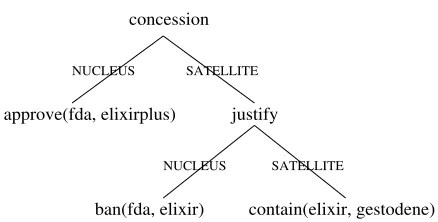
concession
justify approve(fda, elixirplus)
ban(fda, elixir) contain(elixir, gestodene) SATELLITE
NUCLEUS SATELLITE
[image:24.612.103.322.81.192.2]NUCLEUS
Figure 10
Example of rhetorical structure.
of daughter nodes are shown by labels on the arcs (nucleus or satellite in the case of a nucleus-satellite relation, or an integer greater than zero in the case of a multinuclear relation).
The output is a linguistic structure, represented formally by an ordered tree in which each node corresponds to a span of the document. Nodes are labeled with document structure features (e.g., the level and indentation of the unit) and also with syntactic features, which usually become relevant only at the level of text-clause or below. Discourse connectives are already selected and positioned correctly in the tree; the only task left to the syntactic realizer is to elaborate the tree further by generating clauses that express the elementary propositions.
Our aim in ICONOCLAST has been to find a document-structuring method that will generate all document structures that correctly realize an input rhetorical struc-ture, given certain simplifying assumptions about the composition of the document structure and the discourse connectives available in the lexicon. During this initial enumeration of potential solutions, we are not concerned with good style: the pro-cedure should generate clumsy realizations as well as elegant ones. But we do re-quire a minimal standard of correctness. There is no point in considering solutions that leave propositions in the rhetorical structure unexpressed in the document struc-ture or group them wrongly. The strategy is first to define a procedure that gen-erates all solutions that are worth considering at all; using this minimally correct set as a basis, we can then posit further constraints that impose particular stylistic preferences.
We assume that a minimally correct solution must satisfy three conditions:
1. The terminal nodes of the document structure must express all the propositions in the rhetorical structure.
2. In addition to satisfying the document structure formation rules, the solution must conform to correct syntax within text-clauses. For example, two elementary propositions within a text clause must be linked by a conjunction placed in the right position.
3. The document structure must be structurally compatible with the rhetorical structure.
The first two of these conditions are obvious, but the third needs clarification. What exactly is meant by “structurally compatible”?
(a)
approve(fda, elixirplus)
ban(fda, elixir) approve(fda, elixirplus)
contain(elixir, gestodene)
ban(fda, elixir)
(b)
contain(elixir, gestodene)
PARAGRAPH
TEXT−SENTENCE TEXT−SENTENCE
TEXT−CLAUSE
TEXT−CLAUSE TEXT−CLAUSE
TEXT−SENTENCE TEXT−SENTENCE
PARAGRAPH
[image:25.612.106.379.86.201.2] [image:25.612.107.392.233.305.2]TEXT−SENTENCE
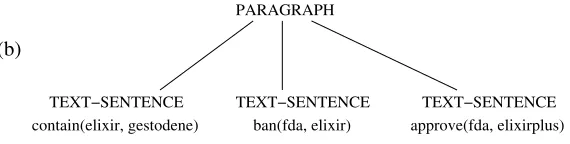
Figure 11
Isomorphic (a) and homomorphic (b) document structures.
1991; Bouayad-Agha, Power, and Scott 2000). Each notion can be conveniently ex-pressed in terms of groupings of propositions in the rhetorical structure and the dis-course structure. For an isomorphism (the strongest definition of compatibility), two conditions must hold:
1. If a node in the document structure represents a span in which the set of propositions expressed is P, there must be a corresponding node in the rhetorical structure that dominates exactly the same set P of propositions. 2. If a node in the rhetorical structure dominates a set P of propositions,
there must be a node in the document structure representing a span in which exactly this set P is expressed.
Informally, for an isomorphism, all groupings of propositions in the rhetorical struc-ture must be transmitted faithfully to the document strucstruc-ture, and no new groupings should be introduced. For a homomorphism from rhetorical structure to document structure, only the first condition is required to be fulfilled. Any grouping found in the document structure must correspond to a grouping in the rhetorical structure, but the document structure may “flatten out” the rhetorical structure by leaving some groupings unexpressed.
remaining implicit. Here are two texts that might result:
(39)
(a) Elixir contains gestodene; therefore, it is banned by the FDA. However, the FDA ap-proves ElixirPlus.
(b) Elixir contains gestodene. Therefore, it is banned by the FDA. However, the FDA ap-proves ElixirPlus.
Note that by losing a grouping from the rhetorical structure, (39b) introduces an ambiguity: its form would also be consistent with an alternative rhetorical structure in which the relationjustifydominatedconcession. From the point of view of express-ing the rhetorical input precisely, the isomorphic solution is always better. However, when the resulting document structure is complex, or when the correct interpretation can be inferred easily from the content, there might be stylistic reasons for preferring a looser homomorphic solution. As a criterion for generating all minimally correct solutions, therefore, we believe the homomorphic definition of compatibility is more appropriate.13
Having decided what counts as a correct solution, our next task is to find an efficient algorithm that will generate all and only these solutions. In ICONOCLAST, this is accomplished through a constraint-solving method that formalizes the options for realizing each part of the rhetorical structure, then eliminates those combined choices that violate constraints. The technique has been explained fully elsewhere (Power 2000), so we will confine ourselves here to a sketch of the main points.
For each node NR on the rhetorical structure, we can lay out some options on how the rhetorical fragment dominated by this node will be realized in the document structure. The crucial choices are as follows:
• What should be the level and indentation of the document structure node that realizes the proposition or relationship NR?
• If NRis a nonterminal node, labeled with a rhetorical relation, what discourse connective (if any) should express this relation in the document structure?
• If NRis nonterminal, in what linear order should its daughter nodes be realized in the document structure?
These decisions can be formalized by associating with each node four variables that we will call level, indentation, connective, and position. The potential values of these variables represent options for realizing the relevant part of the rhetorical structure, and these options will be reduced by considering constraints on which
com-binations of values are allowed. Initially, the possibilities are as follows:
level: The level of the document structure unit realizing NR will be a document unit along the hierarchy from text-phrase to chapter. In the program, it
13 We actually believe that even the less strict requirement of a homomorphism from RS to DS is too strong, because one occasionally finds natural texts that violate it. For example, in Figure 4, RS and DS are not only nonisomorphic, but nonhomomorphic, because there is a grouping in the DS (propositions
A, D, E) that is not found in the RS (no node in the RS dominates just these three propositions). This
is convenient to represent this with an integer, so that constraints on a higher or lower level can be implemented using the operations>and <; we will here continue the notation introduced in Section 4.1, in which L0
means text-phrase, L1 means text-clause, and so forth.
indentation: The indentation of the document structure unit will be a value in the range I0 to IMax, as explained in Section 4.2. Again, in the
implemen-tation, it is convenient to use an integer.
connective: The value of this variable is either ∅, meaning that no connective should be used, or a word from the lexicon. Thus if the node NR has the labelconcession, the potential values might be∅, although, but, and
however.
position: This variable represents the order in which NR will be realized in the document structure, in comparison with its sisters. The value must lie in the range 1. . .S, where S is the total number of sisters (including NR). Thus if NRis an argument in a nucleus-satellite relation, the range will be 1. . .2; if it is an argument in a multinuclear relation, the range may be larger.
The solution process consists in determining the set of options for each variable (these are known in constraint logic programming as the domain of the variable), then im-posing constraints on combinations of values, then enumerating all combinations that satisfy the constraints. Each admissible combination of values can then be used as a blueprint for building one of the document structures that may realize the input rhetor-ical structure. The constraints imposed during the second phase of this algorithm are essentially those described in the last section.
6. Examples of Document Structuring
We now give two examples of the document-structuring method outlined in the last section. First, we look in detail at a very simple task, to make it clear how the method works. Then we show some output for a more complex task, for which the program will generate dozens of solutions even if the wording of individual propositions is held constant.
6.1 Simple Example
To view the document-structuring method from close up, we will use a simplified version of the task discussed in the last section. The rhetorical structure will comprise just two propositions linked by aconcessionrelation:
concession(ban(fda, elixir), approve(fda, elixirplus))
The method works by computing the options for realizing each constituent of the rhetorical structure, where a constituent is any node in the rhetorical structure tree along with its descendents. Thus in the present example there are three constituents— the two propositions and the whole relationship—and for convenience we will label them as follows:
A: approve(fda, elixirplus) B: ban(fda, elixir)