Incremental Processing and Acceptability
G l y n M o r r i l l *
Universitat Polit~cnica de Catalunya
We describe a left-to-right incremental procedure for the processing of Lambek categorial grammar by proof net construction. A simple metric of complexity, the profile in time of the number of unresolved valencies, correctly predicts a wide variety of performance phenomena including garden pathing, the unacceptability of center embedding, preference for lower attachment, left-
to-right quantifier scope preference, and heavy noun phrase shift.
1. Introduction
Contemporary linguistics rests on abstractions and idealizations which, however fruit- ful, should eventually be integrated with human computational performance in lan- guage use. In this paper we consider the case of language processing on the basis of Lambek categorial grammar (Lambek 1958). We argue that an incremental procedure of proof net construction affords an account of various processing phenomena, including garden pathing, the unacceptability of center embedding, preference for lower attach- ment, left-to-right quantifier scope preference, and heavy noun phrase shift. We give examples of each of these phenomena below.
Garden pathing (Bever 1970) is illustrated by the following contrasts:
(1) a. The horse raced past the barn. b. ?The horse raced past the barn fell.
(2) a. The boat floated d o w n the river. b. ?The boat floated d o w n the river sank.
(3) a. The dog that knew the cat disappeared.
b. ?The dog that knew the cat disappeared was rescued.
Typically, although the b sentences are perfectly well formed they are perceived as being ungrammatical due to a strong tendency to interpret their initial segments as in the a sentences.
The unacceptability of centre embedding is illustrated by the fact that while the nested subject relativizations of (4) exhibit little variation in acceptability, the nested
object relativizations (5) exhibit a severe deterioration in acceptability (Chomsky 1965, Chap. 1).
(4) a. The dog that chased the cat barked.
b. The dog that chased the cat that saw the rat barked.
c. The dog that chased the cat that saw the rat that ate the cheese barked. (5) a. The cheese that the rat ate stank.
b. ?The cheese that the rat that the cat saw ate stank.
c. ??The cheese that the rat that the cat that the dog chased saw ate stank.
Discussing such center embedding, Johnson (1998) presents the essential idea devel- oped here, noting that processing overload of dependencies invoked in psycholin- guistic literature could be rendered in terms of the maximal number of unresolved dependencies as represented b y proof nets.
Kimball (1973, 27) considers sentences such as (6), which are three ways am- biguous according to the attachment of the adverb. He points out that the lower the attachment of the adverb, the higher the preference (he calls this relationship Right Association).
(6) Joe said that Martha believed that Ingrid fell today. Left-to-right quantifier scope preference is illustrated by:
(7) a. Someone loves everyone. b. Everyone is loved b y someone. Both sentences exhibit both quantifier scopings:
(8) a.
~xVy(love y x)
b. Vy3x(love y x)
However, while the dominant reading of (7a) is (8a), that of (7b) is (8b), i.e., the preference is for the first quantifier to have wider scope. Note that the same effect is observed when the quantifiers are swapped:
(9) a. Everyone loves someone. b. Someone is loved b y everyone.
While both sentences in (9) have both quantifier scopings, the preferred readings give the first quantifier wide scope.
Morrill Incremental Processing and Acceptability
(10) a. ?John gave the painting that Mary hated to Bill. b. John gave Bill the painting that Mary hated.
We argue that a simple metric of categorial processing complexity explains these and other performance phenomena.
2. Lambek Calculus
We shall assume some familiarity with Lambek categorial grammar as presented in, for example, Moortgat (1988, 1997), Morrill (1994), or Carpenter (1998), and limit ourselves here to reviewing some central technical and computational aspects.
The types, or (category) formulas, of Lambek calculus are freely generated from a set of primitives by the binary infix connectives " / " (over), "V' (under) (directional divisions) and "-" (product). With respect to a semigroup algebra (L, +) (i.e., a set L closed under an associative binary operation + of adjunction), each formula A is interpreted as a subset [A] of L by residuation as follows:
(11)
~[a.B]] ~- ($1q-82]$1 E ~ a ] & s 2 E ~B~} ~AkB]] = {sirs' C [[AB, s'+s E HB]]} ~B/A] -- (sirs' E [[A~,s+s' E ~B]I}A sequent, F ~ A, comprises a succedent formula A and an antecedent configuration F, which is a a finite sequence of formulas. 1 A sequent is valid if and only if in all inter- pretations the ordered adjunction of elements inhabiting the antecedent formulas al- ways yields an element inhabiting the succedent formula. The following Gentzen-style sequent presentation is sound and complete for this interpretation (Buszkowski 1986, Dogen 1992), and indeed for free semigroups (Pentus 1994): hence the Lambek calculus can make an impressive claim to be the logic of concatenation; a parenthetical notation A(F) represents a configuration containing a distinguished subconfiguration F.
F ~ A A ( A ) ~ B Cut (12) a. A ~ A id " A(F).::~ B
F ~ A A(B) ~ C \ L A , F ~ B \ R b. A ( F , A \ B ) =~ C F ::~ AkB
F ~ A A(B) ~ C F , A = ~ B / R c. & ( B / A , F ) ~ C /L r ~ B / A
F , A , B , A ~ C F ~ A A =~ B
• L .R
d. F,A.B,A ~ C F,A =~ A.B
By w a y of example, "lifting" A ~ B/(A\B) is generated as follows: (13)
A =~ A B=~ B \ L A , A \ B ~ B
A ~ B/(A\B) / R
And "composition" A\B, B\C ~ A \ C can be derived thus:
(14) B o B C ~ C \ L
A ~ A B, B\C ~ C
A,A\B, B\C ~ C A\B,B\C ~ A\C \R
Every rule, with the exception of Cut, where the Cut formula A does not appear in the conclusion, has exactly one connective occurrence less in its premisses than in its conclusion. Lambek (1958) proved Cut elimination--that every proof has a Cut- free counterpart--hence a decision procedure for theoremhood is given by backward- chaining proof search in the Cut-free fragment. The nonatomic instances of the id axiom are derivable from atomic instances by the rules for the connectives. But even in the Cut-free atomic-id calculus there is spurious ambiguity: equivalent derivations differing only in irrelevant rule ordering. For example, composition as above has the following alternative derivation:
(15) A = ~ A B ~ B \ L
A , A \ B ~ B C ~ C
A , A \ B , B\C =~ C A \ B , B \ C =~ A \ C \ R
\C
One approach to this problem consists in defining, within the Cut-free atomic-id space, normal form derivations in which the succession of rule application is regulated (K6nig 1989, Hepple 1990, Hendriks 1993). Each sequent has a distinguished category formula (underlined) on which rule applications are keyed:
(16) a. P ~ P id
a(A) ~ B A(.a) ~ B_
r ~ 4 a ( B ) ~ c \L A , F ~ B \R
b. a(F,A\B) ~ C r ~ A\B
r ~ A & ( ~ ) ~ C r , A ~ B
c. A ( B / A , F ) ~ C /L F ~ B / ~ / R
A ~ A F ~ B
- - . R
d. A , F ~ A . B
Morrill Incremental Processing and Acceptability
An alternative formulation (Ades and Steedman 1982, Steedman 1997), which from its inception has emphasized a capacity to produce left-branching, and there- fore incrementally processable, analyses, is comprised of combinatory schemata such as the following (together with a Cut rule, feeding one rule application into an- other):
(17) a. A , A \ B => B B / A , A =~ B
b. A ~ ( B / A ) \ B A ~ B / ( A \ B )
c. A \ B , B \ C ~ A \ C C / B , B / A =~ C / A
By a result of Zielonka (1981), the Lambek calculus is not axiomatizable by any fi- nite set of combinatory schemata, so no such combinatory presentation can constitute
the logic of concatenation in the sense of Lambek calculus. Combinatory categorial
grammar does not concern itself with the capture of all (or only) the concatenatively valid combinatory schemata, but rather with incrementality, for example, on a shift- reduce design. An approach (also based on regulation of the succession of rule ap- plication) to the associated problem of spurious ambiguity is given in Hepple and Morrill (1989) but again, to our knowledge, there is no predictive relation between incremental combinatory processing and the kind of processing phenomena cited in the introduction.
3. P r o o f N e t s
Lambek categorial derivations are often presented in the style of natural deduction or sequent calculus. Here we are concerned with categorial proof nets (Roorda 1991) as the fundamental structures of proof in categorial logic, in the same sense that lin- ear proof nets were originally introduced by Girard (1987) as the fundamental struc- tures of proof in linear logic. (Cut-free) proof nets exhibit no spurious ambiguity and play the role in categorial grammar that parse trees play in phrase structure gram- mar.
Surveys and articles on the topic include Lamarche and Retor¢ (1996), de Groote and Retor¢ (1996), and Morrill (1999). Still, at the risk of proceeding at a slightly slower pace, we aim nonetheless to include here enough details to make the present paper self-contained.
A polar category formula is a Lambek categorial type labeled with input (°) or output (o) polarity. A polar category formula tree is a binary ordered tree in which the leaves are labeled with polar atoms (literals) and each local tree is one of the following (logical) links:
A ° B" .. B ° A" .
- - U - - 1
(18) a. A \ B ° A \ B °
B • A o . . A ° B o .
b. B / A . 11 B/AO 1
A ° B" . B ° A ° ..
c. A.B ° 1 A-B ° 11
d a u g h t e r s are labeled with the i m m e d i a t e s u b f o r m u l a s of their mothers. The polar- ities indicate sequent sidedness, i n p u t for a n t e c e d e n t a n d o u t p u t for succedent; the polarity p r o p a g a t i o n follows the sidedness of s u b f o r m u l a s in the s e q u e n t rules: in the
a n t e c e d e n t (input) rule for A \ B the s u b f o r m u l a A goes in a succedent (output) a n d the
s u b f o r m u l a B goes in an a n t e c e d e n t (input); in the succedent (output) rule for A \ B the
s u b f o r m u l a A goes in an a n t e c e d e n t (input) a n d the s u b f o r m u l a B goes in a s u c c e d e n t (output); etc. The labels i a n d ii indicate w h e t h e r the c o r r e s p o n d i n g s e q u e n t rule is u n a r y or binary. N o t e that in the o u t p u t links the o r d e r of the s u b f o r m u l a s is switched; this c o r r e s p o n d s to a cyclic r e a d i n g of sequents: the succedent type is adjacent to the first a n t e c e d e n t type.
A proof frame is a finite sequence of polar category f o r m u l a trees, exactly one of w h i c h has a root of o u t p u t polarity ( c o r r e s p o n d i n g to the u n i q u e s u c c e d e n t of sequents).
An axiom linking on a set of literal labeled leaves is a partitioning of the set into pairs of c o m p l e m e n t a r y leaves that is planar in its ordering, i.e., there are n o
t w o pairs {L1,LB},{La, L4} such that L1 < L2 < L3 < L4. Geometrically, planarity
m e a n s that w h e r e the leaves are o r d e r e d on a line, paired leaves can be c o n n e c t e d in the half p l a n e w i t h o u t crossing. A x i o m links c o r r e s p o n d to id instances in a s e q u e n t proof.
A proof structure is a p r o o f f r a m e together w i t h an axiom linking o n its leaves. A p r o o f net is a p r o o f structure in w h i c h e v e r y e l e m e n t a r y (i.e., visiting vertices at m o s t once) cycle crosses the edges of some i-link. 2 Geometrically, an e l e m e n t a r y cycle is the p e r i m e t e r of a face or cluster of faces in a p l a n a r p r o o f structure. T h e r e is a p r o o f net
w i t h roots A ° , A I " , . . . ,An" iff A 1 , . . . , A , ~ A is a valid sequent.
4. Incremental Processing Load and Acceptability
Let us a s s u m e the following lexical assignments:
(19)
barn - barn
:= C N
horse - horse
:= C N
past - )~x)~y)~z(past x (y z))
:= ( ( N \ S t ) \ ( N \ S t ) ) / N
raced - race
:= N \ S +
the - the
:= N / C N
The feature + on S m a r k s the projection of a t e n s e d verb form; a v e r b p h r a s e m o d i f i e d
b y past n e e d not be tensed. Let us consider the i n c r e m e n t a l processing of (la) as p r o o f
2 This criterion, adapted from that of Lecomte and Retor6 (1995), derives from Girard's (1987) long trip condition, which is an involved mathematical result. Danos and Regnier (1989) express it in terms of acydicity and connectivity of certain subgraphs. Intuitively, acyclicity assures that the subformulas of
ii-links (binary rules) occur in different subproofs, whereas connectivity assures that the subformulas of
i-links (unary rules) occur in the same subproofs (attributed to Jean Gallier by Philippe de Groote, p.c.).
Morrill Incremental Processing and Acceptability
net construction. 3 In the first case, we suppose that one initially expects some target
category, perhaps (though not necessarily) S. This 'principle of expectation' seems a reasonable or obvious principle of communication; as we shall see, it turns out to
be technically critical. After perception of the w o r d the there is the following partial
proof net (for simplicity we omit features, included in lexical entries, from proof nets themselves):
(20)
N " i i GN °
\ /
S ° N / G N "
the
Here there are three u n m a t c h e d v a l e n c i e s / u n r e s o l v e d dependencies; no axiom links
can yet be placed, but after horse we can build:
(21)
S*
I I
I I
N " i i GN ° I
\ /
:
N / G N ° CN"
the horse
N o w there are only two u n m a t c h e d valencies. After raced we have, on the correct
analysis, the following:
(22)
I I
t I
N * i i CN* I N ° i i S"
\ /
:
\ /
S ° N / C N " CN" N \ S "
the horse raced
Note that linking the Ns is possible, b u t we are interested in the history of
the correct analysis, a n d in that, the verb valencies are m a t c h e d b y the adverb that
follows (henceforth we indicate only the principal connective of a mother node): (23)
S °
I I
I I
N " ii C N * I N ° i i S °
\ /
',
\ /
/ CN" \
I I
I I
I I
S ° i N "
\ /
\I I I I I
N ° i i S °
\ /
i i \
!
N *
the horse raced p a s t
Observe that a cycle is created, but as required it crosses the edges of an i-link. At the penultimate step we have:
(24)
S °
I I
I I
I I
S ° i N °
\ /
\\
_ mI t I I
I [ I I
N ° i i C N ° I N ° ii S" N ° N " ii C N °
\ /
',
\ /
\ /
I CN" \ I
I I I I I
N * ii S"
\ /
i i \
the horse raced past the
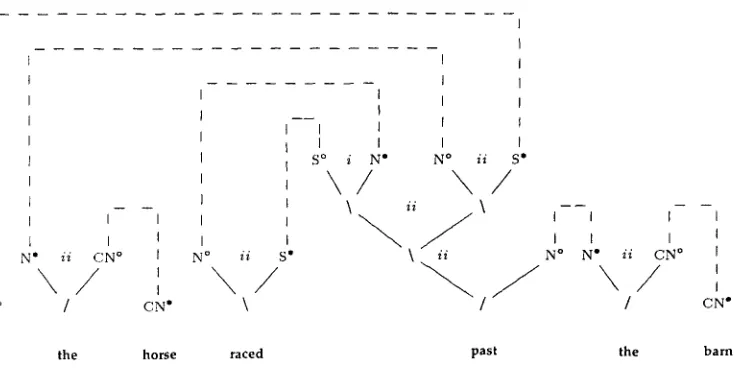
The final proof net analysis is given in Figure 1.
The semantics associated with a categorial proof net, i.e., the proof as a lambda term (intuitionistic natural deduction proof, under the Curry-Howard correspondence) is extracted by associating a distinct index with each output division node and travel- ing as follows, starting by going up at the unique output root (de Groote and Retor6 1996):
Morrill Incremental Processing and Acceptability
I I
I I
N " ii CN ° I
\ /
,I S ° / CN"
I I
I I I
J
I I I I I
I I S° i N* N ° ii S*
, ,
\ /
\ /
] [ \ ii \
I I
N ° ii S ° \ ii
\ /
I I I I
I I I I
N ° N" ii CN" t
\ /
,I / CN"
[image:9.468.43.410.57.247.2]the horse raced past the barn
Figure 1
Proof net analysis of (la) the horse raced past the barn.
traveling up at one end of an axiom link, continue down at the other end;
traveling down at an (input) daughter of an input division link, perform the functional application of the result of traveling down at the mother to the result of traveling up at the other (output) daughter;
traveling down at the left (respectively, right) daughter of an input product link, take the first (respectively, second) projection of the result of traveling down at the mother;
traveling down at the (input) daughter of an output division link, return the associated index;
traveling down at a root, return the associated lexical semantics. Thus for our example we obtain (26a), which is logically equivalent to (26b).
(26) a. (&x&y&z(past x (y z)) (the barn) M(race 1) (the horse)) b. (past (the barn) (race (the horse)))
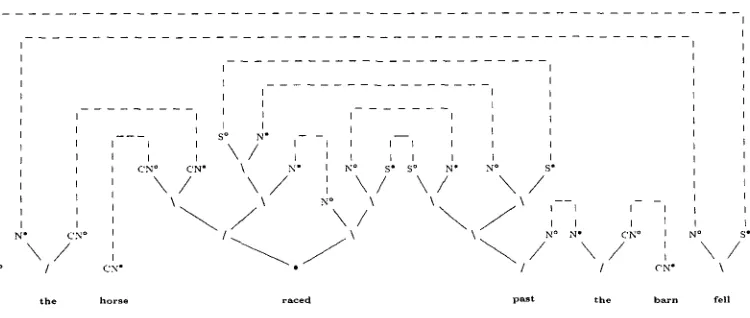
The analysis of (lb) is less straightforward. Whereas in (la) raced expresses a one- place predication ("go quickly"), in (lb) it expresses a two-place predication (there was some agent racing the horse); horse is modified by an agentless passive participle, but the adverbial past the barn is modifying race. Within the confines of the Lambek calculus, the characterization we offer assumes the lexical assignment to the passive participle given in the following: 4
I . . . I I I I -- . . . I
SIo I I I
I --- 1 N . . . .
I I I I [ I I I I
' I , ~ / I I , S I. SIo /.
C N ° C N ° \ N" I N °
\ / \ / ', \ / \ /
\ g o \ \
\ /
\
/ \ \
I
I
I I
N * C N ° \ /
/
I I
1 I
I I I
I I [ I
S ° CN"
I t
, I
i SI°
N ° \ /
, , N ° N •
/
I I
I I
C'N° I \ / ,
/ CN °
N ° S • \ /
\
[image:10.468.46.421.52.211.2]t h e h o r s e r a c e d
Figure 2
Proof net analysis of (lb) the horse raced past the barn fell.
p ~ t t h e barn fell
(27) fell - fall
:= N \ S +
raced - (Ax)~yAz[(y z) A ~w(x z w)],race2)
:= ((CN\CN) / ( N \ ( N \ S - ) ) ) . ( N \ ( N \ S - ) )
Here raced is classified as the product of an untensed transitive verbal type, which can be modified by the adverbial past the barn b y composition, and an adnominalizer of this transitive verbal type. According to this, (lb) has the proof net analysis given in Figure 2. The semantics extracted is (28a), equivalent to (28b)
(28) a. (fall (the (Tra(&xAy&z[(y z) A 3w(x z w)], race2) )~29~30 ()~uAv)~w(past u (v w)) (the barn) M I ( (
(Tr2(/~p/~s&t[(s t) A 3q(p t q)], race2) 29 41) 30) horse))) b. (fall (the)~8[(horse 8) A 37(past (the barn) (race2 8 7))]))
Let us assign to each proof net analysis a complexity profile that indicates, before and after each word, the number of unmatched literals, i.e., unresolved valencies or dependencies, under process at that point. This is a measure of the course of memory load in optimal incremental processing. We are not concerned here with resolution of lexical ambiguity or serial backtracking: we are supposing sufficient resources that the nondeterminism of selection of lexical entries and their parallel consideration is not the critical burden. Rather, the question is: which among parallel competing analyses places the least load on memory?
Since entropy degrades the structure of memory, it requires more energy to pursue an analysis that is high cost in memory than to pursue one that is low cost. From these simple economic considerations we derive our main claim:
(29) Principle of Acceptability
Acceptability is inversely proportional to the sum in time of the memory load of unresolved valencies.
Morrill Incremental Processing a n d A c c e p t a b i l i t y
~'\S ~°
~ ° \ /
. . . i i . . . I . . . i t . . . i
i J i t i
', I ', 1 1 Ii '~ I slo i , ,
cN~ / • . . . • .\ / \ / . . i--', . . . 'N~ ~'N" / \ 7 " N~ / " I--i :- ,, --
~o N" c'x o
\ \ \ x ° N" ~'~° \ \ \
~ / \ / \ / ~ / \ / \ / r
[image:11.468.39.417.58.144.2]<:.x, / I i <N ° / i i C'N*
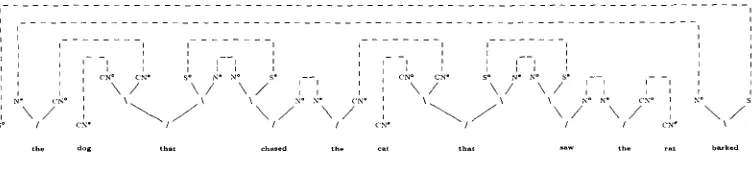
Figure 3
Proof net analysis of (4b) the dog that chased the cat that saw the rat barked.
the complexity curve, the higher the preference for the form of expression. In the case of ambiguity, prosodics is constant. It is then predicted that amongst the readings of an ambiguous expression, the lower the complexity curve, the more dominant the reading. The complexity profile is easily read off a completed proof net: the complexity between two words is the number of axiom links bridging rightwards (forwards in time) at that point. Thus for (la) and (lb) analyzed in Figures 1 and 2, the complexity profiles are as follows:
(30) 6 b
5
4 b a
3 ab b b
2 a b
1 ab a a
0 a
a. the h o r s e raced p a s t the b a r n b. the horse raced p a s t the b a r n fell
We see that after the first two words the complexity of the locally ambiguous initial segment of (lb) is consistently higher than that of its garden path (la). The areas of the a and b curves are 12 and 22 respectively, predicting that in (lb) the less costly but incorrect analysis could be salient, as indeed it is.
Johnson (1998) considers center embedding for subject and object relativization from a similar point of view. We assume here the relative pronoun lexical assignments shown in (31). s
(31) that - AxAyAz[(y z) A (x z)]
:= ( C N \ C N ) / ( N \ S + )
t h a t - AxAyAz[(y z) A (x z)]
:= ( C N \ C N ) / ( S + / N )
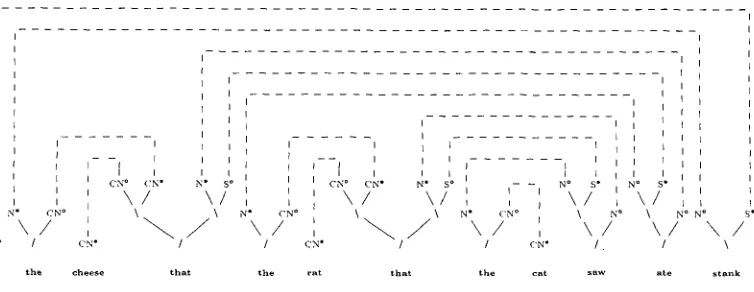
The proof net analysis of sentence (4b) is shown in Figure 3, and that of sentence (5b) is shown in Figure 4. Let us compare the complexities:
(32) 9 b
8 b
7 b b
6 b
5 b
4 ab ab a a
3 ab a a a a
2 ab
1 ab
0 ab
a. the d o g t h a t c h a s e d the cat t h a t s a w the rat b a r k e d b. the cheese t h a t the r a t t h a t the cat s a w ate s t a n k
8 °
I
_ _ f
I ,
C N ° C N " N ° S °
\ / \ /
N " C N ° \ \
/ CN" /
N " C N °
\ /
!
. . . I . . . .
I I I I
I i ' ' ' I '
I SlO I S~°
C N ° C N ° N * - - ~ N ° .
\ / \ / ' , , \ /
NI° I I
\ \ ( ' N ° \ N °
\ / ', \ /
C N * / / C N ° / .
N\
?"
\ N ° N o S •
\ / \ /
! \
t h e c h e e s e t h a t t h e r a t
F i g u r e 4
Proof net analysis of (5b) the cheese that the rat that the cat saw ate stank.
The profile of (5b) is higher; indeed it rises above 8, thus reaching what is usually taken to be the limit of short-term memory. Johnson attributes the increasing ill-formedness of centre embedded constructions to the number of incomplete dependencies at the "maximal cut" of a proof net. This almost corresponds to the maximum height of a complexity profile here, except Johnson includes no target category, whereas we will argue in relation to quantifier scope preference that this is critical. However, we also differ from Johnson in attributing relative acceptability to the area under the complexity curve, not only its maximal height. This is because we believe acceptability is to be explained in terms of the energy required to maintain processes in memory over time, and not just in terms of peak memory load. Finally, it happens that our proposal solves a problem encountered by Johnson. Gibson and Thomas (1996) observe that (33a) is easier to comprehend than (33b).
(33) a. The chance that the nurse who the doctor supervised lost the reports
bothered the intern.
b. ?The intern who the chance that the doctor lost the reports bothered supervised the nurse.
Johnson notes that his proposal does not capture this difference since both sentences have the same size maximal cut. Under our account, on the other hand, it is the com- plexity curves as a whole that account for acceptability. In these sentences, although the height is the same, the complexity curves are not: the area of (33a) is less than that of (33b). 6 Thus, whereas Johnson must look to other factors to explain this difference, our account makes the correct prediction.
6 T o s a v e s p a c e w e e x c l u d e t h e p r o o f n e t s ; t h e c u r v e s a r e :
ab
ab
ab ab
b ab ab b b
a b
b b a
a a a a
ab
[image:12.468.46.423.55.201.2]Morrill Incremental Processing and Acceptability
I
I I
F . . . I
i 1 1 I
I . . . I-- --
I ~ I I I I
I I I . . . . . . . . . . . . . . . I I l
I I F I I I I I I I
I I I r-- ~ - - I I--I I I- -t I 1 I r
, I I I i I I II I ' I I I i i I I I
N, (N \ S) / CP, GP / S, N, (N \ S) / CP, CP / S, N, N \ S. (N \ S) \ (N \ $)
Joe s M d t h a t
t
I I I
' - ~ I I I
S, N, {N \ / CP / S.
M a r t h a b e l i e v e d t h a t I n g r i d fell t o d a y
. . . I
p . . .
I I
i i
I . . . i _ _
i E i
I i . . . i i
i i i I I I
l i - - i - - i i r
I i i i i
(N \ S) / CP, CP / S, N, N \ S, (N \ )
I
I I
t I
I
I
\ (N \ s)
Joe s a i d t h a t M a r t h a b e l i e v e d t h a t
I i i I , , I ] Ij I II I[
I ~ I ! I I I
S, X. (N \ S) / CP, CP / S. N. (N \ S) / CP. GP
I n g r i d fell t o d a y
I
. . . I
I I I
I -- -- -- I T
I [ I
, I , 1 I i I
N. N \ S. (N \ S) \ (N \ S)
Joe s a i d t h a t M a r t h a b e l i e v e d t h a t I n g r i d fell today
Figure 5
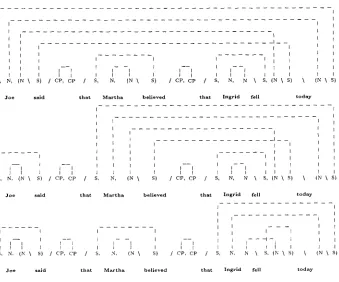
Proof net analyses for (34) Joe said that Martha believed that Ingrid fell today, with lowest (top), middle (center), and highest (bottom) attachment of the adverb today.
5. Preferred Readings
The examples so far involve comparison of different expressions, having many differ- ences to which their relative acceptabilities could be attributed. More factors would be held constant by comparing alternative readings of an ambiguous expression, and most appropriately of all, a structurally ambiguous expression, where there is no lexi- cal alternation. Consider the ambiguity that arises in a sentence such as (34) (repeated from (6)) from the possibility of attaching the adverb at different syntactic levels. As we saw in the introduction, the lower the attachment of the adverb in such sentences, the higher the preference (Kimball 1973, 27).
(34) Joe said that Martha believed that Ingrid fell today.
In Figure 5 we give the analyses for the lowest, the middle, and the highest attach- ments. We now abbreviate proof nets by flattening formula trees into their linear rep- resentations (since this conceals the order switching of output links, the notation belies the underlying planarity, but the portrayal of word-by-word complexity is unaltered). Accordingly, the complexity profiles are:
(35) 6 c bc
5 c c b c b c
4 a b c
3
2 a b c a b a
1 a b c a b a b a a
0 a b c
a. l o w e s t a t t a c h m e n t
b . J o e s a i d t h a t M a r t h a b e l i e v e d t h a t I n g r i d f e l l t o d a y m i d d l e a t t a c h m e n t
[image:13.468.41.380.53.335.2]I I I I I I
I I L i
1 i i I I I i t t i I I
N, N / CN, CN, {GN \ CN)
I I
/ (N
I I
I I
I
- - - - --I-- I i i I I I )
i I I I I t I I
\ s), (N \ s) / N, N. N \ IN / CN), ON
the book that shocked Mary 's title
I I i f i t
i I I i I I I I- I i I I i I I I i i I I i I I I I i I I I I I i
N. N / CN. CN. (ON \ ON) / (N \ S), (N \ s) / N. N, N \ (t," / CN), CN
the book that shocked Mary 's title
Figure 6
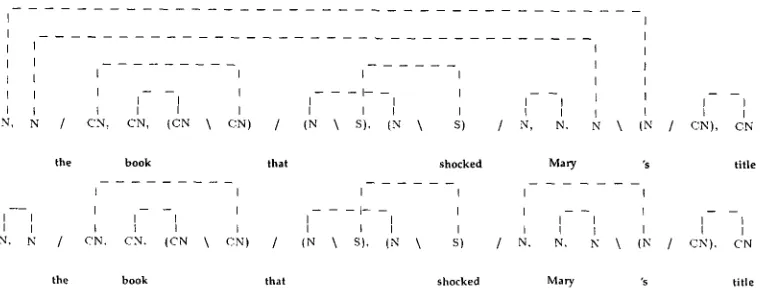
Proof net analysis for the sensical (top) and nonsensical (bottom) interpretations of (36)
the
book that shocked Mary's title.
The same effect occurs strongly in (36), where the preferred reading is the one given b y the lowest attachment, even t h o u g h that one is the nonsensical reading.
(36) the book that shocked M a r y ' s title
The analyses are given in Figure 6. The complexities are thus:
(37) 4 a a
3 a a
2 b b ab
1 ab b b ab
0
a.
the b o o k that s h o c k e d M a r y "s title
b.
ab
sensical nonsensical
6. Left-to-right Quantifier Scope Preference
Let us consider n o w another instance of ambiguity: quantifier scope preference. A r u d i m e n t a r y account of sentence-peripheral quantifier phrase scoping is obtained in Lambek calculus b y m e a n s of lexical assignments such as the following: 7
(38) everyone -
)~xVy(x y)
:=
St/(N\St)
everyone -
)~xVy(x y)
:=
(St/N)\St
someone -
)~x3y(x y)
:=
St/(N\St)
someone -
)~x3y(x y)
:=
(St/N)\St
Given these assignments, one analysis of (7a) is that given in Figure 7. This is the subject w i d e scope analysis: its extracted a n d simplified semantics are as in (39).
[image:14.468.43.424.54.204.2]Morrill Incremental Processing and Acceptability
I I I I I s ° I L
s °
I
J f
I I I I
I I I I I
S ° N • N ° S •
\ /
\ /
i
\ \ N °
\ /
\ /
/ /
I I
I I
I
N • S °
\ /
/\ /
\S °
s o m e o n e l o v e s e v e r y o n e
Figure 7
Proof net analysis for the subject wide scope reading of (7a) someone loves everyone (3V).
(39) a. (Ax3y(x y) M(AxVy(x y) &2(love 2 1))) b. 3xVy(love y x)
A second analysis is that given in Figure 8. This is the object w i d e scope analysis: its extracted and simplified semantics are as in (40).
(40)
a. (.~xVy(x y) .~2(.~x3y(x y) M(love 2 1))) b. Vy3x(love y x)Let us compare the complexity profiles for the t w o readings:
(41)
4 b3
2 a
1 ab
0
ab
ab
a. 3V (subject w i d e scope, F i g u r e 7)
b. s o m e o n e l o v e s e v e r y o n e V3 (object w i d e scope, F i g u r e 8)
S !
S °
I I I I
s ° N " N °
\
/
\
\
\ /
/
I I I
I
I I I I
S" N ° S °
/
'
,\ /
\ N ° /
\ /
\ /
/ \
S °
[image:15.468.38.324.55.200.2] [image:15.468.40.336.394.648.2]s o m e o n e l o v e s e v e r y o n e
Figure 8
s'o ".'o s'.
,-~ / \ /
I~'.
\ \
S ° /
. . . . I
. . . I I I I . . . . .. . I
I SIo h 1 I
_ _ N • . . . .
I C N o C N " \ N " I N o N " N ° - - -- I
,'
\ /
\ /
I\ /
\ /
\ /
~, ',
',
C N ° O N " \ \ N ° \ \ \ I ,.q, S o
\ /
~ /
\ /
\ J
', \ /
\
/ \
\ N o , s.\ ,
~ , /
\\/
[image:16.468.47.424.55.177.2]e v e r y o n e i s l o v e d b y s o m e o n e
Figure 9
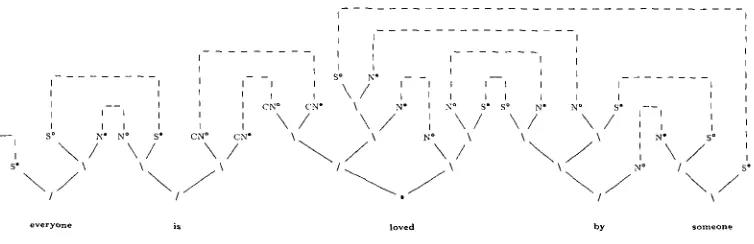
Proof net analysis for the subject wide scope reading of (7b) everyone is loved by someone (V3).
At the only point of difference, the subject wide scope reading, the preferred reading, has the lower complexity.
We emphasize that some target category is expected at the start of language pro- cessing. Lambek proof nets have the property that they can be kept planar under any cyclic permutation of the roots; one can view them as a circular list and require planarity on the interior (or exterior) of a disc. The same proof net w o u l d then have different complexity profiles depending on whether one set in axiom links clockwise or counterclockwise. Language processing, though, takes place in time, which is not cyclic, so we order the roots along a line, starting, according to the principle of ex- pectation, with the target category. As a reviewer has pointed out, if, for example, the target category were placed at the end of the time line, then the predictions of the relative acceptabilities in (41) w o u l d be reversed!
For the passive (7b), let there be assignments as in (42). The preposition by projects an agentive adverbial phrase; is is a functor over (post)nominal modifiers (the man outside, John is outside, etc.) and passive loved is treated exactly like passive raced in (27).
(42)
b y - )~x)~yAz[[z = x] A (y z)] := ( ( N \ S - ) \ ( N \ S - ) ) / N is - )~x)~y(x )~z[z = y] y)
:-- ( N \ S + ) / ( C N \ C N )
l o v e d -
(;~x;~y),z[(y
z) A 3w(x zw)],love)
:= ((CN\CN) / ( N \ ( N \ S - ) ) ) . ( N \ ( N \ S - ) )
A V3 analysis of (7b) is given in Figure 9. This has semantics, after some simplifi- cation, as in (43), which is equivalent to (40).
(43) V163937[[9 = 7] A (love 16 9)]
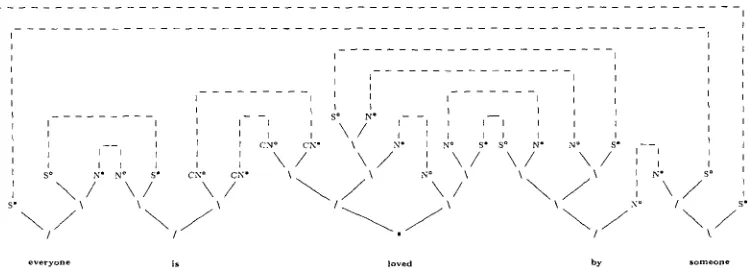
An 3V analysis of (7b) is given in Figure 10. This has semantics, after some sim- plification, as in (44), which is equivalent to (39).
Morrill Incremental Processing and Acceptability
I . . . I
I I
I - - I
j I I t
S~ ° N* I N ° ] S l ,
\ / \ /
S" \
\ / !
I I
I I I
......... I I I I . . . J s o N • -- - -
I I I E I I
t C N o C N • \ N • l N* S ° N " N o S °
F ~ I - - - - I
, \ / \ / I \ / \ / / , ,
C N ° C N " \ \ No \ \ \ I N "
\ / \ / \ / ,,
\ / " • \ x o / / ' ~ s°
e v e r y o n e i s l o v e d b y
Figure 10
Proof net analysis for the object wide scope reading of (7b) everyone is loved by someone (3V).
Again, the preferred reading has the lower complexity profile:
(45)
6 b
5
4 b b a
3 ab
2 a a
1 ab
0 ab
a. V3 ( F i g u r e 9)
b. everyone is loved by someone 3V (Figure 10)
7. Preferred Forms
Another good test would be to compare different expressions that are synonymous, holding semantics constant. Our account appears to explain the preference for heavy noun phrases to appear at the end of the verb phrase (heavy noun phrase shift). Of the following two sentences, repeated from (10), the second is more acceptable:
(46) a. ?John gave the painting that Mary hated to Bill. b. John gave Bill the painting that Mary hated.
The analyses are given in Figure 11. The complexities are thus:
(47) 4 a
3 a a b
2 ab ab a b b
1 ab b b a
0
a. J o h n gave the painting that Mary hated to
b. J o h n gave Bill the painting that Mary hated
a
b a
[image:17.468.45.419.57.196.2]I -- - - I
, I I ,
S, N, I N \ S)
J o h n
/
s a v e t I
k I I
- - - L . . .
. . . I
I I I I I L I
- - - I - I - - I I I - - I I
(N • P P ) , N [ C N . C N , [ C N \ C N ) [ (S [ N ) , N, ( N \ S) / N, P P
the p. that M a r y h a t e d
/ N , N
I I
I -- -- b • . ( N \ S I)
I I
I I I I I I I
/ (N - N), N, N [ C'N. ( ' N . ff-'N \ C N ) / 15; / N t . N, ( N \ / N
J o h n g a v e Bill the P. that M a r y h a t e d
Figure 11
Proof net analysis for (46b) John gave Bill the painting that Mary hated (bottom) and (46a) John
gave the painting that Mary hated to Bill (top).
8. Conclusion: Valencies versus Category Complexity
Finally, another dramatic example of unacceptability ing: 8
is provided by the follow-
(48) a. That t w o plus t w o equals four surprised Jack.
b. ?That that t w o plus t w o equals four surprised Jack astonished Ingrid.
c. ??That that that t w o plus t w o equals four surprised Jack astonished Ingrid bothered Frank.
The passive paraphrases, however, seem more or less equally acceptable:
(49) a. Jack w a s surprised that t w o plus t w o equals four.
b. Ingrid w a s astonished that Jack w a s surprised that t w o plus t w o equals four.
c. Frank w a s bothered that Ingrid w a s astonished that Jack w a s surprised that t w o plus t w o equals four.
In Figure 12 w e give the analysis of (48b) and in Figure 13 that of (49b). It is very interesting to observe that the complexity profile of the latter is in general lower even though the analysis has more than twice the total number of links.
[image:18.468.45.405.54.200.2]Morrill Incremental Processing and Acceptability
f . . . I
I
I . . .
I I
I I . . . I
I I i r I
I I ~-- J ---- I I ----
I
t
I I I
l
I I
I I
I
S, C P / S. clip / S. N, (N \ N) / N, N, (N \ S) / N. N, (CP \ S) / N,
I I I I
N, ( C P \ S) / N. N
[image:19.468.43.420.53.172.2]that that two plus two equals four surp. Jack ast, Ingrid
Figure 12
Proof net analysis of (48b) that that two plus two equals four surprised Jack astonished Ingrid.
I I
s, N, (N \ S)
I . . . I
I I I I
. . . i- . . . q . . . . E . . . . I
I I I I I ~ I I I
-- -- -- q- -- ~1 1 -- -- --I . . . . I . . . . . . r-- -- I P I I
!
/ (CN \ GN), ((CN \ CN) / (N ~ (CP \ S))} * (N \ (CP \ S)), ((CP \ S) \ (CP \ S)) ] S
Ingrld w~ ast. that
I . . . I
. . . L - - ~ J . . .
I P I I I I I i
', r , 1 , , , I ~ , I I ~ I , ,
N, (N \ S) / (CN \ CN), ((CN \ CN) / (N \ (('P \ S))) . (N \ (CP \ S)), ((CP \ S) \ (CP \ S{)) [ / S
Jack w ~ surp. that
I . . . I I
N, (N \ N} [ X. N. (N \ S) / X, N,
[image:19.468.44.419.212.403.2]two plus two equals four
Figure 13
Proof net analysis of (49b) Ingrid was astonished that Jack was surprised that two plus two equals four.
(50)
7 a
6 a a
5 a a
4 b a b
3 a a b
2 b b b b a b b
I a b b b a
0 a
a. that that two plus two equals four surp. Jack ast. Ingrid
b. Ingrid w a s ast. that Jack w a s surp. that two plus two equals four
Acknowledgments
For helpful remarks I thank Gabriel Bes, anonymous reviewers, and various audiences, and especially for recent comment, Ewan Klein and Mark Steedman.
References
Ades, Anthony E. and Mark J. Steedman.
1982. On the Order of Words. Linguistics
and Philosophy, 4:517-558.
Bever, Thomas. 1970. The cognitive basis for linguistic structures. In J. R. Hayes, editor,
Cognition and the Growth of Language, Wiley,
New York.
Buszkowski, Wojciech. 1986. Completeness results for Lambek syntactic calculus. Zeitschrift f~r mathematische Logik und
Grundlage der Mathematik, 32:13-28.
Carpenter, Bob. 1998. Type-Logical Semantics. MIT Press, Cambridge, MA.
Chomsky, Noam. 1965. Aspects of the Theory
of Syntax. MIT Press, Cambridge, MA.
Danos, Vincent and Laurent Regnier. 1989. The Structure of Multiplicatives. Archive for Mathematical Logic, 28:181-203. Dogen, Kosta. 1992. A brief survey of
frames for the Lambek calculus. Zeitschrift
fiir mathematische Logik und Grundlage der
Mathematik, 38:179-187.
Gibson, E. and J. Thomas. 1996. The processing complexity of English center-embedded and self-embedded
structures. Proceedings of NELS, University
of Massachusetts, Amherst. Girard, Jean-Yves. 1987. Linear Logic.
Theoretical Computer Science, 50:1-102. de Groote, Philippe and Christian Retort.
1996. On the Semantic Readings of Proof-Nets. In Geert-Jan Kruijff, Glyn Morrill and Richard. T. Oehrle, editors, Proceedings of Formal Grammar 1996, P r a g u e , pages 57-70.
Hendriks, Herman. 1993. Studied
Flexibility: Categories and Types in Syntax and Semantics. D.Phil.
dissertation, Universiteit van Amsterdam, Amsterdam.
Hepple, Mark. 1990. Normal form theorem proving for the Lambek calculus. In
H. Karlgren, editor, Proceedings of the 13th
International Conference on Computational Linguistics (COLING 1990), pages 173-178, Stockholm.
Hepple, Mark and Glyn Morrill. 1989. Parsing and Derivational Equivalence. Proceedings of the Fourth Conference of the European Chapter of the Association for
Computational Linguistics, pages 10-18,
Manchester.
Johnson, Mark. 1998. Proof nets and the complexity of processing center
embedded constructions, Journal of Logic,
Language and Information, 7(4):433-447.
Kimball, John. 1973. Seven principles of surface structure parsing in natural
language. Cognition, 2:15-47.
KOnig, Esther. 1989. Parsing as natural
deduction. Proceedings of the 27th Annual
Meeting, pages 272-279, Vancouver. Association for Computational Linguistics.
Lamarche, Frangois and Christian Retor6. 1996. Proof nets for the Lambek calculus--an overview. In V. Michele Abrusci and Claudia Casadio, editors, Proofs and Linguistic Categories: Applications of Logic to the Analysis and Implementation of
Natural Language. CLUEB, Bologna,
pages 241-262.
Lambek, Joachim. 1958. The mathematics of
sentence structure. American Mathematical
Monthly, 65:154-170.
Lecomte, Alain and Christian Retor4. 1995. An alternative categorial grammar. Glyn Morrill and Richard. T. Oehrle, editors, Proceedings of Formal Grammar 1995, Barcelona, pages 181-196.
Moortgat, Michael. 1988. Categorial
Investigations: Logical and Linguistic Aspects
of the Lambek Calculus. Foris, Dordrecht.
Moortgat, Michael. 1997. Categorial Type Logics. In Johan van Benthem and Alice
ter Meulen, editors, Handbook of Logic and
Language. Elsevier, Amsterdam,
pages 93-177.
Morrill, Glyn. 1994. Type Logical Grammar:
Categorial Logic of Signs. Kluwer Academic
Publishers, Dordrecht.
Morrill, Glyn. 1999. Geometry of
Lexico-Syntactic Interaction. Proceedings of the Ninth Conference of the European Chapter of the Association for Computational
Linguistics, Bergen, pages 61-70.
Pentus, Mati. 1994. Language completeness of the Lambek calculus. Proceedings of the Eighth Annual IEEE Symposium on Logic in Computer Science, Paris, pages 487-496.
Roorda, Dirk. 1991. Resource Logics;
Proof-Theoretical Investigations. D.Phil. dissertation, Universiteit van Amsterdam, Amsterdam.
Steedman, Mark J. 1997. Surface Structure and
Interpretation. MIT Press, Cambridge, MA.
Zielonka, Wojciech. 1981. Axiomatizability of Ajdukiewicz-Lambek calculus by
means of cancellation scheme. Zeitschrift
fi, ir mathematische Logik und Grundlage der