Incremental Proofs of Operational Termination
with Modular Conditional Dependency Pairs
Masaki Nakamura, Kazuhiro Ogata and Kokichi Futatsugi
Abstract—OBJ algebraic specification languages support semi-automated verification of algebraic specifications based on equational reasoning by term rewriting systems (TRS). Termination is one of the most important properties of TRSs. Termination guarantees that any execution of the specification terminates in finite times. Another important feature of OBJ languages is a module system with module imports to describe large and complex specifications in a modular way. In this study, we focus on a way to prove termination of OBJ specifications incrementally, based on the notion of modular conditional dependency pairs (MCDP).
Index Terms—Term rewriting, Operational termination, Con-ditional Dependency Pairs, Algebraic specification, OBJ lan-guages.
I. INTRODUCTION
OBJ languages [1], [2], [3], [4] are algebraic specification languages which support several useful advanced features, e.g. module system, typing system with ordered sorts, mix-fix syntax, for describing specifications, and a powerful interactive theorem proving system based on term rewriting systems (TRSs). The following is an example of CafeOBJ specifications, which is one of the active OBJ languages:
mod! NAT+{ [Nat]
op 0 : -> Nat op s_ : Nat -> Nat op _+_ : Nat Nat -> Nat vars M N : Nat
eq 0 + N = N .
eq s M + N = s(M + N) . }
mod! NAT*{ pr(NAT+)
op _*_ : Nat Nat -> Nat vars M N : Nat
eq 0 * N = 0 .
eq s M * N = (M * N) + N . }
where the specification consists of two modules: NAT+and NAT*. The first module NAT+ represents natural numbers with the addition, where the sort Natstands for the set of natural numbers, the operation symbol (constant) 0 is zero andsis the successor function. Thus, the terms0,s 0,s s
Manuscript received December 4th, 2012; revised December 21th, 2012. This work was supported in part by 23220002 Grant-in-Aid for Scientific Research (S) 23220002 from Japan Society for the Promotion of Science (JSPS) and Grant-in-Aid for Young Scientists (B) 22700027 from Ministry of Education, Culture, Sports, Science and Technology (MEXT) Japan.
Masaki Nakamura is with the Department of Information Systems Engi-neering, Toyama Prefectural University, Japan.
Kazuhiro Ogata and Kokichi Futatsugi are with the School of Information Science, Japan Advanced Institute of Science and Technology (JAIST).
0,. . .,sn 0,. . .stand for0,1,2, . . . , n, . . .respectively. The binary infix operation symbol + stands for the addition on natural numbers, and defined by the two equations. The other moduleNAT*represents the multiplication. Note thatNAT* importsNAT+by the import declarationpr(NAT+). In the importing module, the elements of the imported module can be used. The sortNatand the operation symbols0, s, + are used for declaring the multiplication symbol* and two equations for it inNAT*.
The theory of term rewriting systems (TRS) gives us an ef-ficient automated equational reasoning. In the TRS, equations in the modules are regarded as left-to-right rewrite rules, and a given term is reduced by applying those rules until it cannot. For example,s s 0 + s 0is reduced intos s s 0as follows:s s 0 + s 0→s (s 0 + s 0)→s s (0 + s 0)→s s s 0, where the underlined subterms are matched with some left-hand sides of the rewrite rules and replaced with the instances of the corresponding right-hand sides. The first two rewrite steps come from the second equation and the last rewrite step is obtained by the first equation inNAT+. Moreover,s s 0 * s 0is reduced into s s 0 as follows: s s 0 * s 0 → (s 0 * s 0) + s 0 → ((0 * s 0) + s 0) + s 0 → (0 + s 0) + s 0 → s 0 + s 0 → s (0 + s 0) → s s 0. Note that the equations declared not only in NAT* but in NAT+are used.
Termination is one of the most important properties of TRSs, which guarantees that execution of the specification must terminate in finite times. Note that in NAT*, terms are reduced by applying the equations in both NAT+ and NAT*. To prove termination of NAT*, we need to con-sider all equations in both NAT+ and NAT*. In general, termination is not a modular property, that is, for two terminating TRSs R0 andR1, the combination R0∪R1 is
not always terminating even if they have no shared operation symbols. It can be seen in the following famous Toyama’s counter-example: for R0 = {f(a, b, x) → f(x, x, x)} and
R1 = {g(x, y) → x, g(x, y) → y} where f is a ternary
operation symbol, g is a binary operation symbol, a and b are constant symbols, andxandyare variables, then we have the following infinite rewrite sequence:f(a, b, g(a, b))→R0 f(g(a, b), g(a, b), g(a, b)) →R1 f(a, g(a, b), g(a, b)) →R1 f(a, b, g(a, b))→ · · · even if each Ri is terminating (i = 0,1).
[7] seems to be suitable for proving termination of OBJ spec-ifications, however, practical OBJ specifications often include conditional equations which are not treated in [7], where a conditional equation is an equation with a guard condition. In this study, we extend the incremental termination method proposed in [7] in order to cover conditional equations.
II. PRELIMINARIES
In this section, we introduce the notion of term rewriting systems [5].
A. Signature and terms
A signature is a set of operation symbols. An operation symbol has its arity n∈ N, where N denotes the set of all natural numbers. We write the set of operation symbols like
Σ ={f0/n0, f1/n1, . . .} where the operation symbolfi has the arityni. We may omit the arities and writef instead of f /nif no confusion arises. For a signatureΣand a countable set X of variables, the set T(Σ, X) (abbr. T) of (Σ, X) -terms is the smallest set satisfying the following:X ⊆T and f(t1, . . . , tn)∈T if f /n∈Σandti∈T (i= 1,2, . . . , n). We writecinstead ofc()withc/0∈Σ, and call it a constant (for both symbol and term). Throughout this article, we may use x, y, z as variables,f, g, h as operation symbols, a, b, c as constant symbols, l, r, s, t, uas terms, without notice.
A substitutionθis a map fromX toT. We write the term obtained by replacing all variables x in a term t with the terms θ(x)as tθ. A sequence w∈ N+∗of positive integers represents a position of a term.O(t)⊆ N+∗is defined as the smallest set satisfying the following:ε∈O(t)(ε: the empty sequence) and i.p ∈ O(f(t1, . . . , tn)) if 1 ≤ i ≤ n and p∈O(ti). An operation symbol at the positionp∈O(t)int is defined asxε=x,f(· · ·)ε=f, and(f(t1, . . . , tn))i.p= (ti)p. We call tε the root symbol of t. A context C is a term with the special symbol □ which is not included in considered Σand X and occurs only once in C. The term obtained by replacing□with a termtis written asC[t]. The set of all variables in tis written as V ar(t).
Example 2.1: Let Σ+ = {+/2, s/1,0/0} and Σ∗ = {∗/2}. Examples of terms are 0, s(0), +(x, s(0)),
∗(+(x, s(0)), s(y)), etc. Let t = +(x, s(y)). tθ = +(s(0), s(0)) when θ(x) = s(0) and θ(y) = 0, C[t] = ∗(s(x),+(x, s(y))) when C = ∗(s(x),□), and V ar(t) = {x, y}.
B. Conditional rewrite rules and rewrite relation
We formalize conditional term rewriting systems (CTRS) corresponding to CafeOBJ. In CafeOBJ, each module implic-itly imports a built-in Boolean moduleBOOL.BOOLhas the sort Bool and the constantstrue and false, and usual logical operationsand,or,not, etc, onBool. A CafeOBJ conditional equation has the form ofceql=rifc, where cis a term ofBool, and means that the body equationl=r holds whenever c holds. In the reduction, the instancelθ is replaced with rθ when cθ is reduced into true. Note that V ar(r)∪V ar(c)⊆V ar(l). Unconditional equationseql= rcan be considered asl→r⇐true. A(Σ, X)-conditional rewrite rule is a triple (l, r, c), denoted byl→r⇐c, such that l, r, c ∈ T(Σ, X) and V ar(r)∪V ar(c) ⊆V ar(l). A
conditional term rewriting system (CTRS) is a pair of a signature Σ and a set of (Σ, X)-conditional rewrite rules 1. We write l → r instead of l → r ⇐ c when
c = true. We may call just a conditional rewrite rule, a rewrite rule or a rule, instead of a(Σ, X)-conditional rewrite rule if no confusion arises. A CTRS (Σb, Rb) for BOOL is defined as Σb = {true/0,false/0,not/1, . . .} and Rb = {not(true) → false,not(false) → true, . . .}, and hereafter we assume that every CTRS(Σ, R)implicitly includes (Σb, Rb), that is, Σb ⊆ Σ and Rb ⊆ R. We may omitΣand writeR as a CTRS instead of(Σ, R). A rewrite relation→R is defined as follows: (1)s→0t if there exists l → r ⇐c ∈R and a substitution θ such that s =C[lθ], t = C[rθ], and cθ = true. (2) s →i+1 t if there exists
l → r ⇐c ∈R and a substitution θ such that s =C[lθ], t = C[rθ], and cθ →∗i true, where →∗ stands for the reflexible and transitive closure of a binary relation→. (3)
→R=∪i∈N →i.
Example 2.2: Consider the following CafeOBJ module: mod! EVEN{
pr(NAT+)
op even : Nat -> Bool var N : Nat
eq even(0) = true .
ceq even(s N) = true if odd(N) . ceq odd(s N) = true if even(N) . }
The corresponding CTRSRe is defined as follows:
Re=
even(0) → true
even(s(x)) → true ⇐odd(x)
odd(s(x)) → true ⇐even(x)
We haveeven(s(s(0)))→R true sinceeven(0)→0true, odd(s(0))→1true, andeven(s(s(0)))→2true.
III. OPERATIONAL TERMINATION AND CONDITIONAL DEPENDENCY PAIRS
A CTRS R is terminating if there is no infinite rewrite sequencet0→Rt1→Rt2→R· · ·. Although termination is one of the most important properties of CTRS, it does not directly correspond to termination of computation of terms. Consider R = {a → b ⇐ a}. By removing the condition we haveR′ ={a→b} andR′ is trivially terminating and thusR is also terminating since in general→R is a subset of →R′ when R′ is a (unconditional) TRS obtained from R by removing all condition parts. However, computation of reducing a does not terminate since when try to apply a → b ⇐ a to the target term a, the condition a should be checked whether it can be reduced into true, and the procedure fails into an infinite calls of the condition. To capture the above non-terminating behaviors, the notion of operational termination has been proposed [8], which is de-fined by infinite well-formed trees in a logical inference sys-tem of conditional rewrite relation instead of infinite rewrite sequences. By the notion of operational termination, we can guarantee the absence of both infinite rewrite sequences and infinite condition calls. From the space limitation, we omit the precise definition of operational termination. Instead,
1Our definition of CTRSs is categorized into 1-CTRS [5] by regarding
we introduce an equivalent proposition on context-sensitive rewriting later in this section.
A. Conditional dependency pairs
The notion of dependency pairs is one of the most power-ful method to prove termination of (unconditional) TRS [9]. where essential pairs of terms are extracted from rewrite rules and chains of the pairs are analyzed for proving termination. We redefine the notion of dependency pairs for CTRS. An operation symbol at the root position of the left-hand side of some rewrite rule is called a defined symbol, that is, DR={f ∈Σ|f(. . .)→r⇐c∈R}. The marked symbol of f is defined as f# and the set of marked symbols of
Σ is written asΣ#. The marked term t# of a non-variable term t = f(t1, . . . , tn) is the term obtained by renaming only the root symbol, defined as t# = f#(t
1, . . . , tn). An ordinary dependency pair is a pair (l#, u#) of the marked
left-hand side and a marked subterm in the right-hand side whose root symbol is defined. For operational termination, we need to consider the condition part. Thus, besides the right-hand side, a marked subterm u# of the condition c
should be considered.
Definition 3.1: Let Rbe a CTRS. The set CDP(R)of all conditional dependency pair (CDP) of R is defined as follows:
CDP(R) =
{
(l#, u#)⇐c l→r⇐c∈R,
r=C[u], uε∈DR
}∪
{
(l#, u#)⇐
true l→r⇐c∈R, c=C[u], uε∈DR
}
We may write (s, t)instead of(s, t)⇐true.
Definition 3.2: Let R be a CTRS. A (possibly infinite) sequence (l#i , u#i ) ⇐ ci (i = 0,1,2, . . .) of pairs of CDP(M) is called a dependency chain ofR if there exist θi (i = 0,1,2, . . .) such that (1) ciθi →∗R true, and (2) u#i θi→∗Rl
#
i+1θi+1 for each i∈ N 2.
The following sufficient condition of operational termina-tion holds.
Theorem 3.3: A CTRSRis operationally terminating if and only if there exists no infinite chain ofR.
Example 3.4: While Re does not have any ordinary de-pendency pair [9] since any right-hand side does not have defined symbols, it has conditional dependency pair since de-fined symbols occur in the conditions. We haveCDP(Re) =
{(even#(s(x)), odd#(x)),(odd#(s(x)), even#(x))}. There
is no infinite chain of Re since any chain should be in the form of(even#(s
0), odd#(t0))) (odd#(s1), even#(t1)) (even#(s2), odd#(t2)) · · · and the argument of each CDP
should decrease (si > ti because of s(x) > x) and the connected terms are equivalent (ti =si−1) in the meaning
of the model of NAT+. The strict order > on natural number is well-founded, i.e. there is no decreasing sequence n0> n1> n2>· · ·. Similarly, we can see thatR+ ofNAT
does not have infinite dependency chains, and Re∪R+ is
operationally terminating.
2Assume variables in pairs of CDPs are marked such that they are distinct
from each other.
B. Proof of Theorem 3.3
To prove Theorem 3.3, the notion of context-sensitive rewriting (CSR) [10] and the transformation from CTRS to CSR [11] are useful. We introduce the notations and definitions of them. Let R be a (unconditional) TRS. A map µ from Σ to P(N) is called a replacement map if µ(f) ⊆ {1,2, . . . , ar(f)} for each f ∈ Σ. The set Oµ(t) of replacement positions of t is defined as ε ∈ Oµ(t) and i.p ∈ Oµ(f(t1, . . . , tn)) if i ∈ µ(f) and p ∈ Oµ(ti). A context-sensitive rewrite relation of µ, denoted by →µ, is defined as follows: s →µ t if and only if there exists l→r∈R and θ such thats=C[lθ],t=C[rθ],Cp =□, andp∈Oµ(t).
The following unraveling technique with CSR can simu-late computation of CTRS completely.
Definition 3.5: [11] Let(Σ, R)be a CTRS. The (uncon-ditional) TRS (Σ∪ΣU, Ucs(R)) and the replacement map µU are defined as follows: Let each conditional rule inRbe labeled likeα:l→r⇐c.
ΣU = {Uα|α:l→r⇐c∈R}
Ucs(R) =
{
l→Uα(c, x1, . . . , xn) α:l→r Uα(true, x1, . . . , xn)→r ⇐c∈R
}
∪ {
l→r l→r⇐true∈R } µU(f) =
{
{1, . . . , ar(f)} if f ∈Σ {1} if f ∈ΣU
whereV ar(l) ={x1, . . . , xn}.
Hereafter, we may writes→U t instead ofs→µU t.
Example 3.6: Rein Example 2.2 is unravelled as follows:
Ucs(Re) =
even(0) → true
even(s(x)) → Ue(odd(x), x) Ue(true, x) → true
odd(s(x)) → Uo(even(x), x) Uo(true, x) → true
A termeven(s(s(0)))is reduced intotrueas follows: even(s(s(0))) →µ Ue(odd(s(0), s(0))
→µ Ue(Uo(even(0),0), s(0))
→µ Ue(Uo(true,0), s(0))
→µ Ue(true, s(0))
→µ true
A TRS is calledµ-terminating if there is no infinite rewrite sequencet0 →µt1→µ t2 →µ· · ·. Operational termination of CTRS and µ-termination of the transformed TRS have been shown to be equivalent in [11].
Proposition 3.7: [11] LetR be a CTRS. (1) Ifs→R t, thens→+U t, and (2) R is operationally terminating if and only ifUcs(R)isµU-terminating on T(Σ, X).
Now we give a proof of Theorem 3.3.
Theorem 3.3: A CTRSR is operationally terminating if and only if there exists no infinite chain ofR.
Proof:(only if part): We will prove by contraposition. Assume an infinite chain (l#i , u#i ) ⇐ ci (i ∈ N) exists. From Definition 3.1 and 3.5, for each (l#i , u#i ) ⇐ ci, there exist rewrite rules li → Uαi(ci, x
i
1, . . . , x
i n) and Uαi(true, x
i
liθi →U Uαi(ciθi, ⃗x) →U∗ Uαi(true, ⃗x) →U Ci[ui]θi =
Ciθi[uiθi]. From Definition 3.2 (2), u#i θi →∗R l
#
i+1θi+1
and thus uiθi →∗U li+1θi+1. Note that s# →R t# implies s →R t since R does not have any marked symbols f#. Then, we have an infinite rewrite sequence l0θ0→+U C0θ0[u0θ0]→∗U C0θ0[l1θ1]→+U C0θ0[C1θ1[u1θ1]] →∗
U · · · →
+
U C0θ0[C1θ1[· · ·Cnθn[unθn]]] →U · · ·. Since l0θ0 belongs to the originalT(Σ, X),Ris not operationally
terminating from Proposition 3.7 (2).
(if part): AssumeRis not operationally terminating.Ucs(R) is not µU-terminating from Proposition 3.7 (2). We take a minimal infinite rewrite sequence ofµU-termination:t00→U t01 →U t02 →U . . . where t00 ∈ T(Σ, X), and there is no
infinite rewrite sequencet′0→U t′1→U · · · beginning with a strict subtermt′0oft00. From the minimal assumption and the
fact that t00 ∈ T(Σ, X), there exists t0i such thatt
0
i =l0θ0
and t0i+1 = Uα0(c0θ0, ⃗v) for some l0 → r0 ⇐ c0 ∈ R, where vk = θ0(xk). Note that θ0(z) ∈ T(Σ, X) for each
z∈⃗xsincet0
0∈T(Σ, X). We consider the case thatc0θ0is
notµU-terminating. Then, we take a minimal infinite rewrite sequencec0θ0⊵u0θ0 =t10 →U t11→U · · ·. From the min-imality, root(u0)∈ DR. Then, we take (l
#
0, u0#)⇐true
as the first CDP of the chain. Next, we consider the other case that c0θ0 is µU-terminating. Since µU(Uα0) = {1} and t0
i+1 is not µ-terminating, c0θ0 →∗U true holds, and t0
i+1 = Uα0(c0θ0, ⃗v) →∗U Uα0(true, ⃗v) →U r0θ0 where r0θ0 is notµ-terminating. Then, we take a minimal infinite
rewrite sequencer0θ0⊵u0θ0=t10→U t11→U · · ·. From the minimality, root(u0)∈DR. Then, we take(l
#
0, u0#)⇐c0
as the first CDP of the chain. From Proposition 3.7 (1), c0θ0 →∗R true holds. Now, for both cases, there exists t1
i such that t1i = l1θ1 and t1i+1 = Uα1(c1θ1, ⃗v) for some l1→r1⇐c1∈R, and similarly we can take the next CDP (l1#, u1#)⇐c1withθ1. Sinceu0θ0→∗U t1i =l1θ1, we have
u0θ0 →∗R t
1
i =l1θ1 from Proposition 3.7(1). As a similar
way, we can make an infinite chain(l#k, uk#)⇐ck withθk (k∈ N).□
IV. INCREMENTALPROOFS OFOPERATIONAL TERMINATION
A. Hierarchical extension
The notion of the hierarchical extension has been defined for TRSs in [7]. We give a straightforward extension to CTRSs as follows:
Definition 4.1: A pair[Σ1|R1]is called a module
ex-tending a CTRS(Σ0, R0), denoted by(Σ0, R0)←[Σ1|R1],
if (1) Σ0 ∩Σ1 = ∅, (2) (Σ0 ∪Σ1, R1) is a CTRS and
(3) DR1 = Σ1. The CTRS (Σ0∪Σ1, R0∪R1) is called a hierarchical extension of(Σ0, R0)with module [Σ1|R1].
We write(Σ0, R0)←[Σ1|R1]←[Σ2 |R2]when [Σ2 |
R2] extends(Σ0∪Σ1, R0∪R1). A CTRS (Σ0, R0)can be
regarded as a module [Σ0|R0] extending the empty CTRS (∅,∅). Hereafter we may use the module expression for an ordinary CTRSs.
Example 4.2: LetM+= [Σ+|R+]andM∗= [Σ∗|R∗]
such that Σ+ = {0, s,+} declared in NAT+, Σ∗ = {∗}
declared in NAT*, R+ is the TRS which has two rewrite
rules in NAT+, and R∗ is the TRS which has two rewrite rules inNAT*. Then,M+←M∗sinceΣ+∩Σ∗=∅and the
root symbols of the two rewrite rules inR∗ is∗ ∈Σ∗. Also M+ ← Me(= [Σe | Re]) for Σe = {even, odd}(= DRe)
andRe in Example 2.2.
B. Modular Conditional Dependency Pairs
To give a sufficient condition of operational termination in a modular way, we introduce conditional dependency pairs of a module, which is defined by ignoring the subterms u whose root symbol is not in the module in ordinary CDP defined above. While(∗#(s(m), n),+#(n,∗(m, n))belongs
toCDP(R+∪R∗)since+∈DR+∪R∗, it is not considered forM∗= [Σ∗|R∗] since+̸∈DR∗.
Definition 4.3: Let M = [Σ| R] be a module. The set M CDP(R) of all conditional dependency pair of module M (abbr. MCDP) is defined as follows:
M CDP(R) =
{
(l#, u#)⇐c l→r⇐c∈R,
r=C[u], uε∈DR
}∪
{
(l#, u#)⇐true l→r⇐c∈R,
c=C[u], uε∈DR
}
The dependency chain of MCDP is defined as a sequence of MCDPs which are connected by the rewrite relation of some arbitrary CTRSS, which may beR0∪R1, for example.
Definition 4.4: LetM = [Σ|R] be a module andS be a CTRS. A (possibly infinite) sequence (l#i , u#i )⇐ci (i= 0,1,2, . . .) of pairs ofM CDP(M) is called a dependency chain of M over S if there exist θi (i = 0,1,2, . . .) such that (1)ciθi→∗S true, and (2)u
#
i θi→∗S l
#
i+1θi+1 for each
i∈ N.
The ordinary CDP(R) and the dependency chain are equivalent toM CDP([Σ|R])and the dependency chain of
[Σ| R] over R respectively. Collapse-extended termination (CE-termination) is a subclass of termination, which plays important role in proving termination in a modular way [6]. A CTRSR isCE-(operationally) terminating if R∪π is (operationally) terminating, where π = {G(x, y) →
x, G(x, y)→y}with a special fresh binary operation symbol G/2, which means that G̸∈ Σ for any considered Σ. Our main theorem is thatCE-operational termination ofR0 and
the absence of infinite chains of R1 over R0∪R1 imply
(CE-)operational termination of R0∪R1.
Before the main theorem, we show the following theorem betweenCE-operational termination and MCDP.
Theorem 4.5: A CTRS(Σ, R)isCE-operationally termi-nating if and only if there exists no infinite chain of[Σ|R]
overR∪π.
Proof: Since G is fresh, R does not have G and M CDP([Σ|R]) =M CDP([Σ∪ {G/2} |R∪π]).□
The following is a main theorem of this paper.
Theorem 4.6: Let [Σ0 | R0]← [Σ1 |R1]. If (1)R0 is
CE-operationally terminating, and (2) there exists no infinite chain of[Σ1|R1] overR0∪R1∪π, thenR0∪R1 is CE -operationally terminating.
Proof: (Sketch) It can be proved by the same proof strategy with the unconditional version of this theorem in the literature [7] (Theorem 1). An infinite chain ofCDP(R0∪
R1∪π) consists of either
(b) those ofM CDP([Σ1|R1]), or
(c) (l#, u#)⇐csuch thatl
ε∈Σ1 anduε∈Σ0.
In the example of M+←M∗,
(a)M CDP(M+) ={(+#(s(m), n),+#(m, n))}
(b) M CDP(M∗) ={(∗#(s(m), n),∗#(m, n))}
(c)CDP(R+∪R∗)\(M CDP(R+)∪M CDP(R∗)) ={(∗#(s(m), n),+#(∗(m, n), n))}
Since Σ0∩Σ1 = ∅, it suffices to consider infinite chains
constructed from (a) only or (b) only. An infinite chain of (b) contradicts the assumption (2) directly. An infinite chain of (a) does not directly contradict (1) since since infinite chains of CDP(R0)is overR0 while infinite chains of (a)
is over R0∪R1∪π. We can make a chain of CDP(R0)
from a chain of (a) with the same dependency pairs of the sequence and different substitution and connective rewrite relation according to the term interpretation from Σ#0 ∪Σ1
toΣ#0 ∪ {G/2}in [7]. Then, we have the interpreted infinite chain ofCDP(R0)which contradicts (1) and Theorem 3.3. □
The condition ”CE” in Theorem 4.6 (1) is essential since Toyama’s example is a counter-example such that R0 = {f(a, b, x) → f(x, x, x)} and R1 = π. Then,
M CDP([{G} | π]) = ∅ and no infinite chain exists, however, R0∪π is not terminating as shown in I.
INTRO-DUCTION.
V. PROVING OPERATIONAL TERMINATION
To prove the absence of infinite dependency chains of ordinary dependency pairs, the notion of weak reduction pairs is useful [12]. We show that the weak reduction pair also gives a useful sufficient condition for prove operational termination via MCDP.
Definition 5.1: [12] A pair(≥, >)of binary relations on terms is a weak reduction pair if it satisfies the following conditions: (1)≥ is monotonic (s≥t ⇒C[s] ≥C[t]) and stable (s≥t ⇒sθ≥tθ) (2)> is stable and well-founded (no infinite sequence t0 > t1 > t2 > · · ·), and (3) either ≥ ·>⊆>or >· ≥⊆>.
Definition 5.2: Let M = [Σ | R] be a module and S be a CTRS. A weak reduction pair (≥, >) is compatible with M over S if (1) ∀l → r ⇐ c ∈ S. l ≥ r and (2)
∀(l#, u#)⇐c∈M CDP(M).l#> u#.
Theorem 5.3: Let M = [Σ|R]be a module and S be a CTRS. If there exists a weak reduction pair (≥, >) com-patible with M overS, then there is no infinite dependency chain ofM overS.
Proof:Since≥is monotonic and stable,s=C[lθ]→S C[rθ] =t implies s≥t. Since >is stable, l#θ > r#θ for
each (l#, r#) ⇐c ∈ M CDP(M). From an infinite chain (li#, u#i ) ⇐ ci (i = 0,1, . . .), we have l
#
i θ0 > u#θ0 ≥ · · · ≥ l#i θ1 > u#θ1 ≥ · · ·. Now we assume ≥ ·>⊆>of
Definition 5.1 (3). we have li#θ0 > u#θ0 > u#θ1 > u#θ2
> · · ·. It contradicts the well-foundedness of >. Similarly, for the case of>· ≥⊆>, we havel#i θ0 > l#θ1 > l#θ2 > · · ·.□
To make a weak reduction pair, the notion of Σ-algebra is useful [5], [6]. A weakly monotone Σ-algebra (A,≥)
consists of a set A and interpretation Af : An → A
of each f /n ∈ Σ with a quasi-ordering ≥ (a reflexive and transitive binary relation on A) such that every algebra operation is weakly monotone in all of its arguments, that is, for each f /n ∈ Σ and a, b ∈ A with a ≥ b we havef(. . . , a, . . .) ≥f(. . . , b, . . .). A weakly monotone Σ -algebra(A,≥)is well-founded if>is well-founded. A map a:X →A is called an assignment, and it can be extended to a map a : T(Σ, X) → A such that a(f(t0, . . . , tn)) = f(a(t0), . . . , a(tn)). The order≥AonTis defined ast≥At′ if ∀a:X →A.a(t)≥a(t′). The stable-strict ordering>A is defined as s >At if and only ifsθ≥Atθ andtθ̸≥Asθ for each ground substitution θ : X → T(Σ,∅). Then, for a weakly monotone well-founded Σ-algebra (A,≥), a pair
(≥A, >A)is a weak reduction pair [6].
Example 5.4:
1) For R+, a Σ+ ∪ Σ #
+ ∪ {G/2}-algebra (A,≥) is
defined as follows: A = N, A0 = 0, As(x) = x+ 1, A+(x, y) = x+ y, A+#(x, y) = x, and AG(x, y) = x+y. Then, for an assignment a, all l→r∈R+ are interpreted to equations a(l) =a(r).
For π = {G(x, y) → x, G(x, y) → y}, a(G(x, y)) = a(x) +a(y) ≥ a(x) and a(G(x, y)) ≥ a(y). For
(+#(s(m), n),+#(m, n))∈M CDP(M
+), we have
a(+#(s(m), n)) = a(s(m)) =a(m) + 1
> a(m) =a(+#(m, n))).
Then, (≥A, >A)is a weak reduction pair compatible with M+ over R+∪π, and from Theorem 4.6 and
5.3, R+ is CE-operationally terminating. Note that for (∅,∅) ← M+, the empty CTRS is trivially CE -operationally terminating.
2) Next considerM+←M∗. AΣ+∪Σ∗∪Σ #
∗ ∪ {G/2}
-algebra (A,≥) is defined as follows: the same inter-pretation is given for Σ+ and G/2 with A = N.
A∗(x, y) = x×y, and A∗#(x, y) = x. Then, for an assignment a, all l → r ∈ R∗ are interpreted to equationsa(l) =a(r). For(∗#(s(m), n),∗#(m, n))∈
M CDP(M∗), we have
a(∗#(s(m), n)) = a(s(m)) =a(m) + 1
> a(m) =a(∗#(m, n)).
Then, (≥A, >A)is a weak reduction pair compatible with M∗ over R∗∪R+∪π, and similarlly we have
that R+∪R∗ isCE-operationally terminating. 3) ConsiderM+←Me. AΣ+∪Σe∪Σ#e∪{G/2}-algebra
(A,≥)is defined as follows: the same interpretation is given for Σ+ andG/2 withA =N. Atrue = 0 and Aeven(x) = Aodd(x) = Aeven#(x) = Aodd#(x) = x. Then, a(l) ≥ a(r) for all l → r ⇐ c ∈ Re and a(l#)> a(u#)for all(l#, u#)⇐c∈M CDP(M
e). Thus,R+∪Re isCE-operationally terminating.
VI. APPLICATION TO PRACTICALOBJSPECIFICATIONS
mod* ACCOUNT { pr(INT + USER) *[ Sys ]*
op init : -> Sys
bop balance : User Sys -> Int bop deposit : User Int Sys -> Sys bop withdraw : User Int Sys -> Sys vars U U’ : User
var I : Int var A : Sys
eq balance(U,init) = 0 .
ceq balance(U, deposit(U’,I, A)) =
(if U = U’ then I + balance(U,A) else balance(U,A) fi)
if I >= 0 .
ceq deposit(U’,I,A) = A if not ( I >= 0) .
ceq balance(U,withdraw(U’,I,A)) =
(if U = U’ then balance(U,A) - I else balance(U,A) fi)
if balance(U’,A) >= I and I >= 0 .
ceq withdraw(U’,I,A) = A
if not(balance(U’,A) >= I and I >= 0) .
[image:6.595.44.557.51.163.2]}
Fig. 1. An OTS/CafeOBJ specification of bank account systems
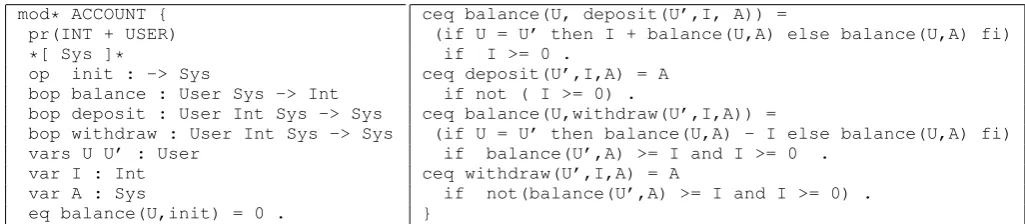
consists of a system module and data modules. A data module is a specification of an abstract data type used in the system, for example, integers with operations, enumerated types, user-defined structures, and so on. A system module is a specification of a state machine defined via observations. We show an example of OTS/CafeOBJ specifications: a specification of a bank account system (Fig.1). The module ACCOUNT imports INT and USER as data modules, where INT is a specification of integers and their operations, and USER is a specification of a user database. balance takes a state of the bank account system and returns the balance value of each user. Users can withdraw from and deposit in their account. For example, the third conditional equation ceq balance(U,withdraw(U’,I,A)) = (if U = U’ then balance(U,A) - I else balance(U,A) fi) if balance(U,A) >= I and I >= 0 means that the balance of the user U’ after withdrawing I is the remainder of subtracting I from the balance of the current state A if the balance of the user U’of the current state A is more than or equal to I and I is not negative, and that of the other userU (̸=U’) is not changed.
Let Ma = [Σa | Ra] be the module corresponding to ACCOUNT. Then, the M CDP(Ma) consists of only four conditional dependency pairs:
(bal#(u, dep(u′, i, a)), bal#(u, a))⇐≥(i,0) (bal#(u, with(u′, i, a)), bal#(u, a))
⇐and(≥(bal(u′, a), i),≥(i,0)) (bal#(u, with(u′, i, a)), bal#(u, a))⇐true
(with#(u′, i, a), bal#(u, a))⇐true
Note that we do not need to consider operation symbols
=, ≥, +, −, if then else f i as defined symbols for M CDP(Ma) even if they may be defined in the imported modules. The last MCDP can be ignored in an infinite chain because with# does not occur in any right-hand side of MCDP. For each of the remaining three MCDPs, the second argument of bal# strictly decreases in the meaning of the number of operation symbolsdepandwith. Thus, there is no infinite chain of MCDP, and if the imported modules are already provedCE-operationally terminating, then the whole CTRS is CE-operationally terminating. Formally, it can be proved by the notion of recursive path ordering (RPO) [5], for example.
VII. CONCLUSIVE REMARKS
One of our goals is to implement a light-weight termi-nation checker in CafeOBJ. Computing MCDPs is easy to be implemented. There are several ordering on terms for
automated checking which can be transformed to a weakly reduction pair, for example, RPO. Consider describing a large specification with several modules. (1) We first describe basic modules, that is, without imports, and proveCE-operational termination of them and label them so. (2) Next we describe a module which imports modules labelled by ”CE-operational termination”. Then, it suffices to show the absence of infinite chains of the module for provingCE-operational termination of the whole system. One of the future work is to improve our results for other features of OBJ languages, e.g. order-sorted specifications, the evaluation strategy, operator attributes for associative and commutative axioms.
REFERENCES
[1] K. Futatsugi, J. A. Goguen, J.-P. Jouannaud, and J. Meseguer, “Prin-ciples of obj2.” in Proceedings of the 12th ACM Symposium on Principles of Programming Languages, POPL, 1985, pp. 52–66. [2] J. A. Goguen, T. Winkler, J. Meseguer, K. Futatsugi, and J.-P.
Jouannaud,Software Engineering with OBJ: Algebraic Specification in Action. Kluwers Academic Publishers, 2000, ch. Introducing OBJ*. [3] CafeOBJ, http://www.ldl.jaist.ac.jp/cafeobj/.
[4] M. Clavel, F. Dur´an, S. Eker, P. Lincoln, N. Mart´ı-Oliet, J. Meseguer, and C. L. Talcott, Eds., All About Maude - A High-Performance Logical Framework, How to Specify, Program and Verify Systems in Rewriting Logic, ser. Lecture Notes in Computer Science, vol. 4350. Springer, 2007.
[5] Terese,Term Rewriting Systems, ser. Cambridge Tracts in Theoretical Computer Science. Cambridge University Press, 2003, vol. 55. [6] E. Ohlebusch,Advanced topics in term rewriting. Springer, 2002. [7] X. Urbain, “Modular & incremental automated termination proofs,”J.
Autom. Reasoning, vol. 32, no. 4, pp. 315–355, 2004.
[8] S. Lucas, C. March´e, and J. Meseguer, “Operational termination of conditional term rewriting systems,”Inf. Process. Lett., vol. 95, no. 4, pp. 446–453, 2005.
[9] T. Arts and J. Giesl, “Termination of term rewriting using dependency pairs,”Theor. Comput. Sci., vol. 236, no. 1-2, pp. 133–178, 2000. [10] S. Lucas, “Context-sensitive computations in functional and functional
logic programs,”Journal of Functional and Logic Programming, vol. 1998, no. 1, January 1998.
[11] F. Schernhammer and B. Gramlich, “Characterizing and proving operational termination of deterministic conditional term rewriting systems,”J. Log. Algebr. Program., vol. 79, no. 7, pp. 659–688, 2010. [12] K. Kusakari, M. Nakamura, and Y. Toyama, “Argument filtering transformation,” in PPDP, ser. Lecture Notes in Computer Science, G. Nadathur, Ed., vol. 1702. Springer, 1999, pp. 47–61.
[13] K. Ogata and K. Futatsugi, “Proof scores in the ots/cafeobj method,” in FMOODS, ser. Lecture Notes in Computer Science, E. Najm, U. Nestmann, and P. Stevens, Eds., vol. 2884. Springer, 2003, pp. 170–184.
[14] W. Kong, K. Ogata, and K. Futatsugi, “Towards reliable e-government systems with the ots/cafeobj method,”IEICE Transactions, vol. 93-D, no. 5, pp. 974–984, 2010.