A Genetic Algorithm Approach for Multiuser
Scheduling on the LTE Downlink
Mehmet E. Aydin, Raymond Kwan, Wei Ding and Joyce Wu
Abstract—The problem of multi-user radio resource schedul-ing on the downlink of a Long Term Evolution (LTE) cellular communication system is addressed in this paper. The optimiza-tion model used imposed that the radio resources for multiple users are jointly allocated at the air-interface. The study shows that optimal and near optimal solutions to such a problem may provide reasonable gain over a simply greedy approach using global and local/heuristic approaches. On one hand, the complexity of the global optimal approach appears prohibitively high, on the other hand, the heuristic approach, namely Genetic Algorithm (GA), provides much better near-optimal results with significant reduction in complexity.
Index Terms—Multiuser scheduling, LTE scheduling, Genetic Algorithms, Mathematical programming, Heuristic optimisa-tion.
I. INTRODUCTION
One of the recent shift in radio access technologies is in the use of Code Division Multiple Access (CDMA) to Orthogonal Frequency Division Multiple Access (OFDMA), which causes very important differences in radio resource management. As the result of this significant shift, stan-dards like Worldwide Interoperability for Microwave Access (WiMAX) [1] and Long Term Evolution (LTE) [2] have been developed to handle these new changes. The aim not only simplifies the design of channel equalizers at the air interface [1], [2], but also provides an additional degree of freedom in exploiting frequency diversity during multiuser resource allocations.
CDMA-based standards such as the High Speed Downlink Packet Access (HSDPA) only involves the time domain while OFDMA-based standards such as LTE requires to allocate resources for users in both the time domain (TD) and the frequency domain (FD). This additional flexibility has been shown to provide throughput and coverage gains of around 40% [3]. In order to take into account the scheduling requirement in both TD and FD, various schemes have been proposed [4], [5], [3], [6]. Assume that we have packets for
Nusers users waiting in the queue and that resources can
only be allocated at the beginning of a pre-defined time period known as the Transmission Time Interval (TTI) or scheduling period. In TD scheduling,U users from the total of Nusers users are selected based on some priority metric.
Let{Pu, u= 1,2, . . . , Nusers}be the set of priority metrics
associated with the users. These metrics are then ranked in a
Manuscript received 10 March 2012
This work was supported by EU FP7 ”IAPP@RANPLAN” project under grant number PIAP-GA-2008-218309
Mehmet E. Aydin, and Raymond Kwan are with the University of Bedfordshire, Park Square, Luton, United Kingdom, LU1 3JU(email:
[email protected],[email protected]).
Wei Ding and Joyce Wu are with Ranplan Wireless Network and Design Ltd., Dunstable, LU6 3HS, UK, (email:[email protected],
descending order. Subsequently, theU users associated with the largest metrics would be selected. After the U users have been selected, appropriate subcarrier frequencies and Modulation and Coding Schemes (MCSs) are then assigned by the FD scheduler. Note that the metrics used for TD and FD scheduling can be different in order to provide a greater degree of design flexibility. Typically, the metrics can take the form of a proportional fair (PF) or maximum C/I metrics. More details and proposals regarding the TD/FD scheduling metrics can be found in [7], [4]. In this paper, the focus will be on the frequency domain scheduling.
In the downlink, the selection of frequency resources and MCSs is done at the base station, which is called eNB for short in the LTE terminology, based on Channel Quality Indicator (CQI) obtained from users over the uplink. A good channel quality can support a higher order MCS, and thereby providing a higher bit-rate, while the reverse if true with a bad channel quality. As specified in [8], frequency-selective CQIs from the users must be available for FD scheduling.
While a smallest unit of frequency resource is a sub-carrier, the smallest unit of channel quality is usually rep-resented for a group of sub-carriers due to limited feedback signalling resources. If a single CQI value is used to convey the channel quality over a large number of sub-carriers, the scheduler may not be able to distinguish the quality variations within the reported range of sub-carriers. This is a severe problem for highly frequency-selective channels. On the other hand, if a CQI value is used to represent each sub-carrier, many CQI values may need to be reported back, resulting in a high signalling overhead.
According to [8], [2], it has been decided that sub-carriers in LTE are grouped into resource blocks (RBs) of 12 adjacent sub-carriers with an inter sub-carrier spacing of 15 kHz. Each RB has a time slot duration of 0.5 ms, which corresponds to 6 or 7 OFDM symbols. The smallest resource unit that a scheduler can assign to a user is a Scheduling Block (SB), which consists of two consecutive RBs, spanning a sub-frame time duration of 1 ms [8], [2].
a reasonable gain over a simple greedy algorithm at the expense of a higher complexity.
The rest of this paper is organized as follows: Section II presents the system model for the original problem, and is followed by Section IV, which introduces the genetic algorithm implementation for the mathematical programming model. Subsequently, relative performances among different schemes are compared in Section V, which is followed by the conclusion in Section VI.
II. SYSTEMMODEL
The radio resources of an OFDMA system such as LTE are selected from the time-frequency grid. In the time do-main, each SB consists of Nsb OFDM symbols. Let L be
the total number of sub-carriers and Ld(ν) ≤ L be the
number of data-carrying sub-carriers for symbol ν, where
ν = 1,2, . . . , Nsb. Also, letR
(c)
j be the code rate associated
with the MCS j ∈ {1,2, . . . , J}, Mj be the constellation
size of the MCS j and Ts be the OFDM symbol duration.
Then, the basic bit rate, rj, associated with a single SB is
given by
rj =
Rj(c)log2(Mj) TsNsb
Nsb
∑
ν=1
Ld(ν). (1)
As mentioned earlier, we assumeU users are to be sched-uled simultaneously, which have already been pre-selected fromNusersusers during the TD scheduling phase. Also, let Ntotbe the total number of SBs that are available during each
TTI,Ni be a subset of theNtotSBs whose Channel Quality
Indicator (CQI) values are to be reported by useri. The size ofNiis denoted byNi. It is assumed that only theNihighest
SB CQI values are fed back. Such a limited feedback scheme requires a smaller bandwidth albeit at the cost of a degraded system performance. We also assume that the total available power is shared equally among the users. As suggested in [10], [11], the system throughput degradation resulting from such an assumption is small when adaptive modulation and coding (AMC) is used, as is the case in LTE.
Let θi,n, n = 1,2, . . . , Ni be a real scalar or vector
re-ported (via a feedback channel) by userito indicate the col-lective channel qualities of all the sub-carriers within then-th reported SB. Furthermore, let qi,max(θi,n) ∈ {1,2, . . . , J}
be the index of the highest-rate MCS that can be supported by userifor then-th SB at CQI valueθi,n, i.e.qi,max(θi,n) = arg maxj
(
R(jc)log2(Mj)|θi,n )
.
Due to frequency selectivity, the qualities of the sub-carriers within a SB may differ. However, the indicator
θi,n should provide a good collective representation of the
qualities for all the sub-carriers within the n-th SB [12], [13], [14], [15]. For convenience, we assume that the MCS rate R(jc)log2(Mj)increases monotonically withj and that
the rate of MCS 1 is zero. SBs whose CQI values are not reported back are assigned to MCS1.
III. OPTIMALSCHEDULER
A. Joint Optimization Model
LetRi,n(θi,n)be the bit rate of SB nselected for user i
given the channel qualityθi,n, and is given by
Ri,n(θi,n) =
qi,max∑(θi,n) j=1
yi,jrj, (2)
whereyi,j ∈ {0,1} is a binary decision variable. Also, let Qmax(i) = maxn∈Ni{qi,max(θi,n)}. In order to ensure that
the MCS for userican only take on a single value between 1andQmax(i), the following constraint is introduced, i.e.
Qmax∑(i) j=1
yi,j = 1. (3)
Note that the above formulation allows the selected bit rate for SBn to be less than what θi,n can potentially support,
as may be the case if useri is assigned more than one SB during a TTI. From (2) and (3), it can be seen that SB n
might be selected for useri only if the MCSj∗ chosen for userisatisfies j∗≤qi,max(θi,n).
Finally, the problem of jointly maximizing the sum of the bit rates for all users can be expressed as
Z1: max
X,{yi} U ∑
i=1
∑
n∈Ni
xi,n
qi,max∑(θi,n) j=1
yi,jrj (4)
subject to (3) and
U ∑
i=1
xi,n = 1, n∈ Ni (5)
xi,n, yi,j ∈ {0,1}, ∀ i, j, n. (6)
In problem (P1), X={xi,n, i= 1, . . . , U, n∈ Ni},yi = [yi,1, yi,2, . . . , yi,Qmax(i)]is an MCS selection vector for user
i, andxi,nis a binary decision variable, with value1if SBn
is assigned to useriand0otherwise. The objective in (4) is to select optimal values forXand the set{yi}to maximize
the aggregate bit rate
Rtot = U ∑
i=1
Ri, (7)
where
Ri =
∑
n∈Ni
xi,nRi,n(θi,n), n∈ Ni. (8)
It is important to point out that (8) corresponds to the assigned bit rate for user i that the system can provide. It does not correspond to the actual throughput Ti, which is
given by
Ti = Ri(1−ϵi(θi,n)), n∈ Ni, (9)
whereϵi(θi,n)is the block error rate (BLER) associated with
useri. However, as it is a requirement that the CQI feedbacks
qi,max(θi,n)selected by user i should fulfillϵi(θi,n)≤0.1
[16], the user throughput is tightly bounded by the assigned user bit rate Ri, i.e. 0.9 ×Ri ≤ Ti ≤ Ri. Thus, the
optimization of the aggregate assigned bit rate Rtot serves
ϵi(θi,n) and θi,n, the incremental benefit in optimizing the
actual throughput does not necessarily justify the added complexity. This slight simplification allows us to formulate the problem without resorting to further approximate the actual non-linear relationship between Ti andθi,n.
While solutions can be obtained using standard optimiza-tion techniques, global optimality is not guaranteed. In [9], it has been shown that additional auxiliary decision variables can be included in order to linearise the problem, and thereby avoiding local optimality. However, these additional auxiliary variable effectively increases the solution space of the problem, and thereby imposing an additional cost in solving the original problem.
B. A Sub-Optimal Scheduler
The complexity of joint optimal scheduling model, which requires the MCSs, SBs, and users to be jointly assigned, remains very high. As it is also very non-linear, one way to solve the problem without loss of integrity is linearisation, which can avoid local optimal solutions, but, it does intro-duce an additional cost via the introduction of the auxiliary variable. One way to reduce complexity is to perform the optimization in separate stages as described in [9]. This approach imposes a two-stage method, where each SB is assigned to the user who can support the highest bit rate in the first stage. In the second stage, the best MCS for each user is searched and determined. The idea behind the sub-optimal scheduler is to assign a disjoint subset of SBs to each user,thereby reducing a joint multiuser optimization problem into U parallel single-user optimization problems. The complexity reduction is further discussed in both [9] and [17].
IV. GENETICALGORITHMS
Heuristic optimisation is the sub-field of problem solving using human expertise in the form of heuristic algorithms. Genetic algorithms (GA) is perhaps one of the most famous meta-heuristic in problem solving, which was invented by John Holland three decades ago inspired of natural selection and recombination of surviving alive creatures. The main idea is to recombine fresh solutions from couples of ex-isting solutions and to promote the more useful solutions produced for next generations with respect to some certain performance measures. A population of solutions is adopted and kept evolving throughout so as to achieve a virtually alive environment [18].
This approach facilitates search (problem solving) across a problem space via genetic operator called recombination and selection operators in which the problem states are altered. Mainly, crossover and mutation operators are used to recombine child (new) solutions, and selection and replace-ment rules are utilised to evolve a population generation-by-generation. Although there are various genetic algorithms im-plemented, we preferred to introduce a standard generational genetic algorithm, which is the most common GA used in the literature. The idea is described in the following.
LetSp⊆ S be a set of solutions adopted as a population,
where Sp = {si : i = 0, ...,| Sp |}, and S is the
whole set of search space. In each generation, a new set of solutions, Sc ⊆ S, where Sc ={si : i = 1, ...,| Sc |},
is produced with which crossover, C(si, sj), and mutation, M(si), functions operate on randomly chosen coupled parent
solutions. C(si, sj) recombines a set of children solutions
from at least two parent solutions, while M(si) works
with a single individual changing a minor information. Both operators are utilised subject to certain probabilities. Once a predefined number of children solutions were born, a selection operator promotes a population for the next gen-eration among all existing individuals. The new population for the (k+ 1)th generation is formed by combining the population of parent solutions and the population of new born children according toSp(k+ 1) =Sp(k)
⊗
Sc(k), wherek
is the generation index and⊗ is the relation identified for replacing the old population with a new set from the mixture of newly born individuals and their parents. The policy to be adopted for such a relation identifies the type of GA, where it can be an elitist policy with generational replacement as undertaken in this study or something else. This evolving process repeats until a predefined number of generations is met.
There are various crossover, mutation and selection opera-tors introduced with records of success within the literature. Due to the sensitivity of this problem, non-standard crossover and mutation operators are preferred to use. Specifically, the standard operators may reproduce infeasible solutions, which require further computation time to repair with particular algorithms. The crossover operator works with two parent-solutions selected by a binary tournament selection operator for reproduction in a similar way that fusion-based crossover operators [19] work. A child solution is built copying succes-sive user’s information from different parents in such a way that userj’s decision information, xjandyj, is copied from
one parent, and then userj+1’s corresponding information is copied from the other parent. Note that each solution in GA is represented with a chromosome, which is a particular en-coding scheme. Supposesi ={Xi,yi} andsj ={Xj,yj}
are two chromosomes representing the ith and jth
parent-solutions selected with binary tournament selection operator. The crossover operator creates the chromosome of a new child solution from scratch copying the complete information of one users, e.g. user 1, from one of the selected parent randomly, say ith parent and the information of the next user, e.g. user 2, fromjthparent, the other parent. Thus, the chromosome of the new solution,x´i, will be built as follows:
´ xin=
{ xi
n r≥0.5
xj
n otherwise
(10)
´ yni =
{ yi
n r≥0.5
yj
n otherwise
(11)
where n is the user index, r ∈ [0,1] is uniform random number andXn andyn, are the decision variables make up
a solution/chromosom as identified in Section III with (3)-(6).
On the other hand, the mutation operator uses the fol-lowing logic to make a slight change in the randomly selected The states of the problem are represented with
to be operated once. If xi is selected, then a
particu-lar column of X, say j, is randomly chosen to assign the jth SB to one randomly selected user, say i.
There-fore, if jth column x
j = (x0,j, ..., xi,j, ..., xk,j, ..., xN,j)T
is (0, ...,0, ...,1, ...,0)T then the resulted new
solu-tion x′j = (x0,j, ..., x′i,j, ..., x′k,j, ..., xN,j)T will be (0, ...,1, ...,0, ...,0)T. This operation must not violate (5).
On the other hand, if the selected decision variable is
b, then yi = (yi,0, ..., yi,j, ..., yi,k, ..., yi,Qmax(i)) with
a possible value of (0, ...,0, ...,1, ...,0) will be randomly chosen to be operated for producing the next state sub-ject to (3). Then the resulted state will be yi′ = (yi,0, ..., y′i,j, ..., yi,k′ , ..., yi,Qmax(i))with a possible value of
(0, ...,1, ...,0, ...,0).
Typically, in order to obtain good results, the mutation rate is configured as higher than crossover rate. Otherwise, higher crossover rate results in more frequent switching between neighbourhoods, and less time would be available for muta-tion to fine-tune the result within a particular neighbourhood.
V. EXPERIMENTALRESULTS
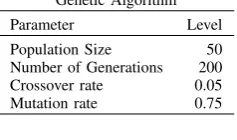
Simulations to illustrate the performance of the proposed heuristic algorithm in comparison to the global optimisation approach have been done. Linear integer programming (LIP), sub-optimal-model-based greedy algorithm (Sub-Opt), and genetic algorithm (GA) are the problem solving approaches examined through this study. LIP is a global optimization method which guarantees the optimum solution even for NP-Hard and NP-Complete problems. This is done based on the linearisation formulation as proposed in [9], and corre-sponding solutions are obtained by the LINGO optimisation package [20]. On the other hand, the Sub-Opt. solves the problem very quickly with a lower solution quality. Further-more, the genetic algorithm (GA) is producing very near optimum solutions with much lower, polynomial, complexity. GA is a population based approach, which usually provides good quality of solutions. The level of parameters used for configuring GA is presented in Table I.
Genetic Algorithm
Parameter Level
[image:4.595.111.230.532.602.2]Population Size 50 Number of Generations 200 Crossover rate 0.05 Mutation rate 0.75
TABLE I
THE LEVELS OF PARAMETERS USED TO CONFIGUREGA
The assumptions made in these simulations are as follows:
Ntot = 12 SBs per TTI, L = 12 sub-carriers per SB, N1 = N2 = . . . = NU = N and that the normal cyclic
prefix configuration is used [2]. For each sub-carrier and user, the fading amplitude follows the Rayleigh distribution [21]. The SINRs for all sub-carriers of each user are assumed to be correlated, but identically distributed (c.i.d.), and that the resource blocks follow the localized configuration [8]. The correlation coefficient between a pair of sub-carriers is given byρ|i−j|, whereiandjare the sub-carrier indices. The SINR of each sub-carrier is assumed to be independent at the begin-ning of each scheduling period, and constant throughout the
entire period. It is also assumed, for simplicity, that the set of MCSs consists of QPSK 1/2 and 3/4, 16-QAM 1/2 and 3/4, as well as 64-QAM 3/4 [1], and the L1/L2 control channels are mapped to the first OFDM symbol within each sub-frame. For illustration purposes, the parameters associated with the MCS thresholds were obtained from [1]. Furthermore, each sub-frame consists of 8 reference symbols [2]. The feedback method is based on the Exponential Effective SINR Mapping (EESM) [13], in which the effective SINR per SB is
given by γi,n =−βlnK1 ∑K
k=1e−
γ(i) n,k
β ,=θi,n, whereγ(i) n,k
corresponds to the SINR for useriat thek-th sub-carrier of SBn, the channel quality,θi,n, is defined to be the effective
SINR,γi,n, over theKsub-carriers within the SBnfor user i under EESM. The quantity β is a positive real parameter which is associated with EESM obtained from [22]. Note that EESM maps a set of sub-carrier SINRs,{γn,k(i)}K
k=1, to a
single effective SINR,γi,n, in such a way that the block error
probability (BLEP) due to{γ(n,ki)}can be well approximated by that atγi,nin additive white Gaussian noise (AWGN) [1],
[13]. The main idea is to reduce uplink signalling feedback overhead.
In order to study the effect of three important aspects of packet scheduling for LTE, three sets of experiments were included in this paper, where each set consists of different values of a specific variable to be studied (while fixing the rest of the parameter values according to the above assumptions). Each given value is calculated on 2500 channel realizations generated according to the assumptions described earlier. In the first set of experiments, the number of SBs,
N, is varied from 2 to 12 so that each CQI feedback can support in order to study the sensitivity of the performance due to the amount of feedback information available to the schedulers. This test is important as more information may improve the accuracy of the channel feedback, but at the expense of a higher signalling overhead. In the second set of experiments, the effect of correlations between sub-carriers is studied. In this scenario, the correlation is varied from 0.1 (less selective) to 0.9 (more frequency-selective). For the first two set of experiments, a maximum of U = 3 simultaneously scheduled users are assumed, and their average signal-to-interference plus noise ratios (SINRs) are10dB,11dB, and12dB respectively. Note that each user is assumed to be fading independently, while the SINRs for each user are correlated among sub-carriers according to the model described earlier. In the third set of experiments, the number of users,U, that can be scheduled simultaneously at each TTI is varied from 1 to 8. The aim of this test is to examine the extent to which the schedulers can benefit from the user diversity. To maintain a fair comparison, the average SINRs for all users are now assumed to be 10 dB.
LetR∗totbe the total bit rate defined in (4), andE[R∗tot]be the value ofRtot∗ averaged over2500 channel realizations.
1.5 2 2.5 3 3.5 4
2 4 6 8 10 12
Average total bit-rate (MBitps)
N, number of SBs with CQI fed back Optrho=0.9 S-Optrho=0.9
GArho=0.9
GArho=0.5 S-Optrho=0.5
[image:5.595.54.280.58.249.2]Optrho=0.5
Fig. 1. Average total bit rate as a function ofN, withU= 3.ρ= 0.5
and0.9.
2.6 2.8 3 3.2 3.4 3.6 3.8 4 4.2
0.1 0.2 0.3 0.4 0.5 0.6 0.7 0.8 0.9
Average total bit-rate (MBitps)
Rho, correlaltion coefficient OptN=12
S-OptN=12
GAN=12
GAN=5
S-OptN=5 OptN=5
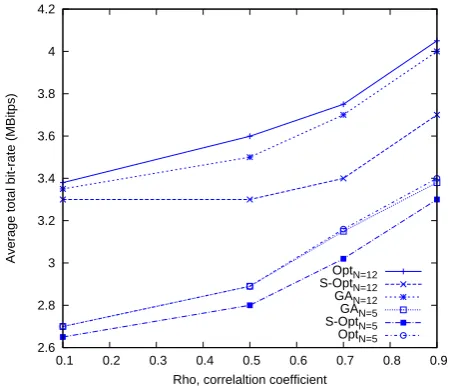
Fig. 2. Average total bit rate as a function ofρ, withU= 3.N= 5and
12withU= 3.
the nature of EESM as described in (V), a higher SINR tends to be de-emphasized compared to a lower SINR. Thus, for the case of lower correlation, the effective SINR γi,n
tends to be skewed towards SINRs of the weaker sub-carriers. Such a conservative approach is characteristic of EESM in order to maintain an acceptable BLEP. Therefore, at a low value of ρ, sub-carriers with large SINRs are not effectively utilized, leading to a relatively poor performance. In Fig. 2, it can be seen that the performance improves with
N, but the rate of improvement decreases. There is little performance improvement as N increases beyond 8 in our example. This observation suggests that a full CQI feedback is not necessary, and the feedback signalling overhead can potentially be reduced without significant degradation to the system. The explanation is as follows. Recall that the quantity
N refers to the SBs associated with the N highest channel quality for each user. As the schedulers make use the CQI feedback for SB assignments, it is the SBs associated with better channel qualities that are more important for each user during the assignment process. Thus, as N reaches up to
2 2.5 3 3.5 4 4.5 5
1 2 3 4 5 6 7 8
Average total bit-rate (MBitps)
U, number of users
[image:5.595.311.536.58.249.2]Opt S-Opt GA
Fig. 3. Average total bit rate as a function of the number of users, U, withρ= 0.9andN = 12.
a certain level, further increase in N would only include additional SBs that are of lower channel qualities and lower chances of being scheduled, and are less likely to contribute to the actually process of scheduling.
It can be seen from Figs. 1 and 2 that the performance of GA tends to be closer to the global optimum than the others. This is especially true with a higher value ofN. Also, GA clearly outperform Sub-Opt., especially in the region of higher N and ρ. Fig. 3 shows E[R∗tot] as a function of the number, U, of users for ρ = 0.9 and N = 12. In this study, the average SINRs for all users are set to 10dB. As
U increases,E[R∗tot]increases due to the more pronounced
benefits from multiuser diversity. The performance of GA remains a little bit below, but quite above the sub-optimal. This is because GA changes neighbourhood to conduct search within more frequently.
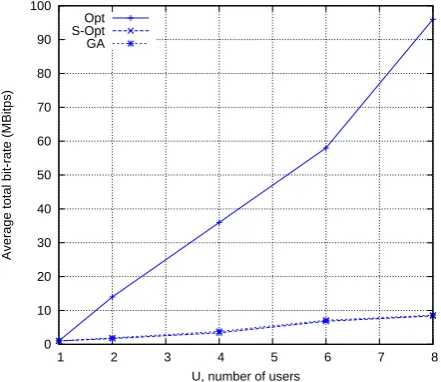
The complexity of GA for this problem is linear as explained in the following. A typical GA implementation goes through a number of generations,G, where a number of reproduction cycles, usually equals to the size of population, |Sp|, is iterated in each generation. The complexity
associ-ated with these two loops isO(G × |Sp|), which reduces to
O(1×1) since bothG and|Sp| are fixed values. The last
remaining complexity issue with GA is created by genetic operators applied per reproduction cycle through which se-lection, crossover and mutation operators are applied usually based on domain-specific procedures. In this implementation, a binary tournament selection operator is used with constant settings, which results in a complexity of O(1), while the crossover and mutation operators described above operate subject to certain probabilities, where the mutation rate dom-inates the crossover resulting in a complexity ofO(U+U) in the worst case. Therefore, the overall complexity becomes O(U).
[image:5.595.54.280.298.491.2]0 10 20 30 40 50 60 70 80 90 100
1 2 3 4 5 6 7 8
Average total bit-rate (MBitps)
U, number of users Opt
[image:6.595.56.277.58.249.2]S-Opt GA
Fig. 4. Normalized CPU time as a function of the number of users, U, withρ= 0.9andN= 12.
optimum performance.
VI. CONCLUSION
The downlink multiuser scheduling problem for LTE sys-tems is addressed in this paper. The problem is particularly tackled with GA in solving the optimization model originally proposed in [9]. The numerical results show that the genetic algorithm approach proposed in this paper significantly re-duce computational complexity relative to the exact approach using linear integer programming, while providing near-optimal performance.
ACKNOWLEDGEMENT
This work was supported by EU FP7 ”IAPP@RANPLAN” project under grant number PIAP-GA-2008-218309.
REFERENCES
[1] J. G. Andrews, A. Ghosh, and R. Muhamed,Fundamentals of WiMAX
-Understanding Broadband Wireless Networking. Prentice Hall, 2007.
[2] E. Dahlman, S. Parkvall, J. Sk¨old, and P. Beming,3G HSPA and LTE
for Mobile Broadband. Academic Press, 2007.
[3] A. Pokhariyal, T. E. Kolding, and P. E. Mogensen, “Performance of Downlink Frequency Domain Packet Scheduling For the UTRAN Long Term Evolution,” inProc. of IEEE International Symposium on
Personal, Indoor and Mobile Radio Communications, Sep. 2006.
[4] G. Monghal, K. I. Pedersen, I. Z. Kovacs, and P. E. Mogensen, “QoS Oriented Time and Frequency Domain Packet Schedulers for the UTRAN Long Term Evolution,” in Proc. of IEEE Vehicular
Technology Conference, Spring, May 11 - 14 2008, pp. 2532 – 2536.
[5] K. I. Pedersen, G. Monghal, I. Z. Kovacs, E. Troels, A. Pokhariyal, F. Frederiksen, and P. Mogensen, “Frequency Domain Scheduling for OFDMA with Limited and Noisy Channel Feedback,” inProc. of IEEE
Vehicular Technology Conference (VTC), Fall, Baltimore, USA, Sept.
30 - Oct. 3 2007, pp. 1792 – 1796.
[6] A. Pokhariyal, K. I. Pedersen, G. Monghal, I. Z. Kovacs, C. Rosa, T. E. Kolding, and P. E. Mogensen, “HARQ Aware Frequency Domain Packet Scheduler with Different Degrees of Fairness for the UTRAN Long Term Evolution,” inProc. of IEEE Vehicular Technology
Con-ference (VTC), Spring, Dublin, Ireland, April 2007, pp. 2761 – 2765.
[7] P. Kela, J. Puttonen, N. Kolehmainen, T. Ristaniemi, T. Henttonen, and M. Moisio, “Dynamic packet scheduling performance in UTRA Long Term Evolution downlink,” inProc. of IEEE International Symposium
on Wireless Pervasive Computing, May 2008.
[8] “Evolved Universal Terrestrial Radio Access (E-UTRA);Physical Channels and Modulation (Release 8),” 3rd Generation Partnership Project, Technical Report 3G TS36.211, September 2007.
[9] R. Kwan, C. Leung and J. Zhang, “Multiuser Scheduling on the Down-link of an LTE Cellular System,”Research Letters in Communications, 2008.
[10] S. T. Chung and A. J. Goldsmith, “Degrees of Freedom in Adaptive Modulation: A Unified View,”IEEE Transactions on Communications, vol. 49, no. 9, pp. 1561 – 1571, September 2001.
[11] N. Miki, Y. Kishiyama, K.Higuchi, and M. Sawahashi, “Optimum Adaptive Modulation and Channel Coding Scheme for Frequency Domain Channel-Dependent Scheduling in OFDMA Based Evolved UTRA Downlink,” inProc. of IEEE Wireless Communications and
Networking Conference WCNC, March 2007, pp. 1785 – 1790.
[12] Y. Blankenship, P. J. Sartori, B. K. Classon, V. Desai, and K. L. Baum, “Link Error Prediction Methods for Multicarrier Systems,” inProc. of
IEEE Vehiclar Technology Conference, Fall, vol. 6, September 2004,
pp. 4175 – 4179.
[13] Ericsson, “System-Level Evaluation of OFDM - Further Consid-erations,” TSG-RAN WG1 #35, Lisbon, Portugal, TR R1-031303, November 2003.
[14] M. Lampe and H. Rohling, “PER-Prediction for PHY Mode Selection in OFDM Communication Systems,” in Proc. of IEEE Globecom, vol. 1, December 2003, pp. 25 – 29.
[15] H. Song, R. Kwan, and J. Zhang, “General Results on SNR Statistics involving EESM-based Frequency Selective Feedbacks,”IEEE
Trans-actions on Wireless Communications, 2010.
[16] “Evolved Universal Terrestrial Radio Access (E-UTRA); Physical layer procedures,” 3rd Generation Partnership Project, Technical Spec-ification 3GPP TS36.213 v9.3.0, 2010.
[17] M. Aydin, R. Kwan, J. Wu, and J. Zhang, “Multiuser scheduling on the lte downlink with simulated annealing,” inVehicular Technology
Conference (VTC Spring), 2011 IEEE 73rd, May 2011, pp. 1–5.
[18] J. Holland,Adaptation in natural and artificial system. Ann Arbor: The University of Michigan Press, 1975.
[19] R. N. T. Yamada, “A Fusion of Crossover and Local Search,” inProc.
of IEEE International Conference on Industrial Technology (ICIT ’96),
December 1996, pp. 426 – 430.
[20] L. S. Inc.,Lingo, the modeling language and optimizer, 2nd ed. Lindo System Inc, 1995.
[21] M. K. Simon and M.-S. Alouini,Digital Communication over Fading
Channels, 2nd ed. John Wiley & Sons, 2005.