1788
©IJRASET: All Rights are Reserved
Comparing the Effect of Earthquake on High Rise
Building with & without Shear Wall and Shear Wall
with Opening by using Software
Susmeet D. Bagde
1, Dr. G. D. Awchat
2,
1Master in Technology student, 2Associate Professor, Dept. of Civil Engineering, Gurunanak Institute of Technology, Nagpur,
Maharashtra, India
Abstract: Most of India's cities are now growing vertically, as the population in cities is rising and the space to accommodate the growing number remains limited, so real estate developers in India are developing high-rise projects, both in luxury and affordable categories, to reach out to a large number of home buyers across different income groups. As we go higher, building have to resist lateral loads due to wind and earthquake. To resist this lateral forces, RCC Shear wall is constructed. In any structure there is need of opening for proper utility and ventilation to all rooms. Shear wall with opening are not preferred because such walls are not able to transfer the load to ground properly, so they fail. This study is carried out on twelve storied residential building with and without shear wall and shear wall with opening by using ETABS software. On the basis of results which we will get from software, Lateral Loads, Story Drifts, Percent of Still is calculated and compared.
Keywords: Shear wall, ETABS, With Opening, Without Opening, Lateral load, Story drift.
I. INTRODUCTION
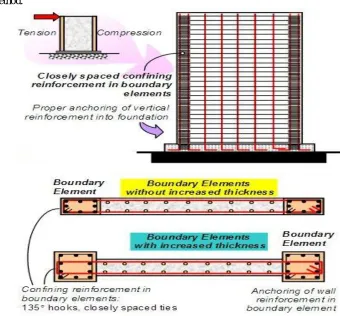
Today, high rise buildings have huge demand due to increase in population and least availability of land in the heart of city. Instead of going outskirts of town, everyone wants to live in the city, so high rise building, towers are one of the best options to satisfy the needs of people. As the height of building increases, lateral forces due to seismic becomes predominant. Shear walls are specially designed structural walls incorporated in buildings to resist lateral forces that are produced in the plane of the wall due to wind, earthquake and other forces. Such wall is mostly constructed in high rise buildings. These walls are designed for the regions likely to experience earthquake of large intensity or high wind. Shear walls are generally made of concrete or masonry. They are usually provided between columns, in stairwells, lift wells, on the corners of building perpendicular to length of building etc.
Shear walls may have one or more openings for functional reasons such as doors, windows, and other types of openings. Depending on purposes of the openings in shear wall, the size and location of openings may vary. The size and location of shear walls is extremely critical. Properly designed and construction of shear wall in buildings have shown good performance in past earthquakes. When a structural member experiences failure by shear, two parts of it are pushed in different directions, i.e. when a piece of paper is cut by scissors. Shear walls in high seismic regions require special detailing. However, in past earthquakes, even buildings with sufficient number of walls that were not specially detailed for seismic performance but had enough well distributed reinforcement, had been saved from collapse. Shear walls are efficient, both in terms of construction cost and effectiveness in minimizing earthquake damage in structural and non-structural elements like glass windows and building contents.
1) Earthquake Zones: The Indian subcontinent has a history of devastating earthquakes. The major reason for the high frequency and intensity of the earthquakes is that the Indian plate is driving into Asia at a rate of approximately 47 mm/year. Geographical statistics of India show that almost 54% of the land is vulnerable to earthquakes. The latest version of seismic zoning map of India given in the earthquake resistant design code of India IS 1893 (Part 1) 2002 assigns four levels of seismicity for India in terms of zone factors. In other words, the earthquake zoning map of India divides India into four seismic zones Zone II, III, IV and V. Unlike its previous version which consisted of five or six zones for the country. According to the present zoning map,
Zone V expects the highest level of seismicity whereas Zone II is associated with the lowest level of seismicity.
2) Factors Affecting Earthquake Design Of Structure
a) Type of soil and different zone.
b) Damping factor of the structure.
c) Ductility of the structure.
d) Importance of the building.
1789
©IJRASET: All Rights are Reserved
There are two methods available for the earthquake analysis of buildings in ETABS.
A. Equivalent Static Lateral Force Method.
B. Dynamic analysis.
1) Response spectrum method.
[image:2.595.118.458.185.501.2]2) Time history method.
Fig -1:Building with Shear wall
3) Objectives: The objectives of the present study have been identified as follows:
a) To analyse an earthquake resistant frame structure.
b) To analyse same structure with rectangular shear wall for earthquake resistance.
c) To analyse same structure with rectangular shear wall with opening. i.e. Openings for door or windows.
d) Comparing the effect of earthquake forces between all three types of structure and analyzing the result.
4) Modelling and Analysis of Structure: In this project, three models of different types are made for seismic zone III and soil type II with the help of ETABS. First is a regular frame structure with columns, beams and slab. The second model is same as the first model but in addition, shear wall is placed on either side of a building. Shear wall is constructed perpendicular to the length of building. Third model is exactly same as second model, except in the third model, we have provided opening in shear wall for proper utility of building. In all this model Dead load and Live load is applied on the basis of IS Code 875 Part I, IS Code 875 Part II. As we know- this building is of twelve story so it comes in Highrise building, therefore we have used IS Code 875 Part III for applying wind loads on building.
5) Required Indian Standard Codes IS 456:2000: As per clause 32, design for wall describes, design of horizontal shear in clause
32.4 given details of how shear wall has to be constructed. IS 1893-2002Criteria of Earth Quake resistant Buildings Part 3 –
page no. 23, clause 4.2 gives the estimation of earth quake loads. IS 13920:1993it gives the ductile detailing of shear wall as
1790
©IJRASET: All Rights are Reserved
[image:3.595.198.398.148.550.2]6) Data used for Modelling
Table -1:Data used for Modeling
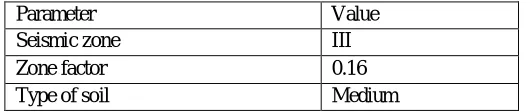
[image:3.595.167.433.674.730.2]Table -2:Load taken from IS Code
Table -3:Seismic data required for analysis
Model Description
Number of stories 12
Height of Stories 3 m
Length of the building 27.91 m
Width of the building 25.03 m
Height of the building 43.5 m
Slab Thickness 150 mm
Grade of concrete M25
Grade of Still Fe 451
Thickness of Shear wall 230
Thickness of outer brick wall 230
Thickness of inner brick wall 115
Size of column 400 x 400
Size of Beam 230 x 400
Live Load on Terrace 2kN/m
Opening in Shear wall for Door 0.9 m x 2.1
m
Wind Speed 44 m/s
Parameter Value
Live Load 3 kN/m2
Floor Finish 1 kN/m2
Parameter Value
Seismic zone III
Zone factor 0.16
1791
©IJRASET: All Rights are Reserved
II. MODELLING
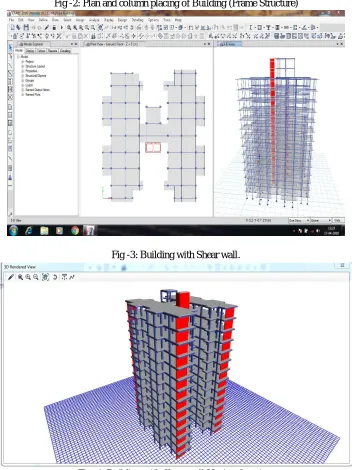
Modelling for Highrise building is done by using ETABS. A Building plan is drawn by using AutoCAD as per building by laws. Then AutoCAD file is imported in ETABS for structural modelling. Three models are made for the comparison. First is Framed structure (regular building) with beams, columns and slab. The second one is as same as first one but shear wall is included in it to resist lateral load coming from earthquake and wind. Shear wall is placed in such a way that it is perpendicular to the longer side of building. As majority of times we need opening in shear wall for proper utility of building, so third model is having shear wall with opening. In this building Plan opening is given for door of size 0.92m x 2.1m.
[image:4.595.122.479.267.737.2]As we are comparing the effect of earthquake on Highrise building, so we have used Response spectra method of ETABS for earthquake resistant design. We have referred IS 875: 2015 Part 3 clause no. 6.2 page no. 6 fig:1 for wind speed. This building is being considered for Nagpur region so we have taken wind speed of 44 m/s. For Imposed factor clause no. 5.3.4 pg. no. 30 and for Coefficient (Cp)= -1.1 clause no. 7.3.3.1 Pg. no. 13.
Fig -2: Plan and column placing of Building (Frame Structure)
Fig -3: Building with Shear wall.
[image:4.595.128.470.275.509.2]1792
©IJRASET: All Rights are Reserved
III. RESULTANDDISCUSSION
After all detailed modeling, model is checked by the software and design command is given. When the designing process is over, we check the results. We get the results of base shear, story drift, shear force, base reaction of each column, bending moment of column and beam, percent of steel etc.
A. Base Shear
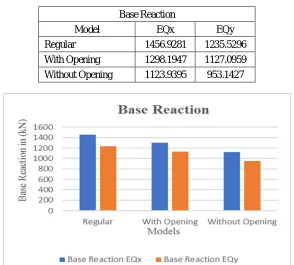
Baseshear is an estimate of the maximum expected lateral force on the base of the structure due to seismic activity. Base shear for structure with and without shear wall and shear wall having openings are taken and compared. See
Table -4: Base Reaction
Graph -1: Graph for base shear for regular structure, with shear wall and shear wall with opening. Base Reaction
Model EQx EQy
Regular 1456.9281 1235.5296
With Opening 1298.1947 1127.0959
[image:5.595.151.445.451.716.2]1793
©IJRASET: All Rights are Reserved
We got values of base shear from model 1, model 2 and model 3. They are compared with each other; It is found that base shear of building without shear wall is higher. While building having shear wall with opening have 10.9% less base shear and building having shear wall without opening is 15.2% less base shear compared to regular framed structure building in X direction.
Similarly, base shear of building without shear wall in Y direction is higher. While the building having shear wall with opening have 8.77% less base shear and building having shear wall without opening is 22.86% less base shear respectively as compared to regular framed structure building in Y direction.
Base reaction of building having shear wall with opening is 4.3% more in X direct and 14.17% more in Y direction respectively as compared to base reaction of building with shear wall.
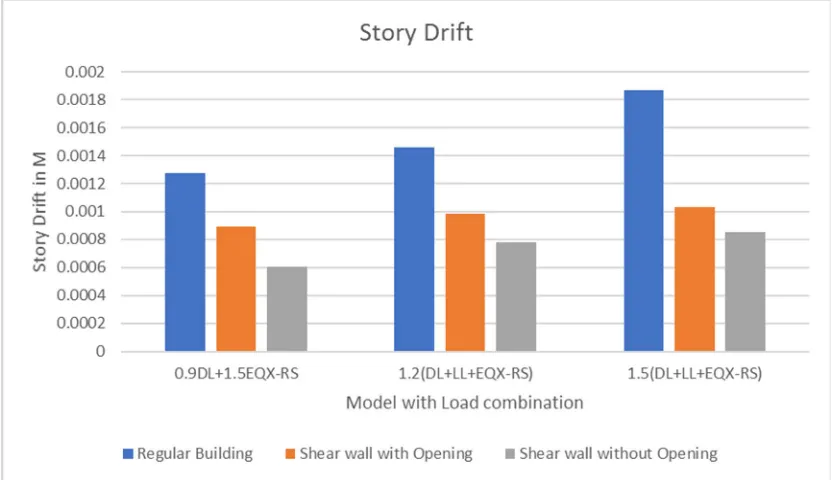
B. Story Drift
Load Combination
Story 7th Floor
Model Meter
0.9DL+1.5EQX-RS
Regular Building 0.00127
Shear wall with Opening 0.000894
Shear wall Without Opening 0.000604
1.2(DL+LL+EQX-RS)
Regular Building 0.00146
Shear wall with Opening 0.000987
Shear wall Without Opening 0.000904
1.5(DL+LL+EQX-RS)
Regular Building 0.00209
Shear wall with Opening 0.00103
[image:6.595.90.507.438.678.2]Shear wall Without Opening 0.000983
Table -5: Storey drift is defined as the ratio of displacement of two consecutive floors to height of that floor.
Graph -2: Graph of storey drift for regular structure, with shear wall and shear wall with opening structure.
1794
©IJRASET: All Rights are Reserved
According to IS: 1893 (Part I) - 2002, the story drift for buildings is limited to 0.004 times the story height, which was not exceeded in this analytical study for all the models.
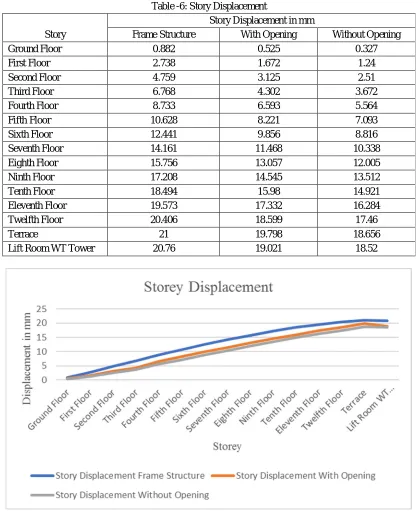
[image:7.595.89.507.161.672.2]C. Storey Displacement
Table -6: Story Displacement
Story
Story Displacement in mm
Frame Structure With Opening Without Opening
Ground Floor 0.882 0.525 0.327
First Floor 2.738 1.672 1.24
Second Floor 4.759 3.125 2.51
Third Floor 6.768 4.302 3.672
Fourth Floor 8.733 6.593 5.564
Fifth Floor 10.628 8.221 7.093
Sixth Floor 12.441 9.856 8.816
Seventh Floor 14.161 11.468 10.338
Eighth Floor 15.756 13.057 12.005
Ninth Floor 17.208 14.545 13.512
Tenth Floor 18.494 15.98 14.921
Eleventh Floor 19.573 17.332 16.284
Twelfth Floor 20.406 18.599 17.46
Terrace 21 19.798 18.656
Lift Room WT Tower 20.76 19.021 18.52
Graph -3: Graph for story displacement for regular structure, with shear wall and shear wall with opening.
1795
©IJRASET: All Rights are Reserved
IV. CONCLUSIONS
In this study, frame structure, frame structure with shear wall and frame structure having shear wall with opening are analysed with the help of ETABS software by using response spectra method for analysis. The results are compared based on the parameters of base reaction, storey drift, storey displacement. In addition, we have included opening in shear wall and we have studied the behaviour of whole structure. On the basis of all the results, we have come to a conclusion as follows.
A. This study reveals that the base shear, story drift, story displacement and overall seismic response of structure is affected by
removal of shear wall as well as giving opening in shear wall.
B. It is found that base shear of the building without shear wall is higher. While, the building having shear wall with opening have
10.9% less base shear and building having shear wall without opening is 15.2% less base shear compared to regular framed structure building in X direction. Similarly, base shear of the building without shear wall in Y direction is higher. While the building having shear wall with opening has 8.77% less base shear and the building having shear wall without opening is 22.86% less base shear compared to the regular framed structure building in Y direction.
C. By comparing values of storey drift of all the three models for storey seven, it is observed that storey drift is less in the model
having shear wall and the model having shear wall has more storey drift. Storey drift is high in the model consist of only frame structure.
D. We got values of storey displacement from model 1, model 2 and model 3. It is found that the storey displacement on the
ground floor is less compared to the top floor of each model while story displacement of frame structure is more compared to structure having shear wall with opening. The structure having shear wall have minimum story displacement compared to the other models.
REFERENCES
[1] Vinayak Kulkarni, Swapnil Cholekar, Hemant Sonawadekar, ‘Effect of Openings of Shear Wall in High Rise Buildings’, Int. Journal of Applied Sciences and Engineering Research, Vol. 3, Issue 4, (2014), ISSN 2277 – 9442
[2] P. P. Chandurkar and Dr. P. S. Pajgade, Seismic Analysis of RCC Building with and Without Shear Wall, International Journal of Science and Research (2013), Vol. 3, Issue. 3, May - June 2013 pp-1805-1810, ISSN (Online): 2319-7064
[3] Anshuman. S, Dipendu Bhunia and Bhavin Ramjiyani, ‘Solution of Shear Wall Location in MultiStorey Building’ International Journal of Civil and Structural Engineering (2011) ISSN 0976 – 4399
[4] N.M. Nikam, L.G. Kalurkar, Pushover Analysis of Building with Shear Wall, International Journal of Earth Sciences and Computing, Volume 6 Issue No. 8, August 2016, pp-2916-2918.
[5] Vishal A. Itware, Dr. Uttam B. Kalwane, ‘Effects of Openings in Shear Wall on Seismic Response of Structure’ Int. Journal of Engineering Research and Applications, ISSN : 2248-9622, Vol. 5, Issue 7, ( Part - 1) July 2015, pp.41-45
[6] Shyam Bhat M, N. A. Premanand Shenoy, Asha U Rao, “Earthquake behaviour of buildings with and without shear walls”. IOSR-JMCE, e-ISSN: 2278-1684, p-ISSN: 2320-334X PP 20-25.
[7] M. S. Aainawala and Dr. P. S. Pajgade, ‘Design of Multistoried R.C.C. Buildings with and without Shear Walls’ International Journal of Engineering Sciences & Research Technology (2014) ISSN: 2277-9655