Travel-Package Recommendation Model based on
Collaborative Approach
Pranoti Shirbhate
1, Prabhakar Ramteke
2 1, 2Computer Science and Information Technology, SGBAUAbstract: The development of wireless setting, touristy promoting transfer from the normal way to the new generation. The mobile commerce technology provides client additional directly and more timely info. The accuracy is improved with a higher travel-tweet training dataset also as a higher travel class identification technique using collaborative Approach. the demand for intelligent travel services, from every tourists and travel corporations, is expected to increase dramatically. Since recommender systems ar successfully applied to boost the quality of service for patrons in an exceedingly} very vary of fields, its natural
direction to develop recommender systems for customized travel package recommendation. when examining the depths of objectives, methodologies, and knowledge sources of the prevailing models, the paper helps anyone inquisitive about the event of travel recommendation systems and facilitates future analysis direction. we've conjointly projected a location recommendation Model supported cooperative Approach. The model’s results represent each the recognition of all social users, however conjointly the individual interest. so it is a personalized recommendation model.
I. INTRODUCTION
Planning route for the travel is a very important step for a tourist to arrange his/her trip. User generated knowledge from the social media are often processed, and employed by the recommendation systems. Recommender system could be a field of data Retrieval that are wide employed in our day to day applications and e-commerce sites to filter product and services in step with user interest and preferences. A recommendation system analyses information like user’s profile, demographic information, user’s past history and interest to suggest a list of products that are found appropriate supported that information. once the info thought-about for the recommendation is user profile and their past history, it's content primarily based recommendation system. cooperative filtering based recommendation system recommends using each history of the user into consideration and conjointly the history of the users who are the same as thought-about user [1].
Travel Package System is associate degree irresistible word once it involves tour and travel packages. we provide tour and travel services together with price ticket bookings, vacation tour packages, domestic tour packages. we offer the foremost appropriately designed likewise because the custom-built travel packages to the purchasers. the big growth of internet and its user base has become supply for big quantity of knowledge obtainable on-line. This data is also useful for users, to counsel things or services as per their preferences.
Recommender system plays the role of generating suggestions by assembling user data like preferences, interests, and locations. The analysis on recommender systems gained importance when the emergence of collaborative filtering. The presence of technology in each personal and travel connections infer the requirement for access to technical support that would facilitate users resolve straightforward and sophisticated technical problems.
Recently, a number of trade has begun to acknowledge edges|the advantages|the advantages} of game based perform and look for opportunities to leverage these benefits, particularly with regard to play for the advantage of the corporation [13]. the most aim of mistreatment personalization techniques is to get custom-built recommendation in step with the user preferences and interests . The recommender system has an objective to filter unwanted data and to supply specific results for the actual user.. within the travel recommender systems, planned model learns the user preferences and generates places of attractions in step with the user interests. This paper focuses on the recommender systems and their application in touristy [10].
II. LITERATURE REVIEW
In a recent years touristy and Travel stores giving an enormous amount of services and traveling info by on-line. additionally this vast volume of data smoothly accessed by electronic devices, like phone, laptop with the supply of web affiliation. once tourists are visiting any cities, most of them aimed to explore the interesting reality or things regarding the places and events.
Logesh Ravi and Subramaniyaswamy Vairavasundaram [10], planned a location recommendation system supported social pertinent trust walker (SPTW) and compared the results with the present baseline random walk models. Later, increased the SPTW model for cluster of users recommendations.
Shuhui Jiang, Xueming Qian [5], presents a customized travel sequence recommendation from each travelogues and community-contributed photos and the heterogeneous data. To recommend customized poi sequence, first, celebrated routes are hierarchic consistent with the similarity between user package and route package. Then high hierarchic routes area unit additional optimized by social similar users’ travel records.
Ling Xing [11], planned model takes into thought the situation, that defines the geographical boundaries of suggested things. The model’s results represent each the recognition of all social users, however additionally the individual interest. therefore it is a customized recommendation model. Experimental results on real-life information show that our model exhibits higher accuracy than different relevant recommendation system.
Hassan Takabi [12], planned a distributed cooperative approach for location privacy in LBS supported k-anonymity. In analysis given approach desires neither a trusty third party nor users to trust one another. By victimization cryptanalytic schemes, user will learn whether or not there are at least k users together with himself/herself within the question space. The analysis shows straightforward state of affairs wherever user and site suppliers are honest-but-curious so we increasingly extend our protocol to handle eventualities wherever entities might conspire with one another. Moreover, we have a tendency to analyze attainable threats. Joseph Coelho [14], this study explores the utilization of twitter information to personalize travel recommendations. A machine learning classification model is employed to spot travel connected tweets. The travel tweets are then wont to personalize recommendations concerning places of interest for the user. The planned model lists ’n’ places of interest from every class in proportion to the travel class score generated by the model.
A. Proposed Collaborative Approach
In this section, we tend to describe our approach that shows however a user will learn whether or not there are at least k users as well as himself/herself during a given question area, wherever k may be a price chosen by the user. The question space at first corresponds to user's current cell and if the user finds out that there are fewer than k users during this cell, he/she will enlarge the question space and re-execute the protocol for the enlarged space. This method may be recurrent multiple times.
The step of algorithm of collaborative approach is described as followers:
1) Step 1: The user must registered into the system User set {u1, u2……….un}.
2) Step 2: Each user record saves into the system with security.
3) Step 3: The request comes from various nodes with their ip addresses. The server sends the notification to each user set {Um1…….Umn}.
4) Step 4: The system records interest of each user according to searching pattern. User set {u1………... un} U Interest Set {I1……… In}
5) Step 5: Package recommendation phase activated according to mutual user account Package Set { p1…………. Pn } If( u1 = = I1)
Then u1= p1
6) Step 6: The step 5 repeat every time for each and every new and existing user. Where,
u1……un indicates user list,
Um1…Umn indicates registration confirmation message I1……In indicates user interested set
B. Travel-Package Recommendation Model
The tourist-relation-area-season topic (TRAST) model has been planned, that facilitate sunders and additionally the explanations why tourists type a travel cluster. This goes on the so much aspect customized package recommendations and is helpful for capturing the latent relationships among the tourists in each travel cluster. to boot, systematic experiments area unit conducted on the necessary world info. These experiments not only demonstrate that the TRAST model is employed as an assessment for travel cluster automatic formation however additionally provide additional insights into the TAST model.
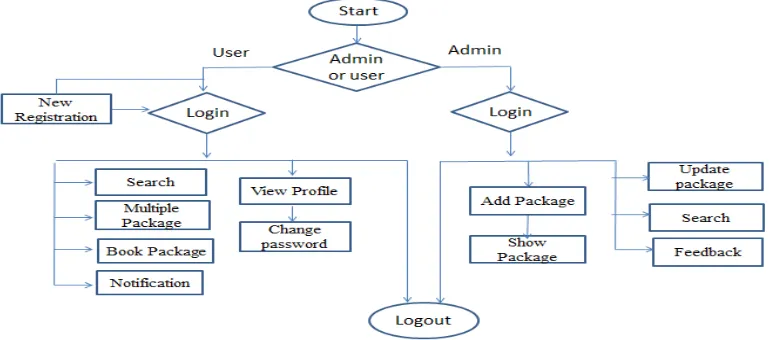
Fig1. Flowchart of Proposed Model
As shown in figure 1 shows the flow chart of proposed model. In proposed model there are 2 modules admin module and user modules. In admin model, admin have some functions like admin can add new packages admin have rights to appear at packages and update package. equally in user model ,users have some functions like search , book package users can checking notifications ,users can modification their profile.
III. RESULTS ANALYSIS
[image:3.595.107.492.195.365.2]The proposed model designed Travel-Package Recommendation Model supported collaborative Approach within the proposed location recommender system, the user’s interaction is completed through the interface module. Then, the user requests are forwarded to the ratings prediction module. New user 1st need to register himself/herself by fill up a registration kind. when with success login of users in user model users have the recommended track package user Figure shows the package details. Figure 2 shows the package details. during this model shows all details regarding package here user will read revelation feedback additionally. With the help of this all details user will selected his/her package.
Figure 3 shows the payment gateway details. For booking the travel package user has to pay payment is shown in figure.
Fig 3: Payment Gateway
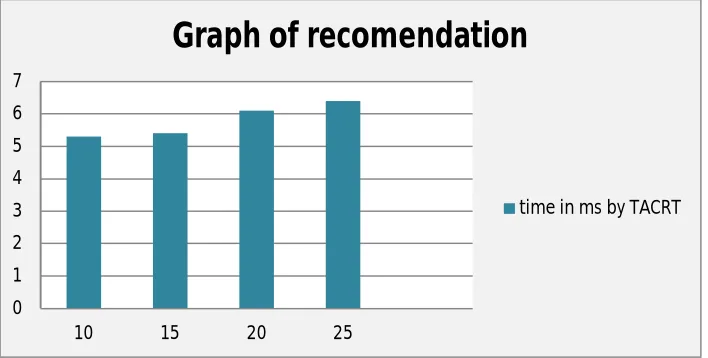
In the graph shows in figure 4 the x axis indicates the number of user files in database. The y axis indicated the total computational time in ms to perform recommendation using TACRT.
In this above table execution time is calculated this can be calculated with the help of the one query i.e SET STATISTICS TIME
ON GO Insert into Registration (id,name, email, mobile, username, pwd-txt, photo, pwd) values
(@id,@name,@email,@mobile,@username,@pwd_txt,@photo,@pwd) GO
SET STATISTICS TIME Off
[image:4.595.122.476.431.610.2]This execution time may vary it’s depend on the system configuration.
Fig 4: Graph Showing time required for Recommendation According to users.
IV. CONCLUSION
This paper explains a recommendation system for personalized travel sequence. This recommendation system considers the user interest with another attribute of users like time, season, and price of travel. exploitation this social media information not alone mining users purpose of interest but in addition the travel sequence of the aim of interest with considering various attribute of user. There are many different types of methods, algorithms and technologies that are used for recommendation. but still there are some problems. The planned system provides a lot of strong resolution for travel package recommendation. In planned technique, a user is in an exceedingly position to urge packages recommended by the system. This system traces the profile data and user searches pattern found the interest of the user, and provide the acceptable travel package to user. In result analysis shows details exhaustion about travel package recommendation model in graph shows the time required for Recommendation according to users.
0 1 2 3 4 5 6 7
10 15 20 25
Graph of recomendation
REFERENCES
[1] Yan-Ying Chen, An-Jung Cheng, and Winston H. Hsu,” Travel Recommendation by Mining People Attributes and Travel Group Types From Community-Contributed Photos”, IEEE TRANSACTIONS ON MULTIMEDIA, VOL. 15, NO. 6, OCTOBER 2013,
[2] Mayuri D. Aswale, Dr. S. C. Dharmadhikari,” Survey on Recommendation of Personalized Travel Sequence”, International Journal of Advanced Research in Computer and Communication Engineering, Vol. 6, Issue 1, January 2017.
[3] Yong Ge, Qi Liu1, Hui Xiong, Alexander Tuzhilin, Jian Chen,” Cost-aware Travel Tour Recommendation,” 17th ACM SIGKDD international conference on Knowledge discovery and data mining, August 21 - 24, 2011.
[4] Yu Zheng, Lizhu Zhang, Xing Xie, Wei-Ying Ma,” Mining Interesting Locations and Travel Sequences from GPS Trajectories”, International conference on World Wide Web 2009 | April 2009.
[5] Shuhui Jiang, Xueming Qian, Tao Mei, Yun Fu, “Personalized Travel Sequence Recommendation on Multi-Source Big Social Media”, IEEE TRANSACTIONS ON BIG DATA, VOL. X, NO. X, SEPTEMBER 2016.
[6] Yanchi Liu; Chuanren Liu, Bin Liu, Meng Qu, Hui Xiong,” Unified Point-of-Interest Recommendation with Temporal Interval Assessment” 22nd ACM SIGKDD International Conference on Knowledge Discovery and Data Mining, August 13 - 17, 2016.
[7] Nikos Mamoulis, Huiping Cao, George Kollios, Marios Hadjieleftheriou, Yufei Tao and David W. Cheung,” Mining, Indexing, and Querying Historical Spatiotemporal Data”, nternational conference on Knowledge discovery and data mining, August 22–25, 2004.
[8] Quan Yuan, Gao Cong, Zongyang Ma, Aixin Sun,” Time-aware Point-of-interest Recommendation”, 36th international ACM SIGIR conference on Research and development in information retrieval, August 01, 2013.
[9] Hari Baaskar.R, S.Monika, B.Divya Bharathi, M.Kave Priadarsni,R.Bagath Singh,” Travel Recommendation by Mining Geo-Tagged Photos Using Internal Search Path Algorithm”, International Journal Of Core Engineering & Management (IJCEM),Volume 1, Issue 9, December 2014.
[10] Logesh Ravi and Subramaniyaswamy Vairavasundaram,” A Collaborative Location Based Travel Recommendation System through Enhanced Rating Prediction for the Group of Users”,Hindawi Publishing Corporation Computational Intelligence and Neuroscience Volume 2016,
[11] Ling Xing,Qiang Ma, Song Chen,”A Novel Personalized Recommendation Model based on Location Computing”,Chinese Automation Congress (CAC),20-22 Oct. 2017.
[12] Hassan Takabi, James B. D. Joshi, Hassan A. Karimi,”A Collaborative K -anonymity Approach for Location Privacy in Location-Based Services”,5th International Conference on Collaborative Computing: Networking, Applications and Work sharing 11-14 Nov. 2009.
[13] Jason C. Hung, Victoria Hsu and Martin M. Weng,”A Study for Task based Recommendation System for Travel Navigation”,International Joint Conference on Awareness Science and Technology & Ubi-Media Computing (iCAST 2013 & UMEDIA 2013),2-4 Nov. 2013.
[14] Joseph Coelho, Paromita Nitu, and Praveen Madiraju,”A Personalized Travel Recommendation System Using Social Media Analysis”,IEEE International Congress on Big Data (BigData Congress), 2-7 July 2018.