Vector Quality
Maayan Zhitomirsky-Geffet
∗ Bar-Ilan UniversityIdo Dagan
∗∗ Bar-Ilan UniversityThis article presents a novel bootstrapping approach for improving the quality of feature vector weighting in distributional word similarity. The method was motivated by attempts to utilize distributional similarity for identifying the concrete semantic relationship of lexical entailment. Our analysis revealed that a major reason for the rather loose semantic similarity obtained by distributional similarity methods is insufficient quality of the word feature vectors, caused by deficient feature weighting. This observation led to the definition of a bootstrapping scheme which yields improved feature weights, and hence higher quality feature vectors. The under-lying idea of our approach is that features which are common to similar words are also most characteristic for their meanings, and thus should be promoted. This idea is realized via a bootstrapping step applied to an initial standard approximation of the similarity space. The superior performance of the bootstrapping method was assessed in two different experiments, one based on direct human gold-standard annotation and the other based on an automatically created disambiguation dataset. These results are further supported by applying a novel quanti-tative measurement of the quality of feature weighting functions. Improved feature weighting also allows massive feature reduction, which indicates that the most characteristic features for a word are indeed concentrated at the top ranks of its vector. Finally, experiments with three prominent similarity measures and two feature weighting functions showed that the bootstrapping scheme is robust and is independent of the original functions over which it is applied.
1. Introduction 1.1 Motivation
Distributional word similarity has long been an active research area (Hindle 1990; Ruge 1992; Grefenstette 1994; Lee 1997; Lin 1998; Dagan, Lee, and Pereira 1999; Weeds and
∗Department of Information Science, Bar-Ilan University, Ramat-Gan, Israel. E-mail: [email protected].
∗∗Department of Computer Science, Bar-Ilan University, Ramat-Gan, Israel. E-mail: [email protected].
Weir 2005). This paradigm is inspired by Harris’s distributional hypothesis (Harris 1968), which states that semantically similar words tend to appear in similar contexts. In a computational realization, each word is characterized by a weighted feature vector, where features typically correspond to other words that co-occur with the characterized word in the context. Distributional similarity measures quantify the degree of similarity between a pair of such feature vectors. It is then assumed that two words that occur within similar contexts, as measured by similarity of their context vectors, are indeed semantically similar.
The distributional word similarity measures were often applied for two types of inferences. The first type is making similarity-based generalizations for smoothing word co-occurrence probabilities, in applications such as language modeling and dis-ambiguation. For example, assume that we need to estimate the likelihood of the verb– object co-occurrence pairvisit–country, although it did not appear in our sample corpus. Co-occurrences of the verbvisitwith words that are distributionally similar tocountry, such as state, city, and region, however, do appear in the corpus. Consequently, we may infer that visit–country is also a plausible expression, using some mathematical scheme of similarity-based generalization (Essen and Steinbiss 1992; Dagan, Marcus, and Markovitch 1995; Karov and Edelman 1996; Ng and Lee 1996; Ng 1997; Dagan, Lee, and Pereira 1999; Lee 1999; Weeds and Weir 2005). The rationale behind this inference is that if two words are distributionally similar then the occurrence of one word in some contexts indicates that the other word is also likely to occur in such contexts.
A second type of semantic inference, which primarily motivated our own research, is meaning-preserving lexical substitution. Many NLP applications, such as question answering, information retrieval, information extraction, and (multi-document) sum-marization, need to recognize that one word can be substituted by another one in a given context while preserving, or entailing the original meaning. Naturally, recogniz-ing such substitutable lexical entailments is a prominent component within the textual entailment recognition paradigm, which models semantic inference as an application-independent task (Dagan, Glickman, and Magnini 2006). Accordingly, several textual entailment systems did utilize the output of distributional similarity measures to model entailing lexical substitutions (Jijkoun and de Rijke 2005; Adams 2006; Ferrandez et al. 2006; Nicholson, Stokes, and Baldwin 2006; Vanderwende, Menezes, and Snow 2006). In some of these papers the distributional information typically complements man-ual lexical resources in textman-ual entailment systems, most notably WordNet (Fellbaum 1998).
Lexical substitution typically requires that the meaning of one word entails the meaning of the other. For instance, in question answering, the word company in a question can be substituted in an answer text by firm, automaker, or subsidiary, whose meanings entail the meaning ofcompany. However, as it turns out, traditional distributional similarity measures do not capture well such lexical substitution relationships, but rather capture a somewhat broader (and looser) notion of semantic similarity. For example, quite distant co-hyponyms such as party and company also come out as distributionally similar to country, due to a partial overlap of their semantic properties. Clearly, the meanings of these words do not entail each other.
quality of distributional word feature vectors. The article describes the methodology, definitions, and analysis of our investigation and the resulting bootstrapping scheme for feature weighting which yielded improved empirical performance.
1.2 Main Contributions and Outline
As a starting point for our investigation, an operational definition was needed for evaluating the correctness of candidate pairs of similar words. Following the lexical substitution motivation, in Section 3 we formulate thesubstitutable lexical entailment relation (or lexical entailment, for brevity), refining earlier definitions in Geffet and Dagan (2004, 2005). Generally speaking, this relation holds for a pair of words if a possible meaning of one word entails a meaning of the other, and the entailing word can substitute the entailed one in some typical contexts. Lexical entailment overlaps partly with traditional lexical semantic relationships, while capturing more generally the lexical substitution needs of applications. Empirically, high inter-annotator agreement was obtained when judging the output of distributional similarity measures for lexical entailment.
Next, we analyzed the typical behavior of existing word similarity measures relative to the lexical entailment criterion. Choosing the commonly used measure of Lin (1998) as a representative case, the analysis shows that quite noisy feature vectors are a major cause for generating rather “loose” semantic similarities. On the other hand, one may expect that features which seem to be most characteristic for a word’s meaning should receive the highest feature weights. This does not seem to be the case, however, for common feature weighting functions, such as Point-wise Mutual Information (Church and Patrick 1990; Hindle 1990).
Following these observations, we developed a bootstrapping formula that improves the original feature weights (Section 4), leading to better feature vectors and better similarity predictions. The general idea is to promote the weights of features that are common for semantically similar words, since these features are likely to be most char-acteristic for the word’s meaning. This idea is implemented by a bootstrapping scheme, where the initial (and cruder) similarity measure provides an initial approximation for semantic word similarity. The bootstrapping method yields a high concentration of semantically characteristic features among the top-ranked features of the vector, which also allows aggressive feature reduction.
The bootstrapping scheme was evaluated in two experimental settings, which cor-respond to the two types of applications for distributional similarity. First, it achieved significant improvements in predicting lexical entailment as assessed by human judg-ments, when applied over several base similarity measures (Section 5). Additional analysis relative to the lexical entailment dataset revealed cleaner and more charac-teristic feature vectors for the bootstrapping method. To obtain a quantitative analysis of this behavior, we defined a measure called average common-feature rank ratio. This measure captures the idea that a prominent feature for a word is expected to be prominent also for semantically similar words, while being less prominent for unrelated words. To the best of our knowledge this is the first proposed measure for direct analysis of the quality of feature weighting functions, without the need to employ them within some vector similarity measure.
this article, suggesting the relevance of our analysis and bootstrapping scheme for the general use of distributional feature vectors.1
2. Background: Distributional Similarity Models
This section reviews the components of the distributional similarity approach and specifies the measures and functions that were utilized by our work.
The Distributional Hypothesis assumes that semantically similar words appear in similar contexts, suggesting that semantic similarity can be detected by comparing contexts of words. This is the underlying principle of the vector-based distributional similarity model, which comprises two phases. First, context features for each word are constructed and assigned weights; then, the weighted feature vectors of pairs of words are compared by a vector similarity measure. The following two subsections review typical methods for each phase.
2.1 Features and Weighting Functions
In the typical computational setting, word contexts are represented by feature vectors. A feature represents another word (or term)wwith whichwco-occurs, and possibly specifies also the syntactic relationship between the two words, as in Grefenstette (1994), Lin (1998), and Weeds and Weir (2005). Thus, a word (or term) w is represented by a feature vector, where each entry in the vector corresponds to a feature f. Pado and Lapata (2007) demonstrate that using syntactic dependency-based features helps to distinguish among classes of lexical relations, which seems to be more difficult when using “bag of words” features that are based on co-occurrence in a text window.
A syntactic-based featuref for a wordwis defined as a triple: fw, syn rel, f role
wherefwis a context word (or term) that co-occurs withwunder the syntactic depen-dency relationsyn rel. The feature role (f role) corresponds to the role of the feature word fwin the syntactic dependency, being either the head (denotedh) or the modifier (de-notedm) of the relation. For example, given the wordcompany, the featureearnings, gen, hcorresponds to the genitive relationshipcompany’s earnings, andinvestor, pcomp of, m corresponds to the prepositional complement relationshipthe company of the investor.2 Throughout this article we use syntactic dependency relationships generated by the Minipar dependency parser (Lin 1993). Table 1 lists common Minipar dependency relations involving nouns. Minipar also identifies multi-word expressions, which is
1A preliminary version of the bootstrapping method was presented in Geffet and Dagan (2004). That paper presented initial results for the bootstrapping scheme, when applied only over Lin’s measure and tested by the manually judged dataset of lexical entailment. The current research extends our initial results in many respects. It refines the definition of lexical entailment; utilizes a revised test set of larger scope and higher quality, annotated by three assessors; extends the experiments to two additional similarity measures; provides comparative qualitative and quantitative analysis of the bootstrapped vectors, while employing our proposed average common-feature rank ratio; and presents an additional evaluation based on a pseudo-WSD task.
Table 1
Common grammatical relations of Minipar involving nouns.
Relation Description
appo apposition
comp1first complement
det determiner
gen genitive marker
mod the relationship between a word and its adjunct modifier
pnmod post nominal modifier
pcomp nominal complement of prepositions
post post determiner
vrel passive verb modifier of nouns
obj object of verbs
obj2 second object of ditransitive verbs
subj subject of verbs
s surface subject
advantageous for detecting distributional similarity for such terms. For example, Curran (2004) reports that multi-word expressions make up between 14–25% of the synonyms in a gold-standard thesaurus.
Thus, in our representation the corpus is first transformed to a setSof dependency relationship instances of the form w,f, where each pair corresponds to a single co-occurrence of w and f in the corpus. f is termed as a feature of w. Then, a word w is represented by a feature vector, where each entry in the vector corresponds to one feature f. The value of the entry is determined by a feature weighting function weight(w,f), which quantifies the degree of statistical association betweenwandfin the setS. For example, some feature weighting functions are based on the logarithm of the word–feature co-occurrence frequency (Ruge 1992), or on the conditional probability of the feature given the word (Pereira, Tishby, and Lee 1993; Dagan, Lee, and Pereira 1999; Lee 1999).
Probably the most widely used feature weighting function is (point-wise) Mutual Information (MI) (Church and Patrick 1990; Hindle 1990; Luk 1995; Lin 1998; Gauch, Wang, and Rachakonda 1999; Dagan 2000; Baroni and Vegnaduzzo 2004; Chklovski and Pantel 2004; Pantel and Ravichandran 2004; Pantel, Ravichandran, and Hovy 2004; Weeds, Weir, and McCarthy 2004), defined by:
weightMI(w,f)=log2
P(w,f)
P(w)P(f) (1)
We calculate the MI weights by the following statistics in the space of co-occurrence instancesS:
weightMI(w,f)=log2
count(w,f)·nrels
count(w)·count(f) (2)
Curran and Moens (2002) argue that, generally, informative features are statis-tically correlated with their corresponding headword. Thus, they suggest that any statistical test used for collocations is a good starting point for improving feature-weight functions. In their experiments the t-test-based metric yielded the best empirical performance.
However, a known weakness of MI and most of the other statistical weighting functions used for collocation extraction, including t-test and χ2, is their tendency to inflate the weights for rare features (Dunning 1993). In addition, a major property of lexical collocations is their “non-substitutability”, as termed in Manning and Schutze (1999). That is, typically neither a headword nor a modifier in the collocation can be substituted by their synonyms or other related terms. This implies that using modifiers within strong collocations as features for a head word would provide a rather small amount of common features for semantically similar words. Hence, these functions seem less suitable for learning broader substitutability relationships, such as lexical entailment.
Similarity measures that utilizeMI weights showed good performance, however. In particular, a common practice is to filter out features by minimal frequency and weight thresholds. Then, a word’s vector is constructed from the remaining (not filtered) features that are strongly associated with the word. These features are denoted here as activefeatures.
In the current work we useMIfor data analysis, and for the evaluations of vector quality and word similarity performance.
2.2 Vector Similarity Measures
Once feature vectors have been constructed the similarity between two words is de-fined by some vector similarity measure. Similarity measures which have been used in the cited papers include weighted Jaccard (Grefenstette 1994), Cosine (Ruge 1992), and various information theoretic measures, as introduced and reviewed in Lee (1997, 1999). In the current work we experiment with the following three popular similarity measures.
1. The basic Jaccard measure compares the number of common features with the overall number of features for a pair of words. One of the weighted generalizations of this scheme to non-binary values replaces intersection with minimum weight, union with maximum weight, and set cardinality with summation. This measure is commonly referred to asweighted Jaccard (WJ) (Grefenstette 1994; Dagan, Marcus, and Markovitch 1995; Dagan 2000; Gasperin and Vieira 2004), defined as follows:
simWJ(w,v)=
f∈F(w)∩F(v)min(weight(w,f),weight(v,f))
f∈F(w)∪F(v)max(weight(w,f),weight(v,f)) (3)
whereF(w) andF(v) are the sets of active features of the two wordsw andv. The appealing property of this measure is that it considers the association weights rather than just the number of common features.
learning distributionally similar words (Ruge 1992; Caraballo 1999; Gauch, Wang, and Rachakonda 1999; Pantel and Ravichandran 2004), is defined as follows:
simCOS(w,v)=
f(weight(w,f)·weight(v,f))
√
f(weight(w,f))2·
√
f(weight(v,f))2
(4)
This measure computes the cosine of the angle between the two feature vectors, which normalizes the vector lengths and thus avoids inflated discrimination between vectors of significantly different lengths.
3. A popular state of the art measure has been developed by Lin (1998), motivated by Information Theory principles. This measure behaves quite similarly to the weighted Jaccard measure (Weeds, Weir, and McCarthy 2004), and is defined as follows:
simLIN(w,v)=
f∈F(w)∩F(v)(weightMI(w,f)+weightMI(v,f))
f∈F(w)weightMI(w,f)+
f∈F(v)weightMI(v,f) (5)
whereF(w) andF(v) are the active features of the two words. The weight function used originally by Lin isMI(Equation 1).
It is interesting to note that a relatively recent work by Weeds and Weir (2005) inves-tigates a more generic similarity framework. Within their framework, the similarity of two nouns is viewed as the ability to predict the distribution of one of them based on that of the other. Their proposed formula combines the precision and recall of a potential “retrieval” of similar words based on the features of the target word. The precision of w’s prediction ofv’s feature distribution indicates how many of the features of the word w co-occurred with the word v. The recall of w’s prediction of v’s features indicates how many of the features of v co-occurred with w. Words with both high precision and high recall can be obtained by computing their harmonic mean, mh(or F-score), and a weighted arithmetic mean. However, after empirical tuning of weights for the arithmetic mean, Weeds and Weir’s formula practically reduces to Lin’s measure, as was anticipated by their own analysis (in Section 4 of their paper).
Consequently, we choose the Lin measure (Equation 5) (henceforth denoted asLIN) as representative for the state of the art and utilize it for data analysis and as a starting point for improvement. To further explore and evaluate our new weighting scheme, independently of a single similarity measure, we conduct evaluations also with the other two similarity measures of weighted Jaccard and Cosine.
3. Substitutable Lexical Entailment
distributional vector representations and, in particular, conduct error analysis for word pair candidates that were judged negatively.
The discussion in the Introduction suggested that multiple text understanding applications need to identify term pairs whose meanings are both entailing and sub-stitutable. Such pairs seem to be most appropriate for lexical substitution in a meaning preserving scenario. To model this goal we present an operational definition for a lexical semantic relationship that integrates the two aspects of entailment and substitutability,3 which is termed substitutable lexical entailment(orlexical entailment, for brevity). This relationship holds for a given directional pair of terms (w,v), saying thatwentails v, if the following two conditions are fulfilled:
1. Word meaning entailment: the meaning of a possible sense ofwimplies a possible sense ofv;
2. Substitutability:wcan substitute forvin some naturally occurring sentence, such that the meaning of the modified sentence would entail the meaning of the original one.
To operationally assess the first condition (by annotators) we propose considering the meaning of terms by existential statements of the form “there exists an instance of the meaning of the termwin some context” (notice that, unlike propositions, it is not intuitive for annotators to assign truth values to terms). For example, the wordcompany would correspond to the existential statement “there exists an instance of the concept companyin some context.” Thus, if in some context “there is a company” (in the sense of “commercial organization”) then necessarily “there is afirm” in that context (in the corresponding sense). Therefore, we conclude that the meaning ofcompanyimplies the meaning offirm. On the other hand, “there is anorganization” does not necessarily imply the existence ofcompany, sinceorganizationmight stand for some non-profit association, as well. Therefore, we conclude thatorganizationdoes not entailcompany.
To assess the second condition, the annotators need to identify some natural con-text in which the lexical substitution would satisfy entailment between the modified sentence and the original one. Practically, in our experiments presented in Section 5 the human assessors could consult external lexical resources and the entire Web to obtain all the senses of the words and possible sentences for substitution. We note that the task of identifying the common sense of two given words is quite easy since they mutually dis-ambiguate each other, and once the common sense is known it naturally helps finding a corresponding common context. We note that this condition is important, in particular, in order to eliminate cases of anaphora and co-reference in contexts, where two words quite different in their meaning can sometimes appear in the same contexts only due to the text pragmatics in a particular situation. For example, in some situationsworker anddemonstratorcould be used interchangeably in text, but clearly it is a discourse co-reference rather than common meaning that makes the substitution possible. Instead, we are interested in identifying word pairs in which one word’s meaning provides a reference to the entailed word’s meaning. This purpose is exactly captured by the existential propositions of the first criterion above.
3 The WordNet definition of the lexical entailment relation is specified only for verbs and, therefore, is not felicitous for general purposes: A verb X entails Y if X cannot be done unless Y is, or has been, done (e.g.,
As reported further in Section 5.1, we observed that assessing these two conditions for candidate word similarity pairs was quite intuitive for annotators, and yielded good cross-annotator agreement. Overall, substitutable lexical entailment captures directly the typical lexical substitution scenario in text understanding applications, as well as in generic textual entailment modeling. In fact, this relation partially overlaps with several traditional lexical semantic relations that are known as relevant for lexical substitution, such as synonymy, hyponymy, and some cases of meronymy. For example, we say that the meaning of company is lexically entailed by the meaning of firm (synonym) orautomaker(hyponym), while the wordgovernmententailsminister(meronym) asThe government voted for the new lawentailsA minister in the government voted for the new law.
On the other hand, lexical entailment is not just a superset of other known relations, but it is rather designed to select those sub-cases of other lexical relations that are needed for applied entailment inference. For example, lexical entailment does not cover all cases of meronyms (e.g., divisiondoes not entailcompany), but only some sub-cases of part-whole relationship mentioned herein. In addition, some other relations are also covered by lexical entailment, likeoceanandwaterandmurderanddeath, which do not seem to directly correspond to meronymy or hyponymy relations.
Notice also that whereas lexical entailment is a directional relation that specifies which word of the pair entails the other, the relation may hold in both directions for a pair of words, as is the case for synonyms. More detailed motivations for the substitutable lexical entailment relation and analysis of its relationship to traditional lexical semantic relations appear in Geffet (2006) and Geffet and Dagan (2004, 2005).
4. Bootstrapping Feature Weights
To gain a better understanding of distributional similarity behavior we first analyzed the output of the LIN measure, as a representative case for the state of the art, and regarding lexical entailment as a reference evaluation criterion. We judge as correct, with respect to lexical entailment, those candidate pairs of the distributional similarity method for which entailment holds at least in one direction.
For example, the word area is entailed by country, since the existence of country entails the existence ofarea, and the sentenceThere is no rain in subtropical countries during the summer periodentails the sentenceThere is no rain in subtropical areas during the summer period.As another example,democracyis a type ofcountryin the political sense, thus the existence entailment holds and also the sentenceIsrael is a democracy in the Middle East entailsIsrael is a country in the Middle East.
On the other hand, our analysis revealed that many candidate word similarity pairs suggested by distributional similarity measures do not correspond to “tight” semantic relationships. In particular, many word pairs suggested by the LIN measure do not satisfy the lexical entailment relation, as demonstrated in Table 2.
Table 2
The top 20 most similar words forcountry(and their ranks) in the similarity list ofLIN, followed by the next four words in the similarity list that were judged as entailing at least in one direction.
nation 1 *city 7 economy 13 *company 19
region 2 territory 8 *neighbor 14 *industry 20
state 3 area 9 *sector 15 kingdom 30
*world 4 *town 10 *member 16 place 35
*island 5 republic 11 *party 17 colony 41
*province 6 *north 12 government 18 democracy 82
[image:10.486.50.438.267.394.2]Twelve out of 20 top similarities (60%) were judged as mutually non-entailing and are marked with an asterisk. The similarity data was produced as described in Section 5.
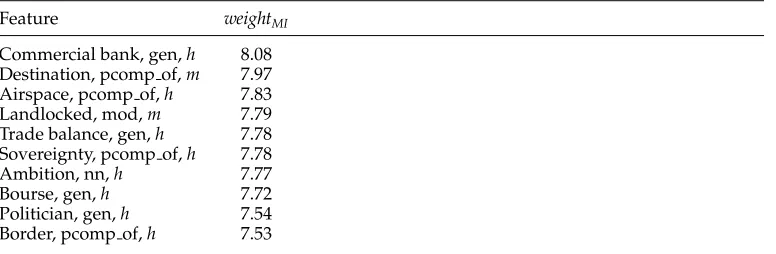
Table 3
The top 10 ranked features forcountryproduced byMI, the weighting function employed in the
LINmethod.
Feature weightMI
Commercial bank, gen,h 8.08
Destination, pcomp of,m 7.97
Airspace, pcomp of,h 7.83
Landlocked, mod,m 7.79
Trade balance, gen,h 7.78
Sovereignty, pcomp of,h 7.78
Ambition, nn,h 7.77
Bourse, gen,h 7.72
Politician, gen,h 7.54
Border, pcomp of,h 7.53
sorted feature list, at positions 461and 832. Overall, features that seem to characterize the word meaning well are scattered across the ranked feature list, while many non-indicative features receive high weights. This behavior often yields high similarity scores for word pairs whose semantic similarity is rather loose while missing some much tighter similarities.
Furthermore, we observed that characteristic features for a wordw, which should receive higher weights, are expected to be common for w and other words that are semantically similar to it. This observation suggests a computational scheme which would promote the weights of features that are common for semantically similar words. Of course, there is an inherent circularity in such a scheme: to determine which features should receive high weights we need to know which words are semantically similar, while computing distributional semantic similarity already requires pre-determined feature weights.
4.1 Bootstrapped Feature Weight Definition
The bootstrapped feature weight is defined as follows. First, some standard word similarity measuresimis computed to obtain an initial approximation of the similarity space. Then, we define theword setof a featuref, denoted byWS(f), as the set of words for whichfis an active feature. Recall from Section 2.2 that an active feature is a feature that is strongly associated with the word, that is, its (initial) weight is higher than an empirically predefined threshold,θweight. Thesemantic neighborhoodofw, denoted by N(w), is defined as the set of all words vwhich are considered sufficiently similar to w, satisfyingsim(w,v)> θsim, whereθsimis a second empirically determined threshold. The bootstrapped feature weight, denotedweightB, is then defined by:
weightB(w,f)=v∈WS(f)∩N(w)sim(w,v) (6)
That is, we identify all wordsvthat are in the semantic neighborhood ofwand are also characterized byf, and then sum the values of their similarities tow.
Intuitively, summing these similarity values captures simultaneously a desired balance between feature specificity and generality, addressing the observations in the beginning of this section. Some features might characterize just a single word that is very similar tow, but then the sum of similarities will include a single element, yielding a relatively low weight. This is why the sum of similarities is used rather than an average value, which might become too high by chance when computed over just a single element (or very few elements). Relatively generic features, which occur with many words and are thus less indicative, may characterize more words within N(w) but then on average the similarity values of these words withwis likely to be lower, contributing smaller values to the sum. To receive a high overall weight a reliable feature has to characterize multiple words that are highly similar tow.
We note that the bootstrapped weight is a sum of word similarity values rather than a direct function of word–feature association values, which is the more common approach. It thus does not depend on the exact statistical co-occurrence level between w andf. Instead, it depends on a more global assessment of the association between f and the semantic vicinity of w. We notice that the bootstrapped weight is deter-mined separately relative to each individual word. This differs from measures that are global word-independent functions of the feature, such as the feature entropy used in Grefenstette (1994) and the feature term strength relative to a predefined class as em-ployed in Pekar, Krkoska, and Staab (2004) for supervised word classification.
4.2 Feature Reduction and Similarity Re-Computation
Once the bootstrapped weights have been computed, their accuracy is sufficient to allow for aggressive feature reduction. As shown in the following section, in our experiments it sufficed to use only the top 100 features for each word in order to obtain optimal word similarity results, because the most informative features now receive the highest weights.
5. Evaluation by Lexical Entailment
To test the effectiveness of the bootstrapped weighting scheme, we first evaluated whether it contributes to better prediction of lexical entailment. This evaluation was based on gold-standard annotations determined by human judgments of the substi-tutable lexical entailment relation, as defined in Section 3. The new similarity scheme, simB, based on the bootstrapped weights, was first computed using the standardLIN method as the initial similarity measure. The resulting similarity lists of simLIN (the
originalLINmethod) andsimBLIN(Bootstrapped LIN) schemes were evaluated for a sam-ple of nouns (Section 5.2). Then, the evaluation was extended (Section 5.3) to apply the bootstrapping scheme over the two additional similarity measures that were presented in Section 2.2,simWJ (weighted Jaccard) andsimCOS(Cosine). Along with these lexical
entailment evaluations we also analyzed directly the quality of the bootstrapped fea-ture vectors, according to the average common-feafea-ture rank ratio measure, which was defined in Section 6.
5.1 Experimental Setting
Our experiments were conducted using statistics from an 18 million token subset of the Reuters RCV1 corpus (known as Reuters Corpus, Volume 1, English Language, 1996-08-20 to 1997-08-19), parsed by Lin’s Minipar dependency parser (Lin 1993).
The test set of candidate word similarity pairs was constructed for a sample of 30 randomly selected nouns whose corpus frequency exceeds 500. In our primary exper-iment we computed the top 40 most similar words for each noun by thesimLINand by
simBLINmeasures, yielding 1,200 pairs for each method, and 2,400 pairs altogether. About 800 of these pairs were common for the two methods, therefore leaving approximately 1,600 distinct candidate word similarity pairs. Because the lexical entailment relation is directional, each candidate pair was duplicated to create two directional pairs, yielding a test set of 3,200 pairs. Thus, for each pair of words,wandv, the two ordered pairs (w,v) and (v,w) were created to be judged separately for entailment in the specified direction (whether the first word entails the other). Consequently, a non-directional candidate similarity pairw,vis considered as a correct entailment if it was assessed as an entailing pair at least in one direction.
The assessors were only provided with a list of word pairs without any contextual information and could consult any available dictionary, WordNet, and the Web. The judgment criterion follows the criterion presented in Section 3. In particular, the judges were asked to apply the two operational conditions, existence and sub-stitutability in context, to each given pair. Prior to performing the final test of the annotation experiment, the judges were presented with an annotated set of entailing and non-entailing pairs along with the existential statements and sample sentences for substitution, demonstrating how the two conditions could be applied in different cases of entailment. In addition, they had to judge a training set of several dozen pairs and then discuss their judgment decisions with each other to gain a better understanding of the two criteria.
vice versa (as shown in Section 3.3), therefore the second pair is judged as not entailing. Eventually, the non-directional pair{company, organization} is considered as a correct entailment.
Finally, the test set of 3,200 pairs was split into three disjoint subsets that were judged by three native English speaking assessors, each of whom possessed a Bach-elors degree in English Linguistics. For each subset a different pair of assessors was assigned, each person judging the entire subset. The judges were grouped into three different pairs (i.e., JudgeI+JudgeII, JudgeII+JudgeIII, and JudgeI+JudgeIII). Each pair was assigned initially to judge all the word similarities in each subset, and the third assessor was employed in cases of disagreement between the first two. The majority vote was taken as the final decision. Hence, each assessor had to fully annotate two thirds of the data and for a third subset she only had to judge the pairs for which there was disagreement between the other two judges. This was done in order to measure the agreement achieved for different pairs of annotators.
The output pairs from both methods were mixed so the assessors could not associate a pair with the method that proposed it. We note that this evaluation methodology, in which human assessors judge the correctness of candidate pairs by some semantic substitutability criterion, is similar to common evaluation methodologies used for para-phrase acquisition (Barzilay and McKeown 2001; Lin and Pantel 2001; Szpektor et al. 2004).
Measuring human agreement level for this task, the proportions of matching de-cisions were 93.5% between Judge I and Judge II, 90% for Judge I and Judge III, and 91.2% for Judge II and Judge III. The corresponding kappa values are 0.83, 0.80, and 0.80, which is regarded as “very good agreement” (Landis and Koch 1997). It is interesting to note that after some discussion most of the disagreements were settled, and the few remaining mismatches were due to different understandings of word meanings. These findings seem to have a similar flavor to the human agreement findings reported for the Recognizing Textual Entailment challenges (Bar-Haim et al. 2006; Dagan, Glickman, and Magnini 2006), in which entailment was judged for pairs of sentences. In fact, the kappa values obtained in our evaluation are substantially higher than reported for sentence-level textual entailment, which suggests that it is easier to make entailment judgments at the lexical level than at the full sentence level.
The parameter values of the algorithms were tuned using a development set of similarity pairs generated for 10 additional nouns, distinct from the 30 nouns used for the test set. The parameters were optimized by running the algorithm systematically with various values across the parameter scales and judging a sample subset of the results.weightMI=4 was found as the optimalMIthreshold for active feature weights
(features included in the feature vectors), yielding a 10% precision increase ofsimLINand
removing over 50% of the data relative to no feature filtering. Accordingly, this value also serves as theθweight threshold in the bootstrapping scheme (Section 4). As for the θsimparameter, the best results on the development set were obtained for θsim=0.04, θsim=0.02, and θsim=0.01when bootstrapping over the initial similarity measures LIN,WJ, andCOS, respectively.
5.2 Evaluation Results forsimBLIN
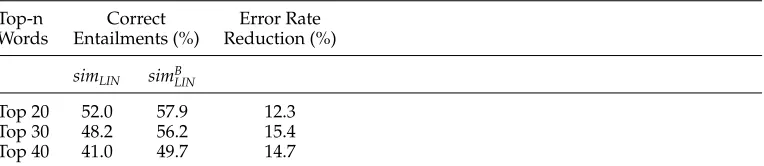
We measured the contribution of the improved feature vectors to the resulting preci-sion of simLIN andsimBLIN in predicting lexical entailment. The results are presented in
Table 4
Lexical entailment precision values for top-n similar words by theBootstrapped LINand the originalLINmethod.
Top-n Correct Error Rate
Words Entailments (%) Reduction (%)
simLIN simBLIN
Top 20 52.0 57.9 12.3
Top 30 48.2 56.2 15.4
Top 40 41.0 49.7 14.7
Bootstrapped LIN method outperformed the original LIN approach by 6–9 precision points at all top-nlevels. As expected, the precision for the shorter top 20 list is higher for both methods, thus leaving a bit less room for improvement.
Overall, the Bootstrapped LIN method extracted 104 (21%) more correct similarity pairs than the other measure and reduced the number of errors by almost 15%. We also computed the relative recall, which shows the percentage of correct word similarities found by each method relative to the joint set of similarities that were extracted by both methods. The overall relative recall of theBootstrapped LINwas quite high (94%), exceeding LIN’s relative recall (of 78%) by 16 percentage points. We found that the bootstrapped method covers over 90% of the correct similarities learned by the original method, while also identifying many additional correct pairs.
It should be noted at this point that the current limited precision levels are deter-mined not just by the quality of the feature vectors but significantly by the nature of the vector comparison measure itself (i.e., theLINformula, as well weighted Jaccard and Cosine as reported in Section 5.3). It was observed in other work (Geffet and Dagan 2005) that these common types of vector comparison schemes exhibit certain flaws in predicting lexical entailment. Our present work thus shows that the bootstrapping method yields a significant improvement in feature vector quality, but future research is needed to investigate improved vector comparison schemes.
An additional indication of the improved vector quality is the massive feature reduction allowed by having the most characteristic features concentrated at the top ranks of the vectors. The vectors of active features ofLIN, as constructed after standard feature filtering (Section 5.1), could be further reduced by the bootstrapped weighting to about one third of their size. As illustrated in Figure 1, changing the vector size significantly affects the similarity results. InsimBLIN the best result was obtained with the top 100 features per word, while using less than 100 or more than 150 features caused a 5–10% decrease in performance. On the other hand, an attempt to cut off the lower ranked features of theMIweighting always resulted in a noticeable decrease in precision. These results show that forMI weighting many important features appear further down in the ranked vectors, while for the bootstrapped weighting adding too many features adds mostly noise, since most characteristic features are concentrated at the top ranks. Thus, in addition to better feature weighting, the bootstrapping step provides effective feature reduction, which improves vector quality and consequently the similarity results.
Figure 1
Percentage of correct entailments within the top 40 candidate pairs of each of the methods, LINandBootstrapped LIN(denoted asLINBin the figure), when using varying numbers of top-ranked features in the feature vector. The value of “All” corresponds to the full size of vectors and is typically in the range of 300–400 features.
of LSA-based vectors is applied, whereas in Curran, and Curran and Moens, only the strongly associated verbs (direct and indirect objects of the noun) are selected as “canonical features” that are expected to be shared by true synonyms.
Finally, we tried executing an additional bootstrapping iteration ofweightB calcula-tion over the similarity results ofsimBLIN. The resulting increase in precision was much smaller, of about 2%, showing that most of the potential benefit is exploited in the first bootstrapping iteration (which is not uncommon for natural language data). On the other hand, computing the bootstrapping weight twice increases computation time significantly, which led us to suggest a single bootstrapping iteration as a reasonable cost-effectiveness tradeoff for our data.
5.3 Evaluation forsimBWJandsimBCOS
To further validate the behavior of the bootstrapping scheme we experimented with two additional similarity measures, weighted Jaccard (simWJ) and Cosine (simCOS) (described
in Section 2.2). For each of the additional measures the experiment repeats the main three steps described in Section 4: Initially, the basic similarity lists are calculated for each of the measures usingMIweighting; then, the bootstrapped weighting,weightB, is computed based on the initial similarities, yielding new word feature vectors; finally, the similarity values are recomputed by the same vector similarity measure using the new feature vectors.
Table 5
Comparative precision values for the top 20 similarity lists of the three selected similarity measures, withMIand Bootstrapped feature weighting for each.
Measure LIN–LINB WJ–WJB COS–COSB
Correct Similarities (%) 52.0–57.9 51.0–54.8 46.1–50.9
and weightBweighting functions. The four lists were judged for lexical entailment by three assessors, according to the same procedure described in Section 5.1. To make the additional manual evaluation affordable we judged the top 20 similar words in each list for each of the 30 target nouns of Section 5.1.
Table 5 summarizes the precision values achieved by LIN, WJ, and COS with bothweightMIandweightB. As shown in the table, bootstrapped weighting consistently contributed between 4–6 points to the accuracy of each method in the top 20 similarity list. We view the results as quite positive, considering that improving over top 20 similarities is a much more challenging task than improving over longer similarity lists, while the improvement was achieved only by modifying the feature vectors without changing the similarity measure itself (as hinted in Section 5.2). Our results are also compatible with previous findings in the literature (Dagan, Lee, and Pereira 1999; Weeds, Weir, and McCarthy 2004) that found LIN and WJ to be more accurate for similarity acquisition thanCOS. Overall, the results demonstrate that the bootstrapped weighting scheme consistently produces improved results.
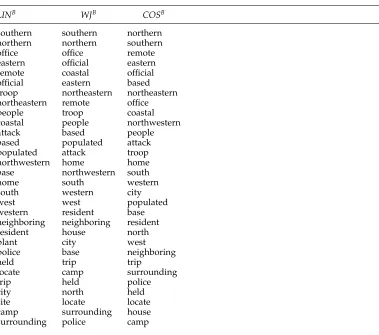
An interesting behavior of the bootstrapping process is that the most prominent features for a given target word converge across the different initial similarity measures, as exemplified in Table 6. In particular, although the initial similarity lists overlap only partly,4the overlap of the top 30 features for our 30-word sample was ranging between 88% and 100%. This provides additional evidence that the quality of the bootstrapped weighting is quite similar for various initial similarity measures.
6. Analyzing the Bootstrapped Feature Vector Quality
In this section we provide an in-depth analysis of the bootstrapping feature weighting quality compared to the state-of-the-artMIweighting function.
6.1 Qualitative Observations
The problematic feature ranking noticed at the beginning of Section 4 can be revealed more objectively by examining the common features which contribute most to the word similarity scores. To that end, we examine the common features of the two given words and sort them by the sum of their weights in both word vectors. Table 7 shows the top 10 common features by this sorting for a pair of truly similar (lexically entailing) words (country–state), and for a pair of non-entailing words (country–party). For each common feature the table shows its two corresponding ranks in the feature vectors of the two words.
4 Overlap rate was about 40% betweenCOSandWJorLIN, and 70% betweenWJandLIN. The overlap was computed following the procedure of Weeds, Weir, and McCarthy (2004), disregarding the order of the similar words in the lists. Interestingly, they obtained roughly similar figures, of 28% overlap forCOS
Table 6
Top 30 features oftownby bootstrapped weighting based onLIN,WJ, andCOSas initial similarities. The three sets of words are almost identical, with relatively minor ranking differences.
LINB WJB COSB
southern southern northern
northern northern southern
office office remote
eastern official eastern
remote coastal official
official eastern based
troop northeastern northeastern
northeastern remote office
people troop coastal
coastal people northwestern
attack based people
based populated attack
populated attack troop
northwestern home home
base northwestern south
home south western
south western city
west west populated
western resident base
neighboring neighboring resident
resident house north
plant city west
police base neighboring
held trip trip
locate camp surrounding
trip held police
city north held
site locate locate
camp surrounding house
surrounding police camp
It can be observed in Table 7 that for both word pairs the common features are scattered across the pair of feature vectors, making it difficult to distinguish between the truly similar and the non-similar pairs. We suggest, on the other hand, that the desired behavior of effective feature weighting is that the common features of truly similar words would be concentrated at the top ranks of both word vectors. In other words, if the two words are semantically similar then we expect them to share their most characteristic features, which are in turn expected to appear at the higher ranks of each feature vector. The common features for non-similar words are expected to be scattered all across each of the vectors. In fact, these expectations correspond exactly to the rationale behind distributional similarity measures: Such measures are designed to assign higher similarity scores for vector pairs that share highly weighted features.
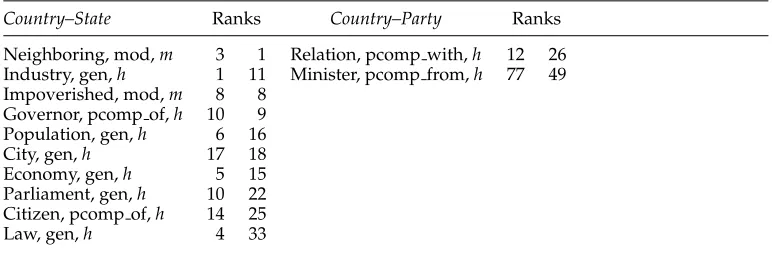
for both words. On the other hand, there are only two common features (among the top 100 features) for the incorrect paircountry–party, both with quite low ranks (compare with Table 7), while the rest of the common features for this pair did not pass the top 100 cutoff.
[image:18.486.50.433.355.489.2]Consequently, Table 10 demonstrates a much more accurate similarity list for coun-try, where many incorrect (non-entailing) word similarities, likepartyandcompany, were demoted. Instead, additional correct similarities, likekingdomandland, were promoted (compare with Table 2). In this particular case all the remaining errors correspond to words that are related quite closely tocountry, denoting geographic concepts. Many of these errors are context dependent entailments which might be substitutable in some cases, but they violate the word meaning entailment condition (e.g., country–neighbor, country–port). Apparently, these words tend to occur in contexts that are typical for countryin the Reuters corpus. Some errors violating the substitutability condition of lexical entailment were identified as well, such as industry–product. These cases are quite hard to differentiate from correct entailments, since the two words are usually closely related to each other and also share highly ranked features, because they often appear in similar characteristic contexts. It may therefore be difficult to filter out such
Table 7
LIN(MI) weighting: The top 10 common features forcountry–stateandcountry–party, along with their corresponding ranks in each of the two feature vectors. The features are sorted by the sum of their feature weights with both words.
Country–State Ranks Country–Party Ranks
Broadcast, pcomp in,h 24 50 Brass, nn,h 64 22
Goods, mod,h 140 16 Concluding, pcomp of,h 73 20
Civil servant, gen,h 64 54 Representation, pcomp of,h 82 27
Bloc, gen,h 30 77 Patriarch, pcomp of,h 128 28
Nonaligned, mod,m 55 60 Friendly, mod,m 58 83
Neighboring, mod,m 15 165 Expel, pcomp from,h 59 30
Statistic, pcomp on,h 165 43 Heartland, pcomp of,h 102 23
Border, pcomp of,h 10 247 Surprising, pcomp of,h 114 38
Northwest, mod,h 41174 Issue, pcomp between,h 103 51
[image:18.486.54.432.536.665.2]Trip, pcomp to,h 105 34 Contravention, pcomp in,m 129 43
Table 8
Top 10 features ofcountryby the Bootstrapped feature weighting.
Feature WeightB
Industry, gen,h 1.21
Airport, gen,h 1.16
Visit, pcomp to,h 1.06
Neighboring, mod,m 1.04
Law, gen,h 1.02
Economy, gen,h 1.02
Population, gen,h 0.93
Stock market, gen,h 0.92
Governor, pcomp of,h 0.92
Table 9
Bootstrapped weighting: top 10 common features forcountry–stateandcountry–partyalong with their corresponding ranks in the two (sorted) feature vectors.
Country–State Ranks Country–Party Ranks
Neighboring, mod,m 3 1 Relation, pcomp with,h 1 2 26
Industry, gen,h 111Minister, pcomp from,h 77 49
Impoverished, mod,m 8 8
Governor, pcomp of,h 1 0 9
Population, gen,h 6 1 6
City, gen,h 1 7 1 8
Economy, gen,h 5 1 5
Parliament, gen,h 1 0 22
Citizen, pcomp of,h 1 4 25
Law, gen,h 4 33
Table 10
Top 20 most similar words forcountryand their ranks in the similarity list by theBootstrapped
LINmeasure.
nation 1 territory 6 *province 11 zone 16
state 2 *neighbor 7 *city 12 land 17
*island 3 colony 8 *town 13 place 18
region 4 *port 9 kingdom 14 economy 19
area 5 republic 10 *district 15 *world 20
Note that four of the incorrect similarities from Table 2 were replaced with correct entailments resulting in a 20% increase of precision (reaching 60%).
non-substitutable similarities merely by the standard distributional similarity scheme, suggesting that additional mechanisms and data types would be required.
6.2 The Average Common-Feature Rank Ratio
It should be noted at this point that these observations regarding feature weight be-havior are based on subjective intuition of how characteristic features are for a word meaning, which is quite difficult to assess systematically. Therefore, we next propose a quantitative measure for analyzing the quality of feature vector weights.
More formally, given a pair of feature vectors for words wand v we first define theiraverage common-feature rankwith respect to the top-ncommon features, denoted acfrn, as follows:
acfrn(w,v)=
1
n
f∈top−n(F(w)∩F(v))12[rank(w,f)+rank(v,f)]
(7)
[image:19.486.52.436.284.342.2]Using this measure, we expect that a good feature weighting function would typically yield lower values of acfrn for truly similar words (as low ranking values
correspond to higher positions in the vectors) than for non-similar words. Hence, given a pre-judged test set of pairs of similar and non-similar words, we define the ratio, acfr-ratio, between the averageacfrn of the set of all the non-similar words, denoted as Non-Sim, and the averageacfrnof the set of all the known pairs of similar words,Sim, to be an objective measure for feature weighting quality, as follows:
acfrn−ratio= 1 |Non−Sim|
w,v∈Non−Simacfrn(w,v)
1 |Sim|
w,v∈Simacfrn(w,v) (8)
As an illustration, the two word pairs in Table 7 yieldedacfr10(country,state)=78 andacfr10(country,party)=64. Both values are quite high, showing no principal differ-ence between the tighter lexically entailing similarity versus a pair of non-similar (or rather loosely related) words. This behavior indicates the deficiency of theMIfeature weighting function in this case. On the other hand, the corresponding values for the two pairs produced by the Bootstrapped LINmethod (for the features in Table 9) are acfr10(country,state)=1 2 andacfr10(country,party)=41. These figures clearly reflect the desired distinction between similar and non-similar words, showing that the common features of the similar words are indeed concentrated at much higher ranks in the vectors than the common features of the non-similar words.
In recent work on distributional similarity (Curran 2004; Weeds and Weir 2005) a variety of alternative weighting functions were compared. However, the quality of these weighting functions was evaluated only through their impact on the performance of a particular word similarity measure, as we did in Section 5. Our acfr-ratio measure provides the first attempt to analyze the quality of weighting functions directly, relative to a pre-judged word similarity set, without reference to a concrete similarity measure.
6.3 An Empirical Assessment of theacfr-ratio
In this subsection we report an empirical comparison of theacfr-ratioobtained for theMI andBootstrappedLINweighting functions. To that end, we have run the Minipar system on the full Reuters RCV1corpus, which contains 2.5 GB of English news stories, and then calculated theMI-weighted feature vectors. The optimized threshold on the feature weights,θweight, was set to 0.2. Further, to compute theBootstrapped LINfeature weights aθsimof 0.02 was applied to theLINsimilarity values. In this experiment we employed the full bootstrapped vectors (i.e., without applying feature reduction by the top 100 cutoff). This was done to avoid the effect of the feature vector size on theacfrnmetric,
which tends to naturally assign higher scores to shorter vectors.
As computing theacfr-ratiorequires a pre-judged sample of candidate word simi-larity pairs, we utilized the annotated test sample of candidate pairs of word similarities described in Section 5, which contains both entailing and non-entailing pairs.
First, we computed the average common-feature rank scores (acfrn) (with varying
values ofn) forweightMIand forweightBover all the pairs in the test sample. Interestingly,
the mean acfrn scores for weightB range within 110–264 for n = 1 0. . . 1 00, while the
corresponding range forweightMIis by an order of magnitude higher: 780–1,254, despite
reflect a desired behavior of the bootstrapping function which concentrates most of the prominent common features for all the distributionally similar words (whether entailing or not) at the lower ranks of their vectors. In particular, this explains the ability of our method to perform a massive feature reduction as demonstrated in Section 5, and to produce more informative vectors, while demoting and eliminating much of the noise in the original vectors.
Next, we aim to measure the discriminative power of the compared methods to distinguish between entailing and non-entailing pairs. To this end we calculated the acfr-ratio, which captures the difference in the average common feature ranks between entailing vs. non-entailing pairs, for both theMI-based and bootstrapped vectors.
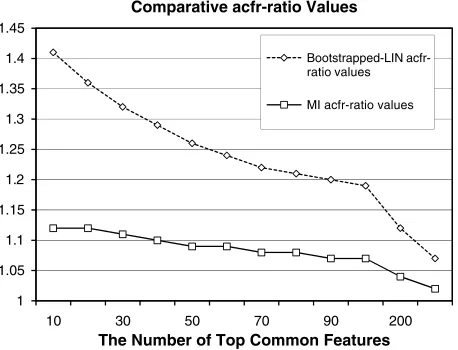
The obtained results are presented in Figure 2. As can be seen theacfr-ratiovalues are consistently higher for Bootstrapped LIN than for MI. That is, the bootstrapping method assigns much higheracfrnscores to entailing words than to non-entailing ones,
whereas forMIthe correspondingacfrnscores for entailing and non-entailing pairs are
roughly equal. In particular, we notice that the largest gaps inacfr-ratiooccur for lower numbers of top common features, whose weights are indeed the most important and influential in distributional similarity measures. Thus, these findings suggest a direct indication of an improved quality of the bootstrapped feature vectors.
7. A Pseudo-Word Sense Disambiguation Evaluation
[image:21.486.55.284.448.623.2]The lexical entailment evaluation reported herein corresponds to the lexical substitution application of distributional similarity. The other type of application, as reviewed in the Introduction, is similarity-based prediction of word co-occurrence likelihood, needed for disambiguation applications. Comparative evaluations of distributional similarity methods for this type of application were commonly conducted using a pseudo-word sense disambiguation scheme, which is replicated here. In the next subsections we first describe how distributional similarity can help improve word sense disambiguation (WSD). Then we describe how the pseudo-word sense disambiguation task, which
Figure 2
corresponds to the general WSD setting, was used to evaluate the co-occurrence like-lihood predictions obtained by alternative similarity methods.
7.1 Similarity Modeling for Word Sense Disambiguation
WSD methods need to identify the correct sense of an ambiguous word in a given context. For example, a test instance for the verbsavemight be presented in the con-textsaving Private Ryan. The disambiguation method must decide whethersavein this particular context meansrescue,preserve,keep,lay aside, or some other alternative.
Sense recognition is typically based on context features collected from a sense-annotated training corpus. For example, the system might learn from the sense-annotated training data that the wordsoldieris a typical object for the rescuing sense ofsave, as in: They saved the soldier. In this setting, distributional similarity is used to reduce the data sparseness problem via similarity-based generalization. The general idea is to predict the likelihood of unobserved word co-occurrences based on observed co-occurrences of distributionally similar words. For example, assume that the noun private did not occur as a direct object of save in the training data. Yet, some of the words that are distributionally similar toprivate, likesoldierorsergeant, might have occurred withsave. Thus, a WSD system may infer that the co-occurrencesave privateis more likely for the rescuing sense ofsavebecauseprivateis distributionally similar tosoldier, which did co-occur with this sense ofsavein the annotated training corpus. In general terms, the WSD method estimates the co-occurrence likelihood for the target sense and a given context word based on training data for words that are distributionally similar to the context word.
This idea of similarity-based estimation of co-occurrence likelihood was applied in Dagan, Marcus, and Markovitch (1995) to enhance WSD performance in machine translation and recently in Gliozzo, Giuliano, and Strapparava (2005), who employed a Latent Semantic Analysis (LSA)-based kernel function as a similarity-based represen-tation for WSD. Other works employed the same idea for pseudo-word sense dis-ambiguation, as explained in the next subsection.
7.2 The Pseudo-Word Sense Disambiguation Setting
Sense disambiguation typically requires annotated training data, created with consid-erable human effort. Yarowsky (1992) suggested that when using WSD as a test bed for comparative algorithmic evaluation it is possible to set up a pseudo-word sense disambiguation scheme. This scheme was later adopted in several experiments, and was popular for comparative evaluations of similarity-based co-occurrence likelihood estimation (Dagan, Lee, and Pereira 1999; Lee 1999; Weeds and Weir 2005). We followed closely the same experimental scheme, as described subsequently.
First, a list of pseudo-words is constructed by “merging” pairs of words into a single pseudo word. In our experiment each pseudo-word constitutes a pair of randomly chosen verbs, (v,v), where each verb represents an alternative “sense” of the pseudo-word. The two verbs are chosen to have almost identical probability of occurrence, which avoids a word frequency bias on the co-occurrence likelihood predictions.
pair, the disambiguation task is to decide which of the two verbs is more likely to co-occur with the given object noun, aiming to recover the original verb from which this pair was constructed. In this example we would like to predict thatrescueis more likely to co-occur withprivateas an object thankeep.
In our experiment 80% of the constructed pairs were used for training, providing the co-occurrence statistics for the original known verb in each pair (i.e., either n, v orn, v’). From the remaining 20% of the pairs those occurring in the training corpus were discarded, leaving as a test set only pairs which do not appear in the training part. Thus, predicting the co-occurrence likelihood of the noun with each of the two verbs cannot rely on direct frequency estimation for the co-occurrences, but rather only on similarity-based information.
To make the similarity-based predictions we first compute the distributional sim-ilarity scores for all pairs of nouns based on the training set statistics, where the co-occurring verbs serve as the features in the distributional vectors of the nouns. Then, given a test pair(v,v’), nour task is to predict which of the two verbs is more likely to co-occur withn. This verb is thus predicted as being the original verb from which the pair was constructed. To this end, the nounnis substituted in turn with each of its kdistributionally most similar nouns,ni, and then both of the obtained “similar” pairs
ni,vandni,vare sought in the training set.
Next, we would like to predict that the more likely co-occurrence betweenn, vand n, v’is the one for which more pairs of similar words were found in the training set. Several approaches were used in the literature to quantify this decision procedure and we have followed the most recent one from Weeds and Weir (2005). Each similar noun niis given a vote, which is equal to the difference between the frequencies of the two
co-occurrences (ni,v) and (ni,v), and which it casts to the verb with which it co-occurs
more frequently. The votes for each of the two verbs are summed over all ksimilar nounsniand the one with most votes wins. The winning verb is considered correct if it
is indeed the original verb from which the pair was constructed, and a tie is recorded if the votes for both verbs are equal. Finally, the overall performance of the prediction method is calculated by its error rate:
error= 1
T(#of incorrect choices+
#of ties
2 ) (9)
whereTis the number of test instances.
In the experiment, we used the 1,000 most frequent nouns in our subset of the Reuters corpus (of Section 5.1). The training and test data were created as described herein, using the Minipar parser (Lin 1993) to produce verb–object co-occurrence pairs. Thek = 40most similar nouns for each test noun were computed by each of the three examined similarity measures LIN, WJ, andCOS (as in Section 5), with and without bootstrapping. The six similarity lists were utilized in turn for the pseudo-word sense disambiguation task, calculating the corresponding error rate.
7.3 Results
Table 11
The comparative error rates of the pseudo-disambiguation task for the three examined similarity measures, with and without applying the bootstrapped weighting for each of them.
Measure LIN–LINB WJ–WJB COS–COSB
Error rate 0.157–0.133 0.150–0.132 0.155–0.145
This experiment shows that learning tighter semantic similarities, based on the im-proved bootstrapped feature vectors, correlates also with better similarity-based infer-ence for co-occurrinfer-ence likelihood prediction. Furthermore, we have seen once again that the bootstrapping scheme does not depend on a specific similarity measure, reducing the error rates for all three measures.
8. Conclusions
The primary contribution of this article is the proposal of a bootstrapping method that substantially improves the quality of distributional feature vectors, as needed for statistical word similarity. The main idea is that features which are common for similar words are also most characteristic for their meanings and thus should be promoted. In fact, beyond its intuitive appeal, this idea corresponds to the underlying rationale of the distributional similarity scheme: Semantically similar words are expected to share exactly those context features which are most characteristic for their meaning.
The superior empirical performance of the resulting vectors was assessed in the context of the two primary applications of distributional word similarity. The first is lexical substitution, which was represented in our work by a human gold standard for the substitutable lexical entailment relation. The second is co-occurrence likelihood prediction, which was assessed by the automatically computed scores of the common pseudo-word sense disambiguation evaluation. An additional outcome of the improved feature weighting is massive feature reduction.
Experimenting with three prominent similarity measures showed that the boot-strapping scheme is robust and performs well when applied over different measures. Notably, our experiments show that the underlying assumption behind the boot-strapping scheme is valid, that is, available similarity metrics do provide a reason-able approximation of the semantic similarity space which can be then exploited via bootstrapping.
The methodology of our investigation has yielded several additional contributions:
1. Utilizing a refined definition of substitutable lexical entailment both as an end goal and as an analysis vehicle for distributional similarity. It was shown that the refined definition can be judged directly by human subjects with very good agreement. Overall, lexical entailment is suggested as a useful model for lexical substitution needs in semantic-oriented applications.