A Computational Theory of Goal-Directed
Style in Syntax
C h r y s a n n e D i M a r c o " University of Waterloo
G r a e m e H i r s t t University of Toronto
The problem of style is highly relevant to computational linguistics, but current systems deal only superficially, if at all, with subtle but significant nuances of language. Expressive effects, together with their associated meaning, contained in the style of a text are lost to analysis and absent from generation.
We have developed an approach to the computational treatment of style that is intended to eventually incorporate three selected components--lexical, syntactic, and semantic. In this paper, we concentrate on certain aspects of syntactic style. We have designed and implemented a computational theory of goal-directed stylistics that can be used in various applications, including machine translation, second-language instruction, and natural language generation.
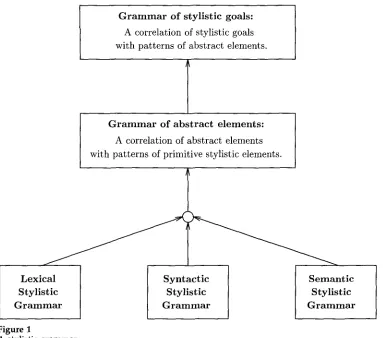
We have constructed a vocabulary of style that contains both primitive and abstract elements of style. The primitive elements describe the stylistic effects of individual sentence components. These elements are combined into patterns that are described by a stylistic meta-language, the abstract elements, that define the concordant and discordant stylistic effects common to a group of sentences. Higher-level patterns are built from the abstract elements and associated with specific stylistic goals, such as clarity or concreteness. Thus, we have defined rules for a syntactic stylistic grammar at three interrelated levels of description: primitive elements, abstract elements, and stylistic goals. Grammars for both English and French have been constructed, using the same vocabulary and the same development methodology. Parsers that implement these grammars have also been built.
The stylistic grammars codify aspects of language that were previously defined only descrip- tively. The theory is being applied to various problems in which the form of an utterance conveys an essential part of meaning and so must be precisely represented and understood.
1. Introduction
1.1 An Advocacy of Style
U n d e r s t a n d i n g a text requires m o r e than just u n d e r s t a n d i n g its propositional content. It requires a sensitivity to the interaction of semantic content, emotional expression, and interpersonal and situational attitudes. This interaction is reflected in the style of the text. Style in language is not just surface appearance, a decorative veneer. Rather, it is an essential part of meaning, part of the a u t h o r ' s c o m m u n i c a t i o n to the reader. So to fully u n d e r s t a n d the nuances of a text, one m u s t d e t e r m i n e not only the propositional content, b u t also h o w its c o m m u n i c a t i v e effect is colored b y the form, w h i c h reflects affective content. While propositional content p r o v i d e s the basic tone, the expressive
form provides the
tonal quality.
Together, form and content create style, that which distinguishes both an individual text and a collective body of writing.Style is created through subtle variation, seemingly minor modulations of exactly what is said, the words used to say it, and the syntactic constructions employed, but the resulting effect on communication can be striking. Consider the following versions of the same text, Matthew 7:27:
1. And descended the storm and came the floods and blew the winds and beat against that house and it fell and the fall of it was great. (Literal translation of the Hellenistic Greek.)
2. And the rain descended, and the floods came, and the winds blew, and beat upon that house; and it fell: and great was the fall of it. (Revised Standard Version, 1952.)
3. The rain came down, the floods rose, the wind blew, and beat upon that house; down it fell with a great crash. (The New English Bible, 1970.) 4. Rain came down, floods rose, gales blew and struck that house, and it
fell; and what a fall it had! (The New Jerusalem Bible, 1985.)
5. The rains fell, the torrents came, the winds blew and lashed against his house. It collapsed under all this and was completely ruined. (The New American Bible, 1973.)
The first variation, a word-by-word translation from the Hellenistic Greek, is actually a good deal less striking than subsequent, widely accepted versions. The placement of the verbs before their subjects is quite normal and the closing is also quite usual. The sense of discord and resulting poetic effect is not as evident as it is in the second variation, from the Revised Standard Version, which is resoundingly poetic in the imitative form of the first five clauses, followed by the inverted form of the final clause. The text begins in strong concord and dissolves into discord, but not unpleasingly so.
Discord,
as we use the term in this paper, refers to a deviation from the norm, but such deviations can be used to good effect. As we will see, in language as in music, it is often through the construction of patterns of concordand
discord, particular combinations of order and disorder that create an overall harmonious arrangement, that certain stylistic effects are achieved.In versions 3 and 4, the dramatic effect of the closing has been retained from the RSV translation but through different choices of words and structure. In 3, the last clause is inverted, but the translator has chosen to place more emphasis upon the fall itself
(down it fell)
than its magnitude(great).
Example 4 ends on an intense note, achieved through the use of an exclamation(what a fall it had!),
rather than an inversion of syntactic structure. And no single word expresses the degree of magnitude of the fall. In the final example, 5, the drama and intensity of the RSV has been lost with the removal of the dissolution from initial concord to final discord. In this case, the translator has opted for plainness and clarity, even at the expense of beauty.Chrysanne DiMarco and Graeme Hirst Goal-Directed Style in Syntax
L e x i c a l a s p e c t s : Compare example 4 to the following constructed versions: 1 6. Rain descended, floods rose, gales raged and beat upon that dwelling,
and it collapsed; and what a fall it had!
7. Rain fell, the water level rose, winds blew and hit that house, and it fell; and what a fall it had!
The differences between 4, 6, and 7 are primarily lexical. Example 6 uses rather ele- gant words, while 7 opts for a more commonplace vocabulary, and 4 lies somewhere between the two in lexical formality.
Syntax: Comparing example 2 to example 5, we see that the former uses syntactic structures that create more dramatic effects: a short climactic sentence, and it fell, and a striking inversion, great was the fall of it, close the text on a powerful note. In contrast, 5 ends with a very ordinary, unremarkable, construction.
Thematic aspects: Comparing example 2 to example 3, we observe that the two sen- tence structures bring different elements into focus: great was the fall of it, in contrast to down it fell with a great crash. In general, variations in thematic structure can create different stylistic effects.
S e m a n t i c s : The exact choice of what is said, or not said, also has stylistic consequences. Compare example 4 to the following two constructed versions:
.
.
A serious storm, with rain and gales and floods, struck that house, which collapsed.
Rain fell and fell and eventually caused a flood, which rose up to that house; also the winds kept blowing until eventually the combined forces of rain, flood, and wind were too great and caused so much structural damage that the house collapsed.
These variations differ in their semantic content: example 4 merely reports the events, but 8 evaluates, a serious storm, while 9 emphasizes technical details, structural damage. These semantic differences are reflected in the texts; and stylistic differences result.
Given that these four parameters--lexical choice, syntax, theme, and semantics-- control stylistic variations, two questions arise:
• How do we characterize each type of variation?
• How does each variation contribute to an overall stylistic effect?
In considering these questions in this paper, we will concentrate on variations of the syntactic parameter.
We emphasize that our intent here is not any form of literary analysis or literary theory. Our main concern will be ordinary, everyday text. It is true that, in the Biblical texts above, we saw how different syntactic forms carry different stylistic import to the point that one form may be poetry while another is just dull, plodding prose. But style
isn't just a matter of achieving poetry or not. Every text, large or small, interesting or dull, effective or not, has its own style. Nor are we talking about style in any of its
normative
senses: the common tenets dictating standard forms (e.g., Chicago 1982), or the textbook prescriptions for 'good' style: be clear, be simple, be precise (e.g., Strunk and White 1979). For people aim to convince, to persuade, to impress, and, even, sometimes to obscure, and standard textbooks tell us very little about such varied and subtle stylistic and pragmatic goals.Rather than a study of literary or normative style, our intent is to determine what gives any ordinary piece of text its stylistic 'feel.' The following examples will demonstrate what we have in mind. These texts are all from newspaper feature articles:
10. Silvia, a commanding woman in her 50% a shrew falsely mellowed by religion, promptly organized prayer sessions on the lines of Tupperware meetings. 2
11. The artist provides a dreamy background done in yellow and bistre brushstrokes to a blue gown with woodenly rigid folds or the profile of a brown angel painted so mineral hard and modeled so carefully that the incoherence of virtue does it injury. 3
12. Crazed with fear, he tried to purify her by dunking her in the ocean and holding her under the water; then in desperation he threw her on the still-smoking pyreo 4
In a newspaper, we might have expected the writer and translator to have simply aimed for clarity. In fact, we find a variety of effects. The first text, 10, emphasizes a sense of harmony by repeating the same kind of structure, a nominal group, in the postmodification of
Silvia.
The second, 11, is more complex, and achieves a certain balance in the judicious use of conjunctions; but the result is so difficult to understand that it doesn't really make sense. Text 12 has a stark initial participle clause,crazed
with fear,
that emphasizes the intensity of the subject's emotional state.To account for the kinds of complex stylistic effects that occur even in everyday writing, we propose a
goal-directed
understanding of style. That is, an author's in- tent can vary with respect to a number of stylistic goals, such as clarity or obscurity, abstraction or concreteness, staticness or dynamism. Particular choices of words, syn- tactic structure, and semantic structure make a text more--or less--stylistically varied and effective. We believe that these choices, goals such as abstraction or concreteness, and the stylistic elements that are used to realize them can be recognized and repre- sented in a formal notation. They are, in a word,codifiable.
It is this codification that is at the heart ofcomputational stylistics. S
1.2 The Function of Style
Propositional content alone is insufficient to determine the nature and form of a sen- tence (Halliday 1985; McDonald and Pustejovsky 1985; Jameson 1987; Hovy 1988; Scott
2 Adapted from The Manchester Guardian Weekly, 7 February 1988. Translated from Le Monde. 3 The Manchester Guardian Weekly, 14 February 1988. Translated from Le M o n d e . .
4 The Manchester Guardian Weekly, 7 February 1988, with minor punctuation corrections. Translated from Le Monde.
Chrysanne DiMarco and Graeme Hirst Goal-Directed Style in Syntax
a n d de Souza 1990). E v e n after the p r o p o s i t i o n a l content h a s b e e n d e c i d e d u p o n , there are still m a n y linguistic, syntactic, a n d e v e n s e m a n t i c decisions that the l a n g u a g e pro- d u c e r m u s t m a k e before a sentence can be f o r m e d . These decisions are a s s u m e d b y the a u d i e n c e not to h a v e b e e n m a d e r a n d o m l y , b u t r a t h e r in specific, deliberate w a y s that e n c o d e a d d i t i o n a l information, s u c h as opinion, e m o t i o n a l affect, a n d interper- sonal relationships. 6 To the extent that a piece of text exhibits a particular, recognizable style, it also reflects the a u t h o r ' s p r e s u m e d intent to c o n v e y the effect associated w i t h that style. Therefore, full u n d e r s t a n d i n g of a text m u s t r e p r e s e n t not o n l y p r o p o s i t i o n a l content, b u t also stylistic effects.
This b e c o m e s m o s t a p p a r e n t in the case of m a c h i n e translation. If a translation is to be faithful, the stylistic effects of the source l a n g u a g e text m u s t be t r a n s f e r r e d to the target l a n g u a g e text, m a k i n g a p p r o p r i a t e use of the stylistic c o n v e n t i o n s of the target language. But a d i l e m m a arises:
• O n e w a n t s to
preserve
the original a u t h o r ' s stylistic intent, the i n f o r m a t i o n b e i n g c o n v e y e d t h r o u g h the m a n n e r of presentation. H o w e v e r , different l a n g u a g e s m i g h t realize this effect in different w a y s . So the source a n d target texts s h o u l d b o t h a i m for the a u t h o r ' s stylistic goal, b u t m i g h t h a v e to a c h i e v e it t h r o u g h different linguistic m e a n s . 7 • Yet o n e w a n t s to p r o d u c e a text w h o s e style is a p p r o p r i a t e a n d n a t u r a lto the particular target language. L a n g u a g e s differ as to the m o s t ' n a t u r a l ' w a y to express an idea. For e x a m p l e , French tends to prefer m o r e abstraction, English m o r e concreteness (Vinay a n d D a r b e l n e t 1958). The best translation, therefore, m i g h t
modify
the original a u t h o r ' s stylistic intent a n d express a different effect.Sometimes, there is no w a y to resolve this d i l e m m a , a n d one is left w i t h an unsat- isfactory translation. But, w i t h a k n o w l e d g e of the
comparative stylistics
of a l a n g u a g e pair, a n d of the stylistic resources of each l a n g u a g e a n d the possible r a n g e of effects t h e y can create, one can substantially i m p r o v e the quality of a translation.1.3 The Structure of the Paper
O u r goal is to create a f o r m a l r e p r e s e n t a t i o n of stylistics for u s e in n a t u r a l l a n g u a g e systems, and, m o r e o v e r , to d o so in a m a n n e r applicable to different languages. The solution w e will p r o p o s e is a codification of syntactic stylistic k n o w l e d g e in the f o r m of a
stylistic grammar.
In the next section, w e will r e v i e w the c u r r e n t status of the codification of style. In Section 3, w e will construct a
vocabulary
for stylistics. The definition of concepts a n d the a t t e m p t to o r g a n i z e t h e m into a recognizable structure is a n e c e s s a r y first step t o w a r d u n d e r s t a n d i n g the p r o b l e m . T h e n w e will d e v e l o p in Section 4 amethodology
for c o n v e r t i n g stylistic k n o w l e d g e into a f o r m a l representation. The m e t h o d o l o g y will6 Thus the speaker or writer is
accountable
for his or her stylistic decisions, in the sense that that term is used in Ethnomethodology and Conversation Analysis. A person encountering friends on the street, for example, may choose to greet them or not, but is held accountable either way--failure to greet is a snub; it is not possible to opt out of the situation altogether (Heritage 1984). Similarly, a speaker or writer is accountable for all the stylistic nuances of his or her utterances; it is not possible to utter a sentence in such a way that only the propositional content counts and not the form in which it is expressed.be as general as possible, ideally applicable to the codification of style for the sen- tence and paragraph levels; appropriate for lexical, syntactic, and semantic style; and applicable to both English and French. The methodology will be used in conjunction with the stylistic vocabulary to guide the systematic collection and creation of stylistic rules. This grammar will provide a formal description of the syntactic patterns that differentiate the various stylistic goals.
In addition to theoretical problems, there are implementation issues to be ad- dressed as well. In Section 5, we will describe the development of a
stylistic parser
that uses the formal bodies of rules to analyze complex English text.In the last section, we will review the contributions of the paper and discuss completed and ongoing extensions to the research.
2. Background to the Study of Style 2.1 Views of Style
2.1.1 The Classical View. The study of style has an ancient history, for the concept first appeared in the fifth century B.C. Scholars of the time conceived the notion that the rhetorical form of a writer's text should reflect his thoughts and intentions. This was to be achieved through the appropriate choice and organization of words and syntactic structures in order to "evoke the desired response" (Corbett 1971). Content and form were recognized as inseparable, and as exerting a reciprocal influence upon each other.
Beginning with Corax of Syracuse, rhetoricians developed methods for systematic instruction in the art of writing. The classical scholars, from Isocrates and Aristotle to Cicero and Quintilian, established standards of rhetoric that influenced curricula for centuries. The contribution of Aristotle was particularly notable. He countered Plato's argument that rhetoric was mere sophistry, deceitful reasoning, by providing a system of instruction that treated the theory and practice of style as a valid discipline, designed to appeal simultaneously to reason and emotion.
This classical approach to style flourished into the Middle Ages, for it formed part of a standard university education. The teaching of formal rhetoric in schools and universities continued to play a significant role throughout the Renaissance and into the 18th century. However, in the 19th century, the teaching of rhetoric gave w a y to the teaching of composition, which came to be associated merely with a set of basic prescriptive rules. This approach was in direct contrast to the original classical theory that stressed the education of the whole person as a preparation for achieving style in writing (Corbett 1971).
2.1.2 The Modern View. Today, the common view of style is still one of conformity to standard good taste and an avoidance of bad form. Textbooks (Fowler 1968; Strunk and White 1979; Kane 1983; Grevisse 1986) promote the idea that there is a universal and correct mode of expression. However, normative rules, while necessary in some degree so that communication is possible at all, may, if too inflexible, deaden the expression of a writer's individual voice. Universal rules of good style are best used, we suggest, simply as a guide to avoiding bad constructions and obstacles to clear writing, but
not
as a basis for a theory of stylistic effects in text.Chrysanne DiMarco and Graeme Hirst Goal-Directed Style in Syntax
(or functional) style. Utilitarian group styles are distinguished from the literary type by their association with a genre of text that has a particular function or purpose, such as medical textbooks or political newspaper writing. In such styles, the writer adjusts her language to what readers expect in a specific situation. The fact that functional group styles are somewhat more restrictive than literary group styles, as they are characteristic of a particular genre, suggests that the problem of codifying utilitarian style will be more tractable than the literary case. For this reason, we will focus on utilitarian texts in general, drawing most of our examples from newspaper and magazine journalism. (Our main source of examples is the English translations, published in The Guardian Weekly, 8 of articles from Le Monde.)
2.2 The Current State of Computational Stylistics
Most of the research to date in computational stylistics has been the development of so-called style-checkers. The UNix-based Writer's Workbench, Grammatik I and II, RightWriter, PC-Style, Punctuation and Style, Electric Webster, and CRITIQUE are ex- amples (Raskin 1986). However, none of these systems is appropriate for our purposes. These programs enforce the basic virtues: be clear, be simple, be precise. They merely check for common grammatical errors such as number disagreement, pronoun case problems, unbalanced punctuation, split infinitives, excessive sentence length, and ex- cessive sentence complexity. There is no systematic approach to constructing a vocab- ulary of style, no structured representation of stylistic rules. Stylistic knowledge may simply consist, as in the case of CRITIQUE, of an unstructured mass of rules (Jensen et al. 1986, p. 190). These programs have no real understanding of the significance of stylistic parameters.
The other main kind of computational research in stylistics has been statistical (e.g., Cluett 1976, 1990; Milic 1982; Biber 1988, 1989). With this approach, a count is made of the number of occurrences in a sample text of a stylistically significant feature, such as an initial prepositional phrase. A statistical analysis is done to compare the count and type of stylistic features with the corresponding parameters of texts written by authors working in the same or different genres. But the interpretation of the statistical results must be done by a human; the computer system has no real understanding of what the variations in style mean.
Although virtually all computational research in stylistics takes a non-AI approach to the representation and use of stylistic knowledge, the usefulness and degree of so- phistication of some of these programs should not be underestimated. The York Com- puter Inventory of Prose Style (Cluett 1976, 1990) has been undergoing development since 1970. The principal contribution of the project is its convincing demonstration that the richness and subtlety of literary style could in fact be correlated, to a perhaps surprising degree of accuracy, with a catalog of syntactic patterns. But the program that performs the stylistic analysis has no understanding of the meaning of its statis- tical results; it relies on human interpretation of the statistics computed. Nevertheless, the York project's findings are still very useful, as they have catalogued the syntactic features that produce particular stylistic effects.
Thus, most current approaches in computational stylistics have not included for- mal stylistic rules, which are clearly a desirable prerequisite. We now review the extent to which such rules have been developed in theoretical stylistics and used in compu- tational stylistics.
The title of Vinay and Darbelnet's (1958) book, Stylistique comparde du fran¢ais et de
l'anglais,
is somewhat misleading, for their purpose was not just to deal with com- parative stylistics in translation, but also to enumerate the more common rules and procedures in the overall translation process. But they did not construct a specific vo- cabulary for comparative stylistics and, in fact, virtually all of their 'stylistic' terms refer to basic syntactic constituents. Using their vocabulary of terms, Vinay and Darbelnet defined rules, expressed in ordinary natural language, that encoded knowledge about French-English comparative stylistics. The rules certainly fell short of the repertoire needed by a professional translator, but no one has yet improved upon their codi- fication of comparative stylistics (Brian Fitch, personal communication). Their book is still used as a prescribed text in translation courses. Vinay and Darbelnet did not take an explicitly goal-directed approach, but their book does contain a great deal of information about the correlation of stylistic goals with particular lexical, syntactic, and semantic choices. Unfortunately, however, their rules proved to be too language- dependent for the framework that is proposed in this paper. But the success of a goal-directed codification, albeit an implicit one, supports the approach that we will take below.Crystal and Davy (1969) hypothesized the creation of a formal stylistic grammar, built upon a vocabulary of stylistic terms and intended to represent the sentence structures characteristic of a particular stylistic sublanguage. However, the grammar that they sketched contained virtually no terms other than purely syntactic ones and no correlations with stylistic goals; it was only a first step, although an ambitious one, toward a codification of the stylistic rules that define a sublanguage. What we have found especially useful to adapt from their work is the overall methodology, the approach to formalizing style, even the belief that style
can
be formalized.Kane's (1983) rhetoric and handbook of style represents the typical textbook that aims to teach the rules of classic good writing. Kane, too, did not take an explicitly goal-directed approach in his stylistic rules, but nevertheless gave numerous references to the stylistic goals associated with particular syntactic structures. The systematic con- struction of a stylistic vocabulary seems not to have been an explicit goal, but he used many terms unique to stylistics. However, his terminology was apparently augmented whenever the need arose to describe a new feature; there was no underlying struc- ture, no formal representation of rules. The stylistic rules were expressed in ordinary English and achieved, as the author intended, good coverage of plain writing style. This body of rules was 'structured' to the extent that there were hierarchies of stylistic sentence types, but, in general, Kane's rules appear to be just an enumeration of stylis- tic tenets, not a deliberately constructed organization. Nevertheless, we have found it useful to draw upon these rules as justification for the syntactic coverage of our grammar.
In computational stylistics, an application area of particular interest to us is ma- chine translation (MT). In suggesting the applicability of computational stylistics to MT, Loffier-Laurian (1986) emphasized an important point: although corresponding group styles may exist across languages, the realization of the style can be different for each language. Tsutsumi (1990) presented a methodology for bridging
stylistic gaps
(stylistic differences) between the syntax of the source and target languages in MT. An impor- tant contribution of Tsutsumi's work is the recognition that computational stylistics is useful for the translation of pairs of languages that are not in the same language group.Chrysanne DiMarco and Graeme Hirst Goal-Directed Style in Syntax
and syntactic characteristics of the text produced. Hovy's method was based on the definition of
rhetorical goals of style,
such as formality, force, and partiality, that control broader pragmatic goals. For example, a low degree of formality combined with high degrees of force and partiality gives a 'no-nonsense' effect.To achieve a particular rhetorical goal, PAULINE examined the options at various points during the production of text and applied the appropriate strategies. For ex- ample, to achieve
formality,
the generator would perform the following actions:Organization of topics: Make long complex sentences by subordinating them in relative clauses or by conjoining two or more sentence topics.
Organization of sentences: Make sentences seem weighty by including a number of adverbial clauses, by placing these clauses toward the beginning of a sentence, by building parallel clauses, by using the passive voice, by using more 'complex' tenses such as the perfect tenses, and by avoiding ellipsis.
Choice of words and phrases: Select formal words and phrases. Avoid doubtful grammar, popular idioms, slang, and contractions.
Although structured in its correlation of the generator's actions with decision points, this approach to representing a goal-directed knowledge of style is essentially heuristic. Hovy's success in implementing a goal-based notion of style, even though lim- ited in scope and informal in the mode of knowledge representation, encouraged our development of a computational approach to goal-directed style.
2.3 Summary
• From existing research in theoretical stylistics, we have seen that there is a basis for the codification of group-based, utilitarian, goal-directed stylistics.
• The need for a vocabulary of stylistic terms is an accepted idea. However, the nature and structure of such a vocabulary for
computational use, which must describe more than basic syntax and be amenable to systematic construction, have not yet been addressed. These issues will be subjects of the next section.
• Similarly, while large bodies of stylistic rules already exist, they have not been organized into the formal structure necessary to a computational approach. Section 4 will develop a structured method for representing stylistic rules by constructing formal grammars.
• The feasibility of a goal-directed analysis of style is supported by previous research, but an actual goal-based codification has not previously been attempted. In the grammar that we will develop in Section 4, we will incorporate such a goal-directed knowledge of stylistics.
3. A Vocabulary of Style 3.1 Stylistic Goals
understood clearly. We will construct a vocabulary from terms that are associated with utilitarian, group-based, goal-directed stylistics. We will start by considering the kinds of stylistic goals to be dealt with in the lexicon.
When a writer composes text, she has certain stylistic goals in mind; such goals might include clarity, or informality, or even the clouding of an unpalatable message. To achieve her various goals, she will choose specific words
(outplacement
orfiring,
for example), syntactic constructions (heavily modified or sparse noun phrases), and semantic organization(Thirty percent of the class failed
orThe majority of students passed).
In applications such as machine translation, we want to understandwhy
a writer has used language in a particular way, what specific effects she intended to convey, and which linguistic choices were made to achieve these goals. There are a multitude of goals that could be considered; indeed, the space of possibilities has never been fully explored. For this study, we have chosen six goals that Vinay and Darbelnet (1958) consider to be among the most commonly used, representing the opposite ends of three dimensions. The goals are listed as follows, with an intuitive description of the corresponding characteristics that a sentence of each type would display:• Clarity: Simplicity, harmony, and no ambiguity.
Obscurity: Complexity, incongruity, and difficulty of understanding.
• Concreteness: Specificity, with an emphasis on certain components.
Abstraction: Generality, with no particular emphasis on any one sentence component.
• Staticness: Uniformity, predictability, continuity.
Dynamism: Deviation from the norm, unexpectedness, action.
3.2 From Theoretical Stylistics to Computational Stylistics
We will now develop a vocabulary of basic terms that will describe stylistically sig- nificant aspects of syntax. Our development is guided by much in classical rhetorical theory; often, our definitions will be extensions of those of the classical theory. We do this in two stages: first, we outline abstract properties of style suggested by classical rhetoric; second, we convert these properties into definitions of abstract elements that will be used in a grammar of style.
Our starting point is the notion of
stylistic norm,
which is defined as the most commonly used structures in a given genre. This notion is intrinsic to the work of the majority of descriptive stylists such as Crystal and Davy (1969) and Cluett (1976, 1990). From this, we derive the notions of stylisticconcord
anddiscord
as the fundamental principles of our formalization. Concord simply means conformity with the norm, and discord, deviation from the norm.Each genre has its own particular norm; for example, the style characteristic of scientific texts may seem disruptive if used in general newspaper writing. This view goes beyond the tenet of prescriptive rhetoric that the stylistic norm merely represents standard, 'good,' style, independent of the use of the text. Rather, we agree with Lanham (1974) that style should be viewed as the tailoring of a text to a specific audience and a specific situation; 'good' style can in fact be quite inappropriate.
Chrysanne DiMarco and Graeme Hirst Goal-Directed Style in Syntax
concord and discord, particular combinations of order and disorder that create an overall harmonious arrangement (Crystal and Davy 1969; Cluett 1976, 1990).
3.2.1 The Divisions of the Vocabulary. As the first step in constructing a vocabulary of style for computational use, we will look at the descriptive terms that stylists have developed over many centuries of use.
One of the most important rhetorical influences on sentence style that has been identified is syntactic parallelism, or coordination: the balancing of syntactically similar forms to achieve a harmonious stylistic effect, an idea dating back to the rhetorical schemes of balance (Corbett 1971, p. 463).
But if parallelism or coordination plays an important role in style, so too does subordination: variations in the hierarchical structure of a sentence that can produce correspondingly different stylistic effects. One part of a sentence can dominate an- other. As with parallelism, the importance to style of syntactic hierarchy is also a well-established principle in classical rhetoric, evident in the schemes of parenthesis, apposition, and climax (Corbett 1971, pp. 466, 468, 476). Thus, modulations in coordinate and subordinate structure are major factors in achieving stylistic expressiveness.
A third major contributor to syntactic style is linear ordering: varying the order of components within a sentence to produce quite marked stylistic differences. The rhetorical terms of anastrophe and parenthesis (Corbett 1971, p. 466) attest to the stylistic importance of the ordering of sentence components.
Thus, we can see that three factors influencing syntactic style are:
• Balance: Parallelism of structure.
• Dominance: Structural hierarchy. • Position: Linear ordering of structure.
We will adapt these factors from theoretical stylistics as the divisions of our vocabulary of style. Now, we will classify commonly used stylistic terms into these three groups in order to identify and abstract the general properties of style characteristic of each group.
3.2.2 Abstract Properties of Style. In the balance group, we classify the terms symmetric construction (Hendricks 1976), serial sentence (Kane 1983), parallel sentence (Kane 1983), balanced sentence (Kane 1983), and intersentence coordination (Crystal and Davy 1969). All of these terms suggest a stylistic imitation, the balancing of syntactically similar clauses. We also find evidence of stylistic parallelism below the clause level in the use of terms such as paired adjectives (Kane 1983), balanced phrases (Crystal and Davy 1969), and intrasentence coordination (Hendricks 1976). As well as identifying similar struc- tures, stylists have recognized characteristic asymmetric constructions (Hendricks 1976) or syntactic counterpoint (Hendricks 1976). These types of structures are most often in- terrupted or convoluted sentences (Kane 1983). For inclusion in our vocabulary, we will choose the most representative terms in the balance group: intersentence coordination and intrasentence counterpoint.
a subordinate clause. The
centered sentence
(Kane 1983) has a central clause flanked by subordinate clauses. Thecumulative sentence
(Kane 1983) has a central clause accom- panied by a series of appositive, modifying, or absolute constructions. Finally, there are more-complicated sentences with more than one dominant clause. Thecompound-
complex sentence
(Kane 1983) can be much more elaborate than a simple compound sentence, as it contains at least two independent clauses and at least one dependent clause. For inclusion in our vocabulary, we abstract from these three types of hierarchi- cal terms to identify trivial single-clause dominance, complex single-clause dominance, and multiple-clause dominance.The
position
group appears to contain the largest number of terms, as any basic term can be qualified to an arbitrarily fine degree by the exact intrasentence position to which it refers. We will use only three qualifiers, associated withinitial, medial,
andfinal
positions (Quirk et al. 1985). At the sentence level, we can have any word or phrase in initial, medial, or final position. Within the sentence, there are almost infinite variations of position terms. A small sample includespostpositive adjectives,
andpre-verbal, post-
verbal,
orpost-clause adverbs
(Crystal and Davy 1969), and complexpremodification
andpostmodification
(Crystal and Davy 1969). We will generalize from these m a n y subtle variations and define terms that have either a concordant or discordant effect, at a particular position in a sentence, according to whether or not their usage is normal.From this grouping of terms into the three divisions of balance, dominance, and position, we have abstracted general properties of style that we want to describe in our vocabulary. The
abstract elements of style
that we will now define will classify the unstructured mass of stylistically significant sentence types into groups of sentences with similar stylistic properties.3.3 Abstract Elements of Style
We will present the abstract elements in three groups, according to their properties of
balance, dominance,
andposition,
which we now define formally as follows:Balance: A balance term characterizes a stylistic effect created by the juxtaposition
of similar or dissimilar sentence components.
For example,
parallelism
in sentence structure is the juxtaposition of syn- tactically similar components.Dominance: A dominance term describes a stylistic effect created by the particular
hierarchical structure of a sentence.
In a
simple
sentence, for example, there is an effect of simplicity associated with the single and therefore, by default, dominant clause.Position: A position term describes a stylistic effect created by the particular place- ment of a syntactic component within a sentence.
For example, in English, a
postmodifying
adjective, as inthe house ablazG
can be more emphatic than the more usualpremodifying
type, as inthe blazing
house.
Now we shall propose a set of stylistic terms, correlated with this classification, that will make explicit those abstract stylistic properties that are now only implicit in existing terminology. These stylistic terms will be based on effects of
concord
anddiscord,
which we formally define as follows:Chrysanne DiMarco and Graeme Hirst Goal-Directed Style in Syntax
Discord: A stylistic construction that deviates from the norm.
We will n o w use these notions to define abstract elements that are related, in turn, to effects of balance, d o m i n a n c e , and position.
3.3.1 Balance Elements. The first g r o u p of abstract elements is related to effects of balance within a sentence. Here, w e will be looking at relationships that t e n d to either p e r t u r b or reinforce the balance of a sentence. The first and simplest type of balance e l e m e n t is a homopoise ("same weight"):
Homopoise: A sentence with interclausal coordination of syntactically similar components.
In other words, there are one or m o r e stylistic 'shapes' in a h o m o p o i s a l sentence, each contributing the same type of effect to the c o n c o r d a n t parallelism of the sentence. In the example below, two v e r y simple clauses, with identically s h a p e d parse trees, are conjoined:
13. The style was f o r m e d a n d the principles were acquired. 9
Sentences that are m o r e c o m p l e x can have their balance i n t e r r u p t e d or p e r t u r b e d b y a heteropoisal ("different weight") c o m p o n e n t :
H e t e r o p o i s e : A sentence in which one or m o r e parenthetical c o m p o n e n t s are syn- tactically ' d e t a c h e d ' a n d dissimilar from the other c o m p o n e n t s at the same level in the parse tree.
It is difficult to formally characterize this class of structures a n d the u n d e r l y i n g notion of a c o m p o n e n t being 'detached.' Q u i r k et al. (1985) also rely on this w o r d to define w h a t they call disjuncts but m a k e no a t t e m p t to define it:
Disjuncts . . . have a superior role as c o m p a r e d with the sentence el- ements; they are syntactically m o r e d e t a c h e d and in some respects 'superordinate,' in that they seem to have a scope that extends o v e r the sentence as a whole. (Quirk et al. 1985, p. 613) l°
Similarly, N u n b e r g (1990), in defining the related idea of the delimiter comma, can do no better than to characterize the class "in a r o u g h w a y " :
There is the class of elements delimited b y commas, either at both ends ( w h e n the elements occur clause-internally) or at one end (roughly, w h e n the elements are either clause-initial or -final) [p. 36] . . . . It is obviously not possible here to p r o v i d e an analysis of the syntax a n d semantics of each of these constructions, m u c h less to try to charac- terize t h e m in such a w a y as to say w h a t they have in c o m m o n . In a r o u g h way, however, w e observe that they all involve constituency
9 Adapted from The Manchester Guardian Weekly, 14 February 1988, p. 15.
problems, so that they do not behave as constituents, for example, under such tests as verb-phrase ellipsis. What is more, all of them can be characterized as supplying material that is communicatively supererogatory to the bare propositional content of the lexical clause in which they a p p e a r . . . . This is all very rough, but it does suggest that the content of these comma-delimited elements plays a distinctive role in the representation of the [rhetorical] argument structure of the text. [pp. 38-39]
Despite the difficulty of formal characterization, we agree with Quirk et al. and Nunberg that there is an intuitively clear class of constructions here, and, like these authors, hope that it can be conveyed to the reader by sufficient use of examples.
We divide the class of heteropoise sentences into three types, depending upon the position of the parenthetical component: a heteropoise may be medial, initial, or final. Moreover, we will distinguish between two subtypes at each position: concordant and discordant.
Medial heteropoise: A heteropoise in which the parenthetical component is in medial position.
Concordant medial heteropoise: A medial heteropoise in which the parenthetical component is cohesively linked to the rest of the sen- tence. (This notion will be made precise when we have introduced the primitive elements in Section 3.4.)
Discordant medial heteropoise: A medial heteropoise in which the parenthetical component is not cohesively linked to the rest of the sentence.
In example 14 below, the relative clause which brought no protests interrupts the main clause, yet, as a postmodifier, it is still a part of the subject noun phrase and so the sentence is a concordant medial heteropoise. But now consider the medial adverbial phrase according to a company spokesman; as a sentence modifier, it is quite detached from the rest of the sentence and so the sentence is simultaneously a discordant medial heteropoise:
14. The measure, which brought no protests, was decided, according to a company spokesman, because of the dangers to which these employees are exposed in travelling to particularly exposed subtropical countries, u Initial heteropoise" A heteropoise, concordant or discordant, in which the paren-
thetical component is in initial position.
Sentence 15 contains an initial parenthesis, an appositive noun phrase, that is cohe- sively linked to the rest of the sentence because it refers to the subject of the main clause. Thus, the sentence is a concordant initial heteropoise:
15. The heir to a fortune, her friend did not care about passing examinations. 12
Chrysanne DiMarco and Graeme Hirst Goal-Directed Style in Syntax
Final h e t e r o p o i s e : A heteropoise, c o n c o r d a n t or discordant, in w h i c h the paren- thetical c o m p o n e n t is in final position.
Sentence 16 contains a final parenthesis, an 'extraneous' phrase, that is distinct from the main clause, as it is not cohesively linked to the rest of the sentence. Thus, the sentence is a discordant final heteropoise:
16. Stephen and Jennifer are not going to b u y the house, according to a spokesman.
We saw in 14 that a heteropoise can contain m o r e than one parenthetical, a n d one of t h e m m i g h t be c o n c o r d a n t while a n o t h e r is discordant. Likewise, it can be the case that one parenthetical is, say, medial, while a n o t h e r is initial or final. The following example shows two successive medial parentheticals rather stridently i n t e r r u p t i n g the main t e x t - - t h e effect is h e i g h t e n e d b y the use of d a s h e s - - a s well as a final parenthetical in the same sentence:
17. The idea of c o m b i n e d French a n d British patrols b y nuclear s u b m a r i n e s - - a proposal once m a d e b y the Social D e m o c r a t leader David O w e n - - l e t alone the plan for "sharing the w o r k " w h e r e the targets a n d missiles carried b y these s u b m a r i n e s are concerned was not even raised, according to a French military spokesman. 13
3.3.2 D o m i n a n c e Elements. The second type of abstract element deals with stylis- tic dominance, which is c o n c e r n e d with the hierarchical structure of a sentence. A c o m m o n type of d o m i n a n c e element is the monoschematic, a v e r y simple sentence: M o n o s c h e m a t i c : A sentence with a single main clause with simple phrasal sub-
ordination and no a c c o m p a n y i n g subordinate or coordinate clauses. H e r e is an example of a canonical m o n o s c h e m a t i c sentence:
18. Posterity has not been kind to him. 14
The most c o m m o n d o m i n a n c e element in the texts that w e have studied is the centroschematic:
Centroschematic: A sentence with a central, d o m i n a n t clause with one or m o r e of the following optional features: complex phrasal subordination, initial d e p e n d e n t clauses, final d e p e n d e n t clauses.
Centroschematic sentences can be quite varied in structure, b u t their shared charac- teristic is a p r e d o m i n a n t c o m p o n e n t that serves as the organizational center for all other components. Such structures are built with s u b o r d i n a t i o n and coordination. In
13 Manchester Guardian Weekly, 7 February 1988, p. 13.
the first example below, the main clause is supported by a complex, but subordinate and coordinate, relative clause structure:
19. Neither these devices nor the cramped viewing rooms which are too narrow and whose ceilings are much too low for the big altarpieces manage to spoil the works. 15
Two subordinate clauses, the first of them adverbial and the second of them relative, accompany but do not dominate the main clause in the following sentence:
20. Not all that long ago, the famous collector Charles de Bestegui, when unable to get hold of certain paintings, was quite prepared to adorn the walls of his Venetian palace with copies, which happily rubbed shoulders with his numerous genuine canvases. 16
Finally, the complex but imitative postmodification in the next example incorporates a substantial amount of information without weakening the dominance of the main clause:
21. Silvia, a commanding w o m a n in her 50's, a shrew falsely mellowed by religion, promptly organised prayer sessions on the lines of Tupperware meetings. 17
Given that we have a progression in complexity from monoschematic to cen- troschematic sentences, a natural extension is to the polyschematic:
Polysehematic: A sentence with more than one central dominant clause and at least one dependent clause.
Such sentences occur much less frequently than the monoschematic or centroschematic varieties, at least in the corpus used in this research. However, a sentence with obvi- ously disparate components occasionally occurs, as in the following example. There are two dominant clauses (we could t h i n k . . , and w e should not forget . . . ) and a dependent clause (if w e consider the progress . . . ):
22. If we consider the progress already achieved, the opposition that had to be overcome, for example, in order to open schools for girls, and the fact that Saudi Arabia is less than 60 years old, we could think that time will permit resolving the contradictions between the most liberal aspirations of one part of society and the ulemas' determination to keep the country as it is, and we should not forget to mention the Islamic fundamentalist movements which are threatening Saudi Arabia. TM
15 Manchester Guardian Weekly, 14 February 1988, p, 15. 16 Manchester Guardian Weekly, 7 February 1988, p. 14.
Chrysanne DiMarco and Graeme Hirst Goal-Directed Style in Syntax
3.3.3 Position Elements. The third g r o u p of abstract elements that we will look at are the position elements. The most c o m m o n types of position e l e m e n t describe
concordant
ordiscordant
stylistic effects in particular positions. Thus, w e haveinitial concord, medial
concord,
a n dfinal concord.
Similarly, w e h a v e a range ofdiscord
elements. The definitions of these elements are closely tied to the primitive-level descriptions of o u r vocabulary, so we will d e l a y their precise characterizations until Section 3.5, after the primitive- level descriptions are introduced. Here, it will be sufficient for the r e a d e r to k n o w only that the concords describe constructions, at a particular position in the sentence, that c o n f o r m to n o r m a l usage while the discords describe constructions that deviate from the norm.In addition to effects created b y a single concord or discord in a particular po- sition within the sentence, w e can observe other kinds of effects pertaining to the relationships b e t w e e n concords a n d discords:
Resolution: A shift in stylistic effect that occurs at the end of a sentence and is a m o v e from a relative discord to a stylistic concord.
We can see an example of a resolution in 23 below. There is an initial discord, created b y the u n u s u a l p l a c e m e n t of the a d v e r b
entirely,
w h i c h is not n o r m a l l y f o u n d in the initial position and is not cohesively linked to the rest of the sentence (cf. Section 3.4.3 below). H o w e v e r , there is a final concord, as the s u b s e q u e n t main clause contains no such incongruities:23. Entirely in the spirit of protective support, could w e suggest y o u pass on an a p p r o p r i a t e c o m m e n t to the p e r s o n n e l c o n c e r n e d J 9
A n d the c o m p l e m e n t a r y effect is dissolution:
Dissolution: A shift in stylistic effect that occurs at the e n d of a sentence a n d is a m o v e from a relative concord to a stylistic discord.
We have already seen an example of a dissolution in one of the Biblical texts of Section 1.1, repeated below as 24. A strong initial concord, created b y imitative clauses, is set against a final discord, p r o d u c e d b y an u n c o m m o n syntactic inversion:
24. A n d the rain descended, and the floods came, a n d the w i n d s blew, a n d beat u p o n that house; and it fell: and great was the fall of it. 2°
3.4 Primitive Elements of Style
3.4.1 Two Kinds of Stylistic Analysis. N o w that a set of abstract stylistic elements has been defined, we m u s t next consider h o w to use t h e m in practical stylistic analysis. So far, these elements are too general to a p p l y to the interpretation of an arbitrary sentence. We m u s t relate these
stylistic
elements to more-basicsyntactic
elements, w h o s e stylistic characteristics are m o r e specific and concrete. In o u r r e a d i n g of the literature19 Quirk et al. (1985, p. 652).
of stylistics, we observed that two analyses of stylistic structure are possible: connective and hierarchic orderings:
Connective ordering: The result of cohesive bonds drawing together components in a linear ordering.
Hierarchic ordering: The result of bonds of subordination and superordination drawing together components in a nested ordering.
These two complementary kinds of analysis are implicit in the work of most stylists and rhetoricians, such as Cluett (1976) and Bureau (1976) (Neil Randall, personal com- munication).
We will now use these notions of connective and hierarchic orderings to guide the definition of more-primitive stylistic elements that provide a precise syntactic basis to the vocabulary, yet also allow a mapping to the abstract elements.
3.4.2 The Role of Corpus Studies in the Classification of the Primitive Elements of Style. We believe that to establish stylistic classifications and construct a practical stylistic grammar, one must undertake corpus studies in the style of Cluett (1976) and Biber (1988, 1989) to support the exact classifications of stylistic effects. But we also agree with Crystal and Davy that:
It is perhaps worth emphasising right away that the first step in any stylistic analysis must be an intuitive one. The stylistician is on pre- cisely the same footing as anyone else here: he notices a linguistic feature which he feels to be stylistically significant. The difference be- tween his approach and that of the untrained observer is that he will have a clearer idea of what is likely to be significant, and will know what to do with his observations once they are made. This last point is the stylistician's main competence: he is able to interrelate his obser- vations within the framework of some theory, and thus piece together any general pattern of linguistic variation which may exist. (Crystal and Davy 1969, p. 12)
Thus, although we have built our grammar of style upon accepted theory, it is currently a prototype for the formal representation of stylistic knowledge, not yet developed as a tool for practical stylistic analysis. 21 For, like Crystal and Davy, our initial objective is to provide a methodology, a vocabulary and apparatus, that will allow others to integrate our approach with analytic procedures to construct useful formalizations of style:
All we can do is systematically point to certain significant facts in the language being analysed, suggest some theoretical principles which will account for the occurrence of these facts, emphasise the need for further analysis to validate or refute these preliminary soundings, and illustrate a procedure which will allow people to do this. (Crystal and Davy 1969, p. 13)
Chrysanne DiMarco and Graeme Hirst Goal-Directed Style in Syntax
In the m a n n e r of Crystal a n d Davy, we agree that statistical verification m u s t follow such research, but we believe that, initially, we can use well-motivated intuitions about stylistic frequencies to classify our stylistic elements:
Such a [statistical] m e t h o d w o u l d be prerequisite for a n y serious re- search work, but it is too detailed for our present purposes. Conse- quently we make use of the alternative m e t h o d of expression, m a k i n g our statements of frequency in more informal terms, using such quan- tifiers as 'rarely', 'commonly', 'often', 'very often', and so on. This range of adverbials in English cuts u p a c o n t i n u u m of frequency very clearly, with very little overlap, and is readily intelligible. It should not be forgotten, however, that a n y statements of relative frequency in these terms can be referred if necessary to the precise statistical situation which underlies them. (Crystal a n d D a v y 1969, p. 22)
3.4.3 Primitive Stylistic Elements. Primitive stylistic elements are individual con- stituents that have a particular stylistic effect. But w h a t should we use as the basis for the definition of 'stylistic effect'? We have said that the two analyses of sentence structure, connective and hierarchic, can provide the appropriate guidance. We will define the stylistic effect of an individual component in terms of its contribution to each ordering:
• For the connective view, a component acquires its stylistic effect from its degree of cohesiveness, its bonding with other components in the sentence. • For the hierarchic view, a c o m p o n e n t acquires its stylistic effect from its
degree of subordination, its dependence on other components in the sentence.
We introduce the terms conjunct, antijunct, subjunct, a n d superjunct (to be defined in the following sections) a n d we use superscripts on all the terms to indicate the degree of connectivity or subordination. In the connective view, we classify syntactic com- ponents as either conjunct 4 (excessively connective), conjunct 3 (strongly connective), conjunct 2 (moderately connective), conjunct 1 (mildly connective), and conjunct ° (neu- tral). Similarly, we use the terms antijunct ° through antijunct 4 to indicate increasingly disconnective effects; conjunct ° and antijunct ° are the same.
There is a complementary vocabulary of primitive elements for the hierarchic view. The stylistic effects of syntactic components are correlated with the degree of subordi- nation or superordination; the classifications are analogous to the connective: subjunct 4 through subjunct ° (decreasingly subordinate) and superjunct ° through superjunct 4 (in- creasingly superordinate); subjunct ° a n d superjunct ° are the same.
Connective primitive elements. In assigning connective effects to syntactic compo- nents, we adapt Halliday and Hasan's (1976) w o r k on cohesion. A l t h o u g h Halliday and H a s a n focused on definitions of cohesion in whole texts, we can apply these definitions to cohesion within the sentence, for, as they point out:
the cohesion is not needed in order to make it hang together. But the cohesive relations are there all the same. (Halliday and Hasan 1976, p. 8)
Halliday and Hasan enumerate five types of cohesion:
substitution, ellipsis, reference,
conjunction,
andlexical cohesion.
We will use all of these except lexical cohesion and will add a new factor,interpolation,
that works against cohesion.Halliday and Hasan define
substitution
as the "replacement" (p. 88) of one item by another. We suggest that such intrasentence phenomena as apposition and extra- position can be considered as types of substitution. For example, in 25, either of the two postmodifying noun phrases could substitute for the head nounSilvia:
25. Silvia, a commanding woman in her 50s, a shrew falsely mellowed by religion, promptly organized prayer sessions on the lines of Tupperware meetings. 22
And, in 26, the clausal subject
for anyone to escape
could substitute for the anticipatory pronounit:
26. It was considered impossible for anyone to escape. 23
Ellipsis
is defined as the omission of an item. Many forms of ellipsis are possible within the sentence, including the omission of elements of clause structure. In the following sentence, the ellipsis is marked by . . .27. I'll gladly pay for the hotel, if you will _ _ for the food. 24
Items that have the cohesive property of
reference
are not interpreted semantically in their own right, but make reference to something else for their interpretation (Halli- day and Hasan 1976, p. 31). In English, such items are personal pronouns, demonstra- tives, and comparatives. These 'directive' elements presuppose the existence of some other element from which information is to be retrieved; whether or not the other element is within the same sentence, the referential item will be cohesive.Conjunctive
elements are defined as:elements [that] are not cohesive in themselves but indirectly, by virtue of their specific meanings; they are not primarily devices for reaching out into the preceding (or following) text, but they express certain meanings which presuppose the presence of other components in the discourse. (Halliday and Hasan 1976, p. 226)
Halliday and Hasan cite the conjunction
and,
certain adverbs, and certain prepositional expressions as instances of conjunction. Many of these elements can promote cohesion within the sentence.To the principles of cohesion described above, we will add
interpolation,
a discon- nective relation that worksagainst
cohesion. Interpolated elements are certain instances22 Adapted from The Manchester Guardian Weekly, 7 February 1988. Translated from Le Monde. 23 Quirk et al. 1985, p. 1392.
Chrysanne DiMarco and Graeme Hirst Goal-Directed Style in Syntax
of parenthetical constructions, those that display none of the forms of cohesion listed earlierY In the examples below (repeated from Section 3.3.1), we see several different types of interpolation:
28.
29.
30.
The measure, which brought no protests, was decided, according to a company spokesman, because of the dangers to which these employees are exposed in travelling to particularly exposed subtropical countries. 26 The heir to a fortunG her friend did not care about passing
examinations. 27
Stephen and Jennifer are not going to buy the house, according to a spokesman.
The cohesive relations described above can be ranked from the most to the least cohesive. Halliday and Hasan (pp. 226-227) consider substitution, including ellipsis, to be the most strictly cohesive relation, followed by reference, and then conjunction. We adopt this ranking, and so we classify intrasentential substitution and ellipsis as strongly connective
(conjunct3),
reference as moderately connective(conjunct2),
and conjunction as mildly connective(conjunct 1).
We classify interpolation as disconnective(antijunct2). 28
As an illustration of our method of classification of connective primitive elements, we will use the following sentences, in which the underlined components exhibit dis- tinct stylistic effects. In the first sentence, the postmodifying construction is a strongly connective,
conjunct 3
reduced relative clause, as it is an instance of ellipsis for which the presupposed items arewho is.
The postmodifying relative clause in 32 is a moder- ately connective,conjunct 2
referential element, as the relative pronoun 'points' to the preceding noun phrasethe man.
Lastly, the postposed adjectival in 33 is a disconnec- tive,antijunct
instance of interpolation, as it is detached from the rest of the sentence and has none of the cohesive properties. (The property of ellipsis is not present, as a postposed adjective, unlike a reduced relative clause, does not have the same element of presupposition of specific missing items.):31. The man _ _ walking into the room is unfit for this task. 32. The man who is walking into the room is unfit for this task. 33. A man always timid is unfit for this task. 29
Hierarchic primitive elements. In assigning a hierarchic classification to a syntactic component, we adapt Halliday's (1985) work on
subordination
in functional grammar and Quirk et al.'s (1985) use of the termsuperordination.
25 Another type of structure that seems to work against cohesion is a disruption in normal linear ordering, as the syntactic inversion at the end of the now-familiar text, And the rains descended, and the floods came, and the winds blew, and beat upon that house; and it fell: and great was the fall of it. However, we
have not yet incorporated this feature into our formalization of style. 26 Manchester Guardian Weekly, 21 February 1988, p. 14.
27 Quirk et al. (1985, p. 1314).
28 We do not use here the full range of connectivity that we defined above; however, some extensions of the theory by Green (1992a, 1992b) do.