Supervisor USA: Professor Milton Lodge
Supervisor NL: Dr. Jordy Gosselt and Dr. Martin Rosema Stony Brook, 6th of July 2012
The reduction problem of priming:
An analysis of potential solutions
Martin Nyhuis
University of Twente
Abstract More than one hundred years of research has proven the effectiveness of unconscious
processes and persuasion techniques. Especially priming has been tested within different situations and demonstrated promising effects on attitude and behavior change. Now, where research showed that priming works, research should move more intensively towards discovering how it works. Thereby, this study gives more insight in potential solutions of one of the so-called “second generation questions” of priming. By trying to focus a prime exclusively on a specific target (voting), this study aims to solve the reduction problem; a single prime often affects a variety of depending variables at the same time. By testing the influence of conditioning and interaction of unconscious and conscious cues, new solutions to narrow the effect of priming were tested to increase the controllability of priming. Thereby, this research analyzed subliminal priming processes in persuasion techniques to increase voter turnout, during the primary elections in the USA. For instance, a 2x2 between-subjects design was used to combine subliminal and conscious primes. Subjects were primed with action (e.g. go, move) or inaction words (e.g. stop, relax). After that they were exposed to photos that were related
to elections or sports. It was assumed that this combination could exclusively activate voting versus sports intentions, depending on the photo condition. However, because there was no main effect of the subliminal prime in this experiment, no new solutions for the reduction process could be gathered. Though the missing main effect contradicts previous findings, this study emphasizes even more the need to get more insights in the underlying principles of priming to uncover how it works.
Samenvatting Meer dan honderd jaar onderzoek hebben de effectiviteit van onbewuste processen en overtuigingsmethodes aangetoond. Een grote focus werd daarbij op priming gelegd. Deze methode werd getest binnen verschillende situaties waarbij kansrijke effecten op attitude- en gedragsveranderingen werden bereikt.
Nu waar duidelijk is dat priming werkt moet onderzoek gericht worden op de achterliggende processen om in kaart te brengen hoe priming werkt. Het doel van dit onderzoek was daarbij meer inzicht in mogelijke oplossingen voor één van de zogenoemde tweede generatie problemen van priming (“second generation questions of priming”) te geven. Door te proberen het effect van primes exclusief op één doel (stemmen) te richten werd verzocht het reductie probleem (reduction problem) op te lossen. Dit probleem houdt in, dat een prime vaak meerdere afhankelijke variabelen tegelijk beïnvloedt.
Contents
1. Introduction 4
1.1 Priming works ... 4
1.1.1 Unconscious processes ... 4
1.1.2 Priming ... 5
1.1.3 Subliminal Priming ... 6
1.2 Priming works, but how? Second generation priming within the political context ... 7
1.2.1 Moving to the second generation of priming ... 8
1.2.2 The reduction problem ... 11
2. Method 16 2.1 Participants ... 17
2.2 Materials ... 18
2.3 Procedure ... 20
3. Results 21 3.1 Main effects ... 22
3.1.1 Main effect subliminal prime (hypothesis 1a) ... 22
3.1.2 Main effect subliminal prime (hypothesis 1b) ... 22
3.1.3 Main effect subliminal prime, control condition (hypothesis 2) ... 23
3.1.4 Main effect photo (hypothesis 3) ... 23
3.2 Interaction effects (hypothesis 4) ... 24
3.3 Time effects (hypothesis 5) ... 25 4. Discussion 25
Bibliography 30
1. Introduction
1.1 Priming works
“Priming works” (Smeesters, Yzerbyt, Corneille, & Warlop, 2009, p. 215). Despite Vicary’s claim about the effect of subliminal primes like ‘drink coke’ or ‘eat popcorn’ has been proven to be false (Dijksterhuis, Aarts, & Smith, 2005), the last decades of research showed impressive effects of unconscious processes that are often used by primes. In addition, priming studies that used these unconscious processes highlight the importance of priming in the field of attitude and behavioral affection. However, even though these examples show prominently that priming works, little is known of how it works. Therefore, this research tried to give more insight in the controllability of priming effects. Specifically, it was aimed to find a solution for the reduction problem of priming, which is one of Bargh’s (2006) unsolved second generation questions of priming; often, one prime can have various effects on several targets. To reduce these various effects, the subliminal priming (action vs. inaction words) was combined with a conscious prime (photos) that was related to one of the two target-constructs (elections vs. sports). Nevertheless, it was not possible to show significant main- or interaction effects within this study.
1.1.1 Unconscious processes
The first experiment, often described as the roots of research about unconscious processes, was done by Pierce and Jastrow (1884) (Kihlstrom, Barnhardt, & Tataryn, 1992a). Within their study, Peirce and Jastrow (1884) showed that they could “discriminate between two objects on the basis of their weight even when the difference in weight was so small that it could not be detected consciously” (Dijksterhuis, Aarts, & Smith, 2005, p. 77).
frightening bridge, subjects were exposed to an increase in bodily arousal but transferred the cause for this arousal to the attractiveness of the experimenter instead of the bridge.
A third experiment shows the power of unconscious processes on attitude formation. Using the concept of the ‘mere exposure effect’, Zajonc (1968) showed that when stimulus objects (e.g. photos of people) are presented repeatedly to individuals, their attitude towards the stimulus objects enhances. This process, which has been observed within more than two hundred experiments (Bornstein, 1989), demonstrates that evaluation of people or objects does not purely rely on rational argumentation. The underlying process for this effect can be found in the processing fluency. Because this fluency increases by repeated exposure, the liking of these stimuli increases as well (Zajonc, 2001).
Based on the described studies about influence on perception, behavior and evaluation, that occur out of awareness of participants, unconscious processes are a powerful and important part of our daily life. Thereby, “we have moved beyond existence proofs [of unconscious processes]” (Kihlstrom, Barnhardt, & Tataryn, 1992b, p. 790) and should move forward towards getting more insight in the underlying processes of unconscious persuasion or impression formation. As Dijksterhuis, Aarts and Smith (2005, p.79) put it: “applications of subliminal stimulation are worthy of space on the scientific agenda”. Thereby, priming is among the most prominent forms of unconscious persuasion and is therefore a great way to get more insight into unconscious processes.
1.1.2 Priming
than when subjects are aware of the repeated exposure” (Zajonc, 2001, p. 225). In other words, effects were stronger in the subliminal form of priming than in the normal (and consciously recognizable) form of priming.
1.1.3 Subliminal Priming
The most famous example of subliminal priming is Vicary’s claim about the possibility to increase the consumption of coke and popcorn in a cinema by flashing these particular words for several milliseconds on the screen (Dijksterhuis, Aarts, & Smith, 2005). The exposure of these words is thereby so short that subjects are not able to spot them consciously. Even though this particular experiment was a hoax, based on fraud by Vicary, there are nowadays promising examples that subliminal priming actually has effects on attitudes and behavior.
Similar to unconscious priming, subjects are exposed to a stimulus (prime), such as a word or photo that is presented before measuring an attitude or behavior. In contrast to the unconscious primes mentioned above, subliminal priming occurs when subjects are not aware of the stimuli. For example, unconscious priming, such as the use of music to affect wine sales, can be recognized by subjects, even though it might not consciously be linked to the dependent variable. Subliminal priming, however, cannot be recognized by the subjects because the exposure lasts only a few milliseconds. As described by Fennis and Stroebe (2010, p. 88) “the priming stimuli are presented at such a brief exposure that participants remain unaware that any stimulus has been presented.” Thereby, the prime is also covered by an immediate presentation of a mask, such as a letter string. “With very brief exposure (in presentation in the center of the visual field usually between 20 to 40 milliseconds) and good masking, participants typically perceive hardly a flash.” (Fennis & Stroebe, 2010, p. 88)
A variety of examples of the effectiveness of priming can be found in the area of political priming, which is among others the major field of priming research (Bargh, 2006) and also the focus of this study. A prominent form of priming to affect voting behavior has been used during the 2000 US Presidential Elections. By making use of the principle of evaluative conditioning, the Republican Party launched a commercial against the plans of the Democrats. Therefore, they subliminally showed the word ‘RATS’ near the word ‘Democrats’ (Burdein, Lodge, & Taber, 2006). Weinberger and Wester (2008) checked the effect of this prime in an experiment and concluded that US voters who saw this advertisement could have evaluated the Democrats more negative. During elections in Israel, Hassin Ferguson, Shidlovski and Gross (2007) primed participants with their national flag for several milliseconds. This subliminal exposure affected attitude, behavioral intention and actual behavior of voter turnout.
1.2 Priming works, but how? Second generation priming within the political context
1.2.1 Moving to the second generation of priming
As seen in the examples discussed so far, priming can be used in very different forms. For example, it can affect behavior versus attitude which can be done either consciously or unconsciously. Until now, research has shown similar effects using different primes but also different effects were generated by using the same prime (Sela & Shiv, 2009). Specifically, Bargh’s (2006) second generation questions concern controllability and side effects of prime interactions, individual and cultural differences in priming effectiveness as well as priming sensitivity to contexts (Bargh, 2006).
vote. Specifically, people who voted within a school were more likely to vote for a school funding initiative (Berger, Meredith, & Wheeler, 2008).
Of course, the interaction between unconscious and conscious primes and the effect of context seem to be highly related to each other. However, while the studies that analyzed the effect of prime interactions focused on the combination of stimuli that are similar (e.g. implicit and explicit instructions to cooperate), the context stimulus does not have to be similar to the unconscious stimulus. Instead, the context that is given to subjects should be seen as a general frame, such as real elections or an economic crisis that is taking part at the time of the experiment and influencing people’s perception towards these topics. Interaction, in contrast, is seen as the combination of two manipulative primes (such as a combination of implicit and explicit instructions). Thereby, these primes can be conscious as well as unconscious. So when an unconscious prime, like the subliminal presentation of action words, is combined with a conscious presentation of activities (such as going to elections) it should be seen as an interaction effect because it is a combination of two (similar) manipulative primes. When priming people during the occurrence of elections for example, the prime is presented in this particular context and the relationship of these factors should be seen as context effect. These differentiations are, however, only general guidelines to describe what is meant by interaction effects within this study since both concepts cannot be differentiated in clear dichotomies.
In this study, the interaction effect was used by combining two different forms of primes to focus the attention of subjects towards a specific target. Bargh (2006) points out that, “selective attention is a powerful tool in the reduction of the often overwhelming abundance of information available in the current environment.” By giving subjects a particular context, their focus on the prime as well as on a particular dependent variable might be narrowed.
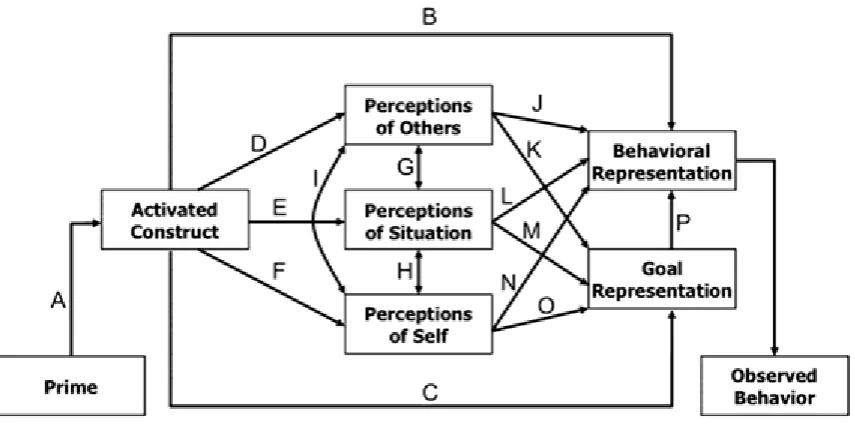
Figure 1. Model of the prime-to-behavior link by Wheeler and DeMarree (2009)
In the model it is shown how the focus of people (e.g. perception of others, perception of situation or perception of self) affects behavioral or goal representations and the occurrence of an assimilation or a contrast effect. Thereby, “assimilation occurs if a subsequent behavior reflects the implication of the prime, whereas contrast or unconscious anchoring occurs if the subsequent behavior reflects the opposite” (Förster, Liberman, & Friedman, 2007, p. 212). This differentiation is used in a variety of priming research. For example, it is shown that when the context of the prime is common to the subjects (e.g. a context that the subjects experienced several times before), the stimulus can lead to an assimilation effect while an uncommon context (new context, not experienced before) leads to a contrast effect (Laran, Janiszewski, & Cunha Jr., 2008). However, even though the differentiation between assimilation and contrast brings some more insight in the process of priming, it is only explaining if a prime affects a specific behavior positively or negatively.
priming people with the word generous. As Bargh (2006) points out, the same prime can have various effects such as activating generous behavior or, alternatively, affecting impressions and trait judgments. In other words, a specific prime can result in a variety of effects and is therefore not limited to the dichotomous differentiation of assimilation versus contrast effects. One possible reason for the multiple effects of a single prime is that “we might not be priming single concepts, but rather conceptual structures, whether they be called metaphors, roles, perspectives, or mindsets” (Bargh, 2006, p. 12). For example, when using action words like go and move to increase voter turnout, as done by Noguchi, Handly and Albarracín (2010) and Nyhuis and Gosselt (2012), the prime might not be limited to the single concept of voting but, instead, also affect the concept of active behavior in general. Based on this assumption, the prime will affect every dependent variable that could be related to action. So when priming people with action words like go and move, it might affect both their intention to go to elections as well as, for example, their intention to go to a sports event. As argued by Bargh (2006, p.6), “the effect of the prime […] just depends on which dependent variable the experimenter happens to be interested in”.
1.2.2 The reduction problem
The problem that is related to the activation of a general conceptual structure instead of a single concept is that the prime will therefore suffer from a lack of controllability. So when trying to use priming effects in a real life context, it might be possible that not the dependent target variable, e.g. voting, will be affected but that, instead, people will participate in different actions that are also related to the activated conceptual structure. Therefore, it should be analyzed how a specific prime can be used to be connected and limited to a specific target construct, e.g. only behavior A and not B. As a consequence, the research question of this study was intended to give more insight in the specific process of reducing the general conceptual structure towards a specific construct:
Research Question: Which factors determine the reduction of the general priming effect to a
specific target construct?
combined with concious primes (photos), as discussed in paragraph 2. Regarding solutions for this “reduction problem” (Bargh, 2006, p. 12) two aspects are particularly interesting; 1) the factors that determine which associations are drawn out of the general conceptual structure and 2) the processing fluency that is related to the interaction between conscious and unconscious priming. The first one is chosen because it includes all factors that were mentioned in the discussed literature, such as individual differences, culture, or context effects. The second one is chosen because it is a typical and often reported process in the field of unconscious persuasion (such as the mere exposure effect, discussed above).
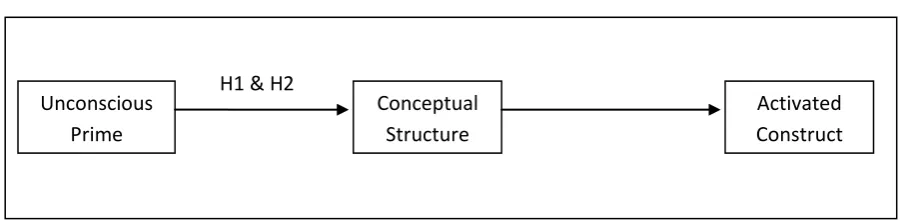
Firstly, the activation of a specific construct, as shown in figure 1, depends on the (implicit) associations that people can make with the prime. So as the model in figure 1 points out, a prime like shopping, for example, should directly activate the target construct of shopping. However, as Wheeler and Berger (2007) point out, when people have different associations with a prime it will affect different types of behavior. For instance, they show that the prime of shopping brings up different associations to men and women and will therefore lead to different types of behavior. This is an additional support for Bargh’s (2006) argument that, instead of a specific construct, a general conceptual structure is activated. Therefore, it can be argued that figure 1 should be changed in such a way that before a specific construct is activated a general conceptual structure is created by the prime. This is shown in figure 2, where the prime (e.g. action words) creates the general conceptual structure (e.g. mindset of activism including everything that could be related to it). Therefore, the subliminal prime should show a main effect on any dependent variable measured after treatment, shown in the following hypotheses. Hypothesis 2 was used to control for eventual biasing effects of the second prime.
H1a: Subjects in the action-voting condition will report higher attitude and behavioral intention
scores on political participation than subjects in the inaction-voting condition.
H1b: Subjects in the action-sports condition will report higher attitude and behavioral intention
H2: Subjects in the action-control (no photo) condition will score significantly higher on both
dependent variables than subjects in the inaction-control (no photo) condition.
[image:13.595.69.522.533.643.2]The process how the general conceptual structure is converted into a specific activated construct can thereby be explained by the individual differences (e.g. gender) that affect the specific associations that people draw with the general conceptual structure. Even though there is no direct evidence that gender affects the influence of the prime that was used in this study, there are a couple of other individual differences that might have effect. They should not be seen as factors where an effect can certainly be assumed but as variables that have to be included to control for eventual biasing effects. In particular, it can be argued that political preferences, former voting behavior and the holding of the voting right for the US Presidential Elections might work as influencing factors on the dependent variable of political participation. However, because of the lack of evidence for their potential influence on the reduction process, these factors will be measured in the survey to use these factors as covariates in case that population within the conditions might differ on these factors. Nevertheless, conditions in this experiment did not differ on these variables, so that they will not be included or discussed in hypotheses or the model.
Figure 2. The role of association drawing in activating constructs
In addition, even though it seems important to take a look at individual differences as control variables, the individual differences are not a manipulative factor that could be used to actively connect the prime to a specific target construct. A process that seems to fulfill the goal to actively create the desired associations can be found in the concept of conditioning. It is shown that
Conceptual Structure Unconscious
Prime
conditioning can be used to link a specific prime to a specific target construct; “Through conditioning […] individuals come to link action-relevant constructs with the primes concepts in memory, which can be spontaneously activated upon exposure to the stimuli” (Wheeler & Berger, 2007, p. 358). Specifically, Feinberg (1986) showed that by priming people with credit cards, their spending behavior can be affected because both concepts are related to each other based on conditioning. Because the prime (credit card) and the target construct (spending) have been related for many years, people developed a mental link between both concepts (Feinberg, 1986). This process of conditioning has also been used by several priming studies, such as combining the word “RATS” with a picture of a political candidate to affect the evaluation of that person (Weinberger & Wester, 2008). In contrast to the credit card prime, however, the RAT prime did not relate both concepts (prime and target) over several years but showed also a main effect of the particular prime. Therefore, it can be argued that conditioning might work to create a mental link between a prime and a specific target in subjects’ minds. Thereby, assuming that the effect of the prime can affect any kind of dependent variable that is measured right after the prime (Bargh, 2006), it can be argued that by presenting the target construct immediately after the prime, it might be possible to steer the prime in that particular direction. So instead of measuring the dependent variable directly after the prime, the topic of the particular target variable has to be presented right after priming to focus the general conceptual structure on that specific target construct. On its own, it might be difficult for people to link a prime (e.g. words like go, move) actively to a dependent variable such as voting. When adding a second stimulus about voting,
H3: The conscious prime (photos) has a significant main effect on the scores regarding political
participation and sports.
H4a: Subjects in the action-voting condition and the inaction-voting condition will show no significant
difference on attitude and behavioral intention scores on sports activities.
H4b: Subjects in the action-sports condition and the inaction-sports condition will show no significant
difference on attitude and behavioral intention scores on political participation.
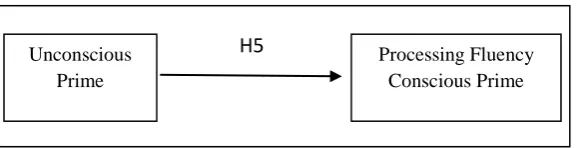
Besides the explanation that it might be possible to link a conceptual structure with a specific target by controlling the association process, solutions to increase the prime controllability might be found in the interaction of primes. As mentioned above, the use of explicit and implicit instructions can “interact and reinforce each other” (Kay & Ross, 2003, p. 7). This is based on the finding that an unconscious prime can affect the response time when measuring the dependent variables after priming (Burdein, Lodge, & Taber, 2006). As they point out, the speed of response “is a function of what information is available and accessible in memory” (Burdein, Lodge, & Taber, 2006, p. 369). Based on that, it can be argued that when presenting an unconscious prime before presenting a conscious stimulus, the processing fluency of the conscious stimulus might be increased. This process can be seen in hypothesis 5 and figure 3.
H5: Subjects who are primed with action words will process the picture stimuli faster than subjects
[image:15.595.70.359.576.650.2]who are primed with inaction words.
Figure 3. The influence of unconscious priming on a conscious prime
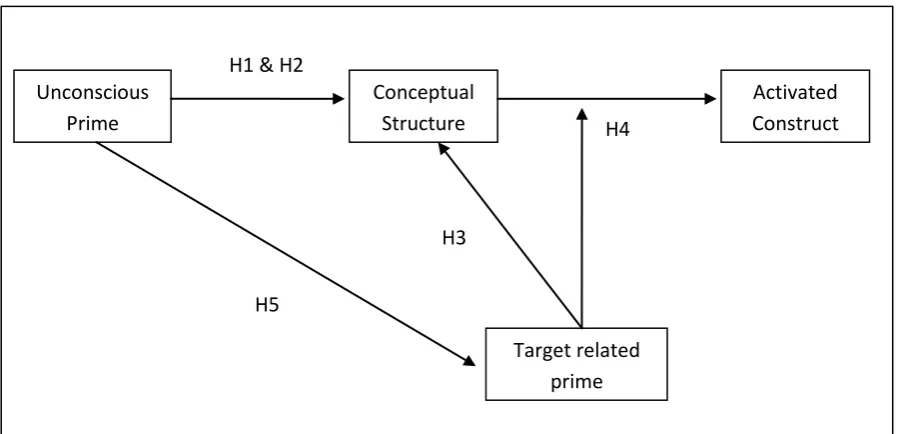
Summarized, the reduction problem might be solved by trying 1) to create an association between the general conceptual structure and a specific target prime and/or 2) by using the interaction
Unconscious Prime
Processing Fluency Conscious Prime
of primes to increase the processing fluency of stimuli material which can ultimately increase the effectiveness. Both concepts are presented in figure 4.
Figure 4. Factors that determine the controllability of the prime
2. Method
To answer the research questions, this study focused on the priming effects in the context of the US presidential elections. Specifically, the proposed model was tested by using action primes (words like go or move) and inaction primes (words like stop or relax). As shown by Noguchi, Handly and Albarracín (2010) in the lab and by Nyhuis and Gosselt (2012) during real elections, those words can affect voting intention when presented in a word search puzzle. However, even though it was shown that there is an effect of that particular prime, the underlying processes are not clear yet. Arguably, it could be possible that the action prime is not limited to voting intention but could also affect other forms of behavior as discussed by the “reduction problem”. Therefore, this study also measured an additional dependent variable besides political participation. Specifically, the behavioral intention and attitude towards doing sports were measured. This concept was chosen because it can arguably, as voting, be related to the general concept of active behavior and might therefore be affected by the prime via the general activated construct of activism. Thereby, the unconscious word primes were extended by conscious stimuli to test the discussed possibilities to reduce the priming
Conceptual Structure Unconscious
Prime
Activated Construct
Target related prime H1 & H2
H5
H3
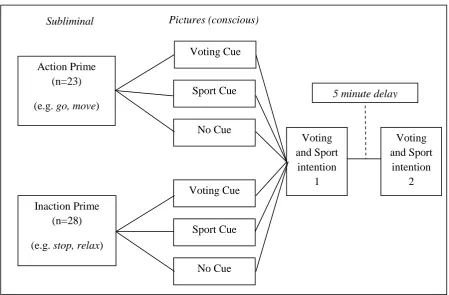
effect to a specific construct. Specifically, photos of elections or sports were added to link a subliminal prime to the target of either voting or sports, depending on the condition. This can be seen in figure 5.
Figure 5. Research model
2.1 Participants
Participants in this study were recruited from the Department of Political Science undergraduate research pool at the State University of New York, Stony Brook. Participants were given extra credit for participation in the experiment. Of course, it could be argued that students in the field of political science might be more interested in political participation then others so that they are not a good representation of the general public. Nevertheless, this would only be problematic if their motivation to vote would be so high that effects of stimuli would be minimal. In total, 113 subjects completed the study: 53 were female and 60 were male. All subjects were at least 18 years old to assure that they had the right to vote. However, because the research pool consisted of international students, only 51 subjects had the right to vote in the 2012 US presidential elections, were able to
Action Prime (n=23) (e.g. go, move)
Inaction Prime (n=28) (e.g. stop, relax)
Voting Cue
Sport Cue Voting Cue
Sport Cue Subliminal Pictures (conscious)
Voting and Sport
intention 1
Voting and Sport
intention 2 5 minute delay
No Cue
confirmed that they are fluent in English and conducted the experiment honestly (not just clicking through). Subjects that just clicked through the experiment were detected by using outlier analysis (above or below one standard deviation). All other subjects were excluded from the analysis to assure that priming with English words could have a potential effect on political participation. This high number of exclusions could not be prevented; because of requirements to get official approval for the study, a pre-given subject pool of the university had to be used. When subjects arrived at the laboratory, they were randomly assigned to one of the six priming conditions. Demographic details (political view, gender, race, previous voting behavior, and previous sports behavior) did not differ significantly between the conditions.
2.2 Materials
As shown in the research design in figure 5, subjects were exposed to one of two conditions of a subliminal prime. Subjects in the action condition were primed by the words go, move, jump, run and join, while subjects in the inaction condition were primed by the words relax, stop, hold, rest, and pause. These words were chosen based on the finding that there is a significant difference in voting
intention when priming with these words, e.g. subjects who are primed with the action words are more likely to vote than subjects who are primed with inaction words (Noguchi, Handly, & Albarracín, 2010; Nyhuis & Gosselt, 2012). The functionality of subliminal priming itself was based on earlier studies that made use of that method. Specifically, subjects were asked to fix their gaze on the middle of the screen as done by Bargh and Pietromonaco (1982). Then the prime was “presented for 28ms, preceded by a string of X’s (XXXXXXXXXXXX) for 300 ms, and immediately followed by a string of #’s (############) for 300 ms” (Karremans, Stroebe, & Claus, 2006, p. 794). This form of “backwards masking” (Weinberger & Wester, 2008, p. 636) was also used by Bargh and Pietromonaco (1982) to cover primes. After that, a letter string was presented whereby subjects had to indicate if the letter string was a real word or a random combination of letters (non-word) by pressing D for a real English word and K for a random letter string. This lexical decision task was based on
be exposed to the primes in case they were blinking during presentation of primes so that every subject was exposed to action or inaction words for 30 times. To control for order effects, the prime words were presented in random order. Thereby, half of the primes were followed by English words. The words were wheel, waterfall, sky, river, forest, car, house, street, computer, chair, table, coffee, phone, window and building. The non-words were badlo, tarkorbas, hil, bikar, zakesp, gaw, gaske, brollet, reupatsa, kiare, elbor, jollri, hogok, boldit and doolwalg. Because the letter strings were constant across all conditions, there was no influence that could bias potential differences between the conditions. Also, all letter strings were pronounceable and in similar length to the prime words.
The conscious prime followed the subliminal prime and consisted of pictures that were related to either elections or sports, depending on the assigned condition. In the voting condition, subjects were exposed to 10 pictures that were related to elections while subjects in the sports condition were exposed to 10 pictures that were related to sports. All pictures were pretested with a Q-Sort method to assure to select pictures that were highly related to either voting or doing sports and to determine potential biasing effects based on differences of pictures (e.g. professional sports versus hobby). The used pictures are attached in appendix A. To measure the fluency by which these pictures were processed, subjects had to click through the pictures manually. Thereby, the total time to evaluate all pictures was measured.
about sports and 3) the intention to persuade others to do sports. For every subconstruct, 6 items were developed and tested for internal consistency in a pretest. Based on the pretest results (appendix A), the number of items could be reduced to three statements per construct. A 5-point Likert scale (don’t agree at all – totally agree) was used to measure the constructs. Based on the conducted pretest it was assured that internal consistency of items was high. Therefore, also in the actual survey all alpha scores were at least .742 for every sub- and total construct. The detailed scores can be found in appendix C.
In addition to measuring the responses on the Likert scale, the response time for the measurement of political participation and sports activity was measured to detect potential outliers (e.g. subjects that click through the experiment in extremely short time). Moreover, subject’s demographics were measured. Specifically, it was asked for a variety of variables, based on the standard demographics questionnaire of the Department of Political Science at the State University of New York, Stony Brook. For example, political partisanship, voting behavior, gender, age, nationality, voting right and race were measured. In addition to that, some questions measured frequency of doing sports to relate those variables to the dependent construct of sports activity. A detailed survey is attached in appendix B.
2.3 Procedure
To test the hypotheses, a 2x2 between-subject design was used, combined with a repeated measure to control for eventual time effects. Subjects were randomly assigned to one of the four conditions. Then, the following research procedure was used.
total processing time (i.e. time to see and evaluate all pictures) was measured. In the control conditions, the presentation of pictures was skipped.
After the exposure to the subliminal and the conscious stimuli, subjects were asked to fill in the survey which consisted of all items that were related to political participation and sports activity. The order by which the constructs were measured (e.g. measuring political participation before measuring sports activity and vice versa) was assigned randomly to make sure that this order had no biasing effect. After this, subjects conducted a short break by answering the survey about their demographic details. After this break, a second measurement of the dependent variables was conducted (i.e. repetition of the survey) to measure eventual time effects. As a last step subjects were fully debriefed whereby they were also asked if they recognized the unconscious prime.
2.4 Analysis
Analyzing the effects of the subliminal prime, means were compared between subjects who were primed with action or inaction words. To compare these two means, independent sample t-tests were used. However, to answer hypothesis 2 it was necessary to compare the scores of the two control groups. Because the sizes of these groups were so small (n=6 and 11) a nonparametric test was used. To measure potential interaction effects between subliminal and conscious prime, an analysis of variance was used. Thereby, the effects on the scores of political participation and sports were used as dependent variables.
3. Results
3.1 Main effects
3.1.1 Main effect subliminal prime (hypothesis 1a)
(H1a: Subjects in the action-voting condition will report higher attitude and behavioral intention
scores on political participation than subjects in the inaction-voting condition.)
To analyze how the subliminal prime affects the intention towards political participation, the scores between action and inaction prime were compared with an independent sample t-test. As stated in the hypothesis H1a and H1b it was assumed that the action group would score significantly higher. However, there was neither a significant effect of the subliminal prime in the first nor in the second survey. During the first moment of measurement, there was no significant difference (t(51) = .003, p = .998) between action group (M = 3.84, SD = .92) and inaction group (M = 3.84, SD = .94) on the total score regarding political participation. Besides, all subconstructs showed no significant differences between the conditions. Detailed results of the subconstructs can be found in appendix D. Similar results were found when taking a look at the scores at the second measurement (survey 2). Action (M = 3.86, SD = .99) and inaction group (M = 3.85, SD = 1.03) did not differ significantly (t(51) = .038, p = .970) on the total score regarding political participation. Again, subconstructs did not differ significantly (appendix D).
3.1.2 Main effect subliminal prime (hypothesis 1b)
(H1b: Subjects in the action-sports condition will report higher attitude and behavioral intention
scores on sports activities than subjects in the inaction-sports condition.)
3.1.3 Main effect subliminal prime, control condition (hypothesis 2)
(H2: Subjects in the action-control (no cue) condition will score significantly higher on both
dependent variables than subjects in the inaction-control (no cue) condition.)
To assure that there was no biasing influence of the photos, the results regarding hypothesis 1 were checked again by comparing the results of the two control conditions. Hypothesis 2 assumed that the subliminal prime would show significant differences within the two control groups (no pictures). This assumption could, in line with the findings concerning hypothesis 1, not be supported by the results of this experiment since all none of the scores did differ between the subliminal priming conditions. Differences were analyzed with a non-parametric test because group sizes were very small (n= 6 and 11), based on the select cases procedure mentioned before. In the first survey, the total score of the action group regarding political participation (Mdn = 4.00) did not differ significantly (U= 30.000, z = -.302, p = .394) from the score of the inaction group (Mdn = 3.92). Moreover, the total score regarding sports activities did not differ significantly (U = 29.000, z = -.402, p = .357) between the action (Mdn =3.90) and the inaction condition (Mdn = 4.00). Therefore, hypothesis 2 was rejected. In the second survey, the action group (Mdn = 4.08) did not differ significantly (U = 31.000, z = -.152, p = .442) from the inaction condition (Mdn= 3.97) on their total scores regarding political participation. Similar to the findings in the first survey, there was also no significant difference (U = 29.500, z = -.284, p = .391) between the action (Mdn = 3.64) and inaction condition (Mdn = 3.67) on the total scores regarding sport. The results per subconstruct can be found in appendix D. The hypothesis was rejected.
3.1.4 Main effect photo (hypothesis 3)
(H3: The conscious prime (photos) has a significant main effect on the scores regarding political
participation and sports.)
survey, there was neither a significant difference between the photo conditions on the total election scale (M election-photos = 3.91, M sports-photos = 3.81, t(32) = .349, p = .729) nor on the total sports scale (M election-photos = 3.65, M sports-photos= 3.31, t(32) = 1.630, p = .113). Similar results were found in the second survey. There was neither a significant difference between the photo conditions on the total election scale (M election-photos = 3.89, M sports-photos = 3.81, t(32) = .229, p = .820) nor on the total sports scale (M election-photos = 3.66, M sports-photos = 3.30, t(32) = 1.751, p = .089). It has to be mentioned that in the second survey there was a significant difference between the election-photo (M = 3.39) and the sports-election-photo condition (M = 2.77) on the behavioral intention to persuade others to do sport t(32) = 2.058, p = .048). However, the difference was directed in the wrong direction. Moreover, there was no significant difference in the first survey. Detailed results can be found in appendix D.
3.2 Interaction effects (hypothesis 4)
(H4a: Subjects in the action-voting condition and the inaction-voting condition will show no
significant difference on attitude and behavioral intention scores on sports activities.)
(H4b: Subjects in the action-sports condition and the inaction-sports condition will show no
significant difference on attitude and behavioral intention scores on political participation.)
3.3 Time effects (hypothesis 5)
(H5: Subjects who are primed with action words will process the picture stimuli faster than subjects
who are primed with inaction words.)
The last hypothesis (H5) implied that subjects who were primed with action words would process the pictures faster than subjects who were primed with inaction words. In the analysis, the subjects in the control groups were excluded because they did not have to evaluate pictures. Results show that the action-control condition (M= 3157, SD= 1162) did not differ significantly from the inaction-control condition (M= 3055, SD= 681), t(51) = .312,
p
= .151. Moreover, as the mean
scores show, the action group took more time (ns) to evaluate the pictures than the inaction group. Hypothesis 5 was therefore rejected.4. Discussion
The main finding of this study is that all assumed hypotheses had to be rejected. Neither the subliminal word primes on their own, nor in combination with a conscious prime had any effect on the measured variables. There were no differences between the conditions on attitude or on behavioral intentions towards sports or political participation. The only exception was found on the variable “behavioral intention to persuade others to do sports”. However, the difference was directed in the wrong direction and there was no difference in in the first survey. Therefore, this difference can be considered as a coincidence. Relating these results to the research question and subquestions that were intended to give more insight into the second generation problems of priming, the following conclusions about 1) main effects, 2) interaction effects and 3) time effects can be drawn.
Therefore, it can be concluded that neither the subliminal, nor the used conscious prime had a main effect on the dependent variables.
Secondly, there was no effect of adding the target construct (by showing pictures) to reduce the general conceptual structure to a specific target construct. Of course, it was not even possible to activate the general conceptual structure but analysis showed also that there was no interaction effect between subliminal and conscious prime.
Thirdly, subjects in the action condition were not able to process the items or the pictures faster than subjects in the inaction condition. Therefore, the conclusion for hypothesis 5 is that the processing fluency had no effect in the relationship of unconscious and conscious priming.
Relating this to the general research question “which factors determine the reduction of the general priming effect to a specific target construct?” it could not be shown that the presentation of
the target construct in form of pictures was effective to increase the activism in only one specific target category (political participation versus sports). This is of course based on the major problem within this study; that it was not possible to show a main effect of the subliminal prime on the general conceptual structure. This missing main effect is partly contradicting earlier research findings of previous studies such as Nyhuis and Gosselt (2012) and Noguchi, Handly and Albarracín (2010).
Nevertheless, when taking a look on the previous findings of Noguchi, Handly and Albarracín (2010) it was shown that it is possible to affect intentions regarding political participation even with priming on the subliminal level of perception. Since Noguchi, Handly and Albarracín (2010) actually used the subliminal form of priming, as done in this experiment, the recent results bring up some concern regarding the effectiveness and stability of subliminal priming with action words.
On the one hand, it can be argued that the different findings are based on methodological differences. Of course, when using subliminal priming there are various details that can influence the effectiveness of a subliminal prime. For example, it is not known if the exposure of the prime (e.g. time, cover story) in the study of Noguchi was similar to the one that was used in this study. Small differences in the research method might already have influence on the effectiveness of a subliminal prime which can be seen as an explanation for the contradicting outcomes. Also, this study adjusted for various forms of potential bias, such as order of priming words and survey questions. Moreover, it can be argued that the elections within this study were not as close to the subjects as for example in the study of Nyhuis and Gosselt (2012). Since the Presidential Elections in the US will be conducted about 8 months after data collection, the accessibility of this concept might have been limited to the subject. Also the concept of doing sports might have been too vague to be affected by a prime that was only shown for 28 ms, since the dependent variable was not related to a specific sports event for example. Moreover, the majority of subjects had to be excluded from the study. Besides a huge number of subjects that were not able to understand English or having the right to vote, some subjects had to be excluded because they only clicked through the experiment within an amount of time that indicated that the subjects did not read the questions, as shown by extreme outlier scores on reaction times. Also, the subject pool consisted exclusively of students from the department of political science which is not representing the total population well enough.
findings in this study were, however, not significant at all, the study of Noguchi, Handly and Albarracín (2010) should be repeated to assure the findings were no coincidence.
Because it was not possible within this study to show a main effect of the action prime, the general conceptual structure of activism could not be activated. Therefore, it was not possible to analyze if the presentation of a target (in form of pictures) is useful to link the general conceptual structure to an activated construct. Based on this, it was not possible to answer the second generation question of priming concerning this reduction process. It is not clear if the presentation of pictures can be effective to reduce a main effect of a subliminal prime. However, this does not imply that this particular second generation question of priming cannot be answered in future. To get more insight in this process however, future research should first focus on the details to assure the occurrence of a main effect of the used subliminal prime and then check different forms to reduce the general activated conceptual structure towards a specific activated construct. Several suggestions for future research are therefore discussed below.
The results of this study offer several suggestions for future research in the field of unconscious priming. Firstly, the role of consciousness in the effectiveness of priming should be analyzed in more detail. Based on the contradicting findings between this study and Nyhuis and Gosselt (2012) it could be assumed that an unconscious but visible prime, such as a word puzzle, is more effective than a subliminal prime, such as used within this study. However, this would contradict the discussed findings in the literature regarding the mere exposure effect where it is shown that a more unconscious prime is more effective than a conscious prime (Zajonc, 2001). This can also be extended by taking a look at the form of priming (time of exposing a subliminal prime or number of repetitions) to get more insight in the differences between Noguchi, Handly and Albarracín (2010) and this recent study.
methodological details are known so that can be assured that this main effect can be repeated. Without the main effect, the reduction process as suggested in figure 4 cannot be analyzed.
Bibliography
Bargh, J. A. (2006). What have we been priming all these years? On the development, mechanisms, and ecology of nonconscious social behavior. European Journal of Social Psychology, 147-168. DOI: 10.1002/ejsp.336.
Bargh, J. A., & Pietromonaco, P. (1982). Automatic information processing and social perception: The influence of trait information presented outside of conscious awareness on impression
formation. Journal of Personality and Social Psychology, 437-449. DOI: 10.1037/0022-3514.43.3.437.
Bargh, J. A., Chen, M., & Burrows, L. (1996). Automaticity of Social Behavior: Direct Effects of Trait Construct and Stereotype Activation on Action. Journal of Personality and Social Psychology, 230-244. DOI: 10.1037/0022-3514.71.2.230.
Bargh, J. A., Gollwitzer, P. M., Lee-Chai, A., Barndollar, K., & Trötschel, R. (2001). The Automatic Will: Nonconscious Activation and Persuit of Behavioral Goals. Journal of Personality and Social Psychology, 1014-1027. DOI: 10.1037/0022-3514.81.6.1014.
Bargh, J. A., Gollwitzer, P. M., Lee-Chai, A., Barndollar, K., & Trötschel, R. (2001). The Automatic Will: Nonconscious Activation and Persuit of Behavioral Goals. Journal of Personality and Social Psychology, 1014-1027. DOI: 10.1037/0022-3514.81.6.1014.
Berger, J., Meredith, M., & Wheeler, C. S. (2008). Contextual priming: Where people vote affects how they vote. Proceedings of the National Academy of Sciences, 8846–8849. DOI: 10.1073/pnas.0711988105.
Bornstein, R. F. (1989). Exposure and affect: Overview and meta-analysis of research, 1968–1987. Psychological Bulletin, 265-289. DOI: 10.1037/0033-2909.106.2.265.
Bornstein, R. F., Leone, D. R., & Galley, D. J. (1987). The generalizability of subliminal mere
Burdein, I., Lodge, M., & Taber, C. (2006). Experiments on the Automaticity of Political Beliefs and Attitudes. Political Psychology, 359-371. DOI: 10.1111/j.1467-9221.2006.00504.x.
Dijksterhuis, A. (2004). I Like Myself but I Don't Know Why: Enhancing Implicit Self-Esteem by Subliminal Evaluative Conditioning. Journal of Personality and Social Psychology, 344-355. DOI: 10.1037/0022-3514.86.2.345.
Dijksterhuis, A., Aarts, H., & Smith, P. K. (2005). The Power of the Subliminal: On Subliminal Persuasion and other Potential Applications. Retrieved February 17, 2012, from
http://unconsciouslab.com/publications/Dijksterhuis%20Aarts%20Smith%20-%20On%20Subliminal%20Persuasion%20and%20Other%20Potential%20Applications.pdf
Dutton, D. G., & Aron, A. P. (1974). Some Evidence For Heightened Sexual Attraction Under Conditions Of High Anxiety. Journal of Personality and Social Psychology, 510-517. DOI: 10.1037/h0037031.
Feinberg, R. A. (1986). Credit Cards as Spending Facilitating Stimuli: A Conditioning Interpretation. Journal of Consumer Research, 348-356. Retrieved February 18, 2012, from
http://www.jstor.org/stable/2489426.
Fennis, B., & Stroebe, W. (2010). The Psychology of Advertising. New York: Psychology Press Taylor & Francis Group.
Förster, J., Liberman, N., & Friedman, R. S. (2007). Seven Principles of Goal Activation: A
Systematic Approach to Distinguishing Goal Priming From Priming of Non-Goal Constructs. Personality and Social Psychology Review, 211-233. DOI: 10.1177/1088868307303029 .
Karremans, J. C., Stroebe, W., & Claus, J. (2006). Beyond Vicary’s fantasies: The impact of subliminal priming and brand choice. Journal of Experimental Social Psychology, 792-798. DOI: 10.1016/j.jesp.2005.12.002.
Kay, A. C., & Ross, L. (2003). The perceptual push: The interplay of implicit cues and explicit situational construals on behavioral intentions in the Prisoner’s Dilemma. Journal of Experimental Social Psychology, 634-643. DOI: 10.1016/S0022-1031(03)00057-X.
Kihlstrom, J. F., Barnhardt, T. M., & Tataryn, D. J. (1992a). Implicit Perception. Retrieved November 13, 2011, from University of Berkeley: http://ist-socrates.berkeley.edu/~kihlstrm/
Bornstein92.htm
Kihlstrom, J. F., Barnhardt, T. M., & Tataryn, D. J. (1992b). The Psychological Unconscious: Found, Lost, and Regained. American Psychologist, 788-791. DOI: 10.1037/0003-066X.47.6.788.
Laran, J., Janiszewski, C., & Cunha Jr., M. (2008). Context‐Dependent Effects of Goal Primes. Journal of Consumer Research, 653-667. DOI: 10.1086/592127.
Lodge, M., & Taber, C. S. (2012). The Rationalizing Voter. Stony Brook: Cambridge Studies in Political Psychology & Public Opinion (Manuscript).
Loersch, C., & Payne, K. B. (2011). The Situated Inference Model: An Integrative Account of the Effects of Primes on Perception, Behavior, and Motivation. Perspectives on Psychological Science, 234-252. DOI: 10.1177/1745691611406921 .
Noguchi, K., Handly, I., & Albarracín, D. (2010). Participating in Politics Resembles Physical Activity : General Action Patterns in International Archives, United States Archives, and Experiments. Associaton for Psychological Science, 235-242. DOI:
10.1177/0956797610393746.
Nyhuis, M., & Gosselt, J. (2012). Out of awareness: Affecting political participation by unconscious priming. Etmaal 2012. Leuven.
Peirce, C. S., & Jastrow, J. (1884). On small diefferences in sensation. Memoirs of the National Academy of Science, 75-83. Retrieved January 15, 2012, from http://www.dominiopublico.
gov.br/download/texto/ps000153.pdf.
Schachter, S., & Singer, J. E. (1962). Cognitive, Social, and Psychological Determinants of Emotional State. Psychological Review, 379-399. DOI: 10.1037/h0046234.
Sela, A., & Shiv, B. (2009). Unraveling Priming: When Does the Same Prime Activate a Goal Versus a Trait? Journal of Consumer Research, 418-434. DOI: 10.1086/598612.
Smeesters, D., Yzerbyt, V. Y., Corneille, O., & Warlop, L. (2009). When do primes prime? The moderating role of the self-concept in individuals' susceptibility to priming effects on social behaviour. Journal of Experimental Social Psychology, 211-216. DOI:
10.1016/j.jesp.2008.09.002
Strahan, E. J., Spencer, S. J., & Zanna, M. P. (2002). Subliminal priming and persuasion: Striking while the iron is hot. Journal of Experimental Social Psychology, 556–568. DOI:
10.1016/S0022-1031(02)00502-4.
Weinberger, J., & Wester, D. (2008). Rats, We Shoud Have Used Clinton: Subliminal Priming in Political Campaigns. Political Psychology, 631-651. DOI:10.1111/j.1467-9221.2008.00658.x.
Wheeler, S. C., & Berger, J. (2007). When the Same Prime Leads to Different Effects. Journal of Consumer Research, 357-368. DOI: 10.1086/518547.
Wheeler, S. C., Smeesters, D., & Kay, A. C. (2011). Culture modifies the operation of prime-to-behavior effects. Journal of Experimental Social Psychology, 824-829. DOI:
10.1016/j.jesp.2011.02.018.
Zajonc, R. B. (1968). Attitudanal Effects of Mere Exposure. Journal of Personality and Social Psychology, 1-27. DOI: 10.1037/h0025848.
Zajonc, R. B. (2001). Mere Exposure: A Gateway to the Subliminal. Current Directions in
Psychological Science, 224-228. http://www.jstor.org/stable/20182748. DOI:
Appendix
Appendix A: Pretest
A.1 Pretest questionnaire
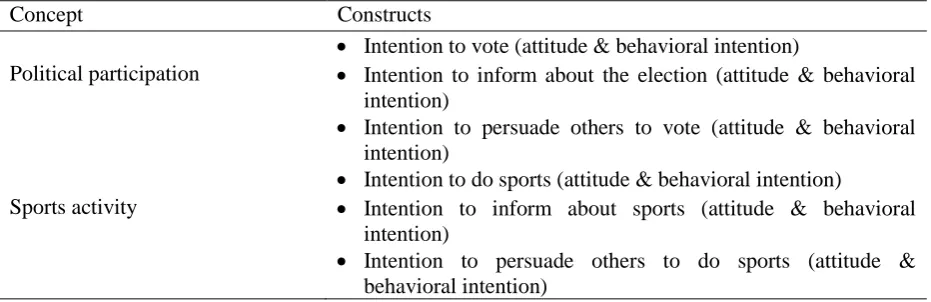
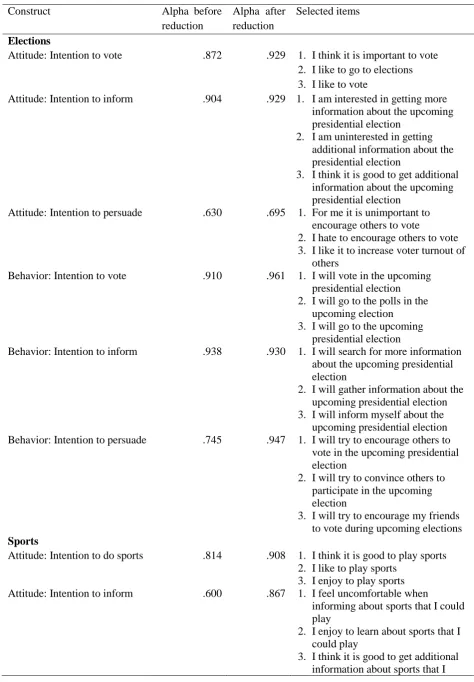
[image:35.595.66.532.379.530.2]To measure the dependent variable in the most effective way, the internal consistency (Cronbach’s alpha) was tested in a pretest. In total, 11 participants conducted the pretest which consisted of 72 questions in total. These items were related to the constructs presented in table A1.1.1 and partly based on the research of Nyhuis and Gosselt (2012). Each construct was divided into an attitude and a behavioral intention scale. Every construct (n=12) was measured by six items. The goal of the pretest was to reduce the total number of questions and to assure a high level of internal consistency.
Table A1.1. Constructs (each construct was also divided into attitude and behavioral intention
Concept Constructs
Intention to vote (attitude & behavioral intention)
Political participation Intention to inform about the election (attitude & behavioral intention)
Intention to persuade others to vote (attitude & behavioral intention)
Intention to do sports (attitude & behavioral intention)
Sports activity Intention to inform about sports (attitude & behavioral intention)
Intention to persuade others to do sports (attitude & behavioral intention)
Table A1.2. Results pretest survey
Construct Alpha before
reduction
Alpha after reduction
Selected items
Elections
Attitude: Intention to vote .872 .929 1. I think it is important to vote 2. I like to go to elections 3. I like to vote
Attitude: Intention to inform .904 .929 1. I am interested in getting more information about the upcoming presidential election
2. I am uninterested in getting additional information about the presidential election
3. I think it is good to get additional information about the upcoming presidential election
Attitude: Intention to persuade .630 .695 1. For me it is unimportant to encourage others to vote
2. I hate to encourage others to vote 3. I like it to increase voter turnout of
others
Behavior: Intention to vote .910 .961 1. I will vote in the upcoming presidential election 2. I will go to the polls in the
upcoming election 3. I will go to the upcoming
presidential election
Behavior: Intention to inform .938 .930 1. I will search for more information about the upcoming presidential election
2. I will gather information about the upcoming presidential election 3. I will inform myself about the
upcoming presidential election Behavior: Intention to persuade .745 .947 1. I will try to encourage others to
vote in the upcoming presidential election
2. I will try to convince others to participate in the upcoming election
3. I will try to encourage my friends to vote during upcoming elections
Sports
Attitude: Intention to do sports .814 .908 1. I think it is good to play sports 2. I like to play sports
3. I enjoy to play sports Attitude: Intention to inform .600 .867 1. I feel uncomfortable when
informing about sports that I could play
2. I enjoy to learn about sports that I could play
could play
Attitude: Intention to persuade .867 .900 1. I like it to increase sports activity of others
2. I think it is necessary to encourage others to play sports
3. I enjoy to encourage others to play sports
Behavior: Intention to do sports .875 .937 1. I will participate in sports (during the next month)
2. I will go to play sports (during the next month)
3. I will be active in sports (during the next month)
Behavior: Intention to inform .864 .945 1. I will search for more information about sports that I could play (during the next month) 2. I will gather information about
sports that I could play (during the next month)
3. I will collect information about sports that I could play (during the next month)
Behavior: Intention to persuade .749 .945 1. I will try to encourage others to play sports (during the next month) 2. I will try to persuade as many
people as possible to play sports (during the next month)
3. I will try to solicit others to play sports (during the next month)
A.2 Pretest pictures
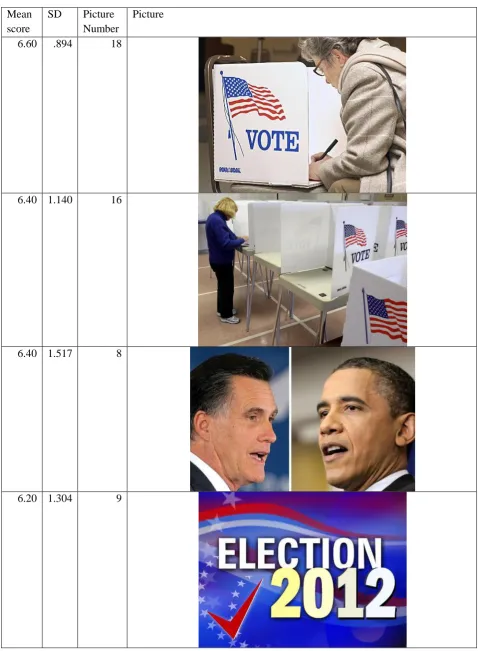
To assure that the pictures, that were used as conscious stimulus, would evoke strong associations with either voting behavior or own sports activity, a pretest was conducted. This was executed with 5 participants (3 male, 2 female). The following procedure was used to identify ten pictures per category (voting and sports) that evoke the strongest association with the respective category. The procedure was used for the voting and sports related pictures, but will only be explained for the voting condition.
picture that was placed in the outer right box had the weakest relation to voting (1 point). Second, the same procedure was repeated with the sports related pictures. Therefore, every participant had to sort two matrixes.
[image:38.595.79.522.238.460.2]To make sure that there was no influence of picture size, every picture was transformed in such a way that the size (cm²) was almost equal among all pictures. Specifically, the mean size was 40.54 cm² (SD = .28 cm²), with a minimum size of 40.0 cm² and a maximum of 41.0 cm².
Figure A.2.1. Matrix to sort pictures
Table A2.1. Results voting pictures
Mean score
SD Picture Number
Picture
6.60 .894 18
6.40 1.140 16
6.40 1.517 8
5.40 1.140 20
5.20 2.168 14
5.00 1.225 4
4.80 .837 17
[image:41.595.65.544.66.391.2]4.40 1.517 7
Table A1.2.2. Results sports pictures
Mean score
SD Picture Number
6.20 1.095 31
6.20 1.483 27
5.80 1.924 36
5.40 .894 34
5.20 1.643 35
4.80 1.789 33
Appendix B: Demographics survey
In general, when it comes to politics, do you think of yourself as (please choose one): Strong Liberal
Not so strong Liberal Moderate
Not so strong Conservative Strong Conservative
Are you a member of the Democratic Party? Yes
No
Don’t want to say
Are you a member of the Republican Party? Yes
No
Don’t want to say Do you consider yourself to be:
Female Male
Do you consider yourself: White Black/African-American Hispanic/Latino Asian Pacific Islander Native American Other ____________________
Have you voted during the last presidential elections? Yes
No
Are you doing sports at least once a week? Yes
No
Are you member in a sports club? Yes
No
6. What is your nationality? US
Other___________________
7. Do you have the right to vote during US presidential elections in November 2012? Yes
No
8. Is English your native language? Yes
Appendix C: Cronbach’s Alpha scores of survey 1 and 2
Table C.1. Cronbach’s Alpha scores of survey 1 and 2, including used items
Construct Alpha Test 1 Alpha Test 2 Used items
Elections
Attitude: Intention to vote .938 .969 2&3
Attitude: Intention to inform .814 .745 1, 2&3
Attitude: Intention to persuade .742 .827 1, 2&3
Behavior: Intention to vote .966 .966 1, 2&3
Behavior: Intention to inform .942 .970 1, 2&3
Behavior: Intention to persuade .981 .967 1, 2&3
Sports
Attitude: Intention to do sports .940 .940 2&3
Attitude: Intention to inform .817 .857 2&3
Attitude: Intention to persuade .866 .916 1, 2&3
Behavior: Intention to do sports .979 .971 1, 2&3
Behavior: Intention to inform .976 .975 1, 2&3
Appendix D: Detailed results of constructs and subconstructs
Table D.1. Differences between action and inaction conditions on first and second survey (scores:
political participation).
Construct Action (n=23) Inaction (n=28) Significance (2-sided)
1. Attitude: Intention to vote M= 3.48, SD= 1.13 M= 3.63, SD= 1.14 T= -.460, α= .648 2. Attitude: Intention to vote M= 3.74, SD= 1.21 M= 3.77, SD= 1.05 T= -.091, α= .928 1. Attitude: Intention to inform M= 4.16, SD= 1.09 M= 4.05, SD= .98 T= .386, α= .701 2. Attitude: Intention to inform M= 4.01, SD= 1.06 M= 4.07, SD= 1.00 T= -.196, α= .845 1. Attitude: Intention to persuade M= 3.64, SD= .86 M= 3.68, SD= .88 T= -.166, α= .869 2. Attitude: Intention to persuade M= 3.70, SD= 1.04 M= 3.61, SD= 1.01 T= .156, α= 877 1. Behavior: Intention to vote M= 3.87, SD= 1.25 M= 4.06, SD= 1.14 T= .566, α= .574 2. Behavior: Intention to vote M= 3.84, SD= 1.23 M= 3.99, SD= 1.19 T= -.453, α= .666 1. Behavior: Intention to inform M= 4.19, SD= .98 M= 3.99, SD= 1.11 T= .678, α= .501 2. Behavior: Intention to inform M= 4.10, SD= .99 M= 3.94, SD= 1.10 T= .544, α= .589 1. Behavior: Intention to persuade M= 3.72, SD= 1.06 M= 3.65, SD= 1.10 T= .229, α= .820 2. Behavior: Intention to persuade M= 3.71, SD= 1.07 M= 3.67, SD= 1.10 T= .146, α= .885 1. Total Attitude: M= 3.76, SD= .89 M= 3.78, SD= .87 T= -.103, α= .919 2. Total Attitude: M= 3.80, SD= 1.00 M= 3.82, SD= .92 T= -.050, α= .960 1. Total Behavior: M= 3.93, SD= 1.00 M= 3.90, SD= 1.03 T= .093, α= .926 2. Total Behavior: M= 3.88, SD= 1.00 M= 3.87, SD= 1.07 T= .065, α= .949
1. Total: M= 3.84, SD= .92 M= 3.84, SD= .94 T= .003, α= .998
2. Total: M= 3.86, SD= .99 M= 3.85, SD= 1.03 T= .038, α= .970
Table D.2. Differences between action and inaction conditions on first and second survey (scores:
sports).
Construct Action (n=23) Inaction (n=28) Significance (2-sided)
1. Attitude: Intention to do sports M= 4.37, SD= .69 M= 4.02, SD= 1.02 T= 1.40, α= .167 2. Attitude: Intention to do sports M= 4.22, SD= .62 M= 3.88, SD= 1.07 T= 1.36, α= .180 1. Attitude: Intention to inform M= 3.96, SD= .78 M= 3.96, SD= .85 T= -0.34, α= .973 2. Attitude: Intention to inform M= 3.87, SD= .63 M= 3.86, SD= .85 T= .058, α= .954 1. Attitude: Intention to persuade M= 3.94, SD= .84 M= 3.60, SD= .90 T= 1.41, α= .166 2. Attitude: Intention to persuade M= 3.74, SD= .99 M= 3.57, SD= 1.13 T= .620, α= .538 1. Behavior: Intention to do sports M= 3.86, SD= 1.25 M= 3.86, SD= .97 T= -.007, α= .995 2. Behavior: Intention to do sports M= 3.83, SD= 1.16 M= 3.69, SD= 1.13 T= .421, α= .676 1. Behavior: Intention to inform M= 2.77, SD= 1.13 M= 3.04, SD= 1.09 T= -.857, α= .396 2. Behavior: Intention to inform M= 3.11, SD= 1.16 M= 3.36, SD= 1.12 T= -.755, α= .454 1. Behavior: Intention to persuade M= 3.13, SD= .98 M= 3.15, SD= .92 T= -.091, α= .928 2. Behavior: Intention to persuade M= 3.17, SD= 1.05 M= 3.26, SD= .98 T= .309, α= .759 1. Total Attitude: M= 4.09, SD= .64 M= 3.86, SD= .85 T= 1.07, α= .290 2. Total Attitude: M= 3.94, SD= .64 M= 3.77, SD= .86 T= .804, α= .426 1. Total Behavior: M= 3.25, SD= .97 M= 3.35, SD= .87 T= -.379, α= .706 2. Total Behavior: M= 3.37, SD= .95 M= 3.44, SD= 1.00 T= -.234, α= .816
1. Total: M= 3.67, SD= .70 M= 3.60, SD= .81 T= .306, α= .761
[image:47.595.63.544.155.430.2] [image:47.595.68.543.518.777.2]